
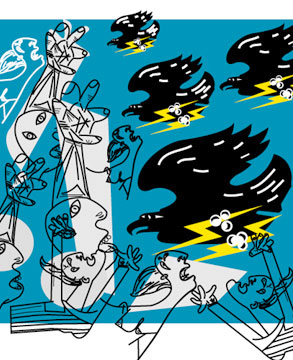

If bombs start falling on Iraq, peace activists say, expect insurgency at home.
Demonstrators are planning to shut down San Francisco’s Financial District, to gather by the thousands in New York’s Times Square and stage sit-ins in Washington, D.C. Others are ready to try to breach security at Vandenberg Air Force Base in Southern California, where many of the military targeting operations will be done for an Iraq bombing campaign. They’re going not just to protest, but to interfere. “We have the possibility of disrupting operations that feed directly into the Iraq war in a limited but very real way,” says Peter Lumsdaine, coordinator of the Military Globalization Project, the group that’s organizing the Vandenberg action.
Until now, most of the big antiwar demonstrations, especially in the United States, have been peaceful, preplanned, law-abiding events. Permits have been secured, routes mapped, and stages set up. The next phase in the antiwar movement is likely to be far more spontaneous and chaotic. Frustrated by a government they say is ignoring their voice, galvanized by the imminence of war, activists are moving from protest to direct action. “My sense is that if the war breaks out, things will escalate,” says L.A. Kauffman, a staff organizer with United for Peace and Justice, a major antiwar coalition. “You’ll see a lot more street blockades and building blockades. You’ll see the normal course of business disrupted by protests in a way that hasn’t happened so far.”
Already, activists are ramping up their tactics. On Friday, March 14, a loose network of people called Direct Action to Stop the War are going to try to shut down the Pacific Stock Exchange in downtown San Francisco, kicking off a campaign of civil disobedience that organizer Patrick Reinsborough says is meant “to show the Bush administration and their corporate backers that if they won’t stop the war, a nonviolent grassroots uprising will physically unplug the war machine.” Next Monday, a coalition called the Emergency Campaign to Reclaim Democracy And Stop the War Now is launching a week of civil disobedience in the Capitol that will include sit-ins in congressional offices; and there will be civil disobedience outside the U.S. mission to the United Nations in New York.
“People are saying, ‘I’ve written letters, sent petitions, and made phone calls, and my representative isn’t listening to me,'” says Celia Alario, a media liaison for United for Peace and Justice, one of the groups taking part in the D.C. campaign. “What am I going to do? I’m going to sit down and occupy their offices and demand that they take a stand against the war.” Four activists from the campaign were arrested Thursday as they tried to enter the Capitol Building.
If war begins, activists say, such actions are likely to snowball. “Worldwide, there are going to be way more protests on the day after a war begins than there were on Feb. 15,” says Kauffman, referring to the massive international protests that took place in hundreds of cities last month. “Part of what was so amazing and magical about Feb. 15 was that everywhere in the world, protests were peaceful except for Greece. That’s not what’s going to happen if the war begins, because people are going to be so angry. I think for days, many cities’ business will be significantly disrupted. The tone is going to be much angrier.”
That’s just what Paul Berman fears. Berman, author of the recent book “Terror and Liberalism,” is a veteran of the ’60s peace movement and an opponent of the Bush administration, but he believes no good can come of war opponents rampaging through the streets. “This is just going to create a real crisis within the country,” he says. “It’s a completely destructive thing to do.”
He’s done it, and now believes that the days of rage he participated in during the ’60s helped prolong the Vietnam War. “At the time I did some of that myself and thought it was doing good, but now it’s apparent to me that all that stuff just fell into a trap laid by Richard Nixon,” he says. “That kind of stuff allowed Nixon to win in 1968 and again in 1972, and a Democratic president would surely have withdrawn sooner. And so in effect, although it’s painful to say so, I think that kind of stuff had the effect of prolonging the war. It played into Nixon’s hands. There were famous scenes where Nixon specifically ordered that his entourage drive through streets where he knew he’d be attacked by demonstrators because he wanted the right scenes to appear on TV. He presented it to the public: You had to choose between Richard Nixon or some long-haired marijuana-smoking lunatic communist. Guess what. The public chose Nixon.”
The larger problem with such protests isn’t that they could help Bush, Berman argues, but that they could hurt Iraqis. Whether or not war is advisable, he says, once it has begun, the question becomes whether Bush will sell out the liberal aspirations of Iraqi reformers, installing a pliable military regime, rather than undertaking the costly job of helping Iraq build its civil society. The problem, he says, is that the debate about war has become so polarized: Just as supporters don’t see an invasion’s potential disasters, so war opponents can’t conceive of anything positive emerging from it — and thus won’t fight to hold Bush to his promises of Middle Eastern democracy.
“There’s a chance that there’s going to be a good result, which would be the liberation of the Iraqi people, possibly with good effects for other people,” Berman says. “This possible consequence depends very largely on what the United States does. If your feeling about Bush is, as mine is, that you don’t trust him to make the right decisions, what you want to do is press the government to do the kinds of things that will lead towards [a democratic] result. Instead, there are a lot of people who are imagining that they can perhaps force the United States to withdraw its troops.”
That’s precisely the hope behind the most radical action of all those planned for the start of war, the plan to infiltrate Vandenberg Air Force Base.
Vandenberg is about 50 miles north Santa Barbara, Calif. In a few days, activists will start converging on a nearby four-acre plot of land that Bud Boothe, a World War II veteran, donated to the Military Globalization Project. They’re going to camp there and train to breach the base’s security and possibly vandalize some of its equipment.
Lumsdaine, the Military Globalization Project coordinator, is a 48-year-old who has been arrested at Vandenberg twice. He describes the base as “the electronic nerve center of the global-surveillance-targeting, weapons-guidance, and military-command satellites that will largely direct the war.” The base is 99,000 square acres, with a perimeter running through rugged, wooded terrain. “If people are committed and determined and in halfway decent physical shape, it is possible to get in, because it’s enormous and much of the land is still fairly wild,” he says.
Within the base, Lumsdaine says, are “major off-limits security zones,” that, when breached, “set off a series of responses in their own security procedures which require disruption and partial shut down of regular activities,” which means the base can’t operate at full capacity.
Other kinds of interference are also expected. “There’s the possibility of people blockading roads and bridges inside Vandenberg and chaining themselves to gates,” Lumsdaine says. “There are ways in which people can put small objects, aluminum foil or Mylar balloons in front of equipment to nonviolently get in the way of electronic telecommunications systems where they transmit attack orders or targeting data to Tommy Franks and his assault forces. We are not organizing people to disable equipment, but that potential exists. I can certainly say I as an individual do not oppose the disabling of equipment which is being used to conduct mass killing on the other side of the world.”
Indeed, Lumsdaine served two years in federal prison for doing just that. In 1992, he was arrested for disabling an Air Force targeting satellite at the aerospace company Rockwell International. He’s aware that a similar danger exists with this operation. Master Sgt. Lloyd Conley, a spokesperson for the base, is aware of Lumsdaine’s plans, and while he declined to specify exactly what penalties would-be saboteurs might face (or what damage they could do), he emphasized that they would be subject to federal prosecution.
A Christian pacifist whose wife, Meg, is a Lutheran pastor, Lumsdaine is inspired by so-called plowshares actions that the late Philip Berrigan pioneered in the ’80s, in which activists set out to destroy military equipment. In fact, Lumsdaine says that before Berrigan was diagnosed with cancer last year, he planned to join the action. Other big names in the protest movement have endorsed the Vandenberg plan, including Global Exchange’s Medea Benjamin and Kathy Kelly from Voices in the Wilderness, a group that runs sanctions-busting trips to Iraq.
Lumsdaine is dismissive of the notion that a war could bring anything but carnage to the Iraqi people. “Saddam Hussein is unquestionably a murderous tyrant, but the argument that we’re going in to right the wrongs of his regime is absurd,” he says. “Even after the Gulf War, we specifically made a decision to throw the Kurdish and Shiite uprisings to Saddam’s dogs. We could easily wind up in a situation where you have U.S. troops locked in battle with anti-Saddam forces. You could have a situation where you have many Iraqis taking turns shooting at Saddam’s elite security forces and shooting at American invaders.”
If U.S. troops do get bogged down, he believes only a robust domestic peace movement will stop Bush from using massive bombs that would kill civilians as well as enemy soldiers. In fact, contrary to Berman’s argument, he’s convinced only civil unrest stopped Nixon from going nuclear in Vietnam. “Resistance by people of conscience in the U.S. and other countries is going to play a key role in how far this war goes and how bad it gets,” he says.
Though most of the planners of the Vandenberg action are religious people like him, Lumsdaine is also hoping the camp draws the kind of young direct-action aficionados who converged on Seattle to protest globalization in 1999. Vandenberg, he says, is “the WTO of global military terror. This is where people need to go. If I’m going to risk arrest, wouldn’t I rather do that blocking strategic command operations targeting facilities than blocking traffic in San Francisco?”
Still, plenty of people are planning to protest the war by blocking traffic in San Francisco. Using an organizing model borrowed from anti-globalization demonstrations, Direct Action to Stop the War has mobilized “affinity groups” to take over different sections of downtown San Francisco the morning after a war begins. Interested parties can choose from a “menu” of targets on the group’s Web site; they include major intersections, corporate headquarters and government buildings.
“We’re going to occupy the Financial District, put our bodies out on the line to draw the connection between this war and some of the forces of cooperate globalization creating insecurity and the breeding grounds for terror,” says Reinsborough. “Thousands of people, potentially tens of thousands, will be blockading streets and targeting the financial infrastructure. If war does break out, San Francisco is going to be a city to watch.”
But not the only one. Kauffman expects many thousands to flood Times Square and midtown Manhattan and says that in London “the whole city is going to be shut down, I think for days.”
Berman foresees something similar, but the prospect fills him with dismay. “It would be dreadful to think we might find ourselves stuck in a war abroad which might not necessarily go well, and also find ourselves in a situation at home where police are out fighting protesters in the streets,” he says.
