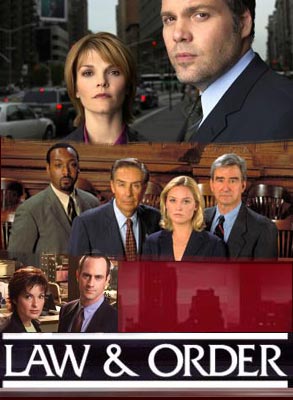

In the criminal justice system, if anything can go wrong, it will. In the TV ratings system, all three hit "Law & Order" shows can't go wrong. Meanwhile, a nation of addicts suffer in silence, untreated!
“Law & Order” is always on. Find the remote right now and see for yourself. Between NBC, TNT and USA, including “Law & Order” and its two spinoffs, you could watch 26 hours of “Law & Order” this week alone, if you felt like it.
But who would feel like it?
Just look around you. All three shows are in the top 20 for the season in total viewers, and each show is dominating its regular competition among viewers ages 18-49. A conservative estimate is that 88 million viewers watch “Law & Order” and its spinoffs and reruns each week. That’s 30 percent of the United States population, which means that 3 out of every 10 people you see have watched the show in the past week.
By piecing together anecdotal evidence, though, a more shocking picture emerges: It’s more likely that one out of every 10 people you see watched a whopping three episodes of “Law & Order” this week. Indeed, “Law & Order” may be the silent scourge of our cities, its crippling addiction afflicting couch potatoes from all walks of life.
I had a roommate whose addiction almost destroyed him. Every night when I came home, there he was, bong in hand, “Law & Order” rerun on the TV. I tried to confront him about this very serious problem, but minutes later I’d find myself glued to the couch, unable to leave without finding out whether the creepy activist or the defensive grad student was responsible for the popular professor’s death.
Five years later, I thought I had shaken the “Law & Order” bug, only to find myself living with a man who would end up watching the show every time he picked up the remote. Despite my complaints, he once spent an entire Thanksgiving weekend tuned in to one of those “Law & Order” marathons on TNT. As I tried desperately to entertain his mother by chatting and playing Scrabble, there he sat in the same room, headphones plugged into the TV, watching his fifth “Law & Order” of the day.
In the past few days, I myself have fallen prey to this hideous harlot of criminal justice. Figuring I’d watch one hour each of “Law & Order” and its two spinoffs to prepare for this piece, I regained consciousness nine hours later, dazed from commingling with snarky detectives, thick-headed from pondering unforeseen investigative twists and still anxious to find out whether or not the arrogant businessman had really been molesting his children. I tried to will myself to fast forward to the end of the episode and call it a day, but as the scenes sped by, my curiosity over the emerging details of the case overtook me, and I had to rewind and watch the rest of the episode in its entirety.
Afterwards, I wanted to hurl myself over the nearest cliff.
But stories like mine are just the tip of the iceberg. What creates this relentless addiction to “Law & Order,” and how can we stomp it out? More importantly, do we really want to?
Creator Dick Wolf controls our weak little minds with all the tools you’d expect, primarily great casting and excellent writing. The show’s plots are remarkably unpredictable, given how long it’s been on the air (13 years) and how obvious the story lines of most other cop shows are. The snappy dialogue is witty and intelligent, with pop-cultural references squeezed in between important bits of information. “They kill abortionists, don’t they?” Jerry Orbach quips to Jesse Martin during one investigation. “So that’s how a brain looks on embalming fluid,” Jamey Sheridan remarks after coming across a spaced-out stoner who dips his joints in formaldehyde.
Unlike soapier shows, “Law & Order” doesn’t focus on the personal lives of its detectives, lawyers and judges at all. As a result, you can pick up in the middle of the season without feeling like you’re missing anything. This also explains the show’s success in syndication — tune in for any episode of “Law & Order,” new or old, and one show feels just as immediate and interesting as the next.
While little is revealed about the show’s main cast of characters, we learn a great deal about the witnesses and suspects we meet along the way, all within a few seconds of encountering them. “My wife and I were driving back from the Forum in Pennsylvania …” says the suspect’s neighbor. “You guys remember every doughnut you eat?” the telemarketer asks the cops. “She used to call the woman a slut. Of course, she was one,” says the old lady down the hall. The show’s formula is set in stone: A felony occurs, the cops seek out clues and find them easily, a suspect is identified, obstacles arise and injustice usually prevails. Yet every scene has a life of its own, thanks to the writers’ devotion to breathing life into each character, no matter how small and insignificant.
Not only does this strengthen the show’s nonlinear “pick any episode” appeal, it may also explain why it’s possible to start watching in the middle of most episodes and still get caught up in the action within minutes.
Of course, pinpointing the guilty party at the earliest possible moment is the main challenge — and draw — for “Law & Order” addicts. Once you learn the show’s vocabulary of unpredictable twists and turns, it becomes much easier to identify the criminal. Outspoken, angry suspects with extremely bad attitudes usually aren’t guilty, unless they’re very arrogant, rich and/or powerful, or they’re members of extremist religious sects or radical political groups. Slightly creepy but quiet suspects with no apparent link to the crime, or victims who are especially emotional and self-pitying who appear early on are the best candidates for guilt. Politicians, doctors, men who cheat on their wives, mothers who insult their children and embittered grad students are also, typically, guilty.
While you may come across a few cheating men and sleazy politicians per episode, there’s a look of restrained fear common among the guilty that becomes easier and easier to spot the more you watch the show. The crazy thing is, the better you get at predicting who’s guilty, the more you want to watch. Addiction is a curious foe, indeed.
Wolf isn’t helping matters much with his latest spinoff, “Law & Order: Criminal Intent,” whose star, Vincent D’Onofrio, is impossibly appealing. This eclectic, slightly dorky, vaguely sociopathic detective steals every scene, smashing the macho-detective stereotype to little bits with his odd head-cocking, mumbling and awkward gestures.
Unlike most TV actors, D’Onofrio dares to be extremely weird. He’s sneaky, playing the naive witness in order to mention inadmissible evidence on the stand, and spilling coffee on his notes on purpose to catch his suspect off guard. He smiles at inappropriate moments. He delights in toying with arrogant men, but goes out of his way to be sensitive to old ladies and children. Just when he’s starting to show a little swagger, he leaps out the door, blurting, “I need to use my most important investigative tool: my library card!”
And despite the breakneck pace of the series, D’Onofrio takes up long blocks of screen time by just … thinking. He pauses, mid-sentence. He looks around the room. He screws up his face. The camera zooms in. What can he possibly be pondering? Unlike the other two shows, on “Law & Order: CI” we already know who committed the crime. Somehow, the fun comes from watching D’Onofrio manipulate his way to truth.
The weakest of the trio is undoubtedly “Law & Order: Special Victims Unit,” a show so melodramatic and sensational that it’s clearly the “Baywatch Nights” of the franchise. The creators insist that the show isn’t gratuitously violent or salacious, despite offering up scenarios like a young boy who witnesses his stepmother being beaten to a bloody pulp, or a teenage girl who stands in the hallway of the precinct, screaming, “He raped me, mother! I was 12 years old! Where were you? Why didn’t you help me?” Then, of course, there’s the mother, whose lines are as subtle as the chorus in a Greek tragedy: “How do I make sense of this? My husband is dead, killed by my own child’s hand! How awful it must have been for my husband!”
But even “Law & Order: SVU” is tough to turn off. With ratings that continue to rise and increasing numbers of our citizenry developing serious addictions, the question is not when “Law & Order’s” omnipresence will end, but what will come next? “Law & Order: Animal Control”? “Law & Order: Financial Crimes Unit”? “Law & Order: Parking Violations Division”?
Based on his track record, there’s no doubt that Dick Wolf could make everything from credit card fraud to stray dachshunds suspenseful and fun to watch. But it’s up to each of us to resist the siren call of new “Law & Order” spinoffs, before the inevitable “Law & Order Channel” emerges and draws us into a black hole of murderous womanizers, high-minded but world-weary prosecutors, and snarky, unstable detectives.
Alex Pareene's annual Hack List is so popular -- and useful -- we thought we should spread it out over the year. This column is a regular feature taking a deeper look at our media's most pernicious hacks, which we'll rank in order at year's end.
Tim Russert was not the unalloyed saint of tough journalism that his celebrators describe in posthumous tributes, but he was at least a classic American success story, of the sort that we still enjoy pretending is common: Blue-collar kid from Rust Belt town becomes enormously successful thanks largely to brains and hard work. The story of Luke Russert, alas, is a much more common one in American life: No-account kid of successful person has more success thrust upon him.
Pretty much immediately upon the death of his father, Luke Russert inexplicably had a full-time broadcasting job, supplanting his part-time broadcasting job co-hosting a satellite radio sports talk show with James Carville. (That was a real thing that actually existed. Can you imagine a human who would want to listen to that?)
Russert isn’t the only famous child in media. He isn’t even the only famous child at NBC, which also employs Jenna Bush Hager and Chelsea Clinton (who renewed her three-month temporary contract earlier this year, despite barely producing any work for the network). Fox has Peter Doocy, Chris Wallace and, here in New York, Greg Kelly. ABC has Chris Cuomo, and CNN Anderson Cooper. A.G. Sulzberger is a reporter for the New York Times. Some of those people are fine journalists, by the way. Nepotism has always been a major force in journalism and media — it is a fact of life and one that would be exhausting to be continually het up about — and plenty of nepotism beneficiaries are wonderful writers and talented people. If you’re raised by interesting people and get a good education at home and at the finest schools, you really ought to turn out pretty smart. But Russert is emblematic of the sort of nepotism that gives nepotism a bad name. He’s not a wonderful writer or a particularly talented person. And unlike Chelsea Clinton and her very silly “reporting good news about people who do charity or something” beat, he’s actually got a real journalism job that someone else without the name Russert could be doing much more effectively. He’s not even particularly good on TV.
Russert in some respects more closely resembles a second-generation politician than a typical dynasty hire in journalism. Like Al Gore and Harold Ford Jr., he is a graduate of St. Albans — the elite Washington all-boys private school that molds little moderate politicians and self-consciously imitates the old New England boarding schools that used to serve the WASPs who ran the country — and like a junior Kennedy he’s decidedly less impressive than his tragic father. Russert spent his college years at Boston College acting basically like a well-off young meathead. (His sole notable achievement during those years was being the subject of one of the Internet’s very first “embarrassing Facebook photo of the child of a notable person” stories.) He was hired at NBC, in what most took to be a slightly unconventional corporate expression of grief, within months of his graduation with a communications degree.
He seems dimly aware that nepotism won him his job, but in denial as to the fact that it’s allowed him to keep it. As he told Howard Kurtz in 2010:
He knows what some colleagues and detractors say — that he wouldn’t be in this job if not for his last name. “I just try to really block that out,” Russert says. “The news media is a results-oriented business. I don’t think a company like NBC would pay me if I wasn’t qualified and wasn’t able to produce on this level…
“There will always be people who will say, ‘Oh, he’s only gotten where he is because of his father,’ and that certainly helped. But I’ve been able to stay here because of me.”
Denial of his extraordinary genetic luck for the sake of his self-respect is a common trope with poor Luke. He was using the same line in 2008, barely after he was hired: “Did my name get my foot in the door? Absolutely, I’ll be the first to admit that. But has my performance and ability got my butt through the door? Yes.” (In the same interview, Russert revealingly compared himself to Joe Buck, a second-generation sportscaster with an astoundingly enviable career, whom no one on Earth actually likes.) He also claimed to have absolutely no clue how he managed to score two much-sought-after (unpaid, natch) internships as a college student, at NBC and at Michael Bloomberg’s City Hall. “I went through the application process like anyone else,” he told the Times. (Russert had at least one other killer internship, too, at ESPN.)
But our target here is Russert, and he is not personally responsible for NBC’s decision to bequeath him a broadcasting job. If we focus on the work and not the means by which Russert got the job, things don’t look much better. Initially, at least, the grown-ups on the air always seemed to be holding Russert’s hand as he tried to remember his lines, as if he were a child and not a fully grown college graduate and professional. It’s obvious that everyone who knew his father loves Luke. But everyone’s affection for the kid is not transmissible through a television set, alas, and Russert’s appearances seemed like some rich guy’s kid’s piano recital suddenly taking place in the middle of a professional orchestra’s concert.
His initial role was as MSNBC’s semi-official “young person” correspondent, because reporting on what he himself was seemed the least ridiculous thing to have Luke Russert suddenly doing in a national cable news network’s presidential election coverage. And in his role as a young person reporting on what young people think of presidential politics, Russert sounded like an old person — like an old Washington lifer — talking about what he thinks the young people today are all about. (No self-respecting young person, to use one brief example, uses the term “millennial.“)
Here’s an early report:
This is like a master class in pointless political pseudo-analysis. All the resources and staff of MSNBC at his disposal, and the package still looks and sounds like it was put together for a high school civics class presentation. (I mean, except that Larry Sabato shows up halfway through. I guess it is professional Washington journalism!) Kids are turning off their reality TV and tuning into the real-life Amazing Race! Facebook and stuff, some experts say! Only time will tell. For MSNBC, I’m a person with no business having this job.
(This is the piece that Russert concluded by making a minor gaffe that set the right against him, for a moment: The “smartest kids in the state” go to UVA, he told Matt Lauer, so they naturally favor Obama. This was actually just poorly stated conventional wisdom, not really “liberal bias” — by “the smartest kids in the state” he meant, he later explained, kids “from affluent, highly educated households.”)
Months after hiring Russert, Steve Capus, president of NBC News, called him one of the network’s “rookies of the year,” which doesn’t reflect well on NBC’s 2008 rookie class. (Russert returned the favor with effusive praise for his boss.)
On the basis of his impressive reporting and ease in front of the camera still being named Russert, Luke was promoted, after the election, to congressional correspondent. That’s the contempt with which NBC News views the occupation of journalism. To make Luke Russert a congressional reporter is to say, “We believe that this job requires no particular knowledge, training or skills. If a German shepard could be trained to speak, it could perform this work.” (That’s true of most cable news work, granted, but it really doesn’t have to be.) Proper reporting on the House of Representatives is actually difficult and largely thankless work, generally done by very hardworking and underpaid reporters. The assignment was transparently NBC’s attempt to help Russert develop chops, and what it has yielded thus far is the time Charlie Rangel called Luke dumb, which MSNBC turned into a two-day story.
NBC seems to be keeping Russert employed in the hopes that he’ll eventually develop an ability to simulate gravitas. Hopefully “Meet the Press” will still be on the air by the time Luke has mastered his serious face.
His Twitter feed presents a perfectly dull person with perfectly banal thoughts. When he drifts into attempted solemnity it’s usually more amusing than his actual attempts at humor. (More quality insight, right here.) It’s precisely what you would imagine the result would be if the elite Beltway press somehow collectively raised a child from birth — which is, in effect, what actually happened. He subscribes to every shibboleth of Washington conventional wisdom and shows fealty to all the proper institutions.
When Jeff Himmelman wrote that the legendary Bob Woodward had misrepresented a few facts in “All the President’s Men,” Russert was outraged on behalf of the institution of Bob Woodward:
Pathetic the chattering class is trying to sell books and papers on issues of no substance attacking the most storied career in journalism.
Luke. “The chattering class” is you. (And Bob Woodward, whose singular goal for the last 35 years or so has been “trying to sell books.”)
A popular reoccurring trope in Russert tweets and interviews is his deep respect for the politicians he is lucky enough to cover. “No matter how much I disagree w pols,” he writes, “I always respect their desire to stand up for their views & put their family through hell 2 win.”
To Kurtz, again:
Unlike most journalists, he describes covering Congress as “a real honor.”
“I have a real respect for them. While a lot of folks view them as the epitome of everything that’s wrong with America now, it takes a lot to put yourself out there in the public sphere, and your family.”
What if some pols’ views, if they even have any to speak of, are not worth standing up for? Was putting the family through hell worth it then? The 435 people who make up the House of Representatives are, on average, no nobler or wiser than any randomly selected group of 435 Americans. In many cases the members of Congress are much dumber and more craven than the people they represent (they’re also, on average, richer, whiter and much more likely to be male). To Luke Russert, though, they are noble public servants, and to love America is to respect its political elite. This is a classic symptom of Beltway myopia: mistaking the politicians for democracy. The greatest moment in politics, for Luke Russert, was the time the president argued in circles with Eric Cantor for a while, on TV, and no one came away having changed their mind.
Because he is being groomed to be a simulacra of his father, and because he is merely a jukebox for the cliches and conclusions of the elders grooming him, Russert can get tripped up when attempting to be Broderian on the fly. Dylan Ratigan threw him for a loop when he challenged him on the eternal wiseness of bipartisan-approved “free trade” deals — Russert just laughed, nervously and idiotically, when faced, for what was probably the very first time in his life, with actual arguments againstmaking it easier for American corporations to gain access to cheap and easily exploitable foreign labor.
Ratigan: My Colombian, the Colombian deal’s my favorite. That’s a big job creator. Whaddya say we do a deal with the only country in the world that openly murders all labor organizers, to ensure that they will never ask for a raise ever.
L’il Luke: Well, Colombia, though, in all fairness, Colombia has had massive strides in improvement in terms of their security. I mean, you’re bringing up something that George Miller–
Ratigan: But I’m saying the murder rate of union organizers on a per capita–
L’il Luke: Well, that’s why there’s Democratic opposition in the House for it right now and they have to figure out that, you know, technicality there.
Just a little technicality! A minor bump on the road to a reassuring, job-creating compromise!
If you look at the backdrop, Dylan, just look at the stats. Federal revenue now is at its lowest level since 1950. If you extend the Bush tax cuts the way the Republicans want, you get $3.8 trillion added to the deficits. If you add them the way Democrats want, you get $3 trillion added over the next three years. If you don’t do anything to Medicare or Medicaid or social security, those programs will not be solvent.
Both parties don’t want to tell the American people it’s time to drink their tough medicine.
Both parties are going to try to take 2012 as the avenue to have this debate further. But as this debate goes on and on and on, the real difficult decisions, the real ideas of how are we going to cut this deficit, they go unanswered.
All so folks can can get re-elected, continue to get their $174,000 salaries, and the beat goes on and on. The special interests get rich, the parties can argue and argue and argue.
Really, nothing sums up contemporary American media and politics better than a twerp like Luke Russert sternly announcing that we’ll all soon have to get used to taking our “tough medicine.”
Alex Pareene writes about politics for Salon and is the author of "The Rude Guide to Mitt." Email him at apareene@salon.com and follow him on Twitter @pareene
More Alex Pareene.
I’m sorry, but I’m just sick of him. I’m sick of his much-remarked-upon sense of humor, notable only because a news anchor capable of verbal communication that doesn’t involve a teleprompter is treated like a dog who knows a particularly clever trick. I’m sick of his constant invocation of his blue-collar Jersey roots, I’m sick of his stories about listening to Springsteen with his old friends Lou the mechanic and Sal the bricklayer. I’m sick of his perfect imitation of the ridiculous old flat-accented voice-of-god news anchors.
NBC gave him a talk show with the deeply stupid name “Rock Center” (no one in the known history of New York has referred to Rockefeller Center as “Rock Center,” I’m sorry that “30 Rock” took the name you wanted but you have to come up with something different), where he is not quite as funny as a late night talk show host and not quite as newsy as a news show host. And, obviously, not as opinionated as a cable news show host, because as a network evening news anchor, Mr. Williams is not allowed to think for himself, or hold opinions on issues other than the annoyingness of those Brooklyn Hipsters.
But it’s the never-ending, nonstop, beat-you-over-the-head blue-collar Jersey Shore shtick that grates the most. It’s desperate and unconvincing, coming from a multimillionaire television personality. We get it! You used to be “authentically” American, according to some arbitrary signifiers! (And if you’re so damn proud, why did you lose your accent?)
HACKIEST 2011 MOMENT:
A January appearance on “The Late Show With David Letterman,” in which Letterman, who in recent years has often displayed an environmentalist streak, asked Williams if recent freak weather events could be traced to anthropogenic climate change. Williams, mugging but clearly uncomfortable, declined to even acknowledge the existence of climate change itself. He refused to “take sides,” and joked, “What have I done to deserve this?” A perfect encapsulation of the uselessness of the “objective” (and idiotic) network nightly news anchor, too cowardly or dumb to “take sides” on a “debate” between craven political actors and the nearly universal scientific consensus. (But why would we expect a regular guy’s guy from Jersey to understand all that complicated climate science? He’s too busy cruising the shore in his souped-up Bel Air Hardtop with Mary and Puerto Rican Johnny to examine the evidence!)
- – - – - – - – - -
(Read the introduction here. Read the 2010 Salon Hack 30 List here.)
Alex Pareene writes about politics for Salon and is the author of "The Rude Guide to Mitt." Email him at apareene@salon.com and follow him on Twitter @pareene
More Alex Pareene.
Should you have ever believed that there couldn’t possibly be any more entertainment barrel yet to be scraped, remember this: NBC has just approved a pilot for a remake of “The Munsters.” Yes, the sitcom about a wacky monster family, a show that has been off the air since 1966, is returning at last. Naturally, this new version will “have a darker and less campy feel” than the Vietnam War-era original. Well, that makes it sound awesome. And NBC is the network that put “Community” on ice while giving “Whitney” a pickup — so I, the viewer, trust its taste implicitly!
It might be a hopeful sign that the show will be overseen by Bryan Fuller, who created the imaginative, not completely awful “Pushing Daisies.” Less hopeful: Fuller is also developing a show based on “Silence of the Lambs.” This undoubtedly essential “Munsters” update comes in the midst of an unprecedented glut of reboots and reimaginings, all thick with the promise that No, really, this will be very different. It will creepy and full of action and with a feminist theme. You know what’s really different? A stinkin’ original idea.
We have already endured the small-screen update of “Charlie’s Angels” and the cinematic revival of “Footloose” – both of which, by the way, died on the vine. Broadway is now almost exclusively revivals, “jukebox musicals,” and stuff based on old Whoopi Goldberg movies. We will soon be treated to both a new “21 Jump Street” and “Dark Shadows.”
Other classics also up for a fresh look: “Godzilla,” which you may recall, fared so well last time someone attempted it. “The Crow.”“20,000 Leagues Under the Sea.”“Woody Woodpecker.” Leonardo DiCaprio is currently considering a “Six Million Dollar Man” remake. Oh, and “rehearsal is for fags” impresario Brett Ratner may be redoing “The Last American Virgin.” I know I don’t catch everything going on with the young folk, but has there been a great national longing that translates into “Give the people another ‘Last American Virgin’!”? Have you seen the original? It’s no “Porky’s.” Quite frankly, it’s not even “Zapped!”
Tired old ideas aren’t just spawning like Duggars, they’re being cloned. There are currently two “dark and less campy” television dramas based on old fairy tales — “Grimm” and “Once Upon a Time.” There are two competing Snow White movies coming out in 2012, “Snow White and The Huntsman” and “Mirror Mirror.” Both, of course, feature a totally kickass Snow White who doesn’t waste her time trilling to little birds. She’s busting heads! Even “The Munsters” will find itself vying for NBC’s attention against another pilot the network has approved: “Frankenstein.” (Not to be confused with the movie of “I, Frankenstein,” also currently in the works.) There are 300 million people in America. And four ideas.
Humans have always had a natural inclination toward returning to the same stories. It’s why the plays of Aristophanes continue to be performed, why vampire tales still ignite the imagination, why “Doctor Who” never goes out of style. I’m not convinced, however, that’s why remakes of “Get Smart” and “The A-Team” happen. Every time a television show or movie gets underway, millions of dollars and hundreds of careers are on the line. It’s understandable that a seemingly sure thing would have more allure than something riskier. (Again I say, “Community.”) And sure, Hollywood has had a self-sucking parasite for eons. That element of terribleness existed even before Ernest made that “Beverly Hillbillies” movie all those years ago.
But all you have to do is sit through the trailers at the next movie you attend, or read what the network midseason replacements include, and you’ll feel a little bit of contact death of the soul, a plague emanating from somewhere deep in the bowels of L.A. But I can’t be alone in saying that I don’t want to watch a movie because I saw it 20 years ago. And I sure as hell don’t want to watch it because it was a crap TV series 20 years ago – no matter how edgy anyone promises that reboot of “Hangin’ With Mr. Cooper” will be.
Former Federal Reserve chairman, Alan Greenspan, reiterated a point Sunday that many economists have made during this debt crisis: It’s not just about creditworthiness.
“The United States can pay any debt it has because we can always print money to do that. So, there is zero probability of default,” said Greenspan on NBC’s “Meet the Press.”
He said that the S&P downgrading of U.S. debt — more than indicating a genuine risk of default — “hit a nerve that there’s something bad going on.” He said the move “hit the self-esteem of the United States, the psyche… . It’s having a much profounder effect than I conceived could happen.”
Greenspan said too that the downgrade would likely precipitate market turmoil, but that the possibility of a double-dip recession depended on Europe..
Appearing alongside Greenspan, Austan Goolsbee, the chairman of the White House’s council of economic advisors, hit out at S&P. “Well, the basic case is they made a $2 trillion math error and forgot to check their work,” he said. “So rating agencies that didn’t make a $2 trillion math error reaffirmed the AAA status.”
Natasha Lennard covers the Occupy movement for Salon. A British-born, Brooklyn-based journalist, she has been covering Occupy Wall Street since before the first sleeping bag was unrolled in Zuccotti Park. One of the first journalists arrested at an Occupy action, she has managed to enrage Andrew Breitbart, Rush Limbaugh and Glenn Beck. You can follow her on Twitter (@natashalennard), and email her any Occupy updates/videos/ideas to natasha.lennard@gmail.com
More Natasha Lennard.
In this July 14, 2011, file photo, President Barack Obama sits with House Speaker John Boehner of Ohio, House Minority Leader Nancy Pelosi of California, House Majority Leader Eric Cantor of Virginia, as he meets with Republican and Democratic leaders regarding the debt ceiling in the Cabinet Room of the White House in Washington, Thursday, July 14, 2011. Obama's decision to haul lawmakers in day by day to negotiate a debt deal comes down to reality: He has no other choice. The president has essentially cleared his agenda to deal with one enormous crisis. (AP Photo/Charles Dharapak)(Credit: AP)
62 percent of self-identified Democrats said they would want Democratic leaders in the House and Senate to make compromises to gain consensus on the current budget debate, while only 43 percent of Republicans want to see their party leaders concede some of their positions. However, around 70 percent of independent respondents said they wanted to see both parties compromise.
The poll results, released Tuesday show that 55 percent of respondents think that failing to raise the debt ceiling would be “a real and serious problem,” while only 18 percent said it would not be. This contrasts starkly to results gleaned from a Gallup survey in May, in which 47 percent of people said they would want Congress to vote against raising the debt ceiling.
Meanwhile, support for President Obama’s proposal for lowering the deficit significantly trumps that for Republican proposals: 58 percent of NBC/WSJ poll respondents said they preferred Obama’s suggestions to lower the federal deficit by $4 trillion over 10 years by cutting federal spending, raising tax revenue from the wealthy and reducing some Medicare spending. Contrastingly, only just over a third prefer the House Republican proposal to reduce the deficit by $2.5 trillion over 10 years through cutting spending alone and not raising additional revenues.
Natasha Lennard covers the Occupy movement for Salon. A British-born, Brooklyn-based journalist, she has been covering Occupy Wall Street since before the first sleeping bag was unrolled in Zuccotti Park. One of the first journalists arrested at an Occupy action, she has managed to enrage Andrew Breitbart, Rush Limbaugh and Glenn Beck. You can follow her on Twitter (@natashalennard), and email her any Occupy updates/videos/ideas to natasha.lennard@gmail.com
More Natasha Lennard.