
Iraq war
Bombs fall on the northern front
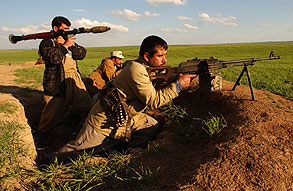
As American airstrikes pound Mosul and Kirkuk, the small Kurdish town of Kalak is protected by lightly armed militia, as U.S. special forces hover nearby.
As American and British troops raced to occupy southern Iraq, most of the residents of Kalak, a small northern town pinned between the Saddam-controlled area and Kurdistan, have fled and left the place shuttered. About 30 miles east, American airstrikes hit Mosul, and the crucial oil city of Kirkuk also came under U.S. attack. Members of the peshmerga, the informal Kurdish militia, walk the streets of Kalak lightly armed, while Iraqi soldiers on a nearby ridge fire Russian anti-aircraft weapons and high-powered rifles in the direction of the town. It is not always clear whether they are shooting into the air or aiming for specific targets in Kalak.
American special forces are operating in northern Iraq under a blanket of extreme secrecy. The peshmerga typically welcome reporters warmly. For the most part, we have maximum freedom to write, report and photograph people and places in northern Iraq — except when Americans are involved. Then peshmerga can be used as a cordon — they block us from sites, force us to delete images from our cameras. Members of the U.S. special forces were seen in Kurdish military headquarters in Arbil, meeting with senior Kurdish commanders.
Kalak’s defense, though, appears to rest entirely with the local militia. And the peshmerga are outnumbered and poorly equipped. To make matters worse, Kalak is a victim of geography, stuck between the front lines and the fast-moving Zab al Khibir River. The town, with the river dividing it from the rest of Kurdistan, seems an attractive target for Iraqi forces who want to slow down an advancing American army. Two bridges join Kalak to Kurdistan; the new bridge is partially under Iraqi control, while the Kurds control the old stone and steel bridge. Some observers in Kalak this morning speculated that the Iraqis could come down out of the hills, take the town and place charges on the second bridge. Fear drives much of the speculation here.
Also on Friday, Turkey moved 1,000 soldiers into northern Iraq to beef up its forces there, and is on the verge of shifting another 5,000 soldiers to the border region. Turkey already maintains several thousand soldiers backed by a few dozen tanks in northern Iraq, to chase Turkish Kurdish guerrillas. So the peshmerga could wind up fighting Turks as well as Iraqis in the days to come.
Early on Friday afternoon an Iraqi sniper targeted a young Kurdish man observing the Iraqi positions through binoculars. The bullet slammed into a wall behind him, lodging itself under a sign that read “Kalak Azadi,” or Free Kalak. Then, as the spring afternoon came to an end, Iraqi firing from the ridge grew more frequent and the sound of guns echoed off the rolling hills. Those left in the town took cover in doorways and houses.
The situation has changed dramatically in Kalak since the start of the U.S.-led invasion, and it is rapidly becoming more volatile. As recently as three days ago, the road to Mosul, 35 kilometers away, was open for people who wanted to cross into Kurdistan from Iraq proper. That road is now closed, and members of the peshmerga believe the Iraqi army has mined it near the river and placed explosives on the new bridge. Kurdish soldiers watched an Iraqi bulldozer dig up the road on their side of the new Kalak bridge, and at 2 in the afternoon on Thursday, soldiers placed a large barrier across the roadway. The few refugees allowed to leave Saddam-controlled Iraq — older men, women and children — are now completely cut off from the Kurdish area, a zone of relative safety for people fleeing the war. The roads have fallen quiet.
Contrary to the Pentagon’s expectations, the Iraqi conscripts have not thrown in the towel at the first sign of war. From Kalak’s main street, it is easy to see the distinct shapes of the soldiers moving from one position to another on the ridgeline. For most of the afternoon, they moved quickly in groups of two and three, remaining on the open for long periods. The peshmerga did not fire on them.
Early Friday morning, Mosul, the major city to the west, was the target of American airstrikes, but to date, there have been no surrenders to peshmerga forces, only hints to various Kurdish commanders. Still, most militia members here believe that the Iraqis on the ridge that overlooks Kalak are a hairsbreadth from surrender, and only need the slightest push in that direction.
“Even if American planes fly very low and use a loudspeaker to tell them to surrender, they will do it,” said Suleiman Hasso, a first lieutenant in Kalak’s Kurdish police force. “They are very poor men, they don’t want to fight, they don’t want to leave home, they are afraid of everything. With fifty peshmerga, I could send them all the way back toward Mosul.”
Mr. Hasso is a giant of a man and offered to take a journalist behind the ridge where the Iraqis were encamped. From a small town just west of the Iraqi position, it seemed that there were hundreds of soldiers on the ridge in makeshift shelters. Most regular army soldiers are conscripts who face prison or worse sanctions if they do not obey Baath party agents. Once in the army, armed political officers make sure that there are no desertions. These agents are part of an “execution committee” whose job is to shoot defectors and dissidents before they can make it to safety.
As a new round of airstrikes hit Mosul around 10 on Friday night, a chorus of shouts came from the Iraqi soldiers in the hills. The shouting is part of a call-and-response system Iraqi commanders use to check the readiness of their troops. A man who doesn’t answer the call is punished. Kurdish men in Kalak shouted back, taunting them. The Associated Press contributed to this report.
Phillip Robertson is reporting from Iraq for Salon. More Phillip Robertson.
America’s real Hunger Games
Young people are already being sacrificed at the whims of the 1%. Just look at Iraq and Afghanistan
U.S. Army soldiers respond after a suicide attack on the US..-led provincial reconstruction team (PRT) compound in the Behsood district of Jalalabad, east of Kabul Afghanistan, on Sunday, April 15, 15 2012. (Credit: AP Phot/Rahmat Gul) When I was growing up, I ate books for breakfast, lunch and dinner, and since I was constantly running out of reading material, I read everyone else’s — which for a girl with older brothers meant science fiction. The books were supposed to be about the future, but they always turned out to be very much about this very moment.
Some of them — Robert Heinlein’s “Stranger in a Strange Land” — were comically of their time: that novel’s vision of the good life seemed to owe an awful lot to the Playboy Mansion in its prime, only with telepathy and being nice added in. Frank Herbert’s “Dune” had similarly sixties social mores, but its vision of an intergalactic world of disciplined desert jihadis and a great game for the substance that made all long-distance transit possible is even more relevant now. Think: drug cartels meet the oil industry in the deep desert.
Continue Reading CloseRebecca Solnit grew up in California public libraries and is thrilled to be revisiting them all over the state as part of the Cal Humanities California Reads project, which is now featuring five books, including her A Paradise Built in Hell: The Extraordinary Communities That Arise in Disaster. More Rebecca Solnit.
Neocons’ new lie
You thought they were gone, but now they're popping up to claim that Iraq inspired the Arab Spring
Dick Cheney, left, and Elliott Abrams (Credit: AP/Pablo Martinez Monsivais) The rulebook for conservative punditry is straightforward. Push for a policy. When it turns into a disaster, defend it. When the defense becomes untenable, ignore it. Finally, when something unrelated but positive occurs, take credit for it.
The newest conservative myth is that the upheavals in the Middle East — called the Arab Spring but occurring too in non-Arab countries like Iran — are a result of the Iraq War. The “freedom” that George W. Bush brought to Iraq had a domino effect on other countries in the region, the argument goes. Neocon Robert Kagan told Salon recently that “there were repeated free elections in Iraq and that undoubtedly had some effect on how neighboring people views their government.” Said Kagan: “I think Egyptians said. ‘If the Iraqis can have elections, why can’t we have elections?’”
Continue Reading CloseJordan Michael Smith writes about U.S. foreign policy for Salon. He has written for the New York Times, Boston Globe and Washington Post. More Jordan Michael Smith.
“War crime” delusions
A WikiLeaks video of an Iraq war massacre raises questions about international laws governing armed conflict
Still of Namir Noor-Eldeen, a 22-year-old war photographer, from WikiLeaks' Collateral Murder video Anyone who would like to witness a vivid example of modern warfare that adheres to the laws of war — that corpus of regulations developed painstakingly over centuries by jurists, humanitarians, and soldiers, a body of rules that is now an essential, institutionalized part of the U.S. armed forces and indeed all modern militaries — should simply click here and watch the video.
Wait a minute: that’s the WikiLeaks “Collateral Murder” video! The gunsight view of an Apache helicopter opening fire from half a mile high on a crowd of Iraqis — a few armed men, but mostly unarmed civilians, including a couple of Reuters employees — as they unsuspectingly walked the streets of a Baghdad suburb one July day in 2007.
Continue Reading CloseChase Madar, is a lawyer in New York, a contributor to the London Review of Books and Le Monde diplomatique and the author of a new book, The Passion of Bradley Manning (OR Books). More Chase Madar.
Our real Iraq losses
We left their nation in turmoil and our own country entangled in an endless "national security" nightmare
A man, left, inspects his destroyed vehicle at the scene of a car bomb attack in Ramadi, 70 miles (115 kilometers) west of Baghdad, Iraq, Tuesday, March 20, 2012. Officials say attacks across Iraq have killed and wounded scores of people in a spate of violence that was dreaded in the days before Baghdad hosts the Arab world's top leaders. (AP Photo) (Credit: AP) People ask the question in various ways, sometimes hesitantly, often via a long digression, but my answer is always the same: no regrets.
In some 24 years of government service, I experienced my share of dissonance when it came to what was said in public and what the government did behind the public’s back. In most cases, the gap was filled with scared little men and women, and what was left unsaid just hid the mistakes and flaws of those anonymous functionaries.
What I saw while serving the State Department at a forward operating base in Iraq was, however, different. There, the space between what we were doing (the eye-watering waste and mismanagement), and what we were saying (the endless claims of success and progress), was filled with numb soldiers and devastated Iraqis, not scaredy-cat bureaucrats.
Continue Reading ClosePeter Van Buren spent a year in Iraq as a State Department Foreign Service Officer serving as Team Leader for two Provincial Reconstruction Teams (PRTs). Now in Washington, he writes about Iraq and the Middle East at his blog, We Meant Well. His book, We Meant Well: How I Helped Lose the Battle for the Hearts and Minds of the Iraqi People (The American Empire Project, Metropolitan Books), will be published this September. More Peter Van Buren.
He was our eyes
The tragic death of Anthony Shadid has made the world a little darker
The late Anthony Shadid I was stunned and saddened to learn of the death of Anthony Shadid, the great New York Times reporter who covered the Middle East. Shadid was quite simply the best mainstream reporter working the most important foreign beat in the world. From his superb coverage of Iraq to his groundbreaking reporting on the Arab Spring, he set the journalistic standard. Shadid’s profound knowledge of the Arab world, his even-handedness, his historical sophistication, and above all his empathy for the ordinary people he wrote about, made him indispensable.
Continue Reading CloseGary Kamiya is a Salon contributing writer. More Gary Kamiya.
Page 1 of 299 in Iraq war