
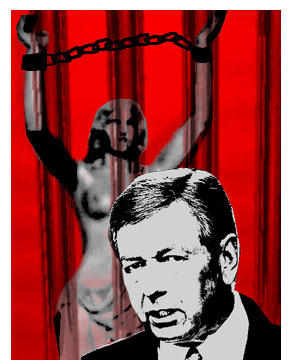

Mike Hawash was on his way home from his job at Intel in Portland, Ore., last month when FBI agents surrounded him in the company parking lot and took him into custody. At the same moment, agents armed with assault rifles were storming through Hawash’s home, terrifying his wife and three small children waiting for their father to come home.
The agents took Hawash to a federal prison outside of Portland, where he has been held in solitary confinement for nearly a month. Hawash is a 38-year-old immigrant — born on the West Bank and raised in Kuwait — who has been a U.S. citizen for 15 years. He has not been charged with any crime, and there has not been any suggestion that he committed one. The Justice Department says Hawash is a witness, but it won’t say to what. It won’t say what information it wants from him, it won’t say what agents were hoping to find when they searched his house, it won’t say why he needs to be in custody, and it won’t say how long it plans to keep him there.
These aren’t the only things the Bush administration won’t say. It won’t say why it’s holding individual detainees at Guantánamo Bay; it won’t disclose the factual basis for its prosecution of Zacarias Moussaoui; and it won’t say how many immigrants it has detained or deported in INS proceedings. It won’t say how many of us are having our telephones tapped, our e-mail messages monitored or our library checkout records examined by federal agents. The administration’s defenders say such secrecy is an unavoidable cost of the war on terror, but it’s an orientation that predated Sept. 11 and that extends beyond the terror threat. The White House won’t reveal who Vice President Dick Cheney consulted in concocting the administration’s energy policy; it won’t disclose what Miguel Estrada wrote while working for the solicitor general; it won’t even release documents related to the pardons that former President Bill Clinton granted during his last days in office.
It won’t disclose any of these things because it doesn’t have to. In the war on terror — and outside of it — the Bush administration is finding increasing latitude to operate with secrecy as the norm, and accountability the exception. Congress has handed the administration broad new powers without requiring it to account for their use, while courts have repeatedly granted the government the right to operate outside the public view and — at times — without any possibility of judicial review.
And if Attorney General John Ashcroft and Utah Republican Sen. Orrin Hatch have their way, the situation may soon get much worse. Ashcroft’s Justice Department is apparently eyeing legislation — dubbed PATRIOT Act II — that would further expand the administration’s powers to act in unilateral silence. Meanwhile, Hatch is working to make PATRIOT Act I permanent now — it is currently set to expire in 2005 — before Congress can consider whether the Justice Department is making appropriate use of the broad surveillance powers provided by it.
Steven Aftergood, a researcher who monitors government secrecy issues for the Federation of American Scientists, calls Hatch’s proposal a “direct assault” on Congress’ ability to monitor the Justice Department. “If it goes through, we might as well go home,” he told Salon. “The administration will have whatever authority it wants, and there won’t be any separation of powers at all.”
It is a dire prediction. But in some ways, it has already come true. Congressional aides complain that the Justice Department has denied Congress the information it needs to serve as a meaningful check on possible executive branch abuses, and the federal courts are increasingly refusing to involve themselves in cases in which the administration’s policies — on secrecy, on terror or on executive authority more generally — have been questioned. As a result, the executive branch is increasingly free to act on its own, without the checks and balances typically imposed by a separated government.
The White House denies that it is operating under any unnecessary cover of darkness. At a conference of newspaper editors earlier this month, Vice President Dick Cheney categorically rejected the perception that the administration has become a “foe of openness,” and he said that the Pentagon’s program of “embedding” reporters with troops in Iraq proves that the administration is committed “to the free flow of information about very important events.”
But just as free-roaming reporters in Iraq have now begun to show that their embedded colleagues saw only the stories the Pentagon wanted them to see, there is increasing concern at home that the White House feels free to tell Congress, the courts and the public only as much as it cares to reveal.
“On a lot of these kinds of questions, the responses are, ‘We can’t tell you,’ or ‘We’re not going to tell you,’ and on some it’s, ‘We don’t keep that kind of information,'” said Lee Tien, a senior staff attorney for the Electronic Frontier Foundation. “That’s what I find offensive. They say, ‘We can’t give you a full picture, but we can tell you that we thwarted a kidnapping or caught a child pornographer.’ So they get to spin it, and you hear the stuff they’d like to tell you about, but you never hear anything about the rest.”
Six weeks after Sept. 11, Congress enacted the USA-PATRIOT Act. Among other things, the act makes it possible for the FBI to obtain personal information about U.S. citizens — logs of their Internet activities, the books they check out from the library, their bank transactions and their phone calls — without any evidence that the subject of such information is involved in any way in any criminal activity. In some cases, the act allows the FBI to obtain such information based solely on its own decision to do so, without first seeking a warrant from a federal court. The PATRIOT Act also dramatically increases the circumstances under which federal law enforcement officers can conduct wiretaps and secret searches under the Foreign Intelligence Surveillance Act.
What the PATRIOT Act does not do is impose any requirement that the administration inform Congress — or anyone else — as to how these new powers are being used. In typical legislation involving criminal law, that might not have been a problem. As the EFF’s Tien explained, law enforcement officers involved in criminal investigations have a strong incentive to police themselves when it comes to civil liberties: If they conduct searches or make arrests in violation of constitutional safeguards, the evidence they need for a conviction may not be admissible at trial. But in wide-ranging and open-ended anti-terror investigations, there frequently is no such check. If agents violate the privacy rights of a library patron or conduct unlawful surveillance of an innocent citizen, there may be no ramifications because there likely would be no trial in which such evidence would come to light — and possibly be suppressed.
Thus, Tien said, abuses are more likely in such investigations. Yet Congress “didn’t change the reporting requirements or enhance them in any way” when it adopted the USA-PATRIOT Act. “And then when members of Congress began to think, ‘What do we know about what the White House or DOJ is doing?’ they realized that they didn’t know a whole hell of a lot.”
So in 2002, Congress began to ask questions. But congressional aides say that the Justice Department has been so tight-lipped about its post-9/11 actions that Congress still lacks basic information about the use and usefulness of the PATRIOT Act powers. And without such information, they say, Congress can neither monitor the department effectively nor make intelligent decisions about whether the PATRIOT Act strikes an appropriate balance between preventing terrorist acts and protecting civil liberties.
An aide to one Democratic member of the Senate Judiciary Committee told Salon that the committee has had “extreme difficulty” in learning how the Justice Department is implementing the PATRIOT Act. Aides on the Republican side of the aisle tell a similar story. Ask them about the administration’s responses to Judiciary Committee queries, and you’ll hear words like “slow,” “recalcitrant, and “a teeth-pulling exercise.”
An aide to Iowa Republican Sen. Chuck Grassley said his boss is “frustrated” by the Justice Department’s failure to cooperate more fully with the committee. “Sen. Grassley believes that senators, particularly senior senators on committees of jurisdiction, have a right to have reasonable questions answered,” the aide said. “Now, sometimes people say, ‘Tell me how many grains of sand are on a pyramid.’ But ‘How often have you used this new power? And what has been the result?’ Those are legitimate questions that should be answered.”
Some of them haven’t been. For example, said Tien, the Justice Department has refused to say how many times it has demanded information from libraries about the books checked out by individual patrons. More generally, the Senate Judiciary Committee has asked the Justice Department numerous times for information about its practices under the PATRIOT Act and the Foreign Intelligence Surveillance Act. Some of those requests have not been answered at all, said the aide to a Democratic member of the committee, while others have been answered only incrementally.
“The curtain came down just after the work on the USA-PATRIOT Act,” the aide said. “That’s when the unilateralism started, both in the Justice Department and in the administration overall.”
While some departments have been more responsive to congressional requests, Senate aides say that many have joined Justice in putting such inquiries on what one Republican Senate aide called “the slow boat to China.” He said that administration officials seem surprised and resentful that they are expected to provide any information at all. “They probably figure, ‘We’ve got both houses in our pocket and we don’t have to get oversight stuck up our ass,'” he said. “They probably figured they could paint [Vermont Democratic Sen. Patrick] Leahy and [Democratic Rep. John] Conyers as partisan. But there are [Republican members of Congress] who ask questions and expect answers, too.”
One of those members is Rep. James Sensenbrenner, the Wisconsin Republican who chairs the House Judiciary Committee. Last summer, Sensenbrenner and Democratic Rep. John Conyers Jr. asked the Justice Department to provide the committee with basic statistical information about its use of its PATRIOT Act tools. The department stalled so long that Sensenbrenner eventually threatened to issue subpoenas and to vote against renewal of the PATRIOT Act when it expires in 2005 pursuant to the “sunset provision” written into the act. In an interview with editors of the Milwaukee Journal Sentinel, Sensenbrenner said he told Ashcroft: “If you want to play, ‘I’ve got a secret,’ good luck getting the PATRIOT Act extended. Because if you’ve got bipartisan anger in the Congress, the sunset will come and go and the PATRIOT Act disappears.”
Shortly thereafter, the Justice Department provided answers to the committee’s questions. In an interview with Salon last week, Sensenbrenner aide Jeff Lungren struck a conciliatory tone. Sensenbrenner and Ashcroft now meet for lunch on a regular basis, he said, and any problems they may have had were the result of the natural “tension” between an executive department and the congressional committee that oversees it.
Still, Lungren agreed that keeping the five-year sunset provision in the PATRIOT Act is “critical” to understanding how the act is being used and whether any “tweaks or changes” need to be made.
At the time of the PATRIOT Act’s passage, many members of Congress said they wouldn’t have voted for the act without the sunset provision. Leahy said at the time that the provision was key to ensuring oversight of the Justice Department. He reiterated that view in a written statement issued earlier this month, saying that Hatch’s proposal to make the PATRIOT Act permanent now would rob Congress of what “little leverage” it has in obtaining information from the Justice Department and would “give up the ghost” on any further congressional oversight.
“Oversight is how we know how well or how poorly these and other laws work in practice, and the sunset conditions give Congress and the American people at least a little leverage in getting answers,” Leahy said. “History shows that a government that doesn’t want oversight often is a government that has something to hide.”
Some in the civil liberties community see the oversight efforts being made by Leahy, Grassley and Sen. Arlen Specter, R-Penn., as a resurgence of congressional authority after a period of acquiescence to administration demands. They view the Hatch proposal as a check on that trend. “It’s a frontal challenge,” said the FAS’s Aftergood. “It’s a test of the backbone that we’re beginning to see. And if it works, congressional oversight will be just a courtesy extended by the executive branch, with no rigor or mandatory character to it.”
To be sure, the administration, at times with the help of compliant federal courts, has already undercut the ability of Congress — and the public more generally — to oversee the government’s activities, both in the war on terror and otherwise.
In October 2001, Attorney General John Ashcroft changed the baseline government policy on Freedom of Information Act requests from one favoring disclosure to one favoring secrecy. Under Clinton Attorney General Janet Reno, federal agencies were to comply with Freedom of Information Act requests unless there was a real risk of “foreseeable harm” in doing so. But under the Ashcroft policy, agencies are to refuse to disclose information sought under FOIA if there is any “sound legal basis” for doing so.
In November 2001, President Bush signed an executive order granting himself the power to veto all requests to open the records of former presidents, even if a former president wants his records released. Under the Presidential Records Act — like FOIA, passed in the wake of Watergate — most records of a president are to be made available for public review 12 years after the president leaves office. Bush’s executive order effectively gutted the Presidential Records Act and allowed him to deny public access to records from the Reagan administration — including records related to his father’s role as vice president.
Groups of historians and journalists have filed suit over the executive order in the U.S. District Court for the District of Columbia. The case is still pending. But if recent decisions from that court are any guide, the historians and journalists should not count on reviewing Reagan-era documents anytime soon.
Earlier this month, the District of Columbia court held that the Bush administration could refuse to release records related to President Clinton’s last-minute pardons of Marc Rich and others based upon Bush’s assertion of a “presidential communications privilege” over the records. While Bush likely had no interest in keeping Clinton’s deliberation’s secret, Bush’s arguments before the court — and the court’s ultimate ruling in his favor — pave the way for him to keep his own pardon deliberations secret.
And in December, the same court dismissed a lawsuit in which the General Accounting Office attempted to obtain the identities of energy industry officials and others with whom Vice President Cheney met in the course of developing the administration’s energy policy.
In his talk with newspaper editors earlier this month, Cheney trumpeted the courts decision as a ruling that the administration had acted “in an appropriate way” in keeping the information secret. “Thats a lie,” said Tien of the EFF. Having held that the federal official who oversees the GAO lacks legal standing to bring such a lawsuit, the court had no occasion to opine about the administrations actions one way or the other.
And the legal disputes over Cheneys energy task force are far from over. On Thursday, two federal appellate judges lashed out at Justice Department lawyers trying to persuade the U.S. Court of Appeals for the District of Columbia Circuit to prevent Judicial Watch and the Sierra Club from reviewing some of the task forces records. But its no surprise that the earlier decision in the GAO case stands out for Cheney. A decision that the administration was right would have been a good thing; a decision saying the courts have no business hearing such a challenge was even better.
The D.C. Circuit — usually considered the “second-highest” court in the land — handed the administration just such a victory in its war on terror earlier this year. In a decision that dumbfounded civil libertarians, the D.C. Circuit held that detainees in U.S. military custody at Guantánamo Bay have no right to challenge their confinement in U.S. courts. So long as the detainees are non-citizens who were captured outside the United States during some sort of military operation and are now being held outside the United States, the courts of the United States “are not open to them.”
If the decision stands, the administration will be free to do whatever it likes with the detainees — without any fear that a court is going to stand in the way or cause it any problems later. Thus, the detainees’ only hope is that the executive branch that holds them decides to treat them justly. There is no other check, no other balance.
The detainees’ case is one of several from the war on terror that may be decided by the Supreme Court in the coming year or so. In another, the ACLU, on behalf of a group of New Jersey newspapers, is challenging the Justice Department’s decision to close all immigration proceedings deemed by the Justice Department to be “of interest” to its terrorism investigations. One court of appeal has upheld the practice; another has condemned it. Given the split among the lower courts, it is likely the Supreme Court will agree to take the case and decide the issue.
But like other federal courts, the Supreme Court is likely to grant the administration substantial leeway in prosecuting the war on terror as it sees fit. In fact, the Supreme Court has already begun to do so. Last month, the court refused to hear the ACLU’s challenge to the Justice Department’s practices under the Foreign Intelligence Surveillance Act — in particular, its failure to maintain a “wall” between domestic police activities and spying activities under FISA.
In his 1998 book on civil liberties during wartime, “All the Laws But One,” Chief Justice William Rehnquist observed that courts typically defer to the executive branch during wartime but then pull in the reins as the immediacy of war subsides. It is not clear how that tendency may play out in the potentially unending war on terror. But even if it does — that is, even if the courts begin to demand accountability from the executive branch — the Bush administration still has a trump card: It can take its business elsewhere.
The trial judge presiding over the case of Zacarias Moussaoui — the only person charged in the United States so far in connection with the Sept. 11 attacks — has raised questions about whether Moussaoui can be tried in the shroud of secrecy the Justice Department has wrapped around the case. She has also held that Moussaoui’s lawyers are entitled to interview a high-ranking al-Qaida official currently in U.S. custody, an interview the Justice Department vigorously opposes.
The Justice Department has insisted that Moussaoui can be tried fairly while preserving government secrets, and it has challenged the ruling on the al-Qaida interview in an appeal now pending before the notoriously conservative U.S. Court of Appeals for the Fourth Circuit. But if the trial judge ultimately rules that the Justice Department has to give up some of its secrets to try Moussaoui — or if the Fourth Circuit agrees that the al-Qaida interview must go forward — there are signs that the Justice Department will simply dismiss the case and file new charges against Moussaoui before a military tribunal.
President Bush issued an executive order in November 2001 establishing such tribunals. In trials before them, he said, the rights guaranteed to defendants in regular criminal trials — rights set forth in the Constitution, the Federal Rules of Criminal Procedure and the Federal Rules of Evidence — are “not practicable” and therefore do not apply. If the administration chooses to try Moussaoui before such a tribunal, the judicial branch of government will have been removed from the equation altogether.
With the Domestic Security Act of 2003 — the draft legislation dubbed “PATRIOT Act II” — the administration is apparently contemplating other ways in which it might avoid the inconvenience of operating in the public eye or answering to the federal courts.
The draft legislation, prepared by the Justice Department but not yet proposed to Congress, includes provisions that would allow federal agents to keep secret the names of individuals arrested in investigations related to “international terrorism”; expand the circumstances under which agents could conduct searches and wiretaps without warrants; and allow the attorney general to deport resident aliens in certain circumstances without any possibility of judicial review.
With trials before military tribunals and legislation like PATRIOT Act II on the horizon, it may be that Mike Hawash should be considered lucky. Having worked for years in the computer industry, he has friends who have launched a Web site to draw attention to his plight. He has a lawyer, he has the backing of the ACLU, and he has the attention of at least one U.S. senator. Still, he has the Bush administration’s Justice Department aligned against him, and that cannot be a comfortable place to be.
“Since Sept. 11, the Justice Department has shown a contempt for due process,” said David Fidanque, the executive director of the ACLU in Oregon, which is watching Hawash’s case closely. “Secrecy is paramount to them, and the Constitution is an obstacle to overcome.”
Last week, the court in Hawash’s case held that the Justice Department can keep him in custody at least until the end of the month so that it will have time to take his deposition or have him testify before a grand jury. While portions of the court’s decision were made public, the reasons for the Justice Department’s interest in him — and the purported factual basis for keeping him in custody — were not.
