
Republican Party

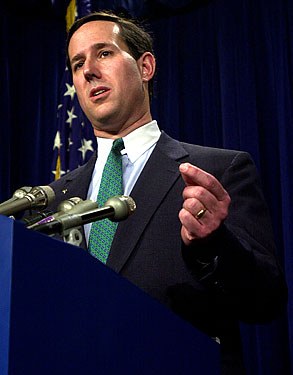
GOP defends Ayatollah Santorum

If the president truly believes the Pennsylvania zealot is "an inclusive man," we're all in trouble.

  • more
    • All Share Services

GOP defends Ayatollah Santorum

It took a few days, but finally President Bush came to the defense of Pennsylvania Sen. Rick Santorum, who’s been hammered by Democrats and a few brave Republicans for equating homosexuality with bigamy, polygamy, incest and adultery in an Associated Press interview.

Since the story broke Monday, there’s been official silence from the White House, but on Friday Bush spokesman Ari Fleischer told reporters, “The president believes that the senator is an inclusive man. … The president has confidence in Sen. Santorum and thinks he’s doing a good job as senator — including in his leadership post.”

Well, now we know. Calling Santorum an “inclusive man” is about as truthful as calling Israeli Prime Minister Ariel Sharon a “man of peace” — even Sharon’s admirers know he’s a warrior. But being president makes you very powerful, and means you’re almost never called a liar, even when you’re lying.

There is nothing inclusive about Rick Santorum, who, as chairman of the Republican Conference, is the GOP’s No. 3 Senate leader. He is a right-wing extremist who has more in common with fanatical Islamic fundamentalists than with many Americans. The president’s failure to repudiate him or his remarks is appalling — and in the long run, it will cost him politically.

I agree with Andrew Sullivan, a stalwart Bush defender who nonetheless wrote on Friday, with evident pain: “The White House still doesn’t understand the damage that this incident is doing, the fact that it is beginning to make it simply impossible for gay people and their families — or any tolerant person — to vote for the president’s party.”

The full text of Santorum’s remarks should give all Americans the creeps — and not only when he grossed out the AP reporter by talking about “man on dog” sex. “I’m sorry, I didn’t think I was going to talk about ‘man on dog’ with a United States senator, it’s sort of freaking me out,” she told him. I bet. (Sometimes I wonder about the inner life of these anti-sex fanatics. Why do I suspect Santorum’s spent more time thinking about “man on dog” sex than the rest of us?) Let’s be clear: Santorum wasn’t just talking about gays; he was expressly denying that Americans have a right to privacy. Talking about a Texas sodomy law currently before the Supreme Court, he went on at great length:

“The right to privacy is a right that was created in a law that set forth a [ban on] rights to limit individual passions. And I don’t agree with that … Does that undermine the fabric of our society? I would argue yes, it does. It all comes from, I would argue, this right to privacy that doesn’t exist in my opinion in the United States Constitution, this right that was created, it was created in Griswold — Griswold was the contraceptive case — and abortion. And now we’re just extending it out. And the further you extend it out, the more you — this freedom actually intervenes and affects the family. You say, well, it’s my individual freedom. Yes, but it destroys the basic unit of our society because it condones behavior that’s antithetical to strong, healthy families. Whether it’s polygamy, whether it’s adultery, where it’s sodomy, all of those things, are antithetical to a healthy, stable, traditional family.”

Sullivan has correctly asked whether that means Santorum wants to criminalize adultery. It’s a good question. And contraception too?

The Pennsylvania ayatollah has refused to retract his remarks. He insists he’s not against homosexuals, only “homosexual acts.” But despite Santorum’s radical statements, Republicans have proudly told reporters there will be no rerun of the Trent Lott debacle, in which the Senate majority leader was sacked for publicly admiring Strom Thurmond’s racist presidential campaign last December. Why? For one thing, Lott got thrown overboard less because his GOP colleagues cared about his racism than because they thought he was a liability who wasn’t loyal enough to Bush, had made a lot of enemies and cut too many deals with Democrats. Santorum’s a company man, so everybody got the talking points: Senate Majority Leader Bill Frist, like Fleischer, calls him “a man of inclusion.” Actually, most Republicans got the no-talking points: The White House and Republican National Committee have advised Republicans not to comment on Santorum’s outrageous remarks when asked about them by the media, so most of them aren’t.

But they should be asked about them anyway, again and again. The other reason Santorum won’t get the Lott treatment is that Republicans think homophobia, unlike racism, won’t cost them politically, and that it’s still safe to bash gays. Reporters should question Santorum and his defenders at every opportunity. Do they think Vice President Dick Cheney’s gay daughter Mary should be prosecuted for her “homosexual acts?” And does the GOP believe in a right to privacy? Should adultery be criminalized? What about contraception?

Reporters tried, but failed, to get Ari Fleischer to expand on his vapid statements defending Santorum on Friday. Get a load of this exchange:

Reporter: What’s the president’s beliefs about homosexuality?

Fleischer: You know, that’s a question that’s been put to the president, and if you go back and you look at it, the president has said that, first of all, he doesn’t ask that question about people. He judges people about who they are, their individual soul. That’s not a matter the president concerns himself with. He judges people for how they act and how they relate, and that’s his focus on that.

How they act sexually? Because I asked sexually …

How they act as a person. The same way …

But the police in Texas asked how they act sexually.

The same way you would say that about how anybody — what’s his reaction to this person or that person — say, are they a nice person, what kind of person are they? It has nothing to do with their sexuality.

So does he believe that they ought to be free to be themselves, without interference from police?

The president has always said that when it comes to legal matters, that it’s a question of different groups, homosexual groups, gay groups should not have special rights or special privileges.

Is it a special privilege to be able to love the person you love the way you want to love them, without interference from the police?

If you’re asking about a matter that is a legal matter that is pending before the Supreme Court, that’s a matter for the court to rule on, and we’ll find out what the court says in the specific case in mind.

So he has no position on that?

It’s a matter that’s pending before the court, in regard to your last question.

- – - – - – - – - – - -

It’s worth remembering who was Texas governor in 1998, when police burst into the bedroom of the gay couple whose case is before the Supreme Court: Yes, it was Fleischer’s boss, our president. He’s had plenty of time to rethink that law, which was enforced on his watch, and he hasn’t. He had all week to rethink Santorum’s outrageous remarks, and repudiate them, and he didn’t.

After watching a segment about Santorum on Fox News the other night, I stayed tuned as the network segued into an Iraq update, and a Fox commentator decried the country’s Shiites for trying to “introduce religion into political life.” Of course the president’s party is trying to do the same. Let’s hope Santorum’s candor wakes more Americans up to the fact that Iraqis aren’t the only ones at risk of losing their freedom to religious fundamentalism.

Joan Walsh

Joan Walsh is Salon's editor at large.

How to cure the crazy

The return of Donald Trump forces the question: Is there anything the GOP can do to recover from insanity?

  • more
    • All Share Services

How to cure the crazyDonald Trump (Credit: Reuters/David Moir)

One thing when writing about the Republican Party and the crazy – you can always be certain that it’ll generate new examples. So just when the news that a member of the House accused dozens of Democrats in Congress of being Communists seemed to be going stale, along comes Donald Trump – who is scheduled to appear at a fundraiser with Mitt Romney next week – to spout birther nonsense.

For those of us who believe that there’s something seriously wrong with the Republican Party (and see Tom Mann and Norm Ornstein’s new book; see also my argument that the problem is not about how “conservative” they are, but about their radical style), the big question is whether anything can be done about it. American democracy needs two strong, solid political parties, but currently one of the parties is just a mess – incapable of making coherent policy when it’s in office, and dangerously obstructionist when it’s out of office.

So how can a party recover? I think there are three ways, but two are unfortunately quite unlikely, and the third is at best uncertain.

Some talk about the possibility that the electorate will punish Republicans for their radicalism. Unfortunately, I think that’s unlikely. Note that consecutive blowouts in 2006 and 2008 certainly didn’t make things better. Part of the problem here, too, is that elections generally don’t work that way. It’s true that the impression of ideological extremism can be costly, as Barry Goldwater and George McGovern learned the hard way, but we’re talking here about 2 or 3 percentage points in a presidential election. Direct action by the voters just isn’t enough to do it. After all, as voters, they can only choose between the nominees that they’ve been offered, and if anything voters are more partisan than ever; they’re not likely to defect just because a candidate embraces the crazy, even if they don’t like it, because they would still have a strong preference for that candidate otherwise.

A second possibility is that they’ll wind up with a successful president who sets a strong example of sane conservativism and who is strong enough within the party that he or she can push a lot of the crazies to the fringes and beyond. That could work. Presidents have limited influence in general, but one thing that a popular president can do is to define normality for his or her own party. They can reward some and punish — or at least avoid rewarding — others, creating real and meaningful incentives that can be very different from what came before. The obvious analogy is Dwight Eisenhower’s maneuverings against Joe McCarthy. The problem is that for this strategy to work it takes a skilled and popular president who decides to try it, but Republicans might have to wait a long time before they get another Ike.

So the first method probably can’t work, and the second one is unlikely to happen. That leaves one other possibility: that the Republican coalition itself might demand change. Specifically, that Republican-aligned interest groups – perhaps business, national security or others – might become upset enough with the crazy, or worried enough that the crazy will impede their ability to get things done, that they’ll push to end it. After all, part of the problem with the crazy is that it truly is random; you really never know what nonsense Limbaugh or the Breitbart sites are going to be up to next, and there’s every possibility that it could interfere with groups within the party pursuing their interests. Even worse: Politicians who believe they were elected because their most valuable allies convinced the electorate that the president was a radicalized foreigner are going to be responsive to those supporters, and not to organized party groups. Those groups have enough troubles as it is, since in the current free-for-all campaign finance environment they have to compete with random billionaires who might have all sorts of unorthodox policy preferences.

We’ve seen a little bit of this already. During the healthcare debate, many normally Republican-leaning groups chose to work with the Obama administration and cut their best deal, rather than sticking with the rejectionist GOP. Several companies quit the conservative state lobbying organization ALEC when it became controversial by lobbying for ideological and partisan goals. On the national security side, a break has emerged between the Department of Defense and movement conservatives; both conservatives who care about national security and (on some issues) businesses might choose to stick with the Pentagon. And it’s not quite the same thing, but there’s been a small but steady stream of defectors from the movement.

Nevertheless, something like this would likely play out in nomination politics, with party-aligned groups insisting on candidates who are willing to fight for their interests while rejecting the crazy, and there certainly isn’t any sign of that yet. Will it in 2014 and 2016 if Romney falls short this fall and the crazy gets even worse? I have no idea – but that’s the only path out of this that I can imagine.

Continue Reading Close

Jonathan Bernstein writes at a Plain Blog About Politics. Follow him at @jbplainblog

GOP to modernity: Stop

For House Republicans, the less we know about our country and our planet, the better

  • more
    • All Share Services

GOP to modernity: Stop House of Representatives Republican leadership (Credit: AP)

Watching the antics of the House GOP, you get the very strong sense that if the class of Republicans elected in 2010 were offered a chance to repeal the Enlightenment, they would leap at the opportunity. The great flowering of science and philosophy that reached critical mass in the 17th century employed human reason to batter away at the dogmas of blind faith. But as far as the Tea Party seems to be concerned, that was just one big wrong turn.

The most recent evidence that the current incarnation of the Republican Party just can’t handle the truth arrived this month when House Republicans voted to get rid of the American Community Survey. The ACS is an annual information-gathering effort that’s part of the U.S. Census. Every year, a randomized sample of 3 million Americans is surveyed for data on “demographic, housing, social and economic characteristics.” In one form or another, the U.S. government has been carrying out similar surveys since 1850 — the current version is the fourth major iteration.

Most sensible people consider the ACS to be extremely useful, the kind of thing that government is really well equipped to carry out. That is not, or at least did not used to be, a partisan statement. Both private and public sector policymakers use ACS data to make important decisions. The federal government allocates $450 billion annually according, in part, to information derived from the ACS. Businesses also consider the ACS vital, which explains why the U.S. Chamber of Commerce, rarely a fan of government spending, is opposed to the House action.

Even conservative economists are leery: The clearest evidence that the House GOP has gone completely beyond the pale can be seen in a Businessweek article reporting that representatives of the American Enterprise Institute, Heritage Foundation and Cato Institute all declared their support for government data gathering. If you don’t understand what’s going on in the U.S. economy on a granular level, you’re flying blind. This should not be a controversial statement.

Even the Wall Street Journal is appalled — although the lead sentence of its editorial criticizing the funding cuts required some remarkable calisthenics before reaching the point of disapproval.

With the contempt of the Washington establishment raining down on House Republicans for voting on principle, every now and then the GOP does something that feeds the otherwise false narrative of political extremism.

Marvelous! In one sentence, the Journal’s editorial writer manages to deny, not once, but twice, the self-evident fact that the current crop of House Republicans occupies the nethermost regions of right-wing extremism, while at the same time admitting that, yeah, well, in this one case they are indeed bonkers.

There’s been no end of media chatter focusing on the importance of the data gathered by the ACS. We’ve also heard how the Constitution specifically enjoins Congress to gather demographic information “in such a manner as they shall by law direct.” And, in fact, the current form of the ACS follows the mandate set forth by a Republican Congress in 2005.

The sponsor of the House measure, the freshman Florida Republican Daniel Webster, claims that ACS questions are too “intrusive” and “the very picture of what’s wrong in D.C.” He seems to be projecting. The very picture of what’s wrong with D.C. is exquisitely captured by daily demonstration that one of our leading political parties is dedicated to the proposition that the less we know about what is going on in our economy or on our planet, the better. If science tells us that one of the consequences of human activity is an overheated planet, then the answer is to defund climate research. If data gathered by the ACS gives us a better understanding of where poverty may be growing as a result of economic policies put into place over the past few decades, best to just to close our eyes and ignore it.

Which brings us back to the 17th century. It’s no stretch to argue that both representative democracy and the Industrial Revolution flourished in large part through the application of Enlightenment principles. The founders of the United States were very much a product of Enlightenment ideals. Looking for an Enlightenment avatar? Think Ben Franklin. Progress is built on the accumulation of knowledge, and ideological rigidity shouldn’t be able to compete against the truth that derives from a better understanding of our universe. And yet that’s where we are today — watching as one of the two major political parties in our country becomes not just more and more distrustful of science, but also opposed to the very notion of information-gathering — and governs accordingly.

Continue Reading Close
Andrew Leonard

Andrew Leonard is a staff writer at Salon. On Twitter, @koxinga21.

Mitt’s favorite new dodge

Romney and the GOP insist the economy is more important than social issues. Why can't we address both?

  • more
    • All Share Services

Mitt's favorite new dodgeMitt Romney (Credit: AP/Carlos Osorio)

One of the most overused metaphors in a writer’s arsenal is the one about “walking and chewing gum at the same time.” As a hiker and Big League Chew enthusiast, I particularly hate this cliché. Nonetheless, I feel it is fitting right now because it so perfectly summarizes the argument being made by Republicans. They now insist that America cannot simultaneously walk the walk on equal rights and also chew economic gum.

In the last week, Colorado was the testing ground for this talking point. At the presidential level, Republican nominee Mitt Romney criticized a Denver television reporter for daring to ask about his position on, among other issues, same-sex marriage. Before restating his opposition, he scoffed at the question, asking: “Aren’t there issues of significance that you’d like to talk about [like] the economy? The growth of jobs? The need to put people back to work?”

At the same time, Colorado’s Republican House Speaker Frank McNulty twice blocked a vote on a bill to legalize civil unions. His rationale? “We should not be spending time on divisive social issues when unemployment remains far too high and [when] far too many Coloradans remain out of work,” he said. Echoing that sentiment, the shadowy Republican front group Compass Colorado financed an automated telephone call telling thousands of voters that the push for civil unions was unacceptable because it is “promoting [a] divisive social agenda over Colorado job creation.”

Obviously, it’s perplexing to see the Republican Party allege that social issues are insignificant and “divisive.” This is, after all, the party whose most recent presidential nominating contest was dominated by attacks on contraception — the same GOP whose politicians have made an art out of riding a “guns, god and gays”-focused agenda to electoral victory.

But while such naked hypocrisy is enraging, the substance of the Republican rhetoric about gay rights is downright offensive. Essentially, conservatives are asserting that we cannot extend equal rights to all Americans and fix the economy. In the process, they are deliberately insinuating that the twin goals are somehow contradictory.

Well, you might ask, do they have a point? History says no. Our country’s story is the story of multitasking — a tale of extending the franchise to women while passing progressive legislation to deal with crushing economic inequality, a tale of both passing civil rights legislation and creating Medicare.

In light of such achievements, would anyone retroactively argue that America should have opposed the campaign to let women vote because the economy was so bad in the early 20th century? Would anyone insist that lawmakers should have halted civil rights legislation in the 1960s because there was a simultaneous need for a War on Poverty? Probably not, because most of us recognize such arguments for what they are: diversionary non sequiturs whose real goal is to preserve institutional bigotry and prejudice.

That’s the same objective of today’s GOP when it comes to rights for same-sex couples. For proof, just consider the abruptness of the shift: the Republican Party that spent the last decade insisting that we should simultaneously cut taxes, prosecute foreign wars and fight to limit a woman’s right to choose an abortion now suddenly says we can’t even discuss equal rights because of a recession.

The language changed not because the new “can’t walk and chew gum” mantra makes sense (seriously — would any sane person really claim that a bad economy justifies continued persecution of lesbians, gay, bisexual and transgender people?). It changed because the cause of equal rights is involved. And, clearly, that cause is what today’s Republicans are now most committed to stopping — no matter how much their flawed logic indicts their credibility.

Continue Reading Close
David Sirota

David Sirota is a best-selling author of the new book "Back to Our Future: How the 1980s Explain the World We Live In Now." He hosts the morning show on AM760 in Colorado. E-mail him at ds@davidsirota.com, follow him on Twitter @davidsirota or visit his website at www.davidsirota.com.

Jon Huntsman for New York City mayor?

Yes, please. It would be very funny to see him lose

  • more
    • All Share Services

Jon Huntsman for New York City mayor?

Yes, Jon Huntsman should definitely run for mayor of New York, because I never tire of watching Jon Huntsman get rejected by voters. The best part of a Jon Huntsman campaign is when his well-heeled supporters very sincerely and tragically argue that the fact that no one wants to vote for Jon Huntsman is a sign that the Republic itself is in peril. They would get so sad and melodramatic when he got 10 percent of the vote.

Now, there is no evidence that Jon Huntsman is planning for run for mayor of New York City, but one of his annoying daughters tossed this one out there last night:

Why not? I mean sure he has never lived in New York and has no connection to the city, but why not?

Of course, now that this idea is floating around, very rich and well-connected morons just might set about trying very hard to make it a reality. Jon Huntsman is a creature of the sort of oblivious center-right rich folk who bankrolled the hilarious failed New York campaigns of Harold Ford Jr. and Reshma Saujani. They would like very much to see another one of their class be the mayor of their city, after Bloomberg ends his term (if he ends his term). The Republicans have essentially no candidate. (I still wouldn’t put it past Police Commissioner and professional harasser-of-minorities Ray Kelly to mount a run, but at the moment he’s sounding disinclined to.) And Jon Huntsman is the sort of nationally prominent “independent” candidate all three major New York newspapers would love (the Daily News would love him the most, obviously, but the Post would love him because he is secretly not actually that moderate).

Jon Huntsman — whose tax plan called for the complete elimination of taxes on capital gains and dividends, as well as the elimination of the Earned Income Tax Credit, the Reagan-era tax benefit for poor people that used to be the sole form of welfare that conservatives supported, and who also wholeheartedly supported the Paul Ryan plan to fix the deficit by eliminating Medicare and not making rich people pay taxes — was of course beloved by the press and labeled a reasonable moderate when he ran for the 2012 Republican presidential nomination. He was mistaken for a political moderate primarily because he does not believe that God created cavemen and dinosaurs at the same time, roughly 4,000 years ago. Huntsman, who supports the complete repeal of Dodd-Frank and is strictly antiabortion and anti-gay marriage and anti-healthcare reform and pro-gun, is now essentially a symbol of the dignity and sagacity of the “radical center,” even though he is a conservative Republican.

So obviously New Yorkers would be thrilled to vote for this guy. I endorse this.

Continue Reading Close
Alex Pareene

Alex Pareene writes about politics for Salon and is the author of "The Rude Guide to Mitt." Email him at apareene@salon.com and follow him on Twitter @pareene

Ron Paul sets up Rand for 2016

The cult libertarian hero keeps his campaign alive, barely, as he prepares to hand the reins to his son

  • more
    • All Share Services

Ron Paul sets up Rand for 2016Ron Paul and Rand Paul (Credit: AP/Charles Dharapak)

So Ron Paul says he is going to stop actively campaigning, but his supporters will continue to rack up delegates by storming state conventions. What will he do with these delegates? That is still unclear. (Barter them for gold?) What is the point of this strategy, exactly? Also unclear, but the Daily Beast’s Ben Jacobs today says it’s part of a “sneaky maneuver” to help his son Rand out. Ron will continue to consolidate power but will not appear to be actively sabotaging the party’s nominee. Dave Weigel says the maneuver is less sneaky and barely a maneuver: He doesn’t want it to be a huge embarrassment when he loses Kentucky, the state his son represents in the Senate.

Interestingly, though perhaps not surprisingly, Paul declined to endorse Libertarian Party nominee Gary Johnson, the former New Mexico governor who endorsed Paul in 2008. Johnson was, formerly, the Republican presidential candidate all those young “liberal” college stoner Ron Paul supporters should have gone with if they’d wanted to support a candidate who believed strongly in liberty but who wasn’t a racist Alex Jonesian conspiracy-mongering goldbug loon. But Johnson had “extensive executive experience” instead of a blimp and a sweet logo, so he did not win over many Paul fanatics.

Ron Paul’s strategy seems to be a gradual takeover of the Republican Party itself, instead of attempting to build a Libertarian alternative to the GOP. I think he’ll find that he can get the party to happily sign on, at least rhetorically, to his fiscal message, as they continue to ignore his popular and populist isolationism and his eminently agreeable but politically untenable positions on criminal justice and civil liberties, forever. The party, in other words, will continue to co-opt whatever they find electorally useful about the Paul phenomenon, as the Tea Party movement stole his iconography and messaging wholesale while attaching it to the same religious-right/nativist sentiment that has driven the party’s activist base for decades.

But Paul thinks the future lies with his son Rand, who shares many of his father’s enthusiasms and beliefs while also appearing to be more acceptable to the mainstream. Various Paul allies and a few other Republicans strongly suggest that Rand is gearing up for a 2016 run; which would mean, of course, that they expect Romney to lose, but that they need to not appear to be rooting for Romney to lose.

The problem is that what makes Rand Paul more acceptable to the mainstream of the Republican Party is what makes him more repellent than his father. Take, for example, Rand Paul’s funny joke this last weekend about Barack Obama and gay marriage.

The president recently weighed in on marriage. And, you know, he said his views were evolving on marriage. Call me cynical but I wasn’t sure that his views on marriage could get any gayer. Now it did kind of bother me, though, that he used the justification for it in a biblical reference. He said the biblical Golden Rule caused him to be for gay marriage …

And I’m like: What version of the Bible is he reading? It’s not the King James version. It’s not the New American Standard. It’s not the New Revised version. I don’t know what version he is getting it from.

Haha Barack Obama is so gay, he should read a Bible for once. Libertarianism!

Nick Gillespie, of the libertarian Reason Magazine, does not get this joke. The crowd, at the Iowa Faith and Freedom Coalition, did seem to get it, or at least they appreciated it. But Rand sounds very different when he speaks to Iowa conservatives than he does when interviewed by Gillespie and Matt Welch. (His address received a nice notice from Robert Costa of the National Review, who did not mention his funny joke.)

While Rand Paul may be, as Gillespie says, the most libertarian senator, he is also not an actual libertarian, as demonstrated by his support for anti-constitutional anti-immigrant legislation and his very vocal antiabortion position. He is also a dumb lout, and I tend to think that having the Senate’s most libertarian member be a dumb lout is not actually that good for the Libertarian movement. When he makes explicitly libertarian arguments, he makes them dumbly. When he goes all anti-gay talk-radio bigot culture warrior, which he does increasingly frequently, he does so dumbly. (If he wants to be a mainstream politician and presidential contender, it was certainly dumb to appear — more than once — on the radio program of Truther/Birther/New World Orderer/every-other-conspiracy promoter Alex Jones, but for some reason he almost entirely escaped mainstream press scrutiny for these appearances.) While I don’t feel much affection for Ron Paul, he seems both significantly smarter and leagues more principled than his son the senator.

If the “electable” face of libertarianism is a fratty anti-gay, anti-choice nitwit like Rand Paul, I will stick with socialism, thank you. And I wonder if the Paul family’s plan is to promote “liberty” or to promote the Paul family.

Continue Reading Close
Alex Pareene

Alex Pareene writes about politics for Salon and is the author of "The Rude Guide to Mitt." Email him at apareene@salon.com and follow him on Twitter @pareene

Page 1 of 284 in Republican Party