
Gaming

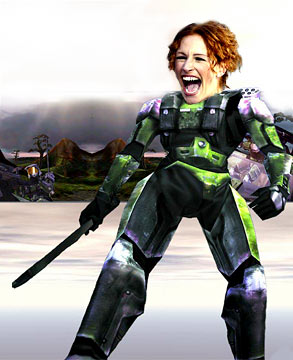
Deathmatch, Julia Roberts-style

America's most bankable female movie star confesses that she is a hardcore shoot-'em-up gamer. What does this mean?

  • more
    • All Share Services

Deathmatch, Julia Roberts-style

MY FAVORITE GAME

Julia Roberts: “Halo”

– Entertainment Weekly, “100 Greatest Videogames,” May 9 issue

- – - – - – - – - – - -

“We received your interview request for Julia Roberts. Unfortunately, she is not available. Thank you.”

– Julia Roberts’ publicist

- – - – - – - – - – - -

Julia Roberts’ weapon of choice is the M19 SSM rocket launcher. Not the zippiest firearm in the toolkit, sure, and does diddly in close-up melee action. But it’s got a double-barrel rocket payload, and pound for pound, it punches like a mofo. Julia Roberts’ favorite trick during multiplayer capture-the-flag matches is to camp near the team banner from a high vantage point and wait until the other side’s closing in. And at the last possible second, when they’re right about to nab it, pop out in the open with that hand cannon and…

“Dance, ya little bitches, dance!” Julia Roberts hoots, as the blast impact flings three opponent squaddies airborne. Her whole wiry body explodes off the Eames couch in the Emperor’s Suite at the Peninsula Hotel, and she jabs her middle finger at the 64-inch plasma flatscreen, as their crispy corpses hit the ground like rag dolls.

Ms. Roberts is trying to live a normal life, according to People magazine’s latest 50 Most Beautiful People issue, and in it, Denzel Washington says, amazed, “You’d be amazed how down to earth she really is.” But he’s not amazed now, because he’s been trying to get her bony ass off the couch for the last five minutes.

“One more round before lunch, Denzy!” But Denzel is all, “Girl, don’t even tell me you’ve been on this thing all day!” Denzel Washington tosses his controller on the couch so he can flick a bit of invisible dust off his Hugo Boss and roll his eyes. I mean, goddamn. Woman’s worse than my kids and their Game Boy Station, or whatever the hell they call it.

Up Sunset, Jennifer Garner huffs and then heaves her copy of Entertainment Weekly into the back wall of the Viper Room. She cannot believe her bitch publicist got her to tell the EW stringer that “Ms. Pac Man” was her favorite videogame. This article was supposed to get her in tight with her geek boy “Alias”/”Daredevil” fan base, but then here comes Miss Thing all talking about “Halo,” some intense, blowing-crap-up deal, while there she is naming some old school, girly-girl arcade game every female in the whole damn world has played.

Once again, she thinks, clenching her fists, America’s sweetheart has preempted us all. Damn Julia Roberts and her Xbox, Jennifer Garner seethes, damn her.

But over in Cambridge, Mass., a shambly professor with twinkly eyes rummages through the pile of PlayStation cartridges and an ungraded stack of term papers on Baudrillard, to fish out his own copy of Entertainment Weekly.

“It seems that Ms. Roberts’ appreciation for ‘Halo’ presages a new era in popular culture,” gaming academic Professor Henry Jenkins declaims to himself, as he peers out on the MIT quad. “Especially inasmuch as the game is a ‘hardcore’ title, in the lingua franca of the subculture: a gamer’s game, as it were. Consider what it means for a figure so unlike the entrenched stereotype of the ‘geek’ or ‘nerd,’ to be one. It is perhaps even more significant and unexpected than Vin Diesel’s recent self-outing as a Dungeons & Dragons fanatic — since, it must be said, the action star resembles a half-orc already. But returning to Ms. Roberts: Here we see a leading, beloved light of the grandfather medium, the princess of mainstream acceptability, finding herself drawn to, and to a certain extent shaped by, our nascent interactive medium. This represents a cultural shift of epic meaning.”*

“And good gracious,” Professor Jenkins adds, glancing once more at the photo on the marked page in EW, “What a hottie!”

Reese Witherspoon is still standing in the foyer of Julia Roberts’ suite, awkwardly shifting the gift-wrapped box of Jimmy Choos from hand to hand. Coming over, Reese decided that this little get-together was going to be some kind of A-list, big-sister/little-sister chat: you know, a passing of, like, the mantle. She tries to squint over Julia Roberts’ shoulder, who’s sitting on the raw silk carpet with a titanium Powerbook propped between her long legs.

Reese Witherspoon coughs chirpily. “So, is this like that ‘Hee-low’ thing again?” she asks, with a bit more edge than she intended.

Julia Roberts shushes her, and unpauses the QuickTime viewer. Onscreen, a military jeep goes twirling end over end while Sinatra sings on the soundtrack. Julia Roberts laughs the horsey, Southern girl laugh that gets her gross points. “Ain’t that Warthog jump just about the funniest dang thing you ever seen? Wait wait wait, have you watched ‘Red vs. Blue’ yet?”

No, thinks Reese Witherspoon, she has not watched “Red vs. Blue” yet.

For somehow, she imagined they’d be propped on the edge of the bed by now, cotton balls wedged between their toes, as they did each other’s nails and talked about boys they loved. But what Reese Witherspoon does not know is, even if that had been the subject, Julia Roberts would still inevitably steer the topic back to Bungie games. She’d talk about the times Lyle would stumble out of the bedroom at 3 a.m. because she was still there at her Power Mac, plowing through once last level of “Marathon.” (“You comin’ to bed, darlin?”) Or how Benjamin would grumble whenever he’d haul the CPU into the Lexus so he could drive it and her to yet one more LAN party in some China Basin warehouse, so she could retain her Emperor crown in “Myth II” multiplayer. (“Ah, Julia… again?”)

Once Reese Witherspoon is gone, Julia Roberts takes a “Halo” respite, so she can log into Xbox Live for a few rounds of “Unreal Championship.” “UC” isn’t exactly her thing, just a bit too macho Camacho for her taste. On the other hand, Julia Roberts has devised a strategy where she primes up three shells in her rocket launcher, then makes a flying leap off an elevated platform, because anyone below her when she lets rip is fricking toast.

In a suburban basement in outer Duluth, a guy in a White Wolf T-shirt screams, and smacks his forehead into the brick and plywood coffee table. It’s the fifth time in as many minutes that this same asshat with a totally gay online name has cold-cocked him. While bloody chunks of his torso fly every which way onscreen, he kicks his Xbox onto the orange plush carpet. “Damn you, ‘Brockobitch,’” he seethes at the screen. “Damn you!”

In her Beverly Hills hotel, Julia Roberts sends the taunt “Don’t h8 me cuz I rool!!!” (her standard online smackdown), then snags up a link gun to take after her next quarry, a chronic masturbator playing in tube socks from his dorm room in Champaign-Urbana.

Hours later, the limo swoops her downtown, and Julia Roberts is at E3 2003, standing in the long line of endomorphic dudes, waiting to catch the “Half Life 2″ demo. She has a baseball cap pulled over her eyes, and her mane of legendary hair tucked underneath, and she’s wearing an extra-large Blizzard T-shirt, and from a distance, she doesn’t even hold a candle to the nearby booth babes and their hydraulic T&A. No, she just looks like one more scrawny tomboy game geek, the kind of mousy industry girl who plays “Kingdom Hearts,” does 3-D modeling for Ubi Soft, and dates a producer at Shiny.

“Lookit that volumetric shadow!” Julia Roberts blurts out despite herself during the demo, elbowing the level designer in a black Neo trenchcoat sitting next to her. Onscreen, barrels are bouncing down a staircase in random, staggeringly realistic fashion. “And the physics, it’s like butter.”

“Yeah, it’s pretty cool,” he sniffs, as he tries to get a better side glimpse of her figure. And failing that, returns to the mental wank-loop that’s still screening on the back of his head, featuring the gangbang porn star who signed his jeans at the Nvidia party last night.

So she emerges from the Staples Center dragging two giant Lineage shopping bags full of game tchotchkes, Valve T-shirts, “SOCOM” key chains, Rockstar bumper stickers, all kinds of kibble.

On the way out, she’s spotted by a junior agent from CAA, who’s there to talk with some William Spectre person about Laura Ziskin’s option on “Deus Ex,” and the agent gulps and thinks to himself, “My god, the rumors are true– she really is a gamer.” Two minutes and three cell phone calls later, the head of CAA is on the phone with Julia’s publicist Marcy, warning her to nip this oncoming public relations train wreck in the bud. Do not let Julia talk about “Halo.” Do not let Julia tell Vanity Fair about how she likes to post on Shacknews. Do not let anyone know that America’s $25-million-a-picture sweetheart is a hardcore gamer. “Whole careers are riding on this!” Marcy screams so loudly that the speakerphone shudders two full inches across CAA’s black lacquer conference table. “Why the blazing hell would anyone greenlight a picture starring someone who’d rather be in her trailer playing ‘Counterstrike’?”

But in subsequent months, Julia Roberts decides to come out to the world about her gaming. At her signal, magazine covers are committed, interviews are arranged, photo ops are calendared. The turbines on Julia Roberts’ publicity dreadnaught dip below the surface, and churn the waters of the world.

“And how does it feel, Julia,” Oprah Winfrey soon purrs, “when you… what was that again? When you ‘frag’ someone?” (Rosie O’Donnell is more effusive when Julia walks her through a single-player level. “Omigawd, didja see what I did?” Rosie yells, as she waves her game pad in the air. “That was a perfect head shot!”) The half-embarrassed giggles of 50 million soccer moms answer the airing of both shows, and one by one, they sneak into their sons’ rooms, fire up the Xbox, and try the cheat code they just heard about during Oprah’s Video Game of the Month tea chat.

Word spreads everywhere: to a game cafe in a high-rise above the neon canyons of downtown Seoul, where Tack-Jin Song hosts multiplayer “Team Fortress” and types in “DM gibfest, Julia Roberts style!!!!” for the match title. To a Moscow basement, where Sergei Ivanov, a hacker working for the Russian mob, churns out a black-market knockoff of “Halo,” in which the Master Chief’s anonymous, shielded faceplate has been replaced by a skin of Julia Roberts’ head, taken from “Sleeping With the Enemy.” (She has a half-scared, half-fierce expression, because it’s scanned from the scene where she’s right about to cap Patrick Bergin’s wife-beater character with a Beretta 9 mm.)

And to a Karachi Internet cafe, where Sayyid Rahmin is ducking a salvo of Israeli bullets in the virtual Gaza, now in his sixth consecutive hour playing “Special Force,” the first-person shooter created by the jihadi gamers in the Party of God. He is still a new recruit to The Base, so they tell him nothing, but he believes this audiotape in the back pocket of his acid-wash 501s contains the next fatwa from the great Sheik himself. He will deliver it as ordered to the Karachi contact to Al-Jazeera, and when it is broadcast, the infidels will once again shudder in their homes.

But for now, he’s trying to score his 10th head shot in a row. He is about to kill his next IDF commando, when a bizarre thought occurs to him.

“Miss Julia Roberts would not like this game.” She would not like how one wages intifada on the bastard soldiers and the settlers of Israel — and besides, he realizes, you do not get any power-ups.

He scoffs to himself. Of course she would not like it, lackey that she is to the Zionist propagandists of Hollywood. And he has heard of that woman’s great love of “Halo,” a product of the high-tech infidel Mr. Bill Gates, whose “Windows” product has already consumed the computers of the entire Muslim world. (Windows for watching what? he snorts. His unholy software crusade?)

Once again, though, the voice in his head comes:

“Miss Julia Roberts would not like this game.”

But this time, he feels a sharp pang, for he also pictures his beloved late sister Yasmeen, clapping her hands before the family television.

“Look, Sayyid!” Yasmeen laughs. “Is she not quite pretty?” On the blurry screen, above a jumble of Pakistani, Urdu, and Pashto subtitles, Miss Julia Roberts stands next to the Asiatic infidel Mr. Richard Gere, and she is punching her slim fist in the air, saying “Woof! Woof! Woof!”… and she is, indeed, a pretty woman. And she would not like this Hezbollah game he is playing now, for she likes Bungie’s “Halo,” and all it represents.

And at that very moment, the hatred just slips away. He hits Escape, and stands; “Special Force” exits to desktop. He will not, he decides right then, deliver this audiotape. He hands it to a passing beggar and makes his way to his friend Mir’s place, where an Xbox awaits him, and Miss Julia Roberts is out there somewhere too, preparing for his arrival with love, forgiveness, and an air-cooled minigun.

The influence of deathmatch, Julia Roberts-style, spreads and takes new forms with each country it enters. “To Julia” becomes a verb, and the word means carnage. Within years, international disputes are resolved in multiplayer. (After some training by Dennis “Thresh” Fong — who’s also quite good at tearful reconciliations, as it turns out — Bush and Chirac bring back the old clan and become agile enough to best the remaining members in the Axis of Evil clan.) And it is as CAA had foreseen (for CAA is always right), but then it grows far beyond what even they had imagined. Millions crowd into the game servers of all the nations, waiting their turn to be slain by Her. For the reach of Julia Roberts will encompass the entire world (which is Covenant), and She will become Shiva, gibber of worlds, and we Her willing frag victims.

Bless us, O Julia Roberts. Bless us in bloody benediction, O bearer of mystic pizza, O flatliner, O briefer of pelicans, O lover of trouble. Lay your thumbs upon the game-pad button of mortality, to let your SSM missiles seek us out, their cloud-white contrails erasing all our sins. Let the rockets find us, and launch us skyward, twirling and flailing into your waiting arms.

Wagner James Au is a frequent contributor to Salon, and also writes "Notes from a New World," an online journal for Second Life, an upcoming MMOG.

Draw Something, decoded

The newest mobile app sensation isn't just a game -- it's an intimate new form of nonverbal communication

  • more
    • All Share Services

Draw Something, decoded

Upon first brush, there’s not too much to grasp on to with Draw Something. The title of the game is essentially its elevator pitch: You are presented with three words, then you pick one, and then have a blank canvas on your smartphone/tablet/whatever to, well, draw something. You use your finger to draw some stuff on the screen, which ten times out of nine comes out as some sub-MS Paint-worthy scribble. The person you’re playing with then guesses what you just drew. Then, they draw something. You watch this happen, all in real time. And on a certain level, that’s it. Pictionary for the digital age. But why do we play Draw Something so obsessively, like an alcoholic returning to the bar for just one more round, and then another? Perhaps there is something downright pedestrian about Draw Something. Then again, that might be the point.

What’s astonishing about the game from a pure numbers standpoint is how many people are playing the damn thing. In its first five weeks, 20 million people downloaded it. Fifteen days later, that number increased to 50 million. Miley Cyrus plays it. So does Rosie O’Donnell. There are 6.9 billion people in the world. That means statistically, about 7 percent of the world plays Draw Something. It is currently the second-ranked paid app in the iPhone and iPad’s app stores (its free version is ranked second on iPads).

Though it reads “social game” much in the same way as Words With Friends and Scramble (also With Friends) do, Draw Something is an entirely different chimera, more of an exercise in interpersonal communication than a game per se.

It’s owned by Zynga, the social gaming behemoth whose IPO launched for a billion dollars. Zynga more or less made its name from FarmVille, which was a game that you probably remember downloading for Facebook and then becoming obsessed with. It was about farming. In all likelihood, you played it for a few weeks and then deleted it because it became annoying. Such is the Zynga way — release something addictingly addictive, have its user base grow tired of it, and then release something else that is equally addictive. Their strategy is, as the notoriously business-minded rapper Jay-Z might say, an exercise in “on to the next one.”

Zynga’s games are overwhelmingly free, and the company is publicly traded (stock is resting comfortably at $9 a share, for all you Gordon Gekkos out there). Essentially, all Zynga games are what some people refer to as “freemium” games. That means they’re free, with a caveat: You get the game, but you don’t get the full experience. If you want the Full Zynga Experience, you have to shell out. In FarmVille, this meant you could convert your money into “Farm Cash,” which could also be earned — albeit at a snail’s pace.

There’s a thing about addiction, though. Eventually, you get over it. You might enter into a 12-step program, or you might just delete Words With Friends from your phone. Whatever you have to do. Zynga understands this. This is why it offers social games of every flavor, from Words/Chess/Scramble/Hanging With Friends to Farm/Fish/Forest/Castle/PetVille to both Mafia and Vampire Wars. Clearly, Zynga is just plugging in different variables to the same equation. But people like the equation.

The same business model applies to Draw Something. In the game, your color palette is extremely limited. You get black, plus the primary colors. There is no mixing. Want pink? Oh, that’ll be 249 gold coins. Don’t worry. You get four other colors with it, too. And if you give Zynga $25 dollars, they will give you 10,000 gold coins, which translates into being able to buy basically every single color in existence, even the ones scientists haven’t come up with yet. This is the same strategy that your friendly neighborhood drug dealer employs: Give something to somebody for free, get them hooked, and then stand out of their way while they trip over themselves to give you money. It’s like the brains behind Zynga got their financial savvy equally from Business School and by listening to Biggie.

Still, there’s something compelling about Draw Something that just isn’t there with other Zynga games. It lies within the fact that unlike Words With Friends or Mafia Wars or any of the approximately 1 zillion other Zynga properties, Draw Something is an intensely communicative nonverbal experience. There’s no chat function (though the recent game update allows you to offer comments on your drawing), so anything you’ve got to say has to go down on that little white canvas. Sometimes, people will just write what they’re trying to draw out. It’s an interesting strategy, and not an unfair one. It’s still hard to draw a word on a touchscreen, and if you’ve got terrible enough handwriting (as I do), it might just look like a herd of portentously shaped snakes.

But by watching someone struggle to draw a clown fish on a blank canvas, you’ve inadvertently opened a window into their personality. There is a certain voyeuristic pleasure to be derived from watching your drawing be sculpted for someone in real time, and then watching them guess at it, and then watching them go through their own creative process, struggling to re-create a pirate ship, or Skrillex, or such abstractions as “champ” or “thug.” Succeeding at Draw Something is less a test of artistic skill — imagine Matisse, color-obsessive that he was, trying to make do with his scant four colors as he tried to draw a facsimile of a snail on his iPhone — and more a testament to the relationship one has with their Draw Something partner.

I might not be able to draw my way out of a paper bag — thankfully, a concept that has not cropped up for me in the game yet — but if someone really gets me, they’ll know that little yellow squiggle with a couple jagged edges is a walrus, not a hornet’s nest or a stack of gold doubloons or an orangutan. (Note to self: Buy the “Mardi Gras Color Package,” whatever that means. It has orange in it.)

That’s another thing about the game — there’s no way to win. Once you hit your 99th turn with someone, the game resets and you’re back to round one, without even so much as a virtual fist bump. It’s Theseus, finally slaying the minotaur, only to find himself back at the start of the labyrinth and having to do it all again. It’s quixotic in the fullest sense of the term, only instead of a suit of armor and Sancho, you’ve got a digital, smartphone-shaped scimitar and your fingers. And your friend.

In this way, Draw Something isn’t really a game at all. It’s a conversation, full of pointed chit-chat, pictures, and sometimes several-hour lapses. After challenging me to a game, my dad didn’t realize that you were supposed to play at your own leisure, and sent me an antsy series of texts because I didn’t draw him back immediately. My father’s immediate instinct to treat the game as if we were sitting across from each other speaks to a very real generational gap. When my father was my age, you were lucky if you could jam a computer into a ranch-style home. Now, he’s got a computer in his hand, and he’s drawing on it. That’s pretty drawesome (as the app puts it), in and of itself.

I have very few running conversations in my life. I like it that way. It’s hard to talk with someone on, say, Gchat, for hours or days on end, and there are few people I would actually try to do such a thing with. However, I am currently playing 14 games of Draw Something. Social games allow for a certain level of mediation, creating the necessary distance to feel like you’re interacting with someone without actually talking to them. In many ways Draw Something is the perfect surrogate for real communication — drawing is an inherently more impressionistic mode of exchange than speaking, but you’re still getting your message across. It’s not like Words With Friends, where you’re taking turns filling in tiles on a faux Scrabble board with somebody you went to school, while holding a real conversation with them in the app’s chat function. There’s still a message to be gleaned. Draw Something just tells you what you’re trying to say.

Continue Reading Close

Drew Millard is an Associate Editor at Kill Screen Magazine and a freelance music writer. His writing has appeared in the Wall Street Journal, VICE, and Time Out New York. His blog Rap Industry Fan Fiction was named one of Huffington Post's "Seven Sites You Should Be Wasting Time On Right Now." He lives in Brooklyn, because of course he does. He tweets from @drewmillard.

“Sleep No More”: Shakespeare meets Internet games

"Macbeth" and alternate reality gaming collide in a show that could suggest the future of cutting-edge theater

  • more
    • All Share Services

"I've gotten to the secret level in Macbeth!"

Sleep No More” is one of the hottest shows in New York right now, which is surprising, considering that I spent most of my two hours during the McKittrick Hotel production wandering around the six-story building, wondering what the hell was going on.

The British company Punchdrunk’s production is ostensibly the story of “Macbeth,” though mixed with Alfred Hitchcock’s film “Rebecca” and told in the form of an interactive maze that owes more to video games — New York magazine compared the experience with “puzzle-horror first-person video games like BioShock” — than Shakespeare.

Audiences form groups and are given “Eyes Wide Shut”-style masks as they enter the lounge area, which serves as the show’s waiting room. They are told they aren’t allowed to speak until they return to the lounge and also not to bother the actors — but nothing else is off-limits. Then you are let loose in the hotel, where every room is decorated like a spread from “Nightmare Homes Monthly,” and run into the “characters” (easy to spot because they aren’t wearing masks). They perform their wordless scenes as they race from room to room. Sometimes they dance. Sometimes they fight (also a form of dancing, with some super-intense choreography). In one room, you might find a weeping woman looking at a photograph while packing a suitcase. In the basement, there’s a dinner party where guests are either having a blood orgy or doing a sweeping waltz, depending when you arrive.

There’s even a strobe-light rave room where a naked man wearing a boar’s head simulates sex with a woman. In another, a lithe man lip-syncs to Peggy Lee’s “Is that All There Is?” while crying. David Lynch would be proud.

“Sleep No More” was beautiful, terrifying and novel. What it wasn’t, however, was coherent. But maybe that’s because I hadn’t known that in order to get the full experience of the play I would have had to spend hours unlocking hidden Internet websites and swapping clues on Facebook with other devotees. Basically, it requires turning your life into one big alternate reality game before the show even begins.

As Ben Brantley wrote in his New York Times review:

“The idea is once you’re let loose on one of the floors of the hotel, you pick out a single character and pursue him or her (though you can switch any time you want), as the performer runs, dances and vaults all over the place.”

That’s easier said than done. These actors will run you ragged through corridors and secret passageways, sometimes locking the door behind them. Audience members themselves act as another deterrent to sticking with Macbeth or one of the witches; mobs form around the actors and block you from seeing all the action. Half the time, the group divides as it tries to (silently) figure out if Macduff ran up the stairs or slipped into a backroom somewhere. Next thing you know, here’s a new character with a plot all his own. You end up watching a bartender fight some other guy for awhile before realizing that you’ve completely missed the point … if there ever was one.

Unlike fragmented films such as “Memento” or “Inception,” there’s no DVD version of “Sleep No More.” If you leave feeling like you didn’t get it, well, you didn’t get it. If only you had bothered to check out the discussion boards on the play’s Facebook page, where hyper-vigilant audience members post clues on whom to follow, where the action is going to take place, and what the hell is actually going on. It’s like a go-to guide for the uninitiated, and after the show it’s the best place to go and post your questions about the production. Say, for instance, that you wanted to figure out how to follow the character of Macbeth without losing him in the crowd. Well, here are some tips (which contain major show spoilers), courtesy of another “Sleep No More” forum:

“I followed Macbeth around pretty much all night. After the dance, Lady Macbeth takes Duncan away to another room. I followed them.

She seduces him, then after some kissing, she goes away.

Duncan undresses and then goes to the area right next to his bedroom that has pillows on the floor, and a basin with blood, and he lies down on the pillows.

Macbeth walks in and smothers Duncan with a pillow. Then he goes to the basin and covers himself in blood.

He runs to the bedroom with the bathtub, Lady Macbeth undresses him and bathes him, etc.

Then Macbeth runs to the Witch Disco Orgy, where he gets covered in blood all over again.

After that, he goes to a room with a pool table and kills Banquo.

He goes and meets Lady Macbeth again (but not in the bedroom) and they go to the banquet scene.

Then Macbeth leaves (unless you’re catching the very last go-around), and goes to the Hotel Lobby.

He beats up and tries to rape Lady Macduff, and then Macduff beats the crap out of Macbeth.

Then Macbeth runs to a balcony (we’re not allowed to follow him, we have to watch from the sides), and he jumps down to the forest.”

Don’t live in New York or have $80 to spend on a ticket? Well, there’s a reason to care about these secret clues and weird haunted-house rooms. Remember that 1997 David Fincher film, “The Game,” the one where Sean Penn buys his uptight corporate brother (Michael Douglas) the ultimate birthday present — a voucher for a live “game” from a company called Consumer Recreation Services. From there on in, every person Douglas’ character comes in contact with is part of the game, from business associates to that pretty waitress who just messed up his food order. Before you can say “Big Brother,” Douglas is running for his life, convinced he is about to be killed by this shadowy CRS conglomerate, which is everywhere and owns everybody.

Now jump ahead a couple of years and meet a man named Elan Lee, one of the founding fathers of alternate reality games (ARGs), who cites “The Game” as one of his major influences.

ARGs usually start out on the Internet (check out ARGN.com, which links to the big games being played right now). A cryptic website leads participants to a couple of clues, which quickly move into real-life scenarios. Players are expected to meet a certain person at a certain place in order to get another piece of the puzzle. The difference between “The Game” and ARGs is that you are working with a team: everyone else who is playing the game at that time. It’s a group activity, where one person’s find is quickly put up on a forum, to be compared with what someone else discovered in a different location. It’s like Fincher’s movie plus Dungeons and Dragons, with enough viral buzz to attract a cultlike following.

Even if you’ve never heard of ARGs, you’ve probably followed one anyway. “The Dark Knight” used one to give away the first peek of Heath Ledger as the Joker. To a lesser extent, it’s how J.K. Rowling revealed Pottermore as her new website, because the clues were only handed out online.

ARGs have been mainstreamed by marketing strategists for everything from the movie “A.I.” (where the game was called “Beast” and revolved around a fictitious murder) to Lee’s first corporate creation, “I Love Bees,” which was actually a viral promotion for “Halo 2.” Here’s a walk-through of how the latter worked:

The great part about using alternate reality games instead of regular advertisements is that a small group of super-fans can be counted on to play the game as quickly as possible, then post the results online. Then it’s picked up by the rest of the Internet and mainstream media, which don’t have the time or inclination to do hours of real-life legwork just to see a sneak peek of an upcoming movie. But for ARG fanatics, the results aren’t the point; it’s the game that matters. Well, the game, and the community built around it.

Which brings us back to “Sleep No More.” Yes, this play is an ARG, although it doesn’t have to be; it can start and end with your experience during a performance. But the show does have bonus material that will lead you to real-life encounters with the characters outside of McKittrick Hotel, provided you can figure out how to unlock Punchdrunk’s coded website. There have been location-based clues at Grand Central and IRL meet-ups for those who are as obsessed with solving the seemingly endless mysteries of “Sleep No More.”

Suddenly, those insanely detailed rooms filled with ephemera in “Sleep No More” don’t seem to simply mean some whimsical set designer had an unlimited budget. As it turns out, everything is a possible clue, relating to a story much larger than the ones told inside the confines of the “Macbeth” story line.

So “Sleep No More” is an interactive play that’s also a community-sourced Internet game that requires a working knowledge of Greek gods and JavaScript in order to solve it. God help all the Luddites of the world if this is the future of theater.

Continue Reading Close

Drew Grant is a staff writer for Salon. Follow her on Twitter at @videodrew.

My summer of Dungeons & Dragons

I was a scared kid with a sick mom. But I finally found the courage I needed -- and it came with polyhedral dice

  • more
    • All Share Services

My summer of Dungeons & DragonsA photo of the author as a teen, with one of his D&D dungeon maps superimposed behind him.

Some say that all narratives ultimately tell only two stories. One: Someone goes on a journey. Two: A stranger comes to town. The summer before my eighth-grade year, when I was 12, I experienced the intersection of both. In other words, I learned how to escape.

This was 1979. My mother had been home from the hospital for a few months, and my sister, brother and I were just coming to understand her. Our “new” Mom.

The new version of my mother was a changeling. At 38 years old, she had suffered, and barely survived, a ruptured brain aneurysm. The head injury caused her to be mostly paralyzed on her left side. Her brain became scrambled. She limped around the house, couldn’t tell time and didn’t know the day of the week. Often, she’d make inappropriate remarks, swearing at the slightest provocation or making some lewd joke in front of friends. At times, she scared me.

“Ethan!” she’d yell from her lair. “Help me get up!” She might be half-dressed in her bed, or on the toilet, or on the floor, or in the bathtub.

Years before my mother’s “accident,” as we called it, my dad had moved several hours away. We saw him regularly, but he and my stepmom were largely out of the picture. A family friend had moved in to help take care of my Mom, my siblings and me. The theory was, Sara Gilsdorf might make a miraculous recovery, and the friend would move out. We eventually discovered this would never come to pass.

It didn’t take long to figure out I couldn’t tame my mother, not this beast. I knew I couldn’t save her, either. I fought with her for a while, usually battling over her inability — what I mistakenly read as her refusal — to regain her old life, be it making a cup of coffee or making a family decision. After a while, I gave up. And kept my distance. I was stuck with a mother I was afraid to love.

We began calling her the Momster.

 ——-

Coincidentally enough, the film “Super 8″ also takes place in the summer of 1979. Like the boys in that film, I armed myself with a movie camera and was determined to be the next Spielbergian blockbuster kid. I studied Disney animation books. I built sets in my sister’s bedroom where stop-motion Plasticine creatures ran amok through an HO-scale train town. I ripped apart Revell model airplane kits to make my own “Star Wars”-like space ships that I’d film, frame by frame, as they dangled from fishing line in front of a hand-painted star-scape.

As I built and destroyed these worlds, my journey through the realm of adolescence to the kingdom of adulthood began to reveal itself as a tricky maze filled with traps, monsters and dead ends, not to mention broken mothers. I longed for some safe way through that labyrinth of conflicting, constricting emotions. The Super 8 movies I shot provided one avenue of escape.

Then, later that same summer of 1979 when my mom came home from the hospital, a stranger came to town — a new kid moved into the neighborhood. And a new path appeared to me.

JP and his family bought the house across the street from me. Not a ramshackle, creaky, 19th century New England colonial like mine, but a more modern one, with linoleum in the kitchen, wall-to-wall carpeting everywhere else, and a fully present, fully functioning father and mother.

I hung out a lot at JP’s house that summer. After a few weeks of watching “Buck Rogers in the 25th Century,” listening to Electric Light Orchestra’s “Discovery,” and programming primitive video games in BASIC on his TRS-80 Radio Shack computer, JP told me about Dungeons & Dragons.

“Elves?” I said one particularly hot afternoon as he cracked open the Basic D&D boxed set’s lid. “Like the Keebler kind?”

“No. Not little ones, doofus.” JP seemed a little miffed. “Have you read ‘Lord of the Rings’?”

“I saw the movie,” I countered. Ralph Bakshi’s half-baked, but still haunting, adaptation of Tolkien’s fantasy novel had come out the year before. I saw the cartoon on a trip to Boston to visit my mother in the hospital and it blew my mind.

“Well, D&D is kinda like ‘Lord of the Rings.’ Only you’re in the book. You’re in the movie. You choose what happens. You can be an elf, or a dwarf, or a human. You can be a wizard, or a fighter, or a thief. Even a cleric.”

I wanted to ask what a cleric was, but I kept my mouth shut. “A fighter. You mean like Conan? Or Strider?”


“Strider is more of a ranger. But yeah, you kill stuff. You’re the tank.”

I didn’t know what a ranger was either. All I could picture was the Lone Ranger, and the Texas Rangers. Mentally, I thumbed through my baseball card collection that my pet cat had recently peed on, ruining it. Neither of the Wild West or Major League Baseball universes seemed to be of use here.

“OK, I’ll be a fighter.”

JP handed me a pile of polyhedral dice — not just 6-sided dice, but 4-, 8-, 12- and 20-sided. I rolled as he instructed and before I knew it I had written six numbers on a sheet of loose-leaf paper, next to six categories that JP called attributes.

“Is 14 Strength good?” I asked. “Wait. He’s only got 5 for Intelligence.”

“He’s pretty strong,” JP said. “But he’s pretty dumb. You’ll have fun.”

Strong and dumb. This sounded like exactly the opposite of me, Ethan: about 5-foot-6, 130 pounds, a predictably good, B-plus/A-minus student, and never once tested in a real fight. Fun. “So now what happens?”

“Go to the store and get your equipment.” JP said my character had a few gold pieces to outfit himself.

This whole role-playing thing was new to me, but not to JP. Using words only — and in my mind, but also in the combined words and minds of JP and me — my fighter went shopping. Once in the “store,” in the “town,” my fighter (me) asked JP (who was the gamer referee, or the Dungeon Master) if he could buy himself a sword, a suit of chain mail, some torches, 50 feet of rope, a grappling hook, food (what JP called “rations”), a throwing dagger, a shield and a helmet. JP said he could. By the time he got out of there, my fighter had about six copper pieces left. JP told me to write down all these items on my character sheet. I dutifully complied.

“So now, you need to find the other adventurers,” JP said. “I’d suggest you go to the tavern.”

Go to the tavern. This was strange. D&D felt too much like little kid’s play, too much like make-believe. But I liked where this story was headed. “OK. I go to the tavern.”

“Good idea.” He smiled. “You push open the door. Inside, it’s gloomy. A fire crackles in the corner. You hear that a ship just docked in town, and a big battle against some nasty goblins just ended, so the place is full of tough-looking guys. There’s a dude in the corner with a funny hat. You might, you know, go over and talk to him.”

“I go over to the corner and talk to him.”

“Hello there, traveler,” JP intoned, with a kind of mysterious, Mr. Roarke from “Fantasy Island” voice. “I have heard of your exploits. You are a brave warrior.”

“I am? I mean, I am.” Maybe I could be a brave warrior. Even if I felt far from brave in the real world. “Yes, good sir, very brave.”

“Well, I have been assembling a group of worthy adventurers for a task.” JP looked up from his books and dice spread out around him on his bedroom’s pale green carpet. “Oh, how rude of me. I forgot to introduce myself,” Mr. Roarke continued. “My name is Malicus. Malicus the Wise, they call me. And your name?” JP raised one eyebrow, wizard-like.

I was sitting on the floor across from him, propped up against his bed. My fingers sunk into the soft fibers of the carpet. “My name is … My name is E … Ethor.” Ethan + Thor = Ethor. It was the best I could do.

“Well, Ethor,” Malicus said, “I know an Elvish archer named Quikpuck, a Halfling thief by the name of Slyfoot, and a cleric named Fabian the Just. The four of us have been hired by Lord Rathbane to investigate some mysterious happenings in the Krog Mountains above this port town. We have been told of treasure in a dungeon there. But also many men have died trying to get it. And these parts are overrun with goblins. We need a fighting man.”

“Uh huh. Well, Sir Mal … what is his name?” I whispered.

“Malicus.”

“Sir Malicus, I am not afraid of goblins. I have slayed many a … uh … Fell beast.” I had no idea where the phrase “fell beast” came from, but I was pretty proud of myself. I raised my arm in the air. “I will join you!” I was getting the hang of it.

“Very good. A stout warrior like yourself will come in handy. We leave at daybreak. You’d best get some rest, Ethor.”

It was way past dark. I could see, across the street, a square of light from my kitchen. The TV flickered like a blue flame. Mom would be wondering where I was. “I should probably go. Can we play again tomorrow?”

JP nodded.

“Can I take this?” I held up Ethor’s character sheet.

“Sure,” JP said, his nose in a rule book, already onto the next thing. “I gotta plan the adventure anyway. Come over after dinner.”

I gathered my stuff and booked it across the street, hoping to get though the front door and sneak past my mom without her seeing me. Maybe like Slyfoot.

——-

That summer, I kept making Super 8 movies, but D&D soon took over. It quickly became more than a game: It became a vital experience that let a geeky, introverted, non-athletic kid — a kid who felt about as powerful as a 3-foot hobbit on the basketball team — take action, be the hero, go on quests, and kill monsters. Not that all guys (and they were mostly guys in those days) who played D&D were geeky, introverted, non-athletic kids, but enough were, and at least this one felt invisible. With everything going on at home, perhaps I was the perfect candidate for escape. But I was also drawn to the idea of this game. I had always sensed that something was missing from the real world. My no-budget movies were one Band-Aid. But shooting my “Star Wars” remakes and clay monster battles took weeks and resulted in three-minute movies. Entering the D&D fantasy was effortless, instantaneous and endless. Epic.

I now see it was no accident that the year I found D&D, or it found me, coincided with my mother’s return from the hospital. It took courage for a teenage boy to deal with the Momster — more courage than I could muster at the time. I couldn’t face down the creature that plagued my own house. But playing D&D let me act out imaginary, possibly symbolic battles instead, and distracted me from the prospect of facing the real ones waged within my family’s four walls. In the D&D playscape, I learned to be confident and decisive, and feel powerful. Even cocky. Some of the guts and nerve and derring-do I role-played began to leak into my real world. By the time I graduated high school, I had transformed. I had used fantasy to escape but also to gather strength for later, when I could face and embrace my mother again. Which, as an adult years later, I finally did.

But in the summer of ’79, I was but a newbie. I needed to gain experience. I had only tasted the power Dungeons & Dragons. I didn’t know that game was about to save my life.

Back to those two archetypal narrative plots: someone goes on a journey; a stranger comes to town. That summer, two strangers came to town: JP, and my mother. Three, if you count me. I would become a stranger, myself, again and again. I would play many new roles. I would go on incredible journeys to imaginary lands. And I would defeat many monsters.

When I got home that night after my virgin D&D session, after slipping past my mother, I headed straight for Webster’s. “Cleric |ˈklerik|, noun. A member of the clergy; a priest or religious leader in any religion.” The next day, back at JP’s for another adventure, I would learn that in the D&D game world, clerics weren’t just priests. They were characters who had dedicated themselves to a god or perhaps several gods. They could cast spells such as “cure light wounds” and “protection from evil.” They could dispel the undead.

Surely those powers would come in handy, at home, or in my head, or in whatever life I would choose to live that summer, or in some realm far away in the future.

Continue Reading Close

Ethan Gilsdorf is the author of the award-winning book "Fantasy Freaks and Gaming Geeks: An Epic Quest for Reality Among Role Players, Online Gamers, and Other Dwellers of Imaginary Realms," his travel memoir/pop culture investigation into fantasy and gaming subcultures. He also writes on pop culture, movies and books for The Boston Globe, New York Times, Christian Science Monitor and contributes the blog "Geek Pride" for psychologytoday.com and blogs for wired.com's Geek Dad. Follow Ethan's adventures at Fantasyfreaksbook.com.

Your guide to day one at Comic-Con

The schedule is set for the opening date of the country's largest collective geek-out. Here's what you need to know

  • more
    • All Share Services

Your guide to day one at Comic-ConGet ready to rock out.

San Diego’s annual Comic-Con can be a very scary place for the uninitiated. With thousands of panels, screenings and artist booths, the four-day entertainment convention is perhaps the only place in the world where you can have a panic attack while staring at six versions of “Sexy Leia.”

In two weeks, nerds will descend en mass to California, and in preparation, the producers of Comic-Con have posted the schedule of events for the kickoff day on July 21. (Technically there is a preview night, but who is counting?)

If you’re still feeling overwhelmed, we’ve prepared a brief guide of the day’s must-sees, as well as what programs to avoid.

Definitely catch: “Game of Thrones” panel

Author George R.R. Martin moderates a panel featuring series executive producers David Benioff and D.B. Weiss as well as cast members Emilia Clarke, Nikolaj Coster-Waldau, Peter Dinklage, Kit Harington and Jason Momoa.

I know this is going to be the hot ticket event of the first day, but I’m not sure if it’s because the show is so popular, or if fans are just going with a bag of rocks to pelt at George R.R. Martin’s head. Either way, it’s not to be missed. Bring your Flip cam.

Definitely avoid: “Battlestar”: So Say We All

Richard Hatch hosts a panel and fan discussion of the “Battlestar Galactica” universe, politics and philosophy with Hatch (Tom Zarek, Capt. Apollo), Michael Taylor (“Battlestar Galactica,” “Caprica,” “Blood and Chrome”), Dr. Kevin Grazier (BG science consultant), and surprise guests for this exciting roundtable and Q&A session.

Guys: “Battlestar” is over. Time to move on. Now, someone show me the way to that Damon Lindelof/”Lost” theory panel.

Definitely catch: “Oh, You Sexy Geek!”

Does displaying the sexiness of fangirls benefit or demean them? When geek girls show off, are they liberating themselves or pandering to men? Do some “fake fangirls” blend sex appeal with nerdiness just to appeal to the growing geek/nerd market, or is that question itself unfair? And what’s up with all the slave Leias? Action flick chick Katrina Hill (ActionFlickChick.com) asks Bonnie Burton (Grrl.com), Adrianne Curry (“America’s Next Top Model”), Clare Grant (Team Unicorn, “G33k & G4m3r Girls”), Kiala Kazebee (Nerdist.com), Clare Kramer (“Buffy the Vampire Slayer”), Nerdy Bird Jill Pantozzi (“Has Boobs, Reads Comics”), Jennifer K. Stuller (Ink-Stained Amazons, GeekGirlCon) and Chris Gore (G4TV’s Attack of the Show!) to discuss whether fans can be sexy and geeky at the same time — and if they should!

I’d say that you could just watch the mashup of hot chicks on late-night shows and save yourself the effort, but since these are actual nerd girls discussing gender issues and not just Mila Kunis talking about World of Warcraft, it’s worth making time for.

Avoid:  TV Guide Magazine: Fan Favorites

TV Guide is back with an all-star panel for the fans! Moderated by editor in chief Debra Birnbaum, Fan Favorites features your favorite talent from your favorite shows — in front of the camera and behind the scenes. Panelists include Nestor Carbonell (“Ringer”), Johnny Galecki (“The Big Bang Theory”), Jorge Garcia (“Alcatraz”), Leslie Hope (“The River”), Zachary Levi (“Chuck”), Joe Manganiello (“True Blood”), Julie Plec (“Vampire Diaries”), Matt Smith (“Doctor Who”), Kevin Williamson (“Vampire Diaries”), Deborah Ann Woll (“True Blood”), and others.

What a clusterfuck … do the same people who want to see Jorge Garcia or Matt Smith really care about what “Chuck” or the guy from “The Big Bang Theory” have to say? I imagine this panel will be the real-life approximation of channel-surfing when you’re bored.

Definitely catch: Entertainment Weekly: The Visionaries: A discussion with Jon Favreau and Guillermo del Toro on the Future of Pop Culture

EW moderates an in-depth conversation with Jon Favreau (“Cowboys & Aliens”) and Guillermo del Toro (“Don’t Be Afraid of the Dark”), two filmmakers at the forefront of bringing geek culture to the masses and making blockbuster art out of pulp fiction. They will discuss their inspirations, their current work, and how they strive to put a personal stamp on blockbuster entertainment. Plus: How is new technology changing the way stories are produced and viewed? And what do they think the pop culture universe will look like a decade from now? Moderated by Jeff “Doc” Jensen.

Comic-Con is one of the first places that “cool” directors will leak spoilers and info about their upcoming features, so get a front seat and turn on your tape recorder in case Guillermo del Toro lets something slip about “Pacific Rim.”

Bonus “Don’t Miss” screenings: Mike Judge hosting the new “Beavis & Butt-Head” episodes, “Archer” viewing and cast discussion, and the exclusive premiere of “Burn Notice: The Fall of Sam Axe.” Just kidding.

This list is far from definitive. What events are you most looking forward to for Comic-Con?

Continue Reading Close

Drew Grant is a staff writer for Salon. Follow her on Twitter at @videodrew.

Even more evidence “Candy Land” movie will be like “LOTR”

Film's writer confirms previous comments; admits to loving challenges, J.R.R. Tolkien, candy

  • more
    • All Share Services

Even more evidence "Here the gumdrop hammer-stroke will fall hardest."

Last week, the sweet world of nostalgic board games got a little bit more bloody. Glenn Berger, one of the writers for the upcoming “Candy Land”  film, told Entertainment Weekly to “envision it as Lord of the Rings, but set in a world of candy.”

While my first reaction was to send that idea to Yikers Island for a life sentence, Berger’s bold vision grew on me. Think of how many jokes there are to be made here! Lord Licorice bellowing from the Cupcake Commons, “NONE SHALL PASS … UNTIL THEY PICK A PURPLE CARD FROM THE TOP OF THE PILE!” And that’s just from the top of my head! I could think of so many more jokes by the time the film actually came out.

So anyone who thought Berger was going to try to backpedal from that grandiose claim was badly mistaken. If anything, the writer wants audiences to know how committed he is to doing a J.R.R. Tolkien thing for the Hasbro game. Also, how committed he is to candy:

That’s precisely, I think, why we got the job on CANDY LAND. But that’s also why we were excited about getting the job on CANDY LAND. It’s something that, on the face of it, seems like a huge challenge: it’s a board game for kids, and there’s no strategy involved. But what it does have is the opportunity to set an action movie in a world made of candy. So when we meet with the director, Kevin Lima, and he says, “I want this to be LORD OF THE RINGS but with candy,” you could either laugh at that, or say, “If you could pull that off, that would be really cool. We’d love to be a part of that because we love LORD OF THE RINGS and we love candy.”

That should just be the film’s tag line: “Love ‘Lord of the Rings’? Love candy? You’ll love this movie!”

Hey, if you can think of a better tag line … or even a better “‘Candy Land’ meets ‘Lord of the Rings’” joke, let me hear them in the comments.

Continue Reading Close

Drew Grant is a staff writer for Salon. Follow her on Twitter at @videodrew.

Page 1 of 27 in Gaming