
Nicholas Thompson

John Bolton vs. the world

His job is to keep a hawk eye on dovish Colin Powell. And he's helped turn Bush foreign policy into an ideological hammer.

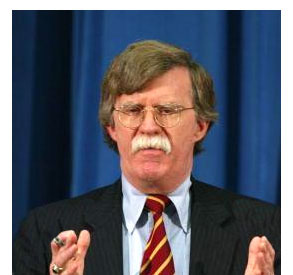
When Jesse Helms, R-N.C., urged his fellow senators in March 2001 to confirm a longtime friend as undersecretary of state for arms control and international security, he gave an endorsement that was, quite literally, out of this world.

“John Bolton,” Helms said, “is the kind of man with whom I would want to stand at Armageddon, or what the Bible describes as the final battle between good and evil.”

Bolton, who passed by a 57-43 vote, plays a much more important role than the flow charts suggest. He’s a hard-line conservative whose intellectual and moral views are simpatico with those of President Bush, Vice President Cheney, Defense Secretary Rumsfeld, and most of the higher-ups in the National Security Council and Defense Department. Well before the accuracy of the president’s rationale for waging a war in Iraq was questioned, Bolton was installed to help forge the administration’s aggressive new foreign policy. His philosophy? To exaggerate slightly, Bolton believes the relationship between America and the rest of the world should resemble that between a hammer and a nail.

His most obvious foil has been the moderate, internationalist man he technically works for: Colin Powell. But Bolton was clearly installed to provide an internal counterweight to the secretary of state, and the administration has long tilted toward Bolton and the conservatives — from shunting numerous international treaties off the table to taking consistently hard lines with Iraq, North Korea, Russia and even much of Europe.

Bolton has maintained a low profile (he declined to speak to Salon for this story) but hasn’t completely avoided public scrutiny. In mid-June, a State Department intelligence official named Christian Westermann accused Bolton of trying to pressure him on intelligence estimates of Cuba’s biological weapons capabilities — coinciding with charges that intelligence data about Iraq had also been cooked.

And on Tuesday, Bolton was caught up in yet another flap about the politicization of intelligence, when the White House was forced to delay his congressional testimony about Syria until September. The administration pulled back Bolton after the CIA and other agencies strenuously objected to its assessment of the threat posed by Syria’s weapons of mass destruction.

But overall, Bolton may well be the most important administration official America has never heard of. Moreover, because of his background and connections, Bolton has played an important role in strengthening the crucial alliance within the Bush administration between the Christian right and the neoconservatives, a process detailed closely in Michael Lind’s new book about Bush, “Made in Texas.”

In a way, the Christian right can be thought of as a body without a brain. It has a power base of millions, but no leader capable of formulating a message that plays well among the non-believers, particularly the mainstream media.

The neoconservatives, however, the defense intellectuals now running the Bush administration’s foreign policy, have always been a brain without a body. They run magazines and think tanks, and they type up policy papers, but they have traditionally lacked both popular support and the ability to get elected to anything.

Bush brilliantly has joined the brain to the body, giving power to the neocons and respectability to the Christian right — even the rabidly growing number of dispensationalists, who believe that Jewish domination of Israel is a necessary precondition for the return of Christ, the battle of Armageddon, and then a 1,000-year reign of Christian peace.

Bolton isn’t close to being the sole link that has created this colossus, though he is an important one. He agrees with the neoconservatives on almost all of the country’s fundamental foreign policy issues. But, coming from a background outside their traditional working groups, he has been able to bring in additional sources of support for the administration. Boltons own religious faith is unclear, but regardless, he has helped Bush win trust from sectors that might otherwise be skeptical of the administration.

For example, while Paul Wolfowitz, Douglas Feith and the other neoconservatives who fill the Bush foreign policy apparatus were serving on committees redrawing maps for the Middle East in the late 1990s, Bolton was serving on the U.S. Commission for International Religious Freedom, an organization working, for example, to prevent the persecution of Christians in countries such as the Sudan.

Further, Bolton has credibility with Republican activists, many of whom are Christian conservatives, because, unlike the neocons, he is willing to enter the political fray. Asked by Salon how his massive enthusiasm for Bolton began, Jesse Helms first cited the now-undersecretary’s role offering legal support in the late 1970s to the senator’s troubled political fundraising committee. More important, when the rest of the neoconservatives were milling around Washington, Bolton served as a lead Republican lawyer in the Florida recount rumble, earning kudos and respect from the rank and file. According to a Newsweek account, after the Supreme Court halted the massive recount, Bolton strode into a library full of officials counting Miami-Dade votes. “I’m with the Bush-Cheney team, and I’m here to stop the vote,” he declared.

John Robert Bolton II was born in Baltimore and studied at Yale, graduating in 1970, a year in which the campus news was dominated by Black Panthers and draft dodgers. Bolton neither took to the streets with his protesting classmates nor traveled in the same partying circles as his campus contemporaries George W. Bush and Howard Dean. Bolton seems instead to have lived the life of a classic conservative political nerd. His senior yearbook notes that he served in the conservative party of the political union, as editor in chief of the Yale Conservative, as a four-year member of the Yale Young Republicans, as “floor leader of the right,” and as executive emeritus of the campus conservative party.

After college, Bolton earned a law degree at Yale and moved in and out of the private sector, helping at one point on the campaign of a Texas attorney general candidate named James Baker. With the help of Baker, a future secretary of state, Bolton moved into the big time when he joined the Reagan administration in 1981. By the beginning of the president’s second term, Bolton was an assistant attorney general.

His first forays onto the national stage were appropriate for someone with his hard-edge conservative background. The New York Times first mentioned Bolton when he was conducting a review for the Justice Department about whether any senior Reagan officials played a role in supplying arms to Nicaraguan rebels. He next popped up in the Times while serving as the Justice Department’s point person in the contentious and partisan Senate battle over the Supreme Court nomination of Robert Bork. He joined the State Department in the first Bush administration and has worked in international politics ever since, first in the administration and then with conservative think tanks, his most prominent position that of vice president of the American Enterprise Institute.

During that time, and during his early tenure in the second Bush administration, Bolton’s first priority appears to have been to roll back public international law so it isn’t used against us by other nations as they battle for power in a dark, Hobbesian world. At its most extreme, this view has led him to say that “if the U.N. Secretary Building in New York lost 10 stories, it wouldn’t make a bit of difference,” and to support former Chilean President Augusto Pinochet against the international courts that hope to bring him to trial on charges of gross human rights violations.

More generally, four years ago, Bolton said: “It is a big mistake for us to grant any validity to international law even when it may seem in our short-term interest to do so — because, over the long term, the goal of those who think that international law really means anything are those who want to constrict the United States.”

Mark Falcoff, a scholar at the American Enterprise Institute, charitably sums up his former colleague’s worldview as follows, “He rejects completely the notion that foreign policies are good to the extent that the Belgians like them.”

Bolton is surely “an ideologue’s ideologue,” as his frequent sparring partner Joseph Cirincione, at the mainstream Carnegie Foundation, describes him. But it’s also not quite that simple.

For one, unlike most ideologues, particularly hard-charging ones on the right, Bolton gains power from his pleasant demeanor, much as Jesse Helms does. During the Florida recount, Bolton was a confident and calm professional. Ron Asmus, a Clinton deputy assistant secretary of state, calls Bolton “friendly, charming and interesting” even while pointing out that Bolton often advocates positions that make Asmus’ jaw drop.

He is also extremely smart — another trait conspicuously absent in many ideologues. At Bolton’s confirmation hearings, Sen. Joe Biden, D-Del., said, while criticizing the nominee: “This is not about your competence. My problem with you over the years has been you have been too competent. I mean, I would rather you be stupid and not very effective.”

But he has been effective, and his star has risen very quickly . One conservative fantasy has him becoming National Security Advisor in a second Bush administration, after Condoleezza Rice takes over the State Department, and Colin Powell moves back to his farm.

But his competence has ultimately allowed Bolton to do much harm, scuttling the international agreements and treaties that make up much of the legal basis for international order and security. With Bolton’s tireless leadership and assistance, the Bush administration has undermined the International Criminal Court, the Antiballistic Missile Treaty, the Biological Weapons Convention, and a potential international treaty on small arms trafficking — while also opposing the Comprehensive Test Ban Treaty.

In the process, and in the rush to wage a unilateral and preemptive war in Iraq, Bolton and his administration allies have burned most of the international goodwill that the United States built up before and after Sept. 11. The enemy of a vast and growing percentage of the world, the United States remains virtually alone in Iraq; reports of American soldiers killed in ambushes are now as routine in the news as reports on the stock market. It doesn’t help that the administration lied about some of the intelligence that served as a prime justification for the war.

Or that Bolton seems interested in possibly taking the war a step further. Soon after Baghdad fell, Bolton said, in his usual, measured way, “We are hoping that the elimination of the dictatorial regime of Saddam Hussein and the elimination of all of Iraq’s weapons of mass destruction would be important lessons to other countries in the region, particularly Syria, Libya and Iran, that the cost of their pursuit of weapons of mass destruction is potentially quite high.” Bolton’s specialty seems to have been the ability to build small bridges that enable him and his allies to destroy big ones. While personally agreeable, he has helped created the policies that have made much of the rest of the world see the United States as an international bully. By forging ties between the hawks in the Defense Department and the White House with the State Department, Bolton has helped to undercut the main government entity supportive of international engagement. By helping to build a relationship between Republican foot soldiers and the neocons, Bolton has helped sever ties between the United States and the rest of the world.

In a less dramatic way, Bolton’s success parallels that which Helms sees at the battle of Armageddon: the forces of good trampling the forces of evil as the seven angels blow their seven trumpets and everything else gets razed. The trouble is that, despite his pleasant demeanor and level-headedness, Bolton’s definition of evil seems rather large — encompassing not just the standard axis but also, for example, the International Criminal Court’s efforts to track down war criminals or genocidaires.

There’s a chance that Bolton’s worldview will ultimately turn out to have been a successful one: Taking a hard line may bring peace and security to the Korean peninsula and the Middle East, along with a long-term world order where America remains so strong and safe that it has no need for international law.

Unfortunately, power has a tendency to ebb and flow. Moreover, despite the removal of the Taliban and Saddam Hussein’s vicious regime, it’s hard to see the world as a better place than it was when Bolton and his colleagues began their project.

The exterminator

Tom DeLay -- a former pest killer who has turned his ire on Democrats -- has helped build a huge Republican money juggernaut. But did his engineering of a Texas GOP landslide break the law?

In May 2002, Westar Energy sent a $25,000 check to Texans for a Republican Majority, an organization set up to propel Republicans into the Texas state government. What did the Kansas-based Westar care about Texas Republicans? Probably not much. But it did want to curry favor with the political group’s founder, Rep. Tom DeLay, R-Texas, the House majority leader.

DeLay’s “agreement is necessary,” one Westar executive helpfully explained in a memo, according to documents released by the company’s board, “before the House conferees can push the language we have in place in the House bill.”

DeLay took Westar’s money, invited its top brass to a golf gala shortly thereafter, and supported Westar’s language for a lucrative special exemption in the House energy bill. That exemption was ultimately dropped when those in Congress learned of a federal fraud investigation into the company. The bad news for Westar still meant money in the bank for DeLay, and he used the donation, along with many others to Texans for a Republican Majority, to construct the GOP juggernaut that commandeered Texas’ elections. Juiced by DeLay’s cash — Texans for a Republican Majority spent about $1.5 million in the 2002 elections — and organizational prowess, Texas Republicans smothered the opposition. Eighteen out of the 22 Texas House candidates supported by the PAC were victorious, contributing heavily to the GOP’s comfortable 88-62 majority in Austin. Once in power, the Texas GOP — at DeLay’s urging — swiftly got to work trying to gerrymander congressional districts in the Republicans’ favor, even though the districts had just been redrawn two years earlier, based on the most recent census. As that spectacle stands now, 11 Democratic legislators are sequestered in a New Mexico hotel, preventing a quorum on a vote they would surely lose, as the Democratic Party sues to prevent the redistricting, calling it a violation of the U.S. Voting Rights Act.

Politically, it was a stunning success for Tom DeLay, perhaps best known as Congress’ most aggressive and outspoken conservative, who steamrolls over anyone who stands in the way of his agenda. What is less well known is that DeLay is also a master of the sometimes dark art of political fundraising. His skill at raising money has helped the GOP maintain its dominance in Congress and has made him perhaps the most feared Texas politician since Lyndon Johnson. But in the 2002 Texas coup, he left behind a muddy trail: A close scrutiny of the money he funneled into the state suggests DeLay may have violated several state laws along the way.

Texas law strictly prohibits campaigns from using corporate donations, and clearly much of Texans for a Republican Majority’s money, such as Westar’s $25,000, came from corporate sources. Jim Ellis, the group’s former director, defends using the corporate money by saying the state rules apply only to organizations directly controlled by labor unions or corporations (a highly disputed reading that, if true, would nullify the point of the law) and that every other similar group in Texas does the same thing — an “everybody does it” excuse that sounds suspiciously like an admission of guilt. Most important, Ellis notes that the organization is split into two groups, a political action committee and a special tax-exempt political group designated a “527″ by the IRS. The two organizations are separate, according to Ellis, because the 527 raised corporate money and the PAC raised money only from individuals and distributed that to candidates.

But according to IRS filings, the 527 clearly used its corporate money to organize polls and pay for political consultants, and even Ellis admits that the PAC used those services. Ellis claims this work was merely an allowed “administrative” cost — an expansive reading, given that the Texas Ethics Commission defines “administrative” as “expenses that would be incurred in the normal course of business by any active organization.” Karen Lundquist, executive director of the Texas Ethics Commission, says, “Consulting for the purpose of setting a political strategy is not administrative.” More bluntly, Fred Lewis of the nonpartisan Texas watchdog group Campaigns for People, says, “They are saying a cat is a dog.”

Just as interesting: On Sept. 20, 2002, the 527 arm of Texans for a Republican Majority sent a check for $190,000 to the Republican National Committee’s state arm (RNSEC). That was legal. But exactly two weeks later, on Oct. 4, the RNSEC sent out precisely $190,000 divvied up among seven candidates supported by Texans for Republican Majority, and all received money from it or DeLay’s national PAC, Americans for a Republican Majority, at different points, according to filings with the Texas Ethics Commission. This raises the question of whether TRM, which couldn’t give the money directly to candidates, simply passed the money to the RNSEC. That would certainly be circumventing the law, if not breaking it.

“It comes down to a question of proof,” says Larry Noble, executive director of the Center for Responsive Politics, noting that the legality of such a transaction depends on whether TRM and the RNC had an explicit or even implicit agreement about how the money would be distributed. Noble adds that such a transaction could well be “a way to launder the money and evade the contribution limits.” Ellis denies any connection between the funds. “We gave $190,000 to the RNC. End of story,” he says. “I think the RNC, with their full staff of lawyers, is well equipped to comply with the laws.”

In the middle of this mess sat Tom DeLay, who simply expressed disbelief that anyone would question his actions. “It never ceases to amaze me that people are so cynical they want to tie money to issues, money to bills, money to amendments,” he declared at a press conference in late June.

DeLay has faced similar problems in Washington. There, a large part of DeLay’s method of gaining power was challenged in 2002 by the passage of the McCain-Feingold bill, which banned legislators from raising, using or controlling the unlimited political contributions to political parties or affiliated organizations, commonly known as soft money. Candidates may still accept donations of up to $2,000 from individuals or corporations, but they can no longer snag the $25,000 or $100,000 checks that companies such as Westar used to pony up for soft-money organizations, which the candidates could apply toward indirect campaign expenditures.

DeLay, it seems, may be getting around that ban through an organization called Americans for a Republican Majority (ARM). According to McCain-Feingold, the soft-money wing of that organization is supposed to be completely separate from DeLay. But the congressman and founder, though he has technically spun it off, has maintained extremely close ties even in the months since the new law came into effect. According to documents filed last month with the IRS that cover the first six months of 2003, ARM employs and supports a number of close DeLay allies. It is headquartered at Williams and Jensen, a lobbying firm that signed DeLay’s then chief of staff, Susan Hirschmann, as a partner two months before McCain-Feingold went into effect. ARM has also employed the Alexander Strategy Group this year. That organization was founded in 1997 by a former DeLay chief of staff, Ed Buckham, while he was still working for DeLay. According to DeLay’s 2002 financial disclosure forms, the Alexander Strategy Group also employed DeLay’s wife, Christine, though DeLay spokesman Stuart Roy says that was mainly as a bookkeeping favor for an affiliated organization, which now covers her complete salary.

According to Federal Election Commission spokesman Bob Biersack, it’s not clear how many close ties a congressman can have to an organization he’s supposed to have split from. “There’s no absolute bright line,” he says. But a look at FEC rules shows that DeLay’s relationship to ARM might exceed the coziness that the law allows. According to FEC rules, “candidates, officeholders, and their agents or organizations established, financed, maintained, or controlled by the candidate can’t raise soft money.” To determine whether someone fits the above criteria, the FEC provides a 10-point list that includes “whether the sponsor has any members, officers, or employees, who were members, officers, or employees of the entity that indicates a formal or ongoing relationship.”

Tom DeLay’s relationship with the Alexander Strategy Group and other people and organizations on the ARM payroll seems clearly formal and ongoing, even if his wife is off the payroll. The Center for Responsive Politics’ Larry Noble, a former FEC general counsel, says that whether relationships such as DeLay’s with ARM are allowed to stand “is a battle ongoing right now within the FEC.” “The game that they are playing is they say that these people no longer work for DeLay and that they have no common membership,” says Noble. “The reality is that they are setting these groups up with people who have long experience and who can definitely parallel what the office holder is doing, and who other people know are connected to the office holder.” Again, DeLay may not face any consequences. According to Craig Holman of the watchdog group Public Citizen, “I believe DeLay is violating the rules. But I also believe the FEC has no backbone.” Both Democrats and Republicans have stacked that organization with people who are hostile to campaign-finance reform. Moreover, as Rep. Barney Frank, D-Mass., points out, people think that all politicians break the rules when it comes to money. Thus, the Democrats might be seen as saying DeLay should be reprimanded because he does it worse. “It’s hard to make the quantitative argument ‘This man is twice as bad as me so he should go to jail,’” Frank says.

The influence of money and politics can make even DeLay’s charitable intentions appear unseemly, however. Last April, the majority leader held a golf tournament in Key Largo, Fla., to benefit his foundation for foster children, the DeLay Foundation for Kids. The tournament offered bigwigs the chance to amble around the links with powerful Republican congressmen such as Roy Blunt, DeLay’s chief whip and sidekick. Mimicking a standard political fundraiser, the foundation solicited funds from a motley collection of supporters: one “platinum”-level donor giving $100,000; 25 “crystal” donors giving $10,000.

The tournament sold out. And why shouldn’t it? Corporations got to give money to DeLay without disclosing it, while receiving both face time with congressmen and tax deductions to boot. To make attracting star power easier, DeLay successfully worked just before the tournament to overturn Congress’ rules preventing charities from paying for representatives’ travel.

Past brochures offered sponsors the opportunity to display their logos at the course’s most prominent holes, and donors included corporations such as AT&T, which gave $25,000 in 2001 and 2002 — about the same amount of money it gave to both Americans for a Republican Majority and Texans for a Republican Majority. According to currently filed tax returns available through GuideStar, no other nonprofit foundations have given to the DeLay Foundation for Kids.

But this isn’t a normal foster-child foundation and the event wasn’t organized like a normal bake sale. The firm handling the fundraising, the DCI group, was simultaneously representing the Burmese junta in its efforts to rebut reports that its army used rape as an instrument of governance in areas controlled by ethnic minorities. That’s not to say DeLay does not care deeply about foster children, and he will no doubt spend the raised money on their behalf. He and his wife have taken in three foster children in years past and even his political opponents credit him for his sustained passion on the issue. But it’s just a typical example of how DeLay’s life seems dominated by the close relationships to the businesses that keeps him politically so unstoppable.

- – - – - – - – - – - -
As a young adult coming of age in Texas, DeLay’s life roughly parallels that of the president he now serves. Kicked out of Baylor University for partying too much, he graduated from the University of Houston in 1970. Along the way, he drew a low number in the Vietnam draft lottery, skipped the war, and then started a pest-control company. He was elected to the Texas State Legislature in 1978 and to Congress to represent his Houston suburb in 1984. Soon after arriving in Washington, he entered a period where, he told the Washington Post in 2001, he drank “8, 10, 12 martinis a night,” before finding a deeper Christianity. According to that same Post profile, he cut off all contact with his two brothers, sister and mother, an issue his press secretary refused to discuss. Mostly, since climbing on the wagon, DeLay has fixated on winning power for conservative Republicans.

As he’s gained experience, DeLay has simply become more effective, making him every Republican’s best friend, worst enemy, and financial lifeline. He is particularly adept on Capitol Hill at a technique called “catch and release.” If a crucial vote comes up where moderate Republicans find themselves opposing the conservative GOP leadership, DeLay and his golfing partner Blunt corral them in the back of the House chambers. If it becomes clear that DeLay’s side will win anyway, the moderates are released to vote their or their constituents’ conscience. If the vote appears headed against DeLay, he twists the moderates’ arms into voting with him.

DeLay can play this game because he knows the moderates fear him. In 1995, Republicans abolished the old system conferring committee chairs based on seniority. Instead, the leadership started deciding who got to serve as chairs. This is why moderate Rep. Christopher Shays, R-Conn., who generally supports DeLay, was blocked from becoming chair of the Government Reform Committee, a move even he says he knew would be a consequence of his support for campaign-finance reform. Rep. Marge Roukema, R-N.J., simply left Congress after DeLay boxed her out of several positions. In several primaries, DeLay has also worked against several moderate Republicans in favor of less electable conservatives, showing that the Texan would sometimes rather lose with a conservative than win with a moderate. DeLay has yet to support a challenger to a moderate incumbent, but before last November’s elections, DeLay gave money to the Club for Growth, a powerful Republican group that spent most of the winter attacking Republican moderates who didn’t support Bush’s full tax cut.

He’s capable of much deeper grudges. According to a story broken by Roll Call, the representative once diverted $70,000 into a Texas sheriff’s race and commissioned push polls against one of the candidates apparently because the candidate made the mistake of hiring the wife of a man whose business partnership with DeLay had soured and wound up in court.

DeLay is also loyal — not just to politicians who vote with him, but to his staffers, many of whom work for him for a few years and then move into lucrative lobbying jobs. When the Hill listed the city’s top lobbyists, four were former DeLay employees. No other member of the House was credited with having more than one alumnus. Three of these alums are connected with ARM and the fourth, Drew Maloney, hasn’t really left the family. Five of his clients at the Federalist Group gave at least $30,000 to DeLay’s different fundraising organizations between January 2000 and December 2002. One of them, Reliant Energy, gave $75,000 to DeLay and, according to Roll Call, its Washington office last year hosted the baby shower of DeLay’s daughter, Danielle Ferro, who has done heavy fundraising for Texans for a Republican Majority. Roy says, “It’s always useful to have people both on the political side and lobbying who still consider themselves part of the organization and looking out for DeLay’s best interest.”

All that has helped DeLay obtain astonishing results, firming up conservative control of all levers in the House and getting moderates to back him when it counts. Consequently, he routinely wins by tiny margins on votes he’s expected to lose. In June, he won a crucial vote on Medicare by one vote. Then in late July, DeLay ripped a homer to deep right field by winning a vote on Head Start — kicking some funding responsibility for that early-education program back to state governments — by a margin of 217-216. Rep. Dick Gephardt, D-Mo., missed the vote while traveling. The one-vote margin gave rise to a mini backlash against one presidential candidate who would surely have opposed the bill. DeLay had outfoxed the Democrats again

The extreme positions DeLay stakes out, and his propensity for outlandish rhetoric, make it easy to portray him as an ideological fruitcake. He has, after all, blamed the teaching of evolution for the massacres at Columbine high school, compared the Environmental Protection Agency to the Gestapo, and once allowed a petrochemical lobbyist named Gordon Gooch to actually write legislation. Speaking of liberals on the House floor earlier this year, DeLay said, “Their malignant hold over the intellectual life of this country must be exorcised, and men and women who are willing to speak the truth offer our only hope of reclaiming our culture from the grip of a hedonistic, reckless and destructive descent into nihilism.”

DeLay’s extremism has made some Democrats hopeful that DeLay might eventually instigate a split in the Republican Party, perhaps pushing a few Jim Jeffordsesque moderates into the Democratic fold or creating a general backlash against the party and President Bush. That hasn’t happened yet, and DeLay has only occasionally sparred with the White House. He quashed Bush’s request to distribute his gigantic tax cuts slightly more evenly, declaring that “ain’t gonna happen” when Bush asked that Congress change the tax bill to include a bigger credit to low-income families. He also took a trip to Israel in July and delivered an extraordinarily inflammatory speech the day after Bush met with Ariel Sharon. Addressing Israel’s parliament, DeLay declared his opposition to a Palestinian state and said, “You’ve got to change a generation before you can have a peaceful state that can live side by side with Israel.”

Still, Bush and DeLay have yet to really clash, and neither has given hints that they will. In fact, if DeLay has done anything to Bush, it has been to make the president appear more moderate than he really is, a potentially calculated service as Bush tries to tack back to the center in time for the 2004 elections.

Some liberals also hold out hope that DeLay will fracture the Republicans’ Christian base with his often-unbecoming fundraising, particularly from quarters that religious conservatives scorn. DeLay and his close confidantes, for example, have raised lots of money from gambling interests — a lobby at odds with the religious right. But still, his fundraising seems to have caused few rifts. “I appreciate the difficulty of good people in difficult positions,” says Tom Minnery, vice president of public policy of Focus on the Family. Says Phyllis Schlafly, president of the Eagle Forum, “His job is to get conservative bills through the legislature, and he is very good at what he does.”

The Democrats’ other, perhaps wistful, hope is that DeLay will ultimately step on one of his own land mines, like the Republican House leader he once served under, Newt Gingrich. The two do share a propensity for saying the outlandish. But Gingrich seemed much more self-serving: worrying as much about getting airtime as managing his revolution, managing an affair with a Hill staffer (now his wife) during the Clinton impeachment mess, and trying to cash in on his power with a book deal. DeLay seems simply concerned about accumulating as much power as possible for himself and the conservative wing of his party, and he’s done a much better job than Gingrich at making sure that his bills become law. “The ethical attacks on DeLay have been about money that he has raised for his cause,” says Barney Frank, the Massachusetts representative. “Gingrich’s ethical problems had to do with the enrichment of Gingrich.”

“Gingrich swung for the bleachers every time,” says Grover Norquist, president of Americans for Tax Reform. Most famously, in 1996, Gingrich grumbled to reporters that Clinton ignored him on Air Force One during flights to and from Israel for the funeral of Prime Minister Yitzhak Rabin, even forcing him to exit the plane from the back. Gingrich went so far as to suggest that Clinton’s rudeness kept House Republicans from compromising on a budget resolution — which caused a government shutdown and idled 800,000 workers. “Cry baby!” cried the front page of the New York Daily News, complete with an illustration of Gingrich in diapers. It was a P.R. disaster. A similar snafu from DeLay seems far more unlikely. Instead of pouting to the press about exiting Air Force One from the rear, DeLay probably would have just quietly removed the plane’s engine.

Continue Reading Close

The Dean machine rolls through the Big Apple

His supporters are all young and white, but in Bryant Park Tuesday the former governor's campaign felt like the real thing.

Howard Dean’s bash in Bryant Park last night makes an easy target. The New York City park was packed, but seemingly everyone there was white, under 30 and dressed for a Burlington, Vt., block party. A man selling tie-dyed shirts did brisk business, and the crowd of about 10,000 seemed oddly disconnected from the incredible mix of people and cultures walking New York’s streets right nearby, many of whom must have wondered what was going on. Save for the ubiquitous blue signs, “Howard Dean for America,” it would have been hard to know that Bryant Park was hosting a presidential candidate last night and not a Hootie and the Blowfish concert.

But even bearing that in mind, it was hard to leave the speech last night without thinking: Wow, this guy can actually win.

People may have initially been drawn to the doctor and former Vermont governor because he opposed a war that few other powerful people did. But Dean’s antiwar stance offers little reason to support him now. Every candidate now criticizes Bush on the war, in particular eviscerating him for the way we got into it. Moreover, Dean is by no means a peace candidate. He methodically explained that he supported the first Gulf War and the obliteration of the Taliban. If elected president, he’d support more wars. Dean even told the audience that it could decide if he was a liberal or not (thus hinting that he’ll soon say he isn’t) and he dropped his trademark crowd-pleasing line, “I’m here to represent the Democratic wing of the Democratic Party.”

The reason 10,000 people gathered in Bryant Park — and it’s hard to imagine a tenth of that many gathering for any of the four candidates now serving in the Senate — is because Dean looks and acts like a normal human being who just happens to be smart, well-informed and passionate about changing the political system. His establishment opponents, like Joe Lieberman and Dick Gephardt, often seem programmed or pulseless. His left-wing opposition, Dennis Kucinich, seems to have a heart rate of about 350 beats per minute.

Dean spoke cogently and confidently without notes. He only pandered a bit, and demagogued only a bit more. He ran on issues, not just a biography of having served in Vietnam or grown up the son of a mill worker. He drew big applause whenever he criticized Bush, but stayed well within the lines of political decorum and the ground rules he announced early on when he said, “We’re going to have some fun tonight at the president’s expense.” More important, he added that the speech would be about what he was for: vastly expanded healthcare coverage, affirmative action, environmental protection, broadband access for rural communities, restoring the world’s respect for America, and more.

Dean even took a shot at describing how he’s going to win the South — pointing out that Southern states have been electing Republicans for decades and then asking, “Tell me what you have to show for it?” That doesn’t sound like a sure winner, but it’s not bad. Previously, Dean has told a tale about a Southern World War II survivor who thanked him for Vermont’s law allowing civil unions. That odd story was perhaps intended to show that one shouldn’t put all Southerners in the same box, but it came across sounding like Dean intended to win South Carolina on the gay vet vote.

Dean is going to have to expand his core supporters, and he probably would have traded the crowd inside of Bryant Park for the one just outside of it: a collage of feisty New Yorkers walking the streets along with a smattering of businessmen peering down into the park from their midtown office windows. Dean is clearly aware of the problem: Last night, he said “When white people and brown people and black people vote together in this country, that’s when we make social progress.” But the former governor is hauling in money faster than a casino — his campaign announced it expects to raise a staggering $10.3 million in the three-month period ending Sept. 30 — is launching TV ads in six new states and has shown few signs of stumbling. There will no doubt be many more rallies, in many more parks, coming soon.

Continue Reading Close

Bush’s lies vs. Clinton’s lies

Lying about war is more serious than lying about sex -- which is why the president's free ride is coming to an end.

Conservative Republicans like to compare George W. Bush to Ronald Reagan, characterizing him as a masculine Everyman, traditionally conservative and regularly underestimated because of his low-key manner. Liberals like to compare him with his father, who seemed Reagan’s tightly wound, Ivy League, career-climbing opposite — and a one-term president to boot.

Now a different former president is the dominant comparison: Bill Clinton. And that bodes very poorly for our commander in chief.

In the past week, as the White House first reeled from plummeting polls and the Iraq intelligence flap, and then beamed at footage of Uday and Qusay’s demise at the Mosul corral, references to Clinton have come both from those taking aim at the president and those buffering his image.

For opponents, Bush’s notorious 16 words in his State of the Union address erroneously talking up the Iraqi nuclear threat make up a far more important prevarication than Clinton’s 11 (“I did not have sexual relations with that woman, Ms. Lewinsky.”) Moreover, the White House’s fine parsing of the phrase matches Clinton’s floundering over the definitions of “is” and “sexual relations.” Consequently, critics argue, the political price that Bush pays for his lie should more or less match what Clinton paid. The stakes, after all, have been wildly disproportionate.

For Bush supporters, Clinton serves as a useful foil. As Republican House Speaker Dennis Hastert, conservative blogger Andrew Sullivan, and others have recently noted, Clinton bombed Iraq and a pharmaceutical factory in the Sudan based on similarly shaky intelligence. Clinton exaggerated Saddam’s weapons capabilities, too.

Furthermore, Republicans are starting to point out that Democrats could face a blowback they’re all too familiar with. If the Democrats kick Bush’s shins over Iraq too long, the public will eventually turn on them, just as it turned on the Republicans during Clinton’s impeachment mess. The Democratic base wants a battle, but most moderates are just happy Saddam Hussein is gone.

“If Democrats are talking about uranium, and Republicans are talking about religious freedom and liberty, that’s a pretty good trade,” says Dan Schnur, a Republican consultant who points out that the Democrats are in danger of falling into the same trap his party did with Lewinsky. The longer the Democrats criticize Bush on the issue, Schnur says, the harder it will be for them to ever change the subject.

There are, of course, differences. Clinton’s lie was meant to cover up a personal scandal; Bush’s partisans can charitably interpret his lie as merely the result of a chain of people in the White House each adding too much rum to the eggnog. Clinton’s lie was completely a personal failure; Bush’s was a failure of the complete administration.

But the similarities are greater and more important. For one, both lies have stuck because of their backdrops. If the United States weren’t losing a soldier a day and pouring a billion dollars a week into a zone of increasing chaos, no one would remember to question Bush’s months-old prevarications. If Clinton hadn’t been facing persistent accusations about his womanizing, no one might have known about his trysts with the intern. The Niger fib fit into a pattern of deception about intelligence and Saddam’s weapons capacity, just as Clinton’s Lewinsky dalliance fit into a pattern of questions about his personal affairs.

The fundamental similarity is that both liars were called on the carpet. And for Bush, that will likely mean an end to what has been an impressive free ride.

In his first two years, Bush lied and exaggerated repeatedly. He lied about the number of stem cell lines available, the benefits for poor people of his tax cuts, his commitment to carbon dioxide emissions reductions, the cost of the war, and much more. Until now, Bush has escaped basically scot-free from each fib.

He successfully tagged Al Gore as a liar during the presidential campaign and maintained a pure image ever since. According to Clinton’s press secretary, Mike McCurry: “The press had high expectations of Clinton, which he did not succeed in meeting, and they had low expectations of Bush, which he surpassed. Plus, they like him more as a guy.”

The last two weeks could irrevocably tarnish Bush and his administration. Even if vindicated, his prevarications will become part of the basic narrative about Bush that reporters and the public pull up. As with Clinton, every action will be scrutinized for cynicism, every statement scrutinized for a shading of the truth.

Just last week, Undersecretary of State John Bolton pulled out of congressional testimony over Syria that seemed likely to result in more exaggerations and then more backtracking. This week, the president has come under fire for pledging his support during the State of the Union to AmeriCorps and then remaining quiet as House Republicans took their knives to it. Bush would have cruised through the AmeriCorps contradiction with a slight stutter-step a few months ago. But with questions of the president’s integrity on the front pages, he’s going to have to answer for his earlier claims.

Even worse for Bush, now that his job-approval ratings are sinking, the Democratic candidates suddenly seem a lot more serious and deserving of respectful coverage and attention. They aren’t just running for the honor of keeling over before the crafty and well-funded Karl Rove. They are actually running for president.

Two polls help illustrate Bush’s predicament. The first measures Bush’s overall favorability ratings. They started out very high and then fell slowly but steadily during the first eight months after Bush’s inaugural. After Sept. 11, they shot up. Gradually, they started drooping before bouncing back up when we invaded Iraq. Now they are drooping again and will probably only perk up slightly with Bush putting Uday’s scalp on the wall.

The second interesting piece of polling data comes from Americans asked whether they would vote for Bush or a generic Democratic candidate in 2004. Bush’s consistently unimpressive numbers on this measure have always lagged behind his general approval figures. The explanation, says pollster Jeremy Rosner, of Greenberg Quinlan Rosner Research, is that approval ratings look at how good a job one did in the past — not who should lead in the future. As of today, Bush is basically tied with a generic Democratic candidate.

In other words, when the country is not at war or under attack, this president is not a very popular guy. Worse, much of his popularity stems from what he did in the past, not on whether people think he’ll do a good job leading in the future.

The criticism of Bush had slowly died down by the beginning of this week, even when Stephen Hadley, the deputy national security advisor, admitted on Tuesday that he had learned of the CIA’s concerns over uranium back in the fall. Moreover, the Democrats don’t control either house of Congress and thus can’t stage congressional investigations, eliminating what was the Republicans’ favorite method of going after Clinton.

But to stabilize his popularity and ultimately win the coming election, Bush still needs something that he can talk about or do. His popularity goes up during combat, but starting another war — with, say, previous candidates like Syria or Iran — seems highly unlikely unless hard and fast evidence emerges that either poses an imminent threat. Moreover, Bush’s checks bounce when he moves to the economy, since jobs are down and the deficit is soaring, in no small part because of the administration’s tax cuts. Furthermore, on almost all domestic issues, now including taxes, the public trusts Democrats more to do the right thing than it trusts Republicans.

Bush is similarly stymied at attacking his opposition. His first option is to paint all Democrats as antiwar in Iraq and implicitly in support of a maniac whose brutality becomes clearer with each mass grave found. This strategy will have particular currency if the situation in Baghdad improves, the bloodletting stops, and troops stop telling reporters that they want to go home. Many Democrats agree that Bush can get traction here. “Most Americans aren’t lawyers or arms inspectors, but they do know an enemy when they see one,” says Will Marshall, president of the Progressive Policy Institute, a centrist Democratic group.

The problem for Bush is that almost all of the top-tier presidential candidates were pro-war. The big difference between their position and the White House’s was that the Democrats wanted to act multilaterally and with the support of the United Nations. That position looks eminently reasonable now, with Americans making up nearly all of the coalition forces patrolling Iraq and with the realization that Saddam almost certainly did not pose an imminent threat to this country.

This is a clear distinction. If Bush is held to a high sincerity standard, he and his allies will gain little ground by trying to obfuscate it, particularly if the Democrats can refrain from appearing to enjoy themselves at the nation’s expense — a mistake the Republican impeachment leaders made — and rooting for further bedlam in Baghdad. The jury’s still out on whether Bush’s position was wiser than Howard Dean’s total opposition to war. But it’s increasingly hard to argue that Bush’s March position — shoot immediately and do it alone — was wiser than most of the other Democrats’.

Bush could also try to tie everything he does to his shining moment combating al-Qaida. This is already a clear Republican strategy, as they make plans for their 2004 convention in New York City as close to the three-year anniversary of the attacks as possible. It’s also clearly on their talking points. This Sunday on “Meet the Press,” Tim Russert asked House Speaker Dennis Hastert, “How troubled are you by the situation in Iraq?”

Hastert responded: “Well, Tim, I think you have to look at the big picture. You know, when 9/11 happened, almost two years ago now, we saw two planes go into the World Trade Tower, we saw a plane go in the Pentagon. I was looking out my window in the Capitol and saw this smoke go across the Mall.”

Hastert went on for a while until Russert cut him off by bluntly asking whether Saddam was connected to Sept. 11.

As reporters know, and Hastert conceded, al-Qaida and Saddam aren’t linked in more than superficial ways. Plus, when it comes to actually combating the threats of al-Qaida, Democrats have more strongly supported homeland security funding than Bush. Again, Bush’s principal chance to make the charge stick of Democratic softness here is to fudge the truth or at least walk in circles around it. A plausible strategy last winter, it’s unlikely to work in the post-yellowcake era.

“George Bush is a nice man who loves his family and goes to church every week, but that isn’t the main issue anymore,” says Democratic strategist Anita Dunn.

Like Clinton, Bush will mainly gain points now by governing well. And that, to date, is one area where the president has generally come up short.

Continue Reading Close