
Music

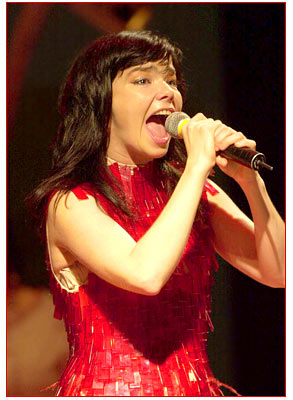
All hail the ice queen

As Bjork releases an extraordinary career retrospective, it's time to crown her as the most important pop musician of her generation.

  • more
    • All Share Services

All hail the ice queen

In 1993, the former lead singer of the Sugarcubes, a popular alternative rock band from Iceland, released an album called “Debut.” So began the most extraordinary musical trajectory of the decade. Ten years later that singer, Björk, is the queen of contemporary music. She has released four solo albums, each one expanding the bounds of what seems possible in popular music. In my experience, no other active musician inspires as much respect in other musicians. A forthcoming documentary titled “Inside Björk” features testimonials from artists as diverse as Thom Yorke, Missy Elliott, Elton John and religious composer John Taverner.

But for all that, Björk remains curiously isolated, her music more loved than influential. Radiohead, probably her closest rival in the intersection of popularity and critical acclaim that makes up at least one definition of greatness, has spawned countless baby Radioheads. Björk has no copycats, no one feeding so obviously off her achievements, because those achievements are so alien. Radiohead is very much of our time, the musical zeitgeist for the millennium, but Björk and her music come from a different time and place. There are two options in placing Björk: Either she is an anomaly, brilliant but finally irrelevant, or she is the most important and forward-looking musician of her generation. In either case, we will need to wait 50 years to really make sense of what she has done, and absorb her influence in any useful way.

Over the course of the summer, One Little Indian Records has been releasing a series of eight Björk-related DVDs, ranging from live concerts to music video collections to documentaries, along with a box set of four live-concert CDs, with each disc corresponding to one of her studio albums (that is, containing the same songs in the same order). This glut of new material comes only half a year after Elektra released the “Family Tree” box set, an idiosyncratically curated career retrospective on one full-length and five 3-inch CDs.

Retrospective projects of this size are normally reserved for dead jazz musicians or canonical classical composers. For a 36-year-old pop star with a mere four solo albums to her name to get this kind of treatment is unprecedented. Even more extraordinary, no one is likely to complain about it: If any other active pop musician (excepting, perhaps, living legends like Bob Dylan or Neil Young, with decades of strong material behind them) were to attempt a similarly grandiose project, it would be taken as an act of unforgivable hubris.

The world of alternative popular culture is none too tolerant of success, as Wilco, the Strokes and even Radiohead have recently discovered, with waves of faddish discontent emanating from Manhattan, leaving no hipster unaffected. But Björk has enjoyed 10 years of uncommonly smooth sailing with nary a backlash in sight. Since striking out on her own in 1993, she has managed to retain complete indie credibility and alterna-cool while still selling millions of records. This is an extraordinary achievement in a world where the two are seen as incompatible. The modern-day parable of Kurt Cobain’s life is the ultimate cautionary tale: The strain between art and commerce was too much for him. Not only does Björk seem unlikely to kill herself, she projects an air of almost enchanted contentment.

One reason that Björk has so successfully escaped criticism is that she escapes the confines of genre. Bands are too often criticized not for their own shortcomings, but for the shortcomings of whatever genre or movement they are perceived to represent. If you’re fed up with the New York rock revival, take it out on the Strokes; if you think that grunge lost its authenticity, go after Pearl Jam. Björk’s music refuses to fit snugly into any genre. Some tracks on her first album, “Debut,” could be called club and some from her second album, “Post,” come close to trip-hop. Otherwise her music exists in more or less uncharted territory. There are, of course, other musicians of whom this is true, but few have had success at all comparable to Björk’s. What is more unusual is that her music can’t effectively be described as a mixture of genres. The work of even the most iconoclastic musicians can usually be approximated with a kind of a + b + c = x (Tom Waits = Tin Pan Alley + Kurt Weill + carnival). No such equation is remotely convincing when it comes to describing Björk’s music.

What kind of music is she making, then? There are a number of possible answers. None of them is entirely satisfying, but each is at least partially illuminating. A friend of mine suggests that she is actively trying to figure out what pop music will be like in 30 years. I would half-seriously propose that she’s making a new kind of Icelandic classical music. This is an answer that Björk herself has hinted at. She discusses her 10 years of conservatory training as an experience of being “force-fed German composers.” Against that, she sets her own desire “to invent a new Icelandic modern musical language.”

Another possible answer, of course, is that she’s just a clubby pop musician who has bent the rules of the genre far enough to appear unique, causing critics like me to wax rhapsodic about nothing much. In the end, pigeonholing gets us nowhere. Rather than trying to provide a definitive answer to this perplexing question, I’ll attempt to outline, as simply as I can, her musical achievements.

It seems impossible to start with anything other than that voice. “Childlike,” “feral,” “alien”: All three words have been used repeatedly in describing her pipes, and their apparent incompatibility alone gives some sense of just how unusual the sound is. Billie Holiday’s voice famously combined childishness with world-weary wisdom. Björk has pushed the paradox a little further, combining childishness with ferocity and unbridled sexuality.

She is a true virtuoso vocalist, the likes of whom popular music has rarely seen. Her operatic range and seemingly effortless pitch control have been demonstrated not only in her own music, but in her performances of Arnold Schoenberg’s notoriously difficult “Pierrot Lunaire.” Her voice can be perfectly clear, and she often phrases in an intentionally tentative way, bringing the childlike quality of her singing to the fore. But that can be undercut immediately by an extraordinary guttural sound, as if the note were too fragile to support the energy coming out of her body. It is a sound no child could ever make.

Aside from her singing, it’s the production on her albums that has garnered Björk the most praise. She is viewed as a true sonic innovator, one who has extended the frontiers of music in general, and electronic music in particular, with each new release. There’s no question that the sonic worlds that Björk has created for her albums are entirely distinctive, but there are two qualifications that should be kept in mind. The first is that this element of her work has been deeply collaborative.

She has worked with some of the most innovative producers and programmers in electronic music, including Nellee Hooper, Marius de Vries, Graham Massey, Mark Bell, Tricky, Howie B and Matmos. The second is that, contrary to much of what has been written, her talent is less for creating new sounds than for recombining existing sounds in new ways. On “Homogenic,” string octet and accordion are combined with volcanic electronic beats, to create a desolate, apocalyptic soundscape. On “Vespertine” she took the sterile clicks and crackles of Powerbook improvisers, and built them into a comforting cocoon of sound, embellished with music boxes and harps. She has consistently taken sounds from the far fringes of electronic and experimental music and used them in her own music. Rarely has a mainstream artist relied so heavily, and so successfully, on the avant-garde.

While Björk has been, if anything, overappreciated as a sonic innovator, she has been underappreciated as a songwriter. She is the only major songwriter in recent memory for whom the apparently inescapable influence of Bob Dylan is irrelevant. Her lyrics stand out for a simple reason: They don’t rhyme. Other songwriters have experimented with nonrhyming lyrics, of course, notably Lou Reed and Radiohead’s Thom Yorke, but it remains an unusual technique.

In this regard, popular song lags far behind poetry: If Cole Porter is Alexander Pope, effortlessly tossing off his couplets, then we have progressed perhaps as far as the Victorian era, gingerly testing out off-rhymes and unusual line breaks. But there is Björk, sprinting ahead to tear the conventions apart, as if T.S. Eliot had been dropped among Tennyson, Arnold and Browning. (A better analogy might be Emily Dickinson, who did write in the Victorian era, who did shatter many of poetry’s conventions and whose crystalline constructions display a definite kinship to Björk’s … but nobody bought her records.)

This is partly a matter of courage (or foolishness) on Björk’s part, simply choosing not to rhyme where anyone else would, but it is also that she often phrases her melodies in a way that seems not to call for rhyme. Pop music songs are almost always written in clear, regular phrases, all of the same length, that are further locked together with rhyme. Writers who tinker with that construction, as Burt Bacharach and Hal David did, by dropping or adding measures, pushing and pulling the melodic lines so that they don’t fit together quite so squarely, often use rhyme as a glue to hold their relatively flimsy structures together.

Björk is different in that she does not tinker with the structure, she discards it. This is not equally true of all of her work, or of all elements of her songwriting — “Venus as a Boy,” for example, has fairly standard melodic phrases, and she often sticks to the verse-chorus structure of popular song — but for the most part she is working from a different template. Her phrases are anything but regular; rather than a series of four-bar phrases, she might have one of three followed by two of five, finished with one of four.

Even more singular, her melodic phrases often display little or no connection to the beats beneath them. The melodies themselves are often developed through motifs, with short phrases repeated and elaborated, in a manner more similar to Brahms than to other popular songwriters. Björk’s 10 years of conservatory training show here — the influence of the composers she despised is clearly in evidence. Listen to the opening of “Hidden Place” from “Vespertine”: The verse melody is a four-note motif, resolved differently each time. It repeats more frequently as it becomes more agitated, never matching up comfortably with the beat beneath it. Finally, it snowballs into the chorus.

Because of these irregular melodic phrases and unrhymed lyrics, it always takes a moment to adjust to Björk’s songs. They can sound clumsy at first, strangely forced, unfocused or simply incomprehensible. The end result, though, is that her music has a freshness, an air of the unexpected, that is unusual. In most pop songs, an attentive listener can pick up the basic structure almost immediately. Consciously or not, he or she anticipates the rhymes, the call and response of the phrases. Björk’s songs keep even the most exacting listeners a little off balance. There are no rhymes to guess at, no way of predicting what will come next. They force you to listen intensely.

And it’s worth listening intensely, not just to the music, but to the words as well. Her lyrics are often reminiscent of e.e. cummings; deeply felt emotions, always tempered by a dash of cheekiness. They can be exhilarating (“I’m no fucking Buddhist/ but this is enlightenment”), touching (“since we broke up/ I’m wearing lipstick again/ I’ll suck my tongue/ as a remembrance of you”), morbid (“I imagine what my body would sound like/ slamming against those rocks/ and when it lands/ will my eyes/ be closed or open?”), observant (“I thought I could organize freedom/ how Scandinavian of me”), and disarmingly intimate (“He slides inside/ half awake half asleep/ we faint back into sleephood/ when I wake up a second time in his arms/ gorgeousness, he’s still inside me”). She likes to fold personal material into the realm of fairy tales, so that everything becomes mythic. The entire lyrics of “Unravel” are “While you are away/ my heart comes undone/ slowly unravels/ in a ball of yarn/ the devil collects it/ with a grin/ our love/ in a ball of yarn/ he’ll never return it/ so when you come back/ we’ll have to make new love.”

It is mystifying that Björk has had such success with such unconventional songwriting. She has produced her share of catchy choruses, to be sure (“Hyperballad,” “Venus as a Boy”), but even hardcore Björk fans would be hard-pressed to hum most of her songs. Even in some of her more accessible material, there are surprises in store: The melody to “Human Behavior,” her first single, is in an entirely different key from the bass line.

Björk’s writing often reminds me of Richard Wagner, who was once called “the greatest master of the miniature” (an ironic designation, given that his compositions sometimes stretched toward five hours) because of the occasional hugely memorable moments (“catchy” is officially out of bounds in discussing classical music) that punctuate the many hours of less easily grasped melody. Björk’s songs have a similar mix of catchy moments scattered through more or less abstruse melodies: Few people know how the melody for “Big Time Sensuality” starts, but anyone who watched MTV in the early ’90s could cheerfully belt out the single measure when she sings the words “big time sensuality.”

Her other secret is her weirdness: Björk is not a pop star with whom we “identify” in the usual sense. It seems only fitting that we don’t sing along with her melodies. Listening to U2, we sing along with Bono, even if only internally; listening to Björk, we sit back and allow ourselves to be amazed.

The quality of music alone can never explain success on the level that Björk has enjoyed it, and indeed her allure extends in a number of nonmusical directions. There is her elfin beauty (the adjective is as persistently attached to Björk as “luminous” is to Cate Blanchett), her seemingly inexhaustible youth and her outlandish fashion sensibility. There are her relationships with stars like Goldie and Tricky, and her current liaison with artist Matthew Barney. There is her accent, an occasionally incomprehensible blend of Icelandic and Cockney, with some Scottish R’s rolled in for good measure, that lends every song and interview an unmistakable air of the exotic. There was her courageous performance in Lars von Trier’s heartless, inhumane film “Dancer in the Dark.” All this aside, I think that Björk is an important figure for symbolic reasons. To explain this, we need to return to her dealings with technology.

The idea of a struggle between man and machine is one that currently enjoys an extraordinary resonance, as the impact of the “Matrix” movies has made clear. Many of the most popular and acclaimed contemporary musicians have addressed this struggle, or at least toyed with it. Cher, Madonna and the vocoder set seem to be hinting at the idea of a bionic woman, merging themselves with electronics. Radiohead has used electronics in a particularly ominous and threatening way, constructing a sonic prison for singer Thom Yorke, heightening the sense of isolation and alienation that was already at the center of the band’s music.

Björk has consistently been at the forefront of electronic exploration in music, often constructing entire tracks with nothing but digitally created sounds. As a possible measure of how much she relies on electronics, it is worth noting that there is not a single guitar or electric guitar in her solo catalog. But the electronics never overwhelm the organic power of her voice. They are like a toy in her hands — an immensely powerful toy, but one that never seems threatening. Her wholehearted embrace of electronics, combined with her unquestioned dominance of them, makes her our most optimistic musician, blasting the matrix apart.

The repackaging and anthologizing that Björk is now undertaking is unprecedented, but it isn’t out of character. Her four studio albums have already been accompanied by a huge array of remixes, special editions, books and so on. This volume of extra material bespeaks Björk’s own desire to make sense out of her career, to give it a definite shape and trajectory. The “Family Tree” box set seemed to propose one way of framing her career, with the content divided into four sections, to coincide with what she claims are the four “chambers” of her being: Roots, “the ancient things in us”; Beats, “our craving for modern times”; Strings, “our struggle with education and all things academic”; and Words. (We all know she’s leaving out that important fifth chamber of her being: Swans, “our craving to wear a bird as a dress.”)

Taken together, these four were supposed to add up to a picture of who Björk is, musically and personally. The covers of her albums, each one with a picture of Björk, propose a narrative of rising confidence (and divinity) — on “Debut” she’s a shy, introverted girl; on “Post,” a confident force to be reckoned with; on “Homogenic,” a kind of cross-cultural warrior/goddess; and on “Vespertine,” a delicate, unearthly spirit. In interviews, Björk herself has stressed the way in which each album corresponds to a different character. The music itself tells a story of someone less tied down to the conventions of the world with each release.

These releases are a chance for the world, not least Björk herself, to take stock of her past achievements. Unlike the four studio albums, or the “Family Tree” box set, they present no clear narrative and no carefully shaped career. Rather, they aim to give some sense of the scope of her vision, of the amount of ground she’s covered over the last 10 years. There’s the live box set, which demonstrates just how far she’s stretched her songs in performance. There’s the “Volumen” DVD, which collects 21 of her groundbreaking music videos. Perhaps best of all, there’s a DVD of her 2001 concert at Covent Garden’s Royal Opera House. I was lucky enough to be there, and the show she put on, with the help of harpist Zeena Parkins, electronics duo Matmos, a 12-piece Inuit choir and a 56-piece orchestra, was a rare and beautiful thing.

For all the pleasures of this material, it’s worth remembering that not only is this an anomaly in the pop world, it is something that not even the most prestigious living jazz musicians or classical composers have found it necessary to produce. Most musicians are constantly moving on, displaying little interest in albums from five or 10 years ago, but Björk is presenting the last decade of her life and work in all its multimedia glory. This puts me more in mind of the art world than the music world. Specifically, it reminds me of the show that her boyfriend, artist Matthew Barney, put on earlier this year at the Guggenheim Museum in New York.

Barney has essentially spent his time since graduating from Yale creating one, massive piece: his five “Cremaster” films, with accompanying sculptures and props. Björk now counters with her four albums, along with accompanying remixes and live concerts. Both are presenting their work as something to be taken as a whole or not at all. It’s not clear whether these productions are just the foibles of a very odd couple indeed, or if they represent a trend in art: increasingly unconstrained by specific media or genre, increasingly grandiose and centering on the vision of a single mind. It’s impossible to know. But I suspect that here as well Björk is showing us the way into the future.

Thomas Bartlett is a writer and musician in New York. He maintains a blog called doveman.

Trust me on this: David Bowie’s “Hunky Dory”

The Old 97's singer credits Bowie's brilliant "Hunky Dory" for rescuing his adolescence and inspiring his career

  • more
    • All Share Services

Trust me on this: David Bowie's (Credit: Benjamin Wheelock)
This is the second story in the Trust Me On This series, which runs through Father's Day. You can read the other entries here.

Dear Kiddos,

Hey, you turkeys. Listen up. I need you to listen for five minutes. I’m going to impart a little wisdom. You can take it or leave it. For what it’s worth, I’d rather you took it.

The advice is this: David Bowie’s “Hunky Dory” is a perfect album, and, since perfect albums are a rare commodity, it is worthy of deep and repeated listenings.

I’m listening to “Hunky Dory” as I write this. How many times have I listened to this, my favorite record? Like a million? And it never gets old.

I discovered “Hunky Dory” by accident. I was a sad, lonely little kid. Eleven years old and obsessed with Joan Jett, another artist I imagine you kids would enjoy. Back then, the radio was still a real thing that people listened to, believed in and learned from. I stayed up past my bedtime one Saturday night during the Christmas holiday to listen to a weekly show called “The King Biscuit Flower Hour” featuring a concert by my secret girlfriend, Joan Jett. At the end of the set, she played a cover of a song that would forever change the course of my budding musical tastes, “Rebel Rebel.” As it turned out, “Rebel Rebel” would never be one of my favorite Bowie tunes, but I could detect, within its lyric, a narrative voice to which I could relate. Like really relate.

I was a latchkey kid, a thing that no longer exists. Both of my parents worked, so every weekday after school, I had a few hours wherein I could do whatever the heck I wanted. What I usually wanted to do was go to Half Price Books & Records. The next Monday, released from the grim confines of Armstrong Elementary, I walked to Half Price where I found exactly one David Bowie album. I brought home “Hunky Dory,” marveling at its weird, androgynous cover. In those pre-Internet days, one was always left with questions. Is that David Bowie on the album cover? Is that person a guy or a lady? Is it a painting or some sort of artsy photo? Is this even rock ‘n’ roll, or is it some other kind of music, the name of which has been kept a secret from me?

It was just that, some other, new kind of music. New to me, anyway. This album, recorded when I had been less than a year old, opened doors for me. And I thought I caught a glimpse of my own future. My family’s house on Gillon Avenue was empty when the needle dropped on Side A. “Changes,” turned up to top volume, was my anthem from the first line of the first verse. “Still don’t know what I was waiting for,” indeed. This was what I had been waiting for. Putting up with all the cruel dullards in my grade school, all the teachers and coaches, all the stupid kids and mean adults, had been almost unbearable. Suddenly, I wasn’t alone.

“Hunky Dory” is not a kids’ record, but there is certainly a preponderance of imagery relating to childhood. “Changes” speaks of “these children that you spit on.” “Oh You Pretty Things” has the song’s object driving his “mama and papa insane.” In “Kooks,” the singer begs his own kid to stay, reassuring the lucky little guy that “we believe in you.” At the time, I needed to hear that sentiment.  I went back to it over and over again throughout the difficult years of adolescence. David Bowie was not my dad, but he was there in a pinch.

As the album goes on, it gets weirder. And deeper. And darker. “Quicksand” offers up an epic take on the human experience, turning on a phrase that would echo dangerously throughout those most perilous years of my youth, “knowledge comes with death’s release.” I didn’t understand, but I did understand, if you catch my drift. These were meditations on the difficulty of everyday life, and the insane nature of our very existence. Heavy, beautiful stuff.

Antidotes appear in the record’s latter portion. “Happiness is happening/dragons have been bled … fear’s just in your head,” Bowie proclaims in the goofy-but-right-on “Fill Your Heart.” Then he proceeds to introduce the listener to Andy Warhol and Bob Dylan. And then comes “Queen Bitch,” wherein we meet Bowie’s longtime foil, the most underrated guitarist in rock history, Mick Ronson. The riff in “Queen Bitch” hints at what is to come on Bowie’s next LP, “The Rise and Fall of Ziggy Stardust and the Spiders From Mars,” Bowie’s breakthrough album, but “Hunky Dory” is still pre-fame Bowie at his folkie best.

Finally, he leaves us with the epic poem that is “Bewlay Brothers.” As an 11-year-old, I played it repeatedly in an attempt to decipher this song’s meaning. I wrote out the lyrics in my journal, hoping to make sense of them. To no avail. I did know that something had gone horribly wrong, there was madness and sadness, and then the record was over. Just like that.

Again and again, I listened. Memorized. Marveled. Sang along. When I could take it no longer, I found a guitar teacher and learned how to do these things myself. Well, not exactly these things, but my own version thereof. My early songs were such a pale imitation of early-’70s Bowie, that I could have been sued — had anyone ever heard my early songs. It’s quite possible that I spent the whole of my teenage years singing with an English accent. As they say, mistakes were made.

I never got over Bowie. Especially “Hunky Dory.” Many of his other records have remained favorites: “Low,” “Ziggy Stardust,” “Station to Station.” But “Hunky Dory” was my first love. I caught a lot of grief for my borderline-obsessive Bowie fandom. Kids at school used it as ammunition in their attacks on my masculinity. Did I care? Sure. Did I care enough to throw Bowie under the bus and pretend to withdraw my admiration for this artist who set me on the path I knew I was destined to follow? Hell no. David Bowie was and is my hero.

Listen, kids: I want you to hear “Hunky Dory” because I think you will love it. Like I said, it’s a perfect record, and how often do those come along? But the real reason I want you to listen to “Hunky Dory” is because, in its 11 tracks, you will find the clues that will lead you to an understanding of me, your dad. You’ll see signposts pointing the way to the path I chose in life.

Making music for a living isn’t easy. Many things about it are tough as hell: The touring and its requisite absences; the self-absorption; the occasional financial insecurity; the mood swings one attributes to the “artistic personality.” This life, however, is what I was made for. This calling is the only one I’ve ever known. I’m not curing cancer or solving the global hunger crisis. I’m making music. But there is a certain hazy nobility in that vocation. Somewhere, an 11-year-old kid may be putting on an album of mine and discovering that the universe isn’t a meaningless jumble of coincidences, that there is purpose to be found in these three-minute constructions of music and lyrics. Some small but elegant meaning.

Heck, before you guys came along, that was all I had. The great thing is that now I have everything.

Continue Reading Close

Rhett Miller is the lead singer of the Old 97s. His latest solo album, "The Dreamer," will be released on June 5.

Illustrating the ’60s music revolution

How one book captured the spirit and art of the cultural transformation -- as it was happening

  • more
    • All Share Services

Illustrating the '60s music revolution
This article originally appeared on Imprint.

Imprint“When did music become so important?” That’s Don Draper from last week’s “Mad Men,” set in 1966. Later in the episode he turns off “Tomorrow Never Knows,” from the Beatles album “Revolver,” and walks out of the room.

art: Rick Griffin

There’s something happening here, but you don’t know what it is — do you, Mr. Draper? One year later, Rolling Stone magazine will make its debut, followed soon by “Rock and Other Four Letter Words.”

“Rock,” a 250-plus-page Bantam paperback, was published in January 1968 and subtitled “Music of the Electric Generation.” It was one of the first books of its kind, chronicling a cultural revolution that was still in the midst of its own creation. Crammed with black-and-white portraits of bands and musicians, it’s part oral history, part visual LSD trip. One of its fold-out spreads has an intricate, circuitlike diagram that connects over a hundred names, from the Butterfield Blues Band, the Beach Boys, and the Byrds to Busby Berkeley, Brubeck and Bach.

The editor-designer was a writer named J Marks. The photographer for most of the images was Linda Eastman, who went on to work for Rolling Stone and — oh, yes — marry Paul McCartney.

By the sheer force of its graphic presentation, ”Rock and Other Four Letter Words” conveys the mid-1960s music scene’s spirit, vitality and relevance.


Continue Reading Close

Protest music’s odd conservative turn

A 100-track, four-CD Occupy collection assembles generations of icons. So why does it sound shapeless and safe?

  • more
    • All Share Services

Protest music's odd conservative turn

“In this hour of the ever-changing season, may our tears not douse the fire in our hearts.”

That’s a guy named Michael Pless singing “Something’s Got to Give.” Even without hearing the song, you can surely imagine the essential elements: Plaintive acoustic strumming, an earnest vocal, and an air of polite outrage to match the stilted syntax and hoary platitudes. Welcome to “Occupy This Album,” the collection of protest-minded songs released by Occupy Wall Street. Sprawling across four CDs and a slew of bonus digital tracks, this behemoth set includes 100 (why not 99?) new and previously released tracks from artists representing a range of generations, genres, backgrounds, settings, and styles. Folkies join hands with rappers; ominous post-rock marches alongside peppy radio pop. There’s spoken-word poetry, tribal percussion, earnest singer-songwriter fare. Even a bit of jazz.

Especially with Occupy reaching a crossroads in summer 2012 — a time when it needs to reassess its ideals, its accomplishments, its methods and its artifacts — “Occupy This Album” plays like a state-of-the-field survey of the protest song. From Jeff Mangum covering the Minutemen to the anonymous drum circles that soundtracked the demonstrations in real time, music has been a constant presence in the movement, although it’s not quite clear what role it has played. The new album portrays a movement with a broad scope and an admirably varied constituency, but the same criticisms that have been leveled against Occupy can also be applied to “Occupy This Album:” There is general unease but no clear direction forward. There is outrage but no plan. There is deep feeling but no clear message.

Ostensibly, there should be something on “Occupy This Album” for everyone to love, but that also means there is more than enough here for everyone to hate. It’s an unwieldy tracklist, almost daring you play it front to back. Of course, it’s pointless to review a 100-track release the same way you would approach a studio album, where functionality and some sense of logical progression are crucial. But there’s no consistent development of political or musical ideas weaving these songs together, nothing to link them or to justify this particular sequencing. As a result, “Occupy This Album” cannot make a statement as an album. In one sense, this release mirrors the leaderless ethos of the movement, which stridently preserves the democracy of the demonstrations. While that idea has certainly energized the Occupy protest, it makes for an amorphous blob of music and a messy, often frustrating listening experience.

But they mean well, right? It’s a charity album after all, with each disc sold separately and with all proceeds benefiting Occupy directly. You’d probably be better off contributing directly to the cause and just making your own mix of politically minded music. You might even have some of these songs in your iTunes already, although why you’d want to include Lucinda Williams’ drippy “Blessed” or Mogwai’s interchangeable “Earth Division” is beyond me.

The music that actually is new — that purports to find direct inspiration in either the righteousness of the demonstrators or the plight of the 99 percent — is generally unimaginative, hokey, disappointingly safe. Most of these artists address these economic issues either through narrative or through high-minded rhetoric. The latter produces the most lackluster results: Jackson Browne’s “Which Side Are You On?” which he has been touting for several months now, turns out to be political white noise, a gentle fist bump to the like-minded that barely puts across either side of the debate. At least it’s better than My Pet Dragon’s epiphany on “Love Anthem”: “Only love can save us now.” To their credit, they sing it like they might actually believe it.

The storytellers have more success, if only because they’re willing to entertain a bit more grit, a bit less blind hope. Featuring Joan Baez and Steve Earle, James McMurtry’s “We Can’t Make It Here” sounds downright curmudgeonly as it surveys the state of the working class in an economy that regularly sends its manufacturing jobs overseas. The song, however, goes a bit overboard when the trio decry litterbugs and graffiti artists.

One of the true standouts among these 100 tracks is Richard Barone’s ditty “Can I Sleep on Your Futon?” about a veteran-turned-singer who couch-surfs from one generous soul to the next. The verses are specific and soulful, as through he’s derived them explicitly from lived experience, and in that regard, the song could function as commentary on the music biz. But Barone stumbles over that massively awkward chorus, “Can I sleep on your futon?” It’s hard to imagine a crowd of protesters singing along.

If there is one overarching theme here, it is, vaguely, “history.” The past informs and even defines this music. Even the very idea of this type of compilations seems like a throwback to the CD’s heyday in the 1990s, when seemingly every charity, from NARAL to the Red Hot Organization, had its own release. It’s an impression reinforced by much of the music, especially hip-hop tracks by Born I Music and George Martinez & the Global Block Collective, whose lyrics and beats sound like they were scavenged from 1994. (For a better example of how hip-hop can address political themes, check out Killer Mike’s new track “Reagan.”)

Of course, there is a lot of folk music on “Occupy This Album.” That style has proved one of the most politicized musical forms of the 20th century, as lefties in the 1930s and 1940s adopted labor songs as battle cries. Clean-scrubbed, buttoned-up folkies like the Kingston Trio had some chart success in the 1950s, but they were quickly rendered obsolete by the Village bohemians reimagining the music as a vehicle for countercultural sentiments. That’s the model so many Occupyers are reverently appropriating, never suspecting that it might not be a natural fit for 21st-century dissent. The folk revivalists of the 1960s drew from the past as well, but took pains to update the music to the times: The mere fact that Dylan wrote new songs in this old style was revolutionary, alienating an older generation of folkie purists.

“Occupy This Album” obviously represents a counterculture, but too many of the artists are too caught up in role playing the past, which seems like an especially boomer enterprise. Michael Moore (yes, that Michael Moore) performs the most chipper version of “The Times They Are A-Changin’” imaginable, one that seems wholly unaware of the gritty realities of 2012, much less of 1964. (The less said about his skiffle version of the song, a hidden track on disc four, the better.) Perhaps the one artist who understands how to plumb history for present-day relevance is Loudon Wainwright III, whose wry “The Panic Is On” updates an 80-year-old tune originally penned by Hezekiah Jenkins (the cover originally appeared on Wainwright’s album “Ten Songs for the New Depression”). It’s an unusual artifact from the early 1930s, but there’s a sneaky observation about class disparity that sounds more disgusted and potent than anything else on the album.

Perhaps the worst thing that can be said about “Occupy This Album” is that the music is deeply conservative. There are so few moments that grab your attention or make you see the world differently. When Occupy already seems to be in danger of losing momentum, it’s hard to say whether the movement has failed to inspire these artists or the artists have failed to document the movement.

Continue Reading Close

Donna Summer: Disco diva and rocker

If you only knew the singing sensation by her 1970s smashes, you barely knew her at all

  • more
    • All Share Services

Donna Summer: Disco diva and rocker

There is so much about Donna Summer that we didn’t know… and not just the cancer that took her life. Let’s start with her relationship to rock. Summer is quite understandably known as a disco singer, and quite rightly so. It was disco that made her, and she, as perhaps disco’s highest profile performer, who helped to shape the genre. But like a number of other disco artists — Nile Rodgers and Bernard Edwards of Chic, the vocal trio Labelle and Chaka Khan all come to mind — Donna Summer was also a rocker. Yes, she grew up singing gospel, but she began her professional career as a ’60s rocker. She would describe this as her Janis Joplin phase, and she did indeed sing in a group that performed at the Psychedelic Supermarket — Boston’s version of Bill Graham’s Fillmore. She then went on to play a hippie in the Munich production of the rock musical “Hair,” and sported an enormous Afro inspired in large part by her hero, the black radical activist, Angela Davis. Although the disco music that she made with producers Giorgio Moroder and Pete Bellotte, and engineer Harold Faltermeyer provoked a fierce backlash from some aficionados of rock, this was a foursome that, as critic Dave Mash pointed out, functioned as a rock band, one in which Summer played a pivotal role as singer and songwriter. And then there is her singing. Listen to her hit “Hot Stuff,” and tell me that Summer could not sing rock.

Summer, who was strikingly beautiful, made some very steamy — some would say X-rated — music, most memorably with her first hit, 1975’s “Love to Love You Baby.” With Summer’s groans, moans and gasps powering the track, it broke new ground in its sexual explicitness. Promoted by her record company in explicitly sexual terms, and giving performances that made Tina Turner’s look tame, Summer soon found herself tagged the “Linda Lovelace of pop music.” She had seen this coming. In fact, she had not wanted to be the singer on that track, and agreed only to record the demo, and only then in a blackened studio where she sang, imagining that she was Marilyn Monroe giving herself over to orgasmic ecstasy. After producer Moroder convinced her to let him use her vocal, her record label president, seeing its bedroom potential, demanded a long-playing version that left the media debating whether the singer came 22 or 23 times. Rock critic Robert Christgau poked fun at the record with a review that consisted of three questions, “Did you come yet? Huh? Did you come yet?” Other reviews were more disparaging. But “Love to Love You Baby,” like much of her music, put female desire front and center in a way that it wasn’t in most rock music. Indeed, Summer’s music is inseparable from second-wave feminism’s emphasis on women’s sexual empowerment.

There is so much to say about Summer, who could have been a full-fledged personality had she not been pigeon-holed and dismissed as a disco tart. I was once on a radio program with her and, believe me, she was nobody’s fool. She described the “star-making machinery” as well as anyone. After she had already became famous she told Rolling Stone that her career sometimes felt like “this monstrous, monstrous force, this whole production of people and props that you’re responsible for, by audiences and everything that rules you until you take it upon yourself to be a machine… And at some point a machine breaks down.” Fame, she observed, diminished her, making her feel like nothing so much as a “commodity.” After falling into a debilitating depression and attempting suicide, she took control of her life again through Christianity.

In a way, I think one hears Summer confront her own commodification on her marvelous record “Bad Girls.” Although the music in the final, released version suggests otherwise, Summer isn’t celebrating prostitution on “Bad Girls.” Rather, she is confronting what she shares with those streetwalkers. “Now, you and me are just the same,” she sings.  And if Summer sounds unusually exuberant as she yells out to a john, “Hey, mista, have you got a dime?” perhaps it’s because Summer understood what it meant to be made into a commodity and reduced to a seductive whisper. Tellingly, in a television interview some years later, Summer noted that “Bad Girls” marked the moment when she stopped being an object and became a subject. Let’s hope that in her death she inspires more writing that fully acknowledges the intelligent subjecthood of this disco diva and kick-ass rock and roller.

Continue Reading Close

Alice Echols, a professor of English, and the Barbra Streisand Chair of Contemporary Gender Studies at the University of Southern California, is the author of four books, including "“Hot Stuff: Disco and the Remaking of American Culture."

Donna Summer, Queen of Disco, dies at 63

The "Last Dance" singer passed away after a battle with cancer

  • more
    • All Share Services

Donna Summer, Queen of Disco, dies at 63

NEW YORK (AP) — Disco queen Donna Summer, whose pulsing anthems such as “Last Dance,” ”Love to Love You Baby” and “Bad Girls” became the soundtrack for a glittery age of sex, drugs, dance and flashy clothes, has died. She was 63.

Her family released a statement Thursday saying Summer died and that they “are at peace celebrating her extraordinary life and her continue legacy.”

Summer gained prominence during the disco era of the 1970s, and released a number of albums that have reach gold or platinum status, including the multiplatinum “Bad Girls” and “On the Radio, Volume I & II.” Her No. 1 Billboard Hot 100 hits include “Hot Stuff” and “MacArthur Park.”

Her sound was a mix of genres, and helped her earn Grammy Awards in the dance, rock, R&B and inspirational categories.

She released her last album, “Crayons,” in 2008. She also performed on “American Idol” that year with its top female contestants.

Page 1 of 284 in Music