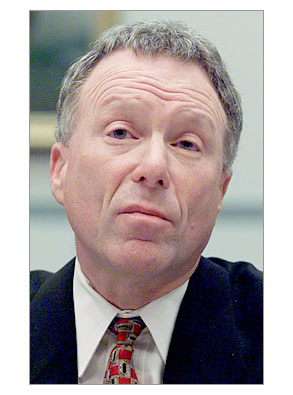

Dick Cheney

Suspicion centers on Lewis Libby

Dick Cheney's chief of staff helped hype the Iraq threat and discredit Joe Wilson. But while the White House has denied Karl Rove is the leaker, so far it's left Libby twisting slowly in the wind.

Criminal leak investigations are notoriously futile, and the identity of the administration officials who illegally blew the cover of CIA operative Valerie Plame may never be known. But one name keeps coming up, and so far it hasn’t provoked a specific, emphatic White House denial: Lewis “Scooter” Libby, assistant to the president and Vice President Dick Cheney’s powerful chief of staff.

On Wednesday the New York Daily News reported that “Democratic congressional sources said they would like to hear from Vice President Cheney’s chief of staff, Lewis Libby.” On MSNBC’s “Buchanan and Press” on Wednesday, Pat Buchanan asked an administration critic who claims to know the leaker’s name point blank if “Scooter Libby” was the culprit (the critic wouldn’t answer). And Republican Sen. Chuck Hagel of Nebraska made a veiled reference on CNBC this week, suggesting that President Bush could better manage the current crisis by “sitting down with [his] vice president and asking what he knows about it.”

But below the surface there’s even more chatter. Says one former senior CIA officer who served under President Bush’s father, “Libby is certainly suspect No. 1.”

Libby might feel more secure if the White House would issue a blanket denial about his involvement, the way it did for Bush’s top political aide, Karl Rove, who was the focus of attention early in the week as the possible source. At a press briefing this week, White House spokesman Scott McClellan was adamant: “The president knows [Rove] wasn’t involved … It’s simply not true.”

And later, McClellan dismissed as “ridiculous” any suggestions that Rove may have played a role, adding, “There is simply no truth to that suggestion. And I have spoken with Karl about it.”

But when a reporter asked about Libby, McClellan cut him off with a non-response.

“Does [Bush] know whether or not the vice president’s chief of staff, Lewis Libby …” the reporter began. McClellan interrupted: “Do you have any specific information to bring to my attention? Like I said, there has been nothing that’s been brought to our attention.”

Asked for a comment about speculation surrounding Libby, Cheney’s spokeswoman Cathie Martin tells Salon, “This is a serious matter and we shouldn’t be speculating in light of an ongoing investigation.”

By all accounts, Libby was certainly at the heart of the administration’s high-level arm-twisting in the intelligence community, trying to massage evidence to make the case that Iraq was an imminent danger to the world. He and his boss Cheney, along with a cadre of administration hawks, took the lead in trying to sell a number of bogus claims, from the notion that Saddam Hussein tried to buy uranium from Niger to the false assertion that hijacker Mohammed Atta met with an Iraqi spy before 9/11.

The Plame controversy, of course, stems from a New York Times opinion piece written by former U.S. Ambassador Joseph Wilson, Plame’s husband, in July. In it, he revealed that in 2002 he traveled to Niger on an assignment for the CIA to investigate allegations that Saddam Hussein was trying to buy uranium from the African nation. Wilson wrote that he reported back that the claims were likely bogus, yet President Bush still included mention of the uranium plot in this year’s State of the Union address.

One week after Wilson’s Op-Ed, conservative columnist Robert Novak wrote a piece defending the White House, arguing that Wilson’s trip to Niger was arranged by his wife, Valerie Plame, “an Agency operative on weapons of mass destruction.”

Novak wasn’t the only journalist who received such a briefing back in July (five others reportedly got the same tip), but he was the only one who went public with the information. The leak was in violation of a 1982 federal law that prohibits the unauthorized disclosure of the identity of a clandestine intelligence officer. And the guessing game has become heated.

Many of the clues pointing toward Libby come from Novak himself, who’s provided a number of details about his source. (Yes, there were two Novak sources, but according to the columnist, after a senior administration source gave him Plame’s identity, the second source merely confirmed that when Novak told him he knew.)

For instance, the source “is no partisan gunslinger,” according to Novak’s Wednesday column. That description would certainly rule out the hyper-political Rove. The “no partisan gunslinger” tag fits Libby better. A consummate Washington Republican insider, Libby rarely throws bombs in the press, or parades in front of the talking-head cameras. Instead, he’s considered a behind-the-scenes power broker who bounces back and forth between senior government jobs and his lucrative Beltway law practice. Between 1995 and 2000 Libby served as fugitive billionaire Marc Rich’s attorney.

And yes, Condi Rice seems to be off the hook; on TV Novak has referred to his source as “he.”

But more significantly, it’s important to remember what Novak was looking for when he dialed up his “senior administration source” last July. According to his accounts, Novak wasn’t fishing for Plame’s identity. Instead he was looking for an answer to the question: Why was Wilson chosen to go to Africa?

Novak told CNN he thought Wilson was a strange choice, since he’d donated to Democratic campaigns and had no experience with weapons of mass destruction.

Wilson’s July Op-Ed appeared on a Sunday. “On Monday, I began to report on something that I thought was very curious,” Novak told CNN. As he explained in his Wednesday column, “During a long conversation with a senior administration official, I asked why Wilson was assigned the mission to Niger.”

The question is, where would have been the logical place for Novak to start his inquiry about Wilson’s trip? One obvious answer is in Cheney’s office. As Wilson had explained in his column, it was because of Cheney that he was sent to Niger: “In February 2002, I was informed by officials at the Central Intelligence Agency that Vice President Dick Cheney’s office had questions about a particular intelligence report. The agency officials asked if I would travel to Niger to check out the story so they could provide a response to the vice president’s office.”

We don’t know whether Libby served as an anonymous contact for Novak inside the VP’s office. But courtesy of Time.com, we do know Libby was talking to reporters about Wilson at around the time Novak’s column ran.

Headlined “At War on Wilson?” and posted online in July, the Time.com article detailed how since the publication of the New York Times Op-ed, “Administration officials have taken public and private whacks at Wilson.” It also noted, “Some government officials have noted [in private] to TIME in interviews, (as well as to syndicated columnist Robert Novak) that Wilson’s wife, Valerie Plame, is a CIA official.”

In other words, Time.com was getting anonymous administration tips about the same information Novak received. But from whom?

Dissecting the piece, it’s interesting to note the three administration officials who were quoted. The first two were then-spokesman Ari Fleischer and CIA director George Tenet. But their quotes about Wilson and his trip were made in front of a group of reporters. The third administration source, whose quote came during “an exclusive interview” with Time, was Libby. He denied Cheney had anything to do with requesting Wilson’s trip or that he knew about the former ambassador’s subsequent report.

One of the simplest shortcuts in journalism when trying to identify an anonymous quote or source of information is to see who is quoted on the record within in the same story, since often during an interview with reporters, sources will interrupt and suggest a specific fact or quote be on background or off the record. So it’s hard not to wonder: During his “exclusive interview” with Time, did Libby, as an aside, pass along the information about Plame, and ask that it not be attributed to him? Or did Time independently confirm the CIA operative’s identity from other administration sources, and then talk to Libby? We aren’t likely to ever get an answer, but the questions are intriguing.

And there are other small clues. According to a Wednesday USA Today article, “Vice President Cheney and his chief of staff, Lewis “Scooter” Libby, met with officials at the [CIA's] Non-Proliferation Center before the invasion of Iraq to discuss reports that Iraq was seeking to buy uranium in Africa.”

Plame works at the Non-Proliferation Center. The paper noted that she did not attend the meetings with Libby, but it’s plausible that he found out about her employment while he was there.

Libby and Cheney, in highly unusual moves, visited the CIA several times before the war, in what many observers saw as an attempt to pressure analysts to produce more damaging assessments about Saddam Hussein’s arsenal or any connection with al-Qaida.

According to a Washington Post report on Monday, Cheney and Libby continued to press the story about 9/11 hijacker Mohammad Atta’s meeting with an Iraqi spy in Prague long after the intelligence community had dismissed it. The two even insisted, on the eve of Secretary of State Colin Powell’s presentation to the United Nations Security Council last February, that the charge be included in Powell’s indictment of Iraq defying the council’s resolutions.

Someone so steeped in CIA intelligence could have been a helpful source on the Plame story.

Several more telling clues about Libby came Wednesday during an MSNBC appearance by Larry Johnson, a former counterterrorism official at the CIA and the State Department.

Earlier in the week Johnson, who calls himself a registered Republican who donated to the Bush campaign, made a media splash with his appearance on PBS’s “Newshour” by confirming that Plame did indeed work undercover for the CIA. It was a key assertion because since Novak’s column first ran, the columnist had tried to back off the claim he made in July that she was an operative. Instead, claimed Novak, she was simply an analyst — the implication being, making her identity known was not that big a deal. Johnson shot that theory down, and to date nobody from the CIA, or any other reporter, has come forward to question his veracity (though several critics have noted that his claim that Plame was an operative “for three decades” was implausible since Plame is only 40.)

Appearing on Wednesday’s “Buchanan & Press,” Johnson told the hosts, “I know the name of the person that spoke with Bob Novak,” and that the person worked “at the White House,” and more specifically, “in the Old Executive Office Buildings.” The vice president’s office is located inside the Old Executive Office Building.

And when Buchanan asked Johnson point-blank, “Scooter Libby. Now, is Scooter Libby the name you heard?” Johnson said simply, “I’m not going to comment on that.”

Eric Boehlert, a former senior writer for Salon, is the author of "Lapdogs: How the Press Rolled Over for Bush."

Two nasty Republicans say nice things about Newt

First Dick Cheney, then Rudy Giuliani suggests Gingrich may be the toughest candidate in the GOP field

Former New York Mayor Rudy Giuliani, left, and Newt Gingrich (Credit: AP)

What does it mean that two of the nastiest men in the Republican Party are saying nice things about Newt Gingrich? On CNN Monday night Dick Cheney warned the GOP not to “underestimate” Gingrich, and lavished praise on the disgraced House speaker for his formidable political skills.

Today, also on CNN, former New York Mayor Rudy Giuliani likewise had kind words for Gingrich, arguing he’s more electable than Mitt Romney in a race against Barack Obama.

“My gut tells me right now as I look at it that Gingrich might actually be the stronger candidate, because I think he can make a broader connection than Mitt Romney to those Reagan Democrats,” Giuliani told Piers Morgan. “You won’t have this barrier of possible elitism that I think Obama could exploit pretty effectively.”

With a straight face, Giuliani explained why charges of “elitism” wouldn’t fly against Gingrich. “One of the strengths he has is he’s got a common touch, he’s able to talk to people, he comes from a poor family, understands poverty from that point of view. He doesn’t come from the American elite. It’s going to be hard to paint him that way. There are a lot of other ways you can paint him, but you can’t paint him that way.”

You can’t? The man with the half-million-dollar Tiffany credit line? The guy who wants to do away with “truly stupid” child labor laws? The one who thinks the poor lack a work ethic? The “historian” who earned just under $2 million from Fannie Mac and took in another $37 million for his healthcare think-tank? The candidate whose tax plan overwhelmingly favors the super-rich? How many ways is Giuliani wrong there? More ways than he and Gingrich have wives between them.

Can we also acknowledge there is no such thing as a “Reagan Democrat” anymore? There are white working-class people who now permanently vote against their own class interests, and they’re Republicans, not Democrats. Then there are white working-class people who are understandably sometimes confused about which party represents them, because Democrats have spent so many years sucking up to Wall Street and playing down their populist past. Some of those voters — the ones who are public workers, or union members, or close to retirement and listening to proposals to raise the eligibility age for Social Security and Medicare — are starting to realize that they have become the GOP’s latest scapegoat, the 21st century welfare queens, and they’re taking another look at Democrats. Some white working-class voters stayed Democrats. But the Reagan Democrat analysis hasn’t made sense for a long time.

Finally, I love the fact that Gingrich and Giuliani have six wives and two marriage annulments between them. Add in Donald Trump, who seems to be leaning toward Gingrich too, they can start a Three Wives Club. Way to go, family values party!

I’ll be talking about the latest on the GOP field with Ed Schultz and Ezra Klein on MSNBC’s “The Ed Show” at 8 ET.

Continue Reading Close
Joan Walsh

Joan Walsh is Salon's editor at large.

Cheney urges “a quick airstrike” against Iran

Mr. Torture thinks President Obama should risk war to recover a downed drone. Plus: Nice words for Newt!

Dick Cheney (Credit: AP)

Once again, CNN philanthropist journalist Erin Burnett has used her show to give voice to the voiceless, to seek out the powerless to offer opinion on the day’s news. She debuted her show “OutFront” in early October by mocking Occupy Wall Street and defending the industry that destroyed the economy.

On Monday night Burnett gave a platform to a man almost as loathed as his Wall Street buddies, former Vice President Dick Cheney. And Cheney, predictably but contemptibly, took the opportunity to bash President Obama for not authorizing “a quick airstrike” to retrieve a predator drone that was recently downed in Iran.

Cheney told Burnett:

The right response to that would have been to go in immediately after it had gone down and destroy it. You can do that from the air. You can do that with a quick airstrike, and in effect make it impossible for them to benefit from having captured that drone. I was told that the president had three options on his desk. He rejected all of them. [...]

They all involved sending somebody in to try to recover it, or if you can’t do that, admittedly that would be a difficult operation, you certainly could have gone in and destroyed it on the ground with an airstrike. But he didn’t take any of the options. He asked for them to return it. And they aren’t going to do that.

The former vice president has been insulting Obama  since Inauguration Day, insisting his policies will make the country “less safe.” Two months into his administration, Cheney charged that the new president “is making some choices that, in my mind, will, in fact, raise the risk to the American people of another attack.” He’s accused Obama of “half measures” and “dithering” on foreign policy. And more than once he’s criticized the president for not taking a tougher stance on Iran.

Even after Obama authorized the successful mission to kill Osama bin Laden, who Bush and Cheney essentially let run free thanks to their discretionary war with Iraq, Cheney wasn’t happy. “I still am concerned about the fact that I think a lot of the techniques that we had used to keep the country safe for more than seven years are no longer available. That they’ve been sort of taken off the table, if you will.”

So Cheney’s carping is nothing new. But suggesting that the president launch “a quick airstrike” to retrieve the downed drone is ridiculous, even for Cheney. There’s no such thing. Cheney has to know that any new U.S. incursion, following on the drone discovery, would sharply escalate tension with Iran, and to do that to recover a drone isn’t at all worth the risk.

It was left to CBS Early Show co-anchor Rebecca Jarvis this morning to ask the follow-up question Burnett did not: “Would not, though, an airstrike on Iran have potentially led us into a war with them?”  Cheney replied:

Well, if you look at what Iran has done over the years, they’ve been the prime backers of Hezbollah, of Hamas, the bombing of the Marine barracks in Beirut in 1983 that cost us 241 American lives. These were Iranian-supported ventures. It’s not as though they haven’t already committed acts that some people would say come close to being acts of war.

For us to go in and take out the drone that crashed would have been, I think, a fairly simple operation, and it would have denied them the value of the intelligence they can collect by having that aircraft,” he said. “But the administrative basically limited itself to saying, ‘Please give it back,’ and the Iranians said no.

ThinkProgress made a good catch: When a U.S. spy plane ventured into Chinese airspace in April 2001 and crashed with a Chinese fighter jet, the Bush-Cheney administration wound up apologizing in order to get 11 soldiers released from Chinese custody.  They didn’t send in “a quick airstrike.”

For the record, Cheney sounded bullish on Newt Gingrich in 2012, though he hasn’t endorsed anyone formally. “I wouldn’t underestimate him,” Cheney said, praising Gingrich’s political skills. “The thing I remember about Newt, we came to Congress together at the same time, ’78, and when Newt showed up, he said, ‘We can become the majority. We can take back the House of Representatives. We hadn’t had the House since the 1940s. And initially, none of us believed it, but he was persistent. And he was tenacious. He kept it up and kept it up and kept it up. And finally by ’94, he’s the newly elected speaker of the House of Representatives with a Republican majority.” Cheney declined to describe the way Gingrich crashed and burned in the years that followed. You’ve got to count that among the nicest things anyone who’s worked with Gingrich has said about him during the whole campaign. Stay tuned.

Continue Reading Close
Joan Walsh

Joan Walsh is Salon's editor at large.

Dick Cheney interviewed by Liz Cheney at “Ideas Forum”

The Atlantic Magazine's celebration of Washington's power elite culminates in a pleasant father-daughter chat

Former Vice President Dick Cheney, accompanied by his daughter Liz, addresses the Washington Ideas Forum on Thursday. (Credit: AP/Manuel Balce Ceneta)

This week, the Atlantic Media Co. held its “Washington Ideas Forum,” one of many regular events held for Washington’s political elite to gather and congratulate themselves for having so many ideas. The Atlantic — which also publishes a monthly magazine, I’m told — throws these pricey orgies of self-regard each year, in Washington and Aspen. One of the big “ideas” presented at this year’s forum was actually a pretty old one: that no matter how awful and criminal certain people’s behavior is in office, they will never, ever be kicked out of the Washington elite.

That’s why the forum hosted Henry Kissinger, this big idea’s mascot. And that’s why the forum ended with an interview with former Vice President Dick Cheney, who has a memoir to promote. Cheney was joined onstage by his daughter and co-author, Liz Cheney, who is devoting herself to whitewashing her father’s legacy of torture and death and shooting old men in the face.

They were technically being “interviewed” by a third party — a journalist! — but for some reason most of the question-asking was actually done by … Liz.

“Were you really secretly running things?” Liz Cheney asked.

“No,” her father said.

As proof, he cited the fact that President Bush once had Cheney’s dog banned from a section of Camp David.

This gentle interrogation seems to have struck certain high-profile Atlantic contributors as a bit silly but on the other hand it would be much harder to get big names to attend these things if they were worried someone might call them out for being a war criminal. (Hot tip for the International Criminal Court: Try sending out invitations for a sham “Ideas Festival”?)

The forum also hosted former Pakistan leader Pervez Musharraf, an actual former dictator. (But one of the “good ones”!)

Continue Reading Close
Alex Pareene

Alex Pareene writes about politics for Salon and is the author of "The Rude Guide to Mitt." Email him at apareene@salon.com and follow him on Twitter @pareene

Guy who wants Obama to read less fiction not as concerned about Cheney’s reading list

Tevi Troy says the former Vice President may not have read much nonfiction, but he did meet with guys who write

Remember Tevi Troy, the Republican “former senior White House aide” who criticized Barack Obama at the National Review Online for reading well-reviewed novels instead of Jonah Goldberg’s “Liberal Fascism” and other conservative book club selections? He’s back with another of his wonderful posts about the reading habits of prominent politicians. This time, he’s talking Dick Cheney.

Dick Cheney’s memoir apparently mentions a lot of books he read and enjoyed. Mostly books about wars and frontier settlers and so on. Good Republican books. But the Washington Post’s nonfiction book editor notes that Cheney doesn’t mention reading anything while actually in office as vice president:

Noticeably missing from the pages of Cheney’s memoir are references to books examining the big issues of our day — issues of crucial importance during his tenure with the Bush administration. From his memoir, it is impossible to know if he took any counsel at all from the estimable books of the past decade on national security, terrorism, torture, Islam, domestic surveillance. He remains opaque to the end.

This seems sort of like a defensible version of the weird criticism Troy leveled at President Obama, right? (As Troy wrote of Obama: “the near-absence of nonfiction sends the wrong message for any president, because it sets him up for the charge that he is out of touch with reality.”) So does Troy agree with the Post on Cheney? No. No, he does not:

When it comes to the books Cheney read as vice president, though, Cheney is indeed less forthcoming about the titles. He does, however, list a variety of thinkers and writers with whom he met while in office, including Fouad Ajami, Bernard Lewis, Nathaniel Philbrick, Jay Winik, Edmund Morris, David McCullough, Charles Krauthammer, and Victor Davis Hanson. In addition, while Cheney was vice president, there were public reports that Cheney read a number of books with contemporary policy implications, including Natan Sharansky’s The Case for Democracy, Elliott Cohen’s [sic] Supreme Command, and Winik’s April 1865 (interestingly, President Bush was reported to have read all three of those as well). I am sure that neither of these lists depicts the totality of what Cheney was reading and to whom he was speaking, so I guess by some measure he does remain “opaque.” But the list of at least some of the outside influences Cheney looked to during his vice presidency was available and out there, both within and outside Cheney’s memoir, if one had chosen to look for them.

He may not have been reading serious nonfiction about contemporary issues, but he met with Charles Krauthammer! That is basically the same thing, right? Reading an “estimable book” on Islam is surely a waste of time when you can just call up Victor Davis Hanson for a chat.

So for Cheney’s reading list we’ve got those all-important “meetings” plus two historical war books and one foreign policy manifesto that plainly reinforced Cheney’s already extant biases. I can see why self-proclaimed presidential reading expert Troy was “somewhat bothered” by that Post piece that made the same argument he made about Obama two weeks ago except not as stupidly.

Turns out this Troy character may not actually be a serious scholar of the history and meaning of presidential reading, and may, in fact, just be some random shameless right-wing think tank hack!

Continue Reading Close
Alex Pareene

Alex Pareene writes about politics for Salon and is the author of "The Rude Guide to Mitt." Email him at apareene@salon.com and follow him on Twitter @pareene

The Cheney Regency

In his new book the former vice president disses his boss -- and boasts of power

Clockwise from upper left: Dick Cheney, George W. Bush, Condoleezza Rice and Colin Powell

Give the old vizier his due. Richard Cheney is the most influential and radical political leader of his times. The former vice president’s new autobiography, assertively titled “In My Time,” tells at least part of the story. The fuller telling of his biography will have to come from guilty aides, declassification of key documents, and possibly a future war crimes tribunal. In the meantime, what the man wants to tell us in the here and now is interesting enough.

Cheney’s memoir — by turns implacable, misleading and frank — presents strong evidence that he served as de facto co-president of the United States from the morning of Sept. 11, 2001, until late 2006. Certainly, the book demonstrates that no vice president in American history has ever wielded such influence — some would say control — of the levers of power in Washington.

His radicalism is served proudly. “I wanted to make sure the governor understood my record was not moderate,” he writes about an early meeting with Texas Gov. George W. Bush.

The Cheney Regency featured a canny bureaucratic mandarin waging war in tandem with a passive chief executive, who shared his views but his not skills. There is nothing comparable in the history of the American presidency. Some sympathizers have discerned the hand of God in Bush’s presidency. Cheney, a less sentimental observer, gives more credit to himself.

Bush, his nominal boss, while occasionally lauded for his “courageous” decisions, cuts an unobtrusive and unimpressive figure in Cheney’s life. The first important political decision that Cheney attributes to Bush was selecting him as his vice-presidential running mate. “Dick, you’re the solution to my problem,” Cheney repeatedly quotes Bush as saying.

About Bush the man, Cheney has nothing to say. Nothing about his struggle with alcoholism, his troubled relationship with his father, his extensive record of two terms as governor of Texas, or his efforts to define a “compassionate conservatism.” Such irrelevant details do not interest Cheney who focuses relentlessly on power.

Chronologically, the next important decision that Cheney attributes to Bush came on Sept. ll as the White House confronted reports of hijacked airliners flying into buildings. The president, he writes, 

“approved my recommendation that they [Air Force pilots] be authorized to fire on a civilian airliner if it had been contacted and would not divert … When the president came on the line I told him about the shootdown order.”

This is a fib, if not a lie, as a careful reading of the 9/11 Commission report indicates. While the report’s language is tactful, senior commission staffers certainly had their doubts that Cheney ever spoke to Bush about the order before it was given. The evidence supports their doubts.

That pattern recurs in Cheney’s book: The chain of command appears to function normally while the vice president shapes crucial decisions. As the Bush White House pondered how to respond to the attacks in September 2001, for example, Cheney recalls offering sage advice: “I suggested to the president that it would be useful to make certain that [Secretary of Defense] Rumsfeld had assigned priority to planning for possible military action against Saddam.” Rumsfeld’s plans would be put into action in Iraq 18 months later.

When British Prime Minister Tony Blair came to Washington in 2002 to ask the White House to support a U.N. resolution against Saddam, Cheney disagreed — and assumed he had Bush’s assent. “I knew the president was no more interested than I was in an endless round of inspections and deception in Iraq,” he writes.

As the preparation for war intensified in the early 2003, Prince Bandar, the Saudi potentate, came to Washington skeptical that Washington was really going to invade Iraq. Cheney says he met with Bandar, who was reassured.

“I conveyed the message to the president. He met with Bandar the following Monday.” End of story. Bush’s conversation with Bandar has no importance in Cheney’s account — and perhaps in reality.

After the destruction of Saddam’s regime in March 2003 and Bush’s reelection, in 2004, Cheney felt so secure in his power he starts omitting Bush from his ambitions altogether. “I felt strongly that a major change was needed in the national security team,” Cheney writes. “Getting a new secretary of state was a top priority.”

It is safe to say that no vice president in American history has dared use such presumptuous language about the composition of a presidential cabinet. Cheney’s target Colin Powell soon resigned — though he claims he planned to all along.

About Iraq’s descent into violent chaos from 2003 to 2006, Cheney is mostly silent. Not surprisingly, he does not address the human toll: the awful civilian deaths or the massive displacement of Iraqi Christians, and the impoverishment of millions. He shrugs off the worldwide revulsion generated by the revelations of torture at Abu Ghraib. He offers occasional paeans to fallen U.S. soldiers, but more often he calls attention to his own influence in ways that seem condescending to his patron.

As the White House was forced by failure to consider a new policy in 2006, Cheney still tried to impose his will. When Bush’s aides prepared a presidential speech about the dismal situation in Iraq that did not include the word “victory,” Cheney proudly reveals that he intervened with the speechwriters — and literally put the talismanic word in the president’s mouth. Even Bush’s critics have stopped retailing such tart anecdotes about the former president. Cheney has not.

Not coincidentally, Bush broke with Cheney about this time. In November 2006, Bush fired Rumsfeld without asking for the vice president’s opinion. For the first time in five years, Bush started making key decisions on his own.

Cheney’s account turns petulant at this point. After 2006, no one in the Bush administration (besides Cheney) can do much good. The new Secretary of Defense Robert Gates mistreated two top generals. Secretary of State Condi Rice was so eager to reach an agreement with North Korea she issued a public statement that was “utterly misleading.” And President Bush had failed by acting on her recommendations, not his.

“The process and the decision that followed seemed so out of keeping with the clearheaded ways I had seen him make decisions in the past,” he writes with surprise.

What had changed was that Cheney no longer dominated the process of presidential decision-making on foreign policy. He was merely the vice president. His reign was over but his pride remained. Like the man or not, the possessiveness of his book’s title is deserved. From 2001 to 2006 was Dick Cheney’s time. 

Continue Reading Close
Jefferson Morley

Jefferson Morley is a staff writer for Salon in Washington and author of the forthcoming book, Snow-Storm in August: Washington City, Francis Scott Key, and the Forgotten Race Riot of 1835 (Nan Talese/Doubleday).

Page 1 of 99 in Dick Cheney