
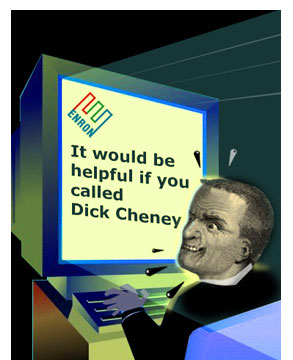

When the Wall Street Journal reported last week that nearly 1.5 million Enron e-mail messages were posted on the Web, waiting for the world to read, the newspaper pointed out that many of the e-mails contained the private ramblings of Enron employees who didn’t deserve to have their dirty laundry put on public display.
Fair enough. While the Federal Energy Regulatory Commission says the public has a right to know the facts upon which the Enron investigation was based, it’s hard to see the public value of releasing messages in which Enron employees chat about their lunch plans, complain about the weather, and joke about visiting strip clubs and their own right hands when their girlfriends and wives are away.
But what the Journal didn’t mention is that the Enron e-mail library posted on FERC’s Web site also contains a remarkable glimpse into the culture of Enron — how the family of Ken Lay lived large in the glory days, how Tom DeLay and other members of Congress used the company as a veritable ATM for campaign contributions, how Enron plotted to place employees in the Bush-Cheney administration, how company executives almost obsessively followed the investigation into price gouging during California’s energy crisis, and ultimately how Enron employees suffered when the company collapsed.
Amid a sea of dick jokes, spam and Internet porn, the e-mails offer a window into the soul, such as it was, of Enron: from the high-flying days when the company decorated its top executive office suites in holiday themes — according to a 2000 e-mail, Ken Lay’s office was done up in honor of St. Lucia, Jeff Skilling’s had Kwanzaa, and Andrew Fastow’s was lit up for Hanukkah — to the end, when things had gone so far south that members of the Lay family began to fear they’d be kidnapped.
The e-mail messages also touch on — albeit briefly — the supposedly secret meeting that California Governor-elect Arnold Schwarzenegger and other business leaders had with Ken Lay in May 2001. After word of the meeting appeared in the San Francisco Chronicle, one internal e-mail suggests that Enron executives tried to figure out who leaked the story. In another e-mail, a friend who had worked with Skilling at McKinsey & Co. warned him that the meeting had been a mistake — “posh location, closed format, odd group, seemingly self-serving agenda” — and that the company should be more careful about public appearances in order to avoid a “coast-to-coast firestorm” that could harm Enron’s “reputation, leadership and shareholder value.”
If he only knew. Enron declared bankruptcy in December 2001. Andrew Fastow and his wife, Lea, are awaiting trial on criminal charges. And while neither Ken Lay nor Jeff Skilling has been charged with any crime yet, they are the subject of any number of civil suits and have become poster boys for everything wrong in corporate America.
The Enron e-mails are available for searching and browsing at FERC’s Web site. For those with better things to do, here are some of the highlights.
– — – — – — – — – — – –
If the Enron e-mail library is any indication, one of Ken Lay’s most frequent correspondents was his daughter, Elizabeth. She wrote to him about friends who wanted jobs at Enron, about her plans for a lavish wedding to attorney Jose Luis Vittor, about her hopes for the Bush-Cheney campaign and, ultimately, about the stress Lay was facing as Enron collapsed. It appears that Lay himself seldom responded to these e-mails; in many instances, his secretary, Rosalee Fleming, did.
To: Ken Lay and Mark Lay
From: Elizabeth Lay
Date: Sept. 26, 2000
Subject: ADay
Dear Dad and Mark,
I am attaching the resume of the lovely and talented Ms. Amanda Day who, like all wise soon to be graduates of business school, is very interested in a position at Enron. Of course she would be an incredibly valuable addition to the Enron team and to Houston. If you have any questions about her character, achievements, or goals, please feel free to contact me.
All my love,
Elizabeth
To: Ken and Linda Lay
From: Elizabeth Lay
Date: Sept. 9, 1999
Subject: Band
Dad & Linda —
…I sent an email to the wedding coordinator … [S]he recommended a photographer out of Atlanta, I love his work, he does candid more so than the traditional portraits. He also did a number of the Kennedys’ weddings, etc. I’ll try and get a price quote, but I might need your help in negotiations.
Also, she sent some information on a decorator/florist who seems phenomenal, I don’t know if Linda might be willing to help me out with that as she knows a lot more about both flowers and decoration than I do. The Ballroom at the Ritz is pretty basic and he can turn it into anything but basic. Also, that we if we find a church that is not so amazing, he can decorate that as well…
I love you!
Liz & Jose Luis
To: Elizabeth Lay
From: Rosalee Fleming
Date: Jan. 27, 2000
Subject: Hotel Reservations
Hi Liz —
The reason Ken and Linda were trying to reach you from the plane was that they had some suggestions for the hotel rooms and wanted you to know their preference. They would like to give the Jasmine Suite that they are currently in to the Vittors with a connecting bedroom, to take care of their family.
They would like Mark and Natalie to have the end or corner suite that the Vittors have.
Ken and Linda said that they would prefer two connecting rooms, hopefully on the 3rd or 4th floor. They would like for the rooms to have the ocean view on the North side. If that isn’t possible, it would be o.k. to overlook the pool, but they would not really like the south side as it wouldn’t be as quiet. The two rooms would give them everything they need, with 2 baths.
They said they can be reached in Switzerland tomorrow… They should arrive in Davos about 9:00 a.m.
– — – — – — – — – — – –
During the company’s glory days, Enron was a generous donor to political campaigns — largely, Republican ones. Numerous e-mail messages in the Enron library concern the coordination of campaign contributions — and the elaborate bookkeeping required to ensure at least technical compliance with campaign-finance laws.
To: Rosalee Fleming, Jeff Skilling
From: Steve Kean [Enron executive vice president and chief of staff]
Date: July 24, 2000
Subject: Jeff Skilling’s letter from Tom DeLay re: RNSEC
Jeff and Ken both received notes from Tom DeLay about designating portions of their contributions for use in Texas. Mr. DeLay would like them to make that designation using the letter below (note that it will need to be modified to be from each individually rather than a joint letter). It is, of course, up to Ken and Jeff whether to make the designation.
To: Steven Kean [Enron executive vice president and chief of staff]
From: Cynthia Sandherr [Enron vice president]
Date: July 24, 2000
Subject: Jeff Skilling’s letter from Tom DeLay re: RNSEC
Per your voicemail, attached is the written response suggested by Congressman DeLay’s fundraiser. We cannot, per his suggested text, write one letter on behalf of both Ken Lay and Jeff Skilling (due to bundling rules we should write two separate letters) and we should put it on personal stationery and not corporate letterhead. Please let Carolyn or I know if you need anything further on this. Thanks, Cynthia.
From: Warren Robold [fundraising consultant for Tom DeLay]
To: Carolyn Cooney [Enron lobbyist]
Date: June 24, 2000
You should write this letter on your letterhead and direct it to Joe Jaso and copy Tom DeLay, Jim Ellis and myself. All funds where money could be left in the State of Texas from corporate and personal should be included.
Dear Joe:
Enron, Mr. Ken Lay and Mr. Skilling are requesting that their contribution be matched per our understanding from the fax and verbal communications from Warren Robold. This totals $100,000 between both individuals and the Corporation for the RNSEC matching funds program. We want these funds matched in time for the Texas State deadlines. It was our intention from the onset of this program to have our funds go to this account. The various points of contact from the RNC caused some minor confusion so checks went to Texas instead of DC. This is very important to Mr. Lay and Mr. Shilling. Let us know if we need to request these funds returned and new checks written and mailed to you at your DC address. You may call me if you have any questions.
In the spring and summer of 2000, power reserves dropped dangerously low in California. In August 2000, California Gov. Gray Davis called for an investigation into whether energy marketers had manipulated prices in the California market. Enron executives began to prepare to answer the questions they would ultimately face.
To: Steve Kean [Enron executive vice president and chief of staff]
From: David Haug [CEO, Enron Caribbean, Enron Middle East]
Date: Aug. 14, 2000
Subject: Re: Talking Points re “reregulation” in California
Steve, thanks for the helpful materials. However, if the experience in overseas deregulating electricity markets where price increases and spikes have occurred is any precedent, we will need to have some more down-to-earth responses to a some of the potentially inflammatory issues facing the politicians:
1. When the prices spike, who reaps the windfall? Who sells that most expensive 1% of the kwh? Is it a careful planner or a lucky speculator or market manipulator? Someone is making a bunch of money off the screwed up system. Who is it, and why is that OK?
2. We do not allow people to inflate water prices to consumers in times of drought, or food prices in times of hurricanes or floods. Even gasoline price increases in periods of high demand are within 20%-30% of the base, not 2, 5, 10 or 100 times the average like spot electric prices. The issue isn’t whether the system is broken or not or how bad partial regulation is or how much demand has increased versus supply. This will be seen as “ivory tower” discussions. The populist political issue is, until the problem is fixed, why should some shrewd big electric company or middleman be allowed to profit off the misfortune of consumers who did not cause the problem? Why should anyone be allowed to profiteer by selling at multiples above their generation cost?
3. The hedges, fixed price contracts and other de facto insurance against volatility that Enron or others offer could be seen as a symptom of the problem rather than the solution. Enron could be seen as at best a band aid and at worst an opportunist made possible only by a broken system — sort of like the guys who ran the old style protection rackets, or Colombian “security consultants” who “guard” pipelines from the threats their guerilla affiliates create, or political risk insurance that you shouldn’t really need if the host country wasn’t so screwed up. Don’t worry about high crime in your neighborhood — just hire an off-duty policeman. Who needed these new electricity risk management products in the old days before deregulation?
We have to be able to answer these types of questions at the level of the ordinary citizen, not merely have the correct long-term competitive market solution, or the forces of ignorance and re-regulation will gain momentum. Are we sure we shouldn’t back a temporary peak hour price cap until the regulatory problems we’re all familiar with are worked out, to avoid a much worse long term rollback?
– – – – – – – – – – – – – – – – –
As the summer of 2000 drew to a close, Enron executives — and Lay family members — were focused on politics on two fronts: the fallout from California, and the prospects of getting the Bush-Cheney ticket elected in November. As some executives began to plot their message in California, one of their colleagues — an Enron vice president named Joe Hillings — appeared to worry about positioning himself for a job in the Bush administration.
To: Ken Lay
From: Joe Hillings [Enron vice president for governmental affairs]
Date: Aug. 25, 2000
Subject: My Retirement
Ken: It is my desire to retire from Enron at the end of March 2001. Thanks to you, my financial position far exceeds what I had ever thought would be the case.
I am still in great health, have plenty of competitive drive and have no desire to reduce my natural speed. I shared with you my desire to seek an ambassadorship in a George W. Bush presidency…
You have been a great leader to follow and my entire family is grateful to you for the blessing and rewards you have brought to us. My thanks to you…
P.S. I enjoyed the time with you, Linda, Elizabeth and Jose Luis in Philadelphia.
To: Ken Lay
From: Elizabeth Lay
Date: Sept. 8, 2000
Subject: Contributions, Jobs, etc.
Dear Dad,
I just sent in an additional contribution to the Bush Campaign and I put your number on the check, but I want you to be aware so that you can assure it is credited to your fundraising efforts…
Thanks, Dad!
Love,
Elizabeth
To: Jeff Dasovich [Enron governmental affairs executive]
From: Jeff Dasovich
Date: Sept. 14, 2000
Subject: Observations on the Hearings this Week
…Observation — The pressure to finger somebody for “price gouging” [in California] is increasing. The administration is hell bent on finding a “fall guy.” The price spikes pose real political risks for [California Gov. Gray] Davis and he and his folks need and want an easy way out. His press release following the hearing renewed the call for “refunds” … The utilities repeatedly called on FERC to do a “real” investigation, with hearings, testimony, data discovery — the works…
Implication — It seems prudent for Enron to understand better its risks of getting fingered. In the best case, the clamoring for a “refund” subsides. In which case, the only cost to Enron is the internal cost incurred to understand better the risks of getting fingered. In the medium case, investigations find that Enron (like others) “played by the rules,” but the rules stunk, and Enron profited at the expense of California consumers.
To: Kenneth Lay
From: Joe Hillings
Date: Sept. 25, 2000
Subject: Selection of My Successor — My Concern
Ken: I have “heard” from two sources in this office that Enron will announce my successor today. I have not been advised of the selection and am concerned that this announcement will not treat my retirement in an appropriate and deserving manner…
Frankly, I think this matter has not been handled in a caring way and I have been accused of giving information on the selection to Tom DeLay, which is untrue. My office mates are all more aware of the candidates and their status than I have been.
I regret having to contact you on this matter but feel that despite my total cooperation, allegiance and dedication to Enron, I am not being treated with the courtesy and sensitivity that this matter deserves.
To: Members of the Lay family
From: The newly married Elizabeth (Lay) Vittor
Date: Nov. 1, 2000
Subject: New York City
Dear Family,
Heather and I were talking about NYC and thought we should make some reservations for dinner for the entire family on Friday and Saturday night. I am trying to get reservations for the entire family at Le Cirque 2000 for Friday night at 7:30 but we will be very lucky to get in. Does anyone have other suggestions or an objection to Le Cirque? I am attaching a review of the restaurant. It is definitely a little “Haute” but I’ve heard it is also a lot of fun…
Luv to all,
Liz
– – – – – – – – – – – – – – – – –
As the nation awaited the results of the presidential recounts and lawsuits, Enron executives began plotting their own roles in the new Bush administration. Ken Lay apparently had more pressing concerns: The phone wasn’t working right in one of his planes.
To: Ken Lay
From: Steve Kean [Enron executive vice president and chief of staff]
Date: Nov. 16, 2000
As I mentioned at the executive committee meeting, we have a number of people who either have expressed interest in serving on the transition team or who I would like to approach to serve on the transition team for Bush. We believe that a call from you to Cheney may be required.
David Haug. David will be returning from his honeymoon on Dec 4 and has expressed a strong interest in serving on the Bush team.
Woody Wodraska. Woody would like to work on environmental and water issues and has been in touch with Bush campaign folks in both California and Florida. He would appreciate a call on his behalf to Cheney. Amanda is aware of his interest and is amenable to his service.
James Steffes. You know Jim. He is one of the most creative and talented people in my organization. He is familiar with state and federal energy regulation as well as the state and federal policy makers who have played an active role in deregulation efforts. He would be great to have on a vetting team for commission nominees. I have talked to Jim and he is interested.
Others. We can make another 4 people available from the government affairs organization with qualifications in energy, communications and market regulation. The question is more a matter of how many Enron people they would like to have. Among them: Dan Allegretti (who will be chair of NEPOOL next year) who campaigned for Bush in New Hampshire; and Sue Landwehr, a Republican who works for us in the upper Midwest.
Linda Robertson has suggested that we try to put as many people on the “vetting” team as possible. Let me know how I need to proceed.
To: Gary Fitch [Enron’s aviation manager]
From: Keith Jones
Date: Nov. 20, 2000
Subject: N5737 — Ken Lay’s phone
Gary,
Least I forget! On N5737 the other day … Mr. Lay reported to Bill Reddick that when his phone (#2 R/H seat) rings and he answers that it disconnects on him. He told Bill that this is the third time he has reported this problem…
Lyndel checked the system and there does seem to be a problem with it disconnecting if you pick it up before the third ring. After the third ring it works fine. That is all I know at this time. Garrett AV is coming over today to check the system…
Keith
To: Ken Lay
From: Gary Fitch
Date: Nov. 20, 2000
Subject: N5737 — Ken Lay’s phone
Mr. Lay, we are looking into the problem and hope to have the problem resolved ASAP. Thanks.
P.S. Our best to you and your family this Thanksgiving.
To: Gary Fitch
From: Rosalee Fleming
Date: Nov. 20, 2000
Subject: N5737 — Ken Lay’s phone
Gary, every time Ken tells me to report it, I tell Anna or Kristi and they, in turn, pass it on to whoever they deal with in Maintenance. It has been at least 3 times.
Rosie
With the Bush-Cheney team finally in the White House and investigations and incriminations swirling around the energy crisis in California, Enron executives continued to focus both east and west in the first half of 2001. In the hope of selling Enron’s “solution” to California’s energy problems, Ken Lay met privately with Arnold Schwarzenegger and other business leaders in May 2001. When the San Francisco Chronicle broke the story about the meeting, one of Jeff Skilling’s friends — a former colleague from his days at McKinsey & Co. — warned Skilling that Enron should be more careful about public relations in the days ahead. Meanwhile, Enron’s governmental affairs executives were working hard to curry favor with the Bush White House — and to ensure that legislation unfriendly to Enron never left Capitol Hill.
To: Jeff Skilling
From: Kevin Scott
Date: May 26, 2001
Subject: Enron’s secret bid to save deregulation
Jeff:
Candidly, this wouldn’t have been my approach (posh location, closed format, odd group, seemingly self-serving agenda).
I read the article below as unsympathetic and almost mocking in its tone toward Enron. It’s noteworthy the Beverly Hills meeting was not covered in the Los Angeles papers. Instead, this article comes from the front page of the Bay Area’s San Francisco Chronicle (Democratic bastion and home to both of California’s United States Senators, power broker Willie Brown, Attorney General Bill Lockyer and the state’s public utility commission).
Consistent with my concern about a “coast-to-coast firestorm” engulfing Enron, the New York Times ran two articles today that were unsupportive of the company…
These follow the Times’ tough piece on Ken Lay yesterday. Undoubtedly, the Washington Post will have to get into fray soon.
My feeling is that just as with the “business” side, Enron’s public policy strategy needs [to] be well informed, sophisticated and comprehensive. I fear that anything less will fuel the potential of undesirable outcomes for Enron’s reputation, leadership and shareholder value.
Kevin
To: Ken Lay and Steve Kean
From: Enron governmental affairs executives Rick Shapiro and Linda Robertson
Date: June 1, 2001
Subject: The President’s Dinner, A Congressional Salute Honoring President Bush and Vice President Cheney, June 7, 2001, in Washington, DC
…The President’s Dinner is a joint fundraising effort by the National Republican Congressional Committee (NRCC) and the National Republican Senatorial Committee (NRSC). We contacted both Congressman Tom DeLay and the House Senate Dinner committee to ensure that Enron could fully participate in The President’s Dinner and receive credit for money we have already committed to the Committees earlier this year.
With the assistance of Congressman Tom DeLay, we were able to apply our previously contributed soft money toward this dinner. Consequently, we will be credited as giving $250,000 to this event, even though we are being asked to give only $50,000 in new soft money. Our earlier contributions of $100,000 each to the NRCC and NRSC will make up the remaining money. You will be listed as Co-Chair of the event, the highest level of giving. We will be crediting Congressmen DeLay, Armey, Barton and Tauzin for raising the $100,000 allocation for the NRCC. As for $100,000 we earlier gave the NRSC, Senator Kay Bailey Hutchison has requested that Enron give her some credit for raising the money. We would like to split it among several other Senators.
In addition, Congressman Tom DeLay has asked Enron to contribute $100,000 to his leadership committee, ARMPAC, through a combination of corporate and personal money from Enron’s executives. ARMPAC funds will be used to assist other House Members as well as the redistricting effort in Texas. We will be meeting this request over the course of this calendar year…
To: Enron executives Steve Kean, Richard Shapiro, Linda Robertson, et al.
From: John Shelk [Enron vice president for governmental affairs]
Date: July 6, 2001
Subject: Status of Discussions on Electricity Legislation — No Agreement Reached.
Once again today I participated in the discussions on possible electricity legislation held in the offices of Majority Whip Tom DeLay with other interested parties including industry segments, public power and state regulators. The other congressional participants were staff to Reps. Steve Largent and Chip Pickering.
After meeting all week (except Wednesday), the group was unable to reach an agreement or even a provisional consensus on what could be placed in an electricity title that could be added to the comprehensive energy package that the House Energy and Commerce Committee will begin to process next week…
As noted, the lack of an agreement reduces our exposure when the mark up occurs…
To: Jeff Skilling and his secretary, Joannie Williamson
From: Bill Gowan, Election Day Consulting, LLC
Date: July 17, 2001
Subject: Tom DeLay CA Aug. Dinner & Golf
Jeff, I spoke to Joannie this afternoon and asked for your e-mail to send this invitation. Here is the initial information on the event. We are expecting additional members of Congress to attend both events. If you have any questions or comment, please let me know…
Tom DeLay / ARMPAC
Guest Speaker — David Horowitz
Four Seasons Aviara — Dinner & Golf Tournament
The event will take place:
Wednesday, August 15
Four Seasons Aviara (Northern San Diego, CA)
Golf … Limited to 40 people … Cost is $5k per person.
Dinner … Speakers Tom Delay and David Horowitz … $1,500 per person, $2,500 per couple … There are four levels of sponsorship: $100K, $50k, $25k and $15k. Contribution levels will also transfer from the dinner and/or Golf Tournament to the ARMPAC “contributor sponsorship program.”
– – – – – – – – – – – – – – – – –
Just as Rosalee Fleming handled Ken Lay’s e-mail correspondence with his family, so a woman named Barbara VanDerVliet sometimes handled family correspondence for Lay’s wife, Linda. Her work touched on issues that all families face — the planning and politics of family holiday dinners, among them — and on some issues that few workaday families ever have to consider.
Members of the Lay family
From: Barbara VanDerVliet
Date: Sept. 28, 2001
Subject: Thanksgiving
Hello everyone,
I am doing an inquiry as to what each family’s level of participation will be for Thanksgivings. If it is an immediate family-only event, when will you be arriving in Galveston, how many people in your family will be there, and will you be attending the dinner?
Mr and Mrs Lay will be there from the 21st-25th of November.
If it is a family plus dinner then what will be your level of participation then? Please answer all the above questions as well as who else you would like to invite?
Please respond by October 5th.
Thanks, Barb.
Members of the Lay family
From: Barbara VanDerVliet
Date: Sept. 28, 2001
Subject: Furniture!
Hello everyone,
Mrs. Lay is taking inventory and organizing her furniture. She has asked me [to] email everyone with the request for everyone to photograph all furniture that is not your own. This means that if you have any of hers or your fellow siblings furniture she would like a photo for our records by the 12th of October.
I have a digital camera or a polaroid that you can borrow. If you have no foreign furniture please reply with a “Nope, don’t have any!” by Friday October 5th.
Also on a side note, Please be on time for the family dinner on the 12th of October. We will be taking the kiddy Christmas shot before dinner.
– – – – – – – – – – – – – – – – –
In the summer and fall of 2001, the Enron empire began to crumble. In August, Jeff Skilling, who had replaced Lay as CEO in February, resigned suddenly for what were said to be personal reasons. Lay took his old job back, and Wall Street began to demand more detailed financial information about Enron’s performance. In October, Enron announced that it would take $10.1 billion in charges, a substantial portion of which it attributed to investment partnerships that were run by CFO Andrew Fastow, who was either fired or forced to quit on October 24, 2001. The next day, Lay’s daughter sent Lay an upbeat assessment of Enron’s future.
To: Ken Lay
From: Elizabeth Vittor
Date: Oct. 25, 2001
Subject: More Good News
Dad,
The message boards look really good today. There are one or two bad guys, but they are the shorts and everyone else is betting on stock back in the 20s before the weekend and a turnaround. The general consensus is Enron is still a good company with good earnings and this is a great time to buy.
Love You, Dad,
Me
Lay’s daughter’s optimism was unfounded, of course. Enron’s stock price kept plummeting, eventually hitting 60 cents per share. As the Enron scandal worsened, Lay family members began worrying about the Enron CEO — and about themselves. Four days after Lay’s daughter wrote her upbeat message, Linda Lay exchanged e-mails with an Aspen-based biochemical nutritionist who had ideas for helping Enron’s CEO.
To: Linda Lay
From: Phyllis Bronson
Date: Oct. 29, 2001
Subject: RE: Biochemical Research Foundation
Dear Linda,
So much for your quieter time of life.
After seeing the NY Times article yesterday, I am glad for Enron that Ken is back at the helm; I trust he will persevere and be more than successful in whatever he does. I am concerned about his level of stress, and would highly recommend that he keep up that anxiety control formula, taking two after meals 3x a day. I have stronger things in my arsenal if needed.
Also, perhaps when he is here sometime, I could check his blood chemistry for stress factors and optimal brain function.
Warmest Regards,
Phyllis
To: Phyllis Bronson
From: Linda Lay
Date: Oct. 30, 2001
Subject: RE: Biochemical Research Foundation
Dear Phyllis,
Bless you for your care and concern. I have forwarded on to Ken’s office and will get him to Aspen as soon as the smoke clears. He is burning the candle day and night with very little sleep. I am praying hard for him and Enron and know that he has the strength, wisdom, skills and courage to persevere and succeed.
I will stay in touch.
Love, Linda
To: Ken Lay
From: Linda Lay
Date: Oct. 30, 2001
Subject: FW: Biochemical Research Foundation
Dear Ken,
I am packaging up extra anxiety control pills to go down to your office. Please have Earl pick them up at the front door.
I love you,
Linda
To: Ken Lay
From: Elizabeth Vittor
Date: Nov. 6, 2001
Dad,
I just wanted to let you know that I love you and I am here if you need ANYTHING! I am in Boston until late Wednesday (I am visiting Christina, Tad, and baby Jack). They all send their love and support to you as well. Jack is adorable!
We are all praying for you and all the people at Enron.
I love you!
Elizabeth
To: Liz Safly, Library Technician, Harry S. Truman Library
From: Linda Lay
Date: Nov. 12, 2001
Subject: Harry S. Truman Quote
I need to verify a quote that is attributed to President Truman, which is as follows:
“At least people should get their facts straight before they mess them up.”
I would appreciate any help that you can give me regarding this quote. Thank you.
The Truman library never found the quotation Linda Lay wanted. By the end of November 2001, the end was near for Enron. On Nov. 28, the company’s bonds were downgraded to “junk” status and Enron announced that it was suspending all nonessential payments.
To: All Enron Employees United States Group
From: Ken Lay
Date: Nov. 30, 2001
Subject: Update — Reporting to Work Next Week
Many of you have asked whether you should come into the office next week, especially if there is no guarantee of being paid for time worked after today. We want to encourage you to come to work. We continue to consider every option available to us as a company; and unfortunately, restructuring through bankruptcy is one of those options. Your continued efforts during these trying times are critical to the company as we go through this decision making process…
To: Ken Lay, et al.
From: Another One — exenron@hotmail.com
Date: Nov. 30, 2001
Subject: Thank you all very much for your support — NOT!
I genuinely believed in Enron and the Values of the company. You demonstrated that that trust was misplaced and worth nothing.
I particularly like your adherence to the core values — you “respected” us, you “communicated” brilliantly with us, your fucking us over was “excellent,” your “integrity” was without question.
You load of bastards — you screwed us all and got on the profits of our sweat. I hope that the board and upper management rot in jail and never see the light of day again — apart from when you are exercising in the open prison yard in your shackles.
— Just Another Fucked-Over Ex-Employee
To: Members of the Lay family
From: Linda Lay
Date: Jan. 17, 2002
Subject: Re: Ken Lay’s SEC Testimony
Dear Fam,
Sally informed me today that John Brindle, a former head of Enron security, is now involved and will be handling all airline reservations (through Gordon Bethune at Continental Airlines), ground transportation and hotel reservations (Four Seasons or Park Hyatt) for us. He has suggested that we use “assumed” names for all reservations being made. John feels strongly that there could be a risk and a small unit will attract less attention and be easier to maneuver, also it will allow for less media coverage which is a good thing…
I talked with Ken about it tonight and as much as we would love to have you there for moral support we do not want to do anything that would put you in harm’s way or create a media spectacle for him. So, unfortunately, the prudent thing to do is have you stay in Houston and pray for him in your safe environments.
For your information, our plan is to go up to DC on Thursday, January 31 and back on Tuesday morning, February 5. Ken gives his testimony at the SEC hearings on Monday morning, February 4, and I am told that it will go on until late in the day…
The following is also from Sally:
John has asked if the kids would have an interest in meeting with him for 20-30 minutes to hear his suggestion for ways in which to best help the situation, and ideas on keeping their families safe on a daily basis… He did express concerns that due to KLL’s high profile, kidnapping is not out of the realm of possibility, but he has numerous suggestions for circumventing this. Let us know your thoughts.
Love, Mom/Linda.
Shortly after Linda Lay sent her e-mail, Elizabeth Vittor responded with a message telling family members they could watch some of Ken Lay’s testimony on C-SPAN. If they failed to tune in, they didn’t miss much: When he finally appeared before the Senate Commerce Committee in February 2002, he offered a brief statement and then refused to testify further on the grounds that doing so might incriminate him.
