
Audiobooks

A delicious voice speaks of abominable things

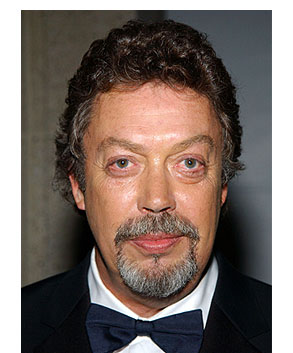
Tim Curry's hambone audio recordings of the Lemony Snicket books make these classics of mock-serious children's literature even more delightful.

  • more
    • All Share Services

A delicious voice speaks of abominable things

The most the average audiobook has to offer is convenience. You can absorb a book on tape or CD while driving, exercising, cleaning the house or doing anything else that requires your eyes to be occupied elsewhere. And the most the average audiobook consumer can hope for is that the recording won’t mess with the book too much. A reader who’s stilted or stagey, or — and this is my own pet peeve — a male reader who adopts a breathy, high-pitched voice for the dialogue of female characters can make the audio version of a good novel unendurable. If you read quickly, even an acceptably performed audiobook can feel like a frustrating slog. Plus, you can’t easily flip forward or back in the text, or skim through long passages of landscape description, the way you can with print.

But an audiobook that actually adds to an author’s work? That ideal once seemed as remote and fabulous a creature as the unicorn. Or so I thought, until a friend gave me Tim Curry’s performance of Lemony Snicket’s “A Series of Unfortunate Events #6: The Ersatz Elevator.” Mr. Snicket used to read the audio versions of his books himself, and he did a pretty good job of it, too, but recently Curry — best known for playing Dr. Frank-N-Furter in the film version of “The Rocky Horror Picture Show” — has taken over. Perhaps Mr. Snicket, who is wanted in several jurisdictions on an assortment of trumped-up charges, has found it necessary to lower his profile, or perhaps he has come to find the details of the Baudelaire orphans’ case too misery-inducing to read aloud. Whatever the reasons for this change, Curry’s recordings of the Series of Unfortunate Events are sublime, the perfect marriage of material and performer and the only audiobook I’ve heard that manages to improve creatively on the print version.

Some adults might still be wondering why they should bother with books that are, after all, aimed at children, but more than almost any other crossover literary hit, Snicket’s work is laced with treats for older readers. Each book features a pointed satirical portrait of a particular type of adult incompetence (being afraid of everything, being excessively optimistic, being overly preoccupied with what’s “in”), and for those who delight in allusions, anagrams and puzzles after the fashion of Lewis Carroll, here is your nirvana. (An impressive listing of them can be found here.) “The Hostile Hospital,” for example, mentions in passing one patient, Clarissa Dalloway, in Room 1508, “who doesn’t seem to have anything wrong with her at all,” and the latest installment, “The Slippery Slope,” has to be the only book labeled “For ages 9 to 12″ that quotes both Nietzsche and Swinburne and includes a definition of Stockholm Syndrome.

Somehow, the tone of solemn disconsolateness that so tickles young readers proves equally amusing to those old enough to have been subjected to much the same sort of thing in deadly earnest. Still, for adults not sure they want to sit down with a volume clearly marketed to readers one-third their age, audiobooks make for a happy alternative. If you’re the sort of person who insists that all your reading should be an improvement to the mind, tapes and CDs provide an out: They don’t have to pass for more than a diversion.

The best children’s books have a theatrical quality that facilitates reading aloud, yet the Series of Unfortunate Events does present some formidable challenges in that department. The narrative voice must be deadpan, of course, and Curry pulls it off, but this is the only aspect in which the author has a slight edge. There’s a faint throb of grief in Snicket’s narration, the whisper of a sigh, that Curry — who can’t possibly feel the tragedy of these events as deeply — doesn’t quite match.

The books also feature dozens of characters, and here is where Curry flourishes, creating a distinctive voice for each. (British accents predominate, but no one does a more preposterous preposterous French accent than Curry.) One in particular, the voice of the arch-villain Count Olaf, is a notable improvement on the author’s version. Snicket’s Count Olaf spoke with a migraine-inducing nasal whine — appropriately repellent, perhaps, but not exactly listenable. Curry’s Olaf is both raspy and sinuous, with a laugh of such hair-raising malevolence that Jim Carrey (set to play Olaf in the upcoming movie) will have his work cut out for him in leaving his own mark on the role.

Others are just as memorable: the oleaginous cooing of Count Olaf’s treacherous and very, very fashionable girlfriend, Esmé Squalor; his mug’s gallery of henchmen, including the Hook-Handed Man, the Bald Man with the Long Nose, the Two White-Faced Women, and the Person Who Looks Like Neither a Man nor a Woman; and the three Baudelaire orphans themselves. Curry has cast the subtlest difference between the voices of Violet and Klaus, though each is the very essence of stout-hearted resourcefulness and a certain polite, literal-minded gravity. (Sunny’s infant utterances, in a kind of coded gibberish, merit a graduate school thesis of their own.)

“The Slippery Slope” is, at six hours, the longest audiobook yet in the series. It’s a key text, revealing not only several important facts gleaned from the notorious Snicket File, but also featuring the appearance of an individual previously thought dead, the introduction of two people too menacing to name, and some wholesome transitions in the lives of the Baudelaires themselves. Nevertheless, Curry’s moment of glory so far has been the recording of “A Series of Unfortunate Events #9: The Carnivorous Carnival.”

In “The Carnivorous Carnival,” Violet, Klaus and Sunny, having stowed away in Count Olaf’s car during their flight from the burning of Heimlich Hospital, arrive at the eponymous attraction. They hope to learn more about the mysterious V.F.D. and to follow up on hints that one of their parents has survived the fire that destroyed the Baudelaire mansion. To elude Olaf’s clutches, they disguise themselves as freaks and seek employment at Caligari Carnival’s House of Freaks. Violet and Klaus occupy a single costume, pretending to be a “two-headed person,” while Sunny, covered in fake hair, is presented as someone who is “half wolf and half person,” aka Chabo the Wolf Baby.

Disguises are a key Snicket motif (this is one of the few books in the series in which Count Olaf does not attempt to pass himself off as someone like Stephano the lab assistant, Captain Sham, Coach Genghis, Günther the interior decorator or Shirley the receptionist). Silly accents come with the territory, but for Beverly and Eliot (Violet and Klaus’ fake two-headed identity), Curry brilliantly manages to create disguised voices that are variants of the voices he’s already created for Violet and Klaus. He adds to this an array of cretins among the carnival’s spectators, the perpetually stoked reporter from the error-ridden Daily Punctilio newspaper, Madame Lulu the fortuneteller with her goulash of Eastern European intonations and the orphans’ fellow residents in the House of Freaks. (In an especially amusing touch, all the wicked, misguided and contemptible characters say the word “freak” with exactly the same emphasis, a ski slope of nasty glee.) They include Colette, a woebegone French contortionist, and Kevin, who can barely choke back the tears as he describes his lonely lot as a freakishly ambidextrous person who can sign his name equally well with either his right hand or his left hand.

“The Carnivorous Carnival” is already one of the funniest Snicket books, but Curry’s performance tips it over the edge into hilarity. His propensity toward hamminess is exactly what’s required by the Series of Unfortunate Events. Sometimes, he works it hard, in the voices of a degenerate crowd demanding ever grander spectacles of “violence and sloppy eating” (specialties of Caligari Carnival), say, or in stretching Mr. Poe’s chronic cough into a near-epic expression of his inadequacies as the orphans’ financial executor. (Curry can get phenomenal mileage out of a cough or chortle.) Sometimes, he merely brings a fillip of zest to the books’ running jokes. When Curry speaks of Count Olaf’s “shiny, shiny eyes” (one of the series’ refrains) or adds a sepulchral echo to that fateful address, 667 Dark Avenue (it comes out “667 Dahhhk Avenue”), you can imagine children across the nation mimicking him with relish. And if you aren’t tempted to do it yourself, you really might want to think about lightening up a bit.

Laura Miller

Laura Miller is a senior writer for Salon. She is the author of "The Magician's Book: A Skeptic's Adventures in Narnia" and has a Web site, magiciansbook.com.

Neil Gaiman’s audiobook record label

The best-selling author talks about introducing his new, hand-picked lineup of favorite books to American ears

  • more
    • All Share Services

Neil Gaiman's audiobook record label (Credit: AP)

Neil Gaiman’s enthusiasm for audiobooks is no secret. The best-selling author has narrated many of his own titles, including “The Graveyard Book,” which won the Audiobook of the Year award (from the Audio Publishers Association) in 2009. He’s even narrated books by other authors on occasion.

Recently, Gaiman kicked his advocacy up a notch by agreeing to hand-select and produce a line of audiobooks in partnership with the audio download retailer Audible.com. Neil Gaiman Presents released its first five titles last month; they include the novel “Land of Laughs” by Jonathan Carroll and “You Must Go and Win” by musician-turned-essayist Aline Simone. Future releases will include books by the early 20th-century American author James Branch Cabell (the target of a once-notorious censorship suit for writing an “offensive, lewd, lascivious and indecent book”) and “Dimension of Miracles” by Robert Sheckley, a work Gaiman likens to “A Hitchhiker’s Guide to the Galaxy,” and which will be narrated by television personality John Hodgman.

Most omnivorous audiobook consumers have been frustrated by the relatively limited selection of available books (especially if you’re looking for something besides best sellers). Neil Gaiman Presents is part of a larger enterprise by Audible.com, called ACX (for Audiobook Creation Exchange). It aims to bring new titles to the public by hosting a service through which authors (and other rights holders) can connect with professional narrators.

“The short-term reason I got involved with ACX,” Gaiman told me, “is that there are books I love that I want to bring to the world. The long-term reason I signed up is because I want to live in a world where every book that exists has a great audiobook.” I telephoned him to find out more about Neil Gaiman Presents and why it’s been so difficult to get a wider variety of audiobooks to the ears of America’s readers.

Have long have you been an audiobook fan?

I remember at age 9 or 10 staying up to catch the BBC classic serial of “Mansfield Park” on Radio 4. They’d do 15 minutes a night. I just thought it was a great story. I had no idea who Jane Austen was.

I got my second wind when CDs started coming out. Before that, the packaging had made things so unwieldy. You’d have these huge things with cassettes in. The first giant CD thing I bought was Stephen King’s “Bag of Bones,” read by Stephen King, which was a 20-CD set. The problem with that was that they were $60 and you’d only play them once.

In 2003, I was told by an audiobook publisher I’d met that they probably had at most a year until the audiobook division of this publisher would be closed down for good. The economics didn’t work. The tragedy was that the packaging was what was killing them. Then I saw my first iPod and thought: You know, I don’t think it’s as dead as they think.

Did you always read your own work?

As long as they would let me. The ones I didn’t read, I didn’t read for a reason. I didn’t do “American Gods” because — as was demonstrated on “The Simpsons” last night — you don’t want to ask me to do even a bad American accent. You do not want a story that is meant to feel absolutely accurate in terms of place to have an English person doing his idea of an American accent.

Then there’s “Anansi Boys,” my favorite audiobook of all of my stuff, partly because I imagined [actor] Lenny Henry reading it while I was writing it. And partly because there is no way on God’s green earth that I’m going to do an audiobook that has four little old Jamaican ladies in it. I still tell people that if they like “Anansi Boys,” the real version of it is Lenny reading it. That’s the author’s preferred text.

How did Neil Gaiman Presents come about?

Basically, what Don Katz [CEO and founder of Audible.com] said to me was, “How would you like your own record label? We need a Judas goat” — actually, he didn’t say Judas goat; I did, because it’s a fun word — to lead these other authors and show them it’s not scary. And not just authors. Agents and publishers also have these rights and could be doing this.

Why is there so much hesitation?

For me, the tragedy of audiobooks is that the physical limitations and impossibilities of putting out complete novels as audiobooks in the days of LPs and then pretty much in the days of cassettes, meant that the costs and the odds were always against you. Most books aren’t out as audiobooks. If you like a book, it’s probably not been done as an audiobook.

Publishers would take audio rights but then never do anything with them. Don wants to circumvent the process. That process is that you persuade your publisher to do an audiobook and then you have no control over who gets cast, or who reads it. You have no quality control over pronunciation or goofs or anything like that. And then your publisher brings it out and then your publisher remainders it.

That is the problem that ACX was created to solve — and for me it’s also the problem that it’s highlighting. I’m hitting it more and more. All I know is that there could be lots and lots of audiobooks out there that aren’t. For years it didn’t matter that the rights were held by people because nobody could do anything anyway. But we’re not in that world anymore.

Did you start out with a list of titles you’d always wanted to see adapted? I know I have quite a few.

I had authors and titles. There’s an amazing number of them where we’re still looking for the rights. With some, I contacted the author and the author said, “Sure,” but we’re still down the rights rabbit hole with agents and publishers trying to figure it out. The first five books that have come out on Neil Gaiman Presents have simply been the first five books that were ready. I went out to a huge bunch of authors of books I liked to see what we could see.

And you found all the narrators through the ACX exchange?

In one case, I cheated and leaned on a friend. That was for “Dimension of Miracles.” It’s such a great book. There is no one who likes “A Hitchhiker’s Guide to the Galaxy” or who cares about what Douglas Adams did who wouldn’t enjoy it, but I needed a voice for it that is as iconic as Peter Jones’ or Stephen Fry’s — a voice that would have that kind of quality, but also be American.

The book begins on Madison Avenue in the early ’60s. I thought: Who could give me that iconic voice, with the urbane, American quality it has to have, and who can deadpan a joke as well as Stephen Fry or Peter Jones? So, naturally, I thought: Hodgman. And I leaned on him, which consisted of saying, “Will you do this?” He had never read the book, so was astonished by it, loved it and immediately understood why I’d asked.

Did you have a concept for the collection as a whole?

It’s very much being defined by “books I like.” The plus side of Neil Gaiman Presents is that it’s all stuff I like. The downside of Neil Gaiman Presents is that you do not have to like it too. I can’t imagine that anybody completely shares my tastes in anything. I’d love it if people tried new things.

I love the fact that I’m bringing Jonathan Carroll to wider audience who might not otherwise know his work. I’ve loved Jonathan Carroll’s work for 20-something years. But I don’t expect that everyone who likes Jonathan Carroll’s “Land of Laughs” is also going to like M. John Harrison’s “Light,” a challenging, weird work that in many ways defines what’s most interesting about early 21st-century science fiction. It’s a challenging novel and it’s not about falling in love with characters.

I imagine there are some books that will never be adapted for audiobook — like Tom Phillips’ “Humument.” But apart from that, I’d like to think there will come a day when pretty much anything that was published in prose or in poetry you can listen to.

There are those who would say that that’s not “really” reading.

I remember reading a piece by Harold Bloom where he explained that audiobooks were not books because the proper experience goes in through the eyes. The reading experience is only an ocular experience, not an auditory one. That had me sitting there thinking about old John Milton, who obviously was not a proper writer at all because he couldn’t even see what he was writing. He was dictating it to his daughters who wrote it down. What kind of a faux poet was he?

What I realize when I’m doing an audiobook is that I actually have a much closer relationship to the text than I do when I’m reading. There’s no temptation to skim. You often notice things that the author in all probability thought he or she had buried brilliantly in the text, sitting there in plain sight. I first noticed this phenomenon when I was reading Diana Wynne Jones’ books to my daughter. I normally get to the end of a Diana Wynne Jones book and think, “What just happened?” and have to flip back to figure it all out. We weren’t getting that because I was reading it aloud and everything was there for you.

Audiobooks have certainly become a lot more popular of late.

People are really busy. One of the joys for me of audiobooks is that you can do them while doing something else. I no longer have commuting time anymore. The evil nature of email is such that simple downtime tends to fill up with people needing things from me. Writing time is at a premium. I’m no longer doing many long drives.

So my reading time becomes my exercising time. I lost 30 pounds on “Bleak House” earlier this year. That was awesome.

Can you talk a bit about the importance of the right narrator, and how much that person can add to or subtract from the audiobook experience?

I remember once talking to a best selling author about audiobooks. He’d written a book that was narrated by a 20-something black male and the audiobook was read by a 50-something white female. He had no say in this and after listening to it for five minutes he stopped, feeling physically sick.

In some cases, when the author is alive and available, I cede that choice to the author. I become the production entity and I’ll cast a deciding vote if the author says it’s between three narrators he or she likes equally. If the author’s alive, I want the author happy. That’s the most important bit.

Narrators have a huge part to play. With one of the authors we’re doing for Neil Gaiman Presents, James Branch Cabell, the first round of auditions were all from actors who clearly thought, “This is a work of fantasy and there’s magic in it, therefore I have to do this in English accents and everything has to be portentous.” I listened to seven people in a row kill every joke on the page by not noticing it was there.

It was the only case in which I had to write a little essay, saying “Look, this is a cultured Southern gentleman making jokes, occasionally quite filthy ones, with a completely straight face and with gentle irony.” I listened to another four or five auditions after that and the one that made me say, “You!” was the first time it was funny. I was laughing at the jokes. Finally I could hear them.

It’s very weird. You’re listening to five people read, and one of them will make you want to hear what happens next, will make you want to keep going.

Even though it’s the exact same words. It’s remarkable how much the reader contributes.

I had something like this deciding between 17 different versions of “Bleak House.”

Which one did you end up picking?

I went with Hugh Dickson. It was the BBC version. Huge thumbs up for Hugh Dickson!

Continue Reading Close
Laura Miller

Laura Miller is a senior writer for Salon. She is the author of "The Magician's Book: A Skeptic's Adventures in Narnia" and has a Web site, magiciansbook.com.

Audiobooks for the people

A company is making recordings of the best of the small presses accessible -- and cheap

  • more
    • All Share Services

Audiobooks for the people

Omnivorous readers who use audiobooks to while away long car trips or laps around the park will eventually bump up against the form’s biggest drawback: limited selection. If you like bestsellers, self-help, inspirational books and popular genre fiction, you’re in luck. If your tastes are more adventurous, you won’t find as many eye-sparing alternatives to print and e-books. (High prices have been a barrier for many potential audiobook readers, but libraries and subscription services like Audible can take some of the bite out of those.)

For the past five years, a nonprofit called Librivox has been giving away MP3 recordings of public-domain books read by volunteer narrators. It’s a great service, especially when it comes to obscure older texts. But now that most libraries are lending out professional-quality digital recordings of such classics as “Treasure Island” or “The Great Gatsby,” the unevenness of Librivox’s performers has become a bigger stumbling block. If you can get “Alice’s Adventures in Wonderland” read by Jim Dale (whose narrations of the Harry Potter novels have made him an audiobook superstar) for the same cost as a version in which each chapter is read by a different amateur, which do you think you’d choose?

Librivox’s indefatigable founder, Hugh McGuire, however, is not resting on his laurels. Last week he announced the launch of Iambik Audiobooks, a company that sells recordings of select titles by independent small presses for the more-than-reasonable price of $4.99 apiece. (Big new releases on audiobook tend to cost somewhere between $17 to $ 30.) The books are narrated by Librivox’s best and most committed volunteers, people whose own literary interests and tastes will play a leading role in selecting which titles Iambik records. Instead of advances or work-for-hire fees, most contributors will be paid via revenue-sharing.

These are relatively new books (unlike the out-of-copyright titles recorded by Librivox) but for the most part not commercial enough to persuade a traditional audiobook publisher to spring for a full-fledged production. Some of these titles could be called experimental, like the stories of legendary writer/editor Gordon Lish; others deal with subjects that might be seen as restricting their appeal, such as Felicia Luna Lemus’ “Like Son,” about a post-punk Latina living as a man. Others are simply eccentric, like Dustin Long’s wacky Nordic romp, “Icelander.”

For all its quirkiness, this is an impressive lineup. I’ve read and can highly recommend a couple of the books on Iambik’s inaugural list: “Icelander” and “Oh Pure and Radiant Heart” by the brilliant Lydia Millet. Another, J. Robert Lennon’s eerie page-turner, “Castle,” I started reading when it first came out, but (for reasons too tedious to go into) wasn’t able to finish; I’m grateful for the chance to get back to it and find out what happens. Another, “The Impossibly,” is by a writer I’ve been meaning to check out, Laird Hunt. I’ve loved early novels by the doyen of downtown fiction, Lynne Tillman, so discovering that I can listen to her latest, “No Lease on Life,” read by an especially pleasing Librivox narrator, Karen Savage, is a double delight.

Rigorous curation is the secret weapon here. At 5 bucks a pop (except for the Millet novel, which is 6) — cheaper than a mass market paperback! — Iambik does present a great opportunity to sample the crème de la crème of the alternative press, but if the titles on offer fail to impress, the samplers aren’t going to be coming back for more. The 11 books Iambik has launched with are not brand-new; for the most part they’ve had the chance to earn good reviews and win a word-of-mouth following. Above all, they’re books the narrators have loved — enough to spend hours recording them without any guarantee of recompense, perhaps the highest recommendation of all.

Veteran audiobook listeners should bear in mind that not all of Iambik’s narrators read with the fluency and nuance of professional actors. (On the other hand, I’ve shelled out for a few traditionally produced audiobooks whose narrators weren’t notably adept, either.) If you adjust your expectations to, say, what you might hear if a good friend offered to read aloud to you, you’re less likely to be disappointed. Since with almost all of these titles the alternative is no audiobook at all, and one less opportunity to explore the work of emerging and idiosyncratic authors, I’m more than willing to meet them halfway.

Continue Reading Close
Laura Miller

Laura Miller is a senior writer for Salon. She is the author of "The Magician's Book: A Skeptic's Adventures in Narnia" and has a Web site, magiciansbook.com.

Great audiobooks for your kids

From Beverly Cleary classics to ironic robots -- the perfect soundtrack to your summer family road trip

  • more
    • All Share Services

Great audiobooks for your kids

As a child, I always wanted to read in the car during long road trips. But somehow reading in the back seat of our wood-paneled Aspen station wagon usually left me dizzy and heaving on the side of a highway. Plus my mother said it was bad for my eyes (that part might have been right, judging from my contact lens prescription).

My own children are blessed with a built-in DVD player in our minivan. But a parent can only take so many animated features during a long car ride — and so much whining and poking of little brothers. And what if we have to drive Dad’s (more, err, “rustic”) vehicle?

That’s where audiobooks comes in. OK, they’re technically not reading, but it is listening to literature read aloud — verbatim — by people who can do the voices much better than Mom or Dad, and they lack the noisy sound effects and soundtracks of most kids entertainment. Plus, there’s usually a good supply of high-quality stories available at your public library.

Here are a few of my favorites:

  • “Stories of Robots,” edited by Russell Punter: This is a collection of three short stories, read with a delightful British accent. The stories, which are about robots with surprisingly human foibles, have enough slapstick humor to be entertaining to the preschool to early elementary set coupled with a surprising dose of irony to keep the parents engaged. The publisher, Usborne Children’s Books has a whole series of these CD/Book sets, featuring the typical preschool lineup of dinosaurs, mermaids, fairies and knights, but the only other one I’ve been able to get my hands on is “Stories of Pirates.” Our family has owned the robots and pirates audiobooks for about five years and we never get tired of them.
  • Beverly Cleary classics: Ramona, Beezus and Henry were some of my favorite literary characters, even though they lived a generation before my childhood. With Neil Patrick Harris voicing many of the Henry stories and Stockard Channing reading the Ramona series, the tales from Klickitat Street come alive for my boys, who ask how it’s possible that kids are riding buses alone and knocking on strangers’ doors. These are especially a nice break from the popular eye-rolling, gross-out chapter books aimed at mid-elementary boys.
  • Modern Classics: such as Carl Hiaasen’s “Hoot,” Louis Sachar’s “Holes” or Linda Sue Park’s “A Single Shard.” I have to admit, I have not read — or listened to — these books all the way through. They were part of a CD sampler we got at our local independent children’s bookstore. All I can say is that at the time we got this disk, my older son (who was only 3 at the time) would listen rapt to to this entire CD (which also included chapters from many other Newbery Award-winning children’s books, such as “Island of the Blue Dolphins”) and ask to ask to hear it again.

Maybe I’ll have to track down “Hoot” or “Holes” (which both have nature or outdoors themes) to play on the way to one of our summer camping trips.

Continue Reading Close

“War and Peace” made easy

Finally get around to reading that classic novel this summer by listening to it instead

  • more
    • All Share Services

A friend of mine has been vowing to read Thomas Mann’s “The Magic Mountain” every summer for the past several years. Yet once he nestles into his seat on the plane or flops down on the grass in the sun, he just can’t bring himself to crack open that hefty chunk of 20th-century German bildungsroman. The handful of times he has summoned the discipline to try, he found himself falling asleep or swiping a friend’s copy of the latest Michael Connelly mystery instead. After all, isn’t he supposed to be on vacation?

Many people swear that, come summer, they’ll finally get around to reading a classic work of literature they missed during their student years; “War and Peace” is a perennial candidate. For some, this is the intellectual equivalent of using a week of paid vacation to finish a big household project, like installing a patio. Others honestly believe that a 900-page Russian novel that seemed too daunting a prospect in November will somehow be easier to scale in a hammock. Too often, these grand plans end in shirking and a vague sense of failure. “Moby-Dick” the novel becomes almost as elusive as the white whale himself.

Here’s a modest proposal: Try listening to it instead. I first turned to audiobooks because I get motion sickness from reading in cars, buses and other moving vehicles. I soon graduated to listening as I cooked, cleaned house, ran errands, worked out and, of course, drove. As someone who reads for a living, I’m eager to get out of my armchair and give my eyes a break after a long day’s work, but with audiobooks I’ve been able to squeeze in a lot of recreational reading around the edges.

Audiobooks are, furthermore, an ideal way to finally get to those bypassed literary classics. I was never going to find the time to sit down and read all 1,072 pages of “Don Quixote,” but I listened to the whole thing over the course of a month’s worth of waiting in post-office lines and doing lat pulls. With the advent of downloadable digital audiobooks and portable MP3 players, it’s possible to keep recordings of several titles on hand at all times, snatching 15 minutes of Balzac here and there. Still, a long car trip accompanied by an audio version of a Dickens or Austen novel may be the most sublime use of the form.

It’s also the most summery. Listening is less work than reading from a page; it feels like a treat rather than an assignment, and treats are what vacations are all about. If your attention goes a little out of focus during a long paragraph of 19th-century landscape description, who’s to know?

There are a few important things to understand about audio recordings of classic novels. First, avoid abridged versions, which publishers seem to be phasing out anyway. Second, be sure to check out a sample of the recording before you buy. Many of the audio classics on the market are older recordings, with poor sound quality and unappealing narrators. (I can’t recommend the Oxbridge toff who read “Don Quixote” to me, for example, though the material did transcend his performance. And whose idea was it to have an American narrate Boswell’s “Life of Johnson” — a biography of the quintessential Londoner, written by a Scot — anyway?)

A talented narrator, however, can enrich your understanding of a novel. My late-blooming passion for the work of Anthony Trollope is partly due to the performances of Simon Vance and Timothy West. Disdained by modernist critics as an uninterestingly bourgeois Victorian novelist with an overly intrusive authorial persona, Trollope is rarely assigned to college students, but he has a devoted cult among common readers. Since driving from New York to Maine, blasting “Barchester Towers” all the way, a few years back, I’ve joined it. Trollope’s novels are primarily about class and, as read aloud by Vance, each character has a voice and accent that instantly conveys his or her social background.

Able, professional actors cost money, and that’s one reason why audiobooks can be pricey. However, there are economical ways to acquire them. Audible.com, which has practically cornered the retail market, offers a tiered membership plan that dispenses a certain number of credits monthly, with each credit good for one book. You can also buy books outright, at discounted member’s prices. It’s not the simplest system in the world, but it means that you can get decent audiobooks for $15 or less. And while the Audible site is not great, especially for browsers, the company is owned by and linked to Amazon, so you can cruise for titles using Amazon’s dense database of tags and customer referrals, then easily check to see if they’re available as audio downloads.

Sites and apps offering free audiobook downloads of public domain titles almost always use recordings made by LibriVox, the audio equivalent of Project Gutenberg. Volunteers record themselves reading chapters and submit them to Librivox, who distributes the files online for free. This is a noble, selfless project, and a boon to readers with visual impairments who want access to more obscure texts. But if you’re accustomed to professional narrators, chances are you’ll find the LibriVox recordings hard to listen to; many of the readers are wooden, others are outright grating. The recordings frequently switch narrators in the course of a book, which means that even when you find a narrator you like, chances are he or she won’t be sticking around for long.

Alternatively, many libraries loan out audiobook downloads as well as CD and cassette tape sets. (There are also software programs for converting CDs to digital audiobook files for MP3 players, but the process is time-consuming and a bit of a hassle.) Libraries use a service called OverDrive which may have the single worst support documentation I’ve ever encountered, so expect to invest some time in getting it set up. The idea is that you download OverDrive’s console software to your hard drive, then you download specific titles from your library’s website and can play them via the console for a limited period of time.

I have squandered hours of my life trying to figure out why so many of the New York Public Library’s downloadable audiobooks wouldn’t transfer to my iPod. I’ll try to save other Mac users the same frustration: Be aware that much of your local library’s collection simply can’t be played on any Apple device unless the file first goes through a Windows PC — presumably due to conflicts involving digital rights management. Only those audiobooks made available in MP3 format can be borrowed by Mac users; files in the WMA format, more than half of what my library carries, will not work. An OverDrive app recently released for the iPhone is affected by similar limitations. (I can’t testify to how smoothly OverDrive works on a Windows PC, so if you’ve tried it, please post a comment and tell us what you think.)

Finally, while the selection of audiobook classics in English is respectable, translation is another matter. Russian novels usually come in the much-derided Edwardian translations by Constance Garnett. With Proust, it’s C.K. Scott Moncrieff’s version from the 1920s. More recent translations are often still under the translator’s copyright, and publishers apparently think most buyers won’t know the difference, so why pay extra for the rights? It’s often impossible even to find out who the translator is from an audiobook’s product page.

That won’t be a concern for my friend, however: The only recording I’ve been able to find of “The Magic Mountain” is abridged and in Spanish, alas. Well, there’s always next summer.

Continue Reading Close
Laura Miller

Laura Miller is a senior writer for Salon. She is the author of "The Magician's Book: A Skeptic's Adventures in Narnia" and has a Web site, magiciansbook.com.