
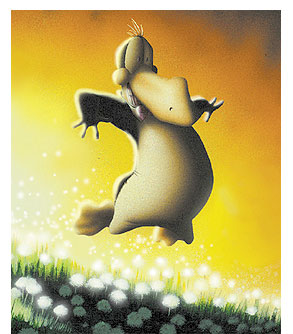
Hard facts about Berkeley Breathed are scarce. At signings for his children’s books, his only public appearances besides engagements at animal rights rallies, he seems genial. But, then, so did Samuel Langhorne Clemens, and he was a notorious son of a bitch. Their faces arrange themselves in similar ways, too, mustaches hovering over instantly familiar smiles, and you can easily imagine either one stooping to speak warmly with a young admirer. It is clear, at any rate, that no matter what he might think of anything else, Breathed loves animals and children.
They have populated his work almost exclusively since the early days of “Bloom County,” his wildly successful daily comic strip that ran from 1980 through 1989, earning him a 1987 Pulitzer Prize. They roamed the fantastically florid hills of “Outland,” a Sunday-only “Bloom County” spinoff that ran from 1989 to 1995. And they are the main protagonists of the six lushly illustrated children’s books he has published since then.
They will almost certainly also inhabit “Opus,” Breathed’s latest venture, a Sunday strip set to launch Nov. 23 in 160 newspapers nationwide. In an indication of the reader appeal Breathed is still believed to command, he has demanded (and received) guarantees that each newspaper running the strip will give him half a page in the comics section, something no cartoonist has received since Bill Watterson retired “Calvin and Hobbes.”
Opus first appears on Page 30 of the “Bloom County Babylon” anthology, as the neurosis-addled Michael Binkley announces to his father that he has adopted a “manly dog.”
“Great Scott,” his father exclaims. “That’s a penguin.”
“Is it?” Binkley responds, whirling to examine the bow-tied blob that has waddled into the frame. “Oh dear.”
The next day, watching “Mister Rogers’ Neighborhood,” Opus has his first speaking role. “Can you say ‘tuba player’?” the television host asks his audience.
“Tuphlem grdlphump,” Opus responds proudly.
“Good!” chirps Mister Rogers, from inside the box.
A few strips later, Opus had learned to speak. In the coming years Opus would develop with striking versatility, first as a foil to Binkley and friends, and later as a uniquely vulnerable low-status flightless waterfowl who among other things ran for vice president (his running mate: a dead cat named Bill), played sousaphone in a heavy metal band called Deathtongue, and ventured periodically to Antarctica in quest of his mother. His nose developed, too, from an angular beak to a truly whimsical schnoz.
What made the strips remarkable was the way Breathed effortlessly intertwined graphic ideas, concepts and gags. He regularly broke the fourth wall (or, in this case, the fifth panel), as when his characters threatened to strike if their space on the page was shrunk again. “Bloom County’s” absurdity meant that it seemed to melt the boundaries between the comics and the rest of the paper, broaching issues not traditionally associated with even the most experimental or political strips.
Since retiring “Outland,” the reclusive Breathed has devoted his time to fatherhood, work on his children’s books, and various other projects. In the past several years, Breathed has only granted sporadic e-mail interviews, including an uproarious exchange with the Onion in the summer of 2001 in which he compared comics to “the buggy whips of this millennium: quaint and eclipsed,” admitting only a “nostalgic twinge” for the medium.
As he prepared “Opus” for its maiden voyage, he agreed to communicate electronically with Salon from the Southern California home he shares with his wife and two children.
– – – – – – – – – – – –
From: Berkeley Breathed
Date: Fri, Oct 10, 2003, 1:51 AM
Subject: Fwd: salon interview
> Last we heard from you, via the Onion interview a few years back,
> the odds of you ever doing a strip again seemed pretty slim
> (to put it mildly). What changed?
The world went and got silly again. I left in 1995 with things properly, safely dull, and couldn’t imagine why anyone would feel it necessary again to start behaving ridiculously. It would have been at least courteous of the Republicans to warn a few of us inclined to retire our ink-swords that they had King George waiting in his zoom-zoom jetsuit aching to start the Crusades again.
> What are the advantages of a Sunday-only strip?
In my case, having a life. Ever see a seven-day-a-week cartoonist?
They all look like Keith Richards at 5 a.m. I’ve said that cartooning, like education and sex, is wasted on the young … but I understand why it’s that way. It’s wearing, corrosive, killing work. Consider Charles Schulz. Look where he is today.
> Again, in the Onion interview, you claimed that it was no longer possible to
> satirize American politics. In the past two years, the (visible) political landscape
> has changed considerably. Do you still believe it’s impossible to satirize?
I think there’s both a saturation point and a failure point in events being beyond satire. I started stripping in 1981, the same month that MTV started. Daily satirical comment was either “Doonesbury” or “The Tonight Show.” The horizon was clear. We had the whole playing field. You young punks just try to imagine that there wasn’t even a World Wide Web. Michael Jackson jokes passed as edgy comedy in “Bloom County.”
Now. Lord, now. The din of public snarkiness is stupefying. We’re awash in a vomitous sea of caustic humorous comment. I hope to occasionally wade near the black hole of pop references only obliquely without getting sucked in with everyone else. Full disclosure: I’ll admit that I had a momentary lapse and recently inked a strip where Opus’ mom sees a picture of Michael Jackson in 1983, proclaims Jacko’s old nose irresistible and voices an urgent wish to nibble it off down to the nub.
It took every thoughtful middle-aged fiber in my being for the courage to toss the finished strip. I did, but I wept.
Now the flip side of this is when events get untouchable. It becomes like the occasional lampoons of supermarket tabloids: unfunny because they’re mocking something that’s funnier than the satire. You can’t effectively satirize Bill Clinton getting waxed by an office vixen in the office of Abraham Lincoln. It’s done. Over. Go home. Know when you’re beat. It almost was physically painful to watch the great Garry Trudeau have to try to get a handle on it.
> What was your comic reading experience like as a child?
None. I’m sorry, I don’t know how else to put this. I watched “Wild Wild West” and collected snakes.
> Would you let your daughter anywhere near a modern comics page?
Not without those magnifying glasses you buy at the counter of Thrifty-Mart.
Your question brought me briefly back to the old days. There was a time in that hazy, sunny morning time in a bygone innocent America when a slightly off-color “Bloom County” or “Doonesbury” would hit the comic pages and the nation’s ministers would proclaim the funnies as ground zero on the cultural battleground for the morals of our youth.
Now it’s the sale rack of thongs for preschoolers at J.C. Penney. Even with “Boondocks,” the comics don’t even cause a ripple on the moral Zeitgeist anymore. This speaks poorly of where the comic page is today, by the way … which speaks volumes about why we’re bringing Opus back and why we’re demanding a half-page. Things have simply gotten far too bleak.
> Opus has existed in several mediums now — two comic strips, as well as
> children’s books, and an animated cartoon. Did transferring him to other
> mediums require you to reimagine the character at all?
Yes, regrettably. His personality often served at the mercy of the joke or story that needed telling. This makes for funny gags sometimes … but not good writing. After 15 years, I honestly didn’t think I had a handle on my marquee character: He was a cipher. Suddenly I’ve found myself curious as to what really makes him tick. I plan to explore. Or at least after we’re done transforming him into “To Kill a Mockingbird” for some real money.
– – – – – – – – – – – –
– – – – – – – – – – – –
The question is, does anybody care that an occasionally cranky “stripper” is going back to work?
If not, they should. As Willie Sutton robbed banks because that’s where the money was, it should never be forgotten that the comics page is where the readers are. For all of the astounding changes in the media, there are, according to an estimate by the Metro-Puck Comics Network, an advertising agency that represents about 200 national newspapers, still somewhere in the vicinity of 105 million people reading the comics pages on a given Sunday.
“The newspaper funny page [is] a great American story in itself,” Breathed remarked to Editor and Publisher upon “Outland’s” retirement in 1995, “shrunken in size and buffeted by new technology, still bravely resisting its own ending.” It has been a slow decline since the Golden Age of the early 20th century, when surreal masters like Winsor McKay (“Little Nemo in Slumberland”) and George Herriman (“Krazy Kat”) reigned over vast expanses of newsprint to a broad audience.
Since then, strips’ space on the page has been consistently decreased as newspaper readership has shrunk. With few notable exceptions, such as Aaron McGruder’s “Boondocks” and Garry Trudeau’s Doonesbury (from which Breathed occasionally cribbed in his early years), most strips could have been written at any point in the past 50 years. This year, “Doonesbury” and Jerry Scott and Jim Borgman’s “Zits” caused industry stirs by using the words “masturbation” and “sucks,” respectively, in their strips — boundaries crossed years ago, to say the least, in most other popular mediums.
“Kids and adults and everybody see and hear candid words on cable and in magazines, on the Web,” says Dave Astor, the features columnist for Editor and Publisher. “I think papers are much too cautious. The reason they give is that kids read the comics.” Though the term “family-oriented” is frequently applied to the medium, according to the Metro-Puck figures the 105 million comics readers break down into 75 million adults, 17 million teens and 13 million children between the ages of six and 12.
Comics not only seem a flashback to an earlier morality, but an earlier sensibility. In a relentlessly self-reflective culture, comics remain resolutely straightforward: an end node with few links back to the outside world. The Sunday pages continue to be dominated by serialized adventures (“Annie,” “Prince Valiant”), simple family foibles (“Out of the Gene Pool,” “1 Big Happy”), and wryly talking pets (“Heathcliff,” “Get Fuzzy”). A “Gilligan’s Island” reference in “The Lockhorns” passes for intertextuality.
From production (hand-drawn and inked) to distribution (via massive centralized newspaper syndicates), the whole industry feels like it belongs to an earlier epoch. In a recent Editor and Publisher column, Astor profiled the traveling salesmen who still make the bread-and-butter sales for the comics syndicates. His descriptions of sample-laden satchels and hustled deals can only strike the modern reader as weirdly romantic.
But business is no place for nostalgia. When Breathed retired “Outland” in 1995, David Shearer of the Washington Post Writers Group — Breathed’s syndicate — expressed some remorse over the fate of the strips’ sizes. “I’d like to see comics displayed bigger. We all would. But that’s not the reality of it,” he said, pointing toward electronic media as a place for artists to experiment. Ironically, with Breathed’s return, the WPWG is using that missed experimentation as a selling point. “The one and the only place to see ‘Opus’ will be in newspapers,” Shearer says. “This is a tremendous opportunity to increase circulation.”
For his part, as mentioned above, Breathed is demanding half a page for his bird. “We heard a little bit of grumbling from some editors who thought it was too much space,” says Suzanne Whelton, Breathed’s editor at WPPG, “but once they saw the artwork, they were all easily convinced that it was deserving of that kind of space. He’s really honed his talents as a painter over the past years. It really has a more painterly look than ‘Outland’ or ‘Bloom County.'”
“I don’t think a half-page ‘Opus’ is going to have a big impact,” Astor says sadly. “In the early ’90s, Bill Watterson, who did ‘Calvin and Hobbes,’ had the clout to do a half-page on Sundays. It didn’t really change anything. It didn’t lead to other comics doing that. It didn’t lead to an expansion of the comics section. Sunday papers who wanted to get ‘Calvin and Hobbes’ knocked out one or two other strips.”
Or, typically, they shrunk them — both of which some editors have already announced they will do to make room for ‘Opus.’ In that sense, Breathed might be considered a mercy killer — the suicidal stripper come to slam his foot and force others back down the inkwell whence they oozed. Given Breathed’s occasionally adversarial tone, it’s hard not to read his actions as those of a vigilante guardian.
– – – – – – – – – – – –
From: Berkeley Breathed
Date: Fri, Oct 10, 2003, 7:08 PM
Subject: Re: salon interview
> Was having more space to play with a condition of your return?
> Do you think you deserve more space than other strips? Or is this
> an attempt to encourage other strippers to demand the same?
Strips are in the tiny size and proportion that you see now to allow editors flexibility to cut the boxes apart and rearrange in psychedelic patterns all over their kitchen ceilings if they want, I guess. Bill Watterson halted this graphic slide toward nothingness several years into his strip … and the editors screamed, but went along for the most part. They thought it was safely behind them until we offered them “Opus” in only one size.
Would I like to see other strips run similarly? Good God, yes … if anyone bothers to put the work into the drawings. My drawings are going to be fun to look at or I’m going to get bored. And if readers want to see what bored cartoonists produce, take a look at much of the page. Actually, some are so bored, they’re actually dead. That’s another issue.
> It’s upsetting editors, but has it caused any major setbacks? Are enough
> papers picking up the strip?
We’ll be in all the major markets. But the size issue will initially keep us out of the majority of the nation’s newspapers unless the readers make a fuss. Boy, I’d hate to see that happen. I’d hate to see readers force editors to eliminate the comic strips marketed by corporations, widows and distant relatives long after their deceased creators pass on. What would happen to all the hacks hired by Jim Davis to write and draw “Garfield” if we were to put it out of business? Remember what they did to Mel Gibson at the end of “Braveheart”? There’s an idea.
> That said, would it be your wish to cause ripples?
As an end, controversy is a dead end. It’s why TV shows tried to throw in nudity some years ago. I notice now that the ripples de jour are lesbian kisses. It’s a sign of desperation, not good writing. Not to say that if I could figure out a way to throw in some hot lesbian action into “Opus,” I wouldn’t.
> Do you have a sense of mission with your return? Do you feel you have
> something to prove or accomplish?
There ain’t no going home again. That truth burns with a vengeance on the comic page as in does in other popular entertainment. “Bloom County” had its perfect, temporary moment during the ’80s … the only moment it would have ever flourished. My goal now is to simply have some fun — and I never really did before, oddly. If I can encourage other artists to have some fun too … then that’s about as big a mission as I’d want to claim. Actually being alive and aboveground is also an asset I’d like to encourage in more of today’s strip cartoonists.
> You haven’t read the daily comics page in a while, but I was curious if you
> followed those comics that attempt to bridge the gap between the daily paper
> and the Op-Ed section (and usually end up running in alt-weeklies), such as
> Tom Tomorrow’s “This Modern World,” David Rees’ “Get Your War On,” etc.?
I’d hate to see the funnies become a de facto editorial page, frankly. But you see more raw energy and passion in the strips that you mentioned than you would in the next 200 years of “Garfield” strips, which — by the way — have already been written by Jim Davis’ staff.
> Is it possible for the comics page to ever regain the sweeping popularity it
> enjoyed at its peak?
Well, we won’t know it if the page is forever filled with “Peanuts” reruns from 1957 and those undying vixens from “Apartment 3G,” will we? Housecleaning time, girls!
> What do you hope to achieve with a strip? A laugh? Or something more?
Something much more. A laugh from me.
> A lot of old syndicated comics used teams of artists, writers and inkers to
> produce their work. Are your strips a one-man show, or do you have help?
If you need all that help, well, you’re — Jim Davis, actually. Rich and slothful. The comic strip works best as deeply personal art and writing produced by near-insane, passionate creators. Like music and filmmaking, actually. The more hands-off it becomes, inevitably, the more boring it becomes, if not actually killable (a unique aspect to our business).
> With “Outland,” you took a whole lot of chances visually, which didn’t
> always go over too well with readers. Now, eight years later, do you
> have any game plan to balance experimentation with accessibility?
Balancing creative growth and experimentation with accessibility is the issue of the day for any artist. All I can say is that there’s nothing more populist than a comic strip. The comic page is not the place for the whacked-out Jackson Pollocks out there to ram their nutso visions down the readers’ throats … not that I haven’t tried that myself. The counterpoint to overexperimentation is being offered “Blondie” 73 years after it started. But we also have to stay interested ourselves. There’s the balance. And balance is the operative word.
> You’ve spent the better part of the last decade working on children’s
> books, where you have an extremely fine control over color and detail.
> Is it safe to assume that this is one of the reasons why that medium
> has been so attractive? If this is the case, having worked in that form, have you
> gained a different perspective on how to use the cruder boundaries of newsprint?
Painting picture books necessitated me actually learning something about art. And like a baby armed with a new box of colorful crayons and a newly painted living room wall … I’m anxious to wreak some havoc.
> What kinds of things keep you visually interested in a strip?
Emotion. Raw visible emotion. It’s virtually absent from most comics today. It flared warmly with “Calvin and Hobbes” and has mostly disappeared again. That and nudity.
> How frequently does an idea for a strip begin with a gag or punch line,
> vs. beginning with a visual idea, or even a conceptual/structural idea
> (a different arrangement of the frames, for example)?
The reality of a cartoon strip or character is vapor-thin. I doggedly decline to test that gossamer construction by discussing the characteristics of the smoke it is made of. I will go to my grave in a state of abject endless fascination that we all have the capacity to become emotionally involved with a personality that doesn’t exist.
Especially a smudgy one a half-inch high on newsprint. The power we find in our hands if we’re one of the lucky few that find that we have invented such a thing fills me with the awe that I normally reserve for watching my children sleep or contemplating the age of starlight or watching George Bush Jr. try to actually pronounce the word “to” without leaving the “o” off.
> Can a strip be socially relevant without resorting to pop-culture references?
Ya know, just reading those words “socially relevant” made me physically wince just now. Our job is to make people smile. If my cartoons stray into — I’m sorry, I can’t type them again … those words you used above — it’s an accidental byproduct in the effort to make ME smile.
> What is it you most love about the medium of the comic strip?
If the “Opus” comic strip were instead a movie, for instance, I’d have to send a memo to Bob Weinstein (when I knew he was having a good morning and enjoying his eggs) and ask if he wouldn’t mind me drawing a panel where his ass falls off while flossing too vigorously. Opus’ ass, not Bob’s. Later, I’d have to follow up with a budget adjustment requesting the funds for drawing the ass falling off. Later we’d have to cut the scene after two 14-year-old boys in Dubuque wearing pants well below their own ass wrote on their test-screening response card that the butt scene sucked.
I love comic strips because I can skip the above.
But then, coincidentally, I actually am making “Opus” into a movie right now. And I should add here that I hope Bob Weinstein understands that I’m just having a little fun and that I honestly think of him like a father.
– – – – – – – – – – – –
It may be that satire is truly impossible now. Recent so-called parodies in the Onion almost read as straight news. But in a way, “Bloom County” can be read as a forerunner to the type of self-aware flotsam that washes over the media at the turn of the century. Likewise, Breathed’s 1987 Pulitzer Prize seems an acknowledgment that the traditional boundaries of “news” had begun to blur. In 2003, that lands Breathed in Newsweek alongside other “newsmakers” such as Hollywood couple Antonio Banderas and Melanie Griffith.
You can’t go home again, though the modern comic strip might be as close as you can get. Trapped between the many streams of popular culture and the classical bounds of simple narrative, comics have essentially become contemporary dumb shows — which was always an unfortunate name for simple gestures that are so revealing.
“You know, when I was little, I didn’t know anything about politics. But I read those strips and I knew that Ronald Reagan was a bad man,” the clerk at the bookstore tells me, ringing up a used copy of an out-of-print “Bloom County” anthology, one of the many “a little mildewed from sitting at the base of all those toilets in all those bathrooms throughout America during the ’80s,” as Breathed described them to the Onion.
“They have a half-life of a flounder laying on the back porch,” he claimed. This hasn’t prevented “Bloom County” reruns from becoming among the best-selling strips on UClick.com, a subscription-based comic site. Breathed’s ’80s strips were rife with topical humor, and those references have certainly become dated. But unstable substances have a way of mutating, and — with all the historical context drained from them — “Bloom County” strips have transmogrified the ’80s, turning names like “Caspar Weinberger” into objectively bizarre monikers just as strange as any villain Little Nemo might face in Slumberland.
Separated from circumstance, one can truly begin to appreciate Breathed’s strategy of the absurd, in which human truths reveal themselves within his etched lines. Breathed doesn’t seem particularly inclined to discuss how his art works. At “Bloom County’s” peak, he would frequently cram a month’s worth of work into 90 hours, followed by a trip to the airport to put the strips — and sometimes himself, if he hadn’t yet finished them — on a plane to the syndicate in Washington. In that feverish state, “Bloom County” must have seemed like a dream, ready to slip away the next morning.
What was undoubtedly deeply personal for Breathed became instinctively so for his readers. By bridging the space between a child’s wonder and an adult’s confusion — the kinds of thoughts grown-ups contemplate after they have turned the light off, but before they have fallen asleep — Breathed did something wonderful: He individualized politics.
This is why the reappearance of a penguin on the funny pages is a profoundly good thing. If “Bloom County” and “Outland” were dream worlds, then they hit their readers early in the day, maybe over breakfast, when the pleasant haze of dreams still hung in their consciousness. And if they hit right, they might be able to pull that innocent state full into the daylight, if only for a second.
Even if Breathed resists the urge to go political with “Opus,” it’s hard to imagine him turning in anything remotely escapist. It would be ridiculous to think that Opus the penguin can change anything. But it gives one pause to think of 105 million readers simultaneously plunged into Breathed’s fantasyland for 10 or 15 seconds apiece. It might even make him smile.
