
In 1948, while running for president of the United States on the Dixiecrat ticket, Strom Thurmond proclaimed, “All the laws of Washington and all the bayonets of the Army cannot force the Negro into our homes, into our schools, our churches and our places of recreation and amusement.”
But in 1925 it apparently had taken neither legislation nor bayonet to force a 16-year-old black maid named Carrie Butler into the bed of Thurmond himself, then a 22-year-old graduate of Clemson University living with his parents in Edgefield, S.C.
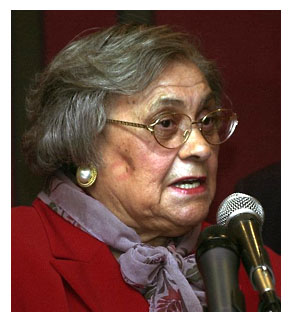
This week, it was officially revealed that the union between the former South Carolina judge, governor and senator, who died earlier this year at age 100, and his family’s teenaged maid, produced a daughter: Essie Mae Washington-Williams, 78, a retired school teacher living in Los Angeles. In a press conference Wednesday, Washington-Williams announced that she was coming forward because she decided her children, grandchildren and great-grandchildren deserved to know “from whom, where, and what they have come” and explained that the relationship between her and her father had been warm, their communication regular. Earlier this week it was reported that Thurmond had put his daughter through college and supported her financially before she was married, and after her husband, Julius, died.
Though Washington-Williams’ story garnered headlines this week, the fact that Thurmond had a half-black daughter out of wedlock has been an open secret in South Carolina, amongst Southern historians, and in Thurmond’s own Senate offices, it seems, for decades. It is also surely one of the oldest stories in America, one that Thurmond has in common with Thomas Jefferson: The powerful white man, who publicly draws sharp lines between the races, has at his own foundations a barely buried story of racial commingling. “There are many stories like [Jefferson’s slave and mistress] Sally Hemings’ and mine,” said Washington-Williams, clad in a red suit and chiffon scarf. “The unfortunate measure is that not everyone knows about these stories that help to make America what it is today.”
Thurmond’s eldest legitimate son, Strom Thurmond Jr., 31, was quick to issue a statement in which he acknowledged that there was no reason not to believe that he had a black sister 40 years his senior. He also said he would like to meet his half-sister. But why is the truth of Thurmond’s bloodlines only being reported widely now that Thurmond is dead? Why has the same press corps that was eager enough to expose the power-skewed sexual assignations of President Clinton held its tongue about a lawmaker whose interracial liaison might have changed the way his politics were received? And why has the story only come to light after Thurmond and Butler — the only two people who could have answered the thorny legal and emotional questions about consent, race and power — are both dead?
The most likely explanation for the mainstream news media’s failure to report the story (assuming they knew about it and found it credible) is the ethics rule — whether unspoken or explicit — against exposing people’s personal secrets or private lives, unless they are in a position of power and their personal life has a direct bearing on their official actions. That rule continues to govern decisions made by editors to this day. And in decades past, the news media also kept public figures’ private lives — especially their sexual peccadilloes — under a shield of decorum. The fact that Thurmond was a U.S. senator and battled civil rights legislation might have made him fair game for exposure if those battles had happened today — but they took place a long time ago.
But these explanations don’t satisfy everyone.
“I am from South Carolina,” said Randall Kennedy, a professor at Harvard Law School and author of “Interracial Intimacies: Sex, Marriage, Identity and Adoption.” “And I can tell you that every black person I have ever known in South Carolina has known about this.” Kennedy said that he had relatives who attended the all-black South Carolina State College with Washington and remembered regular, public visits from Thurmond. “He would come visit,” Kennedy said. “Take her for a meal.”
The only real surprise about the Washington-Williams revelation, according to Kennedy, is “its legitimization by the major white news organizations.”
In fact, details of the story were alluded to in print in 1996 in the Black Commentator, in 1992 in the Washington Post, and in Jack Bass’ and Marilyn Thompson’s 1999 Thurmond biography “Ol’ Strom.” But few of the Thurmond obituaries, including a 3,000-word write-up in the New York Times, contained information about the late senator’s eldest daughter.
“I wonder why was this not raised when he was alive and powerful and this might have been worth something? Why now, when he’s dead and not important, is it a story?” said Kennedy. “What, did the New York Times not know about Strom Thurmond’s black daughter?”
Essie Mae Washington-Williams only decided to come forward now, after her father’s death, because, she has said, she did not want to ruin his career by making her identity a matter of public record.
“Maybe she was ceding to her biological father’s wishes, being dutiful and generous,” Kennedy said. “A less generous way to look at it is to say that maybe she waited until he was out of the way.” Yet another way to view the situation is that Washington-Williams had been supported and paid off for her silence by her father.
“Basically this smacks of hush money that was paid to silence her,” said Stephen Wainscott, a political science professor and director of the Honors College at Clemson University, Thurmond’s alma mater.
Washington-Williams said at Wednesday’s press conference that her decision to come forward “was only at the urging of my children … I am committed in teaching them and helping them to learn about their past. It is their right to know.”
“I thought it was very interesting that it was her kids who said you have to come forward with this,” said Stephanie Coontz, the national co-chairwoman for the Council on Contemporary Families and a professor of history and family studies at Evergreen State College. Coontz pointed out that it was only in 1969 that the mother of a child born out of wedlock had the same legal rights to that child as a married mother. The fact that the offspring of Washington-Williams were the ones to push for acceptance of their identity, Coontz said, simply reflects the fact that Washington-Williams herself “was born long enough ago to have totally internalized the idea that it was [Thurmond’s] prerogative to not acknowledge her.”
“If you can’t publicly acknowledge a father, then in one sense you don’t have one,” said Dr. Alvin Poussaint, a professor of psychiatry at Harvard Medical School. “Keeping this secret was probably a major stress on [Washington-Williams] as a little girl. She didn’t have Strom Thurmond as a father in any tangible sense. He was the classic absent father — the thing they like to put on black men — and she must have felt in her heart somewhere that he didn’t love her.”
And, Poussaint continued, the feelings of rejection would not have stopped at the particulars of their personal relationship. “Here was this rabid segregationist spewing hatred toward black people, a man who in every public way was saying ‘You are inferior’ and that on some level he despises you, in the same way that Jefferson kept his children slaves. This is beyond hypocrisy; there is something sick about this stuff.”
Washington-Williams grew up during segregation — seated on the back of the bus, drinking from separate water fountains, disenfranchised in every way. And she would have been 32 years old in 1957 when her father staged a 24-hour and 18-minute filibuster on the Senate floor in a futile attempt to prevent the passage of a civil rights bill.
Poussaint raised another question about the union, more than three-quarters of a century ago, of Thurmond and his family’s maid. It’s a question that, now that both of Washington-Williams parents are dead, will never be answered. “One thing to consider is, Did he rape her?” said Poussaint. “We know at that time in history that a white man could have had a black woman for the pickings … The definition of rape down there, back then, this didn’t have a definition for black women. They were close to property, totally disenfranchised and without power; there was no one to protect them.”
In an interview on “60 Minutes II” Wednesday night, Washington-Williams characterized the relationship between her mother and Sen. Thurmond as an “affair” and said her mother remembered Thurmond as a “very nice person.”
When Thurmond and Butler conceived Washington-Williams, the age of consent for women in South Carolina was 14, so legally what transpired was not statutory rape. The union also did not break miscegenation laws of the time. According to the 1895 South Carolina Constitution, while “the marriage of a white person with a negro or mulatto or person who shall have one-eighth or more negro blood shall be unlawful or void,” and “no unmarried woman shall legally consent to sexual intercourse who shall not have attained the age of fourteen years,” there was no law prohibiting intercourse between a white man with a black woman.
And yet, the sexual politics of interracial relationships have always been legally charged. Case in point: 1942’s State vs. Thomas, in which a white South Carolina woman accused a black man of raping her. Then-Judge Strom Thurmond sentenced the man to the electric chair.
“There were dalliances between whites and blacks back to the early days of slavery,” said Wainscott. “In today’s terminology this is sexual harassment, Exhibit A. But it has been a historical and cultural ethic for slaves to perform sexual services for their white masters and to receive in return less harsh treatments and favors. Obviously in 1925 we’re not talking about a slavery situation but about a social caste system.”
Bruce Ransom, Wainscott’s colleague in Clemson’s political science department, agreed: “These liaisons weren’t something that was just among the run-of-the-mill white population, but among those who were the leaders. Those who helped define the policies and enforce the policies — those who separated the races — were on a personal level somehow involved in relationships or sexual liaisons that crossed the line.”
Noting that Thurmond seems to have confided the truth about his offspring to his friends and some of his staff, Wainscott said: “People like George Wallace and Gene Talmadge may have had similar dalliances. But something tells me they would have absolutely pulled out all the stops to keep that information from ever being known. Most of his ilk — the unreconstructed segregationists, probably would not have confided in their friends. They would probably have had this kind of secret buried with their bodies.”
Thurmond, however, was reconstructed, at least to some extent. He was one of the first Southern senators to hire an African-American aide, and in 1983 supported the creation of a national holiday to honor the Rev. Martin Luther King Jr. “He was ahead of his time in raising his finger to the wind and realizing that times were changing,” said Wainscott — though the times did not change enough for him to publicly acknowledge his mixed race offspring before his death.
The 54-year-old Ransom remembered hearing first about Thurmond’s black daughter from one of his father’s friends when he was around 10 years old. “Over the years the official word was denial that such a daughter existed,” said Ransom. “But in the community and on the street, even without hard evidence, there was a belief that this did happen.”
It happened so much, in fact, that stories like Jefferson’s and Thurmond’s litter American culture. Julia Stern, a professor of American literature and culture at Northwestern University, and an expert in the novels of William Faulkner, said: “This is the nation’s founding story.”
Well, it’s Essie Mae Washington-Williams’ story now too. And whatever else she’s seeking — closure, identity, legitimacy — it seems her admission has also provided her with the most fundamental of American ideals: “I am Essie Mae Washington-Williams,” she said at the end of yesterday’s press conference, her voice breaking. “And at last, I feel completely free.”
