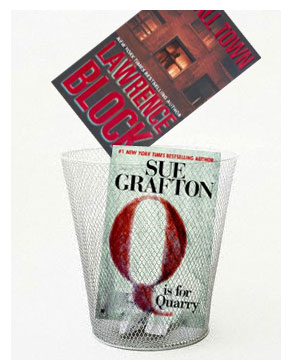

Mysteries

The case of the overrated mystery novel

Robert Parker, Dennis Lehane, Lawrence Block, Michael Connelly -- I've read them all. Amid the logrolling and endless hype, one thing gets obscured: Raymond Chandler and Ross Macdonald did it first, and did it a lot better.

  • more
    • All Share Services

The case of the overrated mystery novel

Edmund Wilson’s 1945 New Yorker essay “Who Cares Who Killed Roger Ackroyd?” (the title referred to Agatha Christie’s 1926 novel “The Murder of Roger Ackroyd”) more or less demolished the “classical” country-house murder mysteries of Christie and her school. The series detective novel took its place, and today it rules the realm of crime fiction. These books provide pleasure to many loyal fans, which is all to the good. What’s not so good is the inflated critical reputation of the better writers, and of the genre as a whole. The American detective novel may be commercially viable, but it is devoid of creative or artistic interest.

It took me a long time to realize this. I got started in this genre in 1969, after reading Eudora Welty’s rave review of Ross Macdonald’s “The Goodbye Look” on the front page of the New York Times Book Review. I got my parents to drive me to the library, where I took out the novel. I found myself in agreement with Welty, and went on to read nearly all of the rest of Macdonald’s novels, which featured and were narrated by private detective Lew Archer. The books worked on multiple levels. As I learned when I later read the greatest worker in this field, Raymond Chandler — who was at his artistic peak at the time of the Wilson essay — Macdonald kept the sense of the private eye as a flawed knight patrolling the mean streets, but toned down the emotional volume and the verbal extravagance: Chandler averages one simile a paragraph, Macdonald one a chapter. What the latter writer offered, more than his literary mentor, was, first, coherent plots; second, an almost journalistic interest in the social and economic strata of contemporary Los Angeles; and, third, a consistent and compelling theme: the power of the past to influence the present.

I can’t prove this, but it seems to me that the Welty review started a trend: taking a detective writer and anointing him or her as not just a pulp writer (not just a Mickey Spillane) but a purveyor of literature (a Chandler). Such claims were made every year or two, and I dutifully tried each one out. I think the first was Robert Parker. His Spenser books — I read three or four of them — were pleasant enough. But they weren’t in Macdonald’s ballpark, and not in Chandler’s sports complex. Some of the observation of behavior and relationships was OK, but what I seem to remember most was a lot of posturing. I went on to the next writer. And then — like Charlie Brown kicking the football — to the next.

Each time I’d prowl bookstores and libraries and pick the detective books with the best blurbs. And some have amazing blurbs — five or six pages of them in the front of the paperbacks, declaring that the book is brilliant or unforgettable or a classic. Sometimes I’d have a slip of paper in my wallet with a recommendation from Janet Maslin, who’s inherited Christopher Lehmann-Haupt’s habit of devoting a few New York Times columns a year to surveying the best of the best detective novels. In this way I made my way through Sue Grafton, Elmore Leonard, James Lee Burke, Lawrence Block, Tony Hillerman, Jonathan Kellerman and a half-dozen others. Sometimes, as in Leonard’s case, I truly admired the writer’s skill. (I list him as a series writer even though his lead characters have different names. But they are the same guy.) But whether I stayed with the writer for two or three books (Block and Kellerman, who with his sympathetic child shrink, Alex Delaware, follows Macdonald just as Macdonald followed Chandler) or barely was able to finish the first, I always ended up disappointed.

The problem, I came to realize, is that all detective series seem to require two items that run counter to literary values and that, no matter what the author’s skills (clean prose, social or psychological observation, plot construction), will artistically doom it. The first is the main character, who is invariably romanticized or sentimentalized and who is always a combination of three not especially interesting things: toughness, efficacy and sensitivity. (When the writer resists applying any or all of these traits, the character ends up being bland.) The second is the very formulaic quality that lets a book be part of a series. Similar things happen in similar ways, which is probably as apt a definition as you’ll ever find of how not to make good literature. Chandler — not to mention Arthur Conan Doyle — got away with it because he was a genius and an original, Macdonald because he was gifted and started early in the day. Their successors have no such luck.

I’ve generally been able to resist football-kicking lately, but earlier this year, I was in an airport with nothing to read. So I bought the book with the best blurbs — “City of Bones” by Michael Connelly, whom Maslin had recently hailed. For another long plane ride a bit later, I picked up S.J. Rozan’s “Winter and Night,” on the cover of which was a quote from Dennis Lehane: “To read S.J. Rozan is to experience the kind of pure pleasure only a master can deliver.” Inside I found the following from another much-praised writer, Robert Crais: “S.J. Rozan paints with the full palette of the human heart, using depth, detail and nuance of character that I haven’t seen since Raymond Chandler. (Yes, I mean it.)” One thing that characterizes the current valorized crop — which also includes George P. Pelecanos and Harlan Coben — is a lot of logrolling in the blurb department.

It turned out that the admiration for these books went beyond blurbs. Unbeknownst to me, “Winter and Night” had already won the Edgar Award (given by the Mystery Writers of America) as the year’s best novel. Then, this past fall, at the Bouchercon convention for fans, writers and editors of mystery books, “City of Bones” won both the Anthony and the Barry awards as best novel of the year, and “Winter and Night” won the Macavity Award for best mystery novel.

These two books’ sweep of the accolades seals the case. To start with “City of Bones,” the best way I can characterize it is with an oxymoron: amazingly ordinary. The detective, Hieronymus “Harry” Bosch of the Los Angeles Police Department, is a knight of the Chandler-Macdonald school, without any notable individuality or insight. He tries to do the right thing, despite roadblocks of various kinds in his path. In a perfunctory way, he gets the girl, despite being twice her age. He solves the mystery, which turns out to be neither surprising nor interesting. The girl dies, gratuitously. Harry broods over that, and also whether to quit the LAPD because it is a dehumanizing bureaucracy. He does. End of book. It was a competent piece of craft and a painless enough way to kill a few hours, but nothing more.

Connelly has since published another Bosch book, “Lost Light,” and the first few sentences of the (glowing) Publishers Weekly review tell me all I need to know: “Even though this marks the ninth outing for Harry, the principled, incorruptible investigator shows little sign of slowing in his unrelenting pursuit of justice for all. Disillusioned by his constant battle with police hypocrisy and bureaucracy, Harry quits the department after 28 years on the job. Like so many ex-cops before him, he finds retirement boring: ‘I was staying up late, staring at the walls and drinking too much red wine.’ He decides to take advantage of his newly minted private-eye license and get back to work.”

“Winter and Night” turned out to be as negligible as “City of Bones,” but more annoying. Although the setting is New York rather than L.A., and the main character a classical-piano-playing private eye (Bill Smith) rather than a cop with a saxophone, it’s driven by the same warmed-over angst: It’s just that Rozan’s pathetic fallacy involves cold overcast days instead of Connelly’s smog and Santa Ana winds. (The Boston Globe called the book “very well-written, displaying Rozan’s ability to describe place and weather.” I don’t know about you, but I’m always in the market for a good weather novel.) The book is overlong (388 small-print pages), overwritten and overly dependent on the convention of moving the plot by means of cellphone calls, and on bits of business involving preparing and drinking coffee and lighting and smoking cigarettes.

Unusually for this genre, the novel, much of which is set in the all- or mostly male worlds of high school football teams and police departments, has an agenda, or at least a thesis, having to do with the burden of violence that all men must confront and deal with. This is at least arguable, but Rozan, who is female, has no clue how males talk among themselves. She seems to have gotten her ideas about this from observing the conversations of 10-year-old boys. That is, her guys swear at roughly the rate of every fourth word and always address each other by their last names.

Here’s what one character says after Smith points out the Harvard diploma on his wall:

“Harvard fucking Law. Rutgers undergrad, where I worked my fucking ass off to get into fucking Harvard. Because I was going to goddamn be somebody, Smith.”

We can be thankful that Chandler and Macdonald are not alive to read that nonsense. I am, however, and it has strengthened my current resolution that even if the blurbs glow with the intensity of the midday sun, I am off these books for good.

Ben Yagoda is the author of "About Town: The New Yorker and the World It Made" and the forthcoming "The Sound on the Page: Style and Voice in Writing." He directs the journalism program at the University of Delaware.

A sex traffic mystery

A new horror novel delves into the dark corners of the Internet as it investigates a girl's murder

  • more
    • All Share Services

A sex traffic mystery

Nobody concludes a novel quite the way Mo Hayder does: with a revelation that leaves the reader staring at the page, poleaxed, willing more words to appear or flicking back to see just how she did it. Hayder’s astonishing 2007 horror novel “Pig Island,” for example, ended with the stunned narrator, framed for murder, watching his nemesis depart and “something coiled and dark, like smoke or a spirit, lifting itself out of the car and hovering near the roof…” Now, on the final page of “Hanging Hill,” a mother lovingly watches her young daughter and a friend drive off to the Glastonbury Festival. “The van turned left. Not right, the way she would have gone…. Leave them alone, she thought…. You just can’t go on worrying about your children for ever.” Worrying: a quaint, domestic impulse; utterly redundant in the terrifying world that Hayder creates.

Barnes & Noble ReviewHere, as always, a Hayder plot that seems straightforward is masterfully skewed. In Bath, England, Lorne Wood, a privileged teenage beauty, is found horribly murdered beside a canal. Detective Inspector Zoe Benedict is led, by instinct as much as evidence, to suspect a connection to the sex trade and Internet pornography, a realm that Hayder evokes in all its dankness. “[M]ost of the time they’re doing it because it’s easier than standing behind a till at Top Shop for eight hours a day,” one avuncular pornographer tells Zoe of his “models.” Less benign are fetishistic practices “all about humiliating the woman.” As one jaded dame explains, this is what sells “by the shedload … Makes you wonder about human nature, don’t it?”

Zoe doesn’t wonder anymore. She has seen too much. And she has secrets of her own. But that is another story, one of a handful that Hayder expertly steers on parallel tracks as she shunts the murder investigation forward, then makes it stall or veer, all the while heightening our sense of dread. While Zoe courts danger by revisiting her past and pursuing Lorne’s likely killer, Zoe’s estranged sister, Sally, becomes the housekeeper for a nouveau-squire who exudes criminality and violence. Divorced, somewhat clueless, and mother to teenage Millie, Sally has little choice. She does, however, have a shady lover who reveals that Sally’s employer is involved with the Ministry of Defense, the UN mission in Kosovo, and sex trafficking.

These are filaments that flicker at the periphery of our anxious vision while Zoe and Sally demand our attention. Especially Zoe, who, like many female Hayder protagonists, is both wounded and feral. Slumped in a toilet cubicle, for example, her own blood dripping onto the floor, she resolves to “…take some time off work…. Sleep rough and drink Guinness out of the can.” Fueled by desperation more than courage, Zoe is as startling as the cinematic action scenes that Hayder so expertly stages. Shocks intensify — a nail gun comes into play, a body is dismembered, foul sex committed — while the tidal pull of Hayder’s intersecting narratives churns up tangled evidence that could incriminate Sally’s vile employer, a local drug dealer or a lovesick teenager. Toward the end, the sisters traverse moonlit farmland — “Two lonely figures casting long blue shadows…feet shushing the dead corn” — to confront Lorne’s killer and the final horror. Which is not, of course, the end at all.

Continue Reading Close

National Review asks why Obama reads critically acclaimed fiction instead of Jonah Goldberg

Conservative "intellectuals" examine the president's vacation book list -- and become concerned

  • more
    • All Share Services

National Review asks why Obama reads critically acclaimed fiction instead of Jonah Goldberg

Barack Obama is reading gritty rural neo-noir by an acknowledged master of the crime fiction genre, and the National Review is not happy with him. The president bought Daniel Woodrell’s “Bayou Trilogy,” along with a number of other novels, at a Martha’s Vineyard bookstore, and Tevi Troy, a “senior fellow at the Hudson Institute and a former senior White House aide” (“senior fellow at the Hudson Institute” means “minor Republican apparatchik in need of a paycheck while his party’s out of power”) is analyzing the president’s reading list for you.

The reports are in about the books President Obama is looking at on his annual trip to Martha’s Vineyard. According to reports from the Los Angeles Times and the AP, Obama purchased five books on his trip to the Vineyard bookseller Bunch of Grapes: Marianna Baer’s Frost, Aldous Huxley’s Brave New World, Daniel Woodrell’s Bayou Trilogy, Emma Donoghue’s Room, and Ward Just’s Rodin’s Debutante.

The second wave came when, according to Alexis Simendinger, White House aides listed for reporters the three books Obama brought with him to the Vineyard: two more novels — Abraham Verghese’s Cutting for Stone and David Grossman’s To the End of the Land — and one nonfiction work — Isabel Wilkerson’s The Warmth of Other Suns: The Epic Story of America’s Great Migration.

This “may constitute the oddest assortment of presidential reading material ever disclosed,” according to Troy. Because Woodrell’s books may be almost universally praised, but they are genre fiction, and genre fiction is too trashy for presidents to read. “Bill Clinton, for example, used to love mysteries, but he did not advertise the titles of what he once called ‘my little cheap thrills outlet.’” Even Bill Clinton knew better than to tell people he read books with crimes in them! (Can you imagine if Barack Obama was found to be hiding the fact that he read crime fiction? IMPEACHMENT.)

Also one of the novels is by an Israeli author, but it is by an Israeli author who criticizes Israeli policy, proving once again that Obama is no friend of Israel. “[R]eading this novel will likely not assuage those concerned about Obama’s views on the Middle East,” says Troy, and he should know, because he is the one using it to attempt to score an insane political point.

The best part (noted by Matt Yglesias) is when Troy asks why this bookstore’s online store doesn’t list horrible books written by National Review contributors as “in stock.”

Obama, like other Democratic presidents, has tended to read mainly liberal books, although he could stand to gain some insight from conservative ones. There could be many reasons for his selection bias, but buying his books at the “legendary” Bunch of Grapes probably is not helping matters. While I have never had the pleasure of shopping there, the store’s website highlights a variety of its offerings, with nary a conservative work. There may be some on the shelves there somewhere, but they are probably not staring Obama in the face when he visits the store.

According to the results of my completely unscientific survey of Bunch of Grapes’s website, Laura Ingraham’s Of Thee I Zing, Jonah Goldberg’s Liberal Fascism, and Mark Steyn’s After America were listed as available for online ordering. Thomas Friedman’s Hot, Flat, and Crowded, which appeared as an Obama book selection twice, in 2008 and 2009, was listed as “In Stock.” This is not meant as a criticism of the bookseller; Bunch of Grapes is running a business, and they need to cater to the liberal crowd at Martha’s Vineyard in order to bring in customers. At the same time, if Obama wants to diversify his reading selections, Bunch of Grapes may not be the place to go.

Why would Bunch of Grapes stock Emma Donoghue’s “Room,” a novel Aimee Bender called “truly memorable” and “remarkable,” when they could stock Jonah Goldberg’s “Liberal Fascism,” a book that the American Conservative says “reads less like an extended argument than as a catalogue of conservative intellectual clichés, often irrelevant to the supposed point of the book”? Liberal bias, that’s why. Liberal fascist bias.

Anyway, the president is “out of touch” and “in a bubble” because he can read, according to a conservative intellectual, at a “think tank.”

Continue Reading Close
Alex Pareene

Alex Pareene writes about politics for Salon and is the author of "The Rude Guide to Mitt." Email him at apareene@salon.com and follow him on Twitter @pareene

The latest “Game of Thrones” casting news

Gwendoline Christie, Natalie Dormer join with houses of Tarth and Tyrell

  • more
    • All Share Services

The latest British actress Gwendoline Christie, a new "GoT" cast member.

George R.R. Martin’s blog, “Not a Blog” (it’s a LiveJournal), posted a cryptic message yesterday, about bunnies and Aussies and barbicans.

Since the tag was “Game of Thrones” and “HBO,” the collective Internet began salivating as it tried to unravel the mystery. Surprisingly, some people got it.

Turns out all these references were clues about the casting of Brienne, Maid of Tarth, a character that appears in the second “A Song of Fire and Ice” book. British actress Gwendoline Christie snagged the coveted role of a woman described as “piggish” and “awkward” in the books, who is mocked with the nickname “Brienne the Beauty” because she is well … not.

Christie however, is quite a looker, though I see where Martin saw the female knight in her: The actress is 6’3.

Martin revealed the meaning of his riddle later that night:

As for my clues … Christie played in a music video called DAMARIS, which includes a song about Isabelle, the She-Wolf of France (wife of King Edward II, for the history nerds out there), and played in Shakespeare’s CYMBELINE at the Barbican theatre. She also posed for Australian photographed Polly Borland for a show called “Bunny.”

She also appears in the recent Imaginarium of Doctor Parnassas, though I did not use that one in my clues.

Here’s Gwendoline in action, in a (very) short NOMAD film called “Ourhouse.”

Oh yeah, she’s going to be great.

An earlier announcement has pegged “The Tudors” actress Natalie Dormer to play 16-year-old Margaery Tyrell.

Continue Reading Close

Drew Grant is a staff writer for Salon. Follow her on Twitter at @videodrew.

Pick of the week: A natural-born Romanian killer

Pick of the week: From the Romanian New Wave's greatest director comes the inside-out murder mystery "Aurora"

  • more
    • All Share Services

Pick of the week: A natural-born Romanian killerCristi Puiu in "Aurora"

It’s tough to say where Romanian director Cristi Puiu’s dark and mesmerizing new film “Aurora” ranks on the “cultural vegetables” scale. On one hand, it’s a bone-dry existential comedy, or perhaps a reverse-engineered murder mystery, that runs almost three hours and is far more concerned with capturing the rhythms and rituals of everyday life than with delivering a plot. On the other hand, “Aurora” tells an inherently dramatic story about the moment when an ordinary guy snaps the tether, goes out and buys a gun, and proceeds to wreak bloody vengeance on the world. This is something like “Falling Down,” that Joel Schumacher movie with Michael Douglas, as remade by Andrei Tarkovsky or Chantal Akerman.

In the first sentence above, I’m referring to a recent kerfuffle among film critics that began with a New York Times Magazine article by Dan Kois and continued with responses by Times critics Manohla Dargis and A.O. Scott and numerous others (including yours truly). This included various allegations of crimes against art and totalitarian groupthink, along with unhelpful discussion of the meaning of the word “boring.” Thankfully, the schism that was conjured up between intolerable art-house snobs and lightweight slaves of Hollywood is mostly imaginary. Hardly anyone who cares about cinema only likes one kind of movie, or judges every movie by the same standard. Right now, I’m suggesting that you should catch “Aurora” (with the parenthesis that it’s not going to be everybody’s cup of bitter Romanian coffee), and I’d say almost the same thing, with slightly more apologetic eye-rolling, about “Transformers: Dark of the Moon.”

Still, that debate provided an interesting background for “Aurora,” which I found to be a gritty, atmospheric and nerve-wracking work that powerfully evokes the disordered mental condition and depressed surroundings of its middle-aged protagonist (played by Puiu himself). I totally get that the idea of watching a three-hour film in Romanian is daunting, but once I adjusted to Puiu’s rhythms I was fully engaged. That said, if you go in expecting a conventional mode of narrative and explication, where every scene advances us further into the plot in some specific way, and you understand who all the people are and how they relate to each other, then this movie will frustrate you and drive you completely freakin’ nuts.

As in the film that made Puiu’s international reputation, “The Death of Mr. Lazarescu,” the narrative of “Aurora” is turned upside-down, or maybe inside out. The earlier movie tells us what’s going to happen in the title, and then we don’t, in fact, witness the death of Dante Lazarescu, only the entirely ordinary day full of quarreling neighbors and distracted nurses and mechanical malfunctions that’s going to be the last one of his life. Instead of the intense subjectivity of most movies, where the hero’s trials and tribulations become the focus of heightened and artificial drama, Puiu pulls back to a more objective view, reminding us that momentous events in the real world don’t come with a pulsing soundtrack or a temporary suspension of the universal tendency toward entropy.

Puiu’s character in “Aurora,” who we eventually learn is named Viorel, may be having a worse day than Mr. Lazarescu, if that’s possible. A taciturn and nearly affectless fellow of 40 or so, he skulks through the streets of Bucharest, by car and by bus and on foot, with a haunted look in his eyes. Viorel appears to be a family man, at least in the deceptively calm opening scene, but things have evidently gone wrong somehow (and trust me, it’s not worth trying to figure it out). He appears to be following a blond woman (not his wife) with small children, although we don’t know who they are; he has fragmentary conversations we can’t hear or can’t understand; he acquires a shotgun and some ammunition and spends some time considering suicide before deciding on, shall we say, a more extroverted path. But the startling eruptions of violence in “Aurora” are momentary, and occur either outside the frame or deep in the middle distance. They emerge from a life full of other things: Even as Viorel is noticeably sliding into insanity, he haggles with movers, stands in line at the deli, collects some ironed shirts from his mother, has a testy exchange with his stepfather and a cordial one with a neighbor over water damage accidentally caused by an enthusiastic kid in the bathtub.

Puiu’s films belong to a recognizable tradition of Eastern European social comedy, and depict post-Communist Romania as a place where everybody feels aggrieved at everybody else and where nothing can ever happen without a great deal of pointless argument and defensive grumpery. In a way, that’s the joke of the film, that even a guy going on a killing spree has to navigate the tremendous hassle of Romanian society, and that nobody much cares. I don’t think Puiu is blaming Romania’s depressed and contentious national mood for Viorel’s crimes, exactly; Americans are all too aware that this sort of thing can happen anywhere. Mordant, anti-psychological and masterfully shot (by Viorel Sergovici), “Aurora” is both a mystery and a mysterious accomplishment. It may demand multiple viewings, both to understand a bit more about what’s going on and also, if you get me, to figure out what the hell is going on.

“Aurora” is now playing at the IFC Center in New York, and will open Aug. 27 at the Harvard Film Archive in Cambridge, Mass., with other cities and dates (and home-video release) to follow.

Continue Reading Close

Heiress’ long-hidden art will go on display

Huguette Clark hoarded works by Monet, Renoir, and John Singer Sargent -- and in her will, has started a museum

  • more
    • All Share Services

Heiress' long-hidden art will go on displayFILE - This Aug. 11, 1930 file photo shows Mrs. Huguette Clark Gower, daughter of the late Sen. William A. Clark of Montana, a copper magnate, in Reno, Nev. Clark, the 104-year-old heiress to a Montana copper fortune who once lived in the largest apartment on Fifth Avenue, died Tuesday, May 24, 2011, at a Manhattan hospital even as an investigation continues into how her millions were handled. (AP Photo, File)(Credit: AP)

Mysterious multimillionaire Huguette Clark was born into privilege and died, more than a hundred years later, in almost total solitude. While there was plenty of interest in her death last month, very little information could actually be reported: She hadn’t been seen in public for decades, and few could guess what might happen to her $400 million fortune and uninhabited luxury properties in California, New York and Connecticut.

In her May obituary, the Los Angeles Times described Clark as “a copper tycoon’s daughter with a taste for exquisite French dolls, baronial homes and solitude;” the New York Times labelled her “the last link to New York’s Gilded Age” — a relic from “the city’s glory days of Astors, Guggenheims and Vanderbilts.” Clark had been raised in a different world, and (or so the papers implied) she seemed to have stayed there, isolating herself from the twenty-first century and its inhabitants.

Indeed, Clark might have died in relative obscurity (as much obscurity as someone worth $400 million can achieve, at least) had it not been for several MSNBC features published last year, including one that questioned the motives of those who cared for the heiress, asking provocatively: “Who protects an old lady who secluded herself from the world, limiting her life to a single room, playing dress-up with her dolls and watching cartoons?” The piece ignited interest in Huguette, ensuring that plenty of eyes would be trained on her estate in the instance of her demise.

Now that Clark has died, questions about her estate and vast personal holdings are finally being answered. The heiress’ will was released this week — you can read the entire document here (pdf), courtesy of the New York Post — and it has some interesting bequests.

Part of Clark’s immense estate will be used to start a new fund, the Bellosguardo Foundation, “for the primary purpose of fostering and promoting the Arts.” The showpiece of the foundation will be Bellosguardo itself: Clark’s grand California home, set on 23 acres and reportedly worth $100 million. The property will be made into a museum — filled with art (including paintings by Renoir and John Singer Sargent), musical instruments (including a Stradivarius), and rare books, all moved west from Clark’s kingly 42-room Fifth Avenue apartments. Clark herself had apparently not visited Bellosguardo “for at least 50 years” before her death; now, the house will likely attract large crowds.

Not all of Clark’s art will go to the California estate, however; a $25 million Monet — one of the “Water Lilies” paintings — has been left to Washington, D.C.’s Corcoran Gallery, which already has a wing named after Clark’s senator father (and owns his 775-piece art collection).

As to the people who will personally profit from Clark’s will — including, prominently, the heiress’ longtime nurse — The Atlantic Wire has assembled a handy cheat sheet. Clark left nothing to her relatives, whom her attorney, Wallace Bock, says she “knowingly and assiduously avoided” over the years.

One million dollars will be split between Bock himself and Clark’s accountant, Irving Kamsler, both of whom fell under suspicion for mismanagement of Clark’s wealth when last year’s MSNBC report was released. “The Manhattan district attorney’s office is investigating how Mr. Bock and Mr. Kamsler have handled Mrs. Clark’s money, according to a person briefed on the case who spoke on the condition of anonymity,” The New York Times reported Wednesday.

Continue Reading Close

Emma Mustich is a Salon contributor. Follow her on Twitter: @emustich.

Page 1 of 17 in Mysteries