
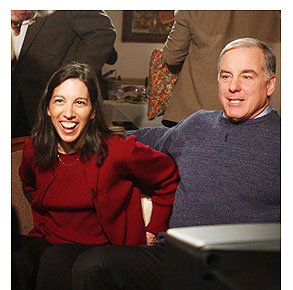

Last night Dr. Judith Steinberg Dean was finally, inevitably wheeled out for closer inspection by the nation’s television audience, in an ABC “Primetime Live” interview with Diane Sawyer that had been hastily thrown together in the preceding 24 hours. It seemed sad that it had come to this so soon — that America couldn’t wait even a few more weeks to set its eyes and sink its teeth into the woman who has dared to say “No thanks” to the idea of trading her medical practice and home life for a ride on the Dean campaign bus. Steinberg Dean has staunchly refused to sacrifice her Vermont patients or the time with her 17-year-old son for the excitement of her husband’s presidential bid, which until recently had been shaking with the energy of a Bruce Springsteen tour.
The television interview followed her surprise cameo in Iowa the day before the Dean upset, when it had looked as though it might have required the jaws of life to pull her from her examining room and deposit her on the podium. But on television for the first time last night, Judy Steinberg Dean — forced to perform the humiliating task of introducing herself, explaining away her enthusiasm for her own career, and affirming for all of America that, yes, she does love her husband — acquitted herself quite beautifully.
It was 12 years, practically to the day, since Bill and Hillary Clinton had performed the same sort of public service for voters, appearing together on “60 Minutes” to explain away some nasty floozy rumors. Even Diane Sawyer felt compelled to make this meta-media comparison, asking the Deans whether this was a strategic repeat of that “Stand By Your Man” episode. (Note to Diane: ix-nay on the media transparency. Just smile big and remember that you kicked Couric and Walters’ asses on this one.) But the vast divide between the Deans and the Clintons was clear as soon as ABC flashed a few seconds of that 1992 interview. There was dowdy old head-banded Hillary, sitting a chilly inch-and-a-half from her sexy hangdog husband. But wow, that un-chic Wellesley girl looked like a teal-clad, heavily rouged Baby Jane when flashed next to the comfy Doctor Judy, snuggled in a red sweater under her husband’s arm.
Steinberg Dean is toothy; she doesn’t seem to use much hair product; her face shows her age. It was both fun and horrifying to imagine her dismay at being set on by a team of eager ABC makeup artists, dying to go where only Noxzema has been before. It was also sad to watch her being forced to look at a photo — the only photo? — of Laura Bush in evening wear. Sawyer, who didn’t even bother to disguise her doubts, wondered aloud how the doctor might feel about having to dress up or look pretty in public.
But when Steinberg Dean opened her mouth to reassure Mrs. Mike Nichols, who was pretending to be confused about that crazy “feminist who uses her maiden name professionally and her married name personally” thing, “I’m Judy Dean,” it was clear that Judy was going to be just fine. Yeah, her voice is nasal and straight out of Long Island. She sounded like my mom’s best friend Diane, or as one friend said, “she’s like my gynecologist from high school.”
For someone who has never been in front of the camera before, she was remarkably cool. She giggled, and smiled a warm grin that lit up her whole face, exposed her healthy overbite, and had nothing in common with the icily perfect smiles of Elizabeth Dole or Nancy Reagan. She knew to look at the camera steadily; she didn’t stammer or stutter; when she spoke to or about her husband, she looked at him. When cornered about whether or not he was “overcoming his reluctance” to ask his wife to join the campaign trail, he said he’d done that when he asked her to come to Iowa; he said he’d noticed that she’d actually had an OK time, and it looked like she agreed with him.
Dean should have been nervous about trotting this shy, untrained fawn into the blinking TV lights. He should have been worried that she would screw up; he should have been eager to maintain control of the interview. But he didn’t interrupt her — he let her talk until she was done with whatever she had to say. He looked at her with respect, nodded in agreement, and always checked to see if she had something to say before beginning to speak himself. It was clear that Howard Dean trusted his wife.
None of Judy’s answers was exactly polished, or particularly politic. She confessed that the YEEEARGH! tape “looked kinda silly.” And when asked why she’d decided to appear, instead of announcing that it had been her idea, she honestly replied, “Howard asked me to do this interview.” But her lack of savvy made her other declarations, like, “I’m not a very ‘thing’ person” — after being unaccountably quizzed about having accepted and been pleased by a rhododendron from Dean on her birthday — ring true, even for the most cynical viewer.
As for the squashed cupcakes and family bike rides: I think we have no choice but to believe the Deans. Who would make up something so deeply geeky? And seeing the good doctor walk and talk makes it clear that this is not a wife who is going to take to media coaching. Can you see her before the interview, surrounded by a pack of cutthroat campaign advisors, urging her, “Whatever you do, bring up the cupcakes!”? No, I think it’s fair to say that every year, when Judy Steinberg’s birthday rolls around, her family goes on a bike ride and eats cupcakes.
But all the cupcakes and rhododendrons and unmailed important packages were window dressing. What Howard Dean’s wife apparently cares about, what she got animated discussing, was her work as a doctor. “I love my job,” she said simply, repeatedly. “I love Howard too,” she said once. Her hands remained cupped on her lap, waiting for his paw to return to its cradle after he was done gesticulating. When she said that if her “husband calls on a Saturday” and she can make her schedule work, “I’ll be there on Sunday,” he reached over and scratched her right shoulder in thanks.
As eager as we all may be to turn Judy Steinberg Dean into a symbol of something — to tattoo “cold careerist bitch,” “feminist role model” or “passive-aggressive wife” onto her body — it turns out that she may just be a boring, sweet, smart Jewish girl who loves her family and her work. Journalists like me and Jodi Wilgoren and Maureen Dowd — people who obviously like attention and are fascinated by power — cannot fathom why a woman wouldn’t be thrilled to be in the center of a political lightning storm. We try to cast her and re-cast her, chew on this mystery meat until we can name her. But that exercise apparently reveals more about us than it does about our subject.
As Howard Dean said last night: Who would want to give up her life and career to join a campaign and “get poked at by everybody?” Maybe that sounds appealing to those of us who write about him, and who have forced his partner onto the examining table. But the Judy Dean we saw on TV plainly has more sense.
