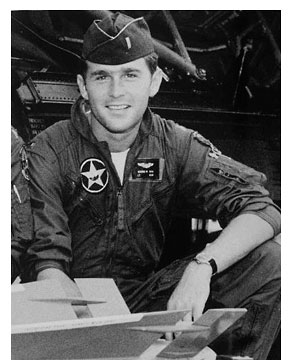

George W. Bush

Bush’s missing year

In 1972, George W. Bush dropped out of his National Guard service and later lied about it. With the media finally paying attention, will he now come clean?

In 1972, George W. Bush simply walked away from his pilot duties in the Texas Air National Guard. He skipped required weekend drill sessions for many months, probably for more than a year, and did not take a mandatory annual physical exam, which resulted in his being grounded. Nonetheless, Bush, the son of a well-connected Texas congressman, received an honorable discharge.

If an Air National guardsman today vanished for a year, military attorneys say that guardsman would be transferred to active duty or, more likely, kicked out of the service, probably with a less-than-honorable discharge. They suggest the penalty would be especially swift if the absent-without-leave guardsman were a fully trained pilot, as Bush was.

Bush’s National Guard record, long ignored by the media, has surfaced with a vengeance. If the topic continues to rage, and if the media presses him, Bush may finally be forced to release his full military records, which could reveal the truth. By refusing to make all those records public, Bush has until now broken with a long-standing tradition of U.S. presidential candidates.

Democrats have seized on the story of Bush’s “missing year,” which was first raised in a 2000 Boston Globe article. This week Democratic front-runner Sen. John Kerry called on Bush to give a fuller explanation of his service record. That brought an outraged response from Bush-Cheney ’04 chairman Marc Racicot, who denounced Kerry’s request as a “slanderous attack” and “character assassination.” White House spokesman Scott McClellan also tried to slam the door on the subject, declaiming that Democratic questions about Bush’s military service “have no place in politics and everyone should condemn them.”

In a sign that the Bush team is taking the issue seriously, on Wednesday Bush’s campaign spokesman questioned the integrity of the retired Guard commander who claims Bush failed to show for duty in 1972, citing the commander’s recent donation to a Democratic candidate for president.

Republicans clearly want to quarantine the issue of Bush’s service and have it labeled as outside the bounds of acceptable public discourse. With good reason: If the story takes root it could do real damage to Bush’s reelection run, which is anchored on his image as a trusted leader in America’s war on terrorism. Trying to make the subject go away could prove difficult, though. “It’s a booby trap that’s out there ticking for Bush,” warns retired U.S. Army Col. David Hackworth. “His opponents are going to keep turning this screw until something gives.”

Right now, the network news is covering the political jousting. It remains unclear, however, whether mainstream journalists will take the time to examine Bush’s military record and ask the president why, after receiving pilot training that cost 1970s taxpayers nearly $1 million, he took it upon himself to decide he was finished with his military requirements nearly two years before his six-year obligation was up.

Bush’s infrequent responses to questions on the issue have been by turns false, misleading and contradictory. His memory has also proved to be highly unreliable: During 2000, Bush variously could not remember which weekends he served during the year in question, where he served, under whose command, or what his duties were.

The story emerged in 2000 when the Boston Globe’s Walter Robinson, after combing through 160 pages of military documents and interviewing Bush’s former commanders, reported that Bush’s flying career came to an abrupt and unexplained end in the spring of 1972 when he asked for, and was inexplicably granted, a transfer to a paper-pushing Guard unit in Alabama. During this time Bush worked on the Senate campaign of a friend of his father’s. With his six-year Guard commitment, Bush was obligated to serve through 1973. But according to his own discharge papers, there is no record that he did any training after May 1972. Indeed, there is no record that Bush performed any Guard service in Alabama at all. In 2000, a group of veterans offered a $3,500 reward for anyone who could confirm Bush’s Alabama Guard service. Of the estimated 600 to 700 Guardsmen who were in Bush’s unit, not a single person came forward.

In 1973 Bush returned to his Houston Guard unit, but in May of that year his commanders could not complete his annual officer effectiveness rating report because, they wrote, “Lt. Bush has not been observed at this unit during the period of the report.” Based on those records, as well as interviews with Texas Air National guardsmen, the Globe raised serious questions as to whether Bush ever reported for duty at all during 1973.

Throughout the 2000 campaign Bush aides never forcefully questioned the Globe’s account. Instead, they searched for military documents that would support Bush’s claim that he did indeed attend drill duties during the year in question. His aides eventually uncovered one piece of paper that seemed to bolster their case that he had attended a drill in late 1972, but the document was torn and did not have Bush’s full name on it.

Today, the White House says that although Bush did miss some weekend drills, he eventually made them up, and more importantly he received an honorable discharge. Bush supporters routinely cite the president’s honorable discharge as the ultimate proof that there was nothing unbecoming about his military service.

But experts say that citation does not wipe away the questions. “An honorable discharge does not indicate a flawless record,” says Grant Lattin, a military law attorney in Washington and a retired Marine Corps lieutenant colonel who served as a judge advocate, or JAG officer. “Somebody could have missed a year’s worth of Guard drills and still end up with an honorable discharge.” That’s because of the extraordinary leeway local commanders within the Guard are given over these types of issues. Lattin notes that the Guard “is obviously very political, even more so than other military institutions, and is subject to political influence.”

For failing to attend required monthly drill sessions and refusing to take a physical, 1st Lt. Bush just as easily could have been moved to active duty, given a less-than-honorable discharge, or had his flying rights permanently revoked, says Eugene Fidell, a leading Washington expert on military law. “For a fully trained pilot, he was assigned to a nothing job [in Alabama], and the available records indicate he never performed that job.”

In the Guard today, as a general rule, “if someone doesn’t show up for drill duty, doesn’t show up, and doesn’t show up, they’ll be separated from their unit and given an other-than-honorable discharge” most likely noting “unsatisfactory participation,” says D.C. military lawyer David Sheldon, who served in the Navy and represented officers before the Court of Military Appeals.

Meanwhile, recent questions have surfaced not only about Bush’s military service, but his official records. “I think some documents were taken out” of his military file, the Boston Globe’s Robinson tells Salon. “And there’s at least one document that appears to have been inserted into his record in early 2000.” That document — the aforementioned torn page that did not have Bush’s full name on it — plays a central role in the story.

“His records have clearly been cleaned up,” says author James Moore, whose upcoming book, “Bush’s War for Re-election,” will examine the issue of Bush’s military service in great detail. Moore says as far back as 1994, when Bush first ran for governor of Texas, his political aides “began contacting commanders and roommates and people who would spin and cover up his Guard record. And when my book comes out, people will be on the record testifying to that fact: witnesses who helped clean up Bush’s military file.”

If Bush wanted to resolve the questions about his National Guard service, he could do so very easily. If he simply agreed to release the contents of his military personnel records jacket, the Guard could make public all his discharge papers, including pay records and total retirement points, which experts say would shed the best light on where Bush was, or was not, during the time in question between 1972 and 1973. (Many of Bush’s documents are available through Freedom of Information requests, but certain items deemed personal or private cannot be released without Bush’s permission.)

Releasing military records has become a time-honored tradition of presidential campaigns. During the 1992 presidential election, Bush’s father, George H.W. Bush, called on his Democratic opponent, Bill Clinton, to make public all personal documents relating his draft status during the Vietnam War, including any correspondences with “Clinton’s draft board, the Selective Service System, the Reserve Officer Training Corps, the Army, the Navy, the Air Force, the Marines, the Coast Guard, the United States departments of State and Justice, any U.S. foreign embassy or consulate.” That, according to a Bush-Quayle Oct. 15, 1992, press release.

Calls to the White House seeking comment on if and when the president’s full military records will be released were not returned.

The spark that reignited this issue came when ABC News anchor Peter Jennings, co-moderating a Democratic debate on Jan. 22, asked retired Gen. Wesley Clark why he did not repudiate comments made by his supporter, filmmaker Michael Moore, who publicly labeled Bush a “deserter.” Jennings editorialized, “Now that’s a reckless charge not supported by the facts.”

Republican pundits agreed. Bill Bennett, a director of Empower America, told Fox News that Clark’s “failure to distance himself, repudiate, absolutely condemn Michael Moore’s description of the president as a deserter was a terrible thing.”

Most informed observers agree that Moore’s choice of words was sloppy and inaccurate. “Deserter” is a criminal term: It refers to a military personnel who abandons his post with no intention of ever returning. But Democrats have taken hold of the broader issue of whether Bush was AWOL. Their willingness to bring up a previously off-limits subject reflects their sense that Bush’s aura of invincibility has worn off and the confidence imparted by Kerry’s resurgent campaign. Democrats feel Kerry, a decorated Vietnam veteran, has the personal history to question Bush’s service.

But the issue is also ripe because of Bush’s own reelection strategy. By donning a fighter flight suit and landing on the USS Abraham Lincoln for a photo-op in May 2003, he has tried to paint himself as a seasoned military leader in the United States’ war on terrorism. With newfound aggressiveness, Democrats are trying to puncture that aura by hammering away on the fact that Bush’s own military record fails to back it up.

That’s what Democratic National Committee chairman Terry McAuliffe did this Sunday on ABC News’ “This Week,” when he referred to Bush as “a man who was AWOL in the Alabama National Guard.” That brought a quick rebuttal from South Carolina’s Republican Gov. Mark Sanford, who told CNN it was wrong for Democrats to be “taking shots at [Bush] for being a guardsman.”

In similar fashion, Rep. Darrell Issa, R-Calif., claimed Tuesday night that by bringing up Bush’s National Guard service, the Democrats are impugning the patriotism of guardsmen, implying that their contributions are less worthy than those who serve in the military. As those disingenuous comments suggest, Republicans are trying to change the subject, falsely framing the debate as a repeat of the National Guard controversy that dogged Vice President Dan Quayle during the 1988 presidential campaign.

It’s easy to see why they’re pursuing this strategy. If the story were simply about how Bush used his family connections to land a slot in the Texas Air National Guard (and all indications are he did just that ), it wouldn’t matter much. But the real story is not how Bush got into the Guard. It’s how he got out.

Until the last two days the mainstream media has routinely ignored or downplayed the issue. Slate columnist Michael Kinsley took euphemism to new heights when he wrote in a Dec. 5 column that Bush was “lackadaisical” about fulfilling his Guard requirement. On Jan. 17, the Associated Press, recapping the “deserter” controversy, did Bush a favor, erroneously reporting that his absent-without-leave time lasted just three months in 1972, instead of the 12-18 months actually in question. And on Feb. 1, ABC News, suggesting Democrats might turn off voters by attacking Bush’s military service, reported Bush simply “missed some weekends of training.” None of those descriptions come anywhere near describing the established facts at the center of the controversy.

Perhaps that’s not surprising. The press, apparently deeming the National Guard story unworthy, paid more attention to the debate over Moore’s “deserter” comment than they did to the actual story of Bush’s unexplained absence when it came out during the 2000 campaign.

While co-moderating the Democratic debate, ABC News’ Jennings was sure he knew the facts about Bush’s military record. But as the Daily Howler noted, a search of the LexisNexis electronic database indicates that ABC’s “World News Tonight,” hosted by Jennings, never once during the 2000 campaign ran a report about the questions surrounding Bush’s military record. Asked if ignoring the story was a mistake, and whether ABC News planned to pursue it in 2004, a network spokeswoman told Salon, “We continue to examine the records of all the candidates running for president, including President Bush. If and when we have a story about one of the candidates, we’ll report it to our audience.”

ABC was not alone in turning away from the story in 2000. CBS News did the same thing, and so did NBC News. But it was the New York Times, and the way the paper of record avoided the issue of Bush’s no-show military service, that stands out as the most unusual. To this day, the Times has never reported that in 1972 the Texas Air National Guard grounded Bush for failing to take a required physical exam. Nor has the paper ever reported that neither Bush nor his aides can point to a single person who saw Bush, the hard-to-miss son of a congressman and U.S. ambassador, perform any active duty requirements during the final 18 months of his service. Instead, the Times served up stories that failed to delve deep into the issue.

The Boston Globe story broke on May 23, 2000. The next day Bush answered reporters’ questions on the campaign trail, defending his military record. His comments were covered by the Times Union (of Albany, N.Y.), the Columbus Dispatch, the Cleveland Plain Dealer, and the Houston Chronicle, among others, which all considered the story newsworthy. Not the Times: The paper ignored the fact Bush was forced to respond to allegations that he’d been AWOL during his Guard service.

Throughout the 2000 campaign, the Times’ Nicholas Kristof wrote a series of biographical dispatches about Bush’s personal history. On July 11, he wrote about Bush’s post-college years, including his National Guard service, but no mention was made of the controversy surrounding Bush’s missing year.

The Times finally addressed the issue on July 22, two months after the Globe exposé was published. The Times article, written by Jo Thomas, focused on Bush’s post-Yale years in the late ’60s and early ’70s. In a section on the National Guard controversy, the Times reported that Bush’s commanding officer had told the Boston Globe that Bush had never showed up, quoted Bush as insisting that he had, and noted that “Emily Marks, who worked in the Blount campaign and dated Mr. Bush, said she recalls that he returned to Montgomery after the election to serve with the Air National Guard.” But then the Times went on to write, “National Guard records provided by the Guard and by the Bush campaign indicate he did serve on Nov. 29, 1972, after the election. These records also show a gap in service from that time to the previous May. Mr. Bush says he made up for the lost time in subsequent months, and guard records show he received credit for having performed all the required service.”

On Oct. 31, the Boston Globe published another damning story, suggesting Bush failed to serve — in fact, did not even show up for duty– during the final 18 months of his commitment. The Times’ Thomas quickly wrote, “A review of records by The New York Times indicated that some of those concerns [about Bush's absence] may be unfounded.” Contradicting the Globe’s account of Bush war service, the paper reported that Bush spokesman Dan Bartlett “pointed to a document in Mr. Bush’s military records that showed credit for four days of duty ending Nov. 29 and for eight days ending Dec. 14, 1972, and, after he moved back to Houston, on dates in January, April and May.”

The document cited by the Times is apparently the mysterious torn paper that appeared in Bush’s records in 2000. That document, a “Statement of Points Earned,” tracks when guardsmen have served, and whether they have fulfilled their annual duty. It contains references to “29″ and “14″ and other numbers whose meaning is not clear. The Times did not inform its readers that the document is badly torn, undated, and unsigned; does not have Bush’s name on it (just a wayward “W”); and has a redacted Social Security number.

“The Times got spun by Dan Bartlett,” Robinson at the Globe told Salon. He and others note that if the documents provided by the Bush campaign proved he did Guard duty upon returning to Houston in January and April of 1973, then why, on Bush’s annual effectiveness report signed by two superiors, did it say, “Lt. Bush has not been observed at this unit during the period of the report,” which covered the dates between May 1, 1972, and April 30, 1973?

“I had a lot of arguments with Dan Bartlett and never got spun by him,” says Thomas, now an assistant chancellor for public affairs at the University of Illinois at Champaign-Urbana. “But if he gave me some documents that proved his point, I’m not going to ignore them.” She added, “The Times carried no brief for or against Bush.”

Nonetheless, the author James Moore says it was those two Times stories, which seemed to back up Bush’s sketchy account of his Guard service, that effectively stopped other reporters from pursuing the story.

Here are the known facts of that story: Following his graduation from Yale University in 1968, with the Vietnam War raging, Bush vaulted to the top of a 500-person waiting list to land a coveted spot in the Texas Air National Guard. Then, despite having no aviation or ROTC experience, he was approved for an automatic commission as a second lieutenant and assignment to flight school.

By every indication, Bush’s service between 1970 and 1972 as a fully trained pilot in the 111th Fighter-Interceptor Squadron near Houston was commendable. But then came the spring of 1972 — and Bush simply vanished.

Contrary to the official campaign biography that appeared on the Bush Web site during 2000, which stated he flew fighter planes until his discharge in late 1973, Bush flew for the last time ever in April 1972. In May, he moved to Alabama to help out in the Senate campaign of Winton Blount, a friend of Bush’s father. Bush asked to be transferred to an Alabama Air National Guard unit where he could do “equivalent training.” Bush asked to be transferred to a postal unit for paper-pushing duties — and remarkably, his Houston commanders signed off on the request. But officials at the Air Reserve Personnel Center in Denver eventually overruled the request, pointing out the obvious: Doing paperwork in a postal unit did not qualify as “equivalent training” for a fully trained pilot.

The situation remained unresolved for months. During that time, Bush was still obligated to attend drill sessions with his regular unit near Houston. Guard records indicate he did not.

In September 1972, Bush won approval to do temporary training at the 187th Squadron in Montgomery. But the unit’s commander, retired Brig. Gen. William Turnipseed, told the Boston Globe he was “dead certain” Bush never showed. “Had he reported in, I would have had some recall, and I do not. I had been in Texas, done my flight training there. If we had had a first lieutenant from Texas, I would have remembered.”

On Wednesday, Bush-Cheney ’04 spokesman Terry Holt told Salon that Turnipseed recently donated $500 to Sen. John Edwards’ campaign. Holt questioned whether the motives behind Turnipseed’s comments regarding Bush’s service were “pure,” or whether he’s part of a “political attack.” Turnipseed could not be reached for comment.

In any case, as already noted, there is no official National Guard record of Bush’s ever serving in Alabama, and not a single guardsman who served at that time has ever come forward and corroborated that Bush was there.

Meanwhile, in July of that summer, Bush’s “failure to accomplish” his mandatory annual physical (that is, to take it) forced the Guard to ground him.

Following Blount’s election loss in November, Bush returned to Houston. But he did not return to his Guard duties, at least according to his commanding officers. In May 1973, his two superior officers at Ellington Air Force Base noted on Bush’s evaluation that he had not been seen during the previous year. In the comments section, Lt. Col. William Harris Jr. wrote that Bush “cleared this base on 15 May 1972, and has been performing equivalent training in a non flying role with the 187th Tac Recon Gp at Dannelly ANG Base, Alabama.” The problem is, Bush never reported for duty there, or anywhere else in Alabama. According to his discharge papers, Bush took the whole year off instead.

Bush was finally recorded as having crammed in 36 active-duty credits during May, June and July 1973, thereby meeting his minimal requirement. But as the Boston Globe pointed out, nobody connected with the Texas unit recalls seeing Bush during his cram sessions, leading to suspicions that Bush was given credits for active duty he did not perform.

The suspicion stems in part from the incorrect, and inconsistent, answers that Bush and his spokesmen have given to the question of why, after going through extraordinarily rigorous flight training, he simply walked away from flying. The day the Globe story appeared on May 23, 2000, Bush explained to reporters that when he returned to Houston in 1973, his old fighter plane was being phased out. “There was a conscious decision not to retrain me in an airplane,” he said, suggesting it was the Texas Air National Guard’s decision to end his flying career. That’s not true. The plane to which Bush was referring, the F-102, was phased out during the 1970s, but it was still being used in 1973. Bush did not tell reporters about his failed physical exam and how that resulted in his being grounded.

That misleading answer about Bush’s Guard service was just one of many the candidate and his aides gave during the campaign. For instance, a campaign official told Cox News reporters in July 1999 that Bush’s transfer to the Alabama Guard unit was for the same flying job he held in Texas. That’s false. There was no flying involved at either Alabama unit (not that Bush ever reported to them, according to Guard records), and without passing a physical, Bush couldn’t fly anyway.

Also in July 1999, Bush’s then-spokeswoman Karen Hughes told the Associated Press it was accurate for Bush to suggest, as he’d done in a previous campaign, that he served “in the U.S. Air Force,” when in fact he served in the Air National Guard.

Asked in 2000 why Bush failed to take his physical in July 1972, the campaign gave two different explanations. The first was that Bush was (supposedly) serving in Alabama and his personal physician was in Texas, so he couldn’t get a physical. That’s false. By military regulations, Bush could not have received a military physical from his personal physician, only from an Air Force flight surgeon, and there were several assigned to nearby Maxwell Air Force Base in Montgomery, Ala. The other explanation was that because Bush was no longer flying, he didn’t need to take a physical. But that simply highlights the extraordinary nature of Bush’s service and the peculiar notion that he took it upon himself to decide that a) he was no longer a pilot and b) he didn’t have to take a physical.

Early in September 1973, Bush submitted a request to effectively end any requirements to attend monthly drills. Despite Bush’s record, the request was approved. He was given an honorable discharge, and that fall he enrolled in Harvard Business School.

One of the obvious questions raised by Bush’s missing year is why he was never brought up on any disciplinary charges under the Uniform Code of Military Justice (UCMJ) and why he was given an honorable discharge. (It’s unlikely Bush could have run for president if he’d been tainted with anything less than an honorable discharge from the military.)

But the issue is not that black and white. “An honorable discharge usually means the person has not committed any misconduct,” says retired JAG officer Lattin. “He may have failed to honor his obligation, but he hasn’t committed a criminal act. And that’s an important distinction.”

It’s important, because based on Lattin’s interpretation of the military law, a guardsman on non-active duty who fails to show up for his monthly drill sessions, as Bush did, is not subject to the UCMJ. The UCMJ, Lattin says, applies only to active-duty servicemen. And while guardsmen who report for weekend duty are covered for those 48 hours by the UCMJ’s unique codes (regarding desertion, being AWOL, etc.), a non-active guardsman who refuses to report for duty in the first place cannot be covered by the UCMJ. Instead, an absent-without-leave guardsman is subject to the state’s military codes of justice, which mirror the UCMJ.

But even then, says Lattin, cases of guardsmen who fail to attend drill sessions are rarely dealt with under the military’s criminal code, but rather administratively, which is less burdensome. Administrative options include transferring the solider to active duty, or separating him from his unit while beginning dismissal procedures that would likely — although not always — result in a less than, or other than, honorable discharge. Also in Bush’s case, he could have been permanently stripped of his flight privileges.

So why was no administrative action taken against Bush during his missing year or more? “It could have been mere inefficiency, or a reluctance to create controversy with the son of an important federal official,” says Fidell, the military law expert. “Observers of the Guard at that time have said it did seem to be an entity in which connections might be helpful.”

Lattin is more blunt. “The National Guard is extremely political in the sense of who you know,” he says. “And it’s true to this very day. One person is handled very strictly and the next person is not. If George Bush Jr. is in your unit, you’re going to bend over backward not to offend that family. It all comes down to who you know.”

Lattin stresses that the Bush episode, and the Guard’s failure to take any administrative actions against him, have to be viewed in context of the early ’70s. With the Vietnam War beginning to wind down and the U.S. military battling endemic low morale, the Pentagon showed little interest in chasing after absent-without-leave guardsmen. “It was too hard and there were too many of them,” says Lattin. “There was a ‘who cares’ attitude. Commanders didn’t want to deal with them. And they knew they’d stir up a hornet’s nest, especially if one of the [missing guardsmen] was named George Bush.”

Eric Boehlert, a former senior writer for Salon, is the author of "Lapdogs: How the Press Rolled Over for Bush."

Using Bush’s playbook

"Karl Rove politics" aren't quite dead: Obama's strategy in 2012 will mirror W's in 2004

George W. Bush and Barack Obama (Credit: Reuters/Larry Downing)

Barack Obama’s presidency was born from nothing so much as his repudiation of George W. Bush’s administration — its policies and politics, its style and tone. One of Obama’s most effective 2008 stump speech refrains was his promise to end the era of “Scooter Libby justice, ‘Brownie’ incompetence and Karl Rove politics.”

But the political dynamics for winning a second presidential term often differ markedly from winning the first. So don’t be surprised by many eerie parallels between Obama’s 2012 reelection bid and Bush’s 2004 campaign. The president may not rely upon “Karl Rove politics” in the strictest sense, and nobody would confuse David Axelrod with Rove. But Obama’s reelection route and rhetoric may bear more than a few Rovian hallmarks.

Now that Mitt Romney has won the Republican nomination, two key features prevail over the 2012 campaign — and both were also plainly evident in 2004. First, the incumbent president’s reelection fortunes are far from certain; and, second, the incumbent faces a decent but nevertheless weak challenger who is further hampered by internal problems within his party’s coalition.

Because incumbents can’t run for reelection promising “change,” and because “hope” during a lingering recession was also off the menu, the Obama campaign’s 2012 theme of  “forward” — a word that often follows “plow,” mind you — was the best available alternative. That said, and substituting the economy for terrorism, Obama is implicitly if not explicitly advancing the same theme Bush did in 2004: America suffered a tough blow, but the situation could have been worse and, more to the point, under my stewardship the nation is steadily regaining its footing.

This counterfactual campaign theme — vote for me not because of what happened, but what might have but didn’t — is a common thread for Bush and Obama. It’s not an uplifting message, but it sufficed in 2004 and Obama is counting on it working again in 2012.

Politics 101 further dictates that when an incumbent’s reelection is in doubt, he must go negative against the challenger. Obama political operatives in the White House and at the Democratic National Committee long ago made it abundantly clear they were willing to do just that. Team Obama may not go negative against Romney to the degree the Bush camp did against John Kerry in 2004. (By mid-summer 2004, 75 percent of Bush’s TV ads were negative attacks on Kerry.) But don’t be surprised if attacks on Romney’s record and even character are plentiful, harsh and relentless. In 2008, America saw candidate Obama’s toothy grin; four years later, expect to see President Obama’s fangs.

Expect the Obama camp to emphasize two major critiques of Romney: that he is a flip-flopper willing to say anything or reverse any position to win; and that he is an economic royalist whose personal and public life suggest a person incapable of understanding the lives and struggles of average Americans. Again — note the unusual parallels with 2004.

Although Romney is a Republican former governor and Kerry was at the time his state’s Democratic junior U.S. senator, the two Massachusetts pols make for similar targets. Each man is an extraordinarily rich preppie and Ivy Leaguer. Each represents the liberal wing of his respective party. Each has shown a propensity for ruining an otherwise valid point with sloppy, backfiring language. And each has a reputation for lacking political spine.

The flip-flop frame is candidate character assassination of the first order. Like the lone negative number in a string of multiplied positives, the critique that nobody can trust any statement or claim made by a politician has the potential to negate every accomplishment or promise. If it sticks, it can be fatal, as Kerry learned in 2004.

Obama and the Democratic National Committee know their electoral history and, sure enough, last November — a year before the election and two full months before a single Iowan had caucused — the DNC released a four-minute “Mitt vs. Mitt” ad and its accompanying website with the damning tag line, “the story of two men trapped in one body.” The site is a brilliant homage to the Bush campaign’s 2004 windsurfer attack ad and the devastating, 11-minute ad the Republican National Committee produced chronicling Kerry’s “evolution” on Iraq.

And then there is what might be called “the Willard factor”: Romney as Richy Rich, the Monopoly Guy with the Bain Capital background and the Swiss bank account. His bio would be political gold to Romney’s opponent any election cycle, but it’s gold-plated platinum in the first full presidential campaign following the biggest economic crisis since the Great Depression, the rise of the Occupy Wall Street movement, and the long overdue national debate over income inequality.

Again, the wealth-personified line of attack mirrors the out-of-touch, Martha’s Vineyard yoke the Bush team put around Kerry’s neck in 2004. Right on cue, in the first public event of his reelection campaign, last week Obama attacked Romney by name and invoked the economic disconnect card with relish. “He sincerely believes that if CEOs and wealthy investors like him make money the rest of us will automatically prosper as well,” said Obama of Romney, adding that “corporations aren’t people – -people are people.” (For the record, Kerry is actually wealthier than Romney, who would become one of the richest men ever to occupy the White House, should he win.)

Obama will also try to shift the national debate toward areas of strength, as Bush did. Historically, this meant the same strategy, but with inverse implications for each party: The so-called mommy party Democrats would encourage voters to focus on more favorable kitchen-table economy issues — healthcare, jobs, education — and away from less favorable “daddy party” Republican issues surrounding foreign wars abroad and culture wars. Because Obama is net-positive in foreign policy approval and net-negative on the economy, rather than mirroring by inversion, Obama will try to duplicate Bush’s shift-in-emphasis in 2004. GOP complaints that Obama is politicizing the killing of Osama bin Laden reveal Republican fears that Obama is going to play the terrorism card in 2012 just like Bush did eight years ago.

The 2004 parallels extend beyond message. Obama will be amply resourced and enjoy a field technology by virtue of his campaign’s state-of-the-art Web, donor, volunteer and social media innovations. Remember the Bush reelection campaign’s vaunted “72-hour” voter turnout model? That seems like an Edsel compared to the Ferrari the Obama team will be sporting this summer and fall. Among the perquisites modern presidential incumbents enjoy is the option to test-drive the best mobilization machines before anyone else.

Finally, what most connects Obama 2012 to Bush 2004 is the stability of the electoral map itself. Only three states — two net to Bush — flipped from one party to the other between 2000 and 2004; only nine states flipped between 2004 and 2008. Split the difference and a good, back-of-the-napkin over-under for number of states likely to flip between 2008 and 2012 is six. And thus, like the lead sailboat during a windless race, Obama doesn’t need or want conditions to change much from 2008: He merely has to replicate the map that swept him into office, with the burden of figuring out how to shake up the Electoral College falling to Romney, just as it did for Kerry against Bush. Even Karl Rove’s mapping of the 2012 election concedes this reality.

The 2008 election was memorable; to borrow the title of one best-selling chronicle, it was a “game changer.” But 2012 will not be. In many respects, it will be a game repeater, with Obama playing Bush to Romney’s Kerry of 2004. The president may be asking Americans to look “forward” in 2012, but the best preview of his reelection campaign can be found by looking backward eight years.

Continue Reading Close

The Bushies are back

Missed the neocons? Don't worry: Mitt Romney's getting the band together again

(Credit: Reuters/Win McNamee)

There was good reason for Republicans to cry foul over the Obama campaign’s advertisement highlighting the president’s killing of Osama bin Laden; the GOP has lost its decades-long edge on national security. According to a Washington Post poll, “By a margin of more than 2 to 1, Americans say the president’s handling of terrorism is a major reason to support rather than oppose his bid for reelection.”

Republicans lost their popularity on security issues for one reason: George W. Bush’s foreign policy was a disaster. And yet, the party’s nominee, Mitt Romney, has assembled a foreign-policy team composed almost exclusively of individuals with the same war-always mentality and ideology that served Bush — and the United States — so poorly. In some cases, the exact same men responsible for Bush’s catastrophic national security policies are advising Romney. The former Massachusetts governor could have included some of the pragmatists and realists from the George H.W. Bush administration. Instead, a Romney presidency seems like it would be Bush 43 all over again.

Richard Grenell, who served as United Nations spokesman under Bush, may be gone from the Romney campaign after an uproar over his sexuality, but there are plenty more former Bushies. First off, there are Romney’s “special advisors.” There’s Michael Chertoff, W.’s Homeland Security director. Chertoff oversaw DHS’s failures during Hurricane Katrina, and amassed unprecedented powers of secrecy. Next up is Eliot Cohen, counselor to the State Department for Bush’s last two years and on the Defense Policy Advisory Board for the president’s entire term. Cohen was an adamant supporter of the Iraq War and advised Bush directly on the issue. Or take Cofer Black, the man who infamously said to Bush in September 2011 about al-Qaida that “When we’re through with them they will have flies walking across their eyeballs.” Black went on to become chairman of Blackwater, where he resigned after the company illegally bribed Iraqi officials.

Then there are the 13 “working groups” composed of equally worrisome individuals. The Middle East and North Africa Working Group is co-chaired by Bush’s Assistant Secretary of Defense Mary Beth Long, and Meghan O’Sullivan, Bush’s special assistant and deputy national security advisor for Iraq and Afghanistan. The remaining co-chair is Walid Phares, who never worked for Bush but advised Lebanese warlords in the 1980s. Romney has reportedly promised Phares a top job in his administration, despite his virulently anti-Islamic views.

All told, Romney lists 37 holdovers from the George W. Bush administration — the very same administration he and all other Republican candidates barely referenced during their many debates because it was so discredited and toxic, even to the Republican base.

It didn’t have to be this way. There are, in fact, people in Republican circles who are sensible on international affairs. The Cato Institute, in particular, has experts that could dramatically change the direction of American foreign policy. Men like Justin Logan and Christopher Preble were prescient on Iraq and a host of other issues. Similarly, the Center for the National Interest (formerly the Nixon Center) has a host of solid scholars, including ones like Dimitri Simes and Geoffrey Kemp, who have valuable government experience in the Nixon and Reagan administrations, respectively, and a history of perceptive analysis. Richard Haass, president of the Council on Foreign Relations, would have been another good pick.

So why aren’t guys like this being tapped? Why is the GOP sticking with a discredited foreign-policy approach rather that looking to its own past for wiser counsel? “Most of the realists and pragmatists have simply been driven out of the Republican Party,” says Stephen Walt, who writes a blog at Foreign Policy and teaches at Harvard. “The neoconservatives have been driving the agenda since Bush was elected and they remain well-entrenched.”

Another factor is that the Republican Party’s base remains strongly militaristic and reluctant to recognize limits on American power. Jon Huntsman’s failed presidential campaign illustrated that problem. The good news is that nobody seems to be calling for nation-building and occupying foreign countries in the mold of Iraq and Afghanistan. But that’s the only lesson that seems to have been learned from the last decade of foreign-policy debacles.

Finally, it may just be that the United States has too much power to change course. While the Unites States has undoubtedly made disastrous decisions in the last decades, it is so powerful that it is largely insulated from the consequences of them. If Romney’s foreign-policy advisor list is anything to go by, a Romney administration would have to teach the U.S. all over again about the problems with trying to police the world. Prepare for Bush redux.

Continue Reading Close

Jordan Michael Smith writes about U.S. foreign policy for Salon. He has written for the New York Times, Boston Globe and Washington Post.

Bush aide blasts torture

Philip Zelikow tried to warn Bush on interrogations. Now he's penned an authoritative article on how he was ignored

(Credit: Reuters/Jim Young)

The Bush administration hasn’t heard the last from Philip Zelikow. After the rediscovery last week of his long lost 2006 anti-torture memo, Zelikow, a former State Department official, has written arguably the most damning article yet about U.S. government’s interrogation policies from 2001 to 2009. The article, called “Codes of Conduct for a Twilight War,” will be released in a forthcoming issue of the Houston Law Journal, and was obtained exclusively by Salon. Says Zelikow in an email: “I’m not aware of other accounts that combine historical, policy and legal approaches to” the subject of the Bush administration’s interrogation methods.

Based on published histories and his firsthand observations, and adapted from a lecture delivered in November, the article calls the administration’s rationale for its use of torture — which he nonetheless insists only on calling “extreme interrogation” and “coercive methods” — “radical,” “an amazing contention,” “untenable and extreme,” “unsustainable,” “an unprecedented program of coolly calculated dehumanizing abuse and physical torment,” and, finally, simply a “mistake.” He concludes: “This was a collective failure of American public leadership, in which a number of officials and members of Congress (and staffers) of both parties played a part, endorsing a CIA program of physical coercion without any precedent in U.S. history.”  In fact, “The only defense against criminal prosecution would be that officials acted in good faith reliance on the advice of their government lawyers.”

Part of what makes Zelikow’s analysis so damning and definitive is its judiciousness. The article is deeply empathetic of the uniquely fearful situation under which the Bush administration was initially operating. Zelikow calls the Sept. 11 attacks a “collective trauma” and a “shoc[k] to mass beliefs.” He notes that Bush and others spent time in burn units, morgues and with survivors of the attacks. One traumatic experienced often overlooked — overlooked because it appeared in Stephen Hayes’ stenographic biography of Dick Cheney — was that the vice-president’s daughter was (falsely, it turns out) told that her house with her children in it had tested positive for anthrax. Similarly, Cheney and National Security Advisor Condoleezza Rice were told that they and others had been exposed to an extremely lethal toxin in a particular area of the White House — and might soon die as a result. “The alarms did not stop and they too were not abstract … The pressure on Bush and his senior advisers was so direct because so much of the response had to be invented and improvised,” the article reads.

An additional factor in the power of the article is Zelikow’s credibility and history. Before entering government, he was a civil rights lawyer in Texas battling the Ku Klux Klan and then a highly esteemed Harvard historian specializing in U.S. foreign policy — he co-authored one book with Rice. He then served on the National Security Council under President George H.W. Bush and directed the 9/11 Commission before becoming counselor to Rice at the State Department from 2005 to 2007. He currently volunteers part-time on the President’s Intelligence Advisory Board under President Obama.

Such bipartisan, establishment credentials render the breakdown and conclusion of this article all the more damning. He believes that what should have been a political and moral question — should the United States torture captives? — became strictly a legal matter left up to government lawyers, few of whom had any experience with these issues, and who had to take the necessity of extreme measures as a given. “These lawyers then became secular priests, granting absolution to the supplicant policymakers,” Zelikow writes.

The problems began when the Office of the Vice President and the CIA took central roles in policymaking. Cheney felt himself above the rest of the National Security Council, bypassing Rice and other traditional channels of national security policymaking. Ad-hoc decision-making and improvisation became “a habit of thought,” which seemed initially to pay off in the security of the nation, as well as in Bush’s political standing and self-confidence.

With Cheney and CIA head George Tenet “the key entrepreneurs in setting codes of conduct for the War on Terror,” it was essentially left to their obsequious lawyers to decide, in secret, on the interrogation methods America should employ. Bush even told the Senate’s Intelligence Committee chairman that “the vice president should be your point of contact … [He] has the portfolio for intelligence activities.” Decisions were made to jettison international treaties. By December 2001, the CIA was already interested in reverse-engineering methods “heretofore used only to treat Americans to resist enemy torture.” When a senior al-Qaida member was captured in March 2002, the prototype for the administration’s torture policies was already developed. “So, for the first time in American history, leaders of the U.S. government carefully devised ways and means to torment enemy captives.”

Zelikow notes that “None of the policy or moral issues connected with these choices appear to have been analyzed in any noticeable way.” Perhaps worst of all, no serious consideration was given to weighing the costs of benefits of the torture program, with reference to relevant historical precedents and/or examinations of the respective French, British and Israeli experiences in dealing with captured terrorists. “Bush and Rice should have insisted on this,” Zelikow writes.

The 52-page article observes the successes of Obama’s counterterrorism policies after repudiating the use of torture. On the basis of the empirical evidence then, “[t]here is no evident correlations between intelligence success and the available of extreme interrogation methods,” no matter what Bush and Cheney claim. Finally, “The program’s costs — which include the high-level effort expended in order to establish, maintain, and defense the program — appear on the evidence so far to have well outweighed any unique value the program might have had as a method of counterterrorism intelligence collection.” This is apart from the damage to America’s international standing and corrosion of its traditional values.

Zelikow concludes his analysis by arguing that, although the Obama administration has the right to wage war and use extralegal methods to defeat al-Qaida, its claim of that authority to defeat “associated forces” is unwarranted. “The U.S. government should publish and explain any overarching policy and legal documents that guide and confine the conduct of deadly operation against its foreign enemies … the executive branch of the U.S. government has a duty to articulate the scope of its warfare to the Congress and the public.” The Bush administration’s unprecedented elevation of torture to national policy may be history, but the job to get U.S. foreign policy in line with its constitutional and moral obligations is far from over.

Continue Reading Close

Jordan Michael Smith writes about U.S. foreign policy for Salon. He has written for the New York Times, Boston Globe and Washington Post.

Thomas Kinkade, the George W. Bush of art

The rise and fall of Thomas Kinkade, the Painter of Light™ in a decade of bad faith

News of Thomas Kinkade’s death arrived on the same day I received in the mail a vintage teacup on which I had spent a ridiculous amount of money. It has a cottage painted on it. Kinkade, whose work has long exerted a morbid fascination for me (to the concern of all my friends), specialized in cottages. So some part of me understands the appeal, I guess, but, damn: Those paintings make my corneas hurt. And yet, I could barely stop looking at them.

Kinkade was only 54, and his family told the media that he died of “natural causes.” This comes after years of reports of drunken public misbehavior: cursing at people who tried to save him from falling off bar stools, heckling Siegfried & Roy, grabbing a woman’s breasts at a publicity event and, most memorably, urinating on a Winnie the Pooh statue at the Disneyland Hotel while proclaiming, “This one’s for you, Walt!” There were DUI arrests. Also, his manufacturing company declared bankruptcy two years ago, and former franchisees of the once-ubiquitous Thomas Kinkade Signature Galleries won settlements against him for fraud.

That’s quite a fall for a man who frequently spoke of his Christian faith and family values when asked to comment on the mammoth success of his brand in the early 2000s. “When I got saved, God became my art agent,” Kinkade explained in a 2004 video. He went from a childhood in Placerville, Calif. (invariably characterized as “hard-scrabble”) to an apprenticeship selling his work in supermarket parking lots to his apotheosis as the nation’s “most profitable” artist, the Painter of Light™, and multimillionaire. He was profiled in the New Yorker by Susan Orlean.

I first learned about the dark side of the Painter of Light™ — sorry, couldn’t resist that one — when I reviewed “his” novel, “Cape Light,” in 2002. The novel, first in a series, was produced much as his paintings are: by a semi-industrial process in which low-level apprentices embellish a prefab base provided by Kinkade. He wasn’t the only artist to work in this way; he wasn’t even the only novelist. To the best of my knowledge, his novels — heartwarming, fuzzily pious tales of small-town life — have been coming out ever since, one more facet of a lifestyle brand that, at its most ambitious, included an entire Thomas Kinkade-themed housing development.

My review was just a goof intended to amuse Salon’s readers, but after it appeared, I began to receive emails from people who had sunk their life savings in Thomas Kinkade Signature Galleries (essentially, mall and shopping-district outlets for his prints) and been fleeced. I didn’t really understand how the financial architecture of Kinkade’s gallery empire worked, and I sure didn’t share their taste in wall art, but these people struck me as decent and sincere. They’d believed in Thomas Kinkade — not just in the man or the company, but in the ethos supposedly represented by his work, one in which (to quote Kinkade’s introduction to “Cape Light”) “people have the time to savor life’s simple pleasures” and lead “deep, satisfying lives.”

My conversations with these victims made me uneasy. Was there some relationship between the franchisees’ naivete, perhaps even their willful self-delusion, and their terrible taste? Was it hopelessly snobby to wonder that? What about Kinkade himself? He seemed to be at best a hypocrite and at worst a crook. Was there a meaningful connection between his bad conscience and his bad art? German thinkers of the 1930s would have said so, and they had plenty of opportunity to observe bad fascist art up close. Hermann Broch maintained that someone who chooses to make kitsch is “ethically depraved, a criminal willing radical evil.” The novelist Milan Kundera believes kitsch to be the natural expression of totalitarianism. That’s a lot of moral weight to place on a bunch of garish cottage paintings, but Kinkade was always the first to present his work as a form of ideology.

I felt compassion for the ripped-off gallery operators, and at the same time I was aware that quite a few of them had probably also fallen for the similarly sanctimonious, bogus folksiness of George W. Bush, thereby subjecting our nation to one of the worst presidents in its history. Kinkade and Bush struck me as of a piece, probably because they had both borrowed from Ronald Reagan in promising that we could get back to a better way of life that never existed in the first place. In nearly every encounter with the press, Kinkade delivered a diatribe against the art-world “establishment” that had shut him out. They were “elites” touting unfathomable, downer junk to hardworking people who needed uplift instead. Art snobs were the aesthetic counterparts of the so-called liberal elites, a group that surely included me.

At the same time, I must admit that I, too, like a cottage. Granted, I like the stylized, art-deco kind painted on bone china, rather than the insanely detailed and phosphorescently lit specimens in Kinkade’s pictures. And I’m in little danger of equating my new teacup with a Brancusi just because it’s cheerier. Nevertheless, I suspect that my idea of what’s pleasing about a cottage isn’t too different from that of Kinkade’s fans: an aura of harmless coziness, of modest domestic beauty and comfort not too cut off from the past. It’s as if we’re speaking the same word, but in different languages.

I suspect this is why Kinkade’s paintings have exerted their weird, hypnotic effect on me. They are so preposterous (especially the stream-side ones; he really needed to sit down with an architect and go over the basics of drainage), so awful. And yet I can still detect — beneath that cacophony of hollyhocks and cobblestones and snapdragons — the whisper of something intelligible. I’m pretty sure I know why the hordes of Kinkade collectors love his work, even if I don’t like it myself. Kinkade’s paintings are irredeemably false, like all kitsch, but through them you can just barely glimpse the honest desires they seek to exploit, sinking under the dreck.

Kundera defined kitsch as “the absolute denial of shit,” meaning it offers an airbrushed, sterilized, sentimentalized view of the world. From that, it doesn’t necessarily follow that art wallows in shit, but art doesn’t exist for the primary purpose of denying it, either. Kitsch is, first and foremost, a lie; its very existence is founded on bad faith.

Kinkade, like Bush, peddled a falsely simplified image of the world — one without mildew or flooded basements, for one thing — which, no surprise, turned out to be plastered over a whole lot of stinky stuff. The true believers, the ones who bought into these men the most during the 2000s, ended up paying some of the highest prices, from the Kinkade acolytes who invested in his gallery Ponzi scheme to the working-class red-staters who sent off their kids to die in a pointless war. Bad taste, harmless as it may seem, can end up costing you a lot.

Further reading

Los Angeles Times obituary for Thomas Kinkade

Susan Orlean’s 2001 profile of Thomas Kinkade for the New Yorker

A 2006 Los Angeles Times story documenting Kinkade’s business problems

Salon’s Janelle Brown visits Hiddenbrooke, a Kinkade-theme housing development in Northern California

Laura Miller reviews “Cape Light,” a novel by Thomas Kinkade and Katherine Spencer

Continue Reading Close
Laura Miller

Laura Miller is a senior writer for Salon. She is the author of "The Magician's Book: A Skeptic's Adventures in Narnia" and has a Web site, magiciansbook.com.

The memo Bush tried to destroy

A document advising the Bush administration against torture has resurfaced, despite his best efforts to hide it

George W. Bush in 2006 (Credit: AP/Ron Edmonds)

In February of 2006, Philip Zelikow, counselor to Secretary of State Condoleezza Rice, authored a memo opposing the Bush administration’s torture practices (though he employed the infamous obfuscation of “enhanced interrogation techniques”). The White House tried to collect and destroy all copies of the memo, but one survived in the State Department’s bowels and was declassified yesterday in response to a Freedom of Information Act request by the National Security Archive.

The memo argues that the Convention Against Torture, and the Constitution’s prohibitions against cruel and unusual punishment, do indeed apply to the CIA’s use of “waterboard[ing], walling, dousing, stress positions, and cramped confinement.” Zelikow further wrote in the memo that “we are unaware of any precedent in World War II, the Korean War, the Vietnam War, or any subsequent conflict for authorized, systematic interrogation practices similar to those in question here, even when the prisoners were presumed to be unlawful combatants.” According to the memo, the techniques are legally prohibited, even if there is a compelling state interest to justify them, since they should be considered cruel and unusual punishment and “shock the conscience.”

Chillingly, the memo notes that “corrective techniques, such as slaps,” may be legally sustained, as might be “[C]ontrol conditions, such as nudity, sleep deprivation, and liquid diets…depending on the circumstances and details of how these techniques are used.” However much distress Zelikow’s memo caused the White House, it was not an ACLU briefing paper.

“I’m pleased the memo is now part of the historical record and available for study,” Zelikow wrote Salon in an email. The White House had determined that the memo — which was not binding since Zelikow’s was a bureaucratic position without legal authority — was too dangerous to exist. “I later heard the memo was not considered appropriate for further discussion and that copies of my memo should be collected and destroyed,” he said in a May 2009 congressional hearing.

At that hearing, before the Senate Committee on the Judiciary, Subcommittee on Administrative Oversight and the Courts, Zelikow said he had “no view on whether former officials should be prosecuted,” a decision he thinks should be left to “institutions.” However, he did call for a thorough inquiry and a public report examining how the U.S. came to employ torture.

Of course, no such inquiry was ever launched. The Obama administration declined to revisit the U.S. employment of torture, with the president saying he didn’t want to “look back.” Zelikow believes this was a mistake. “I still believe an inquiry would be useful, though less so as time passes and more information becomes available, especially after the 9/11 trials conclude, hopefully this year,” he says in an email.

During his congressional testimony, Zelikow declined to say whether Department of Justice lawyers acted improperly or immorally, conceding only that their opinions were “unsound, even unreasonable.” But in a 2007 lecture in Houston, he had no problem saying “the cool, carefully considered, methodical, prolonged, and repeated subjection of captives to physical torment, and the accompanying psychological terror, is immoral.”

The importance of the memo lies in its revelation that there was real, serious debate inside the Bush administration about how to interrogate captured terrorist suspects. The members of the White House declined to enter that debate — indeed, they did their best to squash it. The destruction of Zelikow’s carefully reasoned memo suggests the White House did not want any record of alternative views even existing, lest they be considered reasonable or people get the idea that the torture policies were thought controversial even by members of the administration.

Continue Reading Close

Jordan Michael Smith writes about U.S. foreign policy for Salon. He has written for the New York Times, Boston Globe and Washington Post.

Page 1 of 436 in George W. Bush