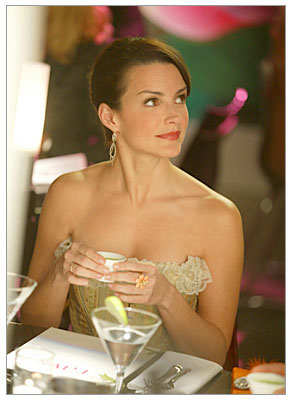
Sex and the City

Let us now praise Charlotte York Goldenblatt

Forget Carrie, Samantha and Miranda. Kristin Davis' deceptively sweet "Sex and the City" character has turned out to be the most intriguing -- and sexiest -- one of all.

  • more
    • All Share Services

Let us now praise Charlotte York Goldenblatt

Being part of an ensemble on a show like “Sex and the City” can’t be easy. Sarah Jessica Parker as Carrie is, of course, the star, and don’t you forget it. She certainly hasn’t, clattering around in her impractically spindly shoes and haute-bag-lady outfits, playing a character who used to be dazzlingly offbeat but who is now something much stiffer and duller: a preening, posing, self-made icon. Over the past few seasons, both Cynthia Nixon’s Miranda (the bright, sensible mother and lawyer who has trouble expressing emotion) and Kim Cattrall’s Samantha (the freethinking, sexually open, slinky beauty) have proven to be far more interesting characters than Carrie, maybe because they’re allowed to make sloppier mistakes with much more surprising, and often pleasurable, consequences. (Every time Carrie learns a lesson about life or love, Parker makes a little moue with her mouth and changes into yet another freakazoid ensemble. Parker, who used to be a supremely likable comic actress, no longer has to act at all — she could just lip-sync her role from across a crowded room.)

But what about Charlotte York Goldenblatt, the dreamily romantic former WASP who always wears delicate cardigans and full, floaty skirts whether Prada is showing them that season or not? The one who, fearlessly, has been known to leave her Upper East Side apartment in a velvet headband that — miracle of miracles — actually looks nice on her? Of the four women on “Sex and the City,” Charlotte has always been treated as the whipped cream on the sundae. She’s light and charming, but she doesn’t wear the same readily identifiable character tags the others do: Carrie is the (alleged) wit, Miranda’s got the knife-edged smarts, Samantha’s sex drive is a force of nature. Charlotte is simply sweet.

But only if you haven’t really been paying attention. As “Sex and the City” rounds the bend toward its last episode ever, this Sunday, I’ve become convinced that the unsung hero of the show, and the one who has almost single-handedly saved its final season, is its most overlooked actress: Kristin Davis.

While the other actresses have all been praised, rightly, for their comic timing (in the show’s early years, Parker may even have been the best of them), Charlotte is the one who’s more often deemed simply adequate, when anybody bothers to take notice at all. That may be because most of us think we know, or may even be, a person like Charlotte — an essentially sweet-natured woman who likes her job well enough, but who harbors romantic dreams of marrying a nice, preferably rich guy and having beautiful children, and who believes there’s one “right” person out there for everyone.

On paper, Charlotte seems ordinary enough to be a clichi. But Davis has always played her with no-frills, no-nonsense determination, a kind of Yankee thriftiness that actually clears more room for complexities rather than less. There may be a springtime crispness to Charlotte’s skirts, but there’s a jumble of old clothes in her heart, an apparent contradiction that Davis has always played with ease. She’s the show’s stealth actress, and the one whose character demands the utmost compassion and openness from us. Face it: Who wants to admit that Junior League types are people too?

Davis is gifted in a different way from the others. She has a knack for stylized farce that’s both broader than what the others do and yet subtler and much harder to pull off. She’d be perfectly at home wrestling down the wriggly charms of elegant ’30s romantic comedies. Her face, with its delicately chiseled nose and alert brown eyes, is 100 percent high-society, but her smile has the fresh earnestness of a farm girl, and she seems to know it: She plays uptown and out-of-town against each other as if there were no difference between them.

And her timing catches you like a cartoon cloud of perfume — it may be brightly colored, but the fragrance is subtle and delicate. A few Charlotte moments from an earlier season prove it perfectly: Charlotte finds herself strangely attracted to her divorce lawyer, Harry Goldenblatt (the marvelous Evan Handler, Prince Charming-owitz), a bald, stocky regular joe who wears loud ties and sweats a lot. He’s mad for her — he will, of course, eventually marry her — but for now, she doesn’t know what to make of him, even though whatever it is he’s got has already gone to work on her, subconsciously at least.

He’s just helped her finalize her divorce. She’s thinking of moving out of the palatial apartment she’s won in the settlement, and, eager to help her further, Harry is showing her around a leather-and-chrome bachelor pad belonging to a friend of his, which is available for rent. This very pretty girl and extremely nervous boy are having a look at the tacky bachelor bedroom when Harry lets it rip: He’s so attracted to Charlotte he can’t think of anyone or anything else. It drives him crazy to look at her. He wants her desperately.

Charlotte, standing there in her spectacles and one of her trademark girly-girl flared dresses, is taken aback. “Harry,” she stammers, flustered and flattered in equal measures, “don’t be ridiculous — I’m wearing my glasses!”

That peculiar Charlotte logic is what makes the character so much frothier, and yet so much more intriguing, than the other women on the show. In her own way, Charlotte is sexier even than the oversexed Samantha. Later, after she has tumbled into bed with Harry (and has also had, as she states unequivocally, the best sex of her life), she offers a friend a perfectly viable explanation of why Harry can’t possibly become her steady boyfriend: “He’s not very attractive. He’s sweaty and pushy. No, no, I could never date him.” Her eyes gleam, her brow furrows; she waits a beat. “But maybe just for the sex. How does that work, exactly?”

I’ve heard women remark that of all the women on “Sex and the City,” Charlotte tends to be the favorite among their male friends, ostensibly because she’s the most conventional, the least threatening, perhaps the prettiest, at least in the cheerleader sense. Miranda, Samantha and Carrie all want so much out of men; they’re complaining all the time. Charlotte just wants someone to take care of her — doesn’t that make things simpler all around?

But the reality, as both Davis and the show’s writers (who have done Davis justice, finally, in the last few seasons) have driven home, isn’t nearly as simple as all that. Charlotte may actually be more complicated than the others; at the very least, she has certainly faced her share of trials. You could argue that of all the characters, she’s grown the most: While it’s true that Miranda has had a baby and Samantha has recently battled cancer, Carrie’s biggest problems have been embodied in a parade of close-but-no-cigar boyfriends.

Charlotte, on the other hand, married her dream man (Kyle MacLachlan), only to find that although he loved her, he was incapable of sexual passion. (While Charlotte has never advertised her love of sex as broadly as her friends have, she’s dropped plenty of not-so-subtle hints that she just might be the most orgasmic of all of them. Samantha may make the most noise, but it’s Charlotte who smolders.) She has faced, and continues to face, the reality that she probably won’t be able to conceive a child (a subject that the show has dealt with intelligently and sympathetically and with no obnoxious hand-wringing). She met a guy who she thought was all wrong for her and, by opening up not just to him but to the deepest parts of herself, realized he was exactly right. She even went so far as to change religions for him, converting to Judaism, an act that could be seen as a way of subsuming herself just to please a man, although it’s impossible to watch Charlotte singing a shabbas prayer without seeing that her new faith has brought out something that was inside her to begin with.

In one of the loveliest moments in the show’s history, Charlotte quizzes Harry on why he refuses to marry a shiksa (in other words, her). In the course of the conversation, she explains to him, anxiously and mournfully, that she’s unlikely to be able to bear children. He tells her, without even taking a breath, that he loves her no matter what, and that they can adopt a child — they’ll be just as much of a family that way. His response is so kind and so compassionate that Charlotte recognizes it as fundamentally “Jewish” — in other words, she sees him as the kind of person that she herself would like to be. Of course, she already is that kind of person, but the moment cements them as a solid match, a case of two people reaching out toward the best in each other — the very sort of romantic realism that a good marriage requires.

Some of Charlotte’s wants and desires do seem retrograde. She loves Elizabeth Taylor, and like Taylor, she also loves big engagement rings. It troubles her that it’s inappropriate for her to have a big second wedding (although, at Carrie’s sensible urging, she goes ahead and has one anyway). You get the sense that she romanticizes motherhood in ways that none of the others do, least of all Miranda, the only one who’s actually a mom. Although it’s not so hard to picture Charlotte changing a poopy diaper. She’d probably wrinkle her nose and come out with a wry little joke about how yucky it is, even as she’d gingerly, and tenderly, get the job done.

Does that necessarily make her the perfect mother and wife, the dream of every man who’d prefer not to be challenged by a woman? I suspect that more women viewers than men see Charlotte as the show’s least-threatening character. Many of us like to think that “difficult” women are somehow superior to easygoing ones (when, in fact, sometimes they’re simply more of a pain in the ass, without necessarily being smarter or more interesting). But even if — or maybe because — Charlotte has sometimes seemed blindly hopeful and optimistic, she’s the show’s most demanding character. Her attitude toward love and sex isn’t as casual as that of the other three, and her expectations are definitely higher — she seems to want more out of life than any of them, a tough bill for any ordinary man to fill.

Of the four women on “Sex and the City,” Charlotte is the one who has historically demanded the impossible out of romance. But instead of being disappointed, she has ended up being happier than she ever could have imagined. That sounds more like the direct opposite of guileless simplicity. Throughout the run of the show, there’s always been something resolutely sensible about Charlotte. She’s like a Jane Austen heroine transplanted to modern Manhattan, coming around to the fact that having a plan is not only useless, it’s plain old boring — not nearly as thrilling as welcoming the surprises that life cooks up for us.

And in playing Charlotte, Davis, more than the other actresses in the ensemble, has helped maintain the tossed-off urban spark that the show started out with, which was the very thing that made it such a delight through its first few seasons. “Sex and the City” has lost much of its lightness over the years, not necessarily because it has taken on more serious themes (cancer, motherhood, infertility, divorce), but because it started to groove too heavily on its own status as a hit: It’s now a ritzy supper club, whereas it used to have the fuzzy-sexy warmth and improvisational vibe of a smoky bar. One moment in last week’s episode recaptured some of the show’s early loose jazziness: Unhappy over Carrie’s decision to move to Paris, Samantha calls her a cunt — and Charlotte, recognizing the affection nestled within the epithet, bursts into tears.

As “Sex and the City” has wound down over the past season, each of its characters has come closer to finding some version of romantic happiness. Charlotte and Harry are contentedly married (although she still dearly wants that baby). Miranda has finally realized how much she cares for Steve (David Eigenberg), her baby’s father. Samantha, who never wanted to settle down in the first place, has one of the sweetest boyfriends any woman could ever hope for (played by the astonishingly endearing Jason Lewis). Carrie is the last one left, flittering and twittering as she bumbles toward her romantic destiny, whatever it is. Will she stay in Paris with her sophisticated Russian (Mikhail Baryshnikov)? Will she end up with Big (Chris Noth), who seems newly reformed? Or will she end up with the great city of Manhattan as her only true partner (a theme the show has tangoed with again and again)?

These are the big questions. The problem is, Who cares? I prefer to remember the show as it was in its glory days, when its trash-talking, high-living breeziness made it one of the most pleasurable comedies of manners of late-20th-century TV.

That said, I can’t help hoping that Charlotte gets the baby she hopes to adopt, so I can send her off into that great beyond, where all fictional characters must eventually go, having everything she wants most out of life. But baby or no, I’ll always treasure the moment when, depressed over her childlessness, she’s jogging through the park and meets a winsome King Charles spaniel in a Burberry dog coat. This is the dog Charlotte will eventually welcome into her home and name (what else?) Elizabeth Taylor. For now, though, Charlotte is desolate; her face is streaked with tears. But when this exquisite little mop scampers toward her, she instinctively swoops down and cuddles the dog’s lush, floppy ears. “Look at your little coat! Did you go shopping?” she asks the dog, a very silly question that this particular creature looks as if she could actually answer.

The moment is pure Charlotte and the sort of thing I’ll always remember Davis for. A dog isn’t part of Charlotte’s plan at all — it’s the last thing she was thinking of, really. And yet here’s the perfect one for her, right down to the stylish coat, and she has instantly fallen in love. Happiness can cut across your path at any moment. Sometimes it’s wearing a little coat, and scooping it up is all you can do. Say what you want about Charlotte York Goldenblatt: She was never too proud to scoop.

Stephanie Zacharek is a senior writer for Salon Arts & Entertainment.

Go away, Carrie Bradshaw

A teen "Sex and the City" prequel is headed to TV. Are women doomed to be compared to this character forever?

  • more
    • All Share Services

Go away, Carrie Bradshaw Sarah Jessica Parker as Carrie Bradshaw (Credit: HBO)

When those inevitable reboots of beloved franchises come around, die-hard fans and newcomers get a chance to return to the roots of a character and glimpse the glory yet to be. They’re all about how one becomes a legend — and they’re wildly successful. Spider-Man. Superman. Batman. Carrie Bradshaw.

Wait, what?

It’s true — this week, the long-threatened “Sex and the City” prequel — “The Carrie Diaries” — got a green light from the CW.

Based on Candace Bushnell’s successful “Carrie Diaries” and “Summer in the City” novels, the as-yet-uncast series will follow the ’80s-era Connecticut high schooler Carrie Bradshaw through her youthful explorations of friendship, romance and the occasional Big Apple adventure. It will be up to producers to determine whether this Carrie will be more like the character in the Bushnell books – a girl with siblings and a doting father – or the character she became through a long-running HBO series and two big-budget movies.

The Hollywood Reporter notes that “former ‘Sex and the City’ scribe/co-producer Amy B. Harris will adapt the book and serve as showrunner,” which certainly offers the promise of continuity between the old television show and the new one. But eight years after it left the airwaves and one widely reviled movie sequel later, does anyone – especially the teens who were in their babyhoods when the show first aired – still care?

Maybe the real question is how Carrie Bradshaw has managed to keep her manicured talons in the public imagination as long as she has. Because Carrie Bradshaw is not the female equivalent of Batman. Sure, she’s a loyal pal, but have you ever watched the series? Carrie is not endearingly flawed the way that all great characters must be. She’s a full-on pain in the ass, easily the least likable member of her famed quartet. She’s fiscally irresponsible; she’s whiny; for a sex columnist, she is way too prissy about anything not vanilla enough for her tastes. And frankly, aside from the shoes, her wardrobe is tragic. How has this self-obsessed suckhole of need who bullied Big about commitment all those years managed to endure as an icon, the female any other woman with strappy heels, a laptop and a diaphragm must inevitably find herself compared to?

In “Sex and the City’s” later years, its three ostensible supporting characters evolved the most — becoming mothers, becoming parental caretakers, battling infertility and illness. Carrie remained frozen in time, the one who dumped her career for one man and then waited for another man to rescue her, the one who, well into her 40s, was still referring to her friends as “girls.” But the Carrie her fans tend to remember is the sassy gal about town, going to fabulous parties and dating a slew of ridiculously hot men. And that’s the allure. It’s not where Carrie wound up — just another middle-aged wife of a rich man – but who she once was. A woman with the potential to be anything.

Carrie Bradshaw still represents the small-town girl yearning for adventure in the big city, the one who believes that once she gets there, she will transform from the dowdy figure in her high-school yearbook into the toast of the town. That’s why this origin story might actually work. The immaturity that would be as much a trademark as her petulant cosmo sipping in later years suits a character who is, in fact, supposed to be immature. Weren’t all of Carrie’s “I couldn’t help but wonders” followed by something that sounded straight out of the mind of a 16-year-old anyway?

In her nascent form, there’s a little bit of Carrie in every girl who’s ever dreamed beyond her ZIP code, who ever said, “I have got to get out of this place.” And in that regard, Carrie does have something grand about her. Not Spider-Man grand, but still. Grand enough for the CW, anyway.

Continue Reading Close
Mary Elizabeth Williams

Mary Elizabeth Williams is a staff writer for Salon and the author of "Gimme Shelter: My Three Years Searching for the American Dream." Follow her on Twitter: @embeedub.

“Law & Order” takes aim at “Spider-Man” musical

Cynthia Nixon shows up as a demanding director when "Turn Off the Dark" gets the Dick Wolf treatment

  • more
    • All Share Services

Vincent D'onofrio on "Law and Order: Criminal Intent."

“Law and Order: Criminal Intent” certainly had some hubris this week, making a “Spider-Man: Turn Off the Dark”-like musical the scene of the crime and placing “Sex and the City” star Cynthia Nixon in the center of suspicion as a drunken Julie Taymor stand-in. “Icarus,” the season finale, is set in a world where “Turn Off the Dark” already exists, so there are various references to both its massive flop and Taymor’s illusions of grandeur. In the opening scene, we see a bleached-blond  sitcom star absolutely ruining Nixon’s vision!

No Cobb salad for her! She needs a drink!

Who is that shady Bono wannabe who accompanies Mark on the sing-along? And what kind of song is that anyway? None of these questions are answered in the next scene, where Mark is eulogized with an equally terrible number called “Hubris” from the fake “Icarus” musical, which Vulture point out is also a dig at Taymor, since “the programs for ‘Turn Off the Dark’ included a section about the “hubris” of Arachne.”

Did we mention Patti Smith was also in this episode? The singer wanted to make this her TV debut since she watches L&O in different languages while on tour to “dispel the loneliness“? Maybe next season, “Criminal Intent” can have an episode about her.

Continue Reading Close

Drew Grant is a staff writer for Salon. Follow her on Twitter at @videodrew.

10 year time capsule: “Sex and the City” on aging gracefully

In a season that began with a life crisis, Darren Star's show proved it could hold its own with HBO big boys

  • more
    • All Share Services

10 year time capsule: Carrie Bradshaw: one of 20th century television's most iconic figures.

June 3, 2001: Carrie Bradshaw and her three best friends hit HBO’s run … er … airways once again, beginning the fourth season right as Sarah Jessica Parker’s character was turning the big 3-5. “[It's] a landmark age for women,” Parker said during an interview about the episode, (titled “The Agony and the Ex-Tacy,” woof), “It makes her think about choices she makes and what she doesn’t want to repeat.”

But it wasn’t just aging wombs that were being counted down on “Sex and the City.” As they embarked on their fourth season, the show had definitely found itself a niche in women who both related and longed to live the lives of the lawyer, the writer, the sexpot, and the Connecticut princess in New York. But it was also an HBO show, straddled in a time slot right after “The Sopranos” and before a quirky new dramedy called “Six Feet Under” premiering that spring.  Over the years, these women would struggle to stay relevant; not only in the dog-eat-dog NYC where young waifs ruled supreme, but as television characters whose lives were just a tad more frivolous than the Soprano’s or the Fishers’. 

And you know what? They pulled it off. Say what you will about “He’s Just Not That Into You“  or Liza singing “All the Single Ladies” in that terrible movie sequel; “Sex and the City” had — has!–  one of the largest influences on popular culture, specifically because it didn’t market itself as an HBO show. (You know what I mean, everyone who canceled their subscription after “The Wire” ended.) The issues touched on by Carrie and co. weren’t all schmaltzy girl stuff either: not only did it earn a place in Time’s top 100 list of best television shows alongside its heavyweight network brethren, but I know just as many straight guys who enjoy the show as much as I do. I’m not an obsessive fan and I never think which character I would be (Samantha…no, Charlotte! No…who is that one that fell out of a window at a cocktail party?) but I can appreciate the clever writing, if not the constant yapping about shoes and dinner reservations. Sometimes I thought those women would have been happiest if they were all engaged to Patrick Bateman. But then I realize I’m just bitter, because collectively I don’t think I’ve had four close female friends over the course of my life. Let alone in New York City. Bitches be scheming.

So love them for what they were or hate what’d become of them, it’s impossible not to see the “SATC” franchise as a force to be reckoned with — and by extension, the women themselves. Look how far these ladies have come: from New York to Abu Dhabi and back again. And hey, if the price is right, maybe one day you’ll see Carrie, Samantha, Charlotte, and Miranda toasting their 80th birthdays in space with a bunch of zero-gravity pink martinis and hunky, underage guys.

Continue Reading Close

Drew Grant is a staff writer for Salon. Follow her on Twitter at @videodrew.

Chick lit reimagined as respectable fiction

We team up with TheGloss.com to find out how to turn that best-selling genre of female writing into real literature

  • more
    • All Share Services

Chick lit reimagined as respectable fictionHow much better would Gabriel García Márquez's book be if it was about shopping??

“Chick lit” is one of the most depressing terms I can think of in the publishing industry. Then again, I don’t know that much book-selling jargon, so there are probably worse ones (“Magical tweenism?”), but that phrase — applied to frothy writing about “modern” women (and their love lives) –  is almost a derogatory term, implying the type of fluffy romance masquerading as post-post-post-new-wave feminist spiel. Yet for some reason, agents are encouraging female writers to think about chick lit marketing when writing their first books. I mean, no one is denying that the genre has mass appeal. But you know what else had mass appeal? “Two and a Half Men.” And Hitler.

In response to this “lowest common denominator” mentality, editors over at the satiric women’s culture and fashion site The Gloss  created an amazing slide show of how some of history’s greatest fiction books would look if they were “chick lit”-ed up. So Hemingway’s classic “The Old Man and the Sea” becomes “The Old Man and the C-Word,” with the blurb:

A saucy tale of gender discrimination set in the fast-paced world of fishing! Santiana is considered too weak and womanly to be a serious fisherman — partly because she hasn’t caught anything in 84 days, but mostly because she’s a woman! Will she be able to reel in a giant marlin and win the respect of her village? What about reeling in her handsome fellow fisher, Manolin?

All of the examples in the slide show are painfully funny, especially for those of us who actually read “The Devil Wears Prada” or “The Nanny Diaries” and are mortified that whole sections of bookstores are now relegated to this non-genre.

In a show of female writer solidarity (and also because I thought it’d be a funny exercise), I asked The Gloss editor in chief Jennifer Wright to help me do the opposite: I sent her slightly altered titles from famous chick books, and she’d have to summarize of the novel as if it was an esteemed piece of literature.

These were the titles I came up with:

“He’s Just Not That Hebrew”

“The Last Confession of a Shopaholic”

“Sax and the City”

“Bridget Jones’ Cowrie”

“The Devil Wears Pravda”

“Twilight, Big City”

And here’s what Jennifer created for descriptions:

One of the epic, heartbreaking works of our generation, “He’s Just Not That Hebrew” begins in economically depressed Germany of the 1930s. Amid the young men proclaiming their status as cameras, an Orthodox Jewish woman pines for a soft-spoken painter. His name? Adolf Hitler. He is not that into her. As time goes by, her quest for romance becomes a quest for survival.

————————————————————————————–

Often called “requiem for the American dream “The Last Confession of a Shopaholic” traces the slow devolution of a shopaholic. When Birkins can no longer fill the empty holes in her heart — as holey as the $1,625 Balmain T-shirt she uses to clean her 4th floor walk-up apartment’s toilet — the ever unnamed shopaholic slowly succumbs to a crippling Diet Coke addiction. Ultimately she’s forced to rediscover the soul she thought she’d sold — but, alas, all too late.

————————————————————————————–


Told entirely in the second person future tense, “Sax and the City” follows an aspiring jazz musician with a devilish morality in a City of Angels. As Cary constantly tries to overcome his provincial Midwestern upbringing, he’s drawn ever deeper into LA’s erotic, Nietzsche obsessed underworld. Long story short? He kills his landlady. With a saxophone.

————————————————————————————–

Sometimes likened to “The Goat: Or, Who Is Sylvia and My Dog Tulip,” “Bridget Jones’ Cowrie” explores the curious bond between woman and beast. Resigned to her spinsterhood, Bridget Jones pads through the house wearing one shoe and an increasingly decaying Sloane Street wedding dress. That is, until she finds her truest friend, the noble snail. A tale of human idealism that reaffirms that all that is slimy does glitter, albeit in its own slug like way.

————————————————————————————–

“The Devil Wears Pravda”: Much like Mikhail Bulgakov’s “The Master and the Margarita,” “The Devil Wears Pravda” explores the ramifications of the Communist regime upon the individual. With wit and subtle satire “The Devil Wears Pravda” examines the life of a homeless teenager — Andi — in 1918 Moscow. Shunned by society and forced to clothe herself entirely (and shabbily) in the revolutionary newspaper of the period, a chance encounter with Alexander Shlyapnikov precipitates her rise to power as one of the most beloved Soviet writers of the period. Her rags turn to riches, but in the process, does she become the Devil?

————————————————————————————–

“Twilight, Big City”: Runner up for the 1986 Booker Prize, Edward is a wunderkid “vampire” on an eternal search for Bolivian Marching powder in Manhattan. Bela is the stony-faced girl working the coat check at Tunnel who refuses to be sucked into his world. As her affections are ultimately captured by a biker “werewolf,” Edward wonders about life after the apple.

I don’t know about you, but I would buy all these books in a heartbeat if they were real. Certainly an improvement over the originals.

Continue Reading Close

Drew Grant is a staff writer for Salon. Follow her on Twitter at @videodrew.

Saved by Pop Culture: How “Sex and the City” helped me get over my marriage

I got by ... with a little help from my friends Carrie, Samantha, Charlotte and Miranda

  • more
    • All Share Services

Saved by Pop Culture: How The best friends a girl could have.

(The author chose to use a pen name for this piece.)

Six and a half years ago, my first and only marriage detonated after only 14 months. My ex-husband, a recovering alcoholic with, it turned out, much bigger mental problems, left in a spectacularly sudden and cruel fashion. He said he’d never been attracted to me, and he told lies about me to his family and friends, and he left. I was lucky, empirically, to get off this easy and only lose a little over three years of my life to the debacle, but the shock of it was deeply traumatic and I was shattered. I was 34.

That winter was one of the wettest in Los Angeles history. It poured and poured, reflecting my own relentless floodgates of pain and confusion. I cried, I screamed, I beat pillows. I found an apartment and moved, and cried and screamed some more. I went to work each morning and spent my days working with foster kids in the inner city, and then I returned to my little apartment and spent the evenings watching the rain and crying.

After a couple of months, I logged into Netflix looking for a critically acclaimed show to help me feel something different — something better, maybe, or at least more complex — preferably a show with at least four or five seasons out on DVD and ready for rapid absorption. I found “Sex and the City.”

I’d seen one episode out of context a few years before but hadn’t felt drawn in. That was it for my knowledge of the show. Well, that, and I’d spent a couple of years having heads turn on me in L.A. restaurants owing to the fact that I have short red hair. That had been weird. That was all I knew of the show. So, yeah, I was late to the party, but at that dark moment in time, a show about love, sex and the triumph of female friendship seemed like a fair bet to help my eyes readjust to the possibility of good in the world.

For the next three months, I worked, gazed out at the rain, and lay on my couch watching Carrie, Miranda, Charlotte and Samantha. Their mistakes and missteps became mine. Their survival became mine. Through their lives, I slowly and tentatively started living again. For a while, they felt like my closest friends. I feel embarrassment saying so; they are fictional characters, obviously, not friends. But they saved my life. Those girls saved my life.

Watching Charlotte yearn for a fairy tale broke my heart open. Watching Miranda’s brittle boundaries soften through experience helped me find compassion for my own intimacy fears. Watching Samantha’s adventurousness coupled with a refusal to compromise herself gave me strength. And watching Carrie’s quest for fulfillment, tempered and frustrated by the presence/absence of Big, helped me step back up and date again, however tentatively.

And that’s saying something. What real life brought me via my ex-husband would never have happened on “SATC.” Fans would have cried foul for the bleakness of that true story, so far outside of the chaotic-but-survivable continuum of the show. To this day, my emotional scars remain somewhat crippling. I haven’t let anyone get close to me since, not really. But without the inspiration of those characters’ courage, resilience and love — pure, vulnerable love, for themselves and for each other — I’m not at all certain I’d even bother trying.

Continue Reading Close

Page 1 of 15 in Sex and the City