
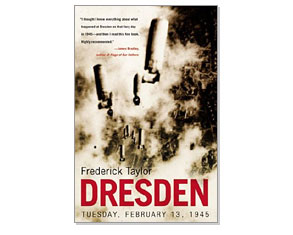

Most Americans — at least, the ones who aren’t addicted to the History Channel — know about the bombing of Dresden in 1945 from Kurt Vonnegut’s bestselling novel “Slaughterhouse-Five,” based on Vonnegut’s own experiences as a prisoner of war. The attack is still a touchstone for the moral perils of war. Frederick Taylor, a British historian whose new book on the subject goes on to challenge much of what we think we know about the bombing, describes the conventional understanding thus: “Dresden was the unforgivable thing our fathers did in the name of freedom and humanity, taking to the air to destroy a beautiful and, above all, innocent European city. This was the great blot on the Allies’ war record, the one that could not be explained away.”
“Slaughterhouse-Five” came out in 1969, a time when many Americans were wondering just how much carnage could be justified by the trumpeted ideals of democracy and freedom. Like Joseph Heller’s “Catch-22,” “Slaughterhouse-Five” is a book set during World War II that was read in the light of Vietnam. It wasn’t the first time Dresden was seen as a proxy. Taylor writes that not long after the war’s end, and certainly before that, “Dresden became one of the most well-placed pawns on [a] virtual propaganda chessboard.” There is the real Dresden and the Dresden of legend. Taylor makes what is by all appearances a good-faith effort to excavate the former by digging through the many layers of the latter. His “Dresden: Tuesday, Feb. 13, 1945” aims to be the last word on the subject, though it’s sure to be argued about for years to come.
The most familiar version of the story, the one that appears in “Slaughterhouse Five,” is that Dresden, the seventh largest city in Nazi Germany, was a lovely, cultured place of no military significance that had been left untouched by the air war before February 1945. The Allies’ attack, two waves of Royal Air Force bombings on the night of Feb. 13 and a lesser raid by American planes the following day, was an unprecedented, unnecessary, vindictive assault made at a point when the war was essentially over and when the Allies knew that the city was full of refugees fleeing the advancing Russian front to the east. The attack, according to this version, was a pure “terror bombing” designed to wreak maximum havoc and culminating in the aerial strafing of people fleeing the flames. Somewhere between 135,000 and a half-million people were killed.
According to Taylor, most of the above is simply untrue. Tapping municipal records that have only recently become accessible after the fall of the Berlin Wall and the collapse of East Germany (the nation that included postwar Dresden), he persuasively argues that the real death toll from the attack was somewhere between 25,000 and 40,000 and that Dresden was far from innocent of war-related industry and activity. After scrutinizing and comparing the records and history of British bombing campaigns against the Third Reich in the latter days of the war, he finds that “Dresden was a big raid, but no bigger than a considerable number of others at that time directed against the urban areas of Germany.” He comes up with several stated and plausible reasons for the Allies to target the city besides the main motive attributed to them by their harshest critics: bloodthirsty revenge for the bombing of London during the Blitz and anti-German zeal. The strafing almost certainly never occurred.
That doesn’t mean that Taylor minimizes the horrors Dresden and its people suffered. “Dresden” is not a simplistic or simplifying book. Along with his diligent documentation of body counts and British bombing strategies, he presents the fruits of in-depth interviews with survivors of the attack. The centerpiece of the book is a riveting narrative account of how Dresden’s citizens experienced the bombing and the monstrous firestorm it succeeded in fomenting. Twenty-five thousand people killed is still a massacre, and Taylor’s description of the bleak aftermath is a nightmare of corpses lying in heaps on a landscape blasted and burned into lunar rubble. The day after, Feb. 14, was Ash Wednesday. That weird metaphorical coincidence is in tune with the many ironies Taylor encountered during his research.
Perhaps the first and most striking of those ironies is that Victor Klemperer, the famous Jewish diarist of the Nazi era, had been ordered to report for deportation on Feb. 16, along with what remained of Dresden’s Jewish population (all married to “Aryans”). Everyone knew what this meant: “It promised at best transportation to the Theresienstadt ghetto, at worst a death march of the kind that had already consigned tens of thousands of Jews to a bitter and brutal fate just as the new Allied advances seemed to bring deliverance so tantalizingly close,” Taylor writes. Klemperer and his wife escaped in the chaos after the bombing, posing as “Aryans” whose papers were destroyed in the fires. (Klemperer’s diaries are one cultural treasure that was saved rather than destroyed by the bombing.) Another of Dresden’s Jews, Henny Wolf, wrote “For us, however macabre as it may sound, the air raid was our salvation, and that was exactly how we understood it.”
There were only about 170 Jews left in Dresden at the time of the attack (and 40 of them died in it), but their welcoming of the raid points up the impossibility of characterizing Dresden as “innocent.” The city had a solid history of anti-Semitism, and while it never had many Jews to persecute, it did its best with the victims at hand. “Dresden was a Nazi stronghold even before Hitler took power,” Taylor explains, noting that the National Socialists became the city’s largest party in the Reichstag elections of 1932. The local party leader and provincial governor, Martin Mutschmann, was a particularly rabid specimen and insisted that the city go into public mourning for the eight days between Hitler’s suicide and the arrival of the Red Army.
As for the idea that Dresden played little part in the war effort, Taylor shows that this was neither the case nor something the Allies believed. Although the city didn’t turn out great big tanks or aircraft like the two other urban centers selected for bombing at the same time, Leipzig and Chemnitz, all of its high-end “precision work” manufacturing capacity had been converted to war use. Instead of cameras and cigarettes, two Dresden specialties besides the famous china and chocolates, the factories (some operating on the slave labor of POWs and Jews) made military optical devices and bullets. How could they not, in a Germany dedicated to the imperative of “total war”?
The British commanders who organized the raid maintained that Dresden was targeted mainly because it was a communications and transport hub. The city contained military barracks, but its role in funneling troops and supplies east to German forces fighting the Soviets was what doomed it, as Klemperer himself predicted four months before the bombing. Yet the February 1945 attack clearly targeted the city itself by focusing on its built-up and highly flammable center, rather than limiting itself to the barracks, industrial suburbs or railways.
The intention behind the attack was to throw the entire city into chaos, and the Allies were prepared to destroy a European architectural and cultural treasure — and to kill thousands of civilians — to do that. The Soviet Army was taking heavy losses after agreeing to push west earlier than originally planned, and the Allies in trade would try to make sure that, in Taylor’s words, “the defending Germans would have their backs to a wasteland, and reinforcement would be almost impossible.”
The war was anything but over to the people who were fighting it, and it’s risky to judge the combatants’ actions on the basis of hindsight about how few months of fighting were left. (Taylor argues that the Ardennes offensive in December 1944 had made the Allies believe that Germany was rallying.) As Taylor points out, to the 79,000 Soviet soldiers and 125,000 Berliners who would die in the taking of Berlin 10 weeks later — or for that matter to the civilians in Paris and London still being targeted by German V-1 and V-2 rockets — the war was anything but a done deal. Nevertheless, it’s in the decision to devastate Dresden that the moral wicket gets sticky. Some of the air crews winced at the idea of raiding a city known to be harboring refugees. “We had leveled ourselves to the Krauts,” one radio operator wrote in his memoirs.
Taylor doesn’t deny that the question of whether it was worth stooping to such tactics remains a painful one. His quarrel is with the notion that Dresden was exceptional, or at least intentionally so. He points out that previous and subsequent raids on other cities aimed to be just as destructive, but didn’t succeed because weather or human error or some other unforeseen factor interfered. Hamburg, a larger city than Dresden, took more casualties when it was bombed in 1943, and the towns of Pforzheim and Darmstadt lost a greater percentage of their population when their turn came. Conditions in Dresden combined to create the firebombing equivalent of a perfect storm. That the same thing did not happen elsewhere wasn’t because the Allies didn’t try.
One factor that contributed to the catastrophe was a widespread lack of preparedness in Dresden: There were few decent shelters and citizens didn’t understand the importance of extinguishing the fires started by incendiary devices as soon as possible. (High-explosive bombs did limited damage by comparison.) As Taylor depicts them, Dresdeners lived in a dream world, “floating happily under the illusion that their city was too beautiful and too famous to suffer as other population centers in the Reich had suffered.”
It’s only when writing about this belief that the scrupulously fair and compassionate Taylor slips into testiness. He implies that this fantasy was a version of the larger German denial about what they’d allowed their nation to become under the rule of a maniac who rhapsodized about their special destiny. He quotes a long-suffering Soviet soldier who asked his superior officer why the conquered Germans should be treated kindly, when “They were well off, well fed, and had livestock, vegetable gardens and apple trees. And they invaded us.”
Perhaps the extremity of the firebombing of Dresden’s civilians was unnecessary, but there is no doubt that the war that caused it was, and that Dresdeners shared with other Germans the responsibility for that war. “With the vast material and spiritual riches of places like Dresden at your disposal,” Taylor writes, “why place all that at risk by launching a ruthless, in large part genocidal attack on the rest of Europe? … Did anyone really expect the world to fight back while wearing kid gloves, in order not to damage Germany’s artistic treasures or kill German civilians?”
Exceptionalism played its part in the legend of Dresden as well, although that has only become obvious over time. The origins of the casualty reports in the hundreds of thousands lie, not surprisingly, in the propaganda efforts of Joseph Goebbels, who wanted to convince Germans that the Allies were so bloodthirsty that their only choice was a fight to the bitter end. And while the bombing was executed largely to support the advancing Soviet Army, once the communists took over Dresden and the Cold War was underway, it became a symbol of Western barbarism. In the unoxygenated environment of the Soviet state media, all sorts of bizarre and exotic rumors flourished, including one that Vice President Harry Truman (who would become president a few months later, after Franklin D. Roosevelt’s death) had personally ordered the bombing.
Most Western misperceptions about the bombing of Dresden — especially the casualty count of 135,000 — come from one source, the 1963 bestseller “The Destruction of Dresden” by David Irving. Irving’s book is the source of much of the misinformation Vonnegut reproduced in “Slaughterhouse-Five,” and Vonnegut goes so far as to mention Irving’s book in his novel. This added the authority of an eyewitness to Irving’s account, but as Taylor demonstrates in “Dresden,” the terror and confusion of enduring a bombing raid often drastically distort the memory. One Dresden survivor recalls finding refuge on an ice floe in the midst of the Elbe River, while another describes the same river aflame with phosphor. It was a mild evening and phosphor didn’t figure significantly in any of the ordnance. To a POW like Vonnegut, forced to excavate corpses from the bomb shelters under the rubble, 45,000 dead could easily look like over 100,000.
Taylor carefully documents the flaws in Irving’s account of the attack. Some of Irving’s mistakes are understandable, given the inaccessibility of much of the evidence. In some cases, however — specifically in verifying reports that Allied planes had strafed refugees — it seems likely that Irving deliberately misrepresented evidence and based his accounts on documents that don’t exist.
This is less shocking now than it would have been in 1963, when Irving still had a reputation as a brilliant if iconoclastic historian and a diligent researcher. Today, he’s best known as a Holocaust denier. When he sued American scholar Deborah Lipstadt for calling him just that, his writings on the Holocaust and Hitler came under greater scrutiny. As Charles Taylor wrote for Salon in reviewing Richard J. Evans’ book about the trial, that work was found to show “a consistent pattern of misquotation, selective editing, reliance on documents later found to be forged (and in one case known by Irving to be forged), suppressed information that ran counter to his case and fiddled figures.” To judge from “Dresden,” Irving was doing this even before he started writing about the Holocaust.
In his afterword to “Dresden,” the author describes a ceremony he attended in 2002 commemorating the bombing. Far-right groups and Nazi apologists gather at the margins of such events, where they can promulgate their message that “in the Second World War the Allies, not the Germans, were the true war criminals.” The inflated death tolls for Dresden become part of a numbers game intended to neutralize the enormity of the Holocaust (which in turn, these groups seek to minimize).
That is, of course, not the way Vonnegut portrays the devastation of the city whose beauty led him to compare it to Oz. For the novelist, and for many others like him, Dresden, like Hiroshima, is a pacifist watchword, proof that even those with right on their side can slip into savagery once they succumb to the moral fog of war. In other contexts, the myth that more people died in Dresden than in the bombing of Hiroshima becomes a cautionary tale about the lethality of conventional weaponry in the atomic age.
Enough people died in Dresden for the event to be justly labeled a tragedy. Enough of them were genuinely blameless (most of Taylor’s sources among the survivors, for example, were children at the time) for the attack to shade into the realm of atrocity. Yet it’s hard to argue that the Allies were wrong in deciding that winning the war mattered more than anything else, given the kind of world we would have inherited had they failed. The moral truth about Dresden is fundamentally ambiguous, however much some parties might want to paint it otherwise. Only histories like Taylor’s, which encompasses both the raw human suffering of Dresden’s people and the incontrovertible political facts about the city and nation they inhabited, can do it justice. And no just cause can be well served by anything less.
