
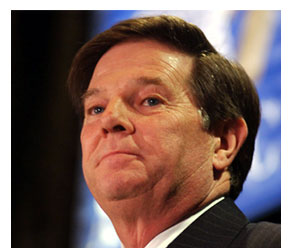

The weekly pen-and-pad press briefings in the office suite of the house majority leader are almost formal events. Thirty to 40 reporters take their seats at a long table and at a second tier of chairs placed against the east and west walls. “The leader” enters, escorted by two aides, Jonathan Grella and Stuart Roy. Roy closes the door at the south end of the elegant dining room and stands beside his boss, who sits at the head of the table; Grella takes his position at the opposite end of the room. Tom DeLay takes his seat, opens with a bit of friendly banter, and begins to work through his agenda. There’s so much decorum that DeLay’s arrival and departure are almost ceremonial. And there is never any doubt about who is in control. The 56-year-old congressman from Sugar Land, Texas, is smart, authoritative and in charge.
Recently the leader’s grip has begun to slip. The first press conference in February ended with a Fox TV news reporter pressing DeLay for answers about the ethics committee’s failure to investigate allegations of bribery on the House floor. DeLay didn’t respond. The last press conference in February ended with Fort Worth Star-Telegram reporter Maria Recio asking about a campaign finance investigation in Texas. “That’s not on the agenda,” DeLay snapped.
Then he went on to answer the question with an unbidden attack on the “vindictive and partisan” district attorney in Austin.
The “vindictive and partisan” D.A. DeLay referred to is Ronnie Earle. For almost six months, Earle and a grand jury have been investigating possible violations of Texas campaign finance law in the 2002 election. Because the state capital lies within the jurisdiction of Travis County, Earle is far more powerful than the D.A.s in larger cities, such as Houston, Dallas and San Antonio. His Public Integrity Unit has a mandate and legislative funding to prosecute public officials who break the law. He’s held office for 27 years, and is the only Democrat with statewide prosecutorial authority. His ongoing investigation of two political action committees that spent a combined $3.4 million on 22 Republican Texas House races is now focused on a PAC founded by DeLay and directed by a DeLay operative. “This is an attempt to criminalize politics,” said a visibly angry DeLay. Ronnie Earle, he told reporters at his Feb. 24 press conference, is a “runaway prosecutor.”
Before Jon Grella could cut off questioning, DeLay was asked about two of his close associates billing Indian tribes a staggering $45 million in lobbying and consulting fees. DeLay said Jack Abramoff had never been on his staff. And he warned: “Anybody trading on my name to get clients or to make money, that is wrong and they [should] stop it immediately.” The warning was a little late. Mike Scanlon, the 33-year-old former press aide who helped coordinate DeLay’s impeachment of President Clinton in 1998, had pocketed a $30 million cut of the fees paid by the Indian tribes. Abramoff resigned from his lobbying position. Sen. John McCain subpoenaed Abramoff’s files. And the D.A. in Austin subpoenaed DeLay’s daughter in a separate investigation.
It will only get worse.
Now it appears that Abramoff and Scanlon are “off the reservation” for good. And DeLay can’t be much help to these associates facing a Senate inquiry. At the same time, the majority leader is confronted by grave problems in his home state. Just as he needs to distance himself from Abramoff — a close friend and longtime member of his “kitchen cabinet” — DeLay must to try to avoid the clutches of Ronnie Earle. The Travis County D.A., after all, can put him in a place and position he’d prefer to avoid: in an Austin courtroom under oath.
Prison is an unlikely fate for DeLay, though he is very close to the center of the investigation. It is equally unlikely for his daughter, Danielle Ferro. “She’s not responsible for the fact that she was paid with illegal money, assuming a court decides the money was illegal,” said an Austin attorney who asked to remain anonymous. But jail is not out of the question for DeLay’s operatives in Texas, who are looking at third-degree felony charges that carry a 10-year sentence.
According to courthouse sources in Austin, some witnesses will soon begin to roll in what is being compared to the Sharpstown scandal of the early ’70s: a banking stock scheme that sent the speaker of the house to jail, ended the career of the lieutenant governor, and fueled a reform movement aimed at curbing influence buying in the Legislature.
That’s not to say Texas is no longer the wild west of campaign finance. You can’t hand out checks on the Senate floor, as chicken tycoon Bo Pilgrim did in the late ’80s. (A senator who didn’t get a check said the $10,000 was a “poultry sum” he never would have accepted.) But when it comes to political contributions in the Great State, the only limit is the size of your bank account. Any citizen of the U.S. can give any amount to any elected official or candidate for public office. All you have to do is declare your contribution to the Texas Ethics Commission. Political action committees also are only restrained by the give-and-declare law.
There are two clear prohibitions: Corporate money and union money cannot be spent in election campaigns. The ban was passed into law in the early 1900s as a response to robber barons buying up railroads, timber, oil and legislators. A “speaker’s statute,” enacted after the Sharpstown scandal, prohibits a candidate for speaker of the house from handing checks to House members or candidates in exchange for support. It is these two state laws that have placed U.S. Majority Leader Tom DeLay and his handpicked speaker of the Texas House, Tom Craddick, under investigation by the Travis County Public Integrity Unit.
The back story is one of intrigue and power grabbing. Tom DeLay badly wanted to redraw the state’s congressional districts to add some half-dozen Republican representatives to the Texas U.S. House delegation. To do so he required a Republican majority in the Texas statehouse.
For four election cycles, Craddick had been expanding that majority. Working with an Austin political operative (one of 58 individuals subpoenaed in Austin), Craddick did it the old-fashioned way: establishing a PAC, raising huge amounts of money, and spending it where Democrats were vulnerable. He was racing against the calendar. Republicans controlled the Senate. But they needed a majority in the House by 2001, so they could redraw the state’s congressional districts after the 2000 census.
They fell a few seats short. And after the Democratic House and Republican Senate failed to reach an agreement on reapportionment in 2001, congressional district lines were redrawn by a panel of three federal judges. The Democrats had held the future at bay and it appeared that the Republicans would have to wait until the next census to redraw the lines. Or so the Democrats reasonably assumed, as reapportionment must be done in the first legislative session following the census. Republicans fell short, according to a party source quoted in the Texas Observer (which has extensively covered the story), because “the Hammer had too many balls in the air.”
The Hammer is Tom DeLay, who in 2001 stopped juggling and came home to Texas. DeLay and Jim Ellis, a political operative who had run DeLay’s Americans for a Republican Majority (ARMPAC), devised a scheme that would get DeLay the House seats he wanted in Washington by electing Republican legislators in Austin. First, they would use DeLay’s Washington contacts to raise the money to get Tom Craddick his Republican majority in Texas. Then, Craddick would deliver to DeLay an off-year redistricting plan that would add as many as seven Republican members to the Texas House delegation in Washington
They were spectacularly successful. They raised and spent $1.5 million. All but three of 21 new Republican legislators elected in 2002 were supported by Texans for a Republican Majority (TRMPAC) — the PAC DeLay and Ellis created. And after he was elected speaker Craddick delivered a redistricting plan, despite Democratic state representatives and senators fleeing the state on two separate occasions to deny the Legislature a quorum. The entire deal was done in one election and three special sessions. It was a bold and brilliant case study of DeLay’s power.
But in their grab they failed to pay close attention to bookkeeping and Texas election law. One group did: Texans for Public Justice. The Austin campaign-finance advocacy group began comparing TRMPAC’s Texas Ethics Commission filings with its IRS filings. “We found approximately $600,000 in contributions on their IRS filings that weren’t filed in Texas,” said TPJ director Craig McDonald. “It wasn’t reported in Texas. It was off the books.” It was also PAC money raised from corporate sources — in almost all circumstances a violation of Texas campaign finance law. McDonald wrote a letter to the Travis County D.A., documenting what he had found and requesting a criminal investigation.
Much of the funding McDonald turned up was from DeLay’s regular funders like Philip Morris and Bacardi. There were also contributions from corporations that had no business dealings in Texas yet were suddenly making campaign contributions there. The Washington-based Alliance for Quality Nursing Home Care contributed $100,000.
Questerra Corp., a Virginia energy company, contributed $50,000. One widely reported contribution was from Westar, a Kansas utility that has no ostensible connection to Texas. When a Westar executive asked in an internal e-mail about the $25,000 donation to DeLay’s Texas PAC, a colleague told him it was to “get a seat at the table” in Washington and ensure that a deregulation provision was inserted in a key piece of legislation. Even the Mississippi Choctaw Indian tribe kicked in $6,000. The tribe does no business in Texas, but its Washington lobbyist was none other than the ubiquitous Jack Abramoff.
DeLay political operative Jim Ellis told the Texas Observer that there is a simple explanation for the two sets of books. TRMPAC raised “hard money” from individuals and spent it on election campaigns, which no one charges is illegal. But TRMPAC had another account that included “soft money” raised from corporate donors. Those funds were reported to the IRS, not to the Texas Ethics Commission, and were spent on administrative expenses rather than direct contributions to political campaigns.
The Travis County D.A. might not buy the argument that that was legal. Texas election law “clearly defines administrative expenses as operating expenses incurred in the normal course of operation of any active organization, whether engaged in politics or not,” said an Austin lawyer who specializes in campaign finance. “The law is further defined by a half-dozen opinions from the Texas Ethics Commission.” DeLay’s PAC spent corporate funds on polling, voter identification, fundraising and candidate recruitment — hardly routine expenses that would be incurred even by businesses not involved in politics, as Texas law requires. That is, unless TRMPAC’s attorneys can convince a jury that Starbucks, say, does political polling, phone banking and candidate recruitment.
Even more explicit in Texas law is the prohibition of the use of corporate money for political fundraising. TRMPAC paid John Colyandro, a former associate of George W. Bush political advisor Karl Rove, a year’s salary with corporate funds, said a campaign finance lawyer close to the case. Also, the Texas Observer reported that the Texas PAC spent $130,000 on fundraising.
“Ronnie has a very, very strong case,” said the campaign finance lawyer. The case seems to get stronger by the week, as reporters following civil suits filed by a former state representative defeated by TRMPAC turn up documents that suggest what the grand jury must be reviewing in its criminal inquiry.
On Sept. 10, 2002, TRMPAC donated $190,000 in corporate money, which could not be legally used in Texas elections, to the Republican National Committee. On Oct. 4, the RNC sent $190,000 that could legally be used in Texas to TRMPAC’s Jim Ellis, with instructions to distribute the money to seven candidates in Texas. If the case ever gets to court, jurors will be told that the check was left blank for Ellis to fill in, which doesn’t look good. Prosecutors will allege a classic soft-money-in/hard-money-out deal, though TRMPAC attorneys contend that the $190,000 up and $190,000 back was a coincidence.
In addition, documentation of 14 TRMPAC checks totaling $152,000 that Craddick personally distributed to 14 Republican candidates has surfaced in the civil case. An e-mail from Colyandro directed TRMPAC’s accountant to send the checks to Craddick. Craddick insists that the 14 candidates were already supporting him, so he was not cultivating their favor and therefore not violating the speaker’s statute. (He has retained an Austin attorney who specializes in defending elected officials facing public corruption charges.)
On March 3, Laylan Copelin, an Austin American-Statesman reporter, found another discrepancy certain to catch the attention of the district attorney: “The Republican Majority committee has said it didn’t report the $600,000 to state election authorities because it was spent on the committee’s administrative expenses … Yet the committee’s 2002 tax return lists $1.6 million — instead of the $900,000 — as ‘activities related to support for state Legislature and statewide offices in the state of Texas.'” The numbers don’t add up and lawyers and accountants for DeLay’s Texas PAC are going to have a hard time coming up with proof they had enough legal (hard dollars raised from individuals) money to cover all they spent on the 2002 Texas election.
All of this makes the notorious Sharpstown scandal look like a parochial pissing match in the political backwater Texas of 30 years ago. Tom DeLay is the majority leader of the U.S. House. He achieved that position by using his federal PAC to elect Republican representatives indebted to him because he provided the money that put them in office. He is grooming himself to replace Speaker of the House Denny Hastert. And the House is likely to remain in Republican (read: Tom DeLay’s) control for years.
The Travis County D.A.’s investigation represents the first time any of DeLay’s fundraising operations have been subjected to legal scrutiny. An impotent Federal Election Commission makes enforcement at the federal level improbable. Democrats filed a racketeering lawsuit against DeLay in 1998 and actually got it certified by the same district judge who presided over the Microsoft antitrust lawsuit in Washington. But they quickly folded and settled. Now, Texas D.A. Ronnie Earle, with subpoena power and a staff of investigators and lawyers, is doing what no one has thus far been able to accomplish. He is investigating the Texas franchise of what in Washington is referred to as DeLay Inc. — the largest funding combine ever controlled by a single member of Congress. (It raised $12.6 million from 2000-’02.)
Earle is in no hurry and is expected to turn the findings over to a second grand jury in April, when the term of grand jurors conducting the current investigation expires. A slow and methodical investigation, if the past month suggests what’s to come, cannot serve the interests of Tom DeLay.
Compounding the majority leader’s problems is Earle’s separate, or perhaps parallel, criminal investigation of the Texas Association of Business whose PAC spent $1.9 million along with the $1.5 million TRMPAC spent on the 2002 election. There are also two civil suits filed by former Democratic legislators who have presented strong arguments that the Texas Association of Business and TRMPAC violated Texas election law. Legal pleadings, depositions and documents obtained in the pretrial discovery process for the civil suits, unlike grand jury proceedings, are public record unless sealed.
How did a bunch of supposedly shrewd political operatives make so many mistakes in one election campaign? In their arrogance they assumed no one would hold them accountable. The Texas attorney general is a former Karl Rove client, who has shown little interest in suing Republicans. The Legislature is firmly in control of the Republicans and unlikely to hold hearings on compliance with campaign finance law. And the only public statement Republican Gov. Rick Perry has made is a demand that “the appropriate authority” begin an investigation — of Travis County District Attorney Ronnie Earle.
Earle is the one variable the wiseguys from TRMPAC failed to include in their equation. His Public Integrity Unit is funded by the Legislature and mandated to prosecute public corruption. But he has done little with that mandate since his 1994 prosecution of U.S. Sen. Kay Bailey Hutchison — for official misconduct and records tampering — fell apart in the courtroom when Earle declined to go forward with the case.
Now Earle is 62, nearing the end of his career, and faces no opponent in November. TRMPAC has presented him with a case he believes he cannot ignore. “He’s really incensed about this stuff,” said Joe Crews, an Austin attorney representing a former state legislator suing ARMPAC. “He really believes that this is where you have to draw the line in a democracy, if we are going to have a democratic process.”
According to sources close to the case there is little doubt that indictments will be handed down. At the center of the investigation is John Colyandro, who showed up at a deposition for the civil suit with his criminal defense lawyer. Colyandro has reportedly been given limited immunity. Jim Ellis, who ran DeLay’s Washington PAC and is hardly naive about campaign finance law, is dangerously close to the center of the inquiry. He directed TRMPAC and called most of the shots, and e-mails turned up in the civil suit connect him to the $190,000 TRMPAC sent to Washington. Bill Ceverha, Tom DeLay’s roommate in “Macho Manor,” a legendary 1980s legislators’ party house, was the PAC treasurer and should have been aware of how money was raised and spent. Two Republican state reps served on the TRMPAC board and raised campaign money.
The majority leader himself may have enough of what Richard Nixon liked to call “plausible deniability” to avoid indictment. But he cannot claim he knew nothing, or even little, of what his PAC was doing in Texas. There are too many documents, e-mails and phone logs. Too many people are talking under oath, when the threat of going to jail for perjury encourages them to tell the truth. A Colyandro deposition in the civil suit already places DeLay squarely in the PAC’s decision-making process: in conference calls and major decisions TRMPAC made. It’s also part of the public record that DeLay was one of the founders of the PAC and served on its board.
Besieged by lawyers and investigators, Texas Republicans seem to be shifting from a litigation strategy to a legislative strategy. The state Republican Party is circulating a petition calling on the Legislature to shut down the Travis County D.A.’s Public Integrity Unit. A source close to the investigation says that the D.A. has been warned that the governor might take up the issue of funding in a special session. Should that occur, Earle will stand on his constitutional authority. The Legislature can take away his funding, but it cannot eliminate his authority to investigate and prosecute public corruption.
The district attorney will soldier on, even if his funding and staff are eliminated. Editorial boards from the state’s major daily newspapers are supporting his efforts. He seems confident that he has both the law and the facts working for him. The threat to cut his funds won’t work. “He’ll go it alone, issuing grand jury subpoenas based on newspaper clips,” the source said. “Ronnie’s in this one for keeps and these guys are in deep shit.”
