
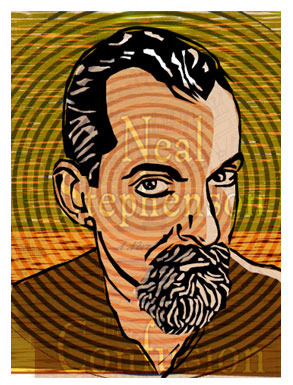

Rumor had it that Neal Stephenson would follow “Cryptonomicon,” his bestselling 1999 novel combining present-day high-tech entrepreneurs and World War II-era derring-do, with a similar tale of fugitive data and high adventure set sometime in the near future. Last year, with the publication of the first of the three-volume “Baroque Cycle,” “Quicksilver,” Stephenson revealed that he’d turned the dial on his time machine in the other direction. “Quicksilver,” written by hand with a fountain pen in an alcove lined with a huge map of early 18th-century London, immersed the author and his legions of devoted readers in one of the most intellectually exciting and politically momentous periods of history. It was the age of such scientific geniuses as Isaac Newton, Gottfried Wilhelm von Leibniz and the undersung polymath Robert Hooke, and also the time when our modern economic systems began to take form.
Unusual subjects for fiction, perhaps, but Stephenson makes the “Baroque Cycle” a weirdly effective mix of high-octane tutorial and ripping yarn. To balance such cerebral characters as Newton and Daniel Waterhouse (Puritan ancestor of the Waterhouses, crack mathematicians and programmers, in “Cryptonomicon”), he introduces Jack Shaftoe, aka the King of the Vagabonds and his sometime-paramour turned countess and financial whiz, Eliza. Shaftoe, like his descendant Bobby in “Cryptonomicon,” skips from one outlandish but irresistibly entertaining exploit to the next, barely escaping with his skin intact: war, thieves, prison, pirates — you name it. As for Eliza, well, she’s the kind of girl who encrypts top-secret military information in her cross-stitch embroidery and surreptitiously handles the investments of half the court of Louis XIV. The second volume in the “Cycle,” “The Confusion,” published on April 19, continues the saga, with an even more lavish serving of the feats of Jack and Eliza.
Stephenson found time for an interview during the course of a road trip, in a borrowed 40-foot R.V., across the high desert of Washington state from Spokane to his home in Seattle. It was a long conversation.
What inspired the “Baroque Cycle”?
It was an unexpected byproduct of “Cryptonomicon.” One of the things I wanted to talk about in that book was the history of computing and its relationship to society. I was talking to Stephen Horst, a philosophy professor at Wesleyan, and he mentioned that Newton for the last 30 years of his life did very little in the way of science as we normally think of it. His job was to run the Royal Mint at the Tower of London. I’d been thinking a lot about gold and money, which were themes in “Cryptonomicon.”
At the same time, I read a book by George Dyson called “Darwin Among the Machines,” in which he talks about the deep history of computing and about Leibniz and the work he did on computers. It wasn’t just some silly adding machine or slide rule. Leibniz actually thought about symbolic logic and why it was powerful and how it could be put to use. He went from that to building a machine that could carry out logical operations on bits. He knew about binary arithmetic. I found that quite startling. Up till then I hadn’t been that well informed about the history of logic and computing. I hadn’t been aware that anyone was thinking about those things so far in the past. I thought it all started with [Alan] Turing. So, I had computers in the 17th century. There’s this story of money and gold in the same era, and to top it all off Newton and Leibniz had this bitter rivalry. I decided right away that I was going to have to write a book about that.
Pretty soon I was thinking this was an exceptionally apt time in which to set a novel. There were so many wild and improbable things going on then that made for good material. The siege of Vienna where the Turks penetrated into Europe is a thing that’s almost inconceivable to us today. That was the deepest into Europe that they got. That’s a pretty dramatic little happening. Things like the Barbary pirates and 800 other different flavors of pirates, Spanish treasure galleons, the wars of Louis XIV, the scientific revolution, the plague, the Great Fire of London. All that falls into the period of time when Newton and Leibniz were alive.
The rivalries between the various scientists you write about are so bitter, it’s surprising even to someone who already knows that science isn’t this Olympian, rational activity totally removed from human pettiness.
Science was new and they didn’t know how to do it yet. Science was and is a somewhat contentious thing. Someone’s got a theory and they promulgate that theory and then something else comes along and alters, improves on or even flatly contradicts it. Now that we’ve got 350 years of perspective on this, scientists understand that this is how it’s done and there’s a mechanism in place for how to do it. It’s refereed journals and it’s become institutionalized. They didn’t have that perspective on it. They couldn’t stand back and say, Well, my theory may get contradicted here and there, but this guy who’s contradicting it will get contradicted in turn. They didn’t have that expectation. They didn’t have journals. The first two journals were the Journale de Savants, which was about 1665, and the Proceedings of the Royal Society, which was right about the same time. Leibniz had to found his own journal in order to publish his own work. They were kind of banging around in the dark trying to figure out how to do this.
Hooke, for example, when he figured out how arches work, published it as an anagram. He condensed the idea into this pithy statement: “The ideal form of an arch is the form of a chain hanging, flipped upside down.” Then he scrambled the letters to make an anagram and published it. That way, he wasn’t giving away the secret, but if somebody came along a few years later and claimed that they’d invented it, he could just unscramble what he’d published. He was establishing precedence.
Hooke squabbled with [Christiaan] Huygens over a bunch of clock-related inventions. This kind of thing was just rife. It came to a head in a grotesque way in the priority dispute over [who invented] the calculus. That was so embarrassing to the whole institution of science and people were so nauseated by it that it taught everyone a lesson. After that, no one would dream of doing what Newton did, which was to invent something really important and then sit on it for 30 years.
I’m still baffled as to why he’d do that.
It was a combination of things. Again, the institutions of science didn’t exist. Even if he’d wanted to publish it there were no journals at the time. The prevailing ethos that he would have been brought up in was alchemy, which was called the “esoteric brotherhood.” They were completely of a mind that you didn’t publish your results, at least not in a way that was intelligible to anyone. So if you read the alchemical recipes of Paracelsus or Robert Boyle or any of those people who practiced this, they’re all couched in metaphor. You have to know what stands for what to understand the recipe. They even thought that some of the Greek myths were disguised alchemy recipes, like the myth of Cadmus, who sowed the teeth that grew into soldiers, which they thought was a set of instructions to make some kind of compound. It wouldn’t have occurred to Newton anyway to make any new material public. He didn’t care at all for fame or getting attention.
But you’d think they’d care about the advancement of their field.
They didn’t have the sense of progress, I think, though that’s debatable. I talked to one historian of math and science who thinks they very much did. Another thing about the calculus is that it was very controversial because it involves adding up infinitesimal quantities to make something, which is an iffy proposition. Newton was very thin-skinned and would become very withdrawn and bitter when people made even routine criticisms of his work. He didn’t want to put it out and then have to spend all his time defending it. Later in the 19th century the mathematical profession finally said, Look, as currently written, this is nonsense, so we’ve got to tear it down and go back to the beginning. They had to go back and build some serious mathematical underpinnings beneath the calculus. They could see that it worked, but the way in which it had been proved was no longer acceptable. Newton may have suspected that, intuited that, and so was afraid to bring it out.
It’s odd that so few historical novelists set their books in the late 17th century, when you think about it. The changes in the air were so huge.
That was one of my reactions, too, when I started getting into this. You see a lot about the late 18th century, the time of the Revolution, you see a lot about the Civil War and the Victorian era. There have been some books about this era published recently — “An Instance of the Fingerpost,” “A Conspiracy of Paper,” about the fall of the South Sea company in 1721. But it’s strangely underrepresented.
Maybe that’s because most novelists tend to be interested in literary history. The age of Johnson is exciting, and the age of Dickens, but not so much this time, in terms of great writers.
Well, in this period you’ve got Milton. He’s coming out with “Paradise Lost” at the same time as the plague, the fire, the founding of the Royal Society. You’ve got [John] Bunyan, “Pilgrim’s Progress,” although that’s a hard book for people to take these days. That’s not anyone’s favorite book.
Also, for a modern readership, the religious disputes of that time are pretty complicated and hard to follow. And people took them so seriously, which is difficult to relate to if you’re secular-minded.
I think you’re on to something in saying that one off-putting thing to people about this period is the religious aspect of it, and also the politics, which are also pretty closely entwined. Milton and Bunyan are intensely religious people and every word they write comes straight from their religion. This was pre-Enlightenment. There were a few people running around with the secular ideas that we accept as being the norm today, but most of these people were religious and really meant it. Newton was that way; Leibniz was that way. They argued about religion, but they did so from the standpoint of people who really took it seriously. I found that an interesting thing to tackle as a writer because these people were so different from the people who are likely to read this book.
You’re remarkably sympathetic to the Puritans, too, which is unusual these days.
I have a perverse weakness for past generations that are universally reviled today. The Victorians have a real bad name, and the word “Puritan” is never used except in a highly pejorative way, despite the fact that there are very strong Victorian and Puritan threads in our society today, and despite the fact that the Victorians and Puritans built the countries that we live in. The other one, by the way, is the ’50s. Someday I’ll have to write a ’50s novel.
The reason why people are so vituperative about those generations is not because they know anything about the history, but because they’re really talking about splits within our culture today that they’re worried about. In the same spirit that I wrote a Victorian novel earlier in my career, I figured it might be a kick to see what to do with some Puritans. Not hip, jaded, cool Puritans, but honest-to-god, fire-breathing Puritans. Drake [Waterhouse, Daniel’s father] is an arch-Puritan, but by no means exaggerated. There were a million guys like this running around England in those days. He became the patriarch of this family of people who have to respond to his larger-than-life status and extreme commitment to religion.
What do you admire about the Puritans?
They were tremendously effective people. They completely took over the country and they created an army pretty much from scratch that kicked everyone’s ass. This is not always a good thing. They were guilty of some very bad behavior in Ireland, for example. But any way you slice it they were very effective. Cromwell was a tremendous military leader. A lot of that effectiveness was rooted in the fact that they had money, in part because persecuted religious minorities, if they’re not persecuted out of existence, often manage to achieve disproportionate wealth. It happened with Jews, Armenians, Huguenots. Earlier in this project, I could have rattled off five more. They have to form private trading networks and lend each other money. They’re unusually education conscious. Puritans — and when we say Puritans, we’re talking about a whole grab bag of religious groups — tended to prize literacy and education. I’m sure they had a higher literacy rate than the general English population. Literacy and education make people more effective.
Another answer is that they very early on adopted a set of views on social topics that everyone now takes for granted as being basic tenets of Western civilization. They were heavily for free enterprise. They didn’t want the state interfering in private property. Now our whole system is built on that. We tend to forget that someone had to come up with that idea and fight for it. And those people did. The separation of church and state — in the absence of that separation, Puritans and other religious minorities couldn’t exist. You had to belong to your parish church. Things like registering births, deaths and marriages, which are state functions to us now, were handled solely by the parish churches. If you didn’t belong, you didn’t exist legally. You had no choice, you had to tithe. It’s often said that Cromwell admitted the Jews to England. He disestablished the church and made it possible for churches other than the established one to legally exist. That’s what enabled Jews to come back and start living there. Opposition to slavery got its start among different Puritan sects. To be fair, there were Catholic theologians who objected to it, too, but in the English-speaking world it started out as a fringe belief among Quakers and some other groups and spread from there to become a tenet of Methodism and Episcopalianism and basically all churches.
Another thing that some people might find surprising is how religious the scientists are — though they called themselves natural philosophers back then. We tend to think of science and religion as being fundamentally opposed.
A lot of secular, modern people claim to be disillusioned whenever they learn that any smart person is religious. That’s applicable to Newton as it is to any other religious smart person.
And then there was alchemy, which was a major preoccupation for Newton.
Alchemy is a whole different bag because it seems wacky, nuts to us. That’s kind of how it’s presented in the early part of the “Baroque Cycle.” In everything that you’ve read so far, you’re seeing alchemy through Daniel’s eyes, and he hates it. He can’t believe that Newton is buying into it at all and feels that fooling around with it has caused Newton to associate with the wrong crowd. At the beginning Newton is every bit as much of the correct young Puritan as Daniel is.
These men were discovering properties like gravity and the movement of the planets, but they also believed there was a whole spiritual realm as well.
They certainly believed in sin, temptation, the devil and witches as being real things. They were trying to integrate the new scientific way of thinking into that without destroying the old beliefs that are important to them. At the time, I think alchemy didn’t have the occult connotation that it might have now. It was an alternate way of thinking about matter, and it was comparatively modern. A lot of smart people believed in it, and a lot of them were perfectly devout Christians, Jews or Muslims. Since then it’s gotten associated with occult practices and one of the chores I’ve got in this book is to try to keep those two things apart.
Daniel thinks that it’s fraudulent. It’s old, it’s wrong, it’s being swept away by the new science, which he sees in Robert Hooke, for example. If you read the text of “Micrographia” [Hooke’s famous book of illustrations of objects observed through various lenses], Hooke goes through and demolishes a bunch of alchemical ideas and talks about light and heat and oxygen — he doesn’t use the word “oxygen,” but that’s what he’s talking about — in ways that are modern. Daniel thinks, why doesn’t Newton get with the program and abandon this old system? It’s clear that a lot of the people practicing it are frauds and second-raters, when there are people like Hooke inventing a whole new chemistry that actually makes sense. Later on, the vision of this is going to become a little more nuanced.
How did Newton and Leibniz reconcile their scientific studies with their religion?
Newton and Leibniz and other people at the same time are struggling to come up with a system of understanding the world that lets them have their cake and eat it too. There are some holes in the system that Newton presents in “Principia Mathematica” that he’s aware of and wants to plug, and you can make a case that the reason he spent so much time on alchemy is that he saw it as a way to finish this grand project. It wasn’t like this nutty, eccentric, oddball thing. It was a carefully thought-out part of his grand strategy for his life’s work. He was going to publish a book on alchemy called “Praxis” that was going to be as great as or greater than “Principia Mathematica” and supply the missing bits.
At the same time Leibniz is toiling away on a totally different system that’s meant to achieve the same goal. It’s really the clash between those two systems that’s the story, not who invented the calculus first. What Newton and Leibniz were arguing about was broad metaphysical topics of absolute space and time: Do we have free will, and if so, what does that mean? What’s a miracle?
Why do you think people find the religious leanings of great scientists so disappointing? Why should they be mutually exclusive?
It’s reductionism. You have to be able to reduce everything to interactions among particles. You can’t have anything other than that.
There are also the attacks on science made by some religious groups.
The fundamentalist churches nowadays do a much better job of promulgating their views and are much more vocal and outspoken, and if you’re a secular person who doesn’t have much interaction with organized religion, then the only time you ever see a Christian, it’s someone saying that evolution is a lie and the world is only 6,000 years old. It’s very easy to miss the fact that the Catholic Church and all the mainline Protestant denominations long ago accepted evolution and have no problem with it at all. I frequently run into militantly secular types who think that all Christians, for example, deny the theory of evolution. That accounts for a certain amount of the militancy of secular types in public discourse. They just can’t believe people believe this stuff. It seems patently idiotic to them.
Do you think that reductionist view of science is insufficient?
Steve Horst is working on a book right now called “Mind in the World of Nature,” where he talks about our standard method of doing science that Galileo got started — which is, you break a system down into its parts, you understand the parts, and then you build back up from that to figure out how to explain observable parts. That’s a description of how all science has been done for a long time. He’s making the argument that a lot of science doesn’t necessarily fit that mold: biological science, psychology. There are plenty of cases you can point to, even in mathematics, where being able to break things down into its smallest components doesn’t really get you anywhere. It doesn’t give you an explanation that’s really worth anything. If you look at cellular automata, for example: Sure, each automaton can be explained as a unit, but that’s not what’s interesting. What’s interesting is the really complicated emergent behaviors that you can get out of a whole bunch of these things acting at once. There’s really no grid to cross that gap.
Yet we’re often led to believe that these things are better understood than they are. Biologists complain that it doesn’t make much sense to talk about having “decoded” the genome when how the coding in genes is used to make proteins is still something of a mystery.
My friend Alvy Ray Smith would say that [the making of proteins from genes] is computation. I would avoid the term “mystery.” The materialist types just go nuts — that’s their word still. To call somebody a mysterian is their way of flicking somebody off the board. At some level there may be no mystery. You may be able to understand everything if you take the time and trouble to figure out how it all works. But it doesn’t give you anything useful, and in the meantime there’s lots of perfectly good science you can do by observing the top-level behaviors. People who do cell biology are doing perfectly good science — you can’t claim that they’re not doing science.
How much is the “Baroque Cycle” linked to “Cryptonomicon”?
People can decide for themselves how much of a piece they are. I stuck certain little details in “Cryptonomicon” that will make no sense whatsoever unless you’ve read “Baroque Cycle,” but they’re so small that you could read through them and not really notice them.
Do you ever worry that the sheer bulk of information you’re putting across in the “Baroque Cycle” might overwhelm your readers?
You’re seeing it in the context of a story that’s hopefully exciting. That makes it more fun to read. I believe that to encounter that kind of material in a story draws people in and gives them a real sense of immediacy, that it was really happening. You want to create a complete picture — the smells, the look of it, how it worked economically, where the money went. You want to get all that in there.
The birth of modern banking stuff seems like the most daunting thing to turn into entertainment. What interested you about this?
The fact that it was invented. At some point it doesn’t exist and then suddenly it’s there. They had a market that was basically one stock, which was Dutch East India stock and various derivatives of that. But it still had all the features of the modern stock market. A lot of that stuff got transplanted to London around the time of the Glorious Revolution. The Dutch came over and established links between Amsterdam and London. That’s where it really flourished. One thing that London added to the mix that really made it go was a modern banking system. We see them coming up with the idea of it in “Quicksilver,” and we see it coming together in “The Confusion,” and then we see it operating with various complications in the last volume, “The System of the World.” A lot of the people who had a hand in it were the same Royal Society types who were cutting up dogs and pursuing all these other science endeavors.
Speaking of the dogs, some of those descriptions are pretty hard to take.
This is what these guys did. They did it a lot. They went through a lot of dogs in that way.
With something like that, there’s only so many different ways for a writer to address it. You can erase it, pretend it didn’t happen, and avoid talking about it just because it’s unpleasant and you don’t want these characters to seem like evil people. But that’s not an honest way to go about it. You can turn it into a piece of propaganda to show they were irredeemably vile people, but they weren’t. If you’re an animal rights advocate, you’ll disagree with that and say they were. But to write a book that feels like propaganda for that point of view … no one would read it. It wouldn’t make a good story. So the one thing you’re left with is to address the ambiguity of these people and the ambiguity of what they did.
Again, some people won’t see any ambiguity. But if you look for it in these Royal Society accounts, it’s clear that at a certain point some of these guys started to feel pretty disgusted by what they were doing and they find excuses to avoid doing it anymore. I just decided to present it pretty much as it’s described in the historical accounts and leave it to the reader to think about what it means. They had peculiar ideas about pain and what kind of organisms felt pain and which didn’t. Of course, they were really just rationalizations. It was believed that black people didn’t feel as much pain, also.
The other half of the equation was that they were all feeling pain all the time. Even the most fortunate ones had lice and you name it. They had it. The incidence of bladder stones, something that nobody gets anymore, was incredibly high.
I’d never heard of those.
People get kidney stones still, but they don’t seem to get bladder stones anymore. I asked a couple of people why, and you get a vague answer like “changes in diet” or what have you. I think they rarely drank water. They were just drinking alcoholic beverages all the time. Nobody in the world drank water, except maybe Indians and people who lived in really pristine places. That’s kind of my pet theory: Every culture can be kind of defined by what they drink in order to avoid dying of diarrhea. In China it’s tea. In Africa it’s milk or animal blood. In Europe it was wine and beer.
Do you see yourself as part of any particular literary tradition?
I absolutely look to — consciously, knowingly look back on — those 19th-century serialized, potboiler novelists as people who are on to something. They got something right. There was something about living in that environment that made these guys incredibly productive. Dickens was the same deal. I do not have the sheer guts that it would take to serialize something. Before you’ve written the last chapter, the first chapter has already been published, so you can’t go back and change anything to make it all work out. I just do not have the sheer chutzpah to start publishing stuff before it’s all done. Mine is a pretty risk-averse strategy.
What do you think makes those writers different from “serious” writers today?
I don’t think they spent a lot of time agonizing about their art. I think that they found gainful employment producing stuff that was meant to be entertaining, that readers of the Strand magazine would enjoy reading. A lot of it was forgettable, but guess what, a lot of what those kinds of people wrote is now thought of as literature. I’ve published books that probably aren’t literature, but to me it just feels easier and more natural to sit down and produce the material and let the chips fall where they may.
Let’s talk about writing. Do you have some plan for what you’re trying to do with your books? They’re such an unusual combination of what we call right-brain and left-brain material.
For me it begins and ends with story. I’m not a great self-analyzer. I don’t think a lot about process. Usually it starts with “Hey, wouldn’t it be a great yarn if…?” Because if you don’t have that, you’ve got nothing. What I’m doing here is writing novels, and novels — never mind what anyone else might tell you — novels are pop entertainment, and they have to tell a story and they have to engage the emotions. There are a few basic tricks they use to do that. One is to tell a good yarn and the other is to make you feel empathy for the characters involved in the doings of that yarn, but you’ve got to have that yarn. That’s what I seize on first. That’s what gives me confidence that I’ve got a pony I can ride. Characters tend to come out of that, and ideas — I don’t know where they come from. The yarn that got me going on “Quicksilver” was Newton pursuing and prosecuting an archvillain in London at the same time as the dispute with Leibniz is at its peak.
Do you see yourself as moving away from the speculative fiction you wrote early on? “Cryptonomicon” was set entirely in the present and past. The “Baroque Cycle” is an entirely historical novel.
But “Cryptonomicon” was nominated for a Hugo Award. I was very happy about that. This gets into a whole conversation about the sociology of writers and the literary world. There’s a long-standing tendency of so-called literary writers and critics to say mean things about science fiction. A lot of science fiction writers don’t care, but the ones who do care feel wounded by that and get defensive. That leads to a common thing that happens when a science fiction writer has achieved some success and gets a readership outside the pure science fiction world. A lot of science fiction people become nervous that this writer perceives himself as trapped in some kind of notional science fiction ghetto and is trying to break out of it.
Some people in the science fiction world are ever alert to anyone who’s showing signs of that. I don’t begrudge them that. I understand where they’re coming from. So I always make it clear that I consider myself a science fiction writer. Even the “Baroque Cycle” fits under the broader vision of what science fiction is about.
And what’s that?
Fiction that’s not considered good unless it has interesting ideas in it. You can write a minimalist short story that’s set in a trailer park or a Connecticut suburb that might be considered a literary masterpiece or well-regarded by literary types, but science fiction people wouldn’t find it very interesting unless it had somewhere in it a cool idea that would make them say, “That’s interesting. I never thought of that before.” If it’s got that, then science fiction people will embrace it and bring it into the big-tent view of science fiction. That’s really the role that science fiction has come to play in literature right now. In arty lit, it’s become uncool to try to come to grips with ideas per se.
I don’t know if that’s really true. Don DeLillo, for example, writes about ideas, and he’s widely revered by literary writers.
He’s less idea oriented now than in the past. If you look at “The Names” or “Great Jones Street,” at the core of both of those novels is a conceit that is very science fiction, in a way. I didn’t see that as much in “Underworld.” You could look on him as a guy who used to write some pretty good science fiction. You could probably find readers and critics who’d say he used to write this iffy stuff with all these geeky ideas, but now he’s matured. This is one of these “perception is reality” deals. If you look at science fiction, it’s a self-defining community and they know what they like. They’ve got their own frame of reference for looking at books. If you read the fine print in the reviews in the back of Locus magazine, there’s a real intellectual movement represented by the discourse going on in those reviews. It’s consciously apart from the mainstream literary world.
One side effect of books getting so little coverage is that different areas of literary activity or excitement often don’t seem to know that each other exists. And the literary establishment often isn’t aware of what most people are reading. What’s most visible in the press isn’t necessarily what’s reaching the majority of the readers.
There’s an interesting phenomenon where… I first noticed this when I was in a bar with a fantasy novelist having a few drinks. We got to the point in the evening when we had the “How big is yours?” conversation. We compared sales figures for “Snowcrash” with this other fellow’s latest and I think he’d sold more than I had and he was dumbfounded and so was I. It turns out that there’s a whole lot of writers like that, who sell impressive numbers of books. Compared to some of those people I don’t sell that many copies. I do fine, but the fact is for some reason I get attention that’s out of proportion to actual sales. What was new to me is that there were people like that, mastodons, who I’d never even heard of.
People see you as having become a crossover writer. Are you deliberately trying to bridge that gap with your more recent work, to reach readers who ordinarily wouldn’t consider science fiction?
But I got a big review in the New York Times for “Zodiac”! I think I got one for “The Big U,” actually, but I’d have to go back and check. I’ve heard from people, “Oh, I don’t like science fiction but someone talked me into reading this book.” There was some of that happening, certainly. But this is not what I ever think about. I try to follow my nose and write what I want to write and do it in a way that’s presentable and engaging for people. Everything beyond that is a marketing decision. I don’t think of myself that way and people don’t think of themselves that way.
Do you worry about losing your old audience?
The “Baroque Cycle” is about science, right? And it’s got ideas in it. So to me it’ll appeal to people who read science fiction. There’s always been a lot of historical stuff in science fiction. Kim Stanley Robinson just published “The Years of Rice and Salt” — which is a kind of historical novel. It’s been going on for a long time. Even when I was a kid, reading science fiction stories and books, every so often I’d run across one that happened to be set in the historical past. That was considered to be within the normal bounds of what these people write about.
There was a review of “Cryptonomicon” with a line in it that struck me as interesting. The guy said, “This is a book for geeks and the history buffs that they turn into.” I’m turning into one. I’m in this history book club, which is not all geeks but it’s definitely got some serious geeks in it. It’s been going for four or five years maybe. We’re all consistently dumbfounded by how interesting history is when you read it yourself compared to how dull it was when they made you study it in school. We can’t figure out why there’s that gap. I think they try to cover too broad a sweep at once so you never get down to the individual people and their stories. It’s all generalities.
You come from a scientific family, don’t you?
Both my grandfathers had Ph.D.’s in the sciences. My dad’s dad was a physicist and my mom’s dad was a biochemist. My dad is an electrical engineering professor. I have uncles who are scientists. More than anything, growing up in a university town got me interested in it. First we lived in Champaign-Urbana and then Ames, Iowa. Ames is the home of a university with a strong orientation toward science, technology, engineering. The community where I grew up, half the parents of the kids I hung out with were Ph.D. science types.
Were you interested in science as a kid?
I was always one of these little science geek guys who would do little experiments and build things. If you call blowing things up experiments, there were a lot of chemistry experiments. We played with model rockets. It was a freedom to mess around with things. Ames was the site of the Manhattan Project facility where they would take uranium ore that they’d trek down from Canada and extract uranium metal from it and then send the uranium on to Oak Ridge to be enriched. There were all kinds of facilities there for dealing with rare earths and radioactive elements. They also had a big agricultural engineering school. We did a thing in my Cub Scout troop where one of the dads got a bunch of corn seeds that were all from the same plant, divided them up into little bags, carried them across campus to another dad of one of the other scouts who worked with radioactive stuff, and he carried it down to the hot room in the basement and exposed these seeds to radiation, some hot isotope that they had down there. These were handed out to use at the next meeting and we were each supposed to take these home and plant them and at the end of the month a prize was given out to the healthiest plant and another to the weirdest mutation. We got some really weird-looking plants out of that. I’ve never had a green thumb, so mine died, but I don’t think it had anything to do with radiation.
I’m surprised you wound up as a novelist.
I started out as a physics major. I should have stuck with it. At some point I got interested in geography. There were fun people in that department to hang around with, and they had easier access to computers there, particularly to computer graphics terminals. I came within a couple credits of getting a double major, physics and geography. I could have gotten a physics degree, but I was ready to leave school, so I left.
How did you wind up writing your first novel?
I think my plan was to drive to the West Coast. I had this old pickup truck that I was going to do it in and I got as far as Iowa before I got it into my head that I should overhaul the engine of this pickup truck. It was burning oil. I was having to stop every 150 miles and put in a quart of oil. Now that’s not so bad. It would have made a lot more sense to buy a couple of cases of oil, but I have always had this fatal weakness for getting involved in the physical nitty-gritty of stuff. It seemed like a cool idea that I’d take apart this engine and fix it up with my own two hands. I launched into that and I was doing it in an unheated garage in Iowa in January. I was 21. It was bitterly cold and the engine was all dirty. If you know what you’re doing, you steam-clean the engine first, and I didn’t do that. I did a bunch of things wrong. It turned into a lengthy, grinding, unpleasant process. But I got it done, got the engine to work right, but I’d lost my momentum to go out West and do something there. My sole assets at that point were the value of the gasoline in the tank of this vehicle, in my parents’ garage.
So I decided to write my second novel. I’d written one in Boston, kind of a starter novel. Kind of a fantasy novel, I guess you could say. “The Big U” is No. 3. The second novel was an epic fantasy.
Were you inspired by Tolkien?
I was very consciously trying to do something that was not like Tolkien. This is a novel with a lot of geography in it. It was set on a planet that had a peculiar geography. It was geography-driven, geographical fiction.
Was that the point that you started to get serious about writing?
I felt like I was starting to get a little bit of traction as a writer. I wasn’t publishing anything, but I was starting to get the hang of it, and I knew what to do better next time. I got a day job in an office and started working on this third book, which became “The Big U.” The bottom line is that eventually it sold. It needed a lot of work because of the way I’d written it. There’s a theory or a paradigm of how to write that I’d imbibed without knowing that I’d imbibed it. Somewhere out there is the platonic ideal of the thing you’re trying to write and your rough draft is just a shadow of it. You toil through one draft after another trying to make it better. I sort of did that with “The Big U” and then I very consciously tried to do it with the thing I wrote after that, which never got published.
What happened to that book?
I had been reading all these accounts by other writers about how they produced their magnum opus and they all followed something I’ll call the distillation narrative. Which was: “I sat down and wrote a manuscript that was a foot thick and it had some good stuff in it, but it was too long. So I rolled up my sleeves and went to work and edited. Toiled. I cut and scraped. I hacked. I shortened and rearranged and got it down to six inches, but it still wasn’t good enough. So I went back and yada yada yada. And eventually I wound up with this trim little manuscript that had all the good parts in it.”
That was a reassuring theory of how to write because it didn’t require you to sit down every day and turn out good material. Instead it required you to sit down for eight hours a day and produce a huge volume of material and hope that there was something good in it. Then you’d go back later and cut out all the crap. Whatever works, but it failed for me, and it failed kind of expensively in the sense that I spent two or three years on that and produced a miserable, incoherent pile and sort of ruined a decent enough idea. I ended up feeling very anxious when I got to the end of the process and came to terms with the fact that this was not a publishable book. Then I panicked and wrote another book very quickly that got almost immediately accepted for publication and that was “Zodiac.”
How did you change your writing process after that?
I did figure out that I tended to write good stuff first thing in the morning. So I had all this free time in the rest of the day that I had to occupy with something other than writing. Because if I sat and wrote, I’d just bury the good stuff I’d written in crap and have to excavate it later. I did some construction work with a friend of mine. Basically the work habit I developed out of all that was of setting things up so I could write in the morning and then stop and exercise my penchant for getting into the nitty-gritty details of physical things. Not because that was productive in any way but because it kept me from screwing up whatever I happened to be writing. I tried to pattern things that way ever since. That’s worked fairly well.
One of things you like to do on the side is dabble in programming. Do you see similarities between writing code and writing fiction?
I think there are common threads between writing and programming. That’s a really easy statement for people to misunderstand and twist around so I’m a little leery of making it. All I’m saying is that the thing you’re making — the novel or the computer program — has got a very complicated and finely wrought hierarchical structure to it. The structure has to work right or the whole thing fails. But the only way you can work on it is by hitting one character at a time. You’re building this thing one character at a time while having to maintain the whole structure in your head. That description applies equally well to programming and novel writing even though they’re very different activities.
I agree that comparing the two could raise hackles in some quarters. People like to believe that one activity is entirely aesthetic and emotional and the other is entirely rational.
That’s a misconception. I justify say that by referring to the work of Antonio Damasio, who’s a friend of mine. He’s written a few books about the brain, and the one that’s most relevant to this discussion is “Descartes’ Error.” The error he’s complaining about is the idea that reason and emotion are different things. He tells a story about a patient who suffered a very specific localized kind of brain damage that was blocking a certain kind of interaction between how he thought and how he felt. In certain situations, this guy was better than other people at certain things. When driving on ice he didn’t panic and he knew all the rules, how to turn the steering wheel and keep his car under control, and he was able to drive when other people were skidding off the road. But if you asked him to schedule an appointment and gave him two dates to choose between, this guy could sit there for an hour, dithering over this simple choice. Every possible contingency or scenario that could play out would flash up in his head, and he didn’t know how to choose between them.
Damasio is arguing that one of the innate faculties of our brain is that we can envision a wide range of possible scenarios and then sort through them very quickly not by logic but through a kind of process of the emotions. Emotions associated with a particular scenario cause us to prune off whole sets of options. He claims that chess masters work that way. Part of the time it’s this very logical, rational thing, but part of the time it’s “This gives me the willies. I’m not going there.” Damasio quotes in this book scientists like Einstein who quite explicitly say that their process of shifting through ideas and deciding where to go with their research has a very strong emotional component to it. I don’t buy the idea of a split between a rational and an emotional mind. I suspect that idea is a lot more common among nonscientists. I think there’s a whole complex of factors behind scientists being pegged as emotionally remote or out of touch with their feelings.
I was amazed to discover that you wrote these three 1,000-page books by hand, but some writers do say that writing by hand puts them in better touch with that kind of intuition.
I do it all on paper. I started that with the “Baroque Cycle.” “Cryptonomicon” is the last book I wrote typing it into a computer. I use a fountain pen. The entire thing is in longhand.
Is that your method from now on?
I think so. It’s hard to say, because I tend to invent a whole different system for writing each book. This may turn out to be something just for these books.
Considering the period you’re writing about, maybe you should have tried writing it with a quill.
I thought about it. But that seemed a little over the top. What I figured out a long time ago is that, while I don’t get blocked that much, when I got really blocked and couldn’t get going on something, what always worked was to get away from the computer and sit down somewhere with a piece of paper and a pen and just start writing. So I thought, if this works so well to get the juices flowing, is there any reason why I shouldn’t try to write more that way? This was around the same time I was discarding the whole notion that one had to produce tons of material every day. The fact that it’s slower is not a problem because I wasn’t worried anymore about producing a lot fast. I like the fact that it never crashes, you can’t lose your work. Occasionally after I’ve typed it and I’m editing it onscreen, I may add a paragraph at the keyboard but that’s probably not more than a few pages out of the entire “Cycle.” Basically, every word was written with a fountain pen.
It’s incredible how much you’ve produced in the past few years while only writing in the morning. What do you do with the rest of the day?
Ever since about ’85 or ’86 I’ve indulged my penchant for getting into physical stuff. A lot of the time I’d do projects, whatever interested me. I’d build a model rocket or work on an electronic circuit or write a little computer program or work on the house or the car. There was a long series of things like that I would do.
Then I started skewing towards things that were really impractical, because if I got into practical things, I’d get into trouble. I’d work on a computer program and then I’d think, “Hey, there’s a business opportunity here.” And then I’d get distracted. Or I’d start a house remodeling project, wiring some outlets or something like that, and something would happen and I’d run afoul of the inspector and get into some kind of situation-comedy tangle that would make it hard for me to work in the morning. I ended up doing a lot of rocket building, large model rockets. That turned into me being on the advisory board of this space company in Seattle, Blue Origin.
Is it a research outfit, or do they actually make things?
It’s intended to be very much a making-things kind of operation, but right now it’s in a hiring and getting-ready stage.
Correct me if I’m wrong, but doesn’t building rockets cost a fortune?
It does cost a fortune, but that’s not my department. I’m a member of the advisory board with machine shop privileges. I go in there and try to make myself useful in an advisory capacity inasmuch as a science fiction writer can. Time will tell. Here I have to get really vague because it’s not my company and I don’t have an ownership stake in it, and so we’re no longer talking about my intellectual property, as it were. I tend to rapidly become bored with the more abstract parts of it. I want to go off and lift heavy objects and operate a plate grinder.
