
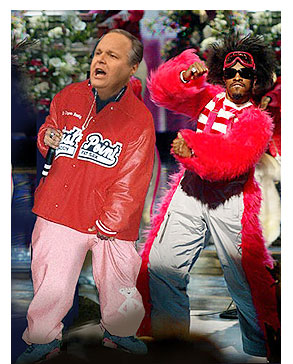
Republicans have never been able to rock. But can they learn to rap?
Bruce Springsteen told President Reagan’s campaign in 1984 to stop using his anthem “Born in the USA” at rallies; he didn’t want it to be associated with the Republicans. In the 2000 campaign George W. Bush received similar cease-and-desist requests from Sting, Tom Petty, John Fogerty, John Mellencamp and Los Lobos. Today, as the party unveils a major new push to land the 18- to 24-year-old vote, the GOP is again grappling with its fragile ties to pop culture. The party wants to appear open and hip while still waging a cultural war.
Prominent right-wing figures make a business of denouncing pop culture as coarse and crude, mocking the music and the message, especially hip-hop. (In the rap world, they’d be tagged as playa hatas.) That disconnect was highlighted last month when the Republican National Committee tried to put a fresh young face on the party by staging a high-profile voter registration drive outside MTV’s studio in Times Square, complete with an 18-wheel rig that morphed into a soundstage and pumped out hip-hop hits. Republican National Committee chairman Ed Gillespie even made a guest appearance on MTV’s daily countdown show, “TRL.”
On March 30, Sen. John Kerry appeared on an MTV news special for an interview, where he was asked about trends in popular music. “I’m fascinated by rap and by hip-hop,” Kerry responded. “I think there’s a lot of poetry in it. There’s a lot of anger, a lot of social energy in it. And I think you’d better listen to it pretty carefully, because it’s important.”
Kerry’s comments set off a furious backlash from conservatives, Rush Limbaugh being the loudest. “We need to understand rap, folks,” Limbaugh told his listeners, in a mocking tone. “There’s a lot of poetry and anger in this. Social energy. It’s important. Look, it’s one thing to say you like it, but to try to pass this off as something you’ve intellectually examined and assigned value to? Sorry, senator. Don’t stand up for white music — associate yourself with rap.” (In the edited version of his comments on Limbaugh’s Web site, his reference to defending “white music” is deleted.)
The animosity of culture warriors like Limbaugh (who is in the midst of a drug prosecution in Florida) could make it extremely difficult for the GOP to court young voters. Hip-hop, especially rap, long ago moved out of the ghetto into the center of mainstream suburban youth culture. That’s why hip-hop record sales have surged in the last decade; why Sears, the purveyors of Main Street America, is rolling out hip-hop urban-wear sections for its stores this year; and why a spokesman for Sprite told the Wall Street Journal this week that rap “is the leader in terms of influencing pop culture today.” Suddenly, being anti-rap means being anti-youth culture. That’s not exactly where Republicans want to be as they make a play for college-age voters.
“When it comes to politics, Republicans have to take hip-hop seriously,” says Bakari Kitwana, author of “The Hip Hop Generation: Young Blacks and the Crisis in African American Culture” and the forthcoming “Why White Kids Love Hip Hop.”
An RNC spokesperson rejects the notion idea that the GOP has a rap problem. “There’s no reason to perceive the Republican Party as being anti-rap or anti-hip-hop,” says Mary Ellen Grant. “We’re reaching out far and wide to youth voters regardless of their musical preference.” One hip-hop envoy to the GOP, Dana Mozier, who once worked with legendary rap act NWA and now works as a political activist and self-proclaimed hip-hop ambassador for the Republican Party, insists Republicans are open-minded. “I’ve been to the White House, met with members of the Cabinet, met with the leadership of the Republican National Committee, and these folks don’t have any qualms about the nature of hip-hop,” he says. “I find the Republican Party is more accepting than most people think.”
But even some grassroots Republicans, working hard to convert college students into GOP supporters, concede the party needs to do a better job understanding the crucial shift that’s underway inside the youth culture. “Within the Republican community, they don’t understand hip-hop,” says Adam Hunter, founder of the Republican Club at predominantly black Howard University, in Washington. “Republicans are trying to marginalize the hip-hop experience. They think it’s just music and don’t understand it’s a full-fledged culture. It’s the way people communicate. And it’s not specifically an African-American culture. Most people who buy hip-hop are white.”
As rap has crossed over to the mainstream, record sales have increased by 75 percent during the last decade, from 8 percent of overall sales in 1994 to 14 percent in 2002, according to the Recording Industry Association of America. By comparison, rock’s overall share of music sales has dropped from 35 percent in 1994 to 24 percent today. This week alone, Billboard’s Hot 100 single chart, awash in Chingy, Jay-Z, Ludacris, Kanye West, D12, G-Unit and others, boasts 18 hip-hop-flavored songs among the top 20 singles.
“People can try to dismiss or ignore hip-hop if they want, but the truth is, it is youth culture in America, for blacks and whites,” notes Hilary Rosen, the RIAA’s former CEO.
As the Christian Science Monitor recently noted, “Teens living on cul-de-sacs and in small towns are increasingly taking fashion cues from rap music videos. Sales of hip-hop fashion, estimated by the NPD Group, a market information company, to be $2 billion in 2001, are considered one of the fastest growing segments of the apparel industry. That’s mostly thanks to mall stores such as Sears, Nordstrom, and Target stocking more urban brands.”
And Business Week weighed in: “Hip-hop music is not about race or place. It’s an attitude, a state of mind. Marketing experts estimate that one-quarter of all discretionary spending in America today is influenced by hip-hop.”
Any serious discussion among 18- to 24-year-old voters must at least acknowledge the legitimacy of hip-hop. And that’s the point Kerry was making on MTV.
“Kerry was saying rap is a cultural language and is a valid part of the younger generation. That’s an indisputable fact,” says Danny Goldberg, CEO of Artemis records and former president of Atlantic Records. “He was sending an innocuous, symbolic message that he respects youth culture. It’s a no-brainer.”
Still, the reaction was swift from conservative commentators who mocked Kerry’s interest in hip-hop. “Is there anything this guy won’t say, anyone he won’t lie to for a few more votes? He ain’t hip-hop, he’s flip-flop” (Boston Herald). “Really? You’re “fascinated” by rap and “listening” to hip-hop? You’re America’s first flip-flopper hip-hopper?” (Chicago Sun Times). “Does anyone, especially under the age of 30, believe this crap?” (New York Press).
A day before Kerry’s MTV interview, Joseph Farah, the editor of the right-wing Web tabloid WorldNetDaily, published a column attacking Democrats for inviting the rap act OutKast to perform at a recent party fundraiser. OutKast is the same group that won top honors at this year’s Grammy awards and whose single “Hey Ya!” was the most listened-to song on American radio last year. Nonetheless, Farah claimed that Democrats, by associating with OutKast, “have declared themselves openly to be on the side of the enemy, the barbarians” in today’s cultural war.
Of course, hip-hop is not above reproach: it’s often shallow, violent, misogynistic and pro-drug. “I love rap, but it’s hard to defend this shit,” quipped Chris Rock in his recent HBO comedy special, referring to a recent, borderline pornographic rap hit by Lil Jon. Too often rap musicians do project negative, minstrel-like images of black America. And Kerry himself noted the lyrics have sometimes “stepped over what I consider to be a reasonable line.”
But those types of distinctions can be lost on cultural conservatives, particularly Limbaugh, who expressed the most deep-seated contempt for Kerry and rap music.
“Rush Limbaugh is like those guys who used to smash Elvis Presley records in the 1950s and said rock ‘n’ roll has no importance. They’re just throwback people,” says David Bositis, a senior political analyst at the Joint Center for Political and Economic Studies, in Washington, a policy institute that focuses on African-American issues. “And when you attack rap, you’re not just attacking the performer but you’re attacking the audience, the majority of which is white.”
“The right wing fears the influence of hip-hop translating into political power, and they attack it every time there’s a glimmer of a political connection,” says Ben Chavis, who runs the nonprofit Hip-Hop Summit Action Network alongside hip-hop mogul Russell Simmons. “Rap baiting, race baiting, it’s the same thing.”
The network is in the midst of a nationwide voter registration drive. “Hip-hop transcends race in America,” Chavis adds. “That’s the greatest fear of the right wing: a generation who would dare to transcend racial division and embrace a vision of a new America that is more inclusive.”
The hip-hop angle wouldn’t matter if the Republicans weren’t launching such a big campaign for the youth vote, hoping to register 3 million new Republican voters. With so many young voters having stayed home in 2000 (71 percent), the potential for outreach, at least in theory, is high. But this GOP effort highlights the party’s uneasy relationship with pop culture, particularly youth culture. The tension is heightened by Republican fears that the association might offend its more conservative Christian base.
In 1976, Democratic candidate Jimmy Carter quoted Bob Dylan in his acceptance speech. Bill Clinton, a saxophonist, tapped into classic rock by using Fleetwood Mac’s “Don’t Stop Thinking About Tomorrow” as his theme song, and Al Gore hired music video director Spike Jonze to create a campaign biography for the 2000 convention. Earlier this year, when asked to select his favorite singer, former Democratic presidential front-runner Howard Dean turned some heads when he named Wyclef Jean, the socially conscious hip-hop singer.
By contrast, during the 2000 campaign Bush told Oprah his favorite song was the 1950s ditty, “Wake Up, Little Susie.” During another campaign interview Bush was asked about his impression of Madonna, but he cut the conversation off: “I don’t follow pop music.” Bush’s father’s lone venture into pop culture extended to using Bobby McFerrin’s “Don’t Worry, Be Happy,” as a campaign theme.
Hunter, the young Republican at Howard University, says the GOP has to adjust — and fast: “Republicans need to wake up and realize they cannot ignore the hip-hop community, and that they’re white, middle-class suburban voters, not black, poor and inner city. They need to get in step before it’s too late and the hip-hop community has changed the political landscape.”
“Are Republicans ever going to be cool? I don’t think so,” says Bositis, the D.C. policy analyst. “Republican have no connection to hip-hop. Some of them are openly hostile to it. Others are mute. But for most of them it just doesn’t exist unless it’s in the news.”
Meanwhile, the RNC registration tour, featuring Reggie the Rig, motors on. Next week, Reggie will be parked in Florence, Ariz., for the four-day Country Thunder music festival — starring Reba McEntire and Montgomery Gentry.
