
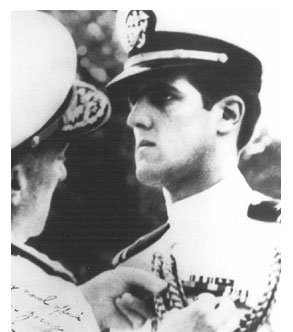

For George W. Bush’s surrogates to question John Kerry’s war record, as they have continued to do in recent days, requires a special Republican brand of super-high-octane gall. Why would the president want to draw additional attention to the most unflattering contrast between him and the Democratic challenger? Why would his flacks reopen the painful issues of that era by questioning Kerry’s undoubted heroism? If anyone ever earned the right to talk about what he had seen in Vietnam and why no more Americans should kill or die there, it was the young, highly decorated Navy lieutenant who had volunteered for duty.
Perhaps Bush and his strategists believe that offense is the only way to play defense on his spotty National Guard record. Perhaps they think that with enough money and enough noise, they can erase Kerry’s medals and heroism. (After all, according to a recent Harris poll, millions of Americans evidently believe that U.S. troops actually found weapons of mass destruction in Iraq, so it is reasonable to think they would believe almost anything.) And perhaps they expect the mainstream media to assist in defacing Kerry’s character — just as important media organizations smeared Al Gore four years ago with Republican spin points.
Whatever plan the White House is pursuing, Karen Hughes proved last Sunday that the highly personal attack on Kerry is coming directly from the top. No one can doubt that Hughes speaks for Bush, sometimes quite literally, as she did in “A Charge to Keep,” the Bush “autobiography” she ghosted for him in 1999. She claimed to be “very troubled” by comments Kerry made in 1971 about atrocities he witnessed during the war and urged the press to “follow up some line of inquiry” about whether he was inventing and exaggerating those concerns — or whether he might even have committed war crimes himself. “I wish we knew a little bit more about that,” said the troubled Hughes, as if deeply concerned whether Kerry tossed his ribbons or his medals over a fence at the Pentagon during a 1971 demonstration.
Now if Hughes were honestly interested in Kerry’s conduct during the war, she could peruse the official Navy documents posted on his Web site, which include his medal citations and sterling evaluations by his superiors. If she is truly ignorant about the horrors perpetrated in Vietnam’s free-fire zones, she could consult the memories of prominent veterans such as Secretary of State Colin Powell and former Sen. Bob Kerrey, or the voluminous history of the My Lai investigation.
More likely Hughes was just being her disingenuous self when suggesting Kerry’s wartime behavior hadn’t gotten enough scrutiny. At any rate, she isn’t in the best position to accuse Kerry or anyone else of false pretenses. Among the press corps that covered the 2000 campaign, her instinct to conceal and dissemble was well known. Indeed, conservative journalist Tucker Carlson suggested last year that her willingness to lie for Bush “almost crosses over … into mental illness.” Feigning indigation over comments made by Kerry more than 30 years ago would pose no challenge for Hughes.
She deserves to be challenged, however, about her own role in the concealment of Bush’s actual service record. Although she is currently peddling her new bestseller, the most pertinent questions concern “A Charge to Keep,” that slim promotional volume with Bush’s name and likeness on the cover.
While including plenty of filler and self-serving rhetoric, Hughes needed only five pages to recount Bush’s military career — from his decision to apply for pilot training to the lessons he learned during his National Guard service. The deceptions begin on Page 51, when Bush claims that during Christmas vacation in Houston, he “heard from contemporaries that there were openings for pilots in the Texas Air National Guard, and I called to ask about them … I met the qualifications and was accepted into the Texas Air National Guard.” It’s a nice, simple story, but it omits most of the facts and distorts others, as this investigation by the Los Angeles Times explains.
The gripping but brief account of Bush’s training and service ends vaguely, with this sentence: “I continued flying with my unit for the next several years.” That’s false; he quit flying after less than two years. He and his ghostwriter don’t mention that he quit flying no later than August 1972, after he missed a flight physical and was suspended. His disappearance into Alabama to work on a Republican Senate race, when he was supposed to be pulling duty, is also left out.
On that chapter’s concluding page, Bush proclaims: “I am proud of my service. Yet I know it was nothing comparable to what our soldiers and pilots were doing in battle in Vietnam.” Having written those words, Hughes should remember them whenever she feels the urge to demean Kerry, who still carries a piece of shrapnel in his left buttock. And should she open her mouth about this subject again, someone should ask her what the president did with his medals.
