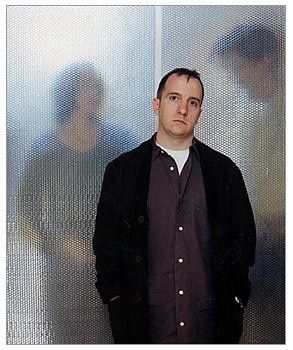

Thomas Bartlett

Irresistible force

Stephin Merritt of the Magnetic Fields may be the best writer of love songs around today. But that doesn't mean he has to be nice.

  • more
    • All Share Services

Irresistible force

Last fall, while recording the latest Magnetic Fields record, “i” (due out on Tuesday), Stephin Merritt also found time to attend the Yasujiro Ozu film festival at Lincoln Center. Not just a film here or there, but all 36 of them, shown over the course of a month. “I don’t usually see movies that aren’t part of festivals. I’m not going to see any of the Orson Welles movies at the Film Forum because I wasn’t around for the beginning of the festival,” Merritt told me, with a trace of the pride that deeply obsessive people tend to have about their obsessions. “Ozu was important to the making of the record, actually. I had a book about ‘Tokyo Story’ sitting on a music stand to remind me to sing as if I were an Ozu actor, not putting my own little ego into the role, but just delivering the lines.”

This is a strange thing to say, particularly for someone working in popular music, where vocal distinctiveness is prized, where we expect singers to emote and where the singer’s ego, whether little or big, is so often exactly the point. It cuts to the heart of what is so unusual about Stephin Merritt and his music.

Although Merritt, who won’t reveal his age but is likely in his late 30s, has been releasing records since 1990, his fame was limited to indie-afficionados until the release, in 1999, of a three-disc set by his band the Magnetic Fields titled, very accurately, “69 Love Songs.”

“It’s just a great title,” Merritt told me. “Even if it hadn’t been a good record, it probably would have been written about, just because of the title and the concept.”

And write about it they did, nearly every magazine and newspaper that covers music, with reviews ranging from the delirious to the merely extremely positive. Suddenly, Merritt was being talked about as one of the great songwriters of his generation. Instead of playing small rock clubs downtown, he was performing “69 Love Songs” at Alice Tully Hall at Lincoln Center as part of their “American Songbook” series. This kind of attention led to a contract with Nonesuch Records, a label that has been assembling a roster of the world’s pop aristocracy — artists like Emmylou Harris, David Byrne, Caetano Veloso and Wilco.

Speaking to people I greatly admire tends to make me very nervous, and judging from articles I found online, I had reason to be nervous speaking to Merritt. Almost everyone who interviews him mentions how prickly he can be, and some even portray him as a nasty man who derives great pleasure from torturing poor, innocent journalists. Although he’s ferociously intelligent and quick, Merritt speaks very slowly, the better to polish his impeccably phrased responses, and his conversation is interspersed with lengthy, ambiguous pauses. Often, after a long pause, I’d ask a question, only to be interrupted and realize that he was, in fact, in the middle of a particularly drawn out response. Other times I’d be sure that he was in the middle of a sentence, and then realize, after 15 seconds of awkward silence, that he was finished with his response and waiting for another question.

But it’s Merritt’s intolerance for questions or statements he finds stupid that makes him so intimidating. The interview got off to a shaky start when I asked him if his new record’s title “i” was derived from the fact that all but one of the songs on his new record were written in the first person.

“No,” he replied, in the tone of someone explaining the obvious to a particularly slow child, “On ’69 Love Songs’ most of the songs are in first person as well. Actually, most of everybody’s songs are in the first person.” And, in a nicely poetic afterthought, “If they’re not invitations to dance, they’re first person.”

Later we were talking about Björk, and I mentioned how innovative I thought she was. Merritt looked a little incredulous and asked me what I was talking about. This should have been easy for me: first of all, the idea that Björk is an innovative force in popular music is widely accepted; secondly, I’d written about it already. But feeling tongue-tied, I stammered for a moment, and then said something about the way she used non-rhyming lyrics, and strange, twisted phrase structures that were rare in popular music. This unleashed a minor tirade, albeit in the same monotone voice, with just an extra touch of pedantry.

“Non-rhymed lyrics have been around since Milton. Most of the blues, much of folk music, especially outside Britain, half of Madonna. But what makes you think that non-rhyming is interesting or revolutionary? And as for her unusual phrase structures, it’s actually just rambling, and because of her rambling, I don’t tend to remember her songs. There’s a reason for repetition, which is that it’s an aid to memory.” Then adding what could be the opening of a Stephin Merritt manifesto on music, “I think formlessness is not the way to go in popular music. More form, I think, is the answer.”

Suitably chastened, I moved onto the safe and completely non-Björk-related topic of drummers, I received this spectacular run-on: “One of my favorite drummers is Mick Fleetwood, who keeps incredible time, but is always doing interesting variations on the beat, and in the most repetitive songs, he never seems to play exactly the same thing twice, and yet he sounds very simple, so I think he’s a genius, which brings me to demolishing your Björk thesis with Stevie Nicks, and the song ‘Dreams’ off of Fleetwood Mac’s ‘Rumors,’ which rhymes, if at all, only every 30 seconds.”

Merritt starts humming to himself to double-check how often it rhymes, then adds, “Maybe when she feels like it, there’s a rhyme tossed in. It’s a very rambling melody, yet quite beautiful, over a simple two-chord progression.” Then, with deep sarcasm and great pleasure, “I would say that Stevie Nicks is an important precursor to Björk, perhaps surpassing her in artistry.”

Snippiness comes naturally to Merritt, and his default stance, toward both himself and others, is critical rather than appreciative. As a music writer for Time Out New York (a job he quit a few years ago because “I don’t want to run into people I’ve just savaged, and I don’t want to have to review only records that I like”) he wrote articulate, minutely descriptive, devilishly funny reviews, which often delighted in trashing the music under consideration. His annual roundups of Christmas albums were particularly notable masterpieces of mockery. A number of times during our conversation, unable to resist a good line, he’d say critical (and very amusing) things about other musicians, only to regret it, and ask me not to print what he’d said. “I don’t want to say bad things about people in print. I’m happy to talk about things I like, but I don’t like being asked if I like other artists, because I say snippy, critical things.” Merritt isn’t mean, he’s just very aware of the faults in everything around him. When I asked him if he enjoyed listening to his new record, he replied flatly, “I just hear all the mistakes.”

For the benefit of the uninitiated, a brief description of Merritt’s oeuvre is in order: He has a deep voice, comically deep, coming, as it does, out of his barely 5-foot frame. As he put it, “I can usually sing along with Gene Martin an octave down.” For the Magnetic Fields, Merritt composes all of the music and plays most of it and, at this point, he does all of the singing as well, though the band does have three other members: Claudia Gonson, Merritt’s longtime collaborator and manager, on piano, cellist Sam Davol, and guitarist John Woo. It’s by far Merritt’s most successful project, but it’s just one of many. His other bands include the Future Bible Heroes (electro-pop), the 6ths (guest vocalists singing Merritt songs), the Gothic Archies (“rock-bubblegum pop”), and the Three Terrors, who assemble for one-time-only themed performances in New York, for instance, “The Three Terrors Sing the Saddest Songs They Know for Valentine’s Day.”

Despite what he said about singing like an Ozu actor, “just delivering the lines,” his voice is far from emotionless. Rather, he uses it in a peculiar way, singing with exactly the same degree and quality of emotion (depression) at all times, regardless of the musical or lyrical content. This style of singing is not unique to Merritt — the great Scott Walker, for instance, sang in a classic crooner style, emoting fiercely, and with much vibrato, at all times, but with no reference to what was going on in the song (a number of the “American Idol” contestants are, I think, unwittingly following his example). However, Merritt uses it particularly effectively.

His production sound is unmistakable. He favors thin sounds — ukuleles, plinky synthesizers, tinny, bassless drum machines — and likes to layer them to form a dense wall of sound. Sometimes it’s close to Phil Spector, sometimes it’s more electro-pop, but it always has that unmistakable Stephin Merritt plink to it, even when the songs are played on acoustic instruments. The arrangements and production are often ingenious, but if there’s a weak link to Merritt’s music, this is it. After listening to too much Merritt, you’ll find yourself longing for something, anything, with a good, heavy bass line. Put on some James Brown. You’ll feel better.

Performance aside, Merritt is most revered, and rightly so, as a songwriter. It’s difficult for me not to resort to a string of meaningless superlatives in describing his songs. Suffice it to say that they manage to be both clever and moving, both coherent and poetic. Each of his songs includes at least one turn of phrase so perfect, so jewel-like, it’s as if Nabokov had overcome his dislike of music, and returned to write songs. His skill is such that he can turn outlandish ideas into successful songs: one of his best is “The Death of Ferdinand de Saussure,” in which the French linguist and father of semiotics begins to deconstruct love, saying that we are unable to understand it, because “you can’t use a bulldozer to study orchids.” This angers the songwriter, who shoots and kills de Saussure to defend the honor of the Motown songwriting team of Holland-Dozier-Holland.

Where most good songwriters try to avoid clichés, Merritt embraces them as an efficient way of communicating emotions that everyone understands. He mentioned “invitations to dance,” a well-worn cliché in pop songwriting, and on this subject alone, he’s written a handful of masterly songs, including “Time Enough for Rocking When We’re Old,” which runs, in its entirety:

There’ll be time enough for rocking when we’re old
We will rock all day in rocking chairs of gold
But tonight I think I’d rather just go dancing
There’ll be time enough for rocking when we’re old, my love

There’ll be time enough for talking in the nursing home
Darling time enough to write an epic poem
But tonight I think I’d rather just go dancing
There’ll be time enough for talking in the home, my love

There’ll be time enough for sleeping when we’re dead
You will have a velvet pillow for your head
But tonight I think I’d rather just go dancing
There’ll be time enough for sleeping when we’re dead, my love

There’ll be time enough for sex and drugs in heaven
Where our pheromones are turned up to eleven
But tonight I think I’d rather just go dancing
There’ll be time enough for sex and drugs in heaven, my love

And time enough for rocking when we’re old

So there you have, in a very simplified form, the complete Stephin Merritt package: depressing, deadpan vocal style, slick, plinky production, catchy, often upbeat melodies, and lyrics that combine pathos and melancholy with a laconic, biting wit. “Tragicomic” is a horrid word, but it describes Merritt’s aesthetic perfectly.

When the reviews for “69 Love Songs” started to appear, Cole Porter’s name was mentioned with astonishing frequency. Rolling Stone said Merritt was “the Cole Porter of his generation,” Spin (in a 10 out of 10 review) said he was “the best lyricist since Cole Porter.” Other publications made similar statements. It was meant to be a flattering comparison, of course. Highlighting Merritt’s debonair wit and technical skill as a songwriter. Cole Porter is, as Merritt pointed out, shorthand for “good lyricist.” And it helped that Porter, like Merritt, was gay. The problem is, Merritt isn’t all that fond of Cole Porter. If you’re determined to look in the Great American Songbook for Merritt’s influences, he’d rather point you to Irving Berlin, whom Merritt is sufficiently fond of to have named his pet Chihuahua after, although he has called him an “artistic hack.”

But comparisons to writers like Porter and Berlin, while capturing Merritt’s extreme facility with clever and unusual rhymes, miss a lot of what his music is about. It’s important to remember that he considers ABBA a truly great band, their songs the pinnacle of pop songwriting. What is for most of us either a guilty pleasure or a kitschy joke, Merritt seems to love without irony. And ABBA’s peculiar combination of melodrama and emotional vacancy can often be heard in his own music.

There are three elements that contribute to the quality of emotional detachment in Merrit’s music: his deadpan singing style, his almost constant reliance on humor, and his habit of appropriating genres in a semi-ironic fashion. Merritt was evasive about all three. When I asked him about his vocal style, he said, “I don’t really like people whooping. I suppose if I could sing like Michael Jackson, maybe I would, but I can’t. I don’t want to make music that I can’t sing along to, and I can’t yelp and whoop, really. I’d be much too self-conscious.” On humor: “Humor is a necessary aspect of rhyming. If you can’t say anything that might be interpreted as silly, you can say very little in rhyme, which is why Bob Dylan and Cole Porter are full of silliness.” And on genre: “It’s important to have a lot of uninteresting elements just to go into the background, to foreground the interesting elements.”

The only living songwriters I can think of who really compete with Merritt in terms of verbal facility and intricacy are rappers, so I was interested to know his thoughts on hip-hop. “In general, I liked the first two years of rap, and after that, it kind of got boring. The first Run DMC album, where the only sounds you hear are one primitive rhythm unit and one orchestra hit, I love the minimalism of that. I thought that was a great record. But once it wasn’t simple anymore, I thought, Why aren’t they singing yet? If they can’t sing, what’s the point? … Who wants to hear pop without melody?”

After a short pause, in which he realizes what a ridiculous question he’s just asked, he adds, “Only suburban teenage boys.” Outkast? “I probably tapped my foot along the first hundred times I heard the goddamned thing. It’s certainly no insult to Outkast to say that that’s the most overplayed record since, well, since ‘Into the Groove,’ I think. I’m desperately sick of hearing it.”

I tried playing Merritt a track by the Southern rapper Cee-lo, called “One for the Road,” a dazzling display of verbal ingenuity and wit I thought he might enjoy. Before Cee-lo actually starts rapping, there’s a short introduction, in which, sounding very Southern and very black, he says, “Yeah, mm-mm-mm, yeah that sho’ feel good. Hello, I go by the name of simply Cee-lo Green, how d’ya do? Welcome. I thought I’d seize this opportunity to tell you a little bit more about myself, if you don’t mind. This is my vision, ya know what I’m sayin’? Check me out now.”

Unremarkable and tame, at least it seemed to me, but it was too much for Merritt, who stopped the song after a few seconds of this. “I think it’s shocking that we’re not allowed to play coon songs anymore, but people, both white and black, behave in more vicious caricatures of African-Americans than they had in the 19th century. It’s grotesque. Presumably it’s just a character, and that person doesn’t actually talk that way, but that accent, that vocal presentation, would not have been out of place in the Christy Minstrels.” Dramatic pause to prepare for the inevitable hyperbolic quip, “In fact, it would probably have been considered too tasteless for the Christy Minstrels.”

Merritt does not keep careful track of what’s happening in popular music these days, and seems entirely dismissive of most that he’s heard. I asked him a few times if there were young and active artists out there whom he liked, and all I got was that Momus (mid-40s) is a “great lyricist,” and that he likes the new High Llamas record. Since he stopped reviewing records, he doesn’t get them sent to him for free in the mail anymore, so he says that “unless it’s boring thumping disco music, I probably don’t hear it, until my friends play it for me. Which they rarely do anymore, since I hate everything they play for me.” Merritt hears so much “boring thumping disco music” because of his songwriting routine. “I sit around in cafes and bars and write. I prefer to have music playing when I write, it’s sort of like having white noise. If I don’t have music playing, my mind wanders. It helps for it to be music that I don’t particularly like. If I like it, I’m listening to it, and that’s distracting,” he says. “The best is boring thumping disco, which is easy to find in gay bars.”

Merritt feels there is nothing new or groundbreaking in popular music these days. “There needs to be a new technology,” he said. “That’s usually when that happens. Robotics would be great. If we could have an easily used robot guitar, for example, we could do lots of nifty things that have not been done. Computer-assisted songwriting would also be great.” And, on queue: “For example, Björk could write a line and then be presented with something that rhymed with it. Great for people who don’t speak English all that well.” Satisfied smile.

He may have turned it into a joke, but I don’t think Merritt was kidding when he said that computer-assisted songwriting would be great. He seems to have very little sympathy for the position that is so natural to most of us: that human care, creativity and, yes, frailty, are at the very core of what makes art moving. Talking about live performance, he said, “It’s a pretty dull record that can be played live. Except maybe solo piano music. But even then, why not, using editing, get the perfect performance on the piano, that you’d never be able to replicate live? À la Glenn Gould.” He said this as if it were an entirely obvious, universally accepted position. Which it is not. For every Glenn Gould and Emerson String Quartet, who edit takes together in the studio to achieve the “perfect” performance, there’s a Rubinstein or a Schiff who would prefer to leave a few imperfections. I’m firmly on the Rubinstein side (although I’m entirely unsympathetic to the bogus arguments used to support it, most of them involving the dubious concept of “authenticity”).

With my Luddite hackles raised by this and a few of Merritt’s other comments (he’s enthusiastic about the development of computerized singing), I wound up asking a genuinely ridiculous question: “Would you want a world in which everyone played perfectly metronomical drumbeats all the time?” Merritt paused to bask in the full absurdity of the question, and then, smiling, his voice more animated than at any other time during our conversations, answered, “Yes! Yes, I would!”

I think that Merritt’s general preference for automation is related to something people hear in his music: the most frequent criticism of Merritt is that his music is cold. While I hear what they are talking about, that’s not the way I experience the music. Stephin Merritt is a romantic who hides his romanticism, equally ineffectively, behind irony, wit, the synth-pop sheen of his productions, and his unfailingly jaded worldview.

But there are signs that Merritt may be shedding the disguise. “i” is a disappointing album, with a few great tracks and a lot of lackluster filler. But the album’s final song, “It’s Only Time,” is my favorite he’s ever written and, I was surprised and pleased to discover, his as well. And there’s nothing conditional about it. It’s an unabashedly romantic, heartbreakingly beautiful song. It’s a declaration of eternal love, that begins “Why would I stop loving you/ One hundred years from now/ It’s only time,” and ends, “I’ll walk your lands/ And swim your seas/ Marry me. And in your hands/ I will be free/ Marry me.”

But even in discussing this song, Merritt remained cynical. I said that it seemed unusually optimistic for one of his songs. He replied “I see a lot of darkness in it. The declaration of love no matter what happens is, in the real world, a really bad idea. Marriage involves a sort of slavery. I don’t think a good song can be a purely happy song. ‘Zippedy-doo-da,’ it’s a great song, because no one in the world can hear it without irony. I wish I had written it.”

My favorite things

The 20 tracks -- all exclusive to Salon -- that make up the best of this year's free downloads.

  • more
    • All Share Services

My favorite things

This year we’ve featured more — and better — exclusive downloads on Audiofile than ever before. Midway through making my list of favorite Audiofile downloads of the year, I realized that all of them were Salon exclusives — not so surprising, really, because nine times out of 10 an exclusive is my favorite song from the album it’s on, a song I was excited enough about to go through the trouble of getting permission to post it.

Anyhow, here are my 20 favorite downloads from Audiofile this year. As usual, they’re not as eclectic as I’d like, as it’s still the case that indie rock is the only genre to have fully embraced the Web and the idea of giving away songs on it as an effective promotional tool. Regardless, much as I wish there were more jazz, more world music, any classical, etc., this is still a batch of 20 songs that I’m proud to have hosted. Tell me where you think I went wrong in the comments. Thanks to all the artists and labels for allowing us to post their music, and thanks to you for listening.

1. “Looter’s Follies,” Destroyer
exclusive download | review
The best track from my favorite record of the year, a songwriting tour de force.

2. “Ambiguity,” David Thomas Broughton
exclusive download | review
The opening track from Broughton’s debut, recorded live in a church.

3. “Jolly Jolly Jolly Ego,” Dirty Projectors
exclusive download | review
An astonishing, brilliantly constructed song from one of the most innovative minds in modern music.

4. “No Education,” Plush
exclusive download | review
An equally brilliant construct from an anachronistic pop classicist.

5. “Lies,” Carl Hancock Rux
exclusive download | review
A standout track from one of my surprise favorites of the year, Carl Hancock Rux’s “Good Bread Alley.”

6. “Marla,” Grizzly Bear
exclusive download | review
The gauzy, impossibly tender emotional core of Grizzly Bear’s brilliant “Yellow House.”

7. “Maybe in Another Year,” Jennie Pearl
exclusive download | review
A haunting song from 15-year-old Joni Mitchell wannabe Jennie Pearl.

8. “The Legend,” Willie Nelson
exclusive download | review
An elegant take on a classic Kris Kristofferson song, by one of the great interpreters of our time.

9. “Estrela,” Susana Baca
exclusive download | review
A honeyed, beatific duet by Baca and Gilberto Gil.

10. “Post-War,” M. Ward
exclusive download | review
A ballad for the dusk from the silky-voiced young songwriter.

11. “Truth Is Marching In,” Marc Ribot and Spiritual Unity
exclusive download | review
The guitar great leads his new quartet through a tribute to Albert Ayler.

12. “O Yes My Lord,” Voices of Conquest
exclusive download | review
A Detroit choir backed by a single drummer — one of the strangest things I’ve ever heard.

13. “Polska på övervåningen,” Väsen
exclusive download | review
The legendary Swedish folk trio giving a gorgeous performance of one of its best compositions.

14. “La Llorona,” Chavela Vargas
exclusive download | review
A legendary and heart-wrenchingly ravaged voice in her Carnegie Hall debut.

15. “Bells,” Albert Ayler
exclusive download | review
The legendary free jazz saxist (that’s three legends in a row, best take a break) in an 18-minute-plus performance of one his signature tunes.

16. “Prepared (2),” Lambchop
exclusive download | review
Whispered, nearly indecipherable intimacies from the masterful Kurt Wagner.

17. “I Cried Last Night,” Junior Kimbrough
exclusive download | review
Junior Kimbrough definitely stands out among modern bluesmen, not just for his singular evocation of the Delta blues ethos but because of how loose and weird and mysterious his music is.

18. “De Makeba,” The Jazz Dazzlers
exclusive download | review
For me, South African township jazz is an instant dopamine booster.

19. “Give All to Love,” Niobe
exclusive download | review
A gorgeous and disorienting song from a German electronic music artist.

20. “This Lamb Sells Condos,” Final Fantasy
exclusive download | review
Dazzling, adorable, punchable.

- – - – - – - – - – - – - – - – -

For more Salon year-end stories, click here.

Continue Reading Close

The best downloads of 2005

Twenty fantastic free tunes that made our year, including songs from Dwight Yoakam, Animal Collective and M. Ward that you can't download anywhere else.

  • more
    • All Share Services

The best downloads of 2005

The past year has been a great one for legal downloads of music, as more and more artists and labels have realized that giving away some songs is free publicity and good business practice. As a general rule, major labels are still abstaining, as are the worlds of jazz and classical music, but there have been promising exceptions, and there will surely be more in 2006.

Salon has played a role in making this such a good year for legal downloads: We’re particularly proud of all the exclusive downloads we’ve been able to offer — great songs that are available only here. Thirteen of the 20 downloads below — my 20 favorites that have appeared on Audiofile this year — are Salon exclusives.

For regular Audiofile readers this is a chance to revisit some great songs from the past year — and to argue with my selections in the letters section. For those of you who are new to Audiofile, here’s a premium sampler of the best of 2005, which I hope you’ll like enough to become a regular visitor in 2006. Happy holidays, and see you next year.

1. “Beautiful Boyz,” CocoRosie
download | review

A duet between two of the most exciting voices in music: Bianca Casady’s dry, crackling wail, impeccably and daringly phrased, and Antony’s honeyed croon, dripping with pathos.

2. “Sun,” Toms
exclusive download | review

This is an absurdly pleasurable, glorious power-pop song from the Numero Group’s “Yellow Pills,” certainly my favorite compilation of the year, and one of my favorite releases, period. Some gym-obsessed Salon colleagues have pointed out that this is a great workout song.

3. “Fuel for Fire,” M. Ward
exclusive download | review

M. Ward is one of the most exciting young talents around, but his latest album, “Transistor Radio,” felt lazy and unpolished — with the shining exception of this song, redolent with nostalgia and old-fashioned elegance.

4. “Swan King in the Snow,” Dave Deporis
download | review

Dave Deporis mesmerizes with just a guitar and his extraordinarily pliable voice, which he pushes to extremes of both sweetness and strangeness, singing incantatory songs of a place long ago and far away.

5. “All the Wine,” the National
download | review

The National put on the best show I saw all year, and their album “Alligator” was a strong contender for my favorite release of the year. “All the Wine” is the band at its most explicitly stadium rock, with chiming Edge-style guitars announcing the song.

6. “Bad Feelings,” the Robot Ate Me
download | review
This is the sweetest of songs from one of the strangest of musical minds. The Robot Ate Me’s Ryland Bouchard has a Brian Wilson-like ability to combine unexpected sounds in unexpected ways into an unexpectedly perfect whole. In the past his music has often evinced an odd and somewhat disturbing sense of humor, and a sense of cynicism that tugs away at an equally powerful sense of naiveté and hope; on this year’s “Carousel Waltz,” the hope wins out.

7. “Fancy That,” Ed Askew
exclusive download | review

A lonely and mysterious psych-folk gem from a reissue of 1968′s “Ask the Unicorn,” an obscure album feted by those in the know, this song has haunted me since I first heard it.

8. “I Turn My Camera On,” Spoon
download | review

While Spoon’s latest, “Gimme Fiction,” has some brilliant moments, as a whole it feels self-conscious and a little passionless to me in comparison with the ferocity of “Kill the Moonlight.” But the best track, “I Turn My Camera On,” is the one where that coldness is pushed to its extreme, a heartless, ruthless machine of a song.

9. “Ghosts,” Albert Ayler
exclusive download | review

This is one of the great Albert Ayler’s most famous recordings, a towering achievement in free jazz from the volcanically powerful saxophonist.

10. “Blame the Vain,” Dwight Yoakam
exclusive download | review

This rocking title track from consistently great country superstar Dwight Yoakam’s “Blame the Vain” is the most popular download in the history of Audiofile.

11. “As I Go,” Richard Swift
download | review

I’ve been so caught up by the melody and punchy, well-crafted arrangement of this song, one of many great tracks off Swift’s debut record, that I only very recently realized the glaringly religious nature of the lyric.

12. “Grass,” Animal Collective
exclusive download | review

Although the record they put out this year, “Feels,” wasn’t as impossible to ignore as “Sung Tongs,” Animal Collective continued to develop in thrilling directions live, exploring new modalities in music making with virtuosity and glee. This is their shimmering, incandescent take on the three-minute pop song.

13. “Panda,” Dungen
exclusive download | review

Dungen was one of the prime hipster pleasures of the year, but the music isn’t just hip, it’s really, really good, a radiant psychedelic fantasia of glowing sounds and glorious harmonies.

14. “Hide and Seek,” Imogen Heap
exclusive download | review

Imogen Heap’s vocoder-altered chorus of voices is probably a trick that will work only once, but it’s a pretty astounding effect on this song, pulsing in oceanic swells and sudden heartbreak stops.

15. “Paw Paw Paw Paw Paw Paw Paw,” Xiu Xiu Larsen
exclusive download | review

In an unexpectedly potent collaboration, enigmatic Italian art-rock band Larsen made lovely ice palaces of sound for Xiu Xiu’s hotblooded, violent Jamie Stewart to sing in.

16. “The Music Lovers,” Destroyer
exclusive download | review

Destroyer’s live reinterpretations, backed by Toronto band Frog Eyes, of his bedroom glam studio recordings usually veered more toward artily dissonant punk, but they turned “The Music Lovers” into a drunken, cracked 6/8 R&B tune, a brilliant and entirely unexpected reworking.

17. “Dear John,” Aimee Mann
download | review

Few writers are canny, disciplined or just plain smart enough to write a fully narrative collection of songs as cohesive but unlabored as Aimee Mann’s concept album “The Forgotten Arm.” The first track, “Dear John,” is one of the best.

18. “Hideyaface,” Prefuse 73
exclusive download | review

One of experimental hip-hop’s strangest minds brings his skewed, glitchy beat sense to the (semi) mainstream in a collaboration with Ghostface.

19. “It Never Changes to Stop,” the Books
exclusive download | review

The Books are the best of the various indie-affiliated bands that are riffing off post-minimalist classical composition, crafting intricate instrumental tracks and layering them with beautifully placed, evocative samples from their extensive sound library.

20. “Instant Lady,” Nervous Cabaret
exclusive download | review

“Instant Lady” is a raucous racket of bawdiness and hedonism from Brooklyn, N.Y.’s fearsome Nervous Cabaret.

Continue Reading Close

“I try to write songs and stuff”

The enigmatic Brian Wilson talks to Salon about emulating McCartney and Spector -- and writing music after "Smile."

  • more
    • All Share Services

Last year, to near-universal critical acclaim, Brian Wilson presented the world with “Smile,” a newly recorded and finally “complete” version of the legendary Beach Boys project he shelved in 1967. For Wilson’s devoted, often obsessive fans, this was a major event, the long-awaited delivery of the holy grail of popular music.

Now his fans have more reason to celebrate. Rhino has released a two-DVD set that includes “Beautiful Dreamer,” a feature-length documentary about the making of “Smile,” and a filmed live performance of the album in its entirety. The documentary, by TV veteran David Leaf, follows the story of “Smile” from the beginning, chronicling Wilson’s growing ambitions (primarily to beat the Beatles in the race to open up new frontiers in popular music), oddities (his infamous piano in a sandbox in the middle of his living room) and paranoia, and his eventual nervous breakdown, from which he has not fully recovered.

Unfortunately, the film doesn’t really get into the minutiae of what Wilson’s mental illness consists of, what his life has been like in the years since the nervous breakdown, and what the current state of this great musical mind is, preferring to sidestep those issues and focus on the positive. It also firmly takes the stance that “Smile,” in both its mythical unfinished and concrete finished forms, is Wilson’s great masterpiece, the best music he ever produced. (“Pet Sounds,” anyone?)

But for music fans interested in the legend of “Smile,” the film is pleasurable and illuminating viewing. Highlights include interviews with the brilliant and deeply dorky Van Dyke Parks, who wrote the lyrics for “Smile,” and bizarre footage of the members of Wilson’s new band, who have a goofily amateurish “Waiting for Guffman” vibe about them: They’re shown working on “Smile’s” complex vocal harmonies and glancing for approval at Wilson, who sits nearby in an armchair, near comatose and completely uninterested.

The real pleasure of “Beautiful Dreamer,” though, is in the interview footage with Wilson. When he has granted interviews in recent years, Wilson has generally come across as seriously damaged, blank and unengaged and incapable of complex thought, answering questions flatly and with as few words as possible. In the interviews for this film, there’s a refreshing liveliness to Wilson’s demeanor. Watch him sitting comfortably at the piano, playing snippets of his music and explaining how they were written, and you can catch glimpses of the dazzling and precocious mind that, at 23, astonished the world with the visionary pop masterpiece “Pet Sounds.”

Wilson spoke to Salon last week at his hotel in Manhattan, during a five-day press trip to promote the DVD release. Wilson, who was to appear that night on “The Charlie Rose Show,” was relaxed and open. A man of few — and sometimes inscrutable — words, he burst forth with enthusiasm about music.

Are you nervous about appearing on “Charlie Rose” tonight?

Very much. I’m very scared and very nervous.

How was it for you having cameras constantly around during the making of “Smile,” filming for the “Beautiful Dreamer” documentary?

I got used to it after four or five days. They were following me all around for two months. Into the studio, out of the studio. On the stage, off the stage. Into my house, out of my house. I got used to it, but the first few days were very uncomfortable.

In the documentary it seemed as though you were much less nervous when you were sitting behind a piano.

Yes, that makes me comfortable.

What kind of piano do you have at home?

I have a piano that’s called a Yamaha piano. I’ve had it for about 10 years. I play piano all the time. I’m always at my piano, playing music.

Your own music?

I try to write songs and stuff. I play Paul McCartney’s music, the Rolling Stones’ music and Phil Spector’s music. Always pop songs.

Is that how you got started in music, playing the piano?

Yes, I taught myself to play the piano.

Your father didn’t teach you? Wasn’t he a musician?

Yeah, he was, but not a very good one. He was a bad musician. I learned nothing from him.

What did you teach yourself to play?

I would listen to Little Richard and Fats Domino and Chuck Berry, and I would listen to how they played their riffs, and after I taught myself that, I taught myself to play my own kind of stuff.

When was it that you started writing your own music?

1955. I was 12.

Do you do technical exercises on the piano these days? Practice scales?

I do. I practice scales. I also go to voice lessons. To keep my throat in shape, I go to a vocal coach in L.A., and I go for a half hour. [Demonstrates vocal exercises.] And by the time I get out, my throat is sore. But it builds up my throat muscles so that I can perform onstage.

Has that changed the way you sing?

It has. It’s given me a much stronger voice.

You have such an angelic voice. Did that come naturally to you?

It came to me naturally. It came to me in a very natural way.

There was no one you were trying to sound like?

I wanted to emulate Bob Flanagan, the high voice in the Four Freshmen. I wanted to sing high like he did.

When you’re asked what music you were listening to when you were making your Beach Boys masterpieces, you generally mention the Beatles and Phil Spector, and not much else. Were you really so focused on just those artists?

I was focused on them: the all-timers, the ones that will always be around. I still feel an inspiration from Phil Spector.

And Paul McCartney is your favorite of the Beatles?

Oh yes. He’s written so many songs, it can make your head swim. If you listened to the whole Beatles catalog in one sitting, you’d wind up feeling dizzy. That’s how good he is at music. He can make you feel dizzy.

And you still listen to his songs a lot?

Oh, absolutely. I like so many of them. [Enthusiastically sings snippets of "Junior's Farm," "Hey Jude" and "The Long and Winding Road."]

Do you listen to much classical music?

Are you Jewish?

No … Why do you ask?

Just asking! No reason.

OK. Do you listen to much classical music?

I listen to Bach, and that’s it. You know that album “Switched-On Bach”? I love that. I love it!!

Do you listen to any music that’s being made now?

No, I don’t.

Don’t members of your band ever try to turn you on to stuff?

No, we’re turned on by our own music. We don’t need that other music. Who needs that other stuff? We have our own stuff to deal with.

Are you writing new music now?

I’ve written about 15 songs in the last three months.

Are you making a new record?

Yeah, we just finished a Christmas record. And after that, we’re going to do rock ‘n’ roll. Rock ‘n’ roll music.

The Rolling Stones kind?

It’ll be like the Rolling Stones. And it will also be influenced by Phil Spector’s records. I think I can make a good rock ‘n’ roll album.

Are you writing the lyrics?

No, I work with a friend named Steve.

What sorts of things does he write about?

He writes about “you” and “me.” “You, me” kind of songs. “I love you,” “you caress me,” “you make me feel good,” that kind of thing. They make me feel good.

Why do you like working with other lyricists?

I like the idea of someone coming in fresh and working with me, someone who can do what I can do. That way you can’t go wrong with it.

You think your skills are more as a composer?

Yes, my skills are musical, not lyrical.

Do you think the music you’re writing now is as good as “Smile” or “Pet Sounds”?

Yeah, the stuff we’re doing is just as good as “Smile,” and it’s better than “Pet Sounds.” And it’s rock ‘n’ roll. And I think rock ‘n’ roll is the best bet for us to do now. I could record an album of ballads — you know what I mean, “Brian Wilson Sings Ballads” — but I’d rather go with “Brian Wilson Rocks Out Like Phil Spector,” you know what I mean? Rock ‘n’ roll. [Begins clapping and singing about rock 'n' roll.]

Because it makes you happier?

It just gets a load off my chest. Like when you first heard Phil Spector’s records, it made you want to dance, right? Made you want to get right out of your chair and dance. That’s what I want to do with my album.

Continue Reading Close

Building a better Live 8

Dump Paul McCartney, Elton John and Sarah McLachlan! Add Prince, Radiohead and -- for heaven's sake -- more black people! Our favorite online observers rate Bob Geldof's big summer sequel.

  • more
    • All Share Services

Building a better Live 8

With the announcement of the Live 8 benefit concerts, slated to be held July 2 in London, Paris, Berlin, Philadelphia and Rome, and some early complaints already being made about the lineups, we asked some of our favorite music critics, musicians and bloggers to weigh in. Specifically, we asked 1) what they think of the lineups, 2) who they would have added, 3) who they would have dropped, 4) which concert they’d pick to attend, and 5) what they think of the criticisms leveled at concert organizer Bob Geldof and the event.

Their answers are below (with most recent contributions listed first):

Alex Ross, music critic at the New Yorker, blogs at The Rest Is Noise.

The London one is the one I’d go to, I guess, though only if it were at the Royal Opera House.

Which ones would I drop? All but the following: the Scissor Sisters, Robbie Williams, Bon Jovi, a-ha and 50 Cent.

If I were picking the artists: Prince, Björk, Cecil Taylor, Missy Elliott, Mary J. Blige, Sonic Youth, Radiohead, Steve Reich & Musicians, Lorraine Hunt Lieberson and the Orchestra of the Age of Enlightenment, René Pape and the Berlin Philharmonic (all-Wagner program), and the Scissor Sisters.

Michael Azerrad, eMusic editor in chief and drummer in the King of France, blogs at You and What Army.

Live 8 is “hideously white,” says Black Information Link? I don’t know if it’s hideous or merely insidious, but there’s a practical angle on the lack of brown faces at Live 8. Twenty years ago, Live Aiders asked the inane musical question “Do They Know It’s Christmas?” A far better question is “Does Bob Geldof know Dizzee Rascal?” Anyone who’s organized a benefit concert on any scale knows that it’s largely a matter of calling in favors from friends. Bob Geldof travels in certain circles; he’s literally part of an old boy network and can call in favors only within that network. So naturally Sir Bob is going to go with old boys like Sir Elton, Sir Paul and St. Bono. I’m just glad someone’s doing something.

I would have invited Eminem, just to see if he’d be willing to help fight AIDS. I’d have invited George Michael, just so he could sing the anti-Blair “Shoot the Dog” (“Tony, Tony, Tony, I know that you’re horny/ but there’s somethin’ ’bout that Bush ain’t right.”) And if I were Bob Geldof, I’d do a whole separate concert in some place like Montgomery, Ala., or Jackson, Miss., sign up Deerhoof, the Arcade Fire, the aforementioned Mr. Rascal, the reunited Chavez, Flaming Lips, Missy Elliott and Bob Dylan and then enjoy the entire stadium to myself.

Failing that, I’d go to the concert at the Circus Maximus to see 1983 French Open winner Yannick Noah. If he’s even half the rocker John McEnroe is, those Romans are in for a real treat.

John Seroff blogs at Tofu Hut

1. Who would you have asked to be in the concerts?
While I certainly don’t begrudge the idea of a big ol’ Lollapalooza of folks showing up for a good cause, there’s not much point that I can see of holding an evening where Madonna, Annie Lennox, U2, REM and Sting play. Most of these are artists who would sound better under the aegis of glamour and spectacle in any case; reducing them to supporting cast with a song or three apiece seems an awful waste. Then again, if it’s in the name of a good cause, you might as well enlist those who can afford to make a difference, right? Damned if you do, and damned if you don’t.

I suppose I would much prefer to see a healthier, shook-up mix of performers with a few less headliners; less name-recognized artists and more genre diversity. The current “diversity” seems designed almost willingly to include one artist for everybody, which is a noble enough pursuit if you’re doing free-form radio but something altogether different when you’re dealing with the known commodities of pop music; who out there was really slavering to see a bill of Crosby, Stills & Nash, Lauryn Hill, a-ha and Die Toten Hosen?

My optimal concert would likely consist of a collective of artists who tread somewhat different ground from one another. Three of the best concerts I’ve seen thus far this year were Devin the Dude, Leslie Feist and The Boredoms; I’d add David Banner, Konono No. 1, James Brown, Anthony and the Johnsons, Basement Jaxx, The Gospel Harmonettes of Demopolis, Alabama and Prince. Matthew Barney could design the set and Timbaland could run the sound boards.

2. Who would you drop from the current lineup?
I wouldn’t presume to drop anyone from the lineup; if somebody wants to donate their time to what, ostensibly at least, seems like a good cause, more power to them. In terms of wanting to see them perform live? Well, I’m not sure I’d pay to see half those folks perform, and there’s a decent percentage stuck in there that I likely wouldn’t cross the street for. More power to them that they make a good living doing what they love, I suppose.

3. If you could choose any one of these concerts to go to, which would it be?
I’m torn betwixt Paris and Philly; I’m inclined to lean toward the city of Brotherly Love solely for Jigga and Stevie. I could always show up late and miss DMB and Maroon 5, I suppose. The 64K question really is: which lineup would you be most willing to sit through all the bands? If that’s the case, I’d lean more toward the London (bragging rights) or the Paris again (shorter).

In any case, multi-artist concerts like these don’t hold much appeal to me. Music seems to be the last thing on anyone’s minds. Instead we get a focus on star power, the complexities of juggling so many egos and the child’s old superhero joy of creating one mega-super group. One is inclined to ask why the artists involved don’t just write a codicil into their contracts demanding that a quarter of the profits that the label sees on their next album go to a worthy cause in lieu of, say, reproduction or commercial rights to the songs?

I honestly don’t like the idea of throwing stones at people who do engage in charitable, well-meaning acts, but could you do it just a bit quieter, please?

Douglas Wolk, a writer and critic, blogs at Lacunae.

The impact of Live 8 is supposed to be political rather than musical; the point has to be to make people pay attention to it, and care about it. So the first person I’d ask to be in Live 8 would be Toby Keith, as little use as I have for his music — if the current U.S. government got the idea that eliminating famine wasn’t a partisan issue, and that right-wing pop stars (and their fans) cared as much about it as the left, it would be a lot more likely that something more substantial than self-back-patting might come out of these concerts. Then I’d ask ABBA, just because if they actually did reunite for the first time in over 20 years, it’d be a very big deal. And Prince, because he’s a great live performer and it’d give him a chance to make amends for his “there’s just as much hunger here at home” bullshit of 20 years ago. And Sleater-Kinney and Sharon Jones and the Dap Kings and M.I.A. (whose “Pull Up the People” should be the anthem of the whole shebang), partly so that anybody under 30 would care, and partly so that there would be some pleasant surprises to keep Live 8 in viewers’ minds afterward, the way that U2 surprised people at Live Aid.

As for who I’d drop: I’m pretty short on haterade here, but I will just note that if you crossed out everybody in the lineup who was a better performer 20 years ago … and then crossed out everybody who was a better performer 10 years ago … and then crossed out everybody left whose music owes everything to artists who aren’t on the bill — well, you’d have a very short concert series.

And if I were to pick one concert to see? Paris. Youssou N’Dour and Manu Chao!

Michael Idov writes for Pitchfork, and plays in Spielerfrau.

1) Who would you have asked to be in the concerts?
My Live 8 lineup would have certainly included most of these artists — it’s more advisable to consult the charts than one’s own taste when charity (or even “awareness”) is on the agenda. I would rather see Rasputina than Coldplay onstage, but then I’d rather see a million people in the audience than 300. That said — no M.I.A.?!! How often does a ravishing Sri Lankan toaster fall into your lap just as you’re putting together a show to help alleviate third-world debt? Apparently often enough.

2) Who would you drop from the current lineup?
I would have dropped Sir Paul, provided he’s not preparing a DJ set with Danger Mouse. After dozens of similar mega-events, and especially after last year’s Super Bowl, his presence signals big and safe and, shockingly — at least to me, a fan — not much more. Macca is an invaluable dispenser of warm fuzzies, and he has dispensed a lot of the stuff since 9/11; I have been warmed and warmed over. I dread the inevitable transcontinental “Hey Jude” singalong.

3) If you could choose any one of these concerts to go to, which would it be?
Rome, just for the brain-melting disconnect between Tim McGraw and Faith Hill, Duran Duran, and Circus Maximus.

Keith Causin blogs at Teaching the Indie Kids to Dance Again.

I’m not going to go into prognosticating a lineup, because it’s a hopeless task. Instead I’ll grouse about how 1) London is clearly hogging all the good acts — even the American ones (R.E.M., Scissor Sisters, hell, I’ll even name Madonna and Velvet Revolver and the Killers — they sure beat what Philly has), and further complain that Philadelphia seems to be pretty amazingly watered down. Will Smith hosting? Bon Jovi? Maroon 5? Rob Freakin’ Thomas? PUFFY? Gimme a break. I am surprised to not see the Foo Fighters on the bill anywhere, too. As to where I’d go? Probably either London for the strength of a whole lineup, or Berlin for Brian Wilson. Also, what the hell is up with the country music in Italy?

Hua Hsu blogs at to here knows when.

1) Who would you have asked to be in the concerts?
Morrissey, Oasis, Radiohead, Missy Elliott, Björk, Mary J. Blige, Dizzee Rascal, a reunited Stone Roses, Beyoncé, De La Soul, Justin Timberlake/Usher, Sleater-Kinney, Seu Jorge, Caetano Veloso, Nas, Bob Dylan, Bruce Springsteen, David Banner, Basement Jaxx.

2) Who would you drop from the current lineup?
Like, three-quarters of the artists playing in London. Also: any band on any of the bills that has had a career of less than three years.

3) If you could choose any one of these concerts to go to, which would it be?
Germany. The possibility of having to see Die Toten Hosen is outweighed by the possibility of getting to see two noteworthy genius-slash-recluses (Brian Wilson and Lauryn Hill) eye each other suspiciously. And I hear Bap is awesome live.

Well, that criticism [that Live 8 London is overwhelmingly white] is hard to dispute. One hardly associates the Killers, Keane, the Kaiser Chiefs or Razorlight with “progressive causes.” I know the point in organizing these things is to stack the bill with big names, but if you have Elton John, Paul McCartney, U2 and R.E.M. in London, did you really need a bunch of fourth-rate imitators of third-rate rock cluttering the bottom of the bill? What about reggae or hip-hop? Dizzee Rascal or even the Streets? DJs or some representatives of club culture? At least 50 Cent (himself a very odd choice) is willing to die in the process of trying to feed himself.

Julianne Shepherd blogs at Cowboyz ‘n’ Poodles.

Patric Augustus’ complaint about the lack of reggae artists is completely right-on. I think the British lineup is hideously white; for one, London is home to grime, which is perhaps the world’s most vital new black art form since hip-hop. I mean, couldn’t they at least have gotten Dizzee Rascal to open? Or M.I.A.? I understand the necessity for big-name artists on the bill, but even London’s South Asian population numbers almost a million; while I cannot be mad at anyone who’s working for change, the whiteness of the British lineup for the concert to help raise poverty awareness in Africa is a little patronizing, especially considering London’s multiethnic population. The Live 8 spokesperson’s response that “Live 8 is a global concert” and that “urban acts in the U.K. aren’t popular in Rome or Paris” is weak. Like Nek is really blowing up the streets of Britain or the U.S. Please.

Jay-Z contributed something like $10,000 to the Christopher Wallace Foundation on the anniversary of Biggie’s death. Raising awareness is one thing, but G.W. Bush, should he enact his African AIDS proposal, favors big-money American pharmaceutical companies, delivers most allocated money to churches and missionaries first, and preaches abstinence (though he has conceded on last-ditch condom distribution/education … in Africa, at least). So I would like to see the American artists on the bills take the matter into their own hands and personally donate money to organizations like Project Hope or Doctors Without Borders.

I do like the idea of Stevie Wonder and Jay-Z on one show. In my fantasy world, I would attend the Philadelphia concert, and fly to Paris during 50 Cent’s set to see Manu Chao. Be still my heart.

Berlin: I totally get the A-Ha headliner spot. But I would have added Ellen Allien, Mia (not M.I.A.; Mia, the Berlin new wave band). I would have put King Sunny Ade on the bill, and at least at the Philly show, mixed in more artists who put in real political work. My picks: Ozomatli, Ely Guerra, Immortal Technique, David Banner. And I would have replaced Will Smith as the Philly host with Rip Hamilton, the Piston with a heart of gold (he gets in because he is a native Pennsylvanian).

Lauryn Hill playing in Berlin is very, very exciting.

Despite its thrilling diva-ness, the London show is kinda boring. I would drop Sir Bob Geldof. I would drop Rob Thomas, Bon Jovi and anyone wearing diamonds from African mines.

Frank Yang blogs at Chromewaves.

I see a lot of incredibly safe, mainstream and, yes, white, artists. The usual suspects, if you will. But something like this isn’t about introducing new or daring artists to the world, it’s not about art — it’s about appealing to the largest possible demographic so that they’ll reach into their pockets and give to a (presumably) worthy cause. And that demographic is quite simply the white, middle-aged, middle-class, middle-of-the-road folks who continue to make it possible for people like Sting to have a career. Indie kids aren’t going to dig deep and donate, people who (can afford to) go to Elton John concerts are.

That said, I find Razorlight offensive in any context so I’d lobby to have them removed from the lineup.

If I had to go to one of these shows, I’d probably go with Berlin. Less crowded than London, I’d like to see Brian Wilson, and I have a long history with a-Ha.

The complaint about the whiteness of things is sort of reasonable. I don’t believe in tokenism, but Mariah Carey is a pretty sorry representative of the black community. Surely they could do better?

Simon Reynolds blogs at Blissblog.

Can’t say I care for anything too much on those lineups — although I suppose the logic is bigger names, bigger attention level. If it was down to me to pick the lineups from my own favorites the event would be a disaster!

But why not Björk, say, or Radiohead? Or the reformed Roxy Music?

I would go to the Rome one, but only because I love Rome.

David Brusie blogs at Music (For Robots).

I would have asked some more of the original players to be involved, especially the ones who are still creating some great music, like David Bowie. Also missing is the great Mark Knopfler, who isn’t with his band anymore but is nonetheless pretty great.

It’s hard to say who I would drop, considering that some of the big-name bands will drum up some well-needed attention for the cause. But if I were at a concert, even a free one, I wouldn’t be too interested in hearing Maroon 5 (despite my undying love for “This Love”), Sarah McLachlan or Rob Thomas. I think it’s a matter of including more bands and artists who have a history of political action. For that reason, I was a little disappointed not to see Peter Gabriel on the list.

I think I’d have to go with the London show, what with R.E.M., Keane, Coldplay, the Killers, the Cure, Annie Lennox … what’s a benefit show without bands like Keane and Coldplay (the “new U2s” onstage with the actual U2!) pumping out some melodrama? Though R.E.M.’s new album is terrible (which it pains me to write), they’re still pretty great live, and when they get to play for a cause, they’re one of the few acts who seem genuinely interested in what they’re playing for. I’d be sorry to miss Stevie Wonder and Jay-Z, only a couple of the show’s non-white performers, do their great things. And how we’ve missed Jay-Z after he’s been retired for so long!

As for the non-white issue, it’s pretty ridiculous that more non-white acts aren’t listed. Even if the event wasn’t for recognition of African poverty, any lineup with so little variety is something of a crime. (And this is more of a pipe dream than a complaint about the lineup, but how great would it be to see Public Enemy out there?)

Nick Barat blogs at Catchdubs.

Bob Geldof can’t reunite the Police? What kind of Live Aid is this?

Objectively speaking, London “wins” on sheer starpower alone, but for my money, that lineup is snooze inducing. My personal choice would be Philadelphia, solely for Jay-Z being on the bill; there’s no way he could do a Philly show and not bring hometown heroes State Property onstage with him. This means Freeway and Peedi Crakk playing Live 8. Freeway and Peedi Crakk! The only thing that could top that is Free and Peedi getting on the Concorde with Phil Collins to play all the other Live 8 dates around the globe. State Prop at the Circus Maximus, the mind boggles.

Aaron Wherry blogs at Pop (all love).

1) Who would you have asked to be in the concerts?
I suppose there aren’t a lot of names I immediately think should be added (Radiohead is one), but there does seem to be a need to even things out. Look at the city-by-city breakdown. While Hyde Park is stacked, Philadelphia gets the MOR trio of Rob Thomas, Sarah McLachlan and Dave Matthews. Paris gets Craig David, Jamiroquai and Placebo (confirming, at least, that all three do still exist). Germany gets Lauryn Hill, Brian Wilson and Crosby, Stills and Nash (arguably the most psychologically unbalanced lineup since the abbreviated ’88 Broadway run of Liza Minnelli and Adam Ant’s salute to Norwegian Death Metal). While Rome gets Tim McGraw, with wife, but without his true partner in life, Nelly.

2) Who would you drop from the current lineup?
Some, but not all, of the above. Also: Elton John. Seriously, dude. You’re like the Sally Struthers of pop music now. It’s tremendously noble. But getting to be cliché.

3) If you could choose any one of these concerts to go to, which would it be?
Well, London, of course. But there is chatter among the igloos here, as we chew whale blubber round the family dinner table with our neighbor, a deserting American soldier, that our Northern outpost might be in line for its own concert. Seems Bono, a good friend of Sir Bob, is good friends with our prime minister. There are plenty of cringe-worthy names being bandied about, but we would like to submit that a Canadian concert serve as the stage for the long-awaited reunion of the Northern Lights — the Great White North’s answer to all those ’80s all-star charity singles. Joni Mitchell! Neil Young! Gordon Lightfoot! Geddy Lee! Not to mention: Corey Hart, Paul Shaffer, Eugene Levy and (AND!) Mike Reno! (See — Warning! Blatant self-promotion ahead! — here for full lineup.)

Other thoughts?
It’s generally nothing but messy to get into debates over such things when it comes to cheesy pop star charity initiatives, but this stew could certainly use a touch more hip-hop. At least outside Philly. Also, just a thought: Seeing as the goal is awareness of Africa, each show would seem to need a few artists who could actually speak of such stuff firsthand, no?

Glenn Peoples blogs at Coolfer.

1) Who would you have asked to be in the concerts?
The Flaming Lips, to add some eccentriciy to the event.
New York Dolls. These shows need danger.
Cesaria Evora, although I know she was recently hospitalized and probably couldn’t perform.
Femi Kuti, Orchestra Baobab, Wapaputsi, Super Rail Band.
How about some Africans on the bills? This would be a fine time to introduce some African artists to the world, erase the horrible ignorance about Africa that exists in the States and show people the continent has more to offer than civil wars and famine. I’ve been fortunate enough to spend time in Kenya and Ethiopia, the latter being vastly different than the stereotype that for many originated with the Live Aid. I think it’s of terrible importance that the Western world gets to know these countries and their people.

2) Who would you drop from the current lineup?
The Kaiser Chiefs, who should at the very most play in a country that actually cares about them. P Diddy, because he’s a much better producer and entrepreneur than he is musician and performer. Sir Elton John, because a man who spends money so recklessly should do absolutely nothing to raise awareness for the poor of third-world countries. He could have fed a few million Africans for life with all the money he’s wasted over the years.

3) If you could choose any one of these concerts to go to, which would it be?
Berlin. The fewer acts on the bill, the better — less chance of error. The London gig has some great artists, but there are more than a few that would drive me to stand in the beer line or head for the exits.

Alan Williamson blogs at Sixeyes.

1) Who would you have asked to be in the concerts?
Spoon. Radiohead. Tom Waits. Antony & the Johnsons. Arcade Fire. The Wrens. The New Pornographers. A.C. Newman

2) Who would you drop from the current lineup?
All the old-timers (McCartney, Wonder, Wilson, et al.) and a number of the new major label names like: Joss Stone, Maroon 5, P. Diddy, Sarah McLachlan, Rob Thomas, Faith Hill and Tim McGraw.

3) If you could choose any one of these concerts to go to, which would it be?
Definitely Hyde Park, London.

Other thoughts?
The lineup looks like a playlist from classic rock radio and current top 40 … ugh! Jeez, I know they are trying to raise money, but they seem to be ignoring the more artistic and creative artists out there who would bring some fire to the cause and the concerts. Faded stars like Elton John, Paul McCartney, Stevie Wonder, Crosby Stills and Nash, and Brian Wilson should just write a check and sit this one out, leaving room for grass-roots artists to grab the spotlight and do their part. As for the accusations of excluding black artists at the Hyde Park event, I would tend to believe that Geldof sought out black musicians as he claims, seeing as there are some huge major label black performers who would have added more money to the event’s coffers.

Steve Marchese blogs at Scissorkick.

1) Who would you have asked to be in the concerts?
I guess eight seems like a reasonable number of artists to include in the, uh, Live 8, so I think one fantastic group of eight huge performers would be:

The Big 8
Stevie Wonder
Jay-Z
Eminem
Metallica
U2
R.E.M.
Radiohead
The Foo Fighters

The “Indie” 8 (not all acts are actually on independent labels)
Arcade Fire
Postal Service
The Killers
Snow Patrol
Bloc Party
M.I.A.
Fischerspooner
Daft Punk

The Scissorkick 8 (had to)
DJ Shadow
Boards of Canada
The Gotan Project
Royksopp
Mr. Scruff
Jaga Jazzist Dangermouse (with Gemini & Murs)
DJ Jazzy Jeff

2) Who would you drop from the current lineup?
Too many to name, but I’d start with Mariah Carey and Bon Jovi. Does Bob Geldof really have to play? Isn’t he too busy organizing things?

3) If you could choose any one of these concerts to go to, which would it be?
Probably go to the London show. Definitely the best lineup. But the fact that each concert has been designed to appeal to the broadest audience makes most of them simply unappealing. For instance, fans of the Killers, U2, R.E.M., the Cure and Snow Patrol would have to sit through sets by Elton John, Madonna, Mariah Carey and Sting. Just doesn’t seem to work.

And where is the world music contingent like Oliver Tuku Mtukudzu or Konono No. 1?

Yancey Strickler maintains a blog here.

Since when is Rome the capital of country music? Did Bob Geldof take the name of Big & Rich and Gretchen Wilson’s posse (the Music Mafia) literally? I’m flinching just thinking about Tim McGraw’s slow-mo fist pumps and ironed-on jeans in front of an Italian crowd, although maybe he and Faith Hill are perfect for Rome, as they have all the subtlety of Silvio Dante and Victoria Gotti.

I wouldn’t attend any of these concerts, even for the spectacle. The chances are at least 90 percent that every one of these things will end in a self-basking round of “Kumbaya,” “Give Peace a Chance” or, at the very least, Pink Floyd’s “Money.” There are a handful of artists on here whose philanthropic past suggests that their involvement is something more than simple self-promotion. And then there’s Velvet Revolver, whose frontman Scott Weiland has single-handedly kept Afghanistan’s poppy crop thriving.

The artist I would most want to see among the Live 8 participants is definitely Lauryn Hill, because she’s crazy great and there’s nothing I love more than getting preached at by a millionaire. It’s telling that she’s appearing in Berlin — one of the more distant locales, surpassed only by Philadelphia — because her history of stage fright and media paranoia is like some unholy combination of Van Morrison and Richard Nixon. A close second is Mariah Carey, another artist stricken with the “crazy” tag (If she were a man it would simply be “eccentric” or “genius.” Brian Wilson, say hello), because I’m a lifelong fan, and her new record is unbelievably great, even if she seems to have awoken one morning to decide that she’s Beyoncé (who is also wonderful, but isn’t fit to mop up Mariah’s spittle).

The group who proclaimed the London lineup as “hideously white” was half-right, as “hideous” alone would have sufficed. As the U.K. charts regularly attest, black music is still a mystery to the Brits, unless it’s being played by a slightly pudgy white dude with bad hair, worse clothes and a voice like a pickled hen. Speaking of which, where is Oasis, anyway? Chances are, Elton John and Paul McCartney were going to be playing Hyde Park that day for the press and spare change regardless, so their presence doesn’t really count. And what’s the over/under on Madonna getting mistaken for a roadie?

Jay-Z — who has “retired” like a Dashiell Hammett detective — alone makes Philly the show to see, while the rest of the lineup makes it the show to miss. Would it have been too much for Geldof to arrange for Terrell Owens and Allen Iverson to duet while Donovan McNabb vomited just offstage? Unless they can pull something like that off, this is just another awards show, albeit dedicated to a cause more worthwhile than celebrity self-glorification, although in their heart of hearts, many of the performers would undoubtedly disagree.

Few of these artists have ever taken anything even close to a true political stand beyond “love one another” and the patchouli-scented like — a huge disappointment considering the amount of attention these concerts will receive, and the tremendous opportunity it presents those who are performing. Numerous articles have been written about pop music’s irrelevance post-9/11 — aside from country’s jingoistic anthems, where was the unifying reaction to the horror? — and this concert only furthers that perception, as artists with genuine political convictions (System of a Down, M.I.A. and, shit, even the horrifyingly-fascist-but-musically-great Montgomery Gentry) are kept just offstage so as not to offend. But the Western world should be offended by its complete ambivalence toward Africa and all developing nations. And if Geldof and the rest aren’t willing to admit that, how much can this concert really accomplish?

Continue Reading Close

“American Idol” virgin

Bland country moxie beat brash Vegas rocker, in the first -- and last -- "Idol" I'll ever watch.

  • more
    • All Share Services

There was a moment in last night’s finale of “American Idol,” when a particularly embarrassing, snicker-inducing failed idol contestant turned around to find his own personal idol, David Hasselhoff, smiling and waving and walking through the auditorium to sit down next to him. It was astounding. It was so far over the top, so purely farcical, so shameless and so absurd, that it fairly bounded toward transcendence.

This, I said to myself, is a Great Pop Culture Moment. It was like a “South Park” parody of “American Idol” — because really, the only place David Hasselhoff belongs these days is as an object of mirth on “South Park” — built directly into the show. But it was just a moment. And it passed.

But let’s go back to the beginning. Let’s go all the way back to … Tuesday night, when I first laid eyes on the pulsating, sticky mess of British ingenuity and modern American shame that is “American Idol.” Yes, my “American Idol” cherry was popped just two days ago. And yes, there was lots of blood.

One of the two final contestants was exactly what I expected: Carrie Underwood, she of the blandly pretty face and the blandly pretty voice; sweet, a little awkward, and with all the charisma of a damp sponge. The other was not. Bo Bice is a cultural mistake, a horrifying monstrosity of mixed metaphors and botched styles, like a Vegas crooner impersonating a grunge rocker. Bo is what would happen if a redneck ate a hippie. “You look like my chemistry teacher,” remarked Simon, “American Idol’s” tetchy, Svengali-like headmaster, proving that he is in fact from some nightmarish alternate universe and not, as he claims, from Brighton.

Tuesday night was the final sing-off, and Bo and Carrie each had three songs to strut their stuff. Each performed two wretched “originals” (i.e., songs composed by “Idol’s” in-house staff of songwriters) and a cover. Bo’s was Ides of March’s “Vehicle,” Carrie’s was Martina McBride’s “Independence Day.” Carrie sang safely and competently, but with some pitch issues on high notes. Bo is, aside from being the most smackable man alive, a better singer than Carrie, and a far more charismatic and natural performer. After singing, Carrie looked thrilled and a little bemused by the applause and adoration, and approached the judges with great humility. Bo soaked up the love with a smile that said he knew he deserved it all and more, and he received the judges’ verdicts with a smirking curled lip so positively Malkovichian that I at one point toyed with the possibility that he was, in fact, John Malkovich, playing a brilliant prank on us all — a hypothesis that at least helped to explain the all-out bizarreness of the man’s persona.

It was a battle between a corn-fed mediocrity and a mutant mass of metastasized ego with a penchant for showing tufts of chest hair. Or, as the show would have it, of “the Country girl with heart versus the Southern rocker with soul.” And, after America had voted by phone, the whole party reconvened 24 hours later to announce the results. But first … an hour and 45 minutes of filler!

The show began with a medley of Beach Boys songs performed with very little regard for pitch by the 10 previously rejected semi-finalists. Brian Wilson no doubt would have been troubled by the spectacle, if he were not already permanently so. Bo reprised “Vehicle,” Carrie, “Angels Brought Me Here.” Bo and Carrie dueted on “Up Where We Belong.” There was boring live footage of thrilled masses in Bo and Carrie’s hometowns (Helena, Ala., and Checotah, Okla., respectively). There was a silly and lengthy sketch about an investigation into Simon Cowell’s clandestine affair with … himself (a lame reference to a lame story). And, since no TV spectacle could be complete without a dash of Schadenfreude, we were treated to a recap of the most embarrassingly bad Idol auditions, and to the painful sight and sound of an obese young black woman performing “The Star Spangled Banner” with undisguised passion and ear-scrapingly atonal verve.

At the opening of the show, host Ryan Seacrest (an extraordinary non-presence, given how much time he spends on-screen) had announced that the program would include appearances by Lynyrd Skynyrd, Kenny G., Billy Preston, Babyface, Kenny Wayne Shepherd and Rascal Flatts. As the minutes ticked by and the remaining time got shorter and shorter, I started to wonder how they were going to fit them all in. And then Seacrest said the magic phrase “all-star medley.” Never words you want to hear.

First off, though (and with the notable exception of Lynyrd Skynyrd and the partial exception of Babyface), what a lame batch of all-stars! I mean, come on, Kenny Wayne Shepherd? Has anybody cared about Kenny Wayne Shepherd since he was 18? The “medley” began with Carrie performing with Rascal Flatts (it is, by the way, an awesome thing about country music that ugly people can still be stars), followed by short numbers by each of the other all stars, appearing with contestants who were rejected from the final 12. I liked the chubby one, the spiky blond one, and the tall skinny one with the afro. If you watched the show this season, you’ll know who I’m talking about. If you didn’t, I’m sure you don’t care who I’m talking about. The sole redeeming moment was a few solo phrases sung by Babyface, a reminder of what an excellent pop singer sounds like — and that there is such a thing.

Last up was Bo singing “Sweet Home Alabama” with Skynyrd, and what a trip that was. The members of the band (they look so old!) were a frightening glimpse into Bo’s future. They looked just like him, but desiccated and pallid, drained of life. Not only that, but Bo’s vocal sounded almost exactly like the original, and he seemed so at home that I started to wonder if he was, perhaps, just a straightforward “Southern rocker,” and not the aberration I had taken him to be. And then I noticed: He was wearing a velvet shirt. Ah Bo, how wily is your sense of the inappropriate, how ingenious your ability to get it just exactly wrong.

As you no doubt know already, voters chose Carrie over Bo, a mistake if you’re choosing on vocal prowess or performance know-how, a no-brainer on likability. The program ended with her singing through tears of joy — which might have been touching, if two hours of “American Idol” hadn’t temporarily destroyed my ability to be touched by anything. Much has been made of the fact that she’s a “country” singer, but it doesn’t need to be. All it really means is that she’ll sing country-inflected pop, rather than R&B-inflected pop like Ruben and Fantasia, or, um, pop-inflected pop, like Kelly and Clay. (It is true, though, that country mannerisms are a good deal more flattering to a mediocre voice than are R&B mannerisms.) How successful her post-”Idol” career is will depend entirely, as it has for past idols, on how good her manager is, and how good the songwriters and producers they hire are. Kelly’s have been very good indeed; Fantasia’s have been incompetent.

I come away from my inaugural “Idol” experience with two conclusions: that I never want to watch the show again, and that even when something seems irredeemable, a strategic unveiling of David Hasselhoff can lead the way to bliss.

Continue Reading Close

Page 1 of 11 in Thomas Bartlett