
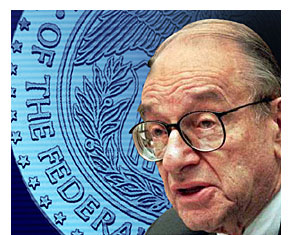
Alan Greenspan plays the role of economist, on TV especially, better than any public official who ever lived. But that doesn’t mean he is one.
Here is a man who spent the first half of his central-banking career fighting an inflation that did not exist. In so doing, the chairman of the Federal Reserve triggered the stock market crash of 1987, the recession of 1990-1991 and a “preemptive strike” on the dead beast in 1994. He had one period of glory, the late 1990s, when by doing nothing for four years he managed to bring on full employment without inflation. This was against the almost-unanimous received wisdom of the “real” economists, it should be said, and for this Greenspan should always be honored.
But then he blew it. He knew that the Internet bubble was getting out of hand. He held the power to do something about it without raising interest rates, but he declined to act. Let me quote myself here, speaking at the White House Conference on the New Economy in early April 2000:
“For its part, and instead of setting off to fight an inflation that is a pure product of academic imaginations, the Federal Reserve Board could control margin lending. Raising margin requirements is the direct approach to a stock bubble, more targeted than raising interest rates and more effective than jawboning the lenders. If a crash comes, sooner or later, a failure to have acted on margins will weigh on the record, and not for the first time.”
Instead, just before and even after the Internet crash, Greenspan raised interest rates — unsettling the markets and hitting hard at presidential candidate Al Gore. It was the wrong policy, attacking an inflation for which by then not a shred of evidence remained. And then, as the markets tumbled, Greenspan did nothing for six months. Only in December — just as George W. Bush was anointed — did he begin to cut rates. And while that surely helped soften the slump, allowing consumers to continue to borrow and spend through the Bush years, it came too late to save the “new economy” from a fiasco costing millions of jobs.
Greenspan has done two other key favors for Team Bush. In 2001, he famously spoke against his own convictions, expressed privately to former Treasury Secretary Paul O’Neill, that without triggers making them conditional on the vanishing surplus, the Bush tax cuts were “irresponsible.” (Now he denies having said this, but there is no reason to believe him.) And in recent weeks he has tried to slit the throat of the Social Security program, calling for benefit cuts while supporting making Bush’s tax cuts permanent. John Edwards correctly called this an “outrage” at the time, and John Kerry said, “We’re simply not going to do it.” But Greenspan is a stalking-horse for the next term of President Bush.
Chairman of the board of governors of the Federal Reserve System is truly a wonderful job. Not only is it at the center of power, money, prestige and mystery, but the occupant can do no wrong. He is always praised for the good times, never blamed for the disasters. Nowhere else in American public life is there a position so similar to that of the pope. Or, perhaps, to the president of Mexico, back in the old days: a high priest while in office — and a complete nonentity as soon as the sash is removed.
Greenspan knows this, of course. For what other reason would he, at 78, choose to linger on in his marble palace? He has survived, after all, the Internet bubble and crash, and four years of stagnation since then. We are in that brief, happy moment that follows the onset of war and that often precedes elections: The country’s growth rate is fairly high, and even employment has been rising these past two months. Now, for the first time since Greenspan was last reappointed in 2000, retirement would not imply admission of defeat.
Not only this, but the future isn’t rosy. High oil and gas prices are percolating through our structure of costs, generating low-grade but perceptible systemic inflation. The dollar continues to fall against the euro. Meanwhile, China is quite sensibly converting some of its dollars into a strategic petroleum reserve. This and other stockpiling will work to keep oil prices up (always allowing for that promised gift from the Saudis of a few months’ price cut just before the election) while further driving the dollar down.
Greenspan is already telling us, as clearly as he ever does, that the Fed will shortly repeat the mistakes of the last oil price shock, back in the 1970s. Faced with inflation — even just a small amount — it will raise interest rates. This is called “fighting inflation.” The headline writers will say so endlessly, until you almost think it is true. But the effect is just the reverse. As higher rates drain funds from many companies, they will respond by raising their prices even more. Only much later, when the effect of high interest rates is to clobber demand, growth, employment and commodity prices, will inflation finally decrease.
Stock prices rose in 2003 in part because the dollar was falling. Hence U.S. transnational corporations could convert their euro earnings into more dollars, making their earnings look terrific. (No doubt, the administration’s cutting the tax rate on dividends also helped.) A rise in rates and the dollar will unravel this effect. And higher rates may also hit the banking sector, depreciating banks’ assets (including mortgage-backed securities) while increasing their costs. Will banks respond, as they did in 1994, by increasing their lending? It’s doubtful: Pent-up demand for new loans does not appear to be there, as it was 10 years ago.
The outlook, therefore, isn’t for another noninflationary boom. It’s for stagflation — the combination of low performance and rising prices some of us dimly remember from the Vietnam War. Thanks to Iraq and his own longevity, Greenspan is now likely to go out on a sour note: the man who stayed too long.
Greenspan will probably retire in 2006, according the arcane rules governing his tenure. But there is one good thing about this reappointment now. It means that President Kerry will be able to place his own man or woman in the job relatively early in his term. But then Kerry will still face the dilemmas Greenspan bequeathed: How to restore the tax system Greenspan helped unravel. How to protect Social Security from the unrelenting Cassandras of whom Greenspan is the ringleader. And how to maneuver between the devil of stagflation and the deep sea of a sinking dollar.
