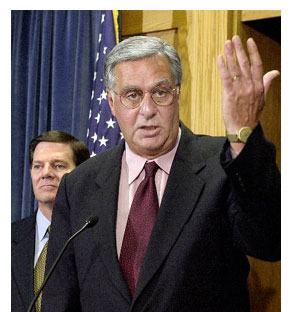

Tom Delay

House divided

GOP enforcer Tom DeLay and his former partner Dick Armey are locked in a nasty dispute over the future of the Republican Party.

  • more
    • All Share Services

House divided

When former House Republican Majority Leader Dick Armey’s official portrait was unveiled at a reception in the Capitol’s Statuary Hall last month, Speaker Dennis Hastert delivered a praiseworthy little speech, as did Armey’s longtime policy nemesis, former House Democratic Leader Dick Gephardt of Missouri. “I was tickled with Dick Gephardt’s generosity,” Armey said in an interview with Salon. “He was very nice. He said he couldn’t resist being there to hang me.”

But one dignitary was conspicuously absent: House Majority Leader Tom DeLay. “I asked that he speak,” Armey said. “Who’d be the most natural guy after the speaker? He is the guy that I came in with — we were part of the celebrated ‘Texas Six-Pack’ of 1984. He is the most senior member of the House from Texas, and he is my successor. He was invited, and he declined.”

Once good friends, the two Texas Republicans — whose relationship was badly strained by the fallout from a botched 1997 coup attempt against then Speaker Newt Gingrich — have now dropped all pretense of collegiality. Because they were leaders of the House GOP during its headiest days, their enmity is more than a personal drama; it is a metaphor for the troubled legacy, 10 years later, of the 1994 Republican “revolution” that brought them into power.

For the first time since the Eisenhower administration, Republicans control all of Washington, from the White House to both chambers of Congress. Yet the party of limited government has, under President Bush, instead presided over a massive expansion of government spending. New spending on defense and security was inevitable after the Sept. 11, 2001, attacks, Armey conceded. But there is no justification, he said, for the budget-busting Medicare prescription drug program, the largest new entitlement since Lyndon Johnson’s Great Society, which will saddle the government with $8.1 trillion in unfunded liabilities over the next 75 years. Record deficits threaten the cherished Bush tax cuts, he added. Even the corporate-welfare farm subsidies that Armey, as a free-market conservative, had fought to kill are back. The moves all have one thing in common, he asserted: They are designed to secure votes.

“We’re letting the political hacks overrule the policy wonks in this town,” Armey lamented to me. Republican principles are being sacrificed in the pursuit of short-term political goals, he complained. And the irony, he added, is that all the maneuvering for votes may instead end up costing Republicans at the polls this year if disgusted fiscal conservatives simply stay home. A spokesman for DeLay declined to comment for this story.

Armey’s stature as a former House leader lends his critique special weight. But most remarkable is that he is willing to make it at all. While many House conservatives say privately that they feel helpless in sticking up for their principles in the face of ruthless intimidation from the Bush White House and DeLay, few have dared to speak as boldly as Armey has. DeLay, who is known as “The Hammer” for his ability to pound Republicans into supporting the party line, doesn’t just discourage dissent, he beats it to a pulp. And the “with us or against us” mentality, once directed only toward terrorists and Democrats, is increasingly targeting conservative dissenters as well.

During last fall’s battle over Medicare prescription drug benefits, for example, DeLay engaged Stuart Butler, a vice president of the conservative Heritage Foundation, in an oddly personal debate at a meeting of the Republican Study Committee, a group of 50 House conservatives. DeLay ridiculed the venerable think tank’s research as uninformed. (Its insistence that the Bush administration was low-balling the bill’s costs turned out to be correct.) His attacks were so aggressive — “name-calling,” as one attendee described it — that many Republicans left muttering that DeLay had crossed a line.

And in March, at a meeting of all the House Republicans, DeLay slammed Armey for having said publicly that high deficits will make it harder to make the Bush tax cuts permanent. “It would seem to me that I stated the obvious, but it was apparently something that offended him deeply,” Armey said.

Although he is out of Congress and the GOP leadership, Armey makes his comments at some personal risk; he is now a lobbyist on Washington’s fabled K Street, which is ruthlessly patrolled by DeLay and his key ally, Americans for Tax Reform president Grover Norquist. For years, Norquist and DeLay have worked to purge the nation’s corporate lobby shops of Democrats, and companies that fill GOP campaign coffers with money are rewarded with access to lawmakers. Enemies don’t get their calls returned, and without access, they lose clients. Access is coordinated by the White House, often through the office of another powerful Texan, political strategist Karl Rove.

For two years, the assistant who answered Rove’s phone was a woman who had previously worked for lobbyist Jack Abramoff, a close friend of Norquist’s and a top DeLay fundraiser. One Republican lobbyist, who asked not to be named because DeLay and Rove have the power to ruin his livelihood, said the way Rove’s office worked was this: “Susan took a message for Rove, and then called Grover to ask if she should put the caller through to Rove. If Grover didn’t approve, your call didn’t go through.”

Observers of Washington’s lobbying scene who know how DeLay plays the money game wonder if the majority leader had a hand in a recent decision by the state of Texas to cancel a $180,000-a-year contract with Armey’s law firm, Piper Rudnick. Texas’ stated reason for the pullout was that Piper Rudnick had created a conflict of interest by agreeing also to represent the state of Florida. However, the Florida contract is for lobbying to prevent military base closures; the contract with Texas specifically excluded work on base closings.

Texas is also represented in Washington by the Federalist Group, which employs a former DeLay aide. A spokesman for DeLay said the majority leader had nothing to do with Texas’ decision to drop the Piper Rudnick contract. Armey declined to comment on the matter, saying only that DeLay doesn’t scare him. “There’s only one person in this town who won’t take my calls, and I wouldn’t call him anyway. You can’t hurt a man who don’t give a damn.”

Armey was an economics professor at the University of North Texas when, after watching Congress on C-Span, he decided to run for the House of Representatives in 1984. Armey “got into Congress not because he wanted to become a political figure, but because he saw it as the best way to achieve his strongly felt policy goals,” said congressional analyst Norman Ornstein of the American Enterprise Institute. Armey subsequently built a dedicated following for his unwavering conservative economics: free markets, less government regulation and a simplified “flat tax.” And Armey was not above hurling insults at the most despised liberals. He once called Rep. Barney Frank, D-Mass., “Barney Fag” (Armey insists that he misspoke) and former first lady Hillary Rodham Clinton a “Marxist.”

DeLay, who owned a pest control business in Sugar Land, Texas, before his election to Congress, was never one of the conservative movement’s intellectual lights. He excelled at the mechanics of politics: cutting deals, counting votes, raising money. And although the two friends shared a deep opposition to abortion rights and gay rights, religious-right issues were never Armey’s passion. DeLay once declaimed from a church pulpit that God was using him to advance a “biblical worldview,” and that he had pursued the impeachment of President Clinton because he had the “wrong worldview.” Armey generally left God out of his public pronouncements, quoting not the Bible but Waylon Jennings and Willie Nelson.

In 1994 Gingrich put Armey in charge of drafting the “Contract With America,” the Republican campaign manifesto that unexpectedly helped propel the minority GOP to power that November. Gingrich found himself speaker, Armey ran unopposed for majority leader and DeLay fought his way into their circle by winning a three-way race for House whip, prevailing over Gingrich’s closest friend in the House, Rep. Bob Walker, R-Pa.

By 1997, however, things were falling apart. Egged on by fiscal militants, Gingrich had pursued an unpopular partial shutdown of the federal government in the winter of 1995-1996 rather than approve President Clinton’s budget. Gingrich’s leadership became increasingly autocratic and erratic, and DeLay and then Rep. Bill Paxon, R-N.Y., hatched a failed plot to oust him. Armey’s role in the plot remains murky. He insists he was not part of the coup and instead tried to warn Gingrich. But many rank-and-file Republicans did not believe him. At the time, Armey was also under assault from conservatives for cutting deals with the Clinton administration as majority leader, and after the coup craziness, Armey’s support eroded. With the position of speaker out of his grasp, he retired from Congress in January 2003 after nine terms.

Now, in addition to his lobbying work, Armey is chairman of Citizens for a Sound Economy, a conservative, grass-roots, free-market advocacy organization. During travels last fall to promote his new book, “Armey’s Axioms: 40 Hard-Earned Truths From Politics, Faith, and Life,” the former majority leader said he found conservatives in the heartland to be discouraged by the enormous expansion of public spending and record budget deficits. “Wherever I went,” Armey said, “I had people who were the natural constituency of the Republican Party say, ‘Oh, the heck with it. I’ll just stay home.’”

In a close presidential election, such GOP disaffection could prove decisive, he argued, a bigger factor undermining Bush than Ralph Nader might be for John Kerry. “You’ve got the Kerry people worried sick about the possibility that Nader might take 3 percent of their vote. But I think the Bush folks need to say, ‘Well, how do we survive if 3 or 4 or 5 percent of our foundation base just decides to sit out the election?”

Echoing Armey, pollster John Zogby said he has heard the same anecdotal evidence of Republican disenchantment. “Today I’m in Austin, Texas,” Zogby said in a phone interview, “and my driver said, ‘I’ve been a Republican all my life, but I can’t support him [Bush].’”

Polling data is beginning to reflect the souring mood, he said. In a survey of likely voters taken May 10-13, Zogby found that President Bush had the support of 71 percent of self-described conservatives, but 19 percent were for John Kerry. “That’s really intriguing to me because the president and the administration have spent the last four years shoring up their conservative base,” Zogby said. “But the tide may be going back out for them.”

In Armey’s view, hardball players like Rove and DeLay have lost perspective in their single-minded pursuit of power. The signal case is Medicare, he said. Desperate to co-opt one of the Democrats’ strongest campaign issues, the White House made passage of Medicare prescription drug benefits one of its top priorities. But the seniors whom the bill was meant to win over are in revolt, perplexed by the program’s complexity and worried that it will encourage employers to drop private drug coverage from retirement benefits. Kerry holds a 20-point advantage over Bush in key battleground states on the question of who would better handle the rising costs of prescription drugs, according to a joint poll conducted last month by the Republican Tarrance Group and the Democratic firm of Lake, Snell and Perry.

On the day the prescription drug bill came before the House for final passage last November, Armey published an Op-Ed in the Wall Street Journal urging lawmakers to vote against it. “I believe that good policy is good politics,” he wrote. “This is a case where bad politics has produced a bad policy proposal. Conservatives would be smart, and right, to reject it.” Armey’s breaking ranks incensed DeLay and Speaker Hastert, who were straining to ram the bill through.

Armey’s encouragement of a mutiny may well have contributed to the extraordinary events on the floor of the House. Fiscal conservatives resisted “The Hammer,” prompting Republican leaders to hold open a 15-minute vote for an unprecedented three hours, from 3 a.m. to dawn, as DeLay and other leaders pounded the holdouts. “There was a lot of heavy-handed, mean-spirited whipping going on,” Armey said. In the end, the bill squeaked through.

Afterward, Hastert told Armey he was furious at his meddling, but the two made up. “It’s always a healthier thing when two people who have a disappointing experience between them meet to say, ‘Hey, my good friend, I know I let you down,’” Armey said. But there was no reconciliation with his fellow Texan. “Tom DeLay somehow saw it as a betrayal on my part, and he’s not so quick to patch things up,” Armey said.

In the long run, Armey says, Republicans will be stronger if they allow genuine internal debate. But that is hardly the trend in the House, where DeLay “has taken every norm the Legislature has operated on and shredded it,” the AEI’s Ornstein said. Once, Republicans lambasted Democrats, when they were in the majority, for denying them the opportunity to amend bills on the House floor. Today, congressional leaders have gone even further by barring Democrats from participating in key conference committees, where final deals on legislation are worked out. In Texas, DeLay engineered a mid-decade redistricting of congressional seats designed to oust incumbent Democrats, breaking the tradition of realigning only after a 10-year census. “On a scale of 1 to 10, Democrats abused their majority status at about a level 5 or 6,” Ornstein observed. “Republicans today have moved it to about an 11.”

And in a symbolic obliteration of Armey’s influence, DeLay took over a Web site Armey had used to promote his prized flat-tax proposal when he was in Congress. The URL — www.freedom.gov — remains the same. But now the site contains propaganda about the “Victory in Iraq.”

Armey opposed the invasion. In August 2002, he met separately with Bush and Vice President Cheney in an attempt to talk them out of it. “I said, ‘This has the potential to be an albatross at election time.’ I was so desperate that I quoted Shakespeare instead of Jimmy Buffett,” he said. “I don’t know the exact quote. Something like, ‘Our fears betray us,’ or ‘Our fears make cowards of us all.’”

While he believed that Saddam Hussein had weapons of mass destruction and links to terrorist organizations, Armey did not agree with the administration’s assessment of a dire and imminent threat. He said he told Bush and Cheney that it was “against the character of our nation” to strike a country that had not attacked first. Liberating the Iraqi people was the more resonant argument, Armey said, because it was in keeping with American principles. But that, of course, was not the stated reason for the war; had it been, it’s unlikely Americans would have supported the invasion.

Similarly, Armey said Congress probably would not have approved the Medicare bill had all relevant information been known before the vote last fall. Medicare’s chief actuary, Richard Foster, revealed after the vote that the Bush administration had threatened to fire him if he informed Congress of his true, higher cost estimate: not $400 billion but as much as $600 billion over 10 years.

If, by speaking out, Armey hopes to embolden his former colleagues to stand up to DeLay’s bullying, it’s not clear he will succeed. In interviews last week, several of the conservatives who voted against the Medicare bill were reluctant to say anything that might draw DeLay’s wrath. And Armey’s critiques do not sit well with others among his former Republican colleagues, some of whom view him as a hypocrite. “What did Armey do when he was in office to restrain the growth of government?” asked Rep. Ray LaHood, R-Ill. “He led the floor debate to create the Department of Homeland Security. I would say he contributed to the growth of government.”

Unlike DeLay, Armey, who now demands simon-pure conservatism, voted for final passage of the No Child Left Behind Act, the Bush-backed education reform much reviled by many on the right as meddling by the federal government in state and local matters.

To his critics, Armey says that’s precisely why he left his job as majority leader. He was having to make even more serious compromises on policy under a Republican president than he did under Clinton, and he no longer wanted to have to take party positions contrary to his philosophy.

“There’s a marvelous song by John Denver,” he said, paraphrasing the lyrics. “It goes: ‘Some days are diamonds, some days are stones. There’s a face I see in the mirror, more and more is a stranger to me, more and more is the danger of becoming what I thought I’d never be.’”

“When you wake up and see that stranger in the mirror,” he said, “that’s when you know it’s time to go.”

Mary Jacoby is Salon's Washington correspondent.

John Edwards’ creepy mug shot

The disgraced senator flashes an unnerving grin -- just like Tom DeLay

  • more
    • All Share Services

John Edwards' creepy mug shotEdwards sports a cold, dead smile in his mugshot

If the pictures of Anthony Weiner and (allegedly) a sunbathing Newt Gingrich weren’t too much for you, here’s another unsettling image: CNN’s Ed Hornick has posted John Edwards’ mug shot. Edwards, who faces felony charges for allegedly using over $1 million of campaign cash to hide his extramarital affair and child, went for the unnerving smile with accompanying cold, dead eyes for his photo:

The image is reminiscent of Tom DeLay from the Republican former House majority leader’s mug shot. (DeLay was ultimately convicted on conspiracy and money-laundering charges.)

We wonder whether the smiles here are meant to convey confidence or an image of innocence. If so, neither man succeeded.

Natasha Lennard covers the Occupy movement for Salon. A British-born, Brooklyn-based journalist, she has been covering Occupy Wall Street since before the first sleeping bag was unrolled in Zuccotti Park. One of the first journalists arrested at an Occupy action, she has managed to enrage Andrew Breitbart, Rush Limbaugh and Glenn Beck. You can follow her on Twitter (@natashalennard), and email her any Occupy updates/videos/ideas to natasha.lennard@gmail.com

Meet Patrick McHenry, the rudest, most shameless College Republican in Congress

Of course he was unfair to Elizabeth Warren: He was trained by the most cutthroat political organization around

  • more
    • All Share Services

Meet Patrick McHenry, the rudest, most shameless College Republican in CongressPatrick McHenry

Rep. Patrick McHenry (R-Countrywide) called Elizabeth Warren a liar at the conclusion of a House Oversight subcommittee hearing that had already consisted mainly of Republican members of Congress getting very basic information about Warren’s Consumer Financial Protection Bureau completely wrong.

McHenry has been one of the most completely shameless of House Republicans since his arrival in Congress, in 2005, when he immediately and publicly endorsed Tom DeLay’s brilliant plan to exempt himself from ethics rules as his connections to Jack Abramoff began to end his career. But he was born to be cheerfully corrupt: He’s a product of the College Republicans, an organization that trains little Lee Atwaters, Karl Roves and Grover Norquists in the arts of scorched-earth campaigning and wholly irresponsible “governing” on behalf of the monied interests that bought you your job. The ethos is win by any means necessary, legal or quasi-legal (or worse, as long as you never get caught), and McHenry was very good at that, according to Benjamin Wallace-Wells’ memorable profile of the then-freshman in the Washington Monthly.

After the College Republicans, and a failed state legislature race, McHenry moved on to truly insidious conservative astroturfing/push-polling/communications firm DCI, then worked for Rove, then took a political appointment in the Bush administration, then moved to the district he now represents, where he started a real estate company that did not actually buy or sell any real estate, so that he could run for Congress as “a small businessman.”

Once in the United States House of Representatives, McHenry personally intervened in a wild and bloody College Republican National Committee chair election, on behalf of a personal friend of his who’d become slightly toxic after he sent fundraising letters attempting to trick “elderly people with dementia” into donating to the CRNC. And he was successful! The horrible kid won, against all odds:

In other phone calls, McHenry was more blunt: “He told me, and several of my friends that we were done in politics if we didn’t support him,” another College Republican chapter president told me. (McHenry has admitted that he and Deans made the calls but denied that they threatened anyone’s career). Over the course of two weeks, after a couple of a dozen calls, McHenry prevailed upon those in the North Carolina delegation to change their votes, removing three votes from Davidson’s column and putting them in Gourley’s. Gourley ended up winning by six votes; had North Carolina voted the other way, Davidson might have won.

Another of McHenry’s first acts in Congress, Wallace-Wells writes, was to champion a bill that was specifically written to rip off a large portion of his constituents, by making it “much harder for government to regulate or block the conversion of credit unions into banks …” He is a close ally of major consumer financial institutions with a plum assignment to the Committee on Financial Services, which is great for raising money.

It’s only natural that Elizabeth Warren, whose mission is to protect consumers from unethical and predatory practices by these institutions, is Patrick McHenry’s enemy. You can complain on his Facebook wall all you like, but the Republican from North Carolina is incapable of feeling embarrassment.

And his treatment of Warren will only make him a bigger conservative hero and an even more attractive investment opportunity for major banks.

Continue Reading Close
Alex Pareene

Alex Pareene writes about politics for Salon and is the author of "The Rude Guide to Mitt." Email him at apareene@salon.com and follow him on Twitter @pareene

The end of Tom DeLay

And why he'll probably never spend a day in prison

  • more
    • All Share Services

The end of Tom DeLayTom Delay

On Monday, Tom DeLay was sentenced to three years in prison on two felony charges, conspiracy and money laundering, in a campaign finance corruption case that had dragged on for years.

The sentencing of DeLay, once one of the most powerful Republicans in Washington and the majority leader of the House of Representatives, was largely ignored because of the aftermath of the mass shooting in Arizona.

But it’s an extraordinary story — and one that’s not quite over. When he was indicted in Texas in 2005, DeLay’s political career sustained a fatal blow. He was forced to step down from his House leadership position and, in 2006, he resigned from Congress. 

The charges arose after DeLay set up a PAC to funnel corporate money, which is barred in Texas elections, to candidates for the state legislature. The group raised $190,000 and funneled it through the national Republican Party, which then distributed the money to several state-level candidates in Texas.

To learn more about the case that brought DeLay down, I spoke with Lou Dubose, who co-authored “The Hammer,” a biography of DeLay. The former editor of the Texas Observer and the current editor of the Washington Spectator newsletter, Dubose covered the trial gavel to gavel in Austin. He was in the courtroom on Monday when DeLay gave a lengthy presentencing speech accusing prosecutors of having political motivations and claiming he had $10 million in legal bills. 

I asked Dubose whether DeLay, who is planning an appeal, will ever see the inside of a jail cell, and whether the former majority leader appears humbled by the ordeal of the trial.  The conversation has been edited for length and clarity.

Did you ever think that you would see this happen?

I really didn’t. This was a working class jury, and I think that made a huge difference.

What was the dynamic with the jury — why did that make a difference?

Gary Cobb, the assistant DA who tried the case, really dragged out the $50,000 checks and the flights on corporate jets with the same persons who had written the checks to DeLay’s PAC. The sort of life that Tom DeLay lived at the expense of the corporate lobby — I think that really made an impact. By their clothes and what we know about them, it was a real working-class jury.

Oddly enough, Tom DeLay spent the entire duration of the three-week trial in a motor home rather than the Four Seasons. He drove his motor coach over here and checked into a motor home park in south Austin, a long way from where he was playing golf at Saint Andrews in Scotland. Then there was also the fact of the way the DeLays dressed, the fact that Reverend Rick Scarborough was sitting behind them. There was a lot of bling there that these people on the jury didn’t have.

Was it possible to tell where the $190,000 ended up? Did it just go to the state GOP?

The money came back, and it went to the candidates in Texas for whom it was designated. The backstory, of course, is that the Republicans controlled everything in Texas but the statehouse. Therefore they could not control redistricting. So DeLay set this organization up in 2001 for the 2002 election and they had to win a majority in the house. They moved this $190,000 up to D.C. because they were specifically raising corporate money, which was easier to raise. They sent it to Washington with specific instructions to send it back to these designated candidates. The candidates got the checks in the exact amount of $190,000.

And DeLay personally raised the money?

Well, that was the question. He stayed in the background but the state proved that he was aware that that transaction had happened. He was probably involved in directing it, although they didn’t have direct testimony on that. They put the three men who did the money-laundering in a room together in Sugar Land, Texas, in DeLay’s district, before the transaction was made.

Remarkably, at one point in the trial, DeLay went out and talked to Laylan Copelin of the Austin American-Statesman, who is a really terrific reporter. And Laylan asked him if he could have stopped the transaction. And DeLay said, “I could have stopped it, but why would I?”

And that was used in the trial?

In the middle of the trial, the state called Laylan Copelin as a witness — really bizarre. He’d been sitting there most of the trial; two weeks into the trial they call him as a witness because of what DeLay had said. His story ran, and two days later he was on the stand testifying as to what he had been told.

So I think DeLay proved to be a terrible client for a storied criminal defense attorney, Dick DeGuerin. That said, the state did an incredible job putting on a case that had to be by nature largely circumstantial.

Do you think he will ever spend a day in jail?

No. Simply because the Court of Criminal Appeals is an elected court, it’s all Republican, it’s highly political. It’s known as a prosecutors’ court, but in this case I would bet that they’re going to rule for the defendant. The Third Court of Appeals, where the appeal will start, is also a Republican court.

What are the issues in the appeal?

These courts are going to have to find a creative way of setting Tom DeLay free. One argument that they once made that they might try to revive is that money-laundering didn’t apply to checks, it applied to cash. This involved checks. The problem with that at the appellate level is that there have been a number of convictions based on money laundering with checks. So are you going to overturn all these prior convictions in order to save Tom DeLay?

What is DeLay doing these days?

You know, nothing. He is struggling to remain relevant. DeLay was always the star at CPAC, the annual conservative conference in Washington. But he hasn’t been allowed to speak there. Two years ago at CPAC, he was trolling for interviews. At the last CPAC convention, he was shunned.

He’s become a pariah to the Republican Party, and I don’t quite understand why. The true believers hold him responsible, rightly, for the Bush Medicare prescription drug bill, which DeLay pushed through. But he’s of no use to them anymore, and he’s not wanted. So most of what he does is struggle to remain relevant, and he’s not. Dick DeGuerin, in his closing argument, said “This prosecution has rendered my client unemployable.” And to my knowledge, he’s not employed.

His media statements have been defiant, but has he changed?

I don’t think so. That’s what’s remarkable. This is the same Tom DeLay that I saw every day for a year and a half when I followed him in Washington. It seemed to me that it never occurred to him that he no longer had the power that he once exercised. He had no regrets — he’s the same guy, except that he’s driving in a motor home instead of sleeping in the Four Seasons.

Continue Reading Close
Justin Elliott

Justin Elliott is a reporter for ProPublica. You can follow him on Twitter @ElliottJustin

Tom DeLay sentenced to 3 years in prison

Former U.S. House majority leader was convicted of money laundering and conspiracy

  • more
    • All Share Services

Tom DeLay sentenced to 3 years in prisonFILE - In this Oct. 26, 2010 file photo, former House Majority Leader Tom DeLay arrives at the Travis County courthouse in Austin, Texas, for jury selection in his corruption trial. Delay will be back in court on Monday, Jan. 10. 2011, for the sentencing phase of his trial after his Nov. 24 conviction on charges of money laundering and conspiracy to commit money laundering in a scheme to illegally funnel corporate money to Texas candidates in 2002. (AP Photo/Jack Plunkett, File)(Credit: AP)

A judge has ordered U.S. House Majority Leader Tom DeLay to serve three years in prison for his role in a scheme to illegally funnel corporate money to Texas candidates in 2002.

The sentence comes after a jury in November convicted DeLay on charges of money laundering and conspiracy to commit money laundering. DeLay was once one of the most powerful men in U.S. politics, ascending to the No. 2 job in the House of Representatives.

The former Houston-area congressman had faced up to life in prison. His attorneys asked for probation.

Senior Judge Pat Priest issued his ruling after a brief sentencing hearing on Monday in which former U.S. House Speaker Dennis Hastert testified on DeLay’s behalf.

Priest declined to hear testimony from the state’s only witness.

THIS IS A BREAKING NEWS UPDATE. Check back soon for further information. AP’s earlier story is below.

Jury convicts Tom DeLay in money-laundering trial

DeLay maintains his innocence and plans to appeal the verdict it took 19 hours to reach

  • more
    • All Share Services

Former U.S. House Majority Leader Tom DeLay — once one of the most powerful and feared Republicans in Congress — was convicted Wednesday on charges he illegally funneled corporate money to Texas candidates in 2002.

Jurors deliberated for 19 hours before returning guilty verdicts against DeLay on charges of money laundering and conspiracy to commit money laundering. He faces up to life in prison on the money laundering charge.

After the verdicts were read, DeLay hugged his daughter, Danielle, and his wife, Christine. His lead attorney, Dick DeGuerin, said they planned to appeal the verdict.

“This is an abuse of power. It’s a miscarriage of justice, and I still maintain that I am innocent. The criminalization of politics undermines our very system and I’m very disappointed in the outcome,” DeLay told reporters outside the courtroom. He remains free on bond, and his sentencing was tentatively set to begin on Dec. 20.

Prosecutors said DeLay, who once held the No. 2 job in the House of Representatives and whose heavy-handed style earned him the nickname “the Hammer,” used his political action committee to illegally channel $190,000 in corporate donations into 2002 Texas legislative races through a money swap.

DeLay and his attorneys maintained the former Houston-area congressman did nothing wrong as no corporate funds went to Texas candidates and the money swap was legal.

The verdict came after a three-week trial in which prosecutors presented more than 30 witnesses and volumes of e-mails and other documents. DeLay’s attorneys presented five witnesses.

Prosecutors said DeLay conspired with two associates, John Colyandro and Jim Ellis, to use his Texas-based PAC to send $190,000 in corporate money to an arm of the Washington-based Republican National Committee, or RNC. The RNC then sent the same amount to seven Texas House candidates. Under Texas law, corporate money can’t go directly to political campaigns.

Prosecutors claim the money helped Republicans take control of the Texas House. That enabled the GOP majority to push through a Delay-engineered congressional redistricting plan that sent more Texas Republicans to Congress in 2004 — and strengthened DeLay’s political power.

DeLay’s attorneys argued the money swap resulted in the seven candidates getting donations from individuals, which they could legally use in Texas.

They also said DeLay only lent his name to the PAC and had little involvement in how it was run. Prosecutors, who presented mostly circumstantial evidence, didn’t prove he committed a crime, they said.

DeLay has chosen to have Senior Judge Pat Priest sentence him. He faces five years to life in prison on the money laundering charge and two to 20 years on the conspiracy charge. He also would be eligible for probation.

The 2005 criminal charges in Texas, as well as a separate federal investigation of DeLay’s ties to disgraced former lobbyist Jack Abramoff, ended his 22-year political career representing suburban Houston. The Justice Department probe into DeLay’s ties to Abramoff ended without any charges filed against DeLay.

Ellis and Colyandro, who face lesser charges, will be tried later.

Except for a 2009 appearance on ABC’s hit television show “Dancing With the Stars,” DeLay has been out of the spotlight since resigning from Congress in 2006. He now runs a consulting firm based in the Houston suburb of Sugar Land.

Continue Reading Close

Page 1 of 35 in Tom Delay