
Nonfiction

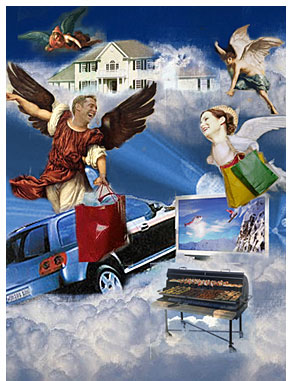
Home Depot heaven

New York Times pundit David Brooks was once a funny and keen-eyed observer of America's social foibles. Now he's become a weird cheerleader for fetishized Ordinary Americans who express their spirituality by buying big-screen TVs.

  • more
    • All Share Services

Home Depot heaven

The distance from amusing to annoying can be a matter of one step or, in the case of David Brooks, a brief, ignominious, muddy slide. Brooks has been hilarious and original in his social and cultural essays for the Atlantic Monthly and in “Bobos in Paradise,” his book about the vicissitudes of the baby boom generation, but his more recent stint as an Op-Ed columnist for the New York Times is a case of the Peter Principle in action. Brooks is out of his depth, as his recent flailings on the Iraq war have made painfully clear. It’s enough to make you yearn for his return to the territory of “Bobos,” where Brooks acquitted himself so well. Then along comes his new book, “On Paradise Drive,” to prove once again that you should be careful what you wish for.

Admittedly, Brooks is in an impossible position. Liberals are forever claiming that they’d be happy to read a conservative writer if only the press would publish one who wasn’t a moron or a hateful, irrational liar. Brooks is supposed to be that writer. He is not, for example, all that conservative, especially on social issues, and he’s neither a snoot of the old school like William F. Buckley Jr. nor a venomous hypocrite like Rush Limbaugh nor, God forbid, a borderline sociopath like Michael Savage.

But although they won’t admit it, most liberals secretly believe that no one sensible and decent could ever seriously entertain conservative ideas, and therefore no one could ever fulfill the platonic role of Acceptable Conservative. It’s a Catch-22 situation Brooks has stepped into. Still, his lack of consistency and intellectual chops certainly hasn’t helped his case any.

What does work for Brooks is what he accurately identifies as the provincial complacency of the people he both writes for and skewers, the intelligentsia on the coasts and in the handful of inland blue states. His brief is to explain the mores and mind-set of the great flyover to overeducated, full-of-themselves urbanites in a way that needles their unthinking disdain for such places. This wouldn’t get him very far, of course, if those urbanites didn’t lap this stuff up, or if the readership of highbrow magazines and the newspaper of record didn’t include lots of people who feel both resentful of and somewhat intimidated by what used to be called the Northeastern elite. Class animosity lives on in America, however much Brooks may claim otherwise.

Also, Brooks is funny, a rare quality among social critics. This serves him well when he’s on his own turf, describing the trappings and preoccupations of the way we live now. (On subjects requiring gravitas — the current war, for example — he’s stripped of his chief rhetorical tool, and the result has been a sorry sight to behold.) However, the ideal format for Brooks’ wit is the 1,000-word column, a length ideally suited to a riff on the psychosexual symbology of outdoor grills, the future market for play-date attorneys or the rituals of the business traveler. String a bunch of these riffs together and you get … a bunch of riffs strung together, or, in the case of “On Paradise Drive,” the riffs plus lots of pithy quotes from the likes of Alexis de Tocqueville, George Santayana and Walt Whitman, glued together with dollops of fuzzy, self-contradictory “analysis” from Brooks himself.

Brooks’ fans see him as wickedly irreverent. That image is based on his mastery of a single technique (and not a particularly original one, since it was first used by historian Paul Fussell in his 1983 book “Class: A Guide Through the American Status System”): He details, with the taxonomic precision of a zoologist, the habits and possessions of American social groups. “On Paradise Drive” takes a highly selective “tour” through a series of representative neighborhoods, starting from the city and heading out. Brooks describes the hipster enclave of “Bike-Messenger Land,” where “You’ll see transgendered tenants-rights activists with spiky Finnish hairstyles, heading from their Far Eastern aromatherapy sessions to loft-renovations seminars.” Then come the “Crunchy Suburbs” where he observes “the sudden profusion of meat-free food co-ops, the boys with names like Mandela and Milo running around the all-wood playgrounds, the herbal soapmaking cooperatives,” etc. Then there’s the “Suburban Core,” where “all those things that once seemed hopelessly outré — cheerleaders, proms, country clubs, backyard barbecues and stay-at-home moms — still thrive.”

And onward, to a new phenomenon that Brooks considers highly significant, the exurbs. Here, where once was empty land for miles, subdivisions arise and are populated in a matter of months, and “you can cruise down flawless six-lane thoroughfares in trafficless nirvana.” In these friction-free “Mayberries with Blackberries,” the development trend called new urbanism has dictated the construction of artificial “town squares” lined with storefronts designed to look as if they weren’t built all at once and rented out to chains like Restoration Hardware and Starbucks. Developers hire jugglers to simulate a “vibrant street life,” and everyone wears khakis ordered from the Lands’ End catalog and talks endlessly about their kids’ sports teams.

This sort of thing feels vaguely insulting when Brooks is describing the subculture you belong to, but the payoff is that you get to smirk meanly when he’s nailing, say, the $6 ice cream cone purchasers of the “Professional Zone,” with their debates about “the merits and demerits of Corian countertops” and their streets where “there are so many blue New York Times delivery bags in the driveways … they are visible from space.” The meanness lies in knowing that every American wants to think that his or her lifestyle is a reflection of individual taste, and that the more affluent the person, the more dearly held is the delusion of originality. “You,” says Woody Allen’s Alvy Singer in “Annie Hall,” to a character played by Carol Kane, “you’re like New York, Jewish, left-wing, liberal, intellectual, Central Park West, Brandeis University, the socialist summer camps and the father with the Ben Shahn drawings, strike-oriented, red diaper … ” “I love being reduced to a cultural stereotype,” she responds sarcastically.

This technique only works if it’s deadly accurate, and recently Sasha Issenberg of Philadelphia Magazine caused a minor media furor when he was able to demonstrate that some of Brooks’ claims about lower-middle-class neighborhoods in his area were wrong. He’s not alone. I don’t personally know much about Manhattan’s ultrahip nightlife, but even I am aware that “rich and beautiful supermodels” don’t “stand around in bars trying to look like Sylvia Plath and the Methadone Sisters.” (Sylvia Plath may have been suicidal, but she always looked like the well-groomed, twin-set-clad Smith graduate she was, and supermodels haven’t tried to resemble heroin addicts for years.) The kind of bohemians who talk “knowledgeably about Cuban film festivals” and “lament the spread of McDonald’s and Disney and the threat of American cultural imperialism” do not frequent Ian Schrager hotels.

But this is mere pettifoggery. Brooks’ cachet comes not from mocking metropolitan hipsters but from lecturing them on the fundamental goodness of the people of Exurbia, those Americans he christens, Adam-and-Eve style, as Patio Man and Realtor Mom. Granted, there’s some gentle teasing about the monstrous size of their SUVs and their visits to megastore centers where “the parking lot is so big you could set off a nuclear device in the center and nobody would notice in the stores on either end.” There’s a line about how “in America it is acceptable to cut off any driver in a vehicle that costs a third more than yours. That’s called democracy.”

Ultimately, though, Brooks cherishes these people. They epitomize something precious in and essential to our national character, our “energy and mobility and dreams of ascent.” Unlike the residents of Bike-Messenger Land or the Crunchy Suburbs, they don’t pretend to reject the American hankering for achievement and wealth while guiltily succumbing to it. They straightforwardly pursue their own dreams of paradise.

Brooks’ expertise when it comes to exurbia is itself notably friction-free. Patio Man and Realtor Mom are paper dolls, composites of statistical information, like the digital inhabitants of SimCity. Unable to speak in their own voices (the book features no interviews with exurbanites), they express their inner Middle American virtue via their favorite brands, their aversion to traffic and the neatness of their lawns. It turns out that the source of Brooks’ knowledge about them comes mostly from reading magazines like American Demographics and hanging out at big-box malls with a 3-by-5 memo pad. “On Paradise Drive” is crammed higgledy-piggledy with statistics, informing you here that “blacks spend more on poultry and telephones and less on furniture and books,” and there that “a quarter of all women have considered breast-augmentation surgery.”

Like a lot of demographic information, the data that Brooks uses is generated mostly by market research firms. And this, at heart, is why the cultural portraits in “On Paradise Drive” feel so thin. Market research firms only care about what people buy, or to be more precise, the aspects of people’s lives that determine what they buy. By hanging out at Wal-Mart taking notes or by culling trade magazines for tidbits like the three things homebuyers most want (more counter space, basement space and closet space), Brooks endorses these parameters. After all, his own reputation is built on sharp little sketches of various cultural types based almost entirely on the products they consume. As far as Brooks is concerned, you are what you buy.

That characterization probably wouldn’t trouble Brooks much, because the thesis behind “On Paradise Drive” is that Americans “are driven to realize grand and utopian ideals through material things.” It’s not that foreign and homegrown critics are wrong in pegging Americans as venal, it’s that they’re blind to the ways that we use venal things like whirlpool baths and Jeep Grand Cherokees to express our longing for transcendence. Home Depot and the PowerPoint presentation you put together to succeed at the business you start in order to shop there are both manifestations of “a spiritual impulse that is quite impressive and profound.”

Since Brooks has spent the entire book, and much of his career, lampooning all the values we think we manifest through the stuff we own, this is a weirdly sanguine assertion. His point seems to be that the hope with which people chase their dreams of affluence somehow ennobles their goals: “The redeeming fact about American business life is that it is a stimulant. It calls forth boundless energy.” Brooks envisions legions of would-be entrepreneurs, filing through what even he describes as the “sheer existential nothingness of an office-park lobby” in search of the one little idea they can promote into a fortune. (His ur-example is Ray Kroc’s French fry, on which the empire of McDonald’s was founded.) “The quest may be epic, but the goal is trivial,” he writes. In other words, the means justifies the end.

And the end is shopping. Brooks assures us that, contrary to the theories of all those old, bearded, spoilsport social thinkers from centuries past, who claimed that people buy expensive stuff to lord it over their neighbors, American love to shop because they’re just so imaginative. You see, even when they can’t afford a Tiffany bracelet or a Lexus, they linger over the pages of glossy consumer magazines luxuriating in daydreams about the perfect future in which they might have it all. After diverting portraits of three such magazines (Real Simple, Easyriders and Cigar Aficionado), in all their pretension and vulgarity, Brooks suddenly veers into praise for the perpetual cycle of longing they inspire. It is not pathetic and misguided, he insists. It is “a realm of enchantment, anticipation and ecstasy.”

Did you know that “often the pleasure that shoppers get from anticipating an object is greater than the pleasure they get from owning it”? In fact, no sooner do they get it than they start fantasizing about how great their lives will finally be once they buy something else. Glossy magazines fuel this hunger because they are fantabulous dream factories, convincing us to aspire to the splendor of $1,400 cigars and to believe that “the cash register is a gateway to paradise.” Brooks adds that all this is not “entirely benign.” Really? You think? “Still, shoppers are bathed in hope. The products they confront might be trivial baubles or shams, but shoppers get caught up in the romance and spend optimistically, if not wisely.”

Brooks may see this as an “impulse to utopia,” but to me it looks a whole lot like what Marx called “commodity fetishism,” a useful term for the aura of glamour advertising spins around some object in order to convince you to pay much more for it than it’s actually worth. Marketing convinces you that the purchase will satisfy some inchoate longing and when it fails to do so, you keep coming back for more junk, hoping against all common sense that this time it will do the trick. How can anyone not see this? I mean, we’re going back to Sociology 101, here.

Since Brooks believes in marketing the way other people believe in the Bible or, for that matter, in Marx, he can somehow envision the whole circus as a beneficent gift to the American people, rather than a sleazy racket. It doesn’t seem to occur to him that there is a terrible waste in all that American ingenuity going to collecting more and more crap, that we might spend so much money and watch so much TV and eat so much junk food because we are bored, and we are bored because we are unchallenged, and we are unchallenged because we have been sidetracked by easy, pleasant piffle. “People who look at advertisements want to want,” he writes. “They are not passive victims in these fantasies.” This may be true, but people want candy, cocaine and cigarettes, too, and that doesn’t make them good for us.

I’m placing Brooks’ argument in the silliest possible light, granted, but it’s not much of a reach to get it there. To be fair, “On Paradise Drive” is not completely specious. Brooks is right that there is something invigorating and life-affirming about the idealistic, can-do spirit of American society, hokey as it may sound. And any spiritual or philosophical system that doesn’t allow for the pleasures of the physical world is impoverished and inhuman. But so is any system that doesn’t account for the suffering and loss inherent to life on earth, and Brooks’ sun-drenched vision of the ever-burgeoning American utopia is just such a system. (Even if he does offer a few demurrals about our willingness to sacrifice safety — i.e., social welfare — for opportunity — i.e., minimal taxes and government regulation.)

“Hopeful American dreamers, who have their heads filled with visions of their own future glories, are never going to develop the tragic view of life that is supposed to be the prerequisite for the probing and profound soul,” Brooks writes. Maybe, but to paraphrase a proverb from Alcoholics Anonymous (a quintessential American institution), you don’t have to worry about getting in touch with tragedy, because sooner or later, tragedy will get in touch with you.

The categorical opposite of Brooks’ outlook was elegantly expressed by Graham Greene, in his novel “The Quiet American.” Brooks has read it, but clearly it hasn’t sunk in, because in “On Paradise Drive” he describes Alden Pyle, the idealistic CIA agent hell-bent on installing democracy in Vietnam, who leaves a swath of catastrophe and carnage in his wake, as the novel’s “protagonist.” The book’s actual hero is Thomas Fowler, a broken Englishman, a journalist, who knows just how dangerous Pyle’s simple, arrogant optimism will be. Fowler is a man with the tragic view of life, and eventually, if briefly, Pyle catches up with him. Even Americans aren’t immune to tragedy, a lesson that, apparently, we have to learn over and over again.

Continue Reading Close
Laura Miller

Laura Miller is a senior writer for Salon. She is the author of "The Magician's Book: A Skeptic's Adventures in Narnia" and has a Web site, magiciansbook.com.

“Why won’t you answer me?”

Kids' questions may be annoying -- but they're more crucial to learning than we've ever thought. An expert explains

  • more
    • All Share Services

(Credit: Bonita R. Cheshier via Shutterstock)

Children can ask a lot of very annoying questions. Starting at about 2 years of age, they begin barraging their parents with endless queries, from “Are we there yet?” to “Why is the moon round?” — questions that often seem more like desperate ploys for parental attention than anything else. And, to make things worse, cooperative parents are often treated to a relentless barrage of follow-up questions, many of which involve one word: “Why?” Is this process infuriating? Yes. But is it crucial to their development? Far more than most of us think. And furthermore, the frequency and form of those questions can tell us a lot, not only about how children learn but also about cultural and class differences in America.

In his new book, “Trusting What You’re Told,” Paul L. Harris, a Victor S. Thomas Professor of Education at Harvard, argues that much of what we’ve assumed about our kids’ early learning may be misguided. Although many parents and teachers think of children as primarily independent “scientific” learners who best absorb knowledge by physically interacting with the world — an idea that informs everything from Montessori education to museum planning —  Harris believes it woefully underestimates the importance of dialogue in young kids’ lives. Conversation — and question asking — allows young children to grasp highly abstract concepts, from religion to history, at an earlier age. However, as Harris points out, the way young children learn can vary surprisingly between working-class and middle-class children, and people from different ethnic backgrounds.

Salon spoke to Harris over the phone about Montessori’s mistakes, Asian-American kids’ deference levels, and why working-class kids ask fewer questions.

Why is it so important to determine where young children actually get their information? 

A lot of research on cognitive development has argued that children do best when they’re exploring the world for themselves in a scientific fashion. That idea has a long pedigree. If you read someone like Rousseau, that’s what he’s basically advocating — along with more recent researchers or educators like Paget or Montessori. Even in the last decade or so there have been a lot of titles within the popular science mode that have focused on the “scientist in the crib” or the “child as a scientist.” But I think it dramatically underestimates children.

Where is this, as you argue, misguided approach to early education reflected?

If you go into a Montessori classroom, which is the archetype of this, the child is given materials to play with — be they rods or cones or things to assemble — and the assumption is that the child learns best about numbers and space from interacting with those concrete materials. I’m not quarreling with this as an educational device; I just don’t think it’s the whole story. You also see this philosophy in progressive science museums for children that pride themselves on being hands-on experiences: The child is not necessarily told very much, and he or she is encouraged to try things out for themselves.

You argue that, rather than allowing children simply to figure things out for themselves, it’s incredibly important that children learn things by interacting with adults from a young age. When does that form of learning start?

Probably before the child learns how to talk. There was a nice set of experiments where toddlers who were barely able to walk were given a slope to go down. The slope was made a little bit too steep for them to be confident on, and they’d often turn toward a parent of caregiver looking for advice. The evidence showed that if the parent looked anxious and apprehensive, the toddler would probably hesitate to tackle the slope, and if the caregiver looked encouraging and optimistic, the toddler would go ahead and try to negotiate it.

But this process of learning from others really comes into its own when the child is starting to talk, from 18 to 24 months upward. If, for example, the child puts a toy in a box in a room, and the child comes back into the room, and you tell the child that you’ve moved the toy to a different box, by around two and a half, children are very good at listening to you and will go search in the new place. This is a very early illustration of the way human children realize that the world may not be as they saw it, or as they see it, and that their best bet is to listen and trust other people for guidance.

At a certain point in their childhood, kids start asking lots and lots of inane question where they don’t even seem to be interested in the answer. It can be insanely annoying, and a lot of parents dismiss this as a way to get attention, but you argue that it’s actually incredibly important.

It’s true that children ask a lot of questions, but if you look more closely at the kinds of questions they ask, about 70 percent of them are seeking information as opposed to things like, for example, asking permission. And then when you look at those questions, 20 to 25 percent of them go beyond asking for bare facts like “Where are my socks?” Children ask for explanations, like “Why is my brother crying?” If a child spends one hour a day between the ages of 2 and 5 with a caregiver who is talking to them and interacting with them, they will ask 40,000 questions in which they are asking for some kind of explanation. That’s an enormous number of questions.

And it’s not just attention seeking. When children ask questions and you answer them, that is actually a setting for a sustained dialogue, and they’re trying to get clear in their minds about a particular issue that’s confusing to them or bothering them.

One disturbing finding you highlight in the book is that children in less wealthy families are far less likely to ask these kinds of inquisitive questions.

The most critical variable is the education of the mother. The more educated the mother, the greater the richness of the vocabulary and sentences they use with their children, and to some extent the greater the amount of time they talk to their children. One study was done in the U.K. with a group of working-class 4-year-olds and middle-class 4-year-olds, and the middle-class 4-year-olds were more likely to ask questions than the working-class 4-year-olds. This was also true not just of the single one-off questions but more persistent series of questions. That study also showed that children asked many more questions at home than at preschool, so when we send kids to preschool we’re giving them opportunities to play with other children and pretend play or whatever, but in terms of one-to-one dialogue where these kinds of sustained explorations can take place, we may be limiting the opportunities.

Children also seem to trust answers that come from parents more than other people they don’t know as well.

We’ve done a variety of experiments, and children seem to have a variety of biases that steer them more toward some informants than others. One of the most basic is that they’ll often turn to familiar people rather than strangers. Though by the time the child is 5, if a familiar person starts saying things that from the child’s point of view are incorrect or implausible, the child will become less receptive to that person.

There’s a surprising finding in the book that Asian-American children are more deferential in their early learning than others. What does that mean?

There is data comparing American children who are European-American and children from Asian-American families, and to cut a long story short, it looks as if the first-generation Asian-Americans children are more likely to scan the social horizon, more likely to listen to other people. I don’t think we should automatically jump to the conclusion that’s an intellectually inferior strategy; it’s actually an intellectually sophisticated strategy. We don’t know exactly what brings this cultural difference about, but our best guess is that it goes back to the dialogue between caregiver and children — that mothers differ in the extent to which they encourage children to voice their own opinions or record a child’s opinion as worthy of attention.

But the willingness to provide and act on what you’re told is not something that’s peculiar to any particular culture. Deference has been an important tool for the transmission of culture. Human technology becomes more elaborate, more complicated, from one generation to the next, and deference allows information to be picked up and acted upon. Chimpanzees, for example, deprive themselves of the ability to learn culturally inherited wisdom passed on from generation to generation. If we look at chimpanzee tool use, it tends to be unsophisticated; it doesn’t accumulate over generations.

You draw parallels and contrasts between childhood beliefs in  religion, in the sense of the existence of God, and in more scientific things, like germs. What are the conclusions you can draw from that?

This is another illustration of how the traditional portrait of the child as a little scientist doesn’t work. A 4- or 5-year-old child isn’t in a position to observe germs, but talk to one, and they are pretty convinced they exist. It’s perfectly routine for children to believe in things that they can’t observe, and they do that presumably by listening to what other people say and looking at the presuppositions in what people say. This is as much true of germs and oxygen as it is of special beings such as God or Santa Claus or the tooth fairy. From the perspective of the child the primary evidence they have is what other people tell them about these entities.

The making of that distinction between scientifically established and more religious or supernatural entities is far from straightforward. There’s a sense that children are a little bit like psephologists: They look at what people say around them, and they do a head count, and they see that there’s nobody who’s a skeptic about germs. But on the other hand there are very subtle signs that God has a different status. Then of course when it  comes to Santa Claus and the tooth fairy — and eventually in the schoolyard — they’re going to meet a skeptic if not several, so their belief in those entities is going to suffer a heavy blow at some point.

What do findings tell us about how children first learn about death and understand it?

They start by understanding that the body has a life cycle, and that people have these internal organs that have to be working for them to live — and that at a certain point in time the life cycle comes to an end. These internal organs cease to function. The biological account of death implies that once you’re dead, that’s it. Life has ceased. By contrast the religious conception of death typically carries with it the implication of some sort of afterlife. But it takes them a longer time to start accepting the claims that a particular community will make about the afterlife. The other interesting finding is that it’s not as if those two accounts are in competition with one another. So when children subscribe in the end to a Christian notion of the afterlife, it doesn’t lead them to abandon the biological conception. Both coexist in the child’s mind — and get recruited in different contexts.

Given your findings, how should we be changing the way we educate and parent our children?

One thing that it calls attention to is how much children can learn just by talking to people and engaging in dialogue with someone they’re familiar with. Even at a fairly young age, children can be guided to think about episodes, places, periods in history which are fairly remote from their own immediate experience. Part of the human experience is the capacity to leave behind the here and now and to think about very different times and times and places. I suppose the other aspect of the book that I didn’t dwell on, though it’s increasingly on our mind, is the fact that thanks to technology, children’s access to information is now amplified. At an early age children have these spontaneous filters. They’re trusting some people more than others; navigating the Internet, which is tricky; and many of them are left to their own devices in figuring out how to do that. It’s not as if we have educational programs which encourage children to think more carefully about where they gather information from. What we tend to do is try to guarantee that children’s access to certain misleading sources or difficult sources is blocked rather than giving them the tools to make assessments for themselves. In the future we’ll have to address that question more systematically than we do and at an earlier age.

Continue Reading Close
Thomas Rogers

Thomas Rogers is Salon's Arts Editor.

Recovery’s new poster boy

Bill Clegg's first addiction memoir shocked readers. We talk to him about his follow-up -- and his newfound fame

  • more
    • All Share Services

Recovery's new poster boyBill Clegg (Credit: Brigitte Lacombe/Little, Brown & Co.)

Two years ago, Bill Clegg’s first memoir dropped like a bombshell on the New York media world. “Portrait of an Addict as a Young Man” chronicled the handsome and hugely successful book agent’s descent into a harrowing crack addiction that cost him his career, his boyfriend and his savings — and left him broke and in rehab. In one harrowing part of the book (excerpted in New York magazine) Clegg decides to blow off a first-class flight to Berlin after a week without sleep for a crack binge and sex with the cabbie driving him to his airport hotel. Staring at his pile of drugs, he wrote, “I wonder if somewhere in that pile is the crumb that will bring on a heart attack or stroke or seizure. The cardiac event that will deliver all this to an abrupt and welcome halt.”

In the years since the events of the first book, Clegg has rebuilt his career as an agent and become one of the best-known faces of addiction recovery. (He is also the rumored muse for “Left-handed,” a recent book of poetry by Jonathan Galassi, and the supposed inspiration for one of the lead characters in “Keep the Lights On,” Ira Sachs’ well-reviewed new film about a troubled gay relationship).

Now Clegg has written a follow-up, “Ninety Days,” a tumultuous chronicle of his early sobriety. The book begins with Clegg’s release from rehab and follows him as he struggles to keep clean for 90 days, a milestone for those in recovery. Over the following weeks, he tries to rebuild his shattered life — befriending other recovering addicts, searching for a new apartment and shuttling from meeting to meeting — but before long, he is once again drinking, smoking crack and having anonymous drug-fueled sex. Thus begins a dramatic series of relapses.

The book, which is written in straightforward, readable prose, is an often-vivid testament to the difficulties of overcoming addiction and the value of companionship. Despite occasional moments of cattiness (Clegg can be ungenerous in his description of other meeting attendees), Clegg comes across as a deeply troubled but a perceptive and sympathetic man, learning lessons about addiction in some very difficult ways.

Salon spoke to Clegg over the phone from Manhattan about the fallout from his first book, the unique appeal of recovery memoirs and why he won’t be writing another book.

It’s been a long time since the events of this book happened, and now you’re doing interviews and publicity about them. Does it feel strange to be rehashing all this stuff?

I wouldn’t say it’s strange, because one of the ways I’ve stayed sober is to stay very close to the things that happened, both when I was using and also in early recovery. I can’t talk enough about those early days of getting sober, because it’s the things I did and the lessons I learned — and the things suggested to me in those early days — that keep me sober today. The more comfortable I get and the more I forget it, the more vulnerable I am to relapse. And it’s pretty simple. Those experiences in those first 90 days are ones I never want to get away from and never want to forget.

Your first book was about your descent into drug addiction and alcoholism. This book is about your recovery. Why did you write it?

It came from a sense of not being finished when I completed the writing of “Portrait of an Addict.” During the three years it took to write that, I felt tethered to this live thing that needed my care and attention. I had this expectation that when I was done I would feel severed from that and I didn’t. So I just kind of didn’t stop writing. But I don’t feel connected to it, or any writing, at this point. I feel completely done.

In what sense?

Finishing this book, the process definitely stopped. I was reading the audio book a couple weeks ago and I hadn’t seen the text in a while. Reading from beginning to end, I almost couldn’t identify with the person who wrote the book. I identified with the person who lived the experiences, but I couldn’t really identify with somebody who would sit for six hours at a time and see that [book] to completion. I just don’t have it in me right now; it’s beyond my imagination that I’d be able to write anything longer than an email. Which is a relief, let me tell you. These books just sort of bullied their way into existence. I have a pretty busy day job as an agent, so I’m kind of amazed that they exist, these things.

What do you think is the overall message of this book?

I thought that once I got out of rehab that if I just stayed away from drugs and alcohol and followed a few simple suggestions there would be a clean narrative of getting sober, that there’d be a before and after that would be clearly defined. And that process for me was a lot messier than that. So if there’s a message in there, it’s that the only way that, in my experience, I’ve gotten sober and seen other people get sober is by asking for help and getting involved deeply in a community of addicts and alcoholics in recovery.

The first book was such a huge success. How did you deal with the sudden fame that came with it? The book included some pretty shocking scenes.

I guess I dealt with that in the same way I dealt with every difficult or wonderful thing, which is one day at a time. If I step back and regard any aspect of my life, whether that be my relationship with my family, or my job, or that publication, or this one, I will probably get overwhelmed and driven to my knees in exhaustion and despair. I was busy at that time doing my job so I just did everything that I always do but maybe with a little bit more desperation. I didn’t stop and look around and try and make meaning of any of it. I just kind of showed up to what I needed to show up to — whether it was an interview or working on the copy-edited manuscripts or whatever — and then moved on to the things that crowd my life.

Do you think your disclosures from “Portrait of an Addict” have changed the way people interact with you?

Because my collapse and the revelations of my alcoholism and drug addiction were so known to people in the book publishing world, it sort of mediated or affected every interaction I had professionally when I came back to work, whether that was with prospective new clients or colleagues. I think because that history was informing so many of my interactions and relationships, I got used to it as a kind of third person in the room. In terms of people outside the sphere of book publishing, it was challenging. I’m a self-conscious person by nature, and there were certainly uncomfortable moments.

Is there one big moment is “Ninety Days” that stands out to you as being particularly meaningful?

When I look back and try and locate some moment where a great shift occurred, it was the feeling [at one point during the recovery period covered in the book] when I was walking toward a place where I did drugs all the time. I was walking towards the door and thought of Polly (this woman I got sober with who is still very close to me) who was not sober at the time. She was, at that point in her recovery, pretty dire — like life or death. I felt like if I went in and got high and went down that rabbit hole, she might show up to a meeting and find out that I had relapsed and that that would keep her out of there.

My involvement in her recovery and connection to her was the thing that stopped me from walking through that door. Somehow the pull of my feeling of usefulness and responsibility to Polly was greater than my desire to use. That was the first time anything stood between me and a drink or a drug. And I turned around and walked away. Very soon after that, the obsession to use and to drink lifted, which was something that hadn’t happened in all of the time that I had tried to get sober.

To me that reminds me how important it is to stay connected to other people in recovery. To me recovery is sort of moving from the first-person singular to the first-person plural. For me as an addict, I can get very consumed with my own anxieties and worries and struggles and ambitions. And if I get too wrapped up in those thing and lift away from my usefulness to other addicts, I’m most vulnerable to relapsing.

In the book, you enter a lot of spaces in which people are meant to be anonymous. There must have been tension between describing the people and wanting to preserve their privacy.

I felt very comfortable talking about my experience getting sober without naming the program of recovery that I’m involved in. And in the instances where there are people in the program that I got sober with and who are still in my life, I spoke to them about the fact that I was going to describe our experience and went to lengths to protect their anonymity and their privacy and followed their lead in terms of what they were comfortable with and what they weren’t. The main point is to transcribe my struggle to get a toehold in sobriety and maintain it. I didn’t feel that the focus of the book is on anyone else’s recovery necessarily, outside a handful of relationships that I had and still have.

One person in the book about whom this question arises is the character of Asa, whom you describe extensively as he helps you during your early sobriety. I’m assuming you weren’t able to get his permission to write about him.

I didn’t think so. He was, he made it clear at a certain point that he didn’t want to have any contact with me because he was no longer sober. But I’m very happy to report that he’s come back into recovery and is sober. He knows that he is in the book, and that he is well masked. I went to great lengths to protect his privacy.

You’ve been the rumored “muse” of a few projects that have gotten coverage in the media in the last few months. How does it feel to be the subject of that kind of attention?

I don’t really have anything to say about that.

One of those projects, the film “Keep the Lights On,” recently got a distribution deal. Did you have any participation in that?

I guess I can’t really speak to any books or films that any other people wrote that I may or may not be connected to by speculation in magazines and elsewhere. It’s not my place.

Fair enough. Going back to your book, the most famous recovery memoir in recent years is the controversial “A Million Little Pieces,” by James Frey, which you allude to in the book. Did other recovery memoirs affect your way of thinking about this book?

You know I haven’t read, probably very consciously, other books of addicts and recovery — but particularly in the last seven years, when I’ve been involved in working on these two books. People I got sober with would use this phrase, “compare and despair.” I probably internalized that while getting sober and set out not to read other books about addiction and recovery when I was writing these. I would probably think they were better writers than me, or be affected by it so I just felt like in the writing of these books, I just had to follow my own instincts.

What do you think is the appeal of the addiction and recovery memoir for readers?

I think there are a lot of alcoholics and addicts in this world. And they touch a lot of people. It’s a disease that cuts through all class and age and race, and affects many, many people. I certainly myself felt very lost when I was first trying to get sober, and other people in my life felt incredibly lost. Both experiences are very isolating, so when reading an account of somebody getting sober — or in the case of David Sheff’s book “Beautiful Boy,” reading an account of a parent whose kid is an addict — I think identification is a powerful thing. It makes the struggle feel less singular, and it shows at least one particular path which one may choose to take or not take in any of those circumstances, whether you’re an addict yourself, or the father of an addict, or the daughter or son. I think people look to books to find answers, separate from addiction and alcoholism, they look to stories to illuminate their lives more clearly, to more clearly find their way.

I think there’s also the appeal of witnessing someone’s downfall and redemption.

Perhaps. People tend to make mistakes, and the reading of how someone may prevail against those mistakes may be encouraging to some people. If it is, that’s one use of those books.

Continue Reading Close
Thomas Rogers

Thomas Rogers is Salon's Arts Editor.

Secrets of creation

From Tommy Wiseau's "The Room" to Werner Herzog, what makes people want to make art? Tom Bissell explains

  • more
    • All Share Services

Secrets of creationTom Bissell

In his new book of collected essays, “Magic Hours,” Tom Bissell writes that literary and artistic success have always been, overwhelmingly, a matter of luck.  The works of Herman Melville, Walt Whitman and Emily Dickinson, though great, are known today as classics because of the slightest, fortuitous turns of circumstance – turns entirely beyond the authors’ control. “Moby-Dick” was met with near universal scorn, until it was found by a sympathetic critic in a used bookstore in 1916, 25 years after Melville’s death. A remaindered copy of “Leaves of Grass” was also happened upon – this time bought from a book peddler and given to a critic as a gift.

For some ambitious writers and creators, this can be reason for panic, as it was for Bissell as a young man. But over the course of “Magic Hours’” sharply observed, lushly descriptive and often extremely funny pages, Bissell (a former Salon writer and the author of “Extra Lives: Why Video Games Matter”) presents a case for art-for-art’s-sake, regardless of what may come.  And, though Bissell has no aspirations to be included in the “how-to” genre of nonfiction, “Magic Hours” subtly discloses a type of directive for new and young artists making their way.  Quite simply and hopefully, it seems to be: tell the truth about yourself and everything else, and pay attention.

Salon spoke to him over the phone about Tommy Wiseau’s “The Room,” the key to creative success and how the Internet has transformed writing.

In the book you write about director Tommy Wiseau and his movie “The Room.” You address our inability to assess our own talents, and the fact that we imagine ourselves, as you wrote, as “superlatively gifted.” That’s something that is discussed frequently now as a problem particular to our time. Do you agree with that idea that that is a product of our current culture?

I do. Tommy Wiseau is a fascinatingly American character in that he seems to have inherited every kind of bad assumption we have today – that not only will everyone have 15 minutes of fame, but everyone should have 15 minutes of fame. The only things that we Americans seem to make, or that anyone wants from us anymore, are entertainment products. We are basically living in the entertainment age. There was the Iron Age, and there was the Stone Age, and we’re in the Entertainment Age. It’s strange to me that someone like Tommy Wiseau really believes the single best use of his time – and emotional energy – is to make a film, despite being completely unversed in filmmaking and being startlingly devoid of talent. I have a hard time imagining any other culture that could welcome and accommodate someone like Tommy Wiseau.

And he’s not at all American. [Ed note: Wiseau is, in fact, an American citizen]

No, but he’s drunk the American Kool-Aid and had seconds. And thirds.

There are two different things happening there. One is that if he can just be an entertainment machine, then he’ll be that. But the original problem was that he really believed that his movie, which has been widely acknowledged as incompetent and utterly terrible, was high art, right?  

Yes. He still does. He thinks his film is one of the best films ever made.

What are your feelings about nonfiction writers who take liberties with facts?

I think this is the single most interesting question facing nonfiction writers today. All description – all literary description of real events – is a distortion. Always. Something can be factually accurate and be less representatively true than something that somewhat distorts the facts. For example, if you ignore the truly representative details about a person, but describe them in other ways, you can distort the picture of them more intensely than if you were to make up a detail about them that more clearly demonstrates who they are.

I’m also concerned with the motive behind the distortion; it matters what the writer is trying to do.  It also matters who is being written about and what information is being distorted.  For example, I wrote a book about a trip I took to Vietnam with my father, and there are some discussions between my father and me in the book, that are said to have happened in one city, but they really happened in another. And I could do that, I think, because that’s my material and it’s my dad’s material, and I told him I would be doing this and he agreed. I think that is my material to shape.  The conversations happened, they’re real, but I’m putting them in a context that is accurate to our relationship and accurate to our experience but is not factually accurate. And I totally stand by having done that.  I don’t think I committed any grave sin.

When I’m writing about people – about Chuck Lorre or Jim Harrison or Werner Herzog – I’m dealing with people I don’t know well, whose lives and reputations are at stake.  In that case, the writer needs to have a totally different standard of factual accuracy. When you can sort of play faster and looser with facts is a very different question depending on your relationship to the person you’re writing about. Personal essayists have a much, much wider range of veracity to play around in, because they’re writing about their own experience, their own memories.  The way you remember your own life is often not the way other people would say it really happened, but those memories are yours, and there’s a difference between lying about yourself and representing yourself in a way that feels true to you.

We can tie ourselves in knots over what are actually pretty basic questions of intent and effect. In my career writing nonfiction, I’m sure I’ve slipped in details – nothing big, nothing that anyone would ever call an outright lie – but something I’ve adjusted. I’m sure every nonfiction writer does things like that. It’s a natural product of your memory. The really weird thing that I’ve noticed is when you write about an experience, the version you write actually becomes your memory: It replaces the memory. What this suggests is that detail tends to trump the reality of what happened. For these reasons, nonfiction fundamentalists, I call them, kind of drive me nuts.

It seems to be that sometimes these disputes are about actually problems of titles and categorization. When you have someone like John D’Agata, who’s saying repeatedly that he’s not a journalist, it can be a frustrating conversation to watch. If he says a story isn’t fact-checkable, how is it salable to publish a book about how that story isn’t fact-checkable?

Yeah, it’s strange. He’s very open about it.  But, at the same time, it gets difficult when he’s writing about a poor kid who jumped off a building and killed himself, as he does in his book “About a Mountain.”  But, I taught that book last year, and he very wonderfully and very intelligently takes us through the public argument about how long radiation will remain deadly to human beings, and he just goes through and finds all these lies. Outright lies people in positions of real authority had put out there about how long it takes radiation to stop killing us. And we’re getting upset about details of how long the kid fell?  The book makes its own point, internally, really elegantly, which is about the kinds of lies we let ourselves be told by people in positions of power versus the kinds of lies an artist will tell for better effect.  And the lies we get mad about are the latter?  That seems nuts. That’s what I love about that book.  The book is a much better argument for his position than anything he says outside of it.

You’re very interested in discussing what an incredible amount of luck is involved in artistic success. 

Well, the thing I would say is that luck is the single most important quality – even more important than talent.  Because not everyone that’s talented is lucky, and not everyone that’s lucky is talented. I tried to explain in “Unflowered Aloes” [one of the book’s essays, about a plant that may live as long as 100 years without flowering, or might never flower at all] that I’d always assumed the opposite: I thought good stuff does eventually break out and bring success. I’m old enough now that a number of people that I came up with as a writer – some of them much more talented than I was – have just sort of stopped writing, and I find that really haunting.  It’s actually very hard to deal with sometimes because it just makes your own relative success seem that much more tenuous and that much more inexplicable. And you actually have a kind weird sort of survivor’s guilt: Why do I get to keep going?  And, if you really let that stuff get on you, you can completely freak yourself out and shut yourself down.

I stress luck as often as I do when I’m talking to students and in “Magic Hours” because it’s the ultimate form of egalitarian reassurance.  Luck can basically hit anyone. It’s not quite like buying a scratch-off lotto ticket because you do have to work really hard to get lucky as an artist, but at the same time, our lives are subject to so many freak accidents and so many completely random occurrences that to be lucky enough to be able to work as a professional writer and get paid for it, and to think that you got there just because you’re so wonderful, that confidence will eventually just make you lazy and uninteresting.  And it’s unreasonable arrogance.

Reading about poor Herman Melville was so heartbreaking: to think that the one of the two or three people who invented the modern novelistic form spent the last 25 years of his life thinking he was a total failure, and thinking that no one would ever read his books again.  If that doesn’t keep every writer alive up at night, both with a kind of optimism about what is possible, but also with a kind of very stern reality check, I don’t know what could. Getting an internship at Harper’s magazine when I was a Peace Corps dropout, having gone to a kind of middle-tier American university, not having had any great accomplishments in life, and lucking into this literary world that I fantasized being a part of, that experience just really made my life.  I’m constantly mindful of that. And I think that knowledge keeps you from getting lazy and it keeps you from getting complacent.  And those are the two biggest dangers, other than alcohol, facing a writer.

In writing about Melville you mention that in his day there was also, as there is in the New York Times Book Review today, what you call a “single, inexplicably important organ of criticism.” (In his time it was Athenaeum.) There is now so much online criticism and there are pockets of the Internet where you can have your own community.  Does that change how publications can affect a career? 

Yes, definitely.  I write in my essay on the poet and novelist Jim Harrison that I caught the very tail end of the kind of traditional literary world that was even around when Harrison was coming up in his career. The New York Times Book Review is still, obviously, a hugely important magazine, but the path that was there to being a writer as recently as 15 years ago just doesn’t exist anymore.  It’s all torn up.  I have no idea what’s coming, I have no idea what a viable path for a young writer really even is today. I struggled with that constantly talking to my students; I just didn’t know what to tell them they should do. But people like Blake Butler of HTMLGiant (Blake was my student, by the way) are making new vehicles for the work.  I think that’s really healthy and I hope there’s more of it.

It’s true that writers are not going to make as much money as they used to. Is that going to mean there are fewer good books, that there are fewer writers?  That I don’t know. But John Updike said, later in his life, that maybe it was just an accident that his generation got to make a living being artists at all. But I have to believe that as much as things change, something really cool and interesting will rise up.  I never want to be the kind of person that assumes that just because the way I’m used to things stops, that life now sucks.  I never want to be one of those people.

Continue Reading Close

Katie Ryder is an editorial fellow at Salon.

Are the French better lovers?

A new book offers a more nuanced look at the sex life of the nation Americans love to romanticize

  • more
    • All Share Services

Are the French better lovers?
This article appears courtesy of The Barnes & Noble Review.

“Obama Begs U.S. Not to Embarrass Him in Front of French,” read the Onion headline during last year’s state visit by Nicholas Sarkozy. Once again, the fake newspaper got the real story: Americans tend to feel that whatever we do, the French do it better, or at least cooler. French women, a popular weight loss guide has it, don’t get fat. A recent Wall Street Journal article caused a sensation by explaining why French children are better behaved and more self-sufficient than American children. And of course, when it comes to love and sex, the French are our touchstone for sophistication: just compare the Lewinsky affair to the funeral of François Mitterand, where his wife and mistress stood side by side.

Barnes & Noble Review“The Paradox of Love,” the latest book-length essay by the prominent French intellectual Pascal Bruckner, confirms most of these American assumptions about France. Among the many subjects of Bruckner’s highly readable meditation is a section titled “Europe, the United States: Different Taboos,” in which he marvels at the parade of American sex scandals — Clarence Thomas, Bill Clinton, Eliot Spitzer. All this “strikes French people as grotesque,” Bruckner writes. “On the moral level… one can only urge Americans to learn from the Old World how to be temperate.”

Yet Bruckner also suggests that all is not entirely well with the French libido, either. It is not a coincidence that the most famous living French writer, Michel Houellebecq, got that way by writing novels full of sexual despair, in which unattractive men, edged out of sexual competition, patronize prostitutes or succumb to sheer nihilism. Bruckner confirms that there is indeed a “paradox” about today’s laissez-faire sexual mores in Europe: The freedom it offers is exactly the freedom of the market, in which there are always winners and losers. “Rejection is so terrible in democratic countries because it cannot be blamed on the wickedness of the state or ukases issued by a church. If I am not received with open arms, I have only myself to blame; I may be dying of desire, but it is my being as such that leaves the other person cold. The judgment is as final as one handed down by a court: no thanks, not you.”

What’s more, even as Bruckner embraces the ideology of romantic love — “a whole erotics, love that makes us as much as we make it” — he shows how the lifelong pursuit of passion exacts an awful toll on relationships. “In some Western European countries marriage has become pointless,” he writes. “Instead of the conjugal straitjacket,” people prefer “a light coat that one can change at will.” After all, if the delight of new love is the highest of human experiences, then a relationship of more than a year or two is simply a kind of martyrdom: “Our romances have never had such short lives.” This is a romantic “poverty that is more insidious than any other, because it arises from satiation, not from lack.” In the end, Bruckner’s urbane but unsparing portrait of the way the French love now suggests that sophistication has as many pitfalls as naiveté.

Continue Reading Close

Adam Kirsch is a writer living in New York.

“Revelations”: The Bible’s scariest book

Elaine Pagels explains that the Book of Revelation has always been more politics than prophecy

  • more
    • All Share Services

A detail from Arnold Böcklin's Der Krieg (Credit: Wikipedia)

Hallucinogenic and ominous, the Book of Revelation has inflamed the Western imagination for over 1,500 years, inspiring everything from cheesy horror movies to panics over bar codes (the Number of the Beast!). By citing the final book of the New Testament, doomsaying Christian cranks have blamed hurricanes on sex and labeled President Obama the Antichrist, but they’re only the book’s most extreme fans. Revelation, the preeminent apocalyptic prophecy of the Abrahamic tradition, has, according to Mathew Barrett Gross and Mel Gilles, set the tenor of our times. Not bad for a text that almost didn’t make it into the Bible in the first place and that some Christians still refuse to acknowledge as scripture.

Elaine Pagels, a professor of religion at Princeton best known for her hugely popular 1979 book, “The Gnostic Gospels,” singles out this controversial text for extended scrutiny in her new book, “Revelations: Visions, Prophecy and Politics in the Book of Revelation.” Although not as (ahem) revelatory as that career-making early work, “Revelations” is an elegant, sensitive effort to place the Book of Revelation in its mystical, historical and — above all — political context.

An introduction to Pagels’ writings can be a life-changing experience for intellectually curious people brought up in orthodox Christian households. That’s mostly because she has concentrated on a range of spiritual texts, written by early Christians, that didn’t end up included in the New Testament. A badly garbled version of the ideas Pagels introduced in “The Gnostic Gospels” — which was based on her study, as a Ph.D candidate, of a cache of papyrus codices discovered near Nag Hammadi in Egypt — turns up in Dan Brown’s “The Da Vinci Code.” This inkling of the New Testament’s complex and fraught history proceeded to blow the minds of many readers. Moving on to “The Gnostic Gospels” became the next stop for those who wanted to learn more about early Christian beliefs that were suppressed by the founders of the Church.

The Revelation of John of Patmos, however, did make it into the official Bible, and in “Revelations” Pagels explains why. It qualified not because it was written by John of Zebedee, one of Jesus’ apostles, as the text’s great champion, Athanasius, the bishop of Alexandria, claimed. It wasn’t. In fact, the author of the Book of Revelation “belonged to the second generation of Jesus’ followers,” part of a cohort struggling to come to terms with the fact that Jesus’ promise — that Judgment Day and the Kingdom of God would arrive within the lifetimes of some of his disciples — had not come to pass.

He was also not a Christian as we currently understand the term. Pagels makes a persuasive case, using what should be obvious to any careful reader of Revelation, that John regards himself as a Jew who has recognized Jesus as the messiah. That’s why he’s so exercised about “them which say they are Jews, and are not, but are the synagogue of Satan.” Pagels believes that these “false” Jews were, like John, members of the radical sect founded by Jesus. John regarded them as dangerously corrupt and idolatrous because they did not observe traditional Jewish strictures surrounding food and sex. Many of them, she suspects, were Gentiles converted by the faction of Jesus’ followers led by Paul, the religion’s first great evangelist.

The Book of Revelation was written at a time when the significance of Jesus’ legacy was furiously contested, and that’s one reason why it gets hauled out so readily at times of similar discord. Presented as a divinely bestowed vision, filled with rains of fire, burning mountains, seas turned to blood and angels with swords flying from their mouths, as well as costarring the ever-popular Four Horsemen, the Whore of Babylon and, of course, the Beast, the text is essentially an over-the-top cry of “You’re doing it wrong.” John of Patmos felt that his religion was being threatened by purported faithful who had assimilated into the dominant culture of the Roman Empire (eating meat from pagan temple sacrifices was a big issue for him), and he wanted to remind them of the hideous fate awaiting that evil empire and anyone who had gotten too cozy with it.

Because the prophetic imagery of the Book of Revelation — much of it derived from the Hebrew Bible and legends — is so figurative and surreal, it has proven remarkably adaptive. John had to cloak his meaning in bizarre symbols because his text was, as Pagels puts it, “anti-Roman propaganda,” of the sort that had probably gotten him exiled to begin with. In the following 400 years or so, John’s Revelation continued to be interpreted in this way, as Roman authorities smashed Jewish rebellions and persecuted Christians who refused to participate in the obligatory civic tributes to Rome’s gods.

Then Constantine converted to Christianity in 312 and gave the religion a favored place in his empire. The Book of Revelation was refitted by leaders like Athanasius for use as a hammer against Christians who did not bow to Church hierarchy. Ironically, a prophecy intended to demonize Rome (in the figure of the Whore of Babylon, that ancient oppressor of the Israelites) was used by those who, with Constantine’s approval, “adopted the Roman army’s system of rank, command and promotion to create effective control over a wide network of congregations,” a network that become the Catholic (“universal”) Church. Then, in a doubled irony, the same old Whore was, centuries later, said to symbolize the Catholic Church by Protestants who viewed Roman Catholicism as depraved and despotic.

Pagels’ sympathies clearly lie with the small religious communities that had sprung up throughout the region (though particularly in Egypt) in Athanasius’ time. These are the inward-looking, simple-living mystics who incorporated into their Christian worship spiritual ideas and practices from all over the ancient world and who preserved the gnostic texts found at Nag Hammadi. Some of those texts are as weird and visionary as the Book of Revelation, and some are far more beautiful, egalitarian and inspiring to many modern eyes. But they were not politically useful, and the Book of Revelation was. So it ended up in the New Testament and they did not. And there it remains, at the end of the Bible, providing fodder for bad Demi Moore movies and disastrously misconceived Mideast policies to this very day.

Continue Reading Close
Laura Miller

Laura Miller is a senior writer for Salon. She is the author of "The Magician's Book: A Skeptic's Adventures in Narnia" and has a Web site, magiciansbook.com.

Page 1 of 81 in Nonfiction