Torture

American torture, American porn

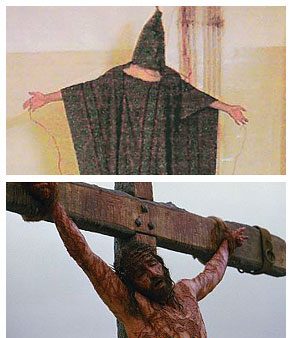
Abu Ghraib and "The Passion of the Christ" are connected in a dark basement of the American psyche.

  • more
    • All Share Services

American torture, American porn

Twice in the last few months torture and its graphic representation has been at the center of public discourse. The first time had to do with “The Passion of the Christ,” a film that features more violence than any big Hollywood movie before it. The second time — now — has to do with the events at Abu Ghraib prison. The two spectacles reveal disturbing truths about American politics, sexuality and spirituality.

It’s easily observed that torture has a highly developed aesthetic dimension. Medieval instruments of torture are gathered in dedicated museums and traveling exhibits all over the world. Those very instruments, of course, were often used in public. Torture, despite its need for secrecy, also needs its own representation. It’s usually meant not only to inflict pain but to instill terror. It’s sometimes meant to please the torturer. Therefore, the ritualistic, fetishistic, “spectacular” aspects of torture are an integral part of the practice. As a spectacle, torture is akin to porn — S/M being the obvious shared territory. It elicits voyeurism and a morbid fascination.

“The Passion of the Christ” was accused by many detractors of being “pornographic.” The torture of Iraqi prisoners is pornography in a very direct and complete sense. It’s not just violence but sexual violation — what is more, it’s sexual violation staged and captured on camera, made into a spectacle readily available for future and expanded viewing. It’s sexual violation fixed into an essential symbolic image to be preserved like a trophy. Just like conventional porn, it’s completely self-conscious and deliberate yet morally unimpeded.

In a recent cover story in the New York Times Magazine, Susan Sontag criticizes Bush and his administration for their initial profession of shock and disgust at the Abu Ghraib pictures, “as if the fault or horror lay in the images, not in what they depict.” This is of course richly deserved criticism, yet there’s another point to be made: The horror that was depicted was largely designed for the depiction itself. It was conceived and executed as pornography.

Several of the pictures we have seen show both victims and torturers posing for the camera. There’s a naked man kneeling in front of another man as if performing oral sex. A naked man on a leash held by a female American soldier. Naked men in chains. Naked men stacked up in a grotesque pile, half gangbang and half mass grave. Other alleged tortures, which may be documented by the hundreds of pictures we haven’t yet seen, included forced masturbation. Whether the sexual acts were performed or simulated, the prisoners were forced into the position of pornographic “actors.” Significantly, the hundreds of pictures seen by Congress after the scandal erupted included not only acts of torture upon prisoners, but acts of sexual intercourse amongst the guards themselves. The soldiers who took the pictures knew that, in both instances, they were making porn (albeit in different sub-genres.) There was no other reason to record the tortures; it was, in fact, self-incriminating and stupid by all practical standards. Except that the idea of recording the acts of torture was, to a significant extent, the inspiration to commit them.

You can sense the sexual disturbance in the minds of the soldiers responsible for this. It’s a disturbance exacerbated by the months away from home, but created by a lifelong familiarity with porn — its cynical humor, cheap patriotism, crude vocabulary of submission and prevarication. The president and his inner circle said, “This is not the America that we know.” But it is. The pictures from Abu Ghraib are American “gonzo porn.” They reek of frat-house hazing and gang initiation rituals, of “Jackass” and “Bumfights.” They encode racial hatred and fetishistic allusions to slavery.

New York Times columnist Frank Rich points out that the right is using the “pornography made them do it” excuse to scapegoat liberal attitudes, invoke censorship and exonerate the Bush administration. This may be true, but it’s no reason to gloss over the sexual nature of the torture. The torturers were enabled by specific political decisions. They were also inspired by broad cultural influences.

The torture/pornography connection is deep and inescapable. Mark Bowden, of “Black Hawk Down” fame, wrote a well-informed, compellingly readable article in October’s Atlantic Monthly about “the dark art of interrogation” (which was promptly optioned for movie development.) He makes a strong case for the effectiveness of torture as a means for acquiring intelligence — which of course is not an unchallenged notion, and not necessarily a justification. But torture is not the mere application of pain to the task of extracting information. Much of what we identify as torture is actually gratuitous, like the ear-severing in the film “Reservoir Dogs.” “I believe you,” says Mr. Blonde (Michael Madsen), “but I’m gonna torture you anyway.” This is, arguably, the real “point” of torture — the assertion of power over the law, over pity, over logic. I’ll torture because I can. I don’t need a reason, I don’t need a goal — the arbitrary nature of the act is in fact its very essence. You cannot understand it except by internalizing the absolute fact that I have all the power and you have none, and our very identity as human beings is defined by this fact. You can conclude that I am not human because I lack pity. But that’s an abstraction. The concrete reality of the situation is that you are not human because you lack all freedom and all dignity.

The torturers of Abu Ghraib had both a reason and a political sanction to do what they did. Yet the nature of the tortures and their recording suggests a casual licentiousness, the arbitrary indulgence of mean appetites. The two aspects — rational justification and gratuitous sadism — are superficially at odds but deeply inextricable from one another. I must inflict pain on you because you and your associates are terrorists, evildoers to be stopped for the greater good of mankind. But because you are an evildoer, enemy of mankind, I can also abandon myself to the pornographic voluptuousness of total control. In fact, not only can I, I must. In order to torture you, it is important that I see you as less than human, and so I will use torture to reinforce that image.

When power is exercised in such an extreme, absolute form as torture, it literally dehumanizes those it’s exercised upon. And they know it. Stripped of rights, of the ability to trust a fellow human being, and most importantly, of self-respect, they lose the very sense of who they are. The identity of the torture victim can never be the same again. That’s why sexual torture is central to the experience. The emasculation of men, the degradation of women, turns them into something they no longer recognize as themselves. Torture is largely the business of creating shame, indelible memories of one’s own impotence which serve as warnings to a whole society. An instinctive understanding of this task can be evinced by the acts of the American torturers. They were aiming to hurt the Arab man where it counts the most — in his masculine pride. There was hardly a more explicit way to do it than to strip him naked and capture him in effigy as the perverse negation of his own self — as a pathetic loser, writhing on the floor or engaging in simulated sexual acts on command, while American men and women pose next to him with a grin and a thumbs-up. This instinctive understanding was further refined by the superior education in pornography that is typical of the contemporary American man (and to some lesser extent, woman.)

Pornography shares with torture an inherent ability to dehumanize. It reduces the individual to a sexual function, flattens identity to a physical act performed for somebody else’s ultimate pleasure. As a performer of pornography, you relinquish your dignity going in. You adopt a vulgar, ludicrous stage name and sell yourself by the pound — or more to the point, by the orifice. Pornography records acts of degradation to be perused, collected, lusted over by anonymous customers. A pornographic image is a trophy: the record of somebody’s submission to the base needs of a customer, exercised as “power” through the laws of the market.

It is noteworthy, of course, that at least three of the alleged torturers are women. This inspires two opposite conclusions: One, that extreme situations such as war produce aberrant behavior, and a woman may occasionally go against her feminine nature and behave like the worst of men (still, that being the exception that proves the rule). Two, the participation of several women in the tortures is consistent with larger social trends, and therefore it belies the idea that pornography, rape and sexually predatory behavior are the exclusive domain of men. If we follow this hypothesis, we may conclude that porn has so deeply corrupted the female psyche that women have become willing to endorse an enterprise that is largely directed at their own degradation.

There is ample evidence in our culture to corroborate this second scenario. Women have been co-opted into watching porn, shopping at the Hustler store, patronizing strip bars. “Porn star” is a label of cool. It’s routine to see actresses and singers showing every allowed inch of skin (and “suggesting” the rest) on the cover of mainstream magazines. Fashion dictates that thongs must peek out of low-rider jeans. Pamela Anderson and Paris Hilton illustrate the willingness of a generation of women to ply themselves into camera-friendly sex objects. Much too much scandal was made out of the Janet Jackson Super Bowl exploit, but few people seemed to object to its most insidious aspect — not the baring of a nipple, but the pantomime of sexual aggression without reprisal: a man rips off a woman’s clothes, she pulls a funny face and keeps on singing. And as far as violence goes, it’s interesting that women are now victimized not only by men but, with statistically increased frequency, by other women. The Glenbrook North High School hazing incident, featuring junior-class girls forced to sit while drunken senior girls doused them in feces, urine, paint, animal guts and blood, followed by punching and kicking — much of which captured in yet another infamous video — was a chilling example of this trend.

This is the sad state of affairs that is, to the Islamic mind, the dark side of our much-touted freedom. And it is exactly this dark side that we are rubbing their nose in. The torture at Abu Ghraib says: Our pornography will conquer you.

In contrast, Islamic terrorists divulged the recording of a bloody execution. The victim, an American civilian: a sacrificial lamb whose blood was spilled with the declared intention to restore Arab pride. This is, as much as ever, a war of symbols, and the symbol of Arab emasculation couldn’t but inspire somebody to create a symbol of absolute and terrifying Arab supremacy over a Western man. The American government reacted with proclamations of horror for such barbarity. But such barbarity is a direct reflection of our own dehumanizing ways. A beheading (a 40-second beheading with a knife) undoubtedly represents a more extreme form of cruelty than to strip somebody naked, beat him, sexually humiliate him and put him on a leash. Yet one has to wonder how much further the American soldiers would have gone if not for fear of disciplinary consequences — something the terrorists don’t have to worry about. If you ever saw “Salo,” Pasolini’s allegory about the last days of fascism in Italy, you know his thesis that separating the exercise of power from the fear of consequences — whether because of granted impunity, or because of already certain doom — is the true test of one’s nature. The power of an individual over another will naturally tend to speak the language of sexual sadism, a language that articulates and celebrates it. Sadism will be implicit in every situation of captivity. It will be explicit in situations where the fear of consequences is reduced. It may become extreme where such fear is removed altogether.

It may seem ironic that a war fought in the name of principles and imbued with religious ardor should degenerate to such sordid lows. While in America people flock to see Christ tortured, in Iraq we torture our own prisoners — for information, for deterrence, but also — as the pictures document — for the sheer fun of it. And yet, perhaps “irony” is not quite the right concept. Perhaps the relationship between a U.S.-made blockbuster about Christ’s pain and the pain inflicted by our soldiers abroad is closer and more inevitable that the notion of “irony” would suggest, because many of the torturers are no doubt heartland Americans, many of them surely devout Christians — the core audience of “The Passion of Christ.” They are the people Bush directly addressed when he characterized the war as a crusade, a fight against evil in the name of the God. The aptitude of Christians for delivering pain draws on a rich, millennial tradition — a tradition built on certainty and a Manichean worldview. The ability to torture somebody both requires and confirms this certainty; the torturer’s exhilarating privilege is to feel right by God while doing what is normally forbidden.

“The Passion of the Christ” is, not unlike an exploitation movie from the ’70s, saturated with ultra-violence to the point of ridiculousness. Yet the representation of this violence is unobjectionable to the audience because the violence is inflicted upon the Christ. There seems to be no limit to the amount of violence you could show in this context (provided you could root it in the Scriptures). The torturers themselves are not the ultimate culprits: those are the Jews, as architects of the deicide. By assigning blame to “them,” we can watch an hour of torture entirely guilt-free. In fact, the more severe the torture, the more godlike and awesome Christ’s endurance. Which means we have a moral incentive to welcome the sight of torture, to wish for more and more punishment to be administered and exhibited on screen. The amount of butchery is directly proportional evidence of our own worth: look what Jesus, the extreme athlete of pain, chose to endure in order to save us! This is the fundamental perversion of the movie — that it encourages us to fetishize and get high on the horror of the martyrdom.

Sacrifice is perhaps the most ancient form of religious devotion. It goes back to pagan times, when it was meant to placate the gods. It is at the heart of our notion of justice, which focuses its previously random nature onto a “culprit” whose death will placate the aggrieved party. Christian sacrifice is rather meant to educate. It comes as the culminating point of a vast body of teachings. By choosing to emphasize the sacrifice outside the context of those teachings, Christianity (Mel Gibson’s version of it) harks back to the most primitive, bloodiest aspect of religiosity. “The Passion of the Christ” repositions pain, blood, sacrifice, at the heart of the religious experience.

Why is this exercise so relevant and so powerful right now? The answer takes us straight to 9/11. As much as we loathed the terrorists, we couldn’t help being affected by their conviction. When Bill Maher disputed the assertion that they were cowards, the hysterical outrage that met his remark was a symptom of a raw nerve being tweaked. Because this kind of conviction is precisely what we couldn’t be further from. The question is not whether their conviction justifies their action — it doesn’t (and I tend to believe a case for the fundamental cowardice of attacking any defenseless person, regardless of whether or not one commits suicide in the process, could be convincingly made.) The question is how we respond to the sheer intensity of the conviction. Because as much as this intensity horrifies us, it may also be something that, in some dark recesses of our psyche, we (some of us, anyway) envy. And so we may want to remind ourselves that our own God performed the ultimate act of self-abnegation, exonerating us from doing the same as long as we maintain and worship the memory of it. You can fly into the building in the name of Allah? We can reenact the torture and crucifixion of Jesus Christ in the name of our own God. The effort to distill every ounce of sacrificial pain from this representation, and the uplift that the audience gets from it, can be read as a response to the suicidal fury of the 9/11 terrorists. Our guy’s sacrifice was not only purer, because he didn’t bring any innocents along for the death trip, but it was also more painful. We can reach back into our spiritual history and find our own, superior certitude .

It’s not simply demagogy that the war against terrorism, or against Iraq, has been cast in religious terms, as a crusade, a fight against evil and for God-given freedom. Sept. 11 shook us to the core because if an act like that can be executed not in the name of profit, power or the traditional motivations we understand, but in the name of religious ideals (however aberrant), our own beliefs — or lack of them — are called into question. We suddenly realize we live in a spiritual vacuum, where no comparable degree of conviction can be easily summoned forth.

“The Passion” came to fill this profound need. Paradoxically, the fervor it inspires is directly proportional to the distance we have accrued from any kind of spiritual authenticity in our life. The more our culture obsesses about fad diets, plastic surgery, Paris Hilton’s sex video, Donald Trump’s hair or Jennifer Lopez’s butt, the more fervent our response to “The Passion” has to be.

And so we come full circle. While frivolousness and pornography saturate our culture, “The Passion” offers us redemption, all the more effectively for pushing the limits of graphic representation that porn itself has irrevocably stretched. And while at home we feast our eyes on the torture inflicted upon the Christ, abroad we vindicate ourselves by torturing the infidel with the same righteous abandon, in the way we know best — a pornographic way. Two faces of torture. Two faces of porn.

Alessandro Camon is a film producer based in Los Angeles.

Memorial for America’s conscience

On this holiday, Americans should confront a grim fact about our country: We are torturers

  • more
    • All Share Services

Memorial for America's conscienceIn this Oct. 9, 2007 file photo US military personnel inspect each occupied cell on a two-minute cycle at Camp 5 maximum-security facility on Guantanamo Bay U.S. Naval Base in Cuba. (Credit: AP Photo/Brennan Linsley, file)

Facing the truth is hard to do, especially the truth about ourselves. So Americans have been sorely pressed to come to terms with the fact that after 9/11 our government began to torture people, and did so in defiance of domestic and international law. Most of us haven’t come to terms with what that meant, or means today, but we must reckon with torture, the torture done in our name, allegedly for our safety.

It’s no secret such cruelty occurred; it’s just the truth we’d rather not think about. But Memorial Day is a good time to make the effort. Because if we really want to honor the Americans in uniform who gave their lives fighting for their country, we’ll redouble our efforts to make sure we’re worthy of their sacrifice; we’ll renew our commitment to the rule of law, for the rule of law is essential to any civilization worth dying for.

After 9/11, our government turned to torture, seeking information about the terrorists who committed the atrocity and others who might follow after them. Senior officials ordered the torture of men at military bases and detention facilities in Afghanistan and Iraq, in secret CIA prisons set up across the globe, and in other countries – including Libya and Egypt — where abusive regimes were asked to do Washington’s dirty work.

The best known of all the prisons remains Guantanamo on the southeast coast of Cuba. For years, the United States naval base there seemed like an isolated vestige of the Cold War – defying the occasional threat from Fidel Castro to shut it down. But since 9/11, Guantanamo – Gitmo – has been a detention center, an extraterritorial island jail considered outside the jurisdiction of US civilian courts and rules of evidence. Like the notorious Room 101 of George Orwell’s “1984,” the chamber that contains the thing each victim fears the most to make them confess, Guantanamo’s name has become synonymous with torture. Nearly 800 people have been held there. George W. Bush eventually released 500 of them, sometimes after years of confinement and cruelty. Barack Obama has freed 67, but 169 remain, even though the president pledged to close the Guantanamo prison within a year of his inauguration. Now, forty-six are so dangerous, our government says, they will be held indefinitely, without trial.

We almost never see the detainees. Were it not for the work of human rights organizations and the forest of lawsuits that have arisen from our actions, the prisoners would be out of sight, out of mind. Five of the Guantanamo prisoners were recently arraigned before a military commission for their role in the attacks. One of them is Khalid Sheikh Mohammed, who says he was the mastermind behind 9/11. He was waterboarded by interrogators 183 times. Pentagon officials predict it will be at least another year before the five go on trial.

Earlier this month, lawyers for Mohammed al-Qahtani – the so-called “20th hijacker” who didn’t make it onto the planes — filed suit in New York federal court to make public what they described as “extremely disturbing” videotapes of his interrogations.  He was charged in 2008 with war crimes and murder but the charges were dropped after the former convening authority for the Guantanamo military commissions, Susan Crawford, told journalist Bob Woodward that al-Qahtani’s treatment “met the legal definition of torture.”

He remains in indefinite detention, as does Abu Zubaydah, a Saudi citizen alleged to have run terrorist training camps. He was waterboarded at least 83 times in a single month.  Just this week a federal appeals court refused to release information on the interrogation methods the CIA used on Abu Zubaydah and other terrorist suspects.

You may also have seen the flurry of action this month around a section of the new National Defense Authorization Act that allows the military to detain indefinitely not only members of al Qaeda, the Taliban and “associated forces” but anyone who has “substantially supported” them.  A federal court struck down that provision in response to journalists and advocates who believe it could be so broadly interpreted it would violate civil liberties.  Nonetheless, two days after the court’s decision, the House of Representatives reaffirmed the original provision.

The other day, eight members of the Bush Administration – including President Bush, Vice President Cheney, and Defense Secretary Rumsfeld – were found guilty of torture and other war crimes by an unofficial tribunal meeting in Malaysia.  The story was played widely in parts of the world press, with reports that the judgment could lead the way to proceedings before the International Criminal Court in The Hague. It received almost no mention here in the United States.

This summer, it’s believed that the United States Senate’s intelligence committee finally will release a report on “enhanced interrogation techniques,” that euphemistic phrase for what any reasonable person not employed by the government would call torture. The report has been three years in the making, with investigators examining millions of classified documents. The news service Reuters says the report will conclude that techniques such as waterboarding and sleep deprivation do not yield worthwhile intelligence information.

So here we are, into our eleventh year after 9/11, still at war in Afghanistan, still at war with terrorists, still at war with our collective conscience as we grapple with how to protect our country from attack without violating the basic values of civilization — the rule of law, striving to achieve our aims without corrupting them, and restraint in the use of power over others, especially when exercised in secret.

In future days and years, how will we come to cope with the reality of what we have done in the name of security? Many other societies do seem to try harder than we do to come to terms with horrendous behavior commissioned or condoned by a government. Beginning in 1996, in South Africa, the Truth and Reconciliation Commission held hearings at which whites and blacks struggled to confront the cruelty inflicted on human beings during apartheid.

And perhaps you caught something said the other day by the president of Brazil, Dilma Roussef.  During the early seventies she was held in prison and tortured repeatedly by the military dictators who ruled her country for nearly 25 years. The state of Rio de Janeiro has announced it will officially apologize to her. Earlier, when she swore in members of a commission investigating the dictatorship, President Roussef said: “We are not moved by revenge, hate or a desire to rewrite history. The need to know the full truth is what moves us.”

In other words, “You shall know the truth and the truth shall make you free.”

Continue Reading Close

Bill Moyers is managing editor of the new weekly public affairs program, "Moyers & Company," airing on public television. Check local airtimes or comment at www.BillMoyers.com.

Michael Winship is senior writing fellow at Demos and a senior writer of the new series, Moyers & Company, airing on public television.

Bush aide blasts torture

Philip Zelikow tried to warn Bush on interrogations. Now he's penned an authoritative article on how he was ignored

  • more
    • All Share Services

Bush aide blasts torture (Credit: Reuters/Jim Young)

The Bush administration hasn’t heard the last from Philip Zelikow. After the rediscovery last week of his long lost 2006 anti-torture memo, Zelikow, a former State Department official, has written arguably the most damning article yet about U.S. government’s interrogation policies from 2001 to 2009. The article, called “Codes of Conduct for a Twilight War,” will be released in a forthcoming issue of the Houston Law Journal, and was obtained exclusively by Salon. Says Zelikow in an email: “I’m not aware of other accounts that combine historical, policy and legal approaches to” the subject of the Bush administration’s interrogation methods.

Based on published histories and his firsthand observations, and adapted from a lecture delivered in November, the article calls the administration’s rationale for its use of torture — which he nonetheless insists only on calling “extreme interrogation” and “coercive methods” — “radical,” “an amazing contention,” “untenable and extreme,” “unsustainable,” “an unprecedented program of coolly calculated dehumanizing abuse and physical torment,” and, finally, simply a “mistake.” He concludes: “This was a collective failure of American public leadership, in which a number of officials and members of Congress (and staffers) of both parties played a part, endorsing a CIA program of physical coercion without any precedent in U.S. history.”  In fact, “The only defense against criminal prosecution would be that officials acted in good faith reliance on the advice of their government lawyers.”

Part of what makes Zelikow’s analysis so damning and definitive is its judiciousness. The article is deeply empathetic of the uniquely fearful situation under which the Bush administration was initially operating. Zelikow calls the Sept. 11 attacks a “collective trauma” and a “shoc[k] to mass beliefs.” He notes that Bush and others spent time in burn units, morgues and with survivors of the attacks. One traumatic experienced often overlooked — overlooked because it appeared in Stephen Hayes’ stenographic biography of Dick Cheney — was that the vice-president’s daughter was (falsely, it turns out) told that her house with her children in it had tested positive for anthrax. Similarly, Cheney and National Security Advisor Condoleezza Rice were told that they and others had been exposed to an extremely lethal toxin in a particular area of the White House — and might soon die as a result. “The alarms did not stop and they too were not abstract … The pressure on Bush and his senior advisers was so direct because so much of the response had to be invented and improvised,” the article reads.

An additional factor in the power of the article is Zelikow’s credibility and history. Before entering government, he was a civil rights lawyer in Texas battling the Ku Klux Klan and then a highly esteemed Harvard historian specializing in U.S. foreign policy — he co-authored one book with Rice. He then served on the National Security Council under President George H.W. Bush and directed the 9/11 Commission before becoming counselor to Rice at the State Department from 2005 to 2007. He currently volunteers part-time on the President’s Intelligence Advisory Board under President Obama.

Such bipartisan, establishment credentials render the breakdown and conclusion of this article all the more damning. He believes that what should have been a political and moral question — should the United States torture captives? — became strictly a legal matter left up to government lawyers, few of whom had any experience with these issues, and who had to take the necessity of extreme measures as a given. “These lawyers then became secular priests, granting absolution to the supplicant policymakers,” Zelikow writes.

The problems began when the Office of the Vice President and the CIA took central roles in policymaking. Cheney felt himself above the rest of the National Security Council, bypassing Rice and other traditional channels of national security policymaking. Ad-hoc decision-making and improvisation became “a habit of thought,” which seemed initially to pay off in the security of the nation, as well as in Bush’s political standing and self-confidence.

With Cheney and CIA head George Tenet “the key entrepreneurs in setting codes of conduct for the War on Terror,” it was essentially left to their obsequious lawyers to decide, in secret, on the interrogation methods America should employ. Bush even told the Senate’s Intelligence Committee chairman that “the vice president should be your point of contact … [He] has the portfolio for intelligence activities.” Decisions were made to jettison international treaties. By December 2001, the CIA was already interested in reverse-engineering methods “heretofore used only to treat Americans to resist enemy torture.” When a senior al-Qaida member was captured in March 2002, the prototype for the administration’s torture policies was already developed. “So, for the first time in American history, leaders of the U.S. government carefully devised ways and means to torment enemy captives.”

Zelikow notes that “None of the policy or moral issues connected with these choices appear to have been analyzed in any noticeable way.” Perhaps worst of all, no serious consideration was given to weighing the costs of benefits of the torture program, with reference to relevant historical precedents and/or examinations of the respective French, British and Israeli experiences in dealing with captured terrorists. “Bush and Rice should have insisted on this,” Zelikow writes.

The 52-page article observes the successes of Obama’s counterterrorism policies after repudiating the use of torture. On the basis of the empirical evidence then, “[t]here is no evident correlations between intelligence success and the available of extreme interrogation methods,” no matter what Bush and Cheney claim. Finally, “The program’s costs — which include the high-level effort expended in order to establish, maintain, and defense the program — appear on the evidence so far to have well outweighed any unique value the program might have had as a method of counterterrorism intelligence collection.” This is apart from the damage to America’s international standing and corrosion of its traditional values.

Zelikow concludes his analysis by arguing that, although the Obama administration has the right to wage war and use extralegal methods to defeat al-Qaida, its claim of that authority to defeat “associated forces” is unwarranted. “The U.S. government should publish and explain any overarching policy and legal documents that guide and confine the conduct of deadly operation against its foreign enemies … the executive branch of the U.S. government has a duty to articulate the scope of its warfare to the Congress and the public.” The Bush administration’s unprecedented elevation of torture to national policy may be history, but the job to get U.S. foreign policy in line with its constitutional and moral obligations is far from over.

Continue Reading Close

Jordan Michael Smith writes about U.S. foreign policy for Salon. He has written for the New York Times, Boston Globe and Washington Post.

The memo Bush tried to destroy

A document advising the Bush administration against torture has resurfaced, despite his best efforts to hide it

  • more
    • All Share Services

The memo Bush tried to destroyGeorge W. Bush in 2006 (Credit: AP/Ron Edmonds)

In February of 2006, Philip Zelikow, counselor to Secretary of State Condoleezza Rice, authored a memo opposing the Bush administration’s torture practices (though he employed the infamous obfuscation of “enhanced interrogation techniques”). The White House tried to collect and destroy all copies of the memo, but one survived in the State Department’s bowels and was declassified yesterday in response to a Freedom of Information Act request by the National Security Archive.

The memo argues that the Convention Against Torture, and the Constitution’s prohibitions against cruel and unusual punishment, do indeed apply to the CIA’s use of “waterboard[ing], walling, dousing, stress positions, and cramped confinement.” Zelikow further wrote in the memo that “we are unaware of any precedent in World War II, the Korean War, the Vietnam War, or any subsequent conflict for authorized, systematic interrogation practices similar to those in question here, even when the prisoners were presumed to be unlawful combatants.” According to the memo, the techniques are legally prohibited, even if there is a compelling state interest to justify them, since they should be considered cruel and unusual punishment and “shock the conscience.”

Chillingly, the memo notes that “corrective techniques, such as slaps,” may be legally sustained, as might be “[C]ontrol conditions, such as nudity, sleep deprivation, and liquid diets…depending on the circumstances and details of how these techniques are used.” However much distress Zelikow’s memo caused the White House, it was not an ACLU briefing paper.

“I’m pleased the memo is now part of the historical record and available for study,” Zelikow wrote Salon in an email. The White House had determined that the memo — which was not binding since Zelikow’s was a bureaucratic position without legal authority — was too dangerous to exist. “I later heard the memo was not considered appropriate for further discussion and that copies of my memo should be collected and destroyed,” he said in a May 2009 congressional hearing.

At that hearing, before the Senate Committee on the Judiciary, Subcommittee on Administrative Oversight and the Courts, Zelikow said he had “no view on whether former officials should be prosecuted,” a decision he thinks should be left to “institutions.” However, he did call for a thorough inquiry and a public report examining how the U.S. came to employ torture.

Of course, no such inquiry was ever launched. The Obama administration declined to revisit the U.S. employment of torture, with the president saying he didn’t want to “look back.” Zelikow believes this was a mistake. “I still believe an inquiry would be useful, though less so as time passes and more information becomes available, especially after the 9/11 trials conclude, hopefully this year,” he says in an email.

During his congressional testimony, Zelikow declined to say whether Department of Justice lawyers acted improperly or immorally, conceding only that their opinions were “unsound, even unreasonable.” But in a 2007 lecture in Houston, he had no problem saying “the cool, carefully considered, methodical, prolonged, and repeated subjection of captives to physical torment, and the accompanying psychological terror, is immoral.”

The importance of the memo lies in its revelation that there was real, serious debate inside the Bush administration about how to interrogate captured terrorist suspects. The members of the White House declined to enter that debate — indeed, they did their best to squash it. The destruction of Zelikow’s carefully reasoned memo suggests the White House did not want any record of alternative views even existing, lest they be considered reasonable or people get the idea that the torture policies were thought controversial even by members of the administration.

Continue Reading Close

Jordan Michael Smith writes about U.S. foreign policy for Salon. He has written for the New York Times, Boston Globe and Washington Post.

Extraordinary rendition lawsuit also window into low point for American experiment

A fight between subcontractors leads to the publication of details of the CIA's secret kidnapping program

  • more
    • All Share Services

Extraordinary rendition lawsuit also window into low point for American experimentThe lobby of the CIA Headquarters Building in McLean, Virginia, August 14, 2008. REUTERS/Larry Downing (UNITED STATES)(Credit: © Larry Downing / Reuters)

A lawsuit between two aviation companies concerning a couple hundred thousand dollars in unpaid expenses has inadvertently led to the publicizing of a great deal of information about the CIA’s extraordinary rendition program. (The program involved the illegal transport of thousands of terrorism suspects to secret CIA prisons in foreign nations and then to countries where suspects could be tortured. It is basically “kidnapping” followed by “torture” but the CIA did it so no one went to jail for it.)

The records from this lawsuit between two sub-contractors involved in the renditions will eventually be taught in an undergrad history course titled “America: Where It All Went Wrong.” Detainees were transported by the same companies that fly billionaires on private jets to their resort vacations. (The CIA doesn’t have an air force, so they relied on massive government contractor DynCorp, which… just rented some private planes.)

We learn that the CIA provided the flights with letters from a fictional State Department official (the State Department was almost certainly not involved in the rendition program) providing diplomatic cover.

We learn that one the planes used to transport a suspect (Abu Omar, captured in Italy and tortured in Egypt) was owned by the co-owner of the Boston Red Sox. The plane sported a Red Sox logo on the tail. I mean a Yankees plane might’ve been more poetically apt but either way it seems like such a pat symbol of America’s behavior in the wretched first decade of the 21st century that I’d roll my eyes at it if it turned up in a piece of fiction. An executive’s private plane, sporting the logo of a rich baseball team and carrying an Imam captured overseas by the CIA, touches down in Egypt, a nation led by an American-backed strongman, where the Imam is to be tortured. What preachy liberal hack dreamed up that one? (The executive also owns part of Liverpool FC, because we can’t forget Great Britain’s help in all this.)

Then the hedge funds took an interest in privatized torture:

DynCorp was purchased in 2003 by Computer Sciences Corp., another leading federal contractor, in a $940 million merger. Computer Sciences Corp. then took on a supervising role in the rendition flights through 2006, according to invoices and emails in the court files. CSC sold three DynCorp units in 2005 to Veritas Capital Fund, a private equity firm, for $850 million, but retained ownership of other parts of the old company. Veritas in turn sold the restructured DynCorp — now known as DynCorp International — for about $1 billion in 2010 to Cerebrus Capital Management, another private equity fund.

So at least a couple rich people got even richer off of our national shame. There’s an upside to everything.

Continue Reading Close
Alex Pareene

Alex Pareene writes about politics for Salon and is the author of "The Rude Guide to Mitt." Email him at apareene@salon.com and follow him on Twitter @pareene

New “sick details” emerge about water torture

On "Countdown," Jeremy Scahill discusses how the DOD hid behind waterboarding while using other water tortures

  • more
    • All Share Services

New Jeremy Scahill on "Countdown"

The official government narrative, as defended by Donald Rumsfeld, is that no prisoners were waterboarded at Guantanamo Bay; the CIA did use waterboarding as an interrogation technique, but only at so-called “black sites”; and only three prisoners were subjected to this treatment.

However, new evidence is emerging to the contrary, largely in anecdotal form. As Truthout reported this week, a number of stories have come out about forced water choking and other uses of water for torture at sites including Gitmo.

Investigative reporter Jeremy Scahill discussed the issue with Keith Olbermann Thursday. He recalled an incident he had investigated (which would not be classified as waterboarding) of a former Guantanamo detainee having a high pressure water hose fixed up a nostril. Water would be forced up his head until suffocation.

Scahill noted President Obama’s “extremely poor record” at holding people accountable for torturous acts and expressed concern that little has changed at Guantanamo.

Rumsfeld currently faces a lawsuit over the alleged use of torture, bought by a former military translator held in Iraq for nine months, but Scahill emphasized that the U.S. administration always tends to get its people off the hook.

Watch the clip for “Countdown” below:


Continue Reading Close

Natasha Lennard covers the Occupy movement for Salon. A British-born, Brooklyn-based journalist, she has been covering Occupy Wall Street since before the first sleeping bag was unrolled in Zuccotti Park. One of the first journalists arrested at an Occupy action, she has managed to enrage Andrew Breitbart, Rush Limbaugh and Glenn Beck. You can follow her on Twitter (@natashalennard), and email her any Occupy updates/videos/ideas to natasha.lennard@gmail.com

Page 1 of 62 in Torture