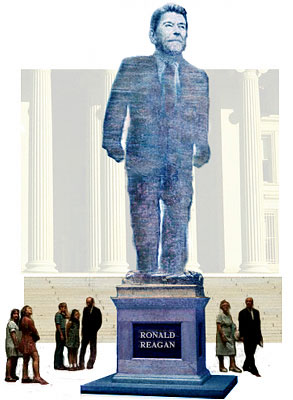

Ronald Reagan

Reagan worship

The "liberal media's" unprecedented 24/7 gushing over a controversial and divisive president caps a quarter-century of fawning.

The media’s weeklong coverage of the passing of President Reagan has produced some of the most rapturous remembrances in modern times. Given Reagan’s long illness, few expected the gloss to be pierced by examinations of his past as an FBI informant, his support for the apartheid regime of South Africa, America’s covert alliance with Saddam Hussein, or the killing fields of Central America. Nonetheless, the sheer volume of media-stoked adoration has been a bit startling to those who are keepers of the flame of objectivity.

“I think when somebody dies there’s a tendency for the press to view them through rose-colored glasses. It’s only polite,” says Alex Jones, director of the Joan Shorenstein Center on the Press, Politics and Public Policy at Harvard University. “But I think they’re doing a great disservice by making this totally positive and uncritical coverage. In fact, Ronald Reagan was a very controversial president, and journalists should be trying to offer something that resembles an honest look back at Reagan’s administration.”

By midweek, a few news organizations, including the Los Angeles Times, New York Times and Washington Post, had at least addressed some of the more controversial aspects of Reagan’s public life. But for the most part, the reports, particularly on the 24-hour news channels, remained uniformly worshipful, as the elaborate funeral cortege, orchestrated after years of planning by Reagan’s old image-makers, marched through the entire week, accompanied by rhetorical flourishes.

“Ronald Reagan is a sort of masterpiece of American magic — apparently one of the simplest, most uncomplicated creatures alive, and yet a character of rich meanings, of complexities that connect him with the myths and powers of his country in an unprecedented way,” trumpeted Time magazine. “He is a Prospero of American memories, a magician who carries a bright, ideal America like a holograph in his mind and projects its image in the air.”

What’s telling is that that passage wasn’t published this week. It comes from a cover story dated July 7, 1986, written by Lance Morrow. The 3,700-word essay serves as a critical reminder that, despite conservative charges of its liberal bias, the press has been fawning over Reagan for years. And this week’s uncritical treatment of the 40th president is a natural culmination of what has been going on for the past quarter of a century

“The rules were different for him,” notes Walter Pincus, veteran reporter for the Washington Post. “Reagan got all sorts of passes from the press.”

That’s not simply Pincus’ opinion. Reagan’s closest aides were saying the same thing in real time, back in the 1980s. David Gergen, Reagan’s first communications director, is quoted by Mark Hertsgaard in his 1989 book, “On Bended Knee: The Press and the Reagan Presidency,” as conceding, “A lot of the Teflon came from the press. They didn’t want to go after him that toughly.” Gergen added, “There is no question in my mind there was more willingness to give Reagan the benefit of the doubt than there was [for Presidents] Carter or Ford.” And as Hertsgaard says now, “The taming of the media during the Reagan years was mostly self-inflicted.”

Michael Deaver, Reagan’s renowned image-maker, wrote in his memoirs that until the Iran-Contra scandal broke in November 1986, Reagan “enjoyed the most generous treatment by the press of any President in the postwar era. He knew it, and liked the distinction.”

In June 1986, Reagan gave one his more rambling and confusing performances at a press conference, after which aides were forced to “clarify” his comments on everything from the future of the Challenger space-shuttle program to the status of the SALT II treaty. Yet a White House aide marveled to the Los Angeles Times about “how easy the press was on him,” saying that reporters treated Reagan “almost reverentially.” The aide added: “He’s gone from the Teflon President to the boomerang President. Nobody wants to throw anything at him, because it comes back and hurts them.”

Looking back, former Washington Post political columnist and historian Haynes Johnson says the press, in addition to genuinely liking Reagan as a man, was acutely aware of the charges by conservatives that it had a liberal, unpatriotic bias. And that defensiveness translated into deferential treatment. “The press wanted to bend over backward not to be seen as part of the liberal establishment agenda,” says Johnson. “I was conscious of it myself.”

“Coming out of Watergate, there was a feeling within the press that we’d gone too far,” says Robert Parry, who covered the Reagan administration for the Associated Press and Newsweek. He left the weekly, he says, after it refused to let him aggressively pursue what subsequently became the Iran-Contra scandal. “There was a feeling we should be more respectful on how we [went] about things and there were places we really shouldn’t go.”

Against that backdrop this week’s unprecedented and at times baffling coverage begins to make some sense. “There’s a lot of deification going on. And it’s around the clock,” Johnson remarked.

There’s undoubtedly something moving and necessary about the pageantry of a nationally televised memorial for a president who has died, even if that means broadcasting, for a solid hour, the picture of a 747 sitting motionless on the tarmac at Point Mugu Naval Air Station in California, as cable outlets and the four major networks did on Wednesday. But the vast majority of coverage this week had little or nothing to do with the official service. Instead, television offered up an endless stream of chatter about optimism, communication, leadership and personality — mostly without discussion of the historical record. With such a huge swath of Reagan’s public and private life apparently deemed off limits by the press — from the Wall Street crash of ’87 to Reagan’s often distant relationship with his own children — the coverage after the first 24 hours morphed into a news-free echo chamber. Clips and quotes from Sunday’s coverage were indistinguishable from the ones airing two, three and four days later.

For example, on Monday night, PBS’s Charlie Rose interviewed Reagan’s former secretary of state, George Shultz, who told a lengthy anecdote about how Reagan had once added a few common touches to improve an important foreign-policy speech Shultz was set to deliver. On Tuesday night, Rose’s program aired archival footage of previous guests discussing Reagan, and there was Shultz, from a 2001 appearance, telling Rose the exact same anecdote in the exact same language.

USA Today suggested that this week’s intense coverage simply “reflect[s] America’s fondness for him.” But there seems to be something else at work. After all, President Clinton left office with higher approval ratings than Reagan did, and a USA Today poll last year found that more Americans consider Clinton to be “the greatest” president than think Reagan was.

Does anyone think that if Clinton were to die in the current media climate, his critics and criticism of him would effectively be banned from the airwaves? If anyone does, perhaps they should tune in to CBS, because news anchor Dan Rather told the Philadelphia Inquirer this week that since Reagan was “a twice-elected, two-full-term president, … [this] is not the time for a seminar on his strengths and weaknesses.”

It is clear that the conservatives’ attacks on the press for having a liberal bias are once again having the desired effect. And once again they’re working to Reagan’s — and the Republicans’ — benefit. The media’s blissful coverage this week “serves a strategic function,” Parry says. “When the press is under attack for being liberal, the logical response is to prove you’re not.” If ever there’s been a time when the press handed the reins over to the Republican sensibility, it was this week.

The hand-in-glove relationship between Republicans and the media has produced some strange exchanges, such as CNN’s Wolf Blitzer asking Richard Perle, who served as Reagan’s assistant secretary of defense, how much of a “hands-on commander in chief” Reagan was. Perle, reading his talking points, assured viewers that, contrary to what all serious biographers have written about Reagan, “he was very much hands-on.” (It is telling about the range of perspective offered on television this week that neocon Perle followed neocon Paul Wolfowitz, Bush’s deputy secretary of defense, as Blitzer’s guest.)

Around-the-clock coverage like this week’s hasn’t been seen since the start of the Iraq War. According to a search of the Nexis database, by the end of day 3 of the Reagan remembrance, CNN had aired approximately 95 separate segments on the former president. That number is likely to approach 150 by the time Reagan is buried in California Friday night. Meanwhile, the normally space-conscious USA Today devoted 37 articles, columns and letters — along with 40 photos and graphics — to Reagan in its Monday edition alone.

“I’m struck by [the length of] this,” Johnson says. “From the time Jack Kennedy took a bullet in the head [on Nov. 22, 1963] until he was buried at Arlington Cemetery — that was four days of TV coverage. This is a whole week.” President Eisenhower died on March 28, 1969, and his official Washington ceremony was complete three days later.

CNN’s Paula Zahn likened the “public expressions of personal grief” taking place this week with the expressions of grief that followed the terrorist attacks of Sept. 11. However, while 9/11 led to a national trauma, television producers have had a hard time finding ordinary Americans outside Simi Valley, Calif., spontaneously choking up about the elderly Reagan’s long-expected death.

“Even my own paper [the Post] had four Reagan stories on the front page” on Monday, Pincus says. “It is the new print imitation of wall-to-wall TV coverage. Even if you run out of things to say, it doesn’t matter.”

Of course, people anticipated that when Reagan died there would be an avalanche of press coverage. As Johnson observes, “Reagan was a consequential figure in our political life. He was a symbol of the conservative movement that has changed our lives for the last two generations.” But, he adds, “that means there’s all the more obligation for the press to sort it out and not to just present deification, but to examine his strengths and weaknesses.”

Early in the week some TV anchors went out of their way to say they would do just that. CNN’s Aaron Brown assured viewers, “Our coverage should reflect all of that, the good days and the bad. Iran-Contra is a chapter, as are the tax cuts. Beirut is as much a part of the story as Berlin. It is a line we will walk carefully and respectfully over the next week.”

Similarly, NBC’s Tom Brokaw said Reagan “was a beloved American leader, but at the same time our journalistic obligation is to put his whole life and his political career in context. The Reagan legacy has some scandals — Iran-Contra, his failure to recognize early on the AIDS epidemic. It’s a very delicate balancing act.”

But the fact is that both CNN and NBC failed in attempting that balancing act and in the end fell off the wire. A search of this week’s transcripts reveals some passing references to Iran-Contra, but nothing approaching a serious discussion of it — or of any other of Reagan’s less-than-rosy scenarios.

In a sense, this week has been the 1980s redux, with the Reagan communication team again providing the press, and particularly TV, with priceless pictures and sentimental narrative lines while appreciative producers and reporters neglect to acknowledge the wholesale media manipulation that is going on. There’s been little or no discussion, for example, of the long planning for this funeral by Reagan’s old political handlers. It’s morning again in America — on a feedback loop.

“They were fucking brilliant at managing the coverage” back then, recalls William Greider, assistant managing editor for the Washington Post during the first Reagan administration. That artfulness continued this week in subtle ways. For instance, Monday’s viewing of the casket at the Reagan Library in Simi Valley was listed as a “private” family service. Yet it was covered live by multiple cameras, one of which was affixed to the ceiling to capture the dramatic moment when Nancy Reagan laid her cheek on the flag-draped coffin. That “private” image was aired continuously on cable news outlets and appeared the next morning on the front page of dozens of major-market newspapers around the country.

“These people [were] spectacular at P.R. And that’s what this is, terrific P.R.,” Pincus says.

While it’s true that the Reagan White House raised uncritical presidential press coverage to an art, it received a helping hand from a self-conscious press corps. As Hertsgaard wrote, “Relieved by the departure of Jimmy Carter, gulled by false claims of a right-wing popular mandate, impressed by Reagan’s recovery after being shot and seduced by his sunny personality and his propaganda apparatus’ talent for providing prepackaged stories boasting attractive visuals, the Washington press corps favored the newly elected President with the coverage that even his own advisers considered extremely positive.”

“We used to do a fact-checking exercise after his press conferences at AP,” says Parry, referring to Reagan’s tendency to manufacture or wildly misstate facts and figures. “And we got such hostility from David Gergen at the White House, and publishers who didn’t like it, that AP backed off and dropped it. That was one of the ways we were not as tough or as skeptical as we should have been.” (In that worshipful 1986 Time cover story, Morrow wrote, “Reagan committed so many press-conference fluffs that eventually no one paid that much attention anymore, assuming that that was just the way Reagan was. Who cared? The results seemed to come out all right.”) When covering early developments in the Iran-Contra affair for AP, Parry experienced that timidity firsthand. When he went to Newsweek in 1987, “it soon became clear they didn’t want to pursue the Iran-Contra story much at all. They didn’t want another Watergate — that’s the way it was put. The magazine was owned by the Washington Post, and although people look back on Watergate as a crowning achievement, it was a very unpleasant experience to live through, and [publisher] Katharine Graham didn’t want to go through it again. So the feeling at Newsweek was, Let’s just take what the White House is telling us, the ‘mistakes were made’ explanation.”

Newsweek wasn’t alone. When the Iran-Contra scandal broke (exposed by a Lebanese newspaper, not an American one), newspaper editors and TV anchors around the country — including CBS’s Rather — cautioned their staffs not to repeat the “excesses” and “mistakes” of the Watergate era, according to a Dec. 5, 1986, article in the New York Times. It was almost as if news executives were demanding passive and restrained reporting. Respected, centrist “NBC Nightly News” commentator John Chancellor seemed to speak for many in the national press corps in early 1987 when, breathing a sigh of relief when it appeared the worst had passed for Reagan on Iran-Contra, he said, “Nobody wants [Reagan] to fail. Nobody wants another Nixon.” Although severely damaged by Iran-Contra — he suffered the most precipitous drop in presidential job approval ratings on record — Reagan was able to rebound to the point where his reputation, among the press at least, now borders on sainthood.

The iconic conservative may ultimately be remembered as one of the two or three most important U.S. presidents of the 20th century. And, Hertsgaard notes, “he could have accomplished none of this without the help of the American media.”

Eric Boehlert, a former senior writer for Salon, is the author of "Lapdogs: How the Press Rolled Over for Bush."

Auction claims to be selling vial of Reagan blood

The blood sample was taken after Reagan was shot in a 1981 assassination attempt

LONDON (AP) — A Channel Islands online auction house has angered Ronald Reagan’s foundation by claiming to offer a vial that once contained his blood.

The PFCAuctions house says the vial contains some of Reagan’s dried blood residue. The auctioneers say it was used by the laboratory that tested Reagan’s blood when he was hospitalized after a 1981 assassination attempt in Washington.

Officials at the Ronald Reagan Foundation in California have told BBC News that the sale is despicable.

Auction house spokeswoman Kylie Whitehead told The Associated Press that the blood is being sold by a man whose late mother took it from the laboratory with permission weeks after the tests were made.

Bidding for the vial had passed the 7,000-pound ($11,000) mark Tuesday.

Reagan required emergency surgery after he was shot by John Hinckley Jr. outside the Washington Hilton Hotel.

Liberals are not uniquely “unreasonable”

A widely discussed critique of the left's attitude toward Obama forgets some important history

By now, you’re probably familiar with Jonathan Chait’s provocatively titled New York magazine story: “When Did Liberals Become So Unreasonable?” Chait’s answer is that they’ve pretty much always been unreasonable – that the same “unceasingly despairing” attitude the left has taken toward Barack Obama’s presidency emerges whenever a Democrat claims the White House.

Of course, Chait is overstating the current depths of liberal despair, given that the outspoken frustration of some left-of-center commentators hasn’t exactly trickled down to the liberal masses, and that overall support and enthusiasm for Obama has fallen more significantly among non-liberal Democrats than among liberals. Joan Walsh did a nice job earlier this week of pointing this out, and of addressing many of the specific points Chait made about Obama’s record.

But the bigger problem is that Chait seems to be misreading history in some important ways.

Take his claim that the historical pattern of despair he describes is a uniquely liberal tradition – that conservatives, because they have “higher levels of respect for and obedience to authority,” don’t exhibit the same level of disappointment with their leaders. This is hard to swallow if you lived through or have spent much time studying Ronald Reagan’s presidency, which featured the same loud and consistent cries of “Betrayal!” from conservative opinion-leaders that we’ve heard from liberals since 2009.

Chait seems to understand this on some level; he acknowledges that the Reagan of the modern conservative imagination is far different from the Reagan who ran the country in the 1980s – a president who “spent most of his administration raising taxes, signing arms-control treaties, and otherwise betraying right-wing dogma.” But what Chait doesn’t grapple with is the fact that conservative leaders of the Reagan-era were very much aware of and appalled by all of this – and didn’t hesitate to say so publicly.

The Reagan story is worth considering because he’s the closest mirror image to Obama among modern Republican presidents. Just like Obama, his party’s base was with him from the very beginning, embracing him as the true believer they’d long been waiting for. Conservatives in the 1980 general election didn’t just vote for Reagan because they wanted to get rid of Jimmy Carter; they also saw an opportunity to impose sweeping conservative change. Liberal voters had similar feelings about Obama in 2008.

Now let’s compare each president’s relationship with his party’s base. Obama, Chait claims, began losing the left a month before he took office, when he asked the socially conservative evangelical pastor Rick Warren to deliver the invocation at his swearing-in. But you can similarly argue that Reagan began losing the right within weeks of his 44-state landslide in November 1980, when he announced that Jim Baker – a moderate Republican and close friend of George H.W. Bush, who had run to Reagan’s left in the 1980 GOP primaries and belittled his supply-side blueprint as “voodoo economics” – would be his White House chief of staff.

The carping that Baker’s selection prompted set the tone for what was to come, with conservative leaders convinced for much of Reagan’s tenure that they were being sold out by the man in whom they’d invested so much hope. The conservative press wasn’t nearly as well-developed then as it is now – there was no Fox News, no Internet and no Rush Limbaugh – but right-wing organs like Human Events, Conservative Digest and the Evans and Novak syndicated column fed this siege mentality, especially in the early years of Reagan’s tenure. The main critique was identical to the one liberals now make about Obama: that President Reagan had proven to be the kind of compromise-happy incrementalist that candidate Reagan had disdained.

As the painful early ‘80s recession – the last time before the Obama administration that the unemployment rate climbed over 10 percent – dragged down Reagan’s job approval rating, conservative leaders convinced themselves that the Reagan presidency was failing because it had abandoned its ideological mission. In June 1982, for instance, a top Reagan donor and conservative Christian leader, Clymer Wright, convened a meeting of about two dozen “New Right” leaders in Texas. The agenda: figuring out how to convince Reagan to tune out Baker and all of the other non-true believer voices he’d installed in the White House. “We want to hold Ronald Reagan’s feet to the fire Ronald Reagan lighted,” Josh Loftin, the Conservative Digest editor, told Newsweek.

Months later, after Republicans suffered through a miserable midterm election and with Reagan’s approval rating well under 40 percent, a band of conservatives led by Richard Viguerie and Howard Phillips called on Reagan not to seek reelection – and began plotting a potential primary challenge against him in case he did run.

“It’s just not a very conservative administration,” Viguerie declared. “It seems like every day they hit us with something that makes us mad. But we don’t even bother getting mad anymore. We want to do something about it.” In a February 1983 article titled “The New Right: Betrayed?” Newsweek provided this explanation for conservative despair:

What infuriates conservative leaders is how far they are from achieving their agenda even though a man they thought of as one of their own sits in the White House. They blame the pragmatic strategies of Reagan chief of staff James A. Baker III, and their list of complaints is lengthy: record budget deficits, adherence to Jimmy Carter’s unratified SALT II policy and the premise that an agreement signed by the Soviets could become a cornerstone of future U.S. policy. The cabinet appointments of Dole and former Massachusetts Rep. Margaret Heckler were particularly irritating since both, though at least nominally opposed to abortion, are viewed by the right as aggressive feminists. New Right leaders acknowledge Reagan’s State of the Union references to public-school prayer, tuition tax credits and a spending freeze — but doubt his true intent or ability to follow through on those issues dear to their hearts. “That sounded good, but he offered no plan to win,” says Viguerie.

All of this is a long way of saying that the right can be as “unreasonable” in judging a supposedly conservative president as the left can be in judging a supposedly liberal one.

Chait claims that conservative frustration is much milder than liberal frustration. But how do you quantify this? After all, if you consider the first two-and-a-half years of their presidencies, Reagan’s job approval rating among Republicans was slightly lower than Obama’s was among Democrats. It was only when the economy began rapidly expanding in the middle of 1983 that Reagan’s standing – with Republicans and with all voters – began climbing and the press stopped paying so much attention to the idea of a conservative revolt. Even then, conservative leaders remained on guard; if you need a refresher, just look at news stories from December 1987, when Reagan was declared excommunicated from the conservative movement by multiple New Right leaders for his advocacy of the INF treaty with the Soviets.

It’s hard to believe the same basic story wouldn’t play out with Obama if the economy were to come roaring back to life now – an overall surge in popularity, the restoration of approval ratings over 90 percent among Democrats, and a precipitous decline in coverage of liberal disgruntlement, even with some liberal activists and commentators still insisting he’d betrayed the cause.

The other issue with Chait’s history lesson is that it fails to distinguish between the concept of a liberal president and a Democratic president. This sets up something of a straw man, allowing Chait to point to one example after another of liberals rejoicing upon the election of a new Democratic president only to hold that president to unreasonable standards. What Chait doesn’t acknowledge is that of the three Democratic presidents elected since 1976, only one – Obama – can accurately be described as the choice of his party’s base. The other two, Jimmy Carter and Bill Clinton, were viewed with suspicion by liberals from the earliest days of their campaigns, and for good reason.

Take Carter, whose emergence as the Democratic nominee in 1976 was essentially a fluke, a product of his campaign’s ability to grasp the significance of the party’s radically expanded primary and caucus calendar before anyone else. Thus was Carter, then a conservative Southern Democrat who had poor relations with organized labor and other traditional liberal constituencies, able to spend the winter and spring of ’76 racking up delegates and building momentum while the party establishment planned for a brokered convention that never came to pass. (It also helped Carter that Ted Kennedy, who could easily have unified the liberal establishment, declined to run and that multiple liberals — Mo Udall, Fred Harris, Frank Church, Jerry Brown and Hubert Humphrey — vied to be the anti-Carter.)

So while most liberals were happy enough with Carter’s fall victory over Gerald Ford and hopeful that liberal voices like Vice President Walter Mondale would prevail in his administration, they were also understandably apprehensive. And when President Carter proved hostile to labor and to the traditional Democratic establishment, liberals understandably revolted, ultimately lining up with Ted Kennedy in his 1980 primary challenge. This seems more a case of a party base doing its job – not a party base being unreasonable.

The story is the same for Clinton. Again, liberals were quite happy when he defeated George H.W. Bush in 1992 and ended 12 years of Republican rule. And they were hopeful too. But that optimism was mixed with trepidation, because he had hardly been their first choice for the Democratic nomination.

The context here is worth remembering. Clinton entered the ’92 race as the anti-liberal candidate, a moderate Southerner and a product of the Democratic Leadership Council, which had been created to push the party away from Mondale/Dukakis-style liberalism. The initial plan was for Clinton to win the nomination by running to the right, under the assumption that his chief rival would be either New York Gov. Mario Cuomo or (if Cuomo didn’t run) Iowa Sen. Tom Harkin, both of whom embodied the Mondale/Dukakis tradition.

The twist is that Cuomo begged off and Harkin failed to ignite, allowing Paul Tsongas, of all people, to emerge as Clinton’s chief foe. Amazingly, Tsongas was even farther to the right than Clinton – a born-again deficit hawk who lectured about the virtues of capitalism and promised to be Wall Street’s best friend as president. When Tsongas won the New Hampshire primary, Clinton improvised and sold himself as the last best hope of the liberal coalition, scaring unions, senior citizens, Jews and minorities away from Tsongas with a slick and effective negative campaign that pushed Tsongas to the sidelines by the middle of March. Thus can it be said that Clinton ran as the liberal candidate for several weeks in 1992 – and that’s about it.

As soon as the nomination was his, Clinton junked the liberalism and went back to showing Middle America that he wasn’t another Mondale. His famous “Sister Souljah” moment – when Clinton intentionally provoked liberal ire by calling out a black rapper while addressing Jesse Jackson’s Rainbow Coalition – well reflected his post-Tsongas posturing

Against this backdrop, the liberal frustration with President Clinton that Chait documents doesn’t seem quite so unreasonable. For instance, maybe you think Clinton was right in enacting welfare reform in 1996; maybe you don’t. Either way, it’s hard to blame any liberal who watched Clinton sign the bill, grew angry, and exclaimed, “This never would have happened under President Cuomo.”

There’s plenty of good history in Chait’s piece, and his point about how modern assessments of presidents often distort their actual records is well-taken. Nor would I contest his belief that there are some real difference in how conservatives and liberals think about their leaders; reverence for a strong, singular executive does seem much more pronounced on the right. It’s also true that Republican voters remained extremely loyal to George W. Bush throughout his entire presidency, even when his overall numbers cratered. (Of course, this may have been a product of 9/11 and his self-styled image as a wartime president, which created intraparty cohesion that might otherwise not have existed.)

Overall, though, modern political history just isn’t as neat and tidy as Chait suggests. He’s far too quick to treat any liberal criticism of any Democratic president as “unreasonable” and far too hesitant to acknowledge that conservatives can – and have been – just as “unreasonable.” In other words, what he’s documented isn’t so much a phenomenon of the left; it’s a phenomenon of all true believers.

Continue Reading Close
Steve Kornacki

Steve Kornacki writes about politics for Salon. Reach him by email at SKornacki@salon.com and follow him on Twitter @SteveKornacki

The Iran-contra scandal, 25 years later

In 1990s, U.S. prosecutors assessed "criminal liabilty" of Reagan, George H.W. Bush

President Ronald Reagan shortly after the Iran-contra scandal engulfed his administration in November 1986. (Credit: AP/Dennis Cook)

 It has been 25 years since President Ronald Reagan stepped up to the microphone in the White House press room and made the announcement that launched one of the greatest scandals in modern American politics.

 Reagan announced that his administration had sent “small amounts of defense weapons and spare parts to Iran” not to trade arms for hostages, but to improve relations and support moderate mullahs. There was “one aspect” of the operation that, the President said, he had been “unaware of.” His attorney general, Edwin Meese, then stepped forward to describe how “private benefactors” had transferred profits from those sales to counterrevolutionary forces, the contras, fighting to overthrow the Sandinista government in Nicaragua.  No U.S. officials were involved, according to Meese, in this “diversion” of funds that linked two seemingly separate covert operations.

The focus on the diversion, as Oliver North, the NSC staffer who supervised the two operations wrote in his memoir, Under Fire, was itself a diversion. “This particular detail was so dramatic, so sexy, that it might actually—well divert public attention from other, even more important aspects of the story,” North noted, “such as what the President and his top advisors had known about and approved.”

The list of the “other… more important ” aspects of the sordid story that became known as “Iran-contra” scandal is a long one but worth recalling 25 years later. The Reagan administration had been negotiating with terrorists (despite Reagan’s repeated public position that he would “never” do so). There were illegal arms transfers to Iran, flagrant lying to Congress, soliciting third country funding to circumvent the Congressional ban on financing the contra war in Nicaragua, White House bribes to various generals in Honduras, illegal propaganda and psychological operations directed by the CIA against the U.S. press and public, collaboration with drug kingpins such as Panamanian strongman Manuel Noriega, and violating the checks and balances of the constitution.

“If ever the constitutional democracy of the United States is overthrow,” the leading political analyst of the scandal, Theodore Draper wrote at the time, “we now have a better idea of how this is likely to be done.”

Despite the gravity of the scandal, and the intense political and media focus it generated in the late 1980s and early 1990s, Iran-Contra has been largely forgotten.

Who remembers how many top NSC and CIA officials were convicted of crimes relating to the scandal? (Six, although two, Oliver North and John Poindexter, had their convictions dismissed and four were pardoned by President George Herbert Walker Bush.)

How many people would recall the televised Congressional hearings in 1987 that riveted the nation?

Who would be surprised to learn that a Congressman named Richard Cheney used his role as head of the minority side of the Congressional Iran-Contra investigating commission to develop his theory that the Executive has unilateral powers to do whatever the hell he wants?

Indeed, how many Americans are aware of the key roles played by President Ronald Reagan, and President-to-be George H.W. Bush?

Reagan and Bush were so deeply involved in various aspects of the Iran-Contra operations that the Independent Counsel, Lawrence Walsh, conducted a “criminal liability” evaluation on both of them. (My organization, the National Security Archive, recently obtained these records through the FOIA. We posted them on today.)  The studies were drafted in March 1991 by a lawyer on Walsh’s staff, Christian J. Mixter, and represented preliminary conclusions on prosecuting both Reagan and Bush for various crimes ranging from conspiracy to perjury.

On Reagan, Mixter reported that he was “briefed in advance” on each of the illicit sales of missiles to Iran, even though Reagan had denied such knowledge at his November 25, 1986, press conference. The criminality of the arms sales to Iran “involves a number close legal calls,” Mixter concluded. He found that it would be difficult to prosecute Reagan for violating the Arms Export Control Act which mandates advising Congress about arms transfers through a third country—the first shipment of U.S. missiles were transferred to Iran from Israel—because Attorney General Meese had told the president the 1947 National Security Act could be invoked to supersede the Arms Export Control Act.

As the Iran operations went forward, Reagan’s top officials certainly believed that both the violation of the Arms Export Act as well as the failure to notify Congress of these covert operations were illegal–and prosecutable.

In a dramatic meeting on December 7, 1985, Secretary of Defense Caspar Weinberger told the President that “washing [the] transaction thru Israel would’t make it legal.” When Reagan responded that “he could answer charges of illegality but he couldn’t answer charge that ‘big strong President Reagan passed up a chance to free hostages,” Weinberger suggested they could all end up in jail. “Visiting hours are on Thursdays,” Weinberger stated.

On the contra operations, the “criminal liability” evaluation determined that the President had authorized the illegal operations by instructing his NSC aides to sustain the contras “body and soul” after Congress had terminated official assistance.  But Reagan was not briefed on the details of the resupply efforts in sufficient detail that would allow him to be charged with conspiracy to violate the Boland Amendment—named for Massachusetts Congressman Edward Boland—that terminated aid to the contras in October 1984. Apparently soliciting the King of Saudi Arabia to cough up millions of dollars to replace Congressional funds was not a prosecutable crime either.

On the role of George Herbert Walker Bush, Mixter reported that the Vice President’s “knowledge of the Iran Initiative appears generally to have been coterminous with that of President Reagan.”  Indeed, on the Iran-Contra operations overall, “it is quite clear that Mr. Bush attended most (although not quite all) of the key briefings and meetings in which Mr. Reagan participated, and therefore can be presumed to have known many of the Iran/Contra facts that the former President knew.”

The first President Bush had publicly portrayed himself as “out-of-the-loop” on both the Iran and Contra operations—and indeed had fostered that image of innocence throughout the 1988 presidential campaign.  The 89-page Mixter report is nothing less than a chronicle of mendacity on Bush’s part.  The report reveals for the first time that in 1983, Bush chaired a secret “Special Situation Group” that had “recommended specific covert operations” including “the mining of Nicaragua’s rivers and harbors.”  Between 1984 and 1986, he attended no less than a dozen meetings at which illicit assistance to the contras was discussed.

But since Bush was subordinate to Reagan and was implementing his policy, his role as a “secondary officer” rendered him not criminally liable for these surreptitious operations.

Despite the Mixter evaluation, Independent Counsel Lawrence Walsh considered criminal indictments against both Reagan and  Bush. In a final effort to determine Reagan’s criminal liability and give him “one last chance to tell the truth,” Walsh traveled to Los Angeles to depose the former president in July 1992. “He was cordial and offered everybody licorice jelly beans but he remembered almost nothing,” Walsh wrote in his memoir, Firewall, The Iran-Contra Conspiracy and Cover-Up. The former president was “disabled,” and already showing clear signs of Alzeimers disease.  “By the time the meeting had ended,” Walsh remembered, “it was as obvious to the former president’s counsel as it was to us that we were not going to prosecute Reagan.”

The Independent Counsel also seriously considered indicting Bush for covering up his relevant diaries that Walsh had requested in 1987. Only in December 1992, after he had lost the election to Bill Clinton, did Bush turn over the transcribed diaries.  During the independent counsel’s investigation of why the diaries had not been turned over sooner, Lee Liberman, an associate counsel in the White House counsel’s office, was deposed. In the deposition, Liberman stated that one of the reasons the diaries were withheld until after the election was that “it would have been impossible to deal with in the election campaign because of all the political ramifications, especially since the President’s polling numbers were low.”

In 1993, Walsh advised now former President Bush that the Independent Counsel’s office wanted to take his deposition on Iran-Contra. But Bush essentially refused. In one of his last acts as Independent Counsel, Walsh considered taking the cover up case against Bush to a Grand Jury to obtain a subpoena to force a deposition. On the advice of his staff, he decided not to pursue an indictment of Bush.

Both Reagan and Bush got away with their misconduct in the Iran-Contra operations.  Few reviews of Reagan’s legacy even include mention of the scandal; Bush’s son was elected and re-elected president, bringing Richard Cheney with him-into the oval office.  For Cheney, the lessons of the scandal were that the White House had the prerogative to ignore the law and the constitution in its exercise of power.  We are still living with the consequences of that approach.

“The Iran-Contra affairs are not a warning for our days alone,” Draper presciently wrote at the time. “If the story of the affairs is not fully known and understood, a similar usurpation of power by a small strategically placed group within the government may well reoccur before we are prepared to recognize what is happening.”

Twenty-five years later, that is why we remember the real meaning of the scandal that defined the dangerous abuse of presidential power.


Continue Reading Close

Peter Kornbluh is a senior analyst at the National Security Archive in Washington D.C. and co-author of The Iran Contra Scandal: A Declassified History.

Peggy Noonan, Reagan's storyteller, says Obama tells too many stories

Crafter of the Reagan Myth doesn't care for the president copying St. Ronald

Peggy Noonan(Credit: wsj.com)

Peggy Noonan has diagnosed what is wrong with Barack Obama: He is too concerned with “telling stories,” and not concerned enough with “leading.” And Noonan should know, because she was a professional writer of stories for Ronald Reagan, the American president whose entire legacy is built around the fact that he was really super good at telling stories.

Noonan has been out in the “real” part of the country talking to people and she sees “a kind of new patriotism among our professional class” and it inspires her, but back East, where the bad politicians live, people are too obsessed with “The Narrative,” which she knows because she read Ron Suskind’s book:

Throughout the interview the president seems preoccupied with “shaping a story for the American people.” He says: “The irony is, the reason I was in this office is because I told a story to the American people.” But, he confesses, “that narrative thread we just lost” in his first years.

Then he asks, “What’s the particular requirement of the president that no one else can do?” He answers: “What the president can do, that nobody else can do, is tell a story to the American people” about where we are as a nation and should be.

Tell a story to the American people? That’s your job? Not adopting good policies? Not defending the nation? Storytelling?

Haha yes, that is a very sensible interpretation of the president’s words, there. He doesn’t care about “good policies” or “defending the nation” because the president’s only job is telling stories. That is exactly what Obama meant.

The problem, of course, isn’t that Obama is too concerned with the “storytelling” role, it’s that he’s too self-aware about it. He explicitly says, out loud, that he needs to tell stories better, instead of just telling stories better. The president does have this weird DC habit of being post-modern about his job as “president.”

And Obama is obviously too focused on the DC media-driven “narrative,” a stupid theatrical production that plays hourly to a marginal audience of people with no connection to the rest of the country. That has long been apparent and it is frustrating for people who don’t care what Mike Allen or the people who talk to or read Mike Allen think. (Which is most people.)

But Peggy Noonan, a member of that class of people that the president pays too much attention to, is not actually criticizing Obama for paying too much attention to people like Peggy Noonan. She is just attempting to re-tell the Reagan story, with Obama as Carter.

Here’s the problem: There is no story. At the end of the day, there is only reality. Things work or they don’t. When they work, people notice, and say it.

Would the next president like a story? Here’s one. America was anxious, and feared it was losing the air of opportunity that had allowed it to be what it was—expansive, generous, future-trusting. It was losing faith in its establishments and institutions. And someone came out of that need who led—who was wise and courageous and began to turn the ship around. And we saved our country, and that way saved the world.

Here is a gem of a good point: Reagan’s sepia-toned deification is due to his stupid storytelling. But his electoral success was due to the fact that after Fed created a recession to tamp down on inflation, they stimulated the hell out of the economy in advance of his reelection campaign. Reagan (like FDR and Kennedy) is remembered as successful because of the media-driven “story” of his presidency, but he was politically successful because of economic factors. That’s the actual lesson Obama has been slow in grasping about the Reagan thing. (Though Obama is right that Democrats are very poor at “selling” liberalism in simple, moral language, which has more of a bearing on the success of liberal policies than it does on Democratic party electoral success.)

But Peggy Noonan is full of shit if she actually thinks Obama highlighting the role of the president as a condescending storyteller to a nation of children is in any sense a misinterpretation of Ronald Reagan’s legacy.

Continue Reading Close
Alex Pareene

Alex Pareene writes about politics for Salon and is the author of "The Rude Guide to Mitt." Email him at apareene@salon.com and follow him on Twitter @pareene

Obama gets to play Ronald Reagan

He praised him on the campaign trail. Now he's channeling his ability to compromise. Why won't the GOP go along?

President Barack Obama and former president Ronald Reagan

Earlier this week President Obama invoked Abraham Lincoln’s Emancipation Proclamation to point to the value of compromise in American politics. Now Democrats and Republicans are fighting over what Ronald Reagan might have done with the debt crisis. It’s nothing new in American politics: In this country with a relatively short history politicians like to look backward at what their predecessors might have done. It’s also rather useless – especially when both sides leave out key parts of the historical picture.

I already talked about what Obama left out of his Lincoln story. Complaining that in today’s climate, unhappy progressives would even have attacked Lincoln’s proclamation because it didn’t free all the slaves, Obama ignored that some progressives of Lincoln’s day did exactly that. Now Republicans are invoking Reagan as the great tax cutter, to argue that he would back their decision not to include any revenues or taxes in deals to raise the debt ceiling. Democrats correctly note that Reagan raised taxes 11 times, and raised the debt ceiling an astonishing 17 times. Even better for Democrats, he made a fiery speech attacking those in Congress who wanted to hold the debt ceiling hostage for “bringing the country to the edge of default before facing its responsibility.”

Steve Kornacki lays out at least some of the ways both parties are wrongly invoking Reagan. The booming deficit mainly created by his massive 1981 tax cuts (bringing the top marginal rate down to 28 percent from 70 percent) alarmed some in both parties, and they tried to tie a debt-ceiling hike to plans that would either raise taxes, force cuts or both. It was in that context that Reagan railed against congressional brinkmanship on the debt ceiling. He finally got an agreement, but it included a plan to cut the deficit by $23 billion. Reagan insisted he wouldn’t raise taxes (sound familiar?) and the two sides deadlocked – until the October 1987 stock market tumble helped push Reagan and Congress into a compromise that included tax hikes.

So what can we take from that stalemate and its resolution? Reagan cared far more about protecting low tax rates than about deficit reduction – and ever since, Republicans feel the same way, and only care about deficits when a Democrat is president. Still, the most relevant point is: Reagan did compromise and raise taxes, as he compromised with Democrats many times. Tea Party intransigents, and their enablers in Congress, are refusing to do that, and there’s no sign they’re going to budge. Although we still don’t know what a stock market tumble might do. If Wall Street freaks out, Mitch McConnell and John Boehner might wake up and realize who they work for, and bludgeon the Tea Party caucus into a deal.

It’s also worth remembering that Reagan was a conservative, but he wasn’t, as president, a radical. He was an ideologue about tax cuts, and yet he did wind up raising taxes many times anyway (but mostly payroll taxes, which hurt middle-income earners, not the rich). He tried to cut Social Security, and when Congress fought him, he wound up putting together a deal with Tip O’Neill to raise payroll taxes to protect it instead. In that sense, he was like Obama (whether I like it or not): When Congress blocked his agenda, he eventually found a way to compromise.

The other thing about Reagan I can praise is that he mostly respected the political process; he didn’t try to use gimmicks like raising the debt ceiling to do an end run around the tough work of building support for spending cuts or tax hikes, year to year, via the budget process. There is something fundamentally anti-democratic in what’s going on right now, where unless Congress passes the kind of clean debt ceiling increase it always has, plans like the “Gang of Six” deal will require that something on the order of $4 trillion in cuts with maybe some revenue hikes be rushed through both houses of Congress to avert disaster. Remember when the GOP claimed it didn’t have enough time to read healthcare reform? The cuts under consideration will touch absolutely every area of the federal budget, under a crisis-shrunk, hysteria-tinged timeline. All this over a debt-ceiling vote that is almost always routine. Do you expect transparency in this process? And we wonder why people don’t trust government.

I do need to part from the Reagan fan club, though, despite his comparative sobriety and statesmanship in a world gone mad. While he famously said he wasn’t out to gut the New Deal — it was the Great Society he was gunning for – he slashed the tax rates that made New Deal America, and post-World War II prosperity, possible. He also normalized a disdain for government that even Democrats now feel they have to echo. Maybe he didn’t mean to kill the postwar American dream. A sunny optimist, Reagan tried to make people believe we could dramatically cut taxes and watch revenues rise, which would mean we could trim programs we didn’t like or that weren’t working, but we didn’t have to sacrifice anything that mattered. Maybe he even believed it. When that didn’t happen, he punted on the unpopular work of program cutting, and left the first peacetime deficit in American history.

It was a Democrat, Bill Clinton, who did the hard work of raising taxes, cutting spending and balancing the budget, and whether or not it was connected, the economy boomed. George W. Bush spent Clinton’s budget surplus into oblivion; he and Cheney decided deficits didn’t matter. (And they really didn’t matter if you minimized them by keeping big spending off the books, as they did with Afghanistan and Iraq war spending.) They trashed the economy and at the same time ran up a record deficit, and left their mess for President Obama. Then, in a recessionary period when most economists urged more government spending to make up for missing consumer demand, Republicans decided deficits mattered, and blocked the stimulus Obama needed to turn the economy around, along with much of the rest of his agenda.

Obama worked with the Congress he had, compromising on the stimulus, and last year, backed an extension of the Bush tax cuts for the wealthy that he’d campaigned against. That was Reagan-like, whether I like it or not, but it didn’t win him the respect, let alone the support, of Republicans. And here we are, with a Republican Party acting like economic terrorists, ready to ruin the economy if Obama doesn’t cave, which would probably also destroy Obama’s presidency.

But on MSNBC’s “Hardball” today, former RNC chair Michael Steele laughed at me when I compared the compromising Obama to Reagan. He tried to insist the Tea Party-run GOP is trying to compromise. Steele tried the GOP’s new stance: They can’t trust Obama’s willingness to compromise, because even though he said he supported the dismal Gang of Six compromise in concept, he hasn’t laid out all the details of what would be cut. Chris Matthews hit Steele with the truth, noting that the loathsome “Cut, Cap and Balance” bill the House GOP supports (as does Steele, apparently) didn’t lay out the details of what it cuts either. Details, apparently, like deficits, only matter for Democrats.

This is a grim spectacle and it’s likely to get worse. Here’s our “Hardball” conversation:

Visit msnbc.com for breaking news, world news, and news about the economy


Continue Reading Close
Joan Walsh

Joan Walsh is Salon's editor at large.

Page 1 of 34 in Ronald Reagan