
Anti-Semitism
The Arabian Panther
Dyab Abou Jahjah's Arab European League calls for sharia law, celebrates 9/11 and warned Belgian Jews to break with Israel or else. Is he defending Muslims' civil rights -- or inciting hatred?
By Abigail R. EsmanTopics: Anti-Semitism, Iraq, Middle East
Shortly after 6:30 p.m. on a Tuesday in December, a young man named Ahmed Azzuz marched into a Belgian television station, burst onto the set of the evening news and, standing beside the startled anchorwoman and directly before the cameras, unfurled the red, black, green and white flag of Palestine. “Stop the hypocrisy!” he demanded in Dutch as news crews scrambled behind the scenes to regain control. It was the 16th anniversary of the first intifada, and Azzuz had a message: “Israel must vanish,” he said, his voice calm and even. “The killings of Palestinians must cease.”
When he had finished speaking, he calmly thanked the audience, rolled up his flag, and walked away. The whole episode took less than two minutes. Police were called, but lacking sufficient grounds for his arrest, he says, they simply gave him a ride home.
Azzuz is a founder and the Belgian president of the Arab European League, or AEL, an outspoken self-styled civil rights movement with a growing membership — and growing influence — in Belgium, the Netherlands, France and beyond. Combining Arab nationalism with impassioned Islamism, it positions itself as an uncompromising defender of European Muslims, eschewing assimilation and espousing confrontational political ideas such as the introduction of sharia law in Europe. It has warned of — or threatened — an “almost unpreventable” attack on Antwerp’s Jewish community if it does not “cancel its support for Jewish policy as fast as possible and distance itself from the state of Israel.” (Azzuz’s “Stop the hypocrisy” was a reference to those Belgian Jews who, he claims, join the Israeli army, which he sees as proof that Belgium is biased toward Israel.)
More recently, the Dutch faction of the League issued an invitation to Pakistani extremist Hussain Ahmed, leader of the Jamaat-e-Islami, a group with known ties to al-Qaida and the Taliban, to speak at a congress center in the Netherlands. (Dutch officials subsequently refused to grant Ahmed an entry visa, citing national security concerns; the AEL blamed “the Zionist lobby” for the decision.) The AEL has issued public approvals of 9/11, pledged solidarity with Iraqi insurgents and has challenged new French measures to ban Muslim headscarves in public schools.
Had Azzuz used his guerrilla TV tactic at an American network, it would have been national news — and he might still be in detention. In Europe, however, Azzuz’s piece of political theater aroused less outrage — in part because Europe, home to some 15 million Muslims, is struggling to figure out how to deal with the militancy of small but growing groups like the Arab European League without trampling on civil rights, and without alienating more moderate Muslims who are by far the bigger bloc.
To its defenders, the league is an uncompromising advocate for European Muslims, in the tradition of American blacks and Latinos who aggressively called for recognition in the ’60s. But to its critics, including some fellow Muslims, the league and its charismatic leader, Dyab Abou Jahjah, are a divisive and potentially destructive force, so provocative that some Belgian officials have sought to knock its Web site offline or even to have the group banned outright. In the wake of the March terror bombings in Spain and a pair of controversial new reports linking anti-Semitic acts in Europe to Muslim immigrants, Jahjah, Azzuz and their league allies are coming under closer law enforcement scrutiny and increasing political pressure.
Just before the Madrid attacks, the Dutch General Intelligence and Security Service disclosed in a report that the number of Muslim immigrants in that country being recruited by international jihadists had increased. Pinpointing groups like the AEL, the report warned that “a violent radical Islamic movement is gradually taking root in the Dutch society.” (The Dutch government has just learned that it could be targeted by al-Qaida, in part because of the radicalization of Muslims in the Netherlands, according to press reports. Spanish and Italian intelligence have reportedly heard on phone taps that a terrorist group is “standing by” in Holland.) And in a report by the European Union’s Monitoring Center on Racism and Xenophobia issued March 31, researchers found that young Muslims were the biggest force behind a wave of anti-Semitic incidents and attacks in Europe since 2001.
Far from apologizing, Jahjah and other league leaders have seemed to draw energy from conflict and controversy. The league has largely declined to condemn a wave of anti-Semitic acts by Muslim youth. League officials have offered no public criticism of the March 11 Madrid train bombings that left nearly 200 dead and hundreds more injured. (Authorities believe the attack was carried out by a Moroccan terrorist cell with ties to al-Qaida). Instead, Jahjah suggested in a televised debate that a similar attack was likely in the Netherlands. “It’s logical,” he said. “You make war with us, we make war with you.”
Despite their confrontational stance, AEL leaders insist that they advocate only peaceful methods of change: Jahjah has declared that “we are against violence.” But their stance is ambiguous. One line from the AEL manifesto asserts: “You don’t receive equal rights: you take them.” And the league’s Web site praises Sheikh Ahmad Yassin, the founder and spiritual leader of Hamas, who along with seven bystanders was assassinated in March by Israel in a missile attack. Yassin, the site said, is “an example for many of us.”
Somali-born Dutch Parliamentarian Ayaan Hirsi Ali, a former Muslim whose outspoken criticism of Islam’s treatment of women has made her the target of death threats from Muslims around the world, blasted this statement in a March 27 Op-Ed in the Dutch newspaper de Trouw. “A terrorist leader with the blood of hundreds on his hands is evidently a source of inspiration for the young men and women of the AEL,” she wrote.
Jahjah stirred more controversy in an open letter to U.S. President George W. Bush.
“Mr. President,” the letter reads, “we are a peaceful people, we do not attack unless we are attacked, we do not kill unless we are killed, and we do not aggress, we defend. If you want peace, you and your people, there is only one way, and that is the way out of our land.” But if the U.S. continues its close backing of Israel and “the Zionists,” Jahjah warns, and persists with its “aggression and occupation troops in Faloudja, in Baghdad, in Nadjaf, in Gaza and Jerusalem and Ramallah … more and more of your soldiers will undoubtedly rest in peace.”
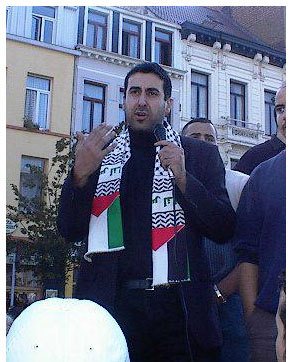
It is the sort of rhetoric that has come to define the self-described “Arabian panther.” Eloquent, charismatic and Hollywood handsome — think George Clooney meets Robert de Niro — the 32-year-old Jahjah founded the Arab European League in Belgium in 2000, before the 9/11 attacks. Born in Lebanon and now a citizen of Belgium, he is part Malcolm X and part rock star. His makes no attempt to conceal his goal: He wants to introduce sharia — the religious laws and codes of Islam — to form what he calls a “sharocracy” in Europe. The sale of alcohol in grocery stores would be banned, as would sexually suggestive advertising. Islamic holidays would become national holidays, like Christmas.
Jahjah has spoken of the Sept. 11 attacks as “sweet revenge,” though the Dutch newsweekly HP/de Tijd quoted him as saying he would prefer to have seen empty planes crash the Pentagon and the White House. “I’d have found that quite beautiful,” he said.
Jahjah and his followers vehemently insist that Middle Eastern immigrants and their children must preserve their own culture and religion; comparing assimilation to “fascism” and “rape,” Jahjah demands that the cultural and religious traditions of Middle Eastern immigrants and their children be not just preserved but integrated into the culture of the West. “I’d rather die than assimilate,” Jahjah has said.
When asked by a Belgian television reporter if terrorism or a revolution were possible in the Lowlands, he offered a curt reply: “With the AEL, it could very well happen.”
Jahjah and the AEL burst into the headlines in November 2002, when Moroccan youths (Belgians of Moroccan descent are simply called “Moroccans”) looted shops, threw stones, smashed cars and staged a three-day standoff with police after a psychologically disturbed Belgian shot and killed a young Muslim teacher on the streets of Antwerp for no apparent reason. Belgian officials blamed Abou Jahjah. Though Jahjah insisted his only part in the event was trying to calm everybody down, police arrested him after the chaos had subsided and thoroughly searched his home. The AEL called this proof of Belgium’s ongoing vendetta against their movement; Belgian lawmakers contended that Jahjah posed a danger to the community of Antwerp. Jahjah was released after an Antwerp court ruled that there was insufficient evidence to hold him.
Either way, the arrest propelled his name and the league’s cause into the international arena. To some, he was a celebrity radical, an alluring combination of sex symbol and martyr; the Belgian media frequently called him the “black angel of integration.”
That was hardly the first brush with notoriety for the league. In April 2002, enraged by Israel’s massive military assault into the West Bank in response to a Palestinian terrorist attack, Moroccans and AEL members smashed the storefronts of Jewish-owned shops, calling for jihad and chanting “Osama bin Laden!” Before the U.S. invaded Iraq a little over a year ago, league members hurled rocks and Molotov cocktails during anti-American demonstrations staged at the Antwerp harbor.
In 2003, almost a year after Pim Fortuyn’s assassination, the league opened a Dutch chapter; soon after, Mohammed Cheppih was appointed to head it. But earlier statements from Cheppih supporting suicide bombers in Palestine and the death penalty for homosexuals provoked such an outcry that he was forced to step down. Still, he remains an influential consultant to the league.
Today, behind a motto that is early Malcolm X — “by any means necessary” — the Arab European League reports steady growth, with members now in 12 countries. In Holland, it says, membership has surged from 200 in March 2003 to about 1,000 now. A new office has opened in France, and last summer, the league deployed a new political wing, the Muslim Democratic Party, to represent its views in European Parliamentary elections this year.
For its adherents, the AEL offers a united platform and an amplified voice. This is especially true for the second- and third-generation children of immigrants who came here — primarily from Turkey and Morocco — as guest workers in the 1960s, ’70s and ’80s, kids struggling to define their identity in a post-9/11 and increasingly nationalistic Europe. The children and even the grandchildren of Turkish and Moroccan immigrants are still considered “Turkish” or “Moroccan,” rather than Dutch or Belgian. To these boys, Jahjah is a role model, a hero; for girls, he is a star. One newspaper quoted a young girl saying to Jahjah’s bodyguards outside a talk he gave in Holland: “I just want to see him in the real.”
In person and via the league’s Web site, Jahjah speaks directly to these disenfranchised youth. He is deeply mistrustful of the Western press, arguing that no matter what he says, he will be misquoted or that his words will be twisted by “the Zionist lobby” in an effort to turn popular opinion against him. Non-Muslim reporters are barred from Jahjah’s lectures and speeches, and he pointedly ignored Salon’s several attempts to reach him. Other AEL officers rarely speak to non-Muslim members of the press.
However, Jahjah’s Belgian lieutenant, Azzuz, agreed to an interview in December, after a series of protests that led to the arrest of 10 league members — including some who hung the Palestinian flag over the Dutch Parliament building in The Hague and Azzuz’s own television caper. Speaking by phone from Antwerp, the 27-year-old Belgian AEL leader, the son of Moroccan immigrants, was cordial but direct. The deaths of 9/11 were “collateral damage” — a term, he says, that Muslims learned from Americans. “Finally, something had happened to those who kill our women and children,” he said of the terror strikes that have reshaped world politics. “But America still blames others. They didn’t learn their lesson at all.” What lesson is that? “Stop supporting the terrorist state of Israel,” Azzuz replied. George Bush “doesn’t hold the strings,” he says, the Zionists do.
Relations between the peoples of the West and the Middle East have deteriorated to such a point, Azzuz said, that “something like Sept. 11 is likely to happen again.”
Belgium is a world capital of the diamond industry; it is a small but powerful engine of European capitalism, a bastion of conservatism and home to a large population of Orthodox Jews. It has long struggled to reconcile the submerged cultural conflicts between its Flemish, or Dutch-speaking, culture and the French-speaking Walloons. Neighboring Holland, by contrast, is a tiny country with a large reputation for liberalism and tolerance. In “coffeeshops” throughout the country, menu items for “Colombian” and “Purple Mountain” refer not to java but to varieties of marijuana; in the winding streets of Amsterdam’s red light district, women pose in lingerie before the windows. It is here that same-sex marriage and doctor-assisted euthanasia were first made legal.
But the two countries share a common dynamic: As their Muslim populations have grown larger and more restive, both have spawned a sometimes fierce anti-immigrant backlash. The result has been a cycle of building hostilities between Muslim and European in which it is usually impossible to tell who threw the first stone.
The influx of Muslims into Holland, Belgium and the other nations of Europe is hardly new. Tens of thousands have arrived, mostly from Turkey and Morocco, since the 1960s and 1970s. Those in the first wave, like immigrants everywhere, often came looking for political freedom and economic opportunity. Even now, though, the grandchildren of those immigrants say they often feel like second-class citizens in the countries they call home. The immigrants’ levels of education are generally lower; for them and their children, unemployment rates are higher. In Belgium, unemployment among Muslims is estimated at up to 40 percent.
Still, the population of Muslims in Europe continues to grow. According to one recent report, it could nearly double by 2015, approaching 30 million.
Almost a million Muslims now live in the Netherlands, giving the country the second-highest Muslim population per capita in Europe, after France. In a country still coming to grips with its guilt over the large numbers of Jews deported during the Nazi occupation more than 60 years ago, many are reluctant to discriminate against a different religious group, even if that group stands opposed to Holland’s famed liberal and secular mores.
But after some Dutch Moroccans openly celebrated the 9/11 attacks, and after a radical imam in Rotterdam pronounced that “homosexuals are pigs,” many among the Dutch were pushed over the brink. The rightist sociology professor Pim Fortuyn rose suddenly to political prominence, inaugurating his own party which he led into Parliamentary elections. Fortuyn, a gay man, ripped Islam as a “backward culture” and called for tough new curbs on immigration. Though he was assassinated in the spring of 2002, his party swept to power with considerable support from voters under 30. Though Fortuyn’s party did not hold power long, its powerful influence is still felt in strict new immigration rules and the planned deportation of 26,000 failed asylum-seekers.
The rise of far-right parties like Lijst Pim Fortuyn and Belgium’s Vlaams Blok and the popularity of right-wing leaders like France’s Jean-Marie le Pen has made European Muslims feel increasingly unwelcome, even hated. “People are getting angry,” says Ayhan Tonca, chairman of Holland’s largest organization of Turkish mosques.
The international political climate in recent years has further eroded tolerance and goodwill on both sides. The bloody Israeli-Palestinian conflict has inflamed Muslim animosity toward the West, a rage fueled by Arab news stations and Internet sites that beam graphic news and propaganda into Muslim homes throughout the West, thousands of miles from the zones of conflict.
In that atmosphere, the rhymes Moroccan youth chant beneath the stormy skies and along the cobbled streets of Holland’s Jewish neighborhoods have become frighteningly familiar: “Hamas, Hamas, alle Joden aan het gas!” they cry. (“Hamas, Hamas, all Jews to the gas!) Or: “Joden moet je doden!” which translates with chilling simplicity: “Kill Jews!” On May 4, 2003, during a national moment of silence in remembrance of those who perished in Holocaust, a group of Moroccan boys began playing soccer with the wreath Holland’s Queen Beatrix had placed by the Holocaust Memorial at the Palace in Amsterdam. There is an increasing incidence of race-based crimes, such as the recent murder of a teacher by a Turkish student in The Hague. “The teacher dishonored him,” one friend of the confessed killer, known only as “Murat D.,” explained to the media as other Turkish classmates chanted, “Murat, we love you!”
And while Jewish schoolboys in France now leave yarmulkes at home because the law demands it, in Holland, they do so out of fear. Indeed, the Dutch Center for Information and Documentation on Israel reports a 140 percent increase in anti-Semitic acts in the year 2002 and first half of 2003. That number “omits any act that could be viewed as anti-Israel,” says the center’s director, Ronny Naftaniel.
“There were some 330 incidents last year,” says Naftaniel, who estimates that 75 percent were perpetrated by Moroccan youth. “There is a minimal amount of anti-Semitism that is constant in Holland, of course, but if you blame Jews for being the world power who direct the politics of the world, if you throw stones at Orthodox Jews, if you chant ‘Hamas, Hamas’ on trams and buses in the cities, that’s anti-Semitism, and that’s a problem.”
Some Muslim leaders also acknowledge rampant, and often rabid, anti-Semitism in the Muslim communities here; even Jahjah and other AEL officials have, on occasion, spoken against it. But not Naima Elmaslouhi, the Arab European League’s vice president in Holland. Speaking briefly by cellphone from the Amsterdam police station in December, as she waited for the release of fellow league officers arrested during a pro-Palestinian demonstration, she said the claims of anti-Semitism are exaggerated. “It’s just one or two incidents,” she said.
Perhaps the clearest expression of who Jahjah is and what he wants comes in his book, “Tussen 2 Werelden: Roots van Een Vrijheidstrijd,” or “Between Two Worlds: The Roots of a Freedom Fight.” Published late last year by the prestigious Dutch-Belgian publisher J.M. Meulenhoff, a house known for its strong list of Jewish literature, Jahjah’s memoir-cum-manifesto suggests that ambiguity and contradiction are central to his character — and maybe to his strategy.
Born and raised in Hanin, in south Lebanon, Jahjah grew up in the midst of that country’s civil war and Israel’s invasion of Lebanon, which culminated in the 1982 slaughter in the refugee camps of Sabra and Shatilla, where an Israeli commission of inquiry found that Israeli forces and their commander Ariel Sharon were indirectly responsible for the massacre of at least 800, and perhaps as many as 2,000, Palestinian civilians at the hands of Israel’s Christian Phalange allies.
In the early 1990s, at the age of 19, Jahjah traveled to the West; he applied for political asylum in Belgium, telling immigration officials that he’d been a member of the militant Shiite group Hezbollah and was seeking to escape its persecution. When authorities began to question his story, he married a Belgian ex-girlfriend, receiving residency as her spouse. The couple divorced shortly after his papers came through. Since then, he has denied he was a member of Hezbollah, saying he made the story up to get asylum.
The league, Jahjah says in his book, isn’t especially radical, but rather a “healthy, democratic protest organization born of the frustration and disappointment and hurt” of its members, a movement that seeks only equality and freedom. Only action, maintains Jahjah, will produce change. Azzuz agrees, saying that sometimes a bit of civil disobedience is necessary to win attention. “It’s not like we take hostages,” he says. But in another passage, Jahjah’s book also contains a somewhat different message: “Violence is no solution,” he writes, “but it can open the way to a solution.”
In his book, Jahjah claims people wrongly accuse him of ties to al-Qaida when in fact, he says, it is the AEL that is terrorized. Bodyguards protect him from the many domestic and international organizations that he claims want him dead, including Israel’s Mossad. (Israel dismissed the charge as “laughable.”)
But critics see evidence of the league’s character not only in what Jahjah says and does, but equally in what he doesn’t say:. For instance, neither he nor the AEL condemns al-Qaida. And while it would be unreasonable to blame Jahjah, Azzuz or the Arab European League for the wave of anti-Semitism, they are widely seen as contributing to the climate of rage and polarization, if only by issuing mixed messages.
This impression was strengthened last November, after terrorists suspected of al-Qaida links killed more than 50 people and injured hundreds in four bombings in Turkey — including two bombings at Istanbul synagogues. Some in the AEL did publicly condemn the attacks. But Elmaslouhi, the Dutch league’s vice president, voiced “support and understanding” for the bombers. “I am against the killing of innocents,” she told the Dutch newspaper Algemeene Dagblad, “but how do you know who is innocent?”
To some critics, Jahjah, Azzuz and others in the Arab European League seem less interested in multicultural harmony than in hostile separatism. These critics warn that a militant “Arab pride” movement poses risks that far surpass mere social tension.
The recent report by the Dutch General Intelligence and Security Service noted that self-styled mujahedin “purposefully influence members of the Muslim communities in the Netherlands in order to create a polarization in society and to alienate the Muslims from the rest of the population.” The effect, according to the report, is to strengthen their recruitment efforts by “appealing to the idea that the rights and interests of ‘good’ Muslims are being violated time and again.” As proof of the potential danger, the report cites the example of two Dutch-Moroccans who were killed in Kashmir while training for jihad.
Such concerns have provoked officials in both Belgium and Holland to wonder whether the Arab European League should be banned. In Belgium, Prime Minister Guy Verhofstadt has called Jahjah a “threat to society,” though his effort to shut down the AEL on the grounds of “inciting violence, issuing threats and disturbing the public order” — a move Jahjah ascribed to “the Zionist lobby” — failed.
But when the AEL posted its statement supporting Hamas founder Yassin on its Dutch-language Web site, motions were filed in the Belgian courts to have the page, if not the entire site, pulled from the Web. While the courts debate, the provider serving the site has cancelled the League’s account, forcing it to scramble for another and rebuild essentially from scratch. (The English version of the site remains for the most part intact.)
But some are concerned that banning the league would only send the movement underground, making it even more dangerous. “At least, it’s out there in the open,” says Ayhan Tonca, who heads the organization of Turkish mosques in Holland.
For their part, AEL members accuse European officials of criminalizing their movement and exaggerating the social problems within the Euro-Muslim community. Even if that’s true, the increased pressure on the league and allied groups is likely to increase the tension. As with the conflict between Israel and the Palestinians and the widening conflict between Islamist groups and the West, it sometimes seems that there is no middle ground.
Tonca, speaking from Holland’s Turkish community, says he understands the appeal of the Arab European League, and cautions that Europe has no choice but to accept a cultural evolution. “We have to accept that Muslims are a part of Europe,” he says. “It isn’t just a Judeo-Christian culture anymore.”
Moroccan-born Mohamed Sini, a Dutch Labor Party official who chairs the organization Islam and Citizenship, calls the league an “extremist group” that only exacerbates tensions. Tonca, too, accuses Jahjah of being not much different than his opponents — Fortuyn, le Pen, the Vlaams Blok. All, he says, divide in anger rather than unite in peace.
The European establishment is wrestling with similar worries. Last December, the European Union shelved a report that blamed Muslims for the recent wave of anti-Semitism; when a new draft was issued last month, it blamed neo-Nazi and other racist groups, with Muslims being only a secondary cause — even though the numbers in the report showed that Muslims were in fact behind most of the incidents.
But to those who say that Europe must become a melting pot now in a way that it has not been in modern times, Jahjah and other league members say they’re not interested in blending in.
Absorbing the principles and norms of Holland, Belgium and other European democracies, they say, would mean sacrificing their integrity, their identity as Muslims. Rather, they argue, the Judeo-Christian majority of Europe should incorporate Islamic norms and values into its own. “Europe would be a better, safer place,” a message on the now-defunct Dutch Arab European League Web site proclaimed, “if it observed the values and the norms of Islam.”
“As a minority group,” says Azzuz, “we have rights.”
“Idiocy!” Naftaniel snaps in reply. “Integration doesn’t ask that you give up your culture.”
Despite the league’s plans to expand its presence in the coming year, especially in France, Naftaniel, Tonca and Sini all maintain that the movement will eventually fall by the wayside. “They fail to serve the real concerns and interests of [European] Muslims,” Sini says, “mostly because they blame everyone else for the tensions without looking within themselves.”
But he is nonetheless concerned, both about the AEL’s actions and about the responses they engender. “Extremism,” he warns, “breeds extremism.”
Tonca likewise worries that Abou Jahjah’s call will produce Turkish militants. “The most dangerous terrorists are those who are well educated in the West,” he notes, “and I fear that the Muslims who are educated here are becoming radical.”
Separation, Naftaniel says, is not compatible with democracy; coexistence requires collaboration and cooperation. “If one believes in democracy,” he says, “then the most challenging thing is to sit down with those who with whom you differ.”
That might be the starting point for détente, but does the league want détente? Its signals have been mixed, at best. Jahjah himself has publicly denounced the chants of “Hamas, Hamas, alle Joden aan het gas!” Elsewhere, though, he has expressed impatience with talk of peaceful coexistence. “The days of sharing couscous with a Jew are over,” he told Belgian newspaper De Morgen in April 2002.
Another top league official, apparently distressed by reports that Muslim children in Holland refuse to listen to classes about the Holocaust, wrote in a statement on a league site that the organization is “against each and every form of discrimination and racism. As Muslims we see the Jews as ‘the people of the book’ and it is obligatory to fight the hate against these people.” But the statement continues: “With equal fury the AEL fights Nazism and Zionism.” This association of Israel with Nazism, common these days among European Muslims, is widely seen as a crude and inflammatory form of anti-Semitism.
Which to believe, then — the overtures of peace, or the rhetoric of fury? In the interest of the vrijheidstrijd, or the freedom fight, Jahjah wraps himself in the mantel of the American revolutionary hero Patrick Henry. “We seek only to live in peace and with the freedom to live our own lives with equality, appreciation, and respect,” he writes in “Between Two Worlds.” “And if anyone tries to remove that right and to oppose us, we will fight until the oppression stops, and we acquire freedom — or die in the attempt.”
Abigail R. Esman, a contributing editor at Art and Auction, writes on art and contemporary culture from New York and Amsterdam. More Abigail R. Esman.
Anti-Semitism charge backfires on ex-AIPAC flack
Two think tanks consider cutting ties with Josh Block after Salon reveals he targeted progressive journalists
By Justin ElliottTopics: Anti-Semitism, Israel, Israel-Palestine
Josh Block Greg Sargent at the Washington Post reports that my recent story on Josh Block, which outlined accusations of anti-Semitism against progressive bloggers that Block promoted on a private neoconservative listserv, has landed the former AIPAC spokesman in some hot water.
Two think tanks he’s associated with — the Progressive Policy Institute and the Truman National Security Project — were apparently rattled by the incident:
PPI head Will Marshall privately told Block that the think tank would sever ties with Block if he didn’t retract the charges detailed in Salon, according to a source familiar with the discussions. Block subsequently offered Politico a statement on the charges, claiming he had never accused people at CAP in particular of anti-Semitism, but not walking back or apologizing for the gist of what was reported in the Salon piece. It’s still unclear how PPI — which declined to comment — will proceed at this point.
Meanwhile, at Truman, top officials privately debated via email whether to cut ties with Block after the Salon story broke, a source says. They had already been unhappy with Block’s attacks on critics of Israel, and the Salon piece exacerbated tensions, I’m told.
I’ve asked Block for comment and will update this post if I hear back. Sargent reports that PPI and Truman officials are mulling whether to sever ties with Block over the incident.
Arguably even more surprising than the reaction by the think tanks is that Block’s business partner, lobbyist Lanny Davis, publicly — and quite strongly — broke with Block over the accusations of anti-Semitism against progressive bloggers.
Davis, keep in mind, is hardly a lefty on Mideast issues. He has been a senior advisor and spokesperson at the Israel Project, one of the biggest organizations that promotes the current Israeli government line in Washington.
“I respect Josh Block but I 100 percent disagree with much of his language. People can disagree about Israel’s policies without being anti-Semites,” Davis told Think Progress.” “In fact I think it’s a terrible mistake to blur the two. We should be able to debate Israel’s policies. I am very pro-Israel. I believe the onus for negotiations is on the Palestinians but both Israelis and Palestinians share responsibility. However, that’s all fair debate. Israelis debate the subject. We debate the subject. Impugning motives of people at the Center [for American Progress] and impugning [that] those motives are driven by anti-Semitism is, in my opinion, wrong.”
Justin Elliott is a reporter for ProPublica. You can follow him on Twitter @ElliottJustin More Justin Elliott.
Right-wing listserv targets Israel’s critics
Ex-AIPAC official urges conservative journalists to echo charges of "anti-Semitism"
By Justin ElliottTopics: Anti-Semitism, Israel, Israel-Palestine
Josh Block (Credit: Reuters/Fox/Salon) The former spokesman for the American Israel Public Affairs Committee (AIPAC) is shopping a 3,000-word trove of opposition research against bloggers critical of Israel to friendly neoconservative journalists.
I’ve obtained an email sent by Josh Block to a private listserv called the Freedom Community, in which he throws around accusations of anti-Semitism against liberal bloggers and calls on other list members to “echo” and “amplify” his assault and “use the below [research] to attack the bad guys.”
The Freedom Community list includes many neoconservative journalists, according to a person familiar with the matter. As of last night, the icon for the listserv was Margaret Thatcher:

***
I sent an inquiry to Block late Wednesday night. By Thursday morning, the listserv had been scrubbed:

(The phrase “the freedom community” has also appeared in a post by Weekly Standard editor Daniel Halper hailing a neoconservative speech by the president of Mongolia. And Ben Smith reported last year on a similar sounding endeavor called “Freedom Mail.”)
Block sent out his email following publication of an article by Politico’s Ben Smith Wednesday about writers at the Democratic-affiliated Center for American Progress and Media Matters who enunciate a more progressive take on the Israel-Palestine conflict than is usually found in Washington. Block was quoted in the story accusing CAP columnist Eric Alterman of writing “borderline anti-Semitic stuff,” a charge Alterman (who is himself Jewish) dismissed as “ludicrous.”
Block’s email to the Freedom Community list arrived under the subject line “Important piece to echo and the research to do it….” – a reference to the Politico story. He wasted no time throwing around more accusations of anti-Semitism.
“This kind of anti-Israel sentiment is so fringe it’s support by CAP is outrageous, but at least it is out in the open now — as is their goal – clearly applauded by revolting allies like the pro-HAMAS and anti-Zionist/One State Solution advocate Ali Abunumiah and those who accuse pro-Israel Americans of having ‘dual loyalties’ or being ‘Israel-Firsters’ – to shape the minds of future generations of Democrats,” Block writes. “These are the words of anti-Semites, not Democratic political players.”
The email continues by encouraging journalists on the Freedom Community list to ask Democratic members of Congress about the story.
“I wonder if Steny Hoyer or Nancy Pelosi or Harry Reid or Chuck Schumer or Dick Durban or James Clyburn agree with CAP?” Block asks. “I wonder if they will say they disagree and condemn this stuff and expect better. You know how I feel – look at the below — and ask them how they feel about this discourse from CAP and Media Matters.”
He goes on: “YOU SHOULD AMPLIFY this. And use the below [research] to attack the bad guys.”
What follows is thousands of words of opposition research focusing on CAP writers Eli Clifton, Matt Duss and Ali Gharib and Media Matters’ M.J. Rosenberg. I’ve posted the full text below. (I’m not vouching for the accuracy of the material, and CAP has responded to the Politico article here.)
Asked for comment about the email, Block sent me this statement:
Those who accuse pro-Israel advocates and American Jews of having “dual loyalties” and being “Israel Firsters” are engaged in anti-Semetic hate speech. Period. These are age-old canards and anti-Semetic smears that go back centuries, suggesting that Jews are disloyal, alien and cannot be trusted. This kind of rhetoric has no place in civil dialogue and anyone’s politics, but especially among progressives.
The organizations who pay the salaries of those using such hate speech, (see below for specific examples), and who have clearly had it brought to their attention, must either confront it and end it, or take full responsibility for it. In this case, that choice belongs to both CAP and Media Matters. This is a free country and people can say what they want, but the question for those organizations is whether they are an appropriate home for such discourse
The Block Freedom Community email is interesting for a few reasons.
First, it’s worth noting that Block is continuing to do AIPAC-style press work even though he left the powerful lobbying group last fall. (AIPAC’s current spokesman has, at least publicly, stayed above the fray, declining to comment for the Politico story.)
Block frequently offers hard-line quotes in Israel-Palestine stories identified as the group’s former spokesman, or occasionally as “a former Clinton administration official who is now a senior fellow at the Progressive Policy Institute.” (He was a spokesman for USAID during the Clinton years.)
In February, for example, months after he left AIPAC, Block sent out an email to reporters and editors proposing “questions to ask the Muslim Brotherhood & Their Allies,” the New York Times reported. In August, he was calling the Obama administration’s approach to Syria “tragically naïve.” In September he was quoted by Eli Lake in Newsweek accusing the Obama administration of encouraging “Israel’s adversaries to pursue their hostile aims against the Jewish state.” And in October, Block was quoted attacking the wording of a poll that came up with unfavorable results for AIPAC.
His gig at the Progressive Policy Institute is in line with that organization’s Lieberman-style Democratic politics. Block is also a partner with Salon favorite Lanny Davis in a lobbying and P.R. firm, Davis-Block.
Block tells me he was shopping the opposition trove on progressive bloggers not as part of work for a client, but rather “just for me … just for what’s right.”
Davis-Block counts among its clients the group Friends of Israel, which is associated with former Spanish Prime Minister Jose Aznar. (Though the group’s website appears to have been defunct since September.)
The existence of the Freedom Community – a private list for the ideologically like-minded that includes proposals for coordination — prompts memories of the JournoList affair of 2010. That involved a listserv of left-leaning journalists and policy wonks whose leaked emails were the subject of (many said dishonest) reporting by the Daily Caller, which was subsequently blown up into a national story by Fox News and Co.
Now, Block’s email is explicitly calling for coordination among conservative writers.
I personally don’t see anything wrong with like-minded journalists and policy folks having private discussions on email lists. Individual journalists could take or leave Block’s pitch. But it’s certainly interesting to see how the sausage gets made.
And next time Block’s name appears in print, it’s worth remembering he has something of a vendetta against anyone who doesn’t fall into line with the status quo view on U.S. policy toward Israel.
UPDATE: This story originally said Block did not respond to a request for comment. He in fact sent the above statement to me Wednesday night, but I didn’t get it because of an email snafu.
—————-
Here’s the complete text of Block’s email to the Freedom Community
[Subject:] Important piece to echo and the research to do it….
Ben Smith is a good reporter and his story is important in exposing what these people are doing. It is not a good story for CAP and Media Matters. READ the story carefully and see below that some good, but not exhaustive, examples of CAP and MEDIA MATTERS outrageous vilification of pro-Israel Americans, Jews, Members of Congress, and pretty much anyone who thinks Iran with nuke is a problem, or supports a strong US-Israe relationship.
This kind of anti-Israel sentiment is so fringe it’s support by CAP is outrageous, but at least it is out in the open now — as is their goal – clearly applauded by revolting allies like the pro-HAMAS and anti-Zionist/One State Solution advocate Ali Abunumiah and those who accuse pro-Israel Americans of having ”dual loyalties” or being ”Israel-Firsters” – to shape the minds of future generations of Democrats. These are the words of anti-Semites, not Democratic political players.
This kind of hate speech has no place in the political discourse, let alone one FUNDED, SPONSORED AND DEFENDED by a group claiming the mantle of the Democratic party.
I wonder if Steny Hoyer or Nancy Pelosi or Harry Reid or Chuck Schumer or Dick Durban or James Clyburn agree with CAP? I wonder if they will say they disagree and condemn this stuff and expect better. You know how I feel – look at the below — and ask them how they feel about this discourse from CAP and Media Matters.
After you read the story, see below for more examples of CAP’s and Media Matter’s work and statements along these lines….
YOU SHOULD AMPLIFY this. And use the below to attack the bad guys.
POLITICO
Two of the party’s core institutions emerge as critics of its pro-Israel congressional leaders.
By Ben Smith
[FULL TEXT OF POLITICO ARTICLE]
###
The below record is divided into two broad categories:
(1) CAP’s substantive positions against Israel and on the side of anti-US, anti-Israel, and anti-Western forces
(2) CAP’s rhetoric and tactics of personal attacks against political opponents.
Obviously the two categories interact. The CAP writers are not above smearing Democratic politicians and mainstream journalists for being Israel-firsters, for carrying AIPAC’s water, etc. But the personal attacks speak to personal unprofessionalism and borderline libel, while the substantive stuff exposes how far out of the mainstream CAP’s work has actually gotten.
Across everything, there’s a weird combination of sneering recklessness and smug childishness that underlies a lot of their rhetoric. On the recklessness side, there’s a degree to which they really don’t know how shrill they sound and how far off the reservation they’ve strayed. It’s almost as if, in talking to each other, it’s now just natural to talk about Jewish money in politics, about treasonous politicians, etc. On the childishness side, people are “stupid” or “douchebags” or (sarcastically) “super-geniuses” or the like, and there’s this kind of petulant foot-stamping on certain central dogmas because those debates are settled (e.g. Petraeus). Much of that is covered in the unprofessional rhetoric section, but it’s a thread that goes through much of what CAP produces on the Middle East.
(1) CAP’s substantive positions: Each of these expose the degree to which CAP’s Middle East policy analysis/prescriptions are far out of the mainstream of Democratic and center-left politics.
(a) Geopolitics – on the micro level, on issue after issue, CAP’s Middle East people can always be relied on dismiss concerns over anti-Israel and Islamic radicalism, on one hand, and attack Israel on the other. The analysis becomes especially absurd on Iran and Turkey.
(b) Israeli/Palestinian issues – CAP is far out of the mainstream on American support for Israel, which leads them to – among other things – attack Democratic members of Congress for being too pro-Israel
(c) Israeli/Palestinian issues – linkage – CAP’s Middle East people are committed to the idea that Israel is at the core of Middle East instability.
(d) Israeli/Palestinian issues – Israeli intransigence is the reason - the setup for the idea that the Israeli/Palestinian conflict is at the core of Middle East instability, this is the argument that Israeli intransigence is at the core of the Israeli/Palestinian conflict
(e) The US/Israeli alliance hurts America’s national interest – these arguments range across the spectrum, from the soft power argument that Arabs don’t like us because of Israel to the super-charged Petraeus argument that Israel gets American troops killed.
(2) CAP’s tactics of personal attacks:
(a) Dual-loyalty/”Israel-
firsters”/Likudniks – a longstanding and by now glib practice of deploying dual-loyalty smears against their political opponents, from accusing them of being “Israel-firsters”/Likudniks to accusing them of propagandizing for The Lobby.(b) Duss’s unprofessional rhetoric – Duss engages in ad homs, snideness, and mockery that’s not only unprofessional but is starkly at odds with what might be called his own personal and analytical failings.
Substantive Positions/Ideology
[A] Geopolitics – on almost every specific issue, even outside the Israeli/Palestinian context CAP can be relied upon to provide “analysis” that runs counter to mainstream consensus – and that always ends up explaining why concerns about anti-American and anti-Western currents are overblown.
Iran… CAP authors have long sought to both debunk and sneer at suggestions of Iranian nuclearization, right through this morning. This flies in the face of overwhelming Congressional and center-left conviction that Iran is nuclearizing and that a robust sanctions regime is necessary to counter their efforts. It turns out that even the assassination plot is proof that Iran isn’t a threat.
Gharib and Clifton – today - http://thinkprogress.org/
security/2011/11/08/364519/ white-house-iaea-report-iran/ - “U.S. Official: IAEA Report ‘Does Not Assert That Iran Has Resumed A Full Scale Nuclear Weapons Program’” Gharib – http://antiwar.com/radio/
2011/01/08/ali-gharib-4/ - Scott Horton Interviews Ali Gharib … no hard evidence that Iran is pursuing nuclear weapons, general sneering about evidence… “just a lie”Duss - http://thinkprogress.org/
security/2009/12/08/72834/ - Congress Rushing To Pass Iran Sanctions That No One Thinks Will Workiran-sanctions-bill/ Duss - http://thinkprogress.org/
security/2011/01/11/176451/ - IAEA Chief: ‘We Cannot Say That Iran Is Pursuing A Nuclear Weapons Program’iaea-chief-we-cannot-say/ Clifton - http://thinkprogress.org/
security/2011/06/07/238238/ - RAND Report Discredits Iran Hawks, Advocates Containment And Deterrencerand-report-iran/ Clifton - http://thinkprogress.org/
security/2011/08/08/290977/ - Hawks Push For Iraq-Style Sanctions On Iranhawks-push-for-iraq-style- sanctions-on-iran/ Clifton - http://thinkprogress.org/
security/2011/08/10/292724/ - AIPAC’s Iran Strategy On Sanctions Mirrors Run-Up To Iraq War Tacticsaipac-iran-iraq/ Gharib - http://thinkprogress.org/
security/2011/10/12/341482/ - Republicans Call Alleged Iranian-Backed Plot An ‘Act Of War’iran-plot-act-of-war/ Gharib - http://twitter.com/Ali_
Gharib/status/ - Ali_Gharib: How the alleged Iran plot undermines neocon talking point about Iran’s ties & influence in Latin America.http://t.co/YbpmdPHX125977984342556672 Turkey … despite constantly attacking religious hardliners in Israel and evangelicals in the United States, CAP’s authors go the ramparts for the AKP and Erdogan. They also attack Democrats for siding with Israel in the context of Israeli/Turkish tensions
Gharib - http://thinkprogress.org/
security/2011/11/07/363028/ house-democrats-turkey-israel/ - House Democrats Call For ‘Urgent Review Of Our Relations With Turkey’ After ‘Confrontation’ With Israel Yglesias - http://thinkprogress.org/
yglesias/2009/02/11/191708/ - on Erdogan and the AKP: “That’s how politics works. I’m not personally a fan of religious-inflected politics, but it’s very common and not something to freak out over”martin_pertez_on_avigdor_ lieberman/ Gharib - http://thinkprogress.org/
security/2011/09/30/332632/ islamophobes-spike-u-s- alliance-with-islamist-turkey/ - Islamophobes Coordinate Campaign To Paint ‘Islamist’ Turkey As U.S.’s ‘Enemy Camp’ Duss - https://twitter.com/#!/
mattduss/status/ - You’re smart enough to know this isn’t true RT @EliLake: @drfarls breakdown in Israeli-Turkey ties is the fault of Turkey & its ruling party99140876168732672 Lebanon… eight days after the beginning of Lebanon II in 2006 Congress passed a resolution supporting Israel’s military action 410-8. CAP was on the other side, doing what they could to defend Hezbollah and channeling the idea that Israeli self-defense was inspiring attacks on US troops:
Shakir - http://thinkprogress.org/
politics/2006/08/19/7002/ - U.S. Commander: Lebanon Conflict May Have Fueled Attacks On U.S. Troopssolidarity-in-middle-east/ “ThinkProgress” - http://thinkprogress.org/
security/2006/07/26/6518/ - McCain Falsely Claims the Iraqi Prime Minister Has ‘Condemned Hezbollah’mccain-hezbullah/ “ThinkProgress” - http://thinkprogress.org/
politics/2006/07/25/6501/us- - U.S. approves two more weeks of fighting.approves-two-more-weeks-of- fighting/ [B] Israeli/Palestinian conflict – even when they’re not smearing supporters of the US/Israel alliance for dual-loyalty, CAP’s position still puts them way outside the mainstream. And so they end up attacking the mainstream, including Democrats, the State Department’s stance on the Gaza blockade, etc. Their opposition to Israel’s Gaza blockade, a position that is overwhelmingly seen as legitimate in Congress, has also led them to attack sitting members.
Yglesias - http://thinkprogress.org/
yglesias/2010/06/11/197528/ - Senator Chuck Schumer Wants to “Strangle” Gaza Residents “Economically” as Collective Punishment … “I find these sentiments disgusting”senator-chuck-schumer-wants- to-strangle-gaza-residents- economically-as-collective- punishment/ Duss – http://twitter.com/#%21/
mattduss/status/ - @mattduss: Read @Lara_APN: U.S. (non)-Recognition of Sovereignty in Jerusalem: A Consistent Policy, pre-1948 -Present bit.ly/nqfsnZ102072268649275392 Gharib - http://thinkprogress.org/
security/2011/06/22/251355/ “state-travel-warning-israel/ State Department Travel Warning: If You Try To Sail To Gaza, Israel May Kill You” Gharib - http://thinkprogress.org/
security/2011/08/12/294357/ state-department-memri-neocon/ - “State Department Grants $200K To Discredited Neocon-Aligned Middle East Media Watchdog” … “a Middle East media watchdog closely aligned with U.S. neoconservatives and Israel’s hawkish security establishment and rightist Likud Party” [MEMRI] Gharib - http://thinkprogress.org/
security/2011/06/30/258319/ - “American Gaza Flotilla Participant Calls Rick Perry’s DOJ Letter ‘The Worst Kind Of Pandering’”… “There is no evidence that any participants in the flotilla plan ‘to commit hostilities’ against anyone” … “The notion — echoing the call of two staunch Israel supporters in Congress — that flotilla participants can be prosecuted for material terror is flimsy at best and made in bad faith at worst.”perry-gaza-flotilla/ Duss – http://thinkprogress.org/
security/2010/05/31/99927/ - “Like segregation in the American South, the siege of Gaza (and the entire Israeli occupation, for that matter) is a moral abomination that should be intolerable to anyone claiming progressive values”israeli-commandos-raid-gaza- aid-flotilla-netanyahu- cancels-meeting-with-obama/ Duss - https://twitter.com/#!/
mattduss/status/ - Everything Amb Rice says here about what UN bid won’t do for Palestinians could be said about admin’s peace effortshttp://yhoo.it/qTWLJT113637438978658304 Duss – http://twitter.com/mattduss/
status/124488310436540417 - mattduss: @Ali_Gharib Maybe Iran should occupy Iraq and start building settlements there. Then Congress would oppose pressuring them.Duss RT’ing Tony Karon - https://twitter.com/#!/
TonyKaron/status/ - US blather about Palestinians needing to return to talks misses the point: Israel rejects the international consensus on peace terms113776561567698944 [C] Israeli/Palestinian conflict – linkage – CAP constantly pushes the talking point that the Israeli/Palestinian conflict is the cause rather than the symptom of Middle East pathologies.
Duss - http://twitter.com/mattduss/
status/41912781733236737 - mattduss Eltahaway: arab hatred for israel will not end until the occupation ends. #jstconf #linkageDuss - http://www.huffingtonpost.
com/matthew-duss/j-street- soros-and-us-lea_b_743119.html - “…Israel’s refusal to extend its settlement moratorium… the centrality of this conflict to a number of other U.S. challenges in the region” Duss - http://mideast.
foreignpolicy.com/posts/2010/ 12/16/linkage_and_its_ discontents_what_wikileaks_ reveals_about_israel_palestine - this post takes Wikileaks, which was all but universally taken as a debunking of linkage, and says that it proves the opposite. Gharib – http://www.lobelog.com/apns-
friedman-on-ajcs-harris- - “APN’s Friedman on AJC’s Harris Linkage-denial – This has been a neoconservative effort of late, which has been mostly absurd, and sometimes from Israel itself, on the dime of a pretty far right-wing Israel lobby group.”linkage-denial/ Duss – http://thinkprogress.org/
security/2010/04/26/176025/ - “Resolving the issue wouldn’t end Al Qaeda terrorism, but it would blunt Al Qaeda’s appeal (just as Haass acknowledges it would Iran’s)”making-the-perfect-the-enemy- of-the-good-in-the-middle- east/ Duss - http://twitter.com/mattduss/
status/41915554663116800 - mattduss Eltahaway: nothing will be solved until the palestinian issue is solved. #jstconf #linkage[D] Israeli/Palestinian conflict – Israeli intransigence – The punchline to linkage, where the Israeli/Palestinian conflict is the cause of Middle East instability, this talking point is that Israeli intransigence is the cause of the Israeli/Palestinian conflict.
Duss – http://thinkprogress.org/
security/2011/02/18/176503/ - “…but let’s be clear on where the fault lies: It is Israel that is violating international law by colonizing territory it has militarily occupied”neocons-vs-reality-again/ Duss – http://twitter.com/mattduss/
status/124847397875630080 - mattduss: @absurdlyari Point of analogy is that settlements are an obvious impediment to peace now. Very few don’t grasp this.Duss – http://twitter.com/mattduss/
status/28102535461998592 - mattduss Hanan Ashrawi: “This is not rocket science. Settlements are built on occupied Palestinian land” http://nyti.ms/h0RmelDuss – http://thinkprogress.org/
security/2010/09/15/176271/do- - “Do Israelis Want Peace?”israelis-want-peace/ Duss – http://twitter.com/#%21/
mattduss/status/ - mattduss Israeli arson RT @Ibishblog: I agree. It’s “only a matter of time until a conflagration erupts” in occupied E Jerusalemhttp://9p5n.sl.pt37899802784178176 Duss - http://twitter.com/#%21/
mattduss/status/ - mattduss Freedland: #PalestinePapers “show that the Israelis were intransigent in public – and intransigent in private.”http://bit.ly/gZr8wx29290921518432256 [E] “Israel damages US interests” – This has for years, going back at least to Lebanon II, been a constant talking point for CAP. More recently it has revolved around the Petraeus testimony, where it’s tacked on as kind of an extension to linkage. The goal is not exactly a secret. Per Mearsheimer talking about Petraeus, it includes both the substantive goal of eroding support for the US/Israeli relationship and the more specific goal of setting up dual loyalty smears: “If that message begins to resonate with the American public, unconditional support for the Jewish state is likely to evaporate… raises legitimate questions about whether it has the best interests of the United States at heart.” It’s also something of a convergence of CAP’s ideology, rhetoric, and worst rhetorical tics. When pushed on it Duss tweeted<em>.@mere_rhetoric Tell it to Petraeus. I remember when this debate was actually interesting(https://twitter.
com/#!/mattduss/status/ ). They seem ideologically and personally committed to mainstreaming the idea that Israel is a strategic drag on the United States, even as the Arab Spring means that the US has lost all but Israel as reliable Near East allies.84678029456060416 It’s worth noting, of course, that Petraeus publicly walked back the CAP interpretation of his testimony (http://israelmatzav.blogspot.
com/2010/03/video-petraeus-i- ).It’s also worth noting, as a matter of substance, that Duss’s self-professed skepticism about the US getting valuable intelligence and technological help from the Israelis calls into question his ability – simply as an analyst – to evaluate what’s going on in the Middle East.never-said-israel.html Duss - http://middleeastprogress.
org/2011/09/obamas- - “the president’s speech today, appeared as little more than an effort to preserve that status quo, at significant diplomatic expense and at considerable cost to America’s global standing. It was, in other words, probably the best demonstration possible for why the Palestinians decided to go to the UN in the first place.”disappointing-un-speech/ Duss – http://thinkprogress.org/
security/2010/06/03/176100/ - “Dagan, Cordesman On Israel’s Strategic Value To U.S.”… o Like Cordesman (for whom, full disclosure, I interned years ago) I’ve always been skeptical of claims about the strategic benefits of the U.S.-Israel partnership. As Cordesman writes, “At the best of times,” Israel “provides some intelligence, some minor advances in military technology, and a potential source of stabilizing military power.”…dagan-cordesman-on-israels- strategic-value-to-u-s/ Yglesias – http://prospect.org/cs/
articles?article=friends_ – “But it shouldn’t be America’s place to do what Congress did on Monday and simply stand and cheer while a foreign prime minister offers absurd lies about who America’s friends are in the world. Israeli politics has taken an aggressively hawkish and nationalistic turn over the past decade, and whether or not that’s good for Israel, it’s certainly not good for the United States.”without_benefits Clifton – http://thinkprogress.org/
security/2011/10/11/340653/ - “Huntsman’s deference to “what leadership in Israel has to say about the timing issue” could come at the expense of U.S. national security interests and further tarnish the respect for U.S. leadership which Huntsman aims to restore.”huntsman-incoherent-middle- east-policy/ Gharib - http://twitter.com/Ali_
Gharib/status/ - Ali_Gharib: In which Graham admits US gov acting for Israel’s interests against US interests…. http://t.co/131724614383579136 4BcLxDtF Duss – http://twitter.com/#%21/
mattduss/status/ - @mattduss: Paul Pillar: Israel Slaps U.S. in the Face Again http://bit.ly/n92SlH101993399061721088 Duss – http://twitter.com/#%21/
mattduss/status/ - @mattduss Ross talking about all Obama admin has done for Israel. Maybe later he’ll talk about all Bibi has done for US. Oh wait… #jstconf42228883281547264 Clifton - http://thinkprogress.org/
security/2011/09/06/311989/ - Do Robert Gates And David Petraeus Agree On ‘Linkage?’petraeus-gates-linkage/ Duss - http://thinkprogress.org/
security/2010/03/25/175950/ - Petraeus Explains The Reality Of Middle East ‘Linkage’gen-petraeus-on-the-reality- of-linkage/ Jilani - http://thinkprogress.org/
security/2010/03/16/86903/ - “Biden recently told Israeli Prime Minister Benjamin Netanyahu that Israel’s intention to build thousands of new settlements was undermining U.S. interest…”conservatives-petraeus-listen- now/ Personal Attacks/Smears
[A] “Israel-Firster” / “Likudnik” rhetoric, and accusations that politicians and journalists are unpatriotic – In the context of Jewish Americans it’s an accusation of dual loyalty; otherwise it’s merely an accusation of treason against journalists (who value their objectivity) and politicians (who have taken an oath)
Clifton - http://twitter.com/
EliClifton/status/ - EliClifton: RT @MJayRosenberg: Ben Smith is something. Publishes full #AIPAC memo to senators incl defense of Koch Brothers. Cool. http://t.co/snem3 …?124884109863555072 Duss – http://thinkprogress.org/
security/2009/07/15/175545/ -goldberg-talking-about-israel- with-arabs-is-hate-speech/ “Goldberg: Talking About Israel With Arabs Is Hate Speech” … “it’s reprehensible, but it’s also typical of Goldberg’s general method on the issue of Israel, which involves presenting himself as a moderate… before invariably delivering bog-standard neoconservative verdicts.” Duss - http://www.tabletmag.com/
scroll/77987/obama-and-israel- - “Over the past couple decades, we’ve been seeing a relationship, Likudniks building bridges with these very right-wing evangelical groups.”matt-duss/ Gharib – http://twitter.com/#!/Ali_
Gharib/status/ - Ali_Gharib: In which @InkSptsgulliver seems to mistakenly think Mark Kirk (R-AIPAC) should care about *anyone* other than Israel. http://tachesdhuile.96432318167793664 blogspot.com/2011/07/mark- kirk-gets-his-feelings-hurt- says.html Clifton and Gharib - http://www.rightweb.irc-
online.org/articles/display/ - The Neoconservative Echo Chamber 2.0the_neoconservative_echo_ chamber_20 Rosenberg - http://www.huffingtonpost.
com/mj-rosenberg/the-fake- - “The Fake Outrage of the Israel Firsters”outrage-israel_b_864952.html Rosenberg - https://twitter.com/#!/
MJayRosenberg/status/ - Israel Firster Cliff May says 2006 Pal elections were neither free nor fair. It was deemed both by US, UN, EU, etc.http://bit.ly/km7KXR78873595278934016 Gharib – http://twitter.com/Ali_
Gharib/status/ - Ali_Gharib: Is there a distinction anymore between US-Israeli military blustering and election campaigning? http://t.co/132869683979362305 VJ1Q4QZ4 Duss – http://thinkprogress.org/
security/2009/08/06/175579/ - GOP delegation criticizes U.S., backs Israeli evictionsgop-delegation-criticizes-us- backs-israeli-evictions/ Duss - https://twitter.com/#!/
mattduss/status/ - Ros-Lehtinen’s bill should be called “The Choosing US Decline and Isolation Act of 2011″ http://bit.ly/qN2OZd108576773234634753 Duss - https://twitter.com/#!/
mattduss/status/ - Ed Koch owes Walt and Mearsheimer an apology. http://nyp.st/oiJrZ91125796667789312 [B] Apropos of nothing, for someone as bad at argument and debate as is Duss, he’s just out of control:
Duss - http://twitter.com/mattduss/
status/29621835880472576 - [about J. Rubin] This woman is a fucking joke: Palestine Papers show “Israel has been generous in its offers of Palestinian statehood”http://wapo.st/h2HjQp Duss - https://twitter.com/#!/
mattduss/status/ - Pincus: So what’s the goal of our being in Iraq again? http://wapo.st/ndET0V124151663266238464 Serves as a good response to Diehl’s pro-war clownery Duss - https://twitter.com/#!/
mattduss/status/ - Keep your Abramses straight: Elliott’s the pro-death squad convicted liar http://bit.ly/ruffS2126684105856389121 Rachel’s the crazy one http://bit.ly/qkB5YA Duss - https://twitter.com/#!/
mattduss/status/ - Noon: Columbus “was properly regarded as a towering douchebag by the people who knew him best.” http://bit.ly/qDgK36123507539148156929 Duss - https://twitter.com/#!/
mattduss/status/ - @NoahPollak @cerenomri You mean the one I linked to and criticized in my post today, super-geniuses? http://bit.ly/114468279774486528 psdwr7 Duss - https://twitter.com/#!/
mattduss/status/ - @EliLake It’s also a convenient mechanism for refusing to acknowledge Israel’s mishandling of the relationship. But I know this is complex.99142380934021121
Justin Elliott is a reporter for ProPublica. You can follow him on Twitter @ElliottJustin More Justin Elliott.
An ambassador smeared
Obama's man in Belgium faces calls for his firing after factual remarks on Israel and anti-Semitism
By Justin ElliottTopics: Anti-Semitism, Israel-Palestine
Howard Gutman (UPDATED BELOW)
The U.S. ambassador to Belgium, Howard Gutman, is facing an intense campaign by hard-line pro-Israel voices in the U.S. who want him fired over remarks he made about anti-Semitism late last month.
Gutman, an Obama fundraiser turned ambassador, as well as a Jew and child of a Holocaust survivor, was addressing a Brussels conference devoted to combating anti-Semitism in Europe last month when he launched into a discussion of the relationship between the Israel-Palestine conflict and tensions between Muslims and Jews.
The first thing to note about the Gutman affair – which has now prompted Mitt Romney and Newt Gingrich, as well as pundits at Commentary and elsewhere to call for his firing – is that the initial reaction was based on a woefully inaccurate account of his remarks.
Gutman was paraphrased by the Israeli news outlet Ynet as saying, “A distinction should be made between traditional anti-Semitism, which should be condemned, and Muslim hatred for Jews, which stems from the ongoing conflict between Israel and the Palestinians.” The clear suggestion is that Gutman was engaging in apologetics for certain forms of Jew hatred.
The Israeli newspaper Haaretz then put that line in quotation marks even though no such words had passed Gutman’s lips. In fact, a reading of his real remarks shows that he explicitly repudiated the idea that any anti-Semitism should be tolerated, rather than condemned.
It’s worth quoting Gutman at length. He did make a distinction between anti-Semitisms, referring to the risk of “oversimplifying and of lumping together diverse phenomena.”
He then described what might be called classical anti-Semitism:
There is and has long been some amount of anti-Semitism, of hatred and violence against Jews, from a small sector of the population who hate others who may be different or perceived to be different, largely for the sake of hating. Those anti-Semites are people who hate not only Jews, but Muslims, gays, gypsies, and likely any who can be described as minorities or different. That hatred is of course pernicious and it must be combated. We can never take our eye off it or just dismiss it as fringe elements or the work of crazy people, because we have seen in the past how it can foment and grow.
This type of anti-Semitism, he said, rears its head from time to time, but does not appear to be growing.
But there is another phenomenon, Gutman argued, that is on the rise.
It is the problem within Europe of tension, hatred and sometimes even violence between some members of Muslim communities or Arab immigrant groups and Jews. It is a tension and perhaps hatred largely born of and reflecting the tension between Israel, the Palestinian Territories and neighboring Arab states in the Middle East over the continuing Israeli-Palestinian problem.
Then – contrary to the right-wing portrayals of his remarks, such as Romney’s description of them as “rationalizing and downplaying anti-Semitism” – Gutman explicitly called this phenomenon unacceptable:
It too is a serious problem. It too must be discussed and solutions explored. No Jewish student – and no Muslim student or student of any heritage or religion – should ever feel intimidated on a University campus for their heritage or religion leading to academic leaders quitting in protest. No high school or grammar school Jewish student – and no Muslim high school or grammar school student or student of any heritage or religion – should be beaten up over their heritage or religion.
But this second problem is in my opinion different in many respects than the classic bigotry – hatred against those who are different and against minorities generally — the type of anti-Semitism that I discussed above. It is more complex and requiring much more thought and analysis. This second form of what is labeled “growing anti-Semitism” produces strange phenomena and results.
He then goes on to explore how this problem might be addressed, including by a resolution to the Israel-Palestine conflict.
The core point that has so many pundits on the right upset is the link between the Israel-Palestine conflict and anti-Semitism. On this, Adam Serwer at Mother Jones makes the crucial point: “Gutman’s suggestion that anti-Semitism would subside if a solution to the Israeli-Palestinian conflict could be reached isn’t the same as saying Israelis or Jews are ‘responsible’ for anti-Semitism.”
As it turns out, there is rigorous research that backs up Gutman’s point — that of, in his words, “tension, hatred and sometimes even violence between some members of Muslim communities or Arab immigrant groups and Jews … largely born of and reflecting the tension between Israel, the Palestinian Territories and neighboring Arab states in the Middle East over the continuing Israeli-Palestinian problem.”
The Community Service Trust is a thoroughly mainstream British organization that specializes in the study of anti-Semitism and providing security for Jews. The group publishes an annual survey on anti-Semitic incidents in the U.K., and its most recent study (.pdf) would seem to vindicate Gutman.
It notes what happened after the IDF killed nine pro-Palestinian activists on a flotilla to break the Gaza blockade in May 2010:
The only significant trigger event in 2010 occurred when Israeli forces boarded a flotilla of ships bearing pro-Palestinian activists who were trying to break the Israeli naval blockade of Gaza; nine activists were killed during the subsequent on-board clashes. Reactions to this episode led to a monthly total of 81 antisemitic incidents in the UK in June 2010, compared to 49 in June 2009, when there was no comparable trigger event.
And it also discusses the number of anti-Semitic incidents in 2009, the year of the Israeli bombing campaign in Gaza:
The record total [of anti-Semitic incidents] in 2009 was triggered by reactions to the Gaza conflict in January of that year, which led to record numbers of incidents in January and February 2009.
Those two points show a correlation between flare-ups in the Middle East and anti-Semitism. But what about causation?
The report explores this complicated question:
Clearly, it would not be acceptable to define all anti-Israel activity as antisemitic; but it cannot be ignored that much contemporary antisemitism takes place in the context of, or is motivated by, extreme feelings over the Israel/Palestine issue. Drawing out these distinctions, and deciding on where the dividing lines lie, is one of the most difficult areas of CST’s work in recording and analysing hate crime.
This point by Community Service Trust echoes Gutman’s sentiments almost exactly. And it shows the Gutman affair is more about driving a particular narrative about tensions between the Obama administration and Israel than it is about any supposedly controversial remarks.
UPDATE 12/7/11: J.J. Goldberg at the Forward finds the IDF has expressed much the same views as Gutman. And Lara Friedman finds still more confirmation for his point from the Tel Aviv University Institute for the Study of Contemporary Antisemitism and Racism. Commentary has an opposing view here.
Justin Elliott is a reporter for ProPublica. You can follow him on Twitter @ElliottJustin More Justin Elliott.
Homeless anti-Semite was around long before Occupy
A man being used to tar Occupy Wall Street as anti-Semitic has long trolled the financial district VIDEO
By Justin ElliottTopics: Anti-Semitism, Occupy Wall Street
(Credit: Justin Elliott/Salon) Right-wing pundits and Republican Party figures are continuing their attempt to smear the Occupy Wall Street movement as anti-Semitic, but we now have more evidence that the charge is profoundly dishonest.
To review: the Emergency Committee for Israel (which, it turns out, is funded by Wall Street) released an ad last week claiming that Occupy Wall Street is shot through with anti-Semitism, and demanding that Democrats condemn the protests. That attack has now been picked up by various pundits and GOP officials. The Republican National Committee started using the line against Democrats Wednesday. The Washington Post’s Jennifer Rubin inevitably piled on. Fox News is all over the story.
Exhibit A in the ad (watch it below) is a sign-bearing man who yells that “Jews control Wall Street!” Now, as I’ve previously reported, Occupy protesters have taken to surrounding the man, who gave his name to me recently as David Smith, with rebuttal signs, including one that reads, “Asshole —>”. Smith has been hanging around Zuccotti Park nearly every day for a couple of weeks.
But as Josh Nathan-Kazis reports at the Forward, Smith started carrying anti-Semitic signs around the financial district long before Occupy Wall Street existed:
Occupy Wall Street’s most visible anti-Semite was picketing the Financial District long before Zuccotti Park was occupied. …
During a trip to Zuccotti Park to observe the early stages of the protest on September 19, two days after activists first set up camp there, the Forward’s Nate Lavey and I watched as Smith entered the plaza with his cardboard sign, was confronted by one vocal passerby, and then was chased out of the occupied plaza by a shouting mob of activists. Police eventually intervened to separate him from the crowd.
Smith is a familiar face to those of us who work downtown. The Forward office is a few blocks from Wall Street, and I saw him at least once earlier this summer, picketing silently near the New York Stock Exchange.
That account matches the widespread hostility I’ve observed among occupiers against Smith. Given that Occupy Wall Street is based in a public space, occupiers simply don’t have the power to permanently kick Smith out. Of course anti-Semitism needs to be confronted when it crops up. And that’s exactly what the true occupiers have been doing.
Smith, according to a recent interview, is homeless and going blind from glaucoma. He previously told me that he made a sign reading “Google: Zionists Control Wall St.” because God told him to. And yet, as Nathan-Kazis notes, Smith has been endlessly written about, photographed and filmed. He now represents Occupy’s “anti-Semitism problem.”
Another man featured in the Emergency Committee for Israel ad is Danny Cline, who appears to be an aspiring YouTube star with no involvement in Occupy Wall Street beyond showing up at the park to film his own rants.
The reality is that the Occupy Wall Street movement is filled with Jews. The Jewish Telegraphic Agency recently noted its distinctly “Jewish flavor.” Fifteen hundred people attended a Yom Kippur service outside Liberty Plaza earlier this month, in what participants described as one of the most powerful and moving events of Occupy to date.
Still, the “Occupy Wall Street is anti-Semitic” meme — a classic example of a tactic known as “nutpicking” — spreads. Don’t expect the fact that all this is largely based on two or three trolls to stop the right from continuing the attacks.
Here’s that Emergency Committee for Israel ad:
And here’s video from the park on Yom Kippur:
Justin Elliott is a reporter for ProPublica. You can follow him on Twitter @ElliottJustin More Justin Elliott.
Anti-Semite gets called out at Occupy Wall St.
Dueling signs at Zuccotti Park
By Justin ElliottTopics: Anti-Semitism, Occupy Wall Street
(Credit: Justin Elliott/Salon) (UPDATED BELOW)
What do you do when a disturbed man shows up at your protest with a giant sign that reads “Google: Zionists control Wall St.” and plants himself at the front of the group for passersby to see?
That’s what happened at Liberty Square in lower Manhattan today. Occupy Wall Street being an entirely open and public protest, no one has the authority to tell the guy with the anti-Semitic sign to leave.
So Stan Rogouski, a protester from New Jersey, decided to make his own sign — “Asshole —>” — and stand as a human rebuke next to the “Zionists” sign guy.
“This absolutely does not represent anyone here,” Rogouski, who is unemployed and has been at the protest from early on, told me. “If I don’t do this then the press is going to seize on [the anti-Semitic sign].”
Indeed, there were passersby and media crowded around the sign, whose holder identified himself to me as David Smith from upstate.
Occupy Wall Street has been accused of being anti-Semitic by conservative blogs, and David Brooks suggested as much in his column this week, in a swipe at the magazine Adbusters, which originally called for the protests. So Rogouski’s concerns seem well-founded.
Smith, for his part, said, “God told me to make the sign. … This is divine inspiration. I feel that God, the son and the holy spirit want me out here to call out this group.”
UPDATE: Rogouski sends along more pictures of other protesters confronting Smith.
Justin Elliott is a reporter for ProPublica. You can follow him on Twitter @ElliottJustin More Justin Elliott.
Page 1 of 9 in Anti-Semitism
Recommendations
-
Germany's Pirates enter mine-infested waters
Alan Nothnagle -
When Is a Hate Crime Not a Hate Crime?
Annie Keeghan -
Dr. Beatrice Tucker: Home Birth for Chicago's Working Class
Bob Simpson