
Paul Shirley

The other regime change

Did the Bush administration allow a network of right-wing Republicans to foment a violent coup in Haiti?

  • more
    • All Share Services

The other regime change

On Feb. 8, 2001, the federally funded International Republican Institute’s (IRI) senior program officer for Haiti, Stanley Lucas, appeared on the Haitian station Radio Tropicale to suggest three strategies for vanquishing Haiti’s president, Jean-Bertrand Aristide. First, Lucas proposed forcing Aristide to accept early elections and be voted out; second, he could be charged with corruption and arrested; and finally, Lucas raised dealing with Aristide the way the Congolese people had dealt with President Laurent Kabila the month before. “You did see what happened to Kabila?” Lucas asked his audience.

Kabila had been assassinated.

IRI’s communications director, Thayer Scott, in an interview with Salon, characterized Lucas’ radio remarks as “a comparative analysis of countries that embrace democracy and those that do not.”

Whatever the case, Lucas and IRI, a nonprofit political group backed by powerful Republicans close to the Bush administration, did more than talk. Throughout the last six years, IRI, whose stated mission is to “promote the practice of democracy” abroad, conducted a $3 million party-building program in Haiti, training Aristide’s political opponents, uniting them into a single bloc and, according to a former U.S. ambassador there, encouraging them to reject internationally sanctioned power-sharing agreements in order to heighten Haiti’s political crisis. Moreover, Lucas’ controversial personal background and his ties to Haitian opposition figures with violent histories — including some who participated in a coup against Aristide in February — raise questions about whether IRI’s Haiti program violated its own guidelines and those of its funders.

The recent political turmoil in Haiti and in Venezuela (where the Bush White House tacitly supported a coup against President Hugo Chavez in 2002, and where IRI also has a murky history of involvement) reflect a troubling pattern in the Bush administration’s prevailing approach to the export of “democracy.” When George W. Bush entered the White House in 2001, he adopted a policy of studied neglect toward Haiti, scaling back President Clinton’s policy of direct engagement while appointing veteran anti-Aristide ideologues to key State Department positions. Meanwhile, the well-connected, smooth-talking Lucas acted as the Haitian version of Ahmed Chalabi, the Iraqi exile who helped neoconservatives in Washington promote the war against Saddam Hussein. Like Chalabi, Lucas ingratiated himself with powerful Republicans sympathetic to the concept of regime change in his native country and lobbied for increased funding to the opposition groups he advised and helped train.

Impeccably dressed and charming, as a young man Lucas gained renown as a Caribbean judo champion and well-connected socialite. He is the scion of a pro-Duvalier Haitian landowning family from the town of Jean Rebel. According to Amnesty International and a longtime Jean Rebel resident now in the U.S. who spoke on condition of anonymity, in 1987 Lucas’ cousins Leonard and Remy organized a machete-wielding mob to hack to death 250 peasants protesting for land redistribution outside their ranch. IRI’s Scott dismisses the massacre as an “urban legend.”

At the time of the massacre, Lucas was active in plans to crush Haiti’s nascent democracy movement. According to Kim Ives, who has known Lucas since 1986 and is editor of the independent Haitian weekly Haiti Progres, during a chance encounter in 1988 in Port-au-Prince, Lucas told him he was training Haitian soldiers in counterinsurgency tactics. “I’d always pictured him as more of a playboy than anything,” Ives recounted. “That was the first time I realized he was a serious player involved with the soldiers preparing to put down the popular uprisings to come.”

According to Bob Maguire, a leading Haiti expert at Trinity College and former State Department official, Lucas’ personal history raises serious questions about IRI’s integrity. “Having this guy as your point person for Haiti, with this kind of background, is just incredibly provocative,” says Maguire. “If your organization wants to have a useful, balanced program, how could you have this guy as your program officer?”

The role of figures like Lucas in the coup suggests a complex web of Republican connections to Aristide’s ouster that may never be known. What is clear, though, is that the destabilization of Aristide’s government was initiated early on by IRI, a group of right-wing congressmen and their staffers by imposing draconian sanctions, training Aristide’s opponents and encouraging them in their intransigence. The Bush administration appears to have gone along, delegating Haiti policy to right-wing underlings like the assistant secretary for the Western Hemisphere, Roger Noriega, a former staffer to Sen. Jesse Helms, R-N.C. Not only did Noriega collaborate with IRI to increase funding to Aristide’s opponents, but as a mediator to Haiti’s political crisis he appears to have routinely acquiesced with the opposition’s divisive tactics.

In February 2004, as insurgents went on the offensive and Haiti began descending into chaos, Defense Secretary Donald Rumsfeld outlined the Bush administration’s view of the situation at a Feb. 10 press briefing: “Everyone’s hopeful that the situation, which tends to ebb and flow down there, will stay below a certain threshold … we have no plans to do anything.” Two weeks later, an international delegation was unable to broker a compromise; Aristide agreed to a power-sharing peace deal, but the rebels declined. With the insurgency sweeping toward the capital on Feb. 28, top Bush officials convened, but rather than send in troops to protect Aristide’s government, they reversed their official position of support, asking Aristide to leave the country immediately under U.S. stewardship. Haiti’s elected leader left on a plane the following day in the company of U.S. diplomats, bound for exile in the Central African Republic.

To be sure, Aristide was a corrupt, problematic leader — but since his ouster, the situation in Haiti appears to have deteriorated to a point lower than at any moment during his tenure. The looting that followed Aristide’s departure has cost Haitian businesses hundreds of millions of dollars; most of the Haitian national police force’s weapons and equipment were stolen and over half of its officers quit; and the price of rice, essential to the diet of Haiti’s poor, has more than doubled in the last four months. Moreover, recent reports describe rampant human rights abuses and extra-judicial killings filling the power void.

For the majority of Haitians who live on one meal and less than a dollar a day, regime change has only brought more violence, chaos and starvation.

The right-wing campaign to oust Aristide has its roots in the GOP’s longstanding support for pro-U.S. dictators in Haiti. In 1971, President Nixon restored U.S. military aid to the brutal regime of dictator Jean-Claude Duvalier, whom he considered an anticommunist counterweight to Cuba. The Duvalier regime eventually crumbled beneath a wave of popular opposition in 1986; a procession of GOP-backed puppets and military dictators followed, until the charismatic Aristide won Haiti’s first democratic election in 1990. But Aristide was overthrown a year later by FRAPH, a CIA-backed junta led by Raoul Cedras, a Haitian army officer trained by the U.S. Army and openly supported by prominent Washington conservatives like Helms.

When Aristide fled Haiti in 1991, he was given sanctuary in Washington by sympathetic liberal politicians and intellectuals, especially members of the Congressional Black Caucus, who were eager to show solidarity with the first democratically elected leader of the world’s oldest black republic. In 1994, under intense pressure from congressional Democrats, President Clinton returned Aristide to power by military force. Though Aristide accepted onerous economic reforms as a condition of his return, his legacy as a liberation-theology preaching slum priest thrust to power by Haiti’s poor masses fueled a perception among conservatives that he was the next Fidel Castro.

The GOP secured a majority in Congress in 1994. Soon afterwards Helms, who chaired the Senate Foreign Relations Committee; his counterpart in the House, Ben Gilman, R-N.Y.; and House Intelligence Committee Chairman Porter Goss, R-Fla. (now considered a potential successor to former CIA Director George Tenet) passed a stream of bills ordering U.S. troops out of Haiti, terminating a host of infrastructure-building initiatives there and imposing an embargo on lethal and nonlethal weapons to the Haitian national police force. Helms even presented a now-discredited CIA document on the Senate floor in 1995 claiming Aristide was “psychotic.”

With conditions deteriorating, Aristide clung to power using a mixture of firebrand rhetoric and repression, surrounding himself with cronies and hiring armed gangs to intimidate his opponents. Meanwhile, confronted with a Clinton White House that preferred to hold its nose to Aristide’s corruption and focus on building Haiti’s fragile democracy, a coalition of Republicans used IRI as a Trojan horse. From the beginning of its Haiti program, in direct contradiction of many of its own guidelines, IRI embraced reactionary political elements far more antidemocratic than Aristide.

IRI was created by Congress in 1983. It has an approximately $20 million annual budget granted by its bureaucratic parent, the National Endowment for Democracy, the U.S. Agency for International Development, and conservative corporate and philanthropic groups. But past IRI activity highlights an agenda for regime change far from democratic in its methods, from organizing groups that participated in a 2002 coup attempt in Venezuela, to hosting delegates from right-wing European parties at a September 2002 conference in Prague to rally support for war on Iraq. Its Haiti program is the brainchild of its vice president, Georges Fauriol, who is a member of the Republican National Committee and the Center for Strategic and International Studies. At CSIS, a conservative Washington think tank, Fauriol worked closely with Otto Reich, a hawkish Iran-Contra figure who served as the Bush administration’s special envoy to the Western Hemisphere until his resignation this June. Fauriol, who rejected an interview request, has worked as a Latin America expert for CSIS since the days when Duvalier ruled Haiti.

By 1992, while the U.S.-friendly Cedras’ FRAPH death squads rampaged through Haiti’s slums and slaughtered Aristide supporters by the thousands, IRI hired Haitian national Stanley Lucas to head its operations there. Though elections had already been nullified by Cedras, IRI spokesman Scott says the group’s work in Haiti at the time consisted of “election monitoring.” Lucas himself rejected an interview request.

For IRI’s Washington backers, Lucas meant unparalleled access to the key anti-Aristide figures on Haiti’s political scene. By 1998, when IRI’s “party-building” program officially began, Lucas spearheaded the training of an array of small parties at IRI meetings in Port-au-Prince. IRI’s Scott characterized the seminars as benign lessons in “Democracy 101.”

Indeed, Lucas and IRI’s involvement with some of Aristide’s most unsavory enemies suggested an altogether different agenda. Among invitees to IRI’s seminars were members of CREDDO, the personal political platform of Gen. Prosper Avril, the former Haitian dictator who ruled with an iron fist from 1988 to 1990, declaring a state of siege and arbitrarily torturing his opponents. Avril wrote about IRI’s meetings in his 1999 memoir, “The Truth About a Singular Lawsuit,” describing a truce he signed “under the auspices of IRI” with his former torture victim Evans Paul. Thanks in part to the rapprochement, Paul became the de facto spokesman for the coalition of parties trained in 1999 by Lucas and IRI: the Democratic Convergence.

Despite IRI’s efforts to create a credible opposition to Aristide, the Convergence proved a lame horse; the party was blown out by Aristide’s popular Lavalas party in the 2000 local and parliamentary elections. Yet questionable vote counting prompted the Clinton administration to block over $400 million in multilateral loans to Haiti. As economic conditions deteriorated there, Convergence changed its tactics. In addition to boycotting the 2000 presidential elections, between 2000 and 2002 Convergence rejected 20 proposed power-sharing compromises designed to ease Haiti’s political crisis. In 2003 the party formed an ersatz transitional government to challenge Aristide’s legitimacy, and its relationship with IRI and Washington Republicans grew even cozier.

According to IRI’s Scott, from 1998 to 2002, IRI bolstered Convergence with “less than $2 million.” In 2000, $34,994 of that money was granted to IRI from NED to junket Convergence leaders to several meetings in Washington designed “to open channels of communication” with “relevant policy makers and analysts.” IRI met Convergence leaders again in February 2002 in the Dominican Republic with a delegation of congressional Republicans including Caleb McCarry, a staunchly anti-Aristide staffer on the House Foreign Relations Committee who, according to a former senior State Department official, “worked hand in glove with Lucas to tie funding to the opposition.”

Secretary of State Colin Powell advised the continuation of Clinton’s Haiti policy — Aristide had eventually “corrected” the election results — calling for increased international aid, but his diplomatic efforts were stymied by Convergence’s rejectionism — and by a White House that seemed determined to move Haiti policy in an opposite direction. By 2002, Bush had eliminated the State Department position of special Haiti coordinator and removed the national security advisor from daily involvement with Haiti. He also appointed Helms’ ideological heir, Noriega, first as the U.S. ambassador to the OAS, and later to assistant secretary of state for the Western Hemisphere, in turn strengthening the influence of IRI.

Meanwhile, IRI’s Lucas began to sabotage the U.S. ambassador, Brian Dean Curran, a career diplomat and Clinton appointee who had evidence that Lucas was undermining diplomatic efforts to resolve Haiti’s political crisis. Seeking to weaken Curran politically, Lucas spread destructive rumors about his personal life, according to a close associate of Curran’s who asked to remain anonymous. A journalist with access to U.S. diplomats in Haiti offered a similar account. Curran’s associate also said that Lucas threatened Curran and another embassy official, claiming they would be fired “as soon as the real U.S. policy is enacted.” IRI refused to discuss Lucas’ interactions with Curran or embassy officials.

In response to Lucas’ freebooting, Curran demanded that USAID block him from participating in IRI’s Haiti program. During a March 10, 2004, Senate hearing on Haiti, Sen. Chris Dodd, D-Conn., pressed Noriega for details of Lucas’ involvement. “The approval of this new grant was conditioned on the IRI [Haiti] director, Stanley Lucas, being barred from participating in this program for a period of time because the U.S. ambassador in Haiti had evidence that he was undermining U.S. efforts to encourage Haitian opposition cooperation with the OAS efforts to broker a compromise. Is that not true as well?” Dodd asked Noriega.

“Yes, sir,” Noriega conceded.

Dodd continued: “Is Stanley Lucas still involved?”

“As far as I know, he is still part of the program,” Noriega said. According to IRI’s Scott, Lucas was barred for only four months by USAID.

Lucas’ continued role frustrated Curran; he resigned in July 2003. In his farewell address in Port-au-Prince, Curran remarked, “There were many in Haiti who preferred not to listen to me, the president’s representative, but to their own friends in Washington, sirens of extremism or revanchism on the one hand or apologists on the other,” Curran said. “They don’t hold official positions. I call then the ‘chimeres’ [a Haitian slang term for "political thugs"] of Washington.”

By the time of Curran’s departure, IRI’s Haiti program was flush with a $1.2 million grant from USAID for 2003 and 2004. According to IRI’s Scott, “roughly $200,000″ of that grant was used to junket over 600 Haitian opposition figures to the Dominican Republic and the U.S. to meet with IRI. With IRI’s help, they formed a new coalition called Group of 184 representing the “civil society” wing of the opposition. IRI currently hosts Group of 184′s home page on its Haiti policy Web site, which features photos of anti-Aristide demonstrations in Port-au-Prince last March. And Scott acknowledged that “IRI played an advisory role in Group of 184′s formation.”

Group of 184′s power brokers were divided into two camps: its majority constitutional wing, which emphasized protests and diplomacy as the path to forcing Aristide out, and a hard-line faction quietly determined to oust Aristide by any means necessary. The constitutionalists were represented by Group of 184′s spokesman and most prominent member, Andre Apaid Jr., a Haitian-American of Lebanese descent who controls one of Haiti’s oldest and largest sweatshop empires. The hard-liners were led by Wendell Claude, a politician who was hell-bent on avenging the death of his brother Sylvio, a church minister burned to death by a pro-Aristide mob after the coup in 1991.

While the constitutional wing mounted a series of anti-Aristide street protests through late 2003, provoking increasing unrest, Claude and the hard-liners hatched plans for a coup. They tapped Guy Phillippe, a U.S.-trained former Haitian police chief with a dubious human rights record. He was to lead a band of insurgents consisting almost entirely of exiled members of FRAPH death squads and former soldiers of the Haitian army, which Aristide had disbanded in 1995. For three years, they camped in Perenal, a border town in the Dominican Republic, using it as a staging point for acts of sabotage against Aristide’s government, including a July 2001 hit-and-run attack on the Haitian police academy that killed five and wounded 14.

Lucas appears to have had at least casual contact with the insurgents. In an interview by cellphone from Haiti, Phillippe said he and Lucas grew up together and that Lucas is a longtime family friend. And though Phillippe said he met with Lucas late last year in the Dominican Republic, he maintained the meeting was not political: “He [Lucas] was helping organize a democratic opposition. I really don’t know about his job because I never would talk about politics with him.”

Others describe more formal ties between IRI and the insurgents. Jean Michel Caroit, chief correspondent in the Dominican Republic for the French daily Le Monde, says he saw Phillippe’s political advisor, Paul Arcelin, at an IRI meeting at Hotel Santo Domingo in December 2003. Caroit, who was having drinks in the lobby with several attendees, said the meeting was convened “quite discreetly.” His account dovetailed with that of a Haitian journalist who told Salon on condition of anonymity that Arcelin often attended IRI meetings in Santo Domingo as Convergence’s representative to the Dominican Republic.

IRI’s Scott fervently denies involvement with the insurgents. “IRI has never dealt with Guy Phillippe or the leaders of other violent groups,” he says. During Senate hearings on Haiti this March, Sen. Dodd probed Secretary Noriega about links between Lucas and Phillippe, and he, too, issued a denial: “I have never heard that [Lucas and Phillippe were associated in any way], and to my knowledge, it wouldn’t be the case. It certainly wouldn’t be acceptable.”

Besides violating its own stated guidelines, IRI also may have broken the rules of its chief funder, USAID, which forbids grantees from working with “undemocratic parties” that do not “eschew the use of violence to overthrow democratic institutions” or “have endorsed or sponsored violence in the past.”

In February 2004 the insurgents attacked, crossing into Haiti and laying siege to its second largest city, Cap-Haitien. Rather than send troops to stop them, the Bush administration sent Noriega on Feb. 18 to attempt to stanch the violence with a power-sharing deal between Aristide and the opposition, which was represented by Group of 184′s Apaid. That afternoon, Noriega presented the proposal to Aristide, accompanied by his general counsel, Ira Kurzban. “Within two hours,” Kurzban said, Aristide agreed to the proposal.

But when Noriega sat down with Apaid that evening, he handled him with kid gloves. “Once we explained to Noriega the situation in Haiti, he understood. I cannot say that he pushed us,” said Charles Baker, Apaid’s brother-in-law and a Group of 184 board member who was briefed on the meeting by Apaid.

“This guy’s an American citizen,” Kurzban said of Apaid, who was born in New York. “You don’t think if the U.S. wanted to put pressure on him, they couldn’t put pressure on him? So it’s like, OK, Andy,’ with a wink and a nod, ‘Take another couple of days to decide.’” Needless to say, Apaid rejected the compromise.

The following day, Phillippe and a band of 200 insurgents armed with vintage rifles and M-16′s (some of which, according to Le Monde’s Caroit, were provided by the U.S.-armed Dominican military) captured Cap Haitien and began their advance on Port-au-Prince.

On Feb. 28, Bush’s top foreign policy officials, including Dick Cheney, Donald Rumsfeld, Condoleezza Rice and Colin Powell, held a teleconference meeting and, according to the Washington Post, decided to press for Aristide’s ouster. The next day, with Haiti’s police in full retreat and the insurgents bearing down on Aristide’s residence, U.S. Embassy officials presented Aristide with a stark choice: stay in Haiti without protection or accept a U.S.-chartered plane into exile. He took the plane. The following day, Phillippe marched into the capital, greeted cheering supporters and boasted to foreign reporters that he was “the chief.”

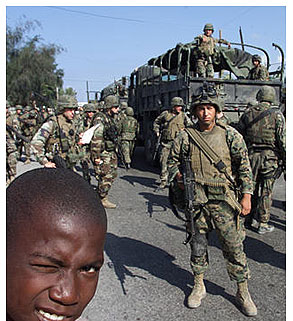
According to the Post, Bush was not involved in the decision to press for Aristide’s ouster nor was the president aware a decision had been made to ferry Aristide into exile. When Aristide was flown out of the country on Feb. 29, Bush had to be awakened from his slumber by a late-night phone call from Rice to inform him. It was only then that he authorized the deployment of U.S. Marines to quell the violence in Haiti.

Aristide’s corruption and authoritarianism may have justified his ouster in the eyes of his opponents, but now that he is gone, is Haiti any better off?

The answer, at present, is that by giving anti-Aristide figures in Washington and Haiti a free hand, the Bush administration has created a situation worse than the one it inherited — and one reminiscent of Iraq after the fall of Saddam. In the wake of Aristide’s departure, widespread looting erupted across Haiti; well-armed thugs terrorized businesses and ravaged the country’s public infrastructure. Virtually every prison in the country was emptied, freeing both common criminals and human rights violators — including Stanley Lucas’ notorious cousin, Remy.

Many Haiti experts, including Trinity College’s Maguire, project the next elections there will be held sometime in the next two years. For now, Haiti’s president is Gerard Latortue, a former World Bank official hailed by Florida Gov. Jeb Bush in a March 23 Washington Post editorial for his “integrity and selfless service.” Yet with no domestic constituency, Latortue has had to kowtow to Phillippe and the insurgents, whom he has publicly called “freedom fighters.” Like another Bush-installed leader — Afghan President Hamid Karzai, whose shaky administration relies on U.N. peacekeeping forces concentrated in his country’s capital — Latortue’s government wields little authority: According to a June 15 press release from the nonpartisan Council on Hemispheric Affairs in Washington, in addition to many hundreds of Aristide supporters murdered inside Port-au-Prince itself, convicted criminals, former paramilitary leaders and other vigilantes retain effective control of most of the Haitian countryside.

And, as it did with European governments on Iraq, the Bush administration’s Haiti policy has provoked a diplomatic crisis in the Caribbean basin: Over four months after Aristide’s departure from Haiti, the 15-nation Caribbean Community still refuses to recognize Latortue’s government, and in June the OAS opened an investigation into Aristide’s ouster. U.S. troops handed over control of the peacekeeping mission in Haiti to the U.N. on June 20.

“One has to be very concerned with the country’s direction,” says Maguire. “An awful lot of people who have been discredited in the past for abusing power and people have been climbing back into government. So far there is no sign that the new government or the U.S. will confront these antidemocratic forces.”

An April press release from the independent Haitian factory workers’ union, Batay Ouvriye, made an urgent plea:

“There is no person legitimately in charge anywhere. A whole series of upstarts have taken advantage of this situation to set themselves up as the authorities, as chiefs, and, in the process, the people are really suffering. THIS SITUATION CANNOT CONTINUE!”

Max Blumenthal is a freelance writer based in Los Angeles.

Media turns to disaster porn to keep an audience

Cable news would rather discuss Haiti's natural disaster than its man-made one

  • more
    • All Share Services

Media turns to disaster porn to keep an audienceBrian Williams

The black T-shirt — so tight, so come-hither. And oh, those safari button-downs — joke-worthy on Eddie Bauer mannequins, but on news correspondents, so … enticing.

America missed these sartorial seductions, pined for their sweet suggestive nothings. And now, finally, a nation of television addicts can thank its disaster pornographers for bringing back the lurid garments — and the lustful voyeurism they evoke.

Yes, thousands of miles from the San Fernando Valley’s seedy studios, the adult entertainment business is alive and panting in Haiti. This year’s luminaries aren’t the industry’s typical muscle-bound mustaches of machismo — they are NBC’s Brian Williams pillow-talking to the camera in his Indiana Jones garb, CNN’s Sanjay Gupta playing doctor and, of course, CNN’s Anderson Cooper in that two-sizes-too-small T-shirt “rarely missing an opportunity to showcase his buff physique,” as The New York Times gushed. They are all the disaster porn stars in the media with visions of Peabodys and Pulitzers dancing in their heads.

And we the ogling people drink it in.

Like any X-rated content, this smut is all flesh and no substantive plot. The lens flits between body parts and journalists pulling perverse Cronkite-in-Vietnam impressions (at one point, CNN showed Cooper and his T-shirt saving a child). But there is little discussion of how western Hispaniola was a man-made disaster before an earthquake made it a natural one.

Though neighboring the planet’s wealthiest nation, Haiti has long been one of the world’s poorest places. It sports 80 percent unemployment and a GDP smaller than the annual executive bonus fund at a single Wall Street bank. The destitution is tragic — and a reflection, in part, of colonial domination.

For much of the last two centuries, Western powers used embargo threats to force the country’s population of erstwhile slaves to reimburse their former European masters for lost “property.” As Harvard’s Henry Louis Gates recounts, America aided these efforts from the beginning because President Thomas Jefferson feared a successful black republic would “inspire slave insurrections throughout the American South.”

Crushed by this oppression, Haiti was then assaulted in the 1990s by American “free” trade policies that destroyed its agriculture economy and tried to turn the country into the world’s sweatshop. In recent years, as the menace of Western-backed coups lurked, Haiti has at times been compelled to pay more interest on its debt than it received in foreign aid.

This is the real story of Haiti that the black T-shirts and safari button-downs (and, alas, their viewers) have never cared about. They’ve only noticed the country when a cataclysm provided more telegenic images than the daily death and despair of the island’s pre-earthquake squalor.

Even now, as the casualty count rises, disaster pornographers barely mention the macabre history. They know that doing so would break unspoken rules against holding up a foreign policy mirror to America and against riling the politicians and business interests that contributed to Haiti’s demise.

Rather than reporting on what made Haiti so poor and therefore its infrastructure so susceptible to collapse, we get clips of Haitians momentarily cheering “USA!” as food packages trickle into their devastated capital. Rather than inquiries about how poverty made Haiti so ill-prepared for rescue operations, the disaster pornographers instead obediently follow George W. Bush, who self-servingly says, “You’ve got to deal with the desperation and there ought to be no politicization of that.”

“Politicization” — so that’s the safe-for-TV euphemism they’re using these days, huh? Evidently, it must be avoided — evidently, nothing kills an audience’s heaving passion faster than “politics” or (God forbid) contextualized news.

Anything like that — anything beyond the exploitation of raw disaster porn — well, it might ruin the money shot. 

Continue Reading Close
David Sirota

David Sirota is a best-selling author of the new book "Back to Our Future: How the 1980s Explain the World We Live In Now." He hosts the morning show on AM760 in Colorado. E-mail him at ds@davidsirota.com, follow him on Twitter @davidsirota or visit his website at www.davidsirota.com.

The view from the Port-au-Prince airport

My grand tour of the least glamorous of the Caribbean islands: Hispaniola. Plus: Landing without "radar" in Haiti

  • more
    • All Share Services

The view from the Port-au-Prince airportThis GeoEye-1 satellite image taken from 423 miles in space at 1037 am EST (1537 GMT) January 16, 2010, shows Port-au-Prince International Airport with multiple aircrafts, supplies and personnel on the ground. World leaders have pledged massive assistance to rebuild Haiti after the earthquake killed as many as 200,000 people, but five days into the crisis aid distribution was still random, chaotic and minimal. REUTERS/GeoEye Satellite Image/Handout (HAITI - Tags: DISASTER ENVIRONMENT) FOR EDITORIAL USE ONLY. NOT FOR SALE FOR MARKETING OR ADVERTISING CAMPAIGNS(Credit: Reuters)

Hispaniola, 1999.

“Sorry, no, it’s too dangerous,” says the driver.

“Um. OK.” To the best of my knowledge and experience, Port-au-Prince is the only place in the world where a cabby will refuse a $20 bill to take a pilot into town for a quick tour. Where else, I don’t know. Maybe Monrovia or Freetown during the wars there?

I’m in Haiti for 90 minutes, on a two-stop turn out of Miami. I was awake before dawn to the roar of the air-conditioning unit when the phone rang, the scheduler rattling off the report time for an afternoon trip to Port-au-Prince and Santo Domingo — a three-leg out-and-back.

This means a grand tour of sorts of Hispaniola, the island shared in an east-west split between Haiti and the Dominican Republic, whose capitals we’ll be stopping in. The border between these nations is one of the few international demarcations clearly visible from 30,000 feet — the latter’s green tropical carpet abutting a Haitian deathscape of denuded hillsides the color of sawdust. You could argue that Hispaniola is perhaps the least glamorous landfall in the Caribbean. But you can’t beat the weather and the on-board pineapple tray.

With nothing else to do I wander the Port-au-Prince apron. Behind our dormant freighter a row of scarred, treeless hills bakes in the noon heat, raped for charcoal by millions of hungry Haitians. In front of the terminal, men ride past on donkeys and women balance baskets atop their heads. Somebody has started a cooking fire on the sidewalk. Haiti is the poorest country in the entire Western Hemisphere, and the squalor along the airport perimeter is at least as distressing as anything I’ve seen in Africa.

And, how to say this, it smells. If you’ve ever been to the tropics, maybe you’ll understand: It’s not a bad or foul smell, necessarily, and this isn’t to be taken as some Ugly American pejorative of things foreign or other-skinned. But it’s pungent. For those who live with changing seasons, it’s like the smell of a neighbor’s fireplace or wood stove on the first cold night of the year. Except it has no season; it’s simply always there, ceaseless and permeating like the heat of the Sahara or the numbness of a glacier. It’s the odor of rain forests burned, of foliage, charcoal and garbage incinerated — these destructive, ubiquitous pastimes of the Third World — and it hits you the second you step from an airplane in almost every latitudinally challenged republic on earth.

I notice a pallet of large white drums being unloaded from our airplane. Something doesn’t look right — crew member intuition — and, concerned that we’d accidentally transported some hazardous material, I ask a loader if he knows what the barrels contain. A forklift carries them to a corner of a ramshackle warehouse, and the driver pries off one of the heavy plastic lids.

What’s revealed is a tangled white mass of what appears to be string cheese floating in dirty water. A vague, quiveringly rotten smell rises from the liquid. The driver sticks in his hand and gives the ugly congealment a churn. “For sausage,” he answers. What we’re looking at, it turns out, is a barrel full of intestines — casings to be stuffed with meat at some horrible Haitian factory. Why the casings need to be imported while the meat itself is apparently on hand, I can’t say, but somebody found it necessary to pay the shipping costs and customs duties to fly 400 gallons of intestines from Miami to Port-au-Prince.

Thirty-three minutes away is Santo Domingo, the filth-and-stucco capital of the Dominican Republic — or the D.R., as savvy travelers and baseball announcers love to call it. The neighborhoods around the airport are some of the poorest on the island, and we’re two days on the heels of a terrible storm. Most of the roofs are missing, and as our jet drops its tires and aims for the runway at Las Américas International, we look straight into the islanders’ concrete-block lives, their belongings violently mingled: plastic bags, rain-soaked clothes, corrugated tin. And in all directions are the triangular, tornado-shaped plumes of garbage fires.

What it lacks in glamour, maybe, Santo Domingo makes up for in history. This is the oldest capital in the New World. With some time to kill, I hire a taxi, this time with no resistance. I’m going to see Christopher Columbus, who died in Spain but whose remains, depending which historian you believe, are interred beneath the cathedral here.

To me there’s something about that name, Santo Domingo, that evokes images of 15th-century explorers, their gray-sailed ships anchored offshore. To others, maybe, it’s thoughts of the slave trade, of indigenous islanders keeling over from those special European gifts of smallpox and typhus. Or boats taking cannonballs through their hulls, bars of gold falling to the ocean floor.

As with every big capital down here, the whiteness of the skyline is striking. White paint is splashed over everything: hotels, apartment blocks, schools. From the highway it looms ahead, clusters of white buildings set against brilliant blue beachfront; against emerald hillsides; against the mushrooming, oil-black storm clouds. And as the taxi brings me closer, I taste and feel that tropical force of humanity and heat — a grimy ooze through every white crack.

Later, in darkness, we’re loading up for the leg home, as it were, to Miami. They’ve unloaded our pallets of automobile parts and tractor tires — tools that will help turn the landscape of this small country into parking lots and strip malls like the rest of the world — and soon we’ll be gone.

I’m in a foul mood, and our captain is a retired Air Force pilot who’s boring us to tears with embellished stories: adventures of earthquakes in Pakistan, crash landings in the Kenyan countryside. He’s old and his face is wrinkled and it makes me miserable to hear him, because who cares, really, about his stories, now that he’s just some old retired serviceman with three ex-wives who’s lost all his hair? And I feel myself, like a disease, turning into the next version of this guy.

I’m tired and I need a shower. I’ve got grease on my shirt. From the metal railing I see the moon. It’s an odd, eerily dangling crescent surrounded by an inky redness, like the moon of the Turkish flag. There’s something wild and strange about it.

- – - – - – - – - – - -

Reports by news outlets have stated that emergency efforts in Haiti have been hampered because the Port-au-Prince airport’s radar was knocked out. Can planes take off or land with no air traffic control radar?

First of all, so that everyone understands, “radar” is a somewhat generic term that can mean different things, the same basic technology used for different purposes. We have cockpit radar, for instance, which is used by crews to detect storms and precipitation. But in this context we’re talking about air traffic control (ATC) radar, which allows controllers to monitor the position, speed and altitude of flights, sequencing them appropriately. There are radar facilities for the higher, en route sectors of airspace, as well as local, or “terminal,” facilities that manage traffic coming and going from particular airports.

But while it might sound primitive, all around the world you will find airports, as well as large swaths of en route airspace, lacking radar coverage. Over the oceans, for example, and in much of Africa. Or at Port-au-Prince. It had no radar even before the earthquake.

Lack of radar means that flights are sequenced “manually” through the use of position reports. Planes on oceanic crossings are spaced by time and altitude along paths or longitude and latitude, sending periodic position reports to distant ATC facilities. In and around airports themselves, controllers handling arrivals and departures will often ask crews for updates on their exact bearing and distance to a particular radio beacon or point-in-space fix, as well as their altitudes, and space them accordingly. Holding patterns are sometimes assigned when multiple flights are inbound, and instructions to turn, climb or descend will sometimes be referenced to fixes, distances or radials. A takeoff clearance might include the following:

“Air Haiti 209, cleared for takeoff. Maintain runway heading until passing 3,000 feet, then turn right on course. Maintain 5,000 feet until passing the 340 radial from the PAP VOR.” Occasionally with climbs or descents there’s a time restriction: “Cleared to climb from level one-three zero to level two-four zero by time one-six four-five. Report reaching. Time now one-six three-five.” In other words, “You’ve got 10 minutes to climb from 13,000 feet to 24,000 feet, and let us know as soon as you get there.”

It sounds old-fashioned — and it is — but it works pretty well, albeit at a much slower pace than at radar-equipped airports. Luckily, if not necessarily, traffic tends to be light at most non-radar airports.

The congestion problem at Port-au-Prince isn’t about radar being “knocked out” (it wasn’t there in the first place), but rather the sudden influx of humanitarian flights into airspace — and tarmac space — that is normally uncrowded. Up to 200 aircraft a day have been arriving at Toussaint Louverture International, with some stacked in holding patterns for 90 minutes or more. At one point all inbound flights from the U.S. were “ground stopped” due to saturation on and around the airport.

In addition, the Port-au-Prince control tower was badly damaged, requiring U.S. military personnel to set up a temporary facility. The media was conflating the terms “control tower” and “radar.” Although tower controllers will use radar, if available, they are not the same things. The loss of the tower, from which aircraft are cleared to taxi, take off and land, was a much more critical issue than a lack of radar it never had.

Speaking of the media, I also heard a CNN reporter describe the Port-au-Prince airport rather emphatically as “tiny.” Not sure what that was about. While it might lack the room for dozens of military transport jets, it’s pretty spacious by Caribbean standards. It has a 10,000-foot runway and a wide rectangular apron.

There is no such thing as “Air Haiti,” by the way. Years ago a small company with that name existed, but today Haiti is one of relatively few countries around the world lacking a national airline. Two others in the region that jump to mind are Guyana and Belize.

As far as earthquakes go, I keep getting asked what might happen if a runway starts shaking just as a jet is taking off or landing. I really don’t know. It depends, I guess, on the severity of the shaking and the speed of the plane. I don’t know what a magnitude 7 temblor feels like, but suffice it to say things would get bumpy. Probably not bumpy enough, however, to damage anything, as aircraft are designed to withstand some pretty severe jolts. As we know, it’s not the shaking of the ground that kills and injures people, but rather buildings falling on top of them. Overall, a plane is probably a pretty safe place to be — much safer than a building.

A runway coming apart is another story. Striking a fissure at high speed would be dangerous — albeit statistically unlikely. I am not aware of anything like that ever happening, although the 1974 disaster film “Earthquake” features a scene where a 707 touches down just as a major temblor hits Los Angeles. The runway fractures and the crew executes a go-around just in the nick of time.

The last scheduled passenger flight to leave Port-au-Prince after the quake was an American Airlines flight to Miami. Presumably the crew ensured that runway conditions were safe. This would have been done by taxiing along the surface, and/or by sending a vehicle out to assess things.

- – - – - – - – - – - -

Do you have questions for Salon’s aviation expert? Contact Patrick Smith through his Web site and look for answers in a future column.

Continue Reading Close

Scientology to the rescue

John Travolta is bringing much-needed supplies to Haiti. The problem? He's also bringing L. Ron Hubbard

  • more
    • All Share Services

Scientology to the rescue

In the wake of the spectacular outpouring of relief to the people of Haiti, a number of generous benefactors have emerged. But few are alighting upon Port-au-Prince with quite as much baggage – for good and otherwise – as John Travolta.

Yesterday the 55-year-old actor did something extraordinary: He got off his ass and flew his own Boeing 707 from Florida down to Haiti with an astonishing four tons of ready-to-eat military rations and medical supplies. It is a gesture no one would look askance at in and of itself, particularly at a time when relief organizations like Doctors Without Borders have been having persistent problems getting into the beleaguered country.  We may raise a skeptical eyebrow at the fact that the famous movie star – and his lovely wife, Kelly Preston – just happened to arrive prepared for a camera-ready scene of unloading cargo, but it’s doubtful anyone in Haiti right now is saying, “Medical supplies? We would, but you really sucked in ‘Old Dogs.’”

Nevertheless, you can’t say “Travolta” without adding “outspoken Scientologist,” and that, inevitably, is where the story gets murky. Because along with all those desperately needed supplies that the dude graciously hauled down there, Travolta also packed something else – a phalanx of Scientology ministers.

This isn’t the first time a high-profile member of L. Ron Hubbard’s religion has rushed to the scene of disaster. Tom Cruise deployed himself to New York City after the 9/11 attacks — and eventually used his mission there as an opportunity to call the Environmental Protection Agency a bunch of “liars”  for their cleanup efforts. Scientology stayed on to help create the auspicious-sounding New York Rescue Workers Detoxification Project, treating firefighters who’d survived the attacks – and their lingering physical effects — through a “purification” program with no scientific credibility and for which some firefighters allegedly were asked to fork over as much as 5 grand. That’s why people get a little creeped out when Scientologists come to the rescue.

And knowing that when Travolta made a similarly swift and generous gesture toward the people of New Orleans after Katrina, the church similarly hustled off to the Gulf Coast to counsel survivors, one gets a sense that the shell-shocked victims of January’s quakes may be in for at the very least some old-fashioned Thetan dogma.

A U.N. spokeswoman told the Associated Press last week that at least 800 relief planes have been on a waiting list to get in to Haiti, which can only handle about 130 flights a day.  So when Travolta told reporters, “We have the ability to actually help make a difference in the situation in Haiti and I just can’t see not using this plane to help,” it’s hard to believe the impulse is coming from anything but a truly decent and altruistic place. (It also makes one wonder how he swung it.)

But missionary work almost always comes with a mix of well-intentioned altruism and occasionally flat-out troubling proselytizing. And spreading good works can also mean spreading some dubious philosophies — along with some troubling “cures.” And it’ll be interesting to see what Scientology, which has long been associated with celebrities who can afford the high cost of becoming “clear” will do in a country that was already the poorest in the Western hemisphere before an incalculable disaster.

The bottom line is, unless you’ve personally flown four tons of supplies to Haiti today, John Travolta has done more for its people and their immediate, life-or-death needs than you or I have or ever will.  It also doesn’t change that hair-on-the-back-of-the-neck sense of dread that come from watching a gift bestowed with what sure look like a whole pack of yellow-shirted “volunteer minister” strings attached. 

Continue Reading Close
Mary Elizabeth Williams

Mary Elizabeth Williams is a staff writer for Salon and the author of "Gimme Shelter: My Three Years Searching for the American Dream." Follow her on Twitter: @embeedub.

When the media is the disaster

In the wake of the Haiti earthquake, false depictions of victims as criminals hinder the relief effort

  • more
    • All Share Services

When the media is the disasterLeft: Haitian children line up to receive food at a food distribution site. Right: A woman defends herself as others try to take a bag she carried out of a damaged building in Port-au-Prince on Thursday.

Soon after almost every disaster the crimes begin: ruthless, selfish, indifferent to human suffering, and generating far more suffering. The perpetrators go unpunished and live to commit further crimes against humanity. They care less for human life than for property. They act without regard for consequences.

I’m talking, of course, about those members of the mass media whose misrepresentation of what goes on in disaster often abets and justifies a second wave of disaster. I’m talking about the treatment of sufferers as criminals, both on the ground and in the news, and the endorsement of a shift of resources from rescue to property patrol. They still have blood on their hands from Hurricane Katrina, and they are staining themselves anew in Haiti.

Within days of the Haitian earthquake, for example, the Los Angeles Times ran a series of photographs with captions that kept deploying the word “looting.” One was of a man lying face down on the ground with this caption: “A Haitian police officer ties up a suspected looter who was carrying a bag of evaporated milk.” The man’s sweaty face looks up at the camera, beseeching, anguished.

Another photo was labeled: “Looting continued in Haiti on the third day after the earthquake, although there were more police in downtown Port-au-Prince.” It showed a somber crowd wandering amid shattered piles of concrete in a landscape where, visibly, there could be little worth taking anyway.

A third image was captioned: “A looter makes off with rolls of fabric from an earthquake-wrecked store.” Yet another: “The body of a police officer lies in a Port-au-Prince street. He was accidentally shot by fellow police who mistook him for a looter.”

People were then still trapped alive in the rubble. A translator for Australian TV dug out a toddler who’d survived 68 hours without food or water, orphaned but claimed by an uncle who had lost his pregnant wife. Others were hideously wounded and awaiting medical attention that wasn’t arriving. Hundreds of thousands, maybe millions, needed, and still need, water, food, shelter, and first aid. The media in disaster bifurcates. Some step out of their usual “objective” roles to respond with kindness and practical aid. Others bring out the arsenal of clichés and pernicious myths and begin to assault the survivors all over again.

The “looter” in the first photo might well have been taking that milk to starving children and babies, but for the news media that wasn’t the most urgent problem. The “looter” stooped under the weight of two big bolts of fabric might well have been bringing it to now homeless people trying to shelter from a fierce tropical sun under improvised tents.

The pictures do convey desperation, but they don’t convey crime. Except perhaps for that shooting of a fellow police officer — his colleagues were so focused on property that they were reckless when it came to human life, and a man died for no good reason in a landscape already saturated with death.

In recent days, there have been scattered accounts of confrontations involving weapons, and these may be a different matter. But the man with the powdered milk? Is he really a criminal? There may be more to know, but with what I’ve seen I’m not convinced.

What Would You Do?

Imagine, reader, that your city is shattered by a disaster. Your home no longer exists, and you spent what cash was in your pockets days ago. Your credit cards are meaningless because there is no longer any power to run credit-card charges. Actually, there are no longer any storekeepers, any banks, any commerce, or much of anything to buy. The economy has ceased to exist.

By day three, you’re pretty hungry and the water you grabbed on your way out of your house is gone. The thirst is far worse than the hunger. You can go for many days without food, but not water. And in the improvised encampment you settle in, there is an old man near you who seems on the edge of death. He no longer responds when you try to reassure him that this ordeal will surely end. Toddlers are now crying constantly, and their mothers infinitely stressed and distressed.

So you go out to see if any relief organization has finally arrived to distribute anything, only to realize that there are a million others like you stranded with nothing, and there isn’t likely to be anywhere near enough aid any time soon. The guy with the corner store has already given away all his goods to the neighbors. That supply’s long gone by now. No wonder, when you see the chain pharmacy with the shattered windows or the supermarket, you don’t think twice before grabbing a box of PowerBars and a few gallons of water that might keep you alive and help you save a few lives as well.

The old man might not die, the babies might stop their squalling, and the mothers might lose that look on their faces. Other people are calmly wandering in and helping themselves, too. Maybe they’re people like you, and that gallon of milk the fellow near you has taken is going to spoil soon anyway. You haven’t shoplifted since you were 14, and you have plenty of money to your name. But it doesn’t mean anything now.

If you grab that stuff are you a criminal? Should you end up lying in the dirt on your stomach with a cop tying your hands behind your back? Should you end up labeled a looter in the international media? Should you be shot down in the street, since the overreaction in disaster, almost any disaster, often includes the imposition of the death penalty without benefit of trial for suspected minor property crimes?

Or are you a rescuer? Is the survival of disaster victims more important than the preservation of everyday property relations? Is that chain pharmacy more vulnerable, more a victim, more in need of help from the National Guard than you are, or those crying kids, or the thousands still trapped in buildings and soon to die?

It’s pretty obvious what my answers to these questions are, but it isn’t obvious to the mass media. And in disaster after disaster, at least since the San Francisco earthquake of 1906, those in power, those with guns and the force of law behind them, are too often more concerned for property than human life. In an emergency, people can, and do, die from those priorities. Or they get gunned down for minor thefts or imagined thefts. The media not only endorses such outcomes, but regularly, repeatedly, helps prepare the way for, and then eggs on, such a reaction.

If Words Could Kill

We need to banish the word “looting” from the English language. It incites madness and obscures realities.

“Loot,” the noun and the verb, is a word of Hindi origin meaning the spoils of war or other goods seized roughly. As historian Peter Linebaugh points out “At one time loot was the soldier’s pay.” It entered the English language as a good deal of loot from India entered the English economy, both in soldiers’ pockets and as imperial seizures.

After years of interviewing survivors of disasters and reading firsthand accounts and sociological studies from such disasters as the London Blitz and the Mexico City earthquake of 1985, I don’t believe in looting. Two things go on in disasters. The great majority of what happens you could call emergency requisitioning. Someone who could be you, someone in the kind of desperate circumstances I outlined above, takes necessary supplies to sustain human life in the absence of any alternative. Not only would I not call that looting, I wouldn’t even call that theft.

Necessity is a defense for breaking the law in the United States and other countries, though it’s usually applied more to, say, confiscating the car keys of a drunk driver than feeding hungry children. Taking things you don’t need is theft under any circumstances. It is, says the disaster sociologist Enrico Quarantelli, who has been studying the subject for more than half a century, vanishingly rare in most disasters.

Personal gain is the last thing most people are thinking about in the aftermath of a disaster. In that phase, the survivors are almost invariably more altruistic and less attached to their own property, less concerned with the long-term questions of acquisition, status, wealth, and security, than just about anyone not in such situations imagines possible. (The best accounts from Haiti of how people with next to nothing have patiently tried to share the little they have and support those in even worse shape than them only emphasize this disaster reality.) Crime often drops in the wake of a disaster.

The media are another matter. They tend to arrive obsessed with property (and the headlines that assaults on property can make). Media outlets often call everything looting and thereby incite hostility toward the sufferers as well as a hysterical overreaction on the part of the armed authorities. Or sometimes the journalists on the ground do a good job and the editors back in their safe offices cook up the crazy photo captions and the wrongheaded interpretations and emphases.

They also deploy the word “panic” wrongly. Panic among ordinary people in crisis is profoundly uncommon. The media will call a crowd of people running from certain death a panicking mob, even though running is the only sensible thing to do. In Haiti, they continue to report that food is being withheld from distribution for fear of “stampedes.” Do they think Haitians are cattle?

The belief that people in disaster (particularly poor and nonwhite people) are cattle or animals or just crazy and untrustworthy regularly justifies spending far too much energy and far too many resources on control — the American military calls it “security” — rather than relief. A British-accented voice-over on CNN calls people sprinting to where supplies are being dumped from a helicopter a “stampede” and adds that this delivery “risks sparking chaos.” The chaos already exists, and you can’t blame it on these people desperate for food and water. Or you can, and in doing so help convince your audience that they’re unworthy and untrustworthy.

Back to looting: of course you can consider Haiti’s dire poverty and failed institutions a long-term disaster that changes the rules of the game. There might be people who are not only interested in taking the things they need to survive in the next few days, but things they’ve never been entitled to own or things they may need next month. Technically that’s theft, but I’m not particularly surprised or distressed by it; the distressing thing is that even before the terrible quake they led lives of deprivation and desperation.

In ordinary times, minor theft is often considered a misdemeanor. No one is harmed. Unchecked, minor thefts could perhaps lead to an environment in which there were more thefts and so forth, and a good argument can be made that, in such a case, the tide needs to be stemmed. But it’s not particularly significant in a landscape of terrible suffering and mass death.

A number of radio hosts and other media personnel are still upset that people apparently took TVs after Hurricane Katrina hit New Orleans in August 2005. Since I started thinking about, and talking to people about, disaster aftermaths I’ve heard a lot about those damned TVs. Now, which matters more to you, televisions or human life? People were dying on rooftops and in overheated attics and freeway overpasses, they were stranded in all kinds of hideous circumstances on the Gulf Coast in 2005 when the mainstream media began to obsess about looting, and the mayor of New Orleans and the governor of Louisiana made the decision to focus on protecting property, not human life.

A gang of white men on the other side of the river from New Orleans got so worked up about property crimes that they decided to take the law into their own hands and began shooting. They seem to have considered all black men criminals and thieves and shot a number of them. Some apparently died; there were bodies bloating in the September sun far from the region of the floods; one good man trying to evacuate the ruined city barely survived; and the media looked away. It took me months of nagging to even get the story covered. This vigilante gang claimed to be protecting property, though its members never demonstrated that their property was threatened. They boasted of killing black men. And they shared values with the mainstream media and the Louisiana powers that be.

Somehow, when the Bush administration subcontracted emergency services — like providing evacuation buses in Hurricane Katrina — to cronies who profited even while providing incompetent, overpriced and much delayed service at the moment of greatest urgency, we didn’t label that looting.

Or when a lot of wealthy Wall Street brokers decide to tinker with a basic human need like housing … Well, you catch my drift.

Woody Guthrie once sang that “some will rob you with a six-gun, and some with a fountain pen.” The guys with the six guns (or machetes or sharpened sticks) make for better photographs, and the guys with the fountain pens not only don’t end up in jail, they end up in McMansions with four-car garages and, sometimes, in elected — or appointed — office.

Learning to See in Crises

Last Christmas a priest, Father Tim Jones of York, started a ruckus in Britain when he said in a sermon that shoplifting by the desperate from chain stores might be acceptable behavior. Naturally, there was an uproar. Jones told the Associated Press: “The point I’m making is that when we shut down every socially acceptable avenue for people in need, then the only avenue left is the socially unacceptable one.”

The response focused almost entirely on why shoplifting is wrong, but the claim was also repeatedly made that it doesn’t help. In fact, food helps the hungry, a fact so bald it’s bizarre to even have to state it. The means by which it arrives is a separate matter. The focus remained on shoplifting, rather than on why there might be people so desperate in England’s green and pleasant land that shoplifting might be their only option, and whether unnecessary human suffering is itself a crime of sorts.

Right now, the point is that people in Haiti need food, and for all the publicity, the international delivery system has, so far, been a visible dud. Under such circumstances, breaking into a U.N. food warehouse — food assumedly meant for the poor of Haiti in a catastrophic moment — might not be “violence,” or “looting,” or “law-breaking.” It might be logic. It might be the most effective way of meeting a desperate need.

Why were so many people in Haiti hungry before the earthquake? Why do we have a planet that produces enough food for all and a distribution system that ensures more than a billion of us don’t have a decent share of that bounty? Those are not questions whose answers should be long delayed.

Even more urgently, we need compassion for the sufferers in Haiti and media that tell the truth about them. I’d like to propose alternative captions for those Los Angeles Times photographs as models for all future disasters:

Let’s start with the picture of the policeman hog-tying the figure whose face is so anguished: “Ignoring thousands still trapped in rubble, a policeman accosts a sufferer who took evaporated milk. No adequate food distribution exists for Haiti’s starving millions.”

And the guy with the bolt of fabric? “As with every disaster, ordinary people show extraordinary powers of improvisation, and fabrics such as these are being used to make sun shelters around Haiti.”

For the murdered policeman: “Institutional overzealousness about protecting property leads to a gratuitous murder, as often happens in crises. Meanwhile countless people remain trapped beneath crushed buildings.”

And the crowd in the rubble labeled looters? How about: “Resourceful survivors salvage the means of sustaining life from the ruins of their world.”

That one might not be totally accurate, but it’s likely to be more accurate than the existing label. And what is absolutely accurate, in Haiti right now, and on Earth always, is that human life matters more than property, that the survivors of a catastrophe deserve our compassion and our understanding of their plight, and that we live and die by words and ideas, and it matters desperately that we get them right.

At the dawn of the millennium, three catastrophes were forecast for the United States: terrorists in New York, a hurricane in New Orleans, and an earthquake in San Francisco. Rebecca Solnit lives in San Francisco with her earthquake kit and is about to make her seventh trip to New Orleans since Katrina. Her latest book, “A Paradise Built in Hell,” is a testament to human bravery and innovation during disasters.

Continue Reading Close

Rebecca Solnit grew up in California public libraries and is thrilled to be revisiting them all over the state as part of the Cal Humanities California Reads project, which is now featuring five books, including her A Paradise Built in Hell: The Extraordinary Communities That Arise in Disaster.

Haiti loses feminist leaders

Three women's rights activists are among the earthquake's casualties

  • more
    • All Share Services

Three leading women’s rights activists can be added to the tragically long list of those confirmed dead from last week’s Haitian earthquake. Magalie Marcelin, Anne Marie Coriolan and Myriam Merlet all made tremendous strides in combating rape and domestic violence in the country — and they all died under the rubble, CNN’s reports.

Marcelin a lawyer and actress in her 50s, founded the women’s rights organization Kay Fanm, which supports victims of domestic violence. The similarly-minded Myriam Merlet helped start domestic violence shelters in Port-au-Prince and campaigned to get Eve Ensler to bring “The Vagina Monologues” to Haiti. The 53-year-old was also a top adviser for the country’s Ministry for Gender and the Rights of Women and a founder of the feminist organization Enfofamn. Coriolan, a 53-year-old sociologist, was also a top adviser for the gender ministry and founded the group Solidarity with Haitian Women. She fought fiercely for courts to take rape seriously as a tool of war and not a “crime of passion,” as it had been.

These would be tragic losses under normal circumstances, but they are even more so considering the vulnerable state of Haiti’s women in the wake of this catastrophe; they could use these activists’ help like never before. In memory of this admirable humanitarian trio, I’ll leave you with a video clip of Democracy Now’s tribute to Merlet.

Continue Reading Close
Tracy Clark-Flory

Tracy Clark-Flory is a staff writer at Salon. Follow @tracyclarkflory on Twitter.

Page 1 of 38 in Paul Shirley