Jeff Nachtigal

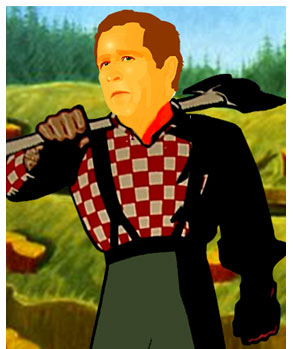
They’re lumberjacks and they’re not OK

Residents of rural logging communities like Hayfork, Calif., hoped the Bush administration's fuel-reduction plan would help them escape poverty. But as Bush slashes economic assistance programs and turns to Big Timber to do the work, their dreams are going up in smoke.

  • more
    • All Share Services

They're lumberjacks and they're not OK

In the Hayfork Watershed Research and Training Center a wall is devoted to monitoring the socioeconomic health of the town’s 1,800 residents. The numbers are not pretty: 80 percent of the town’s kids use the free breakfast and lunch programs at school; 24 percent of the community is unemployed; rising numbers of families are requesting food stamps. The soup kitchen and free showers aren’t quantifiable, but everyone knows where to find them.

For generations logging was the economic engine of Hayfork, Calif., but the days of pulling big trees out of the forest are gone. Regular paychecks are few and far between, and people hang on by stringing together odd jobs and piecemeal work. Many members of the younger generation have moved to urban areas to find work. The biggest emerging industry in Hayfork is signaled by a surge in the number of methamphetamine labs. Every year for the past decade the economic news has grown worse: fewer signs for meaningful, long-term work; more kids in poverty.

The town of Hayfork, which sits in the middle of the Shasta-Trinity National Forest 200 miles north of San Francisco, is similar to thousands of other rural communities in the West that have faced economic crisis over the past decade. Like all other communities situated next to the forest, Hayfork also faces the threat of wildfire every summer and fall. But, paradoxically, fire and a planned shift to forest-restoration-based jobs sparked a ray of economic hope for the town. In 1989, in a move to help rural logging communities become self-sufficient, the first Bush administration created the Economic Action Program. New wood-products industries got money for retraining, technical assistance and marketing so that communities could use smaller, historically “lower-value” trees. Furniture, wood floors and biomass energy were among the fledgling cottage industries, with forest conservation and economic stability the prevailing goal. Along with fire-prevention plans such as an effort at comprehensive fuel reduction in forests, the new industry of forest restoration promised the chance of a livelihood.

But the second Bush administration has undone the work of the first. Even as it has touted its Healthy Forests Restoration Act, billed as a way to reduce wildfires by returning forests to their natural, healthy state, Bush has been wielding a budget-cutting ax. In 2001, the Bush administration slashed EAP funding to the bone. In the three years since, Congress returned some EAP money to the budget, but in 2004 rural communities lost all EAP funding. Hayfork struggled even when it had grants; without them it is teetering on disaster.

Rural forest communities in the West have long held to conservative principles, and Bush has counted them as one of his key constituencies. But that base, estimated by the Western Governors’ Association to number over 11,000 communities, is eroding as he cold-shoulders small towns in favor of big business in the growing debate over how to save our national forests. Communities like Hayfork expected to be included in the planning for forest restoration and to receive economic benefits resulting from legislation like the Healthy Forests Restoration Act. But so far the promises of the bill, like the winds that blow ahead of forest fires, have amounted to little more than hot air.

Last December, as environmentalists howled over the Healthy Forests Restoration Act’s streamlining processes — which raised the image of big timber running rampant in the woods logging old-growth trees — rural communities looked at the act with hope. The HFRA was the Bush administration’s answer to the dangerous buildup of fuel in federal forests, and for rural communities the act suggested there would be chance for them to benefit from Forest Service fuel-reduction dollars.

Given their history of logging and their in-depth knowledge of the local forests — and because they have perhaps the highest stake in reducing wildfire risk because it is their homes that burn first — rural forestry workers seem the logical choice to do fuel-reduction work. As one forest community advocate pointed out, “They live in forests because they are forest people, and they are terribly concerned about the demise of the forest.”

More specifically, the people in Hayfork expected to have regular meetings with the Forest Service to discuss forest-restoration plans, including those for fuel-reduction projects funded under HFRA, and to go over how they might collaborate with the Forest Service in doing the work. But although Congress authorized such meetings, funding was not set aside for them in the final bill. Thus, with no budget for planning meetings the Forest Service has had little incentive to talk to local communities and has instead given contracts for restoration projects to big companies.

Lynn Jungwirth, director of the Watershed Research and Training Center, seethes over the fact that EAP grants and HFRA projects are out of reach for her community.

“There’s been a lot of forward thinking in local communities that pull themselves up by their bootstraps, and now they have to take time out to fight for a program [EAP] that’s only $35 million. That’s nothing. We’re not talking about a $500 million program here,” Jungwirth says. “This one is a very good use of taxpayer dollars.”

Jungwirth has seen firsthand how much help the EAP grants have brought to rural communities. Her husband, Jim Jungwirth, was one of the first recipients of EAP support in Hayfork. His wood-flooring business, which uses small-diameter timber that in the past was not considered valuable, has been a success. The business now has 12 employees.

Frustration is evident in her voice as Jungwirth explains how Hayfork had become a national leader in innovation, working with the Forest Service and experimenting with new business ideas. She is stunned that her community, which played such a role in the EAP plans, is still mired in poverty.

Jungwirth and Maia Enzer, the director of Sustainable Northwest, a nonprofit based in Portland, Ore., that works to promote the interdependence of economies and environmental health in rural communities, have heard a litany of excuses as to why EAP funding has been cut. Among the choicest responses from legislators: “It’s not one the jobs of the Forest Service to work with rural communities” and “There’s a war on.” Only sustained, intense pressure resulted in some of the money being restored, Enzer says.

“We know what the EAP economic action program does,” Jungwirth says. “It creates a consensus at the local level so more restoration work gets done on public ground than they’ve done in their own programs. We’re that small investment that has such a big multiplier effect. We hope it is not this administration’s way of saying, ‘We think we already have the votes from the West, so we don’t need to help them anymore.’”

Enzer puts it this way: “Rural people don’t have a lot of votes, it’s easier to pick on our program, we don’t have much a voice. In terms of reality, this has been devastating for those of us who helped them get restoration work done for wildlife habitat.”

Collaborative planning and forest restoration were key parts of the 10-year National Fire Plan, created by the Western Governors’ Association in 2000. Through grants and community meetings, the wide-ranging effort sought input from a vast number of parties to create a plan to prepare communities for wildfire. The Healthy Forests Restoration Act superseded much of the NFP’s collaborative processes and instituted a top-down management style that consolidates decision making with the Forest Service and to a smaller extent the Bureau of Land Management. Rural towns have been pushed further out of the loop of restoration projects and fire-safety planning.

Hayfork feels especially stung by the government’s abandonment because the community played a key role in developing the fire plans now used by the Forest Service. Jungwirth estimated that Hayfork had already raised nearly $3 million in grants and “bake sale money” for fire planning, fire breaks, and fuel-reduction projects.

Jungwirth repeatedly stresses that without appropriating money for planning at the local level, “money never gets to the ground.”

“Communities have built these templates, but if there is not funding for that work, and funding for the [Forest Service] agency staff to participate in meetings, then you can’t do it, Jungwirth says. “The rhetoric is there, but reality isn’t.”

A spokesperson for the Forest Guild blasted the Bush administration’s 2005 budget for not providing enough funds for restoration activities, noting that “unrealistic expectations will likely drive the Forest Service to cut down merchantable timber to pay for the real cost of forest thinning.” Although the budget for 2005 requests the same $760 million as in 2004, Mark Rey, the undersecretary for natural resources and the environment and a former timber industry lobbyist widely described in the environmental community as a “fox in the henhouse,” admitted that a majority of that total will come from “reprogramming,” or the shifting of funds from other programs. Those other programs are almost certain to include economic development programs.

“There are monies in our annual budget to accomplish that type of work,” says Forest Service planning officer Bill Branham, defending the current allocations the Forest Service makes for collaborating with local communities. “Locally we feel there are sufficient funds to have that work, to hold meetings and conduct outreach. There may be places in the nation where there is not enough money, but locally I don’t see that as a constraint.”

Branham, who plans timber sales out of the Weaverville Ranger Station in Trinity County, Calif., is familiar with the hardships of rural communities and knows that people are hoping to find contract work through the HFRA.

“There is a feeling that the Forest Service has been slow to respond for the demand to put people to work. Some of that is due to the planning timeline to approve projects, and that gets back to the Endangered Species Act. We need to do surveys to comply with that law.”

In the case of large timber harvests, Branham explained that the buyer was free to hire any logging contractor it chose. And in turn, the contractor could hire any workers it chose, whether they were local or not.

Branham says the reality for rural communities such as Weaverville or Hayfork is that the HFRA will not lead to significant economic changes over the long term.

“Funding for fuels-reduction work is declining in the next few years, and the money to do the work is declining and going to places with higher priority to do the work, such as Southern California, where there are lots more people, as opposed to Trinity County. The priority is to put the money where the people are.”

“The bang is not here for the politician’s buck. And at the same time, there is a dramatic need for that type of fuel-treatment work, because we are surrounded by heavy fuels.”

Jungwirth says the overall system is biased toward big industry, but that giving in to Big Timber’s lobbyists doesn’t necessarily mean local job growth. The big companies bring in mobile work crews that clear out brush or cut down marketable timber, and then move on to the next location.

“We decided to look at what the economic opportunities through public land restoration and maintenance were, because we knew it was happening,” Jungwirth recounted. “We tracked it on a GIS map and found out that the work was going to mobile crews on the I-5 corridor, and locals were getting only 7 percent of that work. That’s when we decided that we’ve got to change the system and get organized on a national level.”

In the grand theme of forest restoration, former logging communities have accepted and embraced the idea that they can survive by positioning themselves as long-term stewards of the forests. Clearing underbrush and overgrown fuels from 191 million acres of national forest land is one of the stated goals of the HFRA, and is where local stewardship plays a major role. Although it is easier for a Forest Service contracting officer to hire one big company so that he manages just one fuel-reduction contract, cutting out the local workforce is ignoring the chance for long-term forest restoration from willing stewards. Forest communities are eager to take on the tough, labor-intensive work, and at the same time they want a more integrated approach to restoration that stresses long-term health for forests and communities.

“What are you going to do afterwards?” Enzer wonders. “It’s not just removing the fuels. If you build a fuel break and don’t maintain it, that’s not an efficient use of your money. You can’t just do it once. You need people in place to keep it working.”

Enzer envisions generational poverty on an Appalachian scale for Western communities if they are ignored by restoration projects that could help to rebuild a rural working class.

“We did industrial forestry, but I don’t think industrial restoration is the right scale to get this done,” Enzer says. “Everybody loses doing it that way: forests, local communities and the public, because we’re not fixing the problem and it’s a very shortsighted approach to forest health.”

Paychecks are one side of the coin in rural communities, and the threat of wildfires is the other. The Forest Guild’s director, Laura McCarthy, told a Senate subcommittee last month that the Healthy Forests Restoration Act was falling short on funding for community wildfire-protection plans. Without the seed money from those grants, prevention efforts don’t get started and the fire risk increases.

“It feels like HFRA made a big difference to the agencies to be able to do streamlines — or maybe not, because we don’t know yet about court cases — but in terms of rural communities, they don’t feel safer from wildfires,” McCarthy says.

The lack of funding for economic stimulus grants and community wildfire protection at the rural level reflects larger questions about Bush’s real motivations.

The Bush administration’s rollback of Clinton’s “roadless rule” will open up some 60 million acres of forest to road building, tying neatly into not-so-subtle administration suggestions that it would like to use commercial logging to pay for fuel-reduction projects. This shift toward industry over environmental ethics is no surprise from the Bush administration, but it is an especially bitter pill when taken along with broken forest-restoration promises.

Already this year the total amount of wildfire-burned acreage has surpassed the acreage burned in 2003, including the devastation from the Southern California wildfires that prompted the passage of the HFRA. The 2004 acre burn total is double the average of the past decade. Firefighting occupies the public’s mind as the best way to control wildfires, but the reality is that fire suppression doesn’t work very well at all. Removing the massive amount of kindling that has built up over the past century is the best way to curb fires and maintain healthier forests. Yet fire suppression continues to suck a huge portion out of the budget compared with fuel reduction, despite the promises of HFRA.

“What the administration did was really shortchange HFRA,” says Jay Watson, director of the wildland fire program for the Wilderness Society. “And despite all the rhetoric, it would appear that their commitment to act isn’t all that significant.”

“At the very least it is an opportunity lost to provide communities with real protection.” Whether or not it leads to a lot of logs for the timber industry remains to be seen. In some ways the biggest beneficiary is the Forest Service itself.”

When John Kerry elevated the discussion about forest restoration to the campaign level with his $100 million Forest Conservation Corps, which proposes to reduce subsidies to the timber industry to create new jobs and promote the long-term health of the forests, Lynn Jungwirth was pleased. She’s heartened that both parties are treating the forests as an election-year issue. But she’ll hold off passing judgment until rural communities see some of the benefits.

“We’ve had a lot of talk, but as they say in the woods, ‘Talk is cheap. It takes money to buy whiskey.’”

We own what you think

For seven years, programmer Evan Brown has been fighting his former employer for ownership of an idea he came up with.

  • more
    • All Share Services

We own what you think

In July, the Texas Court of Appeals turned down software programmer Evan Brown’s appeal for a jury trial to decide who owned an idea in his head: Brown, or his former employer. The decision was a victory for business and a blow to the little guy, as well as an affirmation of standard employment-contract law. It’s also a cautionary tale for creative-minded information technology workers.

Seven years ago Brown told his employer, DSC Communications Corp., that he had figured out a system to translate data from old mainframe computer programs into modern computer languages, an innovation that would enable businesses to run their old software on much faster computers. Brown says he had been wrestling with the problem since 1975 and finally, while on vacation in 1996, he figured out the final 20 percent of the puzzle.

His original hope was to make a deal with DSC allowing him to continue working on his idea while still staying employed. But negotiations soon broke down, and within a year, DSC sued Brown, stating that his idea was the property of the company because he had signed an employment agreement giving the company ownership of any “inventions” he conceived or developed during his employment, with the exception of ideas that Brown had explicitly disclosed at the time of original employment. Brown, who ended up working for DSC for 10 years, said he had come up with the idea entirely on his own time and refused to give up the design.

By 1998, Paris-based Alcatel had purchased DSC. Alcatel continued to assert ownership of Brown’s idea, and after it failed to gain control when Brown filed for Chapter 13 bankruptcy, a summary judgment was issued in 2002 from the 219th Judicial District Court in Texas in favor of the company. Not only has Brown lost the rights to his idea, but he is also liable for Alcatel’s $332,000 attorneys’ fees. Brown says he will soldier on and is petitioning for review at the state court level.

The case turned on the issue of employment agreements, in which it is general practice for a company to claim the rights to any invention that an employee comes up with while in its employ. But the case also highlights the more complex issue of the value of ideas in the workplace, and how far intellectual property and ownership rights should extend in an age where the demarcation between thinking for the company and thinking for oneself is increasingly blurred.

“I dug my heels in from day one,” says Brown in a quiet Texas lilt a few days after his appeal was denied. “What they’re doing is wrong. It’s extortion. I had an idea, not an invention, and it was not in the scope of the work agreement. One idea that only exists in your head and that did not yet exist can’t be an invention … All I had was an idea.”

Brown, 54, lives in a barn “out in the sticks” in Hamilton County, Texas, where he “runs 20 cows and does some farming” when he is not researching his case at the Baylor University law library in Waco, Texas. It is a long way from the $104,000 annual salary he earned at DSC, and even further from what Brown estimated could be a “multimillion-dollar per year” business.

In 1996, with concern beginning to build about updating computers to avoid the much-feared Y2K “millennium bug,” Brown thought his idea, dubbed the “Solution,” could be highly valuable to companies and institutions that were hamstrung by elderly computer programs. Brown said he thought the program was particularly applicable in the areas of oil field pipelines, satellites and government weaponry, many of which were still running on decades-old code. DSC, which manufactured products for the telecommunications industry, was also interested in Brown’s idea and at one point offered him up to $2 million for the rights to develop it.

Letting one’s employer know that you have come up with a million-dollar idea on your own time may sound naive, but to Brown it was a matter of principle. Brown says he also knew that DSC had a history of suing former employees, so he decided to be straightforward, confident that DSC couldn’t claim to own what existed only in his head. He sent his supervisor a letter saying he had solved the design elements of the Solution and asked if the company would be interested in helping him develop it, which he says was 18 months away from implementation once he put it down on paper.

“I expected them to sign a release so I could work on my idea,” Brown says. “I had that feeling going in.”

When the relationship between Brown and Alcatel became acrimonious, the company sued, and the letter became a key issue in the case. “The killer was I used the word ‘solved,’ instead of using ‘solving,’” Brown explains. “I should have said that I’m working on an idea. That was the single most critical word out of whole lawsuit.” Brown, who describes himself as a “computer geek in cowboy boots,” is adamant that he developed his Solution completely on his own time.

“There are workaholics and normal people,” Brown says, describing the years during which he worked on his idea. “For normal people they put work aside, go home, have a family, play soccer, go swimming, and stay focused on that part of their life. I didn’t have any kids, and I didn’t go home and kick up my heels and watch football. I came home, went upstairs, got on the computer, and did my own work. I worked for DSC 40 hours a week, and the rest of the time was mine.”

“Alcatel’s attorneys made a big deal about that [letter], and said that it was evidence that the contract was enforceable, and it appeared to have a lot of weight with the judge,” says James C. Lai, a lawyer pursuing a postgraduate degree in the John Marshall Law School’s Information Technology and Privacy program. “From his perspective he showed good faith by dealing with his employer, and it happened to come back to bite him.”

The gist of Alcatel’s case is this: When Brown signed an employment agreement and continued to work for the company, he became bound by its provisions, including those that said that all inventions he came up with belonged to the company. Brown’s letter stating that he had “solved” the idea was proof that his idea was an invention and that he had come up with it while employed by Alcatel/DSC.

Brown challenged the enforceability of his employment agreement, saying that because his idea wasn’t complete and needed more work and that he had been developing the idea for many years before working for Alcatel, it was not an invention that could be patented and it could not be claimed by Alcatel. He also argued for a jury trial, instead of a summary judgment by one judge.

“What I found most remarkable about Evan Brown’s case was that this was the first time an intellectual-property agreement was enforced on something that didn’t yet exist,” says Lai, who criticized the decision in the Spring 2003 issue of the John Marshall Journal of Computer & Information Law. “I do think it is a big deal because this sets a precedent. It’s going to be binding precedent in Texas, and it certainly is something state courts might look at, especially if they have never faced this kind of case.”

Brown has been unemployed for the entire seven years of the lawsuit. Apart from holding on to their golden ideas, there is significant risk for employees like Brown who decide to fight with former employers over intellectual-property rights because “no one wants to buy a lawsuit, no matter how good the person is,” Lai says.

“I certainly think it could be a possibility, especially as the I.T. industry matures, that one of the scenarios is that an employer might rely on this decision as authority to stop people from changing jobs,” Lai says.

In a case littered with complexities, Brown may have erred by not taking the money and running, says Carl Khalil, a lawyer who runs a Web site offering advice to employees about breaking “non-compete” employment contracts.

“I hate to say this, and I’ve been a lawyer for 15 years,” Khalil says. “There’s an old saying in the stock market: ‘A bull can make money in the market and a bear can make money in the market, but a pig never can.’ Here’s a guy that should have taken the offer. With litigation you can hit a home run or strike out, so you’re better off at second base with the offer.”

Khalil says that an additional problem for Brown was that, in addition to turning down the settlement, he sent a memo on company time, using company equipment, saying “I have developed…” Khalil thinks the decision by the Texas court, normally friendly on employee issues of this nature, means that more employers will attempt similar legal action.

Marc Greenberg, the director of the Intellectual Property Law Program at Golden Gate University School of Law, says that Brown shot himself in the foot long before he sent the fateful memo in 1996.

“Brown’s claim that he had 80 percent of this idea completed in his mind before beginning employment at DSC is also a two-edged sword for him,” Greenberg wrote in an e-mail. “He views this as proof that DSC can’t claim ownership of it. However, he had an opportunity to disclose and separate this concept out from his employment agreement, and failed to do so. This hurts his argument, as it implies a waiver on his part.”

The “trafficking of ideas” is an important statute in the entertainment and telecommunications industries, and it is the reason that companies have developed employment contracts that cover intellectual-property issues. Greenberg points out that this is a common issue with academic research scientists: Any idea they have, unless explicitly written into a contract, is the property of the institution. Brown didn’t, which was his mistake.

“Brown’s case has a populist feel, a ‘they’re-stealing-my-mind feel to it,’ but as a matter of law, he doesn’t have a very strong case,” Greenberg says.

What Brown should have done instead, according to Greenberg, was either be more cagey about his inquiry about DSC partnering with him to finish off the Solution, or just plain quit. “Suppose Evan Brown had quit DSC and spent the next 18 months working on the Solution,” Greenberg posited. “What would they do? How could they prove that he had developed it on company time? His problem is, this way he looks like he wants the cake and to eat it too. The court looks at this and thinks he wants to work and collect benefits, and when he finally develops something he wants to quit and walk away.”

What every employee concerned about protecting their own ideas should do, the three lawyers wholeheartedly agree, is be very clear about what they are signing in an employment contract. If they do have a long-running idea, they should make clear in the contract that their idea was developed outside the company.

“Really what it boils down to is, read everything,” Lai says. “Don’t run into ambiguity as to when it’s in effect or not.” As for what this decision means for the future, Greenberg doesn’t think Brown’s case is unusual enough to prompt any significant changes in employment contract law.

As for Brown, he is understandably pessimistic. “Everyone would like to create a better mousetrap, start a business, and be successful,” Brown says, painting a picture of his own dream. “This says, Don’t worry about it, because whoever you’re working for, they own it. It’s not very good at all. It’s pretty depressing for creative people.”

Lai points out that both Texas courts declined to issue written opinions about Brown’s argument that he developed his idea on his own time, opening up a potential gray area in future cases. “Anytime you have situation where a company relies on the creative output of employees for revenue, you’re going to run into this type of situation,” Lai says. “I think this is by no means the last time we’re going to see a situation like this.”

Continue Reading Close

What’s that hissing sound?

Worried about oil running out? Don't look now, but natural gas is next on the endangered hydrocarbons list.

  • more
    • All Share Services

Oil prices hit an all-time high Monday, topping out at $44.97 a barrel. There are a bundle of immediate reasons — sabotage and war in Iraq, the showdown between the Yukos Oil Co. and the Kremlin in Russia, political instability in Venezuela — but there are also fundamental long-term forces pushing prices ever upward. Demand, particularly in countries such as India and China, is growing fast, but the supply is finite.

Still, among consumers in the United States, there appears to be little panic. The coming “oil peak” — that moment when worldwide production of oil reaches its high point — is in the news, but Detroit keeps turning out SUVs, freeways are perpetually jammed, and prices at the pump — so far — have not inspired many of us to cut back.

Our devil-may-care attitude about energy is fueled in large part by an economic principle of “substitutability,” in which we depend on new sources of energy to take the place of the old. But when the oil spigots finally run dry — whether in a few years or a few decades — the next hydrocarbon on the list (and possibly the last, depending on how you count coal) will be natural gas. But if we blow through natural gas in the same reckless manner as we have oil, we’re in for a serious shock, argues Julian Darley in his new book, “High Noon for Natural Gas.”

Darley is a self-described “environmental philosopher” who specializes in researching “non-market and non-technology-based responses to global environmental degradation.” The primary thrust of “High Noon for Natural Gas” is that, unless we unplug as much as we can from our energy-dependent ways, we’re headed off a cliff, and the crash at the bottom won’t be pretty.

As with oil, gauging the peak of natural gas production is an inexact science. The best estimates suggest that oil production will hit its all-time high sometime between 2008 and 2035. But already, in 2002, the world discovered fewer reserves of untapped natural gas than it consumed that year — a clear portent of eventual production declines.

Still relatively plentiful, natural gas will for some time fill the gap left by dwindling oil reserves. But if we move merrily on to the next readily available energy source without dramatically changing our gluttonous energy consumption habits, we will only be prolonging the inevitable, Darley says, and will end up throwing ourselves into the “carbon chasm.”

Darley blames the uncontrollable growth of economies and global overpopulation as the two biggest drivers of energy consumption. His solution is to simply stop using nonrenewable energy — to essentially opt out of the current energy infrastructure. He understands that his suggestions for dealing with the coming energy crisis will not be popular with the vast majority of Western society, nor for those living in fast-growing developing nations. But those who are aware of the problem, he argues, must start the long process of building a new, low-energy infrastructure to replace the current high-energy one we have now.

“The majority seems to act only when the avalanche is upon the roof; it is quite likely that no prediction, however accurate it is, will be sufficient to shift mainstream policy making or opinion,” Darley writes. “Thus it is only those who think that we have already gone too far who will be willing to act, make the kinds of big changes required, and more than anything start building a new infrastructure while we can.”

There are other problems with natural gas aside from its likely future scarcity. For example, the path from underground gas deposit to kitchen range is growing more complex, and expensive, as demand increases.

In the United States, nearly 70 percent of new buildings are heated with gas. Canada and Britain have similar numbers, and most of world is following suit and converting to natural gas heat. But most gas in the future will be used to produce electricity.

Because electricity is so intrinsic to our cities and life itself, Darley says, “anything that threatens the electricity supply is a direct threat to the lives of billions and billions of humans. So although natural gas may seem unrelated to the electricity user, problems with it are not.”

Electricity is generated by coal, nuclear power, hydropower or natural gas. Natural gas currently powers about 20 percent of the United States’ electricity plants, but that rate is sharply rising because low cost has made gas the fuel of choice. In 2003, more than 300 new gas-fired power stations were built, and 90 percent of new electricity plants are powered by gas.

Does it all make economic sense?

“In great part, the colossal rash of power station building has cost the United States precious time in trying to adjust to a landscape that will be seriously short of natural gas,” Darley writes.

Adding to the problems is the greater difficulty of transporting natural gas than moving oil. Once gas is pumped out of the ground it travels by pipeline. But to move gas across oceans to U.S. markets requires freezing it into liquefied natural gas. LNG can then be transported by ocean tanker, but it requires expensive terminals in which to regasify the frozen liquid. The United States has 280,000 miles of gas pipeline, but it lacks adequate LNG terminals, the construction of which is now often contested by environmentally conscious communities.

It costs hundreds of millions to build one LNG terminal, and in combination with related piping infrastructure the cost can run over $1 billion. Building dozens of the required terminals will take care of U.S. demand for the short term, but it’s a high price to pay if a gas peak lurks in the near future. LNG terminals also provide an easy target for terrorists, or in California’s case, earthquakes. Opponents of a California-based terminal plan said that its vast stores of gas could turn into a mile-high fireball.

Even worse, “expansion in LNG (with its main production sources in politically anti-American states) threatens an even greater likelihood of endless war, covert disruption and forced regime change. For all these reasons all citizens of the U.S. should think very carefully before spending hundreds of billions of dollars and entering the global LNG market, one which may only last two or three decades anyway,” Darley writes.

Darley touches briefly on alternative sources of energy, such as hydrogen, solar and wind, but discounts them as full-scale replacements for oil and gas because their implementation is too expensive.

So what can be done? Darley offers some small-scale steps for ordinary people to take, including turning off appliances, insulating homes, using cloth instead of plastic grocery shopping bags, wearing sweaters instead of cranking the heat up, and eating less meat (which requires far more energy to produce than plants).

But he’s not a fan of moving to more “efficient” higher-technology appliances. “Efficiency,” to Darley, is a distraction — little more than a “code word for business-as-usual-lite.” Saving energy through techno-fixes stokes economic growth and encourages increased energy use. Using significantly less energy by cutting energy out of our diet is the best way to scale back our overall energy dependence.

A few of Darley’s suggestions border on the extreme and risk pushing the reader beyond the edge of present-day practicality. His recommendations include dismantling the industrial food system; limiting family size to one child; and “disconnecting from much of what has been built by industrialization and build a new infrastructure.”

But other ideas seem within reach for many of us, such as buying food and goods from local producers and traveling by foot instead of car to bring about local “fuel to foot economies.”

Darley says that North Americans, with their energy consumption, can make an enormous difference by just doing something. He also recognizes that self-sufficiency will come slowly and may never be entirely possible at a local level.

“It is, however, a good aim,” he writes, “just as the goal of not using any hydrocarbons is the one that should guide us, even if we don’t reach it very often, especially in the earlier stages.”

Continue Reading Close