
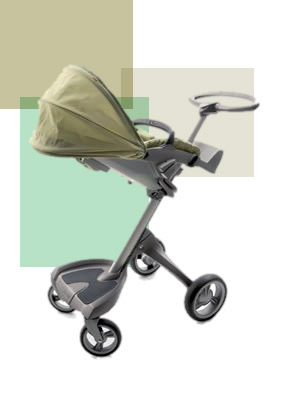

There’s a new stroller on the block. Looking like the product of an unlikely union between the office chair, Segway, and Big Wheel, the Stokke Xplory is actually the newest luxury buggy to invade city sidewalks in the wake of the white-hot Bugaboo Frog frenzy. Priced at $749, the Xplory will not be widely sold in the United States until October. But a handful of prototypes and European models have showed up in New York, and the stroller’s eye-popping design, air of fashion-forward exclusivity, and sprog-friendly functionality (in that order) have guaranteed that wait lists are already filling up. Bet that when it hits stores this fall, it will go head to head with the Frog as the world’s priciest and most sought after transport device for humans under 4.
Welcome to the world of X-treme strolling. The past two years have seen the birth of a new niche market for parents willing to fork over 700 clams for a souped-up pram. That’s about $400 more than the next-most expensive carriage, the Maclaren. The price-tag-busting Bugaboo made its media debut in 2002 when “Sex and the City’s” Miranda chose to haul her tyke around in it; it was no time before the device had found a home in the hearts and foyers of celebrities like Gwyneth Paltrow and Debra Messing. Call it a rip-off, a fad, a status symbol for spoiled yuppies. But then listen to satisfied owners crowing about the Bugaboo’s durability, maneuverability and all-terrain capabilities. Sense the late-night heart-of-darkness jealousy emanating from even those who turn up their noses with disgust. The Bugaboo — all $729.99 of it — is here to stay. And this fall it gets pricey company in the slightly alien $749.99 Xplory.
First the basics: Bugaboo is a Dutch stroller company launched in Amsterdam in 1999. The Frog, which became available in the U.S. in January 2002, looks like a brightly colored riff on a traditional stroller. It features huge tires in the back, two small swiveling wheels in front, a detachable front stroller bar, and a suspension system that acts as a baby-shock-absorber for curbs, stairs, or gaping sidewalk potholes. It’s a convertible; its fabric seat (which can be removed from the chassis and carried to the beach or to bed) transforms from a bassinet for newborns to an upright stroller for toddlers, ideally eliminating the need to buy more than one carriage during the first four years of your child’s life. The seat can be switched so that your kid faces the person pushing the stroller or toward the street; it also reclines. It weighs around 17 pounds. Its fabrics are machine-washable; it comes in colors like safety orange and fire-engine red; it has a five-point harness, a storage bag, sun canopy, rain cover and mosquito netting.
What, no paper shredder?
Despite their similarity in price, the Bugaboo looks nothing like the Xplory. The radical notion behind the newer stroller is that its munchkin passenger seats are elevated several feet above the ground, at least 30 percent higher than any other stroller on the market. Kids perch above the tailpipe-level exhaust fumes of city streets, away from canine butts and face-whapping tails, not to mention the dust-kicking shoes of pedestrian traffic. Stokke USA’s marketing manager, Vincent Donroe, said that he has an infant son who enjoys riding high. “He’s just lookin’ around like this is the best thing since sliced bread,” said Donroe. “Not that he knows what sliced bread is, but if he did …” Donroe said he enjoys the familial intimacy of the elevated seat. “It gives me the ability to look directly at him, talk to him and further develop a parent-child bond,” he said.
The whole contraption looks intergalactic. But no. It’s just Danish.
Stokke is a design company famous for its super-mod furniture and a child’s line that includes the KinderZeat, an ergonomic chair that allows a little one to sit at the dinner table without the boxed-in distance of a high chair. The Xplory, with its telescopic, adjustable handle and open wheelbase, is built to be comfortable for adults, especially those with long strides: There’s no bar to bump their feet against. There is a reflective strip on the back, a storage bag at the bottom and a footrest for the child — especially the child with fleshy leg rolls.
The back legs of the stroller fold into the front legs, making the device easy to pull up stairs. Like the Bugaboo, Xplory converts into a bassinet for a newborn and is supposed to last through preschool days. It has shock absorbers; Alise Kreditor, a publicist for the company, pointed out that it’s been tested in Europe along cobblestone streets, and hauled in and out of the Metro and Tube stations of Paris and London.
Then there is the stroller’s undeniably arresting look. “For $749, you want something that’s going to stop traffic,” said Kreditor, adding that when she pushes an empty version of the stroller around the city, “more men than women — and believe me they’re not trying to pick me up — stop and ask me about it. What really hits them is the height of the kid.” Well, that or the fact that you’re tooling around with an empty stroller.
Donroe said, “What the designers did is look at automobile and aeronautic components, and they also looked at the fashion industry and asked what are up-and-coming hot colors for children in fashion?” The answers were red and fuschia, deep sea blue, and two-tone green. It seems to have worked. A few weeks ago outside a trendy pub in Manhattan’s West Village, people waiting for a table accosted a couple passing with an Xplory, peppering them with questions about where they’d bought it and how much it cost.
The Xplory doesn’t yet have a roster of celebrity clients, besides British singer Sophie Ellis Baxter, and there’s no more “Sex and the City” on which to introduce this new urban must-have. But the few early models pushed around the streets of New York and Los Angeles have already caught the attention of parents, like the gizmo-conscious dads at Daddytypes.com, who in mid-July began to gossip about the new buggy. Some raised eyebrows about price, while others were so enthusiastic that they rushed right out and snapped photos of stranger babies riding their hot new wheels on the streets of Soho. Cool your jets, boys. The thing is going to be ubiquitous soon, thanks in part to ferocious curiosity like yours.
At Buy Buy Baby, New York’s Death Star emporium of baby-product acquisitiveness, an employee who picked up the phone knew right off the bat that the Xplory would be available in mid-October. “People have started putting their names down for it already,” she said. Planet Kids on the tony Upper East Side has sold a dozen of the strollers in advance of October. “It’s a high number, a good order quantity for something that’s not out yet,” said a salesclerk, who said that he’d already seen some Xplorys on the street and assumed that impatient parents had purchased them in Europe.
Stokke has developed a “test-stroll” program in which parents can take a model of the stroller for a walk around the block before deciding whether or not to put their name on the list for October. It’s part of the marketing plan that Stokke seems to have borrowed from Bugaboo. Kari Boiler, director of marketing for Bugaboo USA, said that the stroller’s meteoric rise was mostly dumb luck. “I think the stars aligned,” she said. “The ‘Sex and the City’ thing happened before we actually launched in the States. People started asking about it, we created a wait list, the wait list created extra press. That mix of all those things created a lot of buzz. Everyone wants what they can’t have, and at the time it was this very exclusive thing.”
“Obviously there’s a comparison with Bugaboo,” said Stokke’s Kreditor, “in that they established this price category.” Kreditor pointed out another thing that the two strollers have in common. “At least you know you’re buying European, which means that they don’t build in that it will break after two years.” Kreditor continued to kvell about the special way the Xplory’s wheels absorb shock, trilling, “There are times I wish I could be under 40 pounds so that I could feel what this feels like from the inside!”
“One of the phenomena here is that the Bugaboo entered a juvenile market that has just taken off,” said Boiler, pointing to the increasing schmanciness of everything from designer infant clothes to baby bottles to cashmere swaddlers and special nursing pillows. Boiler attributes the change to an increased number of men and women reproducing later, when they’ve grown accustomed to treating themselves right. “These are parents who don’t want to sacrifice aesthetics and functionality,” said Boiler, as she pointed out some of the perks of the stroller in a way that made it sound as if she were describing a Lexus. “The Bugaboo is not only aesthetically beautiful, but the suspension and swivel wheels make it so easy to steer in the city, and the two pneumatic tires mean it can be an all-terrain vehicle for the beach, the snow or the woods.”
That’s great, except that it’s not a Lexus, it’s a stroller. The suspension and shock-absorption is lovely, but are we at risk of raising a bunch of overprotected wusses who wince when their dirt bikes hit gravel and don’t like to be touched? Or kids who think that nothing has to be uncomfortable or distasteful if you throw enough money at it? The Bugaboo and Xplory fall into the category of products that make life so easy for newborns that it seems downright wrong. Take for instance the sudden ubiquity of “wipe-warmers,” devices that heat diaper-wipes so that babies aren’t forced to deal with clammy cleanings. It’s a nice idea. But haven’t generations of infants survived the scourge of chilly diaper wipes and emerged relatively unscathed? Are we creating coddled kids who will never be able to face hardships like skinned knees or, you know, puberty?
Literary agent Daniel Greenberg and his wife, Tina, who owns a downtown store that carries products made from recycled materials, were given a Bugaboo as a wedding present by a bunch of friends who had all chipped in for it. “My wife and I originally made a pact that we would always say it was a present,” said Greenberg. “But we’ve stopped doing that.” Greenberg, who lives in Manhattan’s slightly scruffy East Village, was wary about his high-end baby lucre. “Initially I felt like it was the Range Rover of strollers and I was embarrassed,” he said. “I thought people were going to point me out as this yuppie who’d spent so much money for a stroller. I imagined walking into Tompkins Square Park and having heads turn and women go into the corner and start whispering about me. But no one seems to care that much. If anything they’re like, ‘Nice stroller.'” The park Greenberg mentioned is a hangout for downtown hipster parents and their half-naked single counterparts. “At Tompkins Square Park it’s all MacClarens,” he said, describing his walking route. “But when you start heading west [into the more upscale West Village] the Bugaboos start coming out.”
What does Greenberg like about this Bugaboo? That he was able to use the bassinet early in his son Sam’s life — and even convert it into his bed for the first three months — and that it now works as a full-sized stroller. “It may be $700, but that’s for a stroller you’re going to use for years and years,” said Greenberg, momentarily sidetracked by some residual defensiveness. “People who live in the East Village are paying these incredibly steep rents just to live there, so how different is that?” he muttered. “I used to roll my eyes when people talked about how you can take it to the beach and have it in the sand and snow,” he continued, “but in the city, in the snow or rain, it’s really nice. You just plow through a puddle with that thing.”
Greenberg said he hadn’t yet had a chance to check out the Xplory, but when he looked it up on the Web he said, “Whoa. That thing looks wild.”
Just wait till October.
