
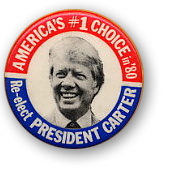
The president — highly intelligent, personally flawed, detested by many, a man who was first elected in a narrow three-way race and then reelected easily — had faced impeachment. In the following election, his vice president, a decent man with decades on Capitol Hill, was beaten by an inexperienced governor from the South. Four years passed. The economy weakened and oil prices soared. Crises in the Persian Gulf and Afghanistan eroded our national confidence. Clearly the president was in trouble. Yet many were not comfortable with his opponent. Yes, he was effective on television. But was he a steady hand? Was he trustworthy? Would the country be safe in his hands? The year was, of course, 1980. And as the Republicans convene in New York, the parallel between George Bush and Jimmy Carter is plainly on their minds. Like Carter, they have a record that is difficult to defend. Like Carter, their strategy is to cast doubt on the character of their opponent. And as it was for Carter with Ronald Reagan, it isn’t going to work.
Not so long ago, Republicans hoped that Bush would be the new Reagan. Fueled by economic growth and the progress of arms, his second campaign was supposed to have matched the triumphal march of 1984. Ain’t gonna happen. Reagan was smarter. He picked on Grenada; he cut his losses in Lebanon; and he actually did cut taxes for the middle class.
More recently, as the Bush-as-Reagan scenario faded to black, Republicans might hope for a replay of Bush vs. Gore — that the vote would be within stealing range. But recent polls show that that, too, is unlikely. The statistically illiterate Washington press corps keeps saying the race is “a statistical tie.” It isn’t. Kerry is plainly ahead. The margin of error doesn’t mean that the difference between Kerry and Bush is meaningless. It means that if the poll were repeated, Kerry’s share would fall within the reported range 95 percent of the time. His actual lead might be smaller. And it could also be more.
And so, as in 1980, we’re all thinking about the “October surprise.” Again, the parallel is instructive. It was Ronald Reagan’s campaign that warned that Jimmy Carter might pull an October surprise — in order to free the American hostages then being held in Tehran. Carter’s ability to do this was minimal; the fiasco of the Desert One hostage rescue mission had already occurred and the Iranian mullahs were intent on humiliating Carter. But Team Reagan helped effectively defuse its political risk by warning that Carter might pull a rabbit from his hat.
It wasn’t quite as dramatic, but Bush has already had his Desert One. That would be the “July surprise,” the deal with Pakistan to deliver a “high-value target” during the Democratic Convention, elegantly exposed by the New Republic. But the July surprise was a fizzle. It amounted to a terror alert few voters took seriously, the disastrous exposure of a double agent working for the U.S. inside al-Qaida, and rushed raids in Britain, which the authorities there didn’t like because they destroyed certain clandestine operations. Whether these matters are serious for our security, I can’t tell. But, as in 1980, they don’t inspire confidence in the men in charge.
Bush’s October surprise? That would be the capture of Osama bin Laden. But the July surprise told us something about that. The delivery of bin Laden, if it happens, won’t be like the capture of Saddam. It will be, rather, a diplomatic, or to put it bluntly, a commercial deal. (Former Pakistani diplomat Husain Haqqani explores the twisted Bush-Pakistan relationship this week in Salon.) Is there anything we have that they want badly enough? Would they sell Osama for some F-16s? Particularly if their embassy tells them, as it must be doing, that Bush is very well going to lose?
To compare George W. Bush to Jimmy Carter is unfair to Carter, who showed his worth as a world citizen last week by upholding the plain fairness of the vote count in Venezuela. Carter was tough-minded and courageous in Caracas. He single-handedly forced the U.S. media — which in early stories was giving equal play to spurious claims of vote fraud — to fall in line with the truth. So let me apologize to that great American, a Nobel Peace laureate, for a parallel that, on a personal level, does him disservice.
And yet, George W. Bush is uncannily like Carter in one more respect. Remember the “malaise” speech of the summer of 1979 — that unfortunate effort by a failing president to ignite the American imagination and get our juices flowing again? Well, Bush has given one of those too. This was the “ownership society” speech, a less-than-stirring call to Americans to go out and “own something.” No doubt Bush will repeat this phrase in his acceptance speech at the Republican Convention. There’s not much to say about this in a country where homes, college degrees and public pensions — Social Security — are already the property of millions, because of government programs that Bush is trying hard to destroy and which destructive efforts he will redouble if he gets a second term. If ever there was an “ownership society,” it’s the one we live in today, thanks to the New Deal and the efforts of presidents ever since who built on that foundation — but not Bush.
Despite the emptiness of the “ownership society” slogan, it does remind me of a story — a hand-me-down, if you will permit, from my father. Some time back, the great University of Texas economist Robert Montgomery was summoned before our Texas Legislature, then hunting subversives. According to legend, the hearing was the shortest on record. It consisted of a single question and answer. Not having ever seen a transcript, let me paraphrase:
Q.: Professor, do you believe in private property?
A.: Senator, I do believe in private property. I believe in it so strongly, I think everyone in Texas should have some.
