
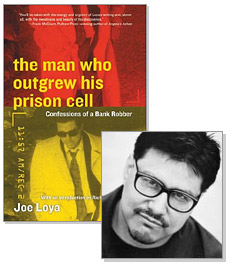

It’s late afternoon, the July summer sun still bright on the booths at Hunan Yuan, the favorite Chinese restaurant of former bank robber, former solitary confinement inmate, and soon-to-be-published memoirist Joe Loya. Joe and I have just slid in for an early dinner: We’ve ordered two Tsingtaos, along with chicken eggplant, sautied string beans and fried orange chicken, which he calls “bullets to the heart.”
Bullets to the heart — an apt metaphor for a man who had lawmakers’ rifles trained on him at least three times during his life as a criminal. Loya’s new memoir, “The Man Who Outgrew His Prison Cell: Confessions of a Bank Robber” (due out in early September from HarperCollins), tells the story of how he went from being a religious and sensitive Protestant East Los Angeles schoolboy to a cynical con man and petty thief, to a bank robber with more than two dozen heists to his name, to a maximum-security convict, to a budding cellblock writer, and — finally — to a new man, released after a grand total of nine years in 1996 at the age of 35, and bent on living an honest life. Or, at least, the reader must hope he is redeemed: The book’s last page is Loya’s first day of freedom from jail.
Loya had a short but lucrative career as a bank robber. His first heist was in downtown San Diego; he left the midsize bank with $4,500. On and off over the next three years, he robbed his way up and down Southern California, netting enough money to always keep 30 to 40 grand in cash stashed under his bed. He never used a gun (a note for the tellers claiming gun or bomb ownership did the trick), and, with the money he stole, he lived a fantasy life of good cars, good clothes and good-looking women. The memoir does full justice to this portion of his life, and the book is a satisfying read — offering lots of car chases, comical accounts of his failed first attempts to strike fear in the hearts of jaded tellers, lurid yarns laced with thick jailhouse raconteur profanity — except for the one question that lingers in the mind after shutting its pages. Once the con man has convinced you he’s a con man, how do you know you’re not still being conned?
For this reader, the question is further complicated by the fact that the con man in question is an old and dear friend, and, since his release in ’96, a model of upstanding citizenship as well, with — to the best of my knowledge — not even a parking ticket to his name. Occasionally, over the years, he’d remind me he used to be a “bad, bad man,” but I never saw it. I knew he used to rob banks, and I’d heard about the car chases, the near misses. I knew he used to be violent; I knew he was abused by his father. I knew that, at age 16, he finally fought back, stabbing his father with a steak knife during a fight. I knew that he had once bitten off part of a fellow prisoner’s ear in a dispute over a stolen porn magazine. But that was the Old Joe, and little in my day-to-day interactions with the New Joe had prepared me for the creepiness of the young man who emerges through the pages of “The Man Who Outgrew His Prison Cell.” Right now, as we wait for our food and the sun sets over the Oakland Hills, I’ve got the tape recorder running, arms folded across my chest, wondering if I ever even knew Joe Loya at all.
We first met in 1998, two years after his release, at Pacific News Service, where we were both working as editors. He had come to the office’s attention through essayist and journalist Richard Rodriguez, with whom he’d struck up a lively correspondence while in prison. He was already a rising star, writing frequent and popular columns about life from an ex-felon’s perspective. I was immediately charmed by his charisma, his scholarly horn-rimmed glasses, his love for Rilke, his intimate knowledge of the Old Testament (a product of his religious upbringing) — and, of course, his thrilling and lurid tall tales about stupid cops, terrified bank tellers and fierce cellmates, all safely buried in his distant past. Jolly and burly, always ready with a smile, a compliment, an invitation to lunch, Joe was no more of a hustler than any other freelancer I knew.
Over the years, we stayed close, meeting up every few months to compare notes on our writing careers, our mutual friends and our shrinks. Joe Loya the ex-con became Joe Loya the literary man-about-town, with a successful and well-reviewed theatrical one-man show based on his experiences, steady work writing Op-Eds on the American prison system — and, of course, the holy grail itself, a publisher’s advance. There have been times when it was hard even to grant him credit for his obvious talent. Man, you’d think, I’d be a brilliant writer too after two years in solitary. Talk about a room of one’s own. And talk about a usable past!
But, of course, Loya didn’t have it easy. In the memoir he writes movingly of his childhood: At 9, he lost his mother to cancer. From age 12 on, he was molested repeatedly by a 22-year-old neighbor named Lorelei. She was troubled and passionate, and it would not occur to him until years later that the sex they shared was actually sexual abuse. The stabbing of his father, Joe Loya Sr., led to the then-teenage Loya’s first stint in county custody, for eight months. The other kids there saw him as a hero of sorts, and he fell in love with the image of himself as a tough guy, above the limits of the law, unanswerable to authority.
His father recovered physically, but as an authority figure, he held no more sway over his son. Thus began Loya’s descent into a rudderless and amoral criminality. He started by conning his friends and stealing from employers; he eventually stole a car. In his own mind, he’d killed God by stabbing his father, and now lived in a free-floating world in which the only thing he needed to answer to was his own greed for the Good Life. Still, after he was finally brought down on the UCLA campus (in one of the book’s funniest scenes) by an agent who had already arrested him once, and then had vouched for his trustworthiness with the district attorney’s office, he had no shame or regret — just a firm desire to claw his way to the top of the prison’s hierarchy. And he succeeded, through a stealth campaign of manipulation and calculated violence — all described in chilling detail in the book.
But what’s chilling is not the action itself — particularly if you happen to know and like the guy. The most disturbing section of the book is precisely the section in which Loya pitilessly outlines the cold and cruel thought processes behind his willingness to con everyone he knew, to play whatever role was necessary to incur their trust. He convinced himself he was a criminal mastermind, a Nietzschean übermensch, even though he was really just a self-centered, angry man who stole money from his friends, cheated on his girlfriends, embezzled money from his bosses, and treated everyone who trusted him or cared for him with pure contempt.
The fact that Loya, now 43 years old — reformed, planning a book tour, and grinning at me from across the table — also happens to be a gifted wordsmith doesn’t make the unsparing portrait of himself he paints in the memoir any more palatable. “If people trusted me, they deserved to get burned,” he writes, and goes on to detail his “intricate intrigues to separate a man from his money, patiently cultivating friendship before fleecing him.”
Loya is no longer a criminal, but the clearing up of a blackened heart is much more difficult to prove than a blackened record. Not yet ready to ask him if he’s ever tried to fleece me, I turn instead for more details about his transformation, and how, to quote from the book, his “thoughtless life of crime ended” and “life of remorse” began.
“It wasn’t one thing,” he says. “I was in solitary confinement, and trying to keep from going crazy. And I had time, lots of time to think about how I’d gotten to this place, and how much of a scared little boy I still was underneath all my bluster.”
He also rediscovered his earlier childhood love for literature. Throughout his two-year stint in solitary confinement under a murder investigation of a former cellmate (the killer was never found), Loya wrote and read incessantly: Martin Luther, Thomas Aquinas and, fittingly, St. Augustine. One night in 1994, at the age of 33, after leaving solitary confinement to return to the general population, he found his very own Norman Mailer on PBS: Richard Rodriguez, the essayist and commentator on the MacNeil/Lehrer NewsHour. Loya wrote to Rodriguez, and the two began a correspondence that helped him develop his ear throughout the rest of his sentence.
The letters between Loya and Rodriguez form some of the most lyrical passages in the book — but they are hardly proof of the honey-tongued prisoner’s progress. (During the course of the correspondence, Loya stabbed a fellow inmate for cutting in front of him in line.) Loya’s release in 1996 — the book ends on his first day of freedom — is indeed a cliffhanger.
A “free man” in only the crudest material sense of the world, Loya barely even left his brother’s house for the first three months after getting out of prison. According to statistics, he tells me, half of ex-cons go back within 90 days, and he was fighting that statistic the only way he knew how, by staying inside. He was fearful of the day-to-day confrontations — a bumped shoulder, a long line, a cutoff on the highway, which ordinary citizens take for granted, but which can lead to violence in prison. He was fearful of passing by banks and succumbing once more to their allure. Ten thousand dollars in 10 minutes. That’s what he used to tell himself, proudly, in his bank-robbing days: I can make $10,000 in 10 minutes. Now he had to be content with whatever he could earn as a writer, and none of his hard-won prison-yard respect could do him any good.
He was tired all the time, just as he’d been in prison, just as he’d been during his teens and 20s — but not just tired; chronically exhausted, almost narcoleptic. It had never occurred to him that there might be a chemical reason for his fatigue, but a girlfriend suggested he visit a therapist, who took just one session to diagnose him with depression and write out a life-changing prescription to Wellbutrin. The medication did wonders for him, as he tells me now in between sips of Tsingtao. “I began to walk a little more comfortably, less afraid that with every step the ground might be taken out from beneath me,” he says. “Honestly, it’s as close to redemption as I’m ever going to get.”
Or almost as close. His professional life had become more and more linked to the marketability of his personal history, but he’d married a woman named Diane, a nonprofit program director who was neither impressed with his past nor appalled by it. “I think that’s part of what made me fall in love with her — she loved me, the man I am now. She never asked me a single question about the damned banks.” But even with the Wellbutrin, he suffered bouts of depression and thoughts of suicide. Last year, when he and his wife decided to start trying to have a child, those bouts became worse. He spiraled downward and eventually checked himself into a mental hospital, where he was diagnosed with bipolar disorder, and put on more medications.
Today, he and Diane are happy. Ongoing therapy, the new medication and the example of close friends who are also parents have convinced him that he has what it takes to be a father. “Right now is a good time,” he tells me. “But it’s still an effort for me to try to be the kind of person I want to be. And I’m ferocious about that. I still work hard to keep the demons at bay; I work really hard to make sure the rage doesn’t come back. So I can live a peaceful life.”
It all sounds good. Too good, maybe, because once you’ve learned how to size people up, how to manipulate, how to seek out the worst in people and exploit it, can you ever drop that skill, that awareness? “Give me an example of working hard,” I say, trying to keep the suspicion from my voice.
“I’ll tell you, it takes vigilance. I’ll give you an example right now,” he says. “I got this half-assed review in Kirkus this week. Not even bad, just half-assed — and, for a minute there, I wanted to find that guy and track him down.”
He’s not the first writer in America to wish bodily harm on the writer of an unfair review. If fantasies were real, Dale Peck‘s bullet-ridden, headless body would have been floating in the East River years ago, gift-wrapped in bloody typewriter ribbon. The Old Joe might have taken that fantasy to a new level, but the New Joe has a different strategy. “I take a step back and remember that every anger covers a wound,” he says. “Something about the review has wounded me in some way, and so I think about that, and then the anger goes away.”
Every anger disguises a wound: This is what he had learned about himself in solitary confinement, as he traced his thoughts and tried to hold onto his sanity by understanding where his emotions were coming from. He traced his rage back to old pains, old fears and gradually began tearing down the facade he had built up. His new self-knowledge — achieved on his own, without access to therapy or counseling — led to a phone call to his father, one in which he brought up a particularly wretched episode from his boyhood, and asked, “Hey, Dad, why’d you beat the shit out of me?”
Faced with an honest question, Joe Loya Sr. gave his son an honest answer, and opened up about his own rage and helplessness in the face of his wife’s illness and how it turned into rage toward his son. Over a prison phone, they talked about the violence and grief that had bound them. “I’d been gradually forgiving him along the way,” he says now. “But now I understood that his rage came from missing my mother. It explains the mystery. My father and I shared the same wound, the loss of my mother, and this created a solidarity along the way.”
Loya also confronted Lorelei, the woman who began molesting him when he was 12 years old. “I asked her what was going on for her back then,” he says. “She was molested by a family member for many years when she was very young. That was about all she had to say about it. She said she felt horrible and I know she’s felt horrible about it. I’m not mad at her.”
Whether it was the therapy, his own personal vigilance or the softening of age, Loya’s capacity for forgiveness (he and his father are now close) now extends beyond Lorelei and beyond his father. “I’m done with anger,” he says. “I can identify it now. I’ve become a patient man.”
Finally, perhaps thanks to the Tsingtao, I say what’s been on my mind all evening. “I gotta tell you,” I begin, referring to the chapters that describe his late adolescent devolution into, in his own words, a mooch and a fraud, “you really were an asshole.”
He laughs. “That was the hardest part of the book to write, man. I was shady, and I know it.”
“So why did you write it down in such squalid detail?”
“You know, I was writing this as much for my friends as anybody,” he says. “The most important thing was to tell the truth, even if it was embarrassing, to tell the truth and tell it well. Sure, I want people to root for me, but I want them to be conflicted, not just think, ‘Oh, he got treated greasy by his parents.’ I want to feel that I’ve exhausted their ability to sympathize, because I have faith that by the end of the book, I’ll have got you back. I have to have confidence that the story itself will keep you hooked, even if you don’t like me when you’re reading it.”
This story has been corrected since it was first published.
