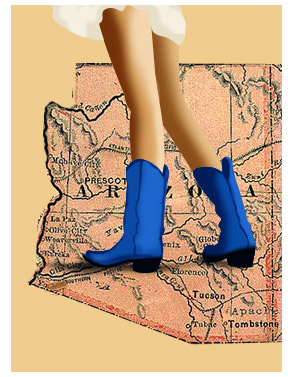

Don’t it make a red state blue
In Arizona, influential Republican women are increasingly coming out for John Kerry.
By Leigh Flayton
Judith Allen, longtime Arizonan and lifelong Republican, says her choice is clear. She is voting for John Kerry on Nov. 2 and says there are plenty more where she came from.
Allen is not a lone voice, crying in the wilderness. She currently serves as a volunteer coordinator for the group Republicans for Kerry, which believes in “putting aside partisan politics to do what is right for America.” In spite of recent polls to the contrary, Allen says her fellow Republicans, turned off by the Bush administration’s sharp turn to the right, are defecting in droves to the other side. If what these Arizonans want is any indication, Bush may well be in trouble. Since Arizona earned statehood in 1912, no Republican has been elected president without carrying the state.
Allen is also part of a brewing revolution of Republican women called the WISH List (Women in the Senate and House), a Washington-based organization committed to electing moderate, pro-choice Republican women to public office. WISH raises about $1 million a year to elect candidates and boasts a 75 percent success rate for the 1,400-plus candidates it has supported since 1992.
In the presidential election, says WISH national board member Deborah Carstens, the group stands firmly behind the Bush-Cheney campaign. Behind the official facade, though, is a different picture. “I’ve met and talked with numerous Republicans since I’ve been in this march for John Kerry,” says Allen, now a senior adviser to Arizona’s Kerry-Edwards campaign. “They have all echoed to me, ‘I will vote for Kerry.’”
Allen, who served for 11 years as a clerk in Maricopa County’s court system, says she was inspired to work for Kerry because she got tired of yelling at Bush on TV. She says that of the more than 700 cross-over Republicans she’s spoken to in Arizona, many remain active in the GOP and reluctant to discuss their support for Kerry. Two WISH women corroborate this with Salon. When asked if they plan to vote, they say yes, then add emphatically, “but not for Bush,” who won Arizona by just 6 percent in 2000.
Still, it’s going to be an uphill battle for Kerry. Arizona is one of those pesky “purple” states. It has a Republican-leaning, albeit largely independent electorate that has been known to swing toward unpredictable places. Bill Clinton was the first Democrat to win Arizona since Harry S. Truman in 1948, and the GOP has a 120,000-voter advantage in party registration over the Democrats. Yet Arizona has a pool of about 600,000 registered Independents.
Although it is traditionally conservative, Arizona boasts a fiercely independent and occasionally progressive streak. It’s the state that produced Barry Goldwater, the far right-winger who morphed into a maverick conservative, as well as the poster child for political independence, John McCain. In 1998, voters elected the “Fabulous Five,” the country’s first all-female line of succession: governor, secretary of state, attorney general, treasurer and superintendent of public instruction. These days, with its constant influx of new residents and Phoenix’s recent designation as the country’s fifth-largest city, Arizona’s political landscape still is tough to categorize. But the last gubernatorial election signaled what many consider to be a powerful shift.
In 2002, the Republican Party pitted a far-right, pro-life conservative, Matt Salmon, against a moderate, pro-choice Democrat named Janet Napolitano. Napolitano, who was tough on crime and favored the death penalty while serving as the state’s attorney general, won by only 1 percent or 11,819 votes to become the state’s first elected Democratic governor in 20 years.
Scores of WISH women, it was learned after the election, had voted for Napolitano. In fact, some of them referred to themselves, unofficially, as “Republican Women for Janet,” in a show of solidarity against the state’s conservative Republican Party leadership. To many on the right, the women were defectors — they have been both credited and criticized for helping Napolitano win the election, depending on which side of the aisle you’re talking to — but Gov. Napolitano calls them “rational deciders.”
Bob Fannin, chairman of the state’s Republican Party, doesn’t buy it. “I just don’t know whether that really happened,” Fannin says. “I’ve heard the same stories. But I don’t know how many women belonged to the WISH List.” He says he doesn’t know who did and who didn’t vote for Napolitano.
Still, party hopping might become commonplace if the right wing doesn’t start to make a move toward the center. Some WISH women, like Allen, are sparking a revolution, while others are trying to work from within to change their party. This conflict was clear at the group’s third anniversary luncheon last summer at the Hilton Scottsdale Resort, when relatively few of the free “W Stands for Women” pins that were handed out were worn.
State Sen. Linda Binder, a Republican from Lake Havasu City and a WISH List member and candidate, sees a clear distinction between Bush and Kerry that’s in line with WISH’s sensibility. “I think Kerry is much more moderate [than Bush],” she says. “I don’t think he’s a liberal. I think that he understands about trying to govern from the middle. To me that’s what you have to do.”
Binder, who was born in London but has lived near the real London Bridge in Lake Havasu City for more than 20 years (and is a member of the London Bridge Republican Women’s Club), believes many Republican women will vote for the Democratic ticket, even though it may be a reluctant, “rational decider” vote. “I don’t think anybody will know until Election Day,” she says in the British accent she still hasn’t lost. “I’ve got a lot of friends who have been staunch Republicans that feel totally abandoned by this administration.”
Binder, who claims she is still undecided, says the Kerry-Edwards ticket is the better choice for women. “The Republican Party has been so captured by the Christian Coalition and the right-to-lifers. They’ve just about destroyed women’s rights and human rights. I would imagine from that perspective the Kerry-Edwards team is a lot more appealing.”
Gov. Napolitano, who was named one of six Kerry debate advisors last month, agrees. “I definitely believe the Kerry ticket favors women on a whole host of issues,” she says. “On the domestic side, with things like healthcare, child care and education, Kerry is much stronger.”
Fannin counters that national security is priority No. 1 for women. “Most women that I talk to believe that we will have a safer place to live if we have a positive, decisive president,” Fannin says. “They don’t believe Senator Kerry would provide the kind of leadership that President Bush has on security issues.” WISH’s Carstens agrees. “Many soccer moms have morphed into security moms,” she says, “and think security is probably the No. 1 issue.”
“Are we safer today?” Judith Allen asks. “No.” But that’s not the only reason she’s campaigning against Bush. Allen cites a laundry list of reasons why she and other Republicans are championing Kerry; since she joined the campaign in mid-July, her role in Republicans for Kerry has expanded rapidly. “It evolved because we had so many [Republican] people calling, saying, ‘How can I get involved?’ They knew I was a Republican and they felt comfortable talking to me. It’s kind of like, ‘It’s all right. You have a friend.’”
One of Allen’s new friends is Phoenix teacher Catherine Wyman. At the group’s behest, Wyman, a registered Republican-cum-Kerry volunteer, paid to attend a recent luncheon in Phoenix in which Wade Sanders, a friend of Sen. Kerry’s since the ’60s who also commanded a Swift boat in Vietnam, spoke to a group of about 30 Democrats, Republicans and Independents. Sanders’ stop in Phoenix was one of many during his tour of Arizona, in which he met with veterans, undecideds and Kerry supporters.
“I just don’t think our country can survive four more years of George Bush,” says Wyman, who flirted with the Libertarian Party for two years but remains registered with the GOP. “I think that the war in Iraq is nothing short of criminal. And I think that his unilateral decision to attack a sovereign nation, it just was horrible and played right into the hands of al-Qaida.”
In Arizona, perhaps enough women agree with Wyman, Binder and Allen to render the Electoral College vote a horse race. “It depends on how tight the election is,” says Robert Robb, veteran political columnist at the Arizona Republic. If only 1,000 Republican women switched sides, that would be more than the margin of victory in both New Mexico and Florida in 2000. However, Robb doesn’t expect that enough Republicans — of both genders — will trade parties to turn Arizona blue. “I think Kerry made some ground in the debate on Thursday night,” he says. “But I don’t see what, short of a national landslide by Kerry, would change the election here.”
Still, says Sue Walitsky, communications director for the Kerry-Edwards campaign in Arizona, Democrats haven’t given up. “We have probably the strongest field operation that this state has even seen; strong in terms of number of people, resources, reach across the state. We are running a ground game here,” she says. (The third presidential debate is scheduled to take place at Arizona State University on Oct. 13.)
So what’s a moderate, pro-choice Republican woman to do? For her part, Allen believes it’s a sign of maturity that enables voters to cross party lines. “I used to think, and I know many people do, you define yourself by your party,” she says. “And since I have not been in [elected] office, I’ve realized, first, that I am an American. And I really don’t want to be defined as a party because currently the party doesn’t represent me.”
Allen hasn’t yet pulled a Teresa Heinz Kerry and registered as a Democrat. “I truly believe that I can help change this [Republican] party,” she says. And she has some words of encouragement for Republicans who want to come out of the Kerry-Edwards closet. “It’s OK,” she says, “you can come forth and, honest to God, no one will shoot you.”
Getting through these dark times
Foreign policy whiz Samantha Power sheds light on a legendary diplomat killed in Iraq, advising Barack Obama and how America can emerge from the Bush era.
By Leigh FlaytonTopics: 2008 Elections, Barack Obama, Iran, Iraq, Middle East
In 2003, Samantha Power won a Pulitzer Prize for her book “A Problem From Hell: America and the Age of Genocide,” in which she chronicled the United States’ responses to the major genocides of the 20th century. But that’s just one of her accomplishments. Power, 37, is a Harvard professor and founder of that university’s Carr Center for Human Rights Policy. She is a prominent voice on stopping the genocide in Darfur, Sudan, and addressing numerous trouble spots around the world. She has shot hoops with fellow Darfur activist George Clooney, and once proclaimed herself the “genocide chick.”
Beneath her sense of humor is a fierce idealism and dedication to improving world affairs. Now, Power is immersed in what she considers the toughest challenge yet in her action-packed career: serving as a senior foreign policy advisor to Democratic presidential candidate Barack Obama.
The demands of that job have only risen since she first began working for Obama when he joined the U.S. Senate in 2005. But Power also found time to produce another book, published last week: “Chasing the Flame: Sergio Vieira de Mello and the Fight to Save the World.” The new volume is a biography of the revered United Nations envoy — once described as a cross between Bobby Kennedy and James Bond — who was killed in the catastrophic bombing of U.N. headquarters in Baghdad by insurgents during the early stages of the U.S. occupation of Iraq. The book is also a treatise on why the world needs the U.N., and the lessons Vieira de Mello learned throughout his career, now more than ever.
“He is the man for dark times,” Power says of Vieira de Mello, whom former U.N. Secretary-General Kofi Annan once called the U.N.’s “go-to guy.” “He had a 35-year head start thinking about how to mend broken people and broken places, these questions that are consuming us now.”
During Vieira de Mello’s career with the U.N., as Power details, he met with members of the Khmer Rouge and Serbian genocidaires, his attempts to broker peace with the latter earning him the nickname “Serbio.” Power says she sees a strong synergy between Vieira de Mello’s principles and Obama’s concept of foreign policy — with their emphasis on justice, human rights, security and, perhaps most controversially, direct diplomatic engagement with foreign adversaries.
Power sat down with Salon recently in New York for a wide-ranging conversation about Vieira de Mello’s legacy, going to work for Obama and the colossal challenges facing whichever candidate becomes the next U.S. president.
Your new book is out and you’ve been on the road with Sen. Obama. Are you having fun?
I’m not having as much fun as you would expect because I don’t know that I’ve ever taken anything so seriously. I think the campaign is the most important thing I’ve ever been associated with. So I’m really tense and actually quite miserable.
How did you end up working for Sen. Obama?
His office called me when he began serving in the U.S. Senate in early 2005. He had just read “A Problem From Hell” and wanted to meet to discuss fixing American foreign policy. I thought, “Well that’s interesting — clearly he’s in some other league.” I mean, who spends Christmas reading a dark book on genocide? No other politician had ever contacted me to discuss it.
We were supposed to meet for only an hour but ended up meeting for three or four hours at a steakhouse. Suddenly it was almost midnight and I heard myself saying to him, “Why don’t I just quit my job at Harvard and work in your office for a year or whatever?” I didn’t even know what I was proposing, but he said, “Great.”
How did you make the leap from journalist to going to work for a political candidate?
I got into journalism not to be a journalist but to try to change American foreign policy. I’m a corny person. I was a dreamer predating my journalistic life, so I got into journalism as a means to try to change the world. I didn’t get into journalism by any means to win a Pulitzer Prize or do anything like that. Back then, I was obsessed with what was going on in Bosnia. I went over there because of that; I tried to get a job at NGOs … But I didn’t wait this long [to work for a candidate] because I was such a hardcore reporter. It was because I never met anybody worth doing it for before.
You were born in Dublin, Ireland, and grew up mainly in the United States. How did you come to write about genocide?
I read about the Holocaust in college [at Yale University]. Right around the time I graduated there were the concentration camps out of Bosnia with these emaciated men behind barbed wire. And I could tell a long story about why that moved me … but it was so moving.
Genocide was the lens for me. And you can see genocide whether you go to Rwanda or you don’t go to Rwanda, but you still have to figure out a way to inject concern for human beings into our foreign policy. This is what was so gratifying to me about the way Obama read “A Problem From Hell” — for him it was about fixing American foreign policy.
What is the biggest foreign policy challenge for the next president?
The next president is really going to have to walk and chew gum at the same time, because no long-term peace in the Middle East is possible until we get some kind of modus vivendi in the Arab-Israeli situation. And then the singular challenge is being handed two wars, two live battlefields — and one of them in the heart of the Middle East. It can’t be an afterthought as it was in the Bush administration.
Afghanistan is a hugely important theater — and of course we neglected it by going to war in Iraq. We probably should not fall prey to this romantic idea that simply by getting out of Iraq and retraining our resources on Afghanistan that solves the problem. We have major deficiencies with what the international system is capable of in terms of reconstruction and development, and that’s ultimately what will stabilize Afghanistan — stop the resurgence of the Taliban, temper the violence, stave off the outbreak of widespread civil war. But while you do that you have to get the other train running: building up infrastructure, roads and schools, the things that are going to actually stabilize the country long term.
And along with all that the next president will have to keep an eye on Lebanon, North Korea, Darfur, China as an economic and geopolitical dynamo, and Russia and its regional adventurism.
In light of all the questioning of Obama’s “experience,” you’ve said he has dirt under his fingernails, and that he would bring a new America to the world. How would he do that?
The idea that he doesn’t have experience is nuts to me. He’s a constitutional law professor. I happen to miss the Constitution; I thought it was a good document. That’s a huge component of being a president when you’re combating terrorism and you’re trying to restore American values.
The fact that he used to work in the inner city, that’s the dirt under his fingernails. If people are an abstraction to you, it’s going to show. If you’re living with people, if you’re working in the inner city, you see the human stakes of it all. He’s also lived abroad, so he’s comfortable crossing boundaries.
You’ve said that the Bush administration has diminished the U.S. government’s credibility among its own citizens. Can the next president fix that?
I don’t think the next president can just show up and have it restored. Whoever wins is probably going to win by a narrow margin. One of the reasons Obama is so appealing to me is that he doesn’t take the American people for granted; you don’t stop having this conversation when you enter the White House. None of the major foreign policy challenges on the horizon can be tackled if we don’t have a thick domestic base. We can’t do foreign aid, we can’t get out of Iraq, succeed in Afghanistan, close Guantánamo and end torture policy without actually talking to people about the costs of that.
Why did you choose Sergio Vieira de Mello as the subject of your new book?
I think to some degree our models are off. We still talk a lot about transnational stress, global demons and things crossing borders, and yet our instincts are to focus on statesmen or people who operate within boundaries. We don’t have models or instruction from people whose lives are themselves commensurate to the challenges that we recognize as the major ones on the horizon.
You’ve talked about what a great teacher Vieira de Mello is. What has he taught you?
I think Sergio makes me see dignity. His great line, and actually my favorite line in the whole book, is, “Fear is a bad adviser.” I love that. It’s so simple. And then that humility and curiosity are very important — but also a sense of fallibility without paralysis.
I think Obama has all those things in spades. I like to think that as I get older I’m getting better at spending time with people who have qualities that make them worth spending time with. My decision to leave Harvard and go work on foreign policy, in the minority party in the U.S. Senate at that time, it was a terrible year. Obama was great, but on national security the Republican committee chairmen were so deferential to the president that it was hard to get anything done. It was the worst year of my professional life, but it was the education of Samantha Power. You spend time with Obama and you learn things. And hopefully I could bring a little bit of what I learned from Sergio to him as well.
In the book you cite Vieira de Mello as saying that countries will kick and scream at the United Nations, but that at the end of the day they get the U.N. they want and deserve. As a career U.N. diplomat, what kind of reforms was he advocating?
Nothing will happen at the U.N. as such, in that building, until and unless states change. The major reform, the first reform would have to come from this country deciding that it’s in our interest to have a stronger body to deal with international threats. We haven’t come to that conclusion. We have to believe in international law and binding ourselves to international standards in the interest of getting others bound to those same standards. We haven’t made that decision yet.
We have to pay our dues on time. We really have to want the U.N. to be well-endowed, and then we can use our diplomacy to make others invest in it, too. The real [potential for change] that Ban Ki-moon, the secretary-general, has is minuscule compared to what specific countries within the U.N. have. But for the last 60 years the debate about U.N. reform has occurred at the U.N. instead of in world capitals.
The Bush administration has a long-standing policy that it doesn’t engage with terrorists or dictators. Is there a time when the United States should?
Absolutely. I’m with Barack on this. But it’s not indefinite. Barack’s point is you don’t treat meeting with America as if it’s in and of itself some great reward. It doesn’t buy the other side anything. In fact, today it hurts a lot of people to be in business with the United States. So what you do is you meet in order to achieve things. You meet in order to know your foe, if it’s a foe. You meet in order to get international wind at your back so that America is not seen as the problem — [Iranian President Mahmoud] Ahmadinejad is the problem. You meet because you want to stop lumping together the unlike — al-Qaida, Hamas, Iran, Iraq.
You recently wrote in Time magazine that the U.S. needs to “rethink Iran.” What did you mean?
We lunge between two extremes, neither of which is helpful. One is the Bush-Cheney saber rattling — hyping of the threat, alienation of international stakeholders because of the sense that this is about ideology rather than about problem solving. In saber rattling we’re ultimately strengthening Ahmadinejad’s base, because the one thing that will unite Iranians — whether secular, moderate, Islamic or nationalist — is the idea that we’re going to come and attack their country.
On the other hand, there are people who are so disgusted and disillusioned with the Bush years that they romanticize in some way this wily Iranian head of state instead of acknowledging that the Iranian government is by all accounts a supporter of terrorist acts, or that Ahmadinejad is a head of state who denies the occurrence of the Holocaust and has made no secret of his militant animosity toward Israel. My feeling is that we need something in between the extremes that acknowledges that this individual, this regime, is dangerous and unconstructive — but that also acknowledges we have strengthened its hand by saber rattling, invading Iraq, dislodging the Taliban and rendering Iran the regional heavyweight.
To neutralize the support Ahmadinejad has domestically, we need to stop threatening and to get in a room with him — if only to convey grave displeasure about his tactics regionally and internationally — and then try to build international support for measures to prevent him from supporting terrorism and pursuing a nuclear program. If we’re ever going to actually put in place multilateral measures to contain Iran, the only way we’re going to do that is if we do it in a more united way with our allies.
How do we get out of Iraq?
We have to put Iraqis at the center of our planning and our thinking, which is not something we’ve done naturally at all — from the ’80s when we supported Saddam Hussein, when he was using chemical weapons against his own people, to the ’90s, when we had sanctions against the regime and paid very little attention to the toll of those sanctions on Iraqi civilians. And then, in the decision to go to war and the way we went to war — which was so not about Iraqis, as shown by our refusal to protect civilians and our failure to do adequate postwar planning.
We need to be incredibly sensitive as we leave Iraq to the welfare of Iraqis who are going to be left in our wake. That potentially entails the idea of sectarian or ethnic relocation if people are in a mixed neighborhood and feel that they’d be safer in a more homogenous neighborhood. Also, [it entails] massive support for neighboring countries that have taken in 2 million refugees, and some very systematic effort between now and the time we begin leaving to build funding and resource streams to internally displaced people.
We have shown again and again that we care about Iraq only insofar as it serves our interests. But I think it’s time to show not only Iraqis but the rest of the world that at least as we leave, we’re leaving with a very vigilant eye on how to mitigate the consequences of our actions.
Lost in America
It was supposed to be a storybook tale of young refugees triumphing against all odds. But an alarming number of Sudan's "Lost Boys" have spiraled into alcohol abuse, crime and even fratricide. What went wrong?
By Leigh FlaytonTopics: Africa
When Joseph Abil arrived in Dallas in 1995, he represented the first wave of extraordinary refugees, mostly young men, who became known to the world as the “Lost Boys of Sudan.” Abil, 20 years old at the time, had fled civil war in his native country that wiped out his village. He survived a perilous migration across Africa, endless hunger, and harsh conditions in a refugee camp in Kenya. When he settled in Texas, with the help of the United States government, he was finally free to lead a life of hope and promise.
But life in America presented Abil with struggles and dangers of a different kind. In 1997, feeling isolated, he moved to Phoenix, where other refugees from his Sudanese community had been resettled. He lived alone in an apartment and worked as a stock clerk at a Fry’s supermarket. Although Abil took medication for mental health problems, his friend Martin Abucha said Abil had no trouble holding down a job.
Early this year, Abil stopped going to work. One afternoon in February, he left his apartment and headed for the I-17 freeway, miles from where he lived, and started wandering north along the median during rush hour. A highway patrol officer approached Abil, and according to a report from Arizona state officials, Abil grew “agitated” and refused to move off the median to a safe location. The officer fired a Taser at Abil, who retaliated by throwing “baseball-sized rocks” at him. Pulling out a handgun, the officer fired three shots at Abil. The refugee who triumphed over years of hardship in Africa fell dead on the Arizona freeway.
Since the late 1990s, the Lost Boys have made headlines around the world. In 2001, their sojourn was hailed as a remarkable success story on “60 Minutes II.” “In Sudan, thousands of Lost Boys fought off dangers we can barely imagine, and are now, happily, flying off to the United States,” reported CBS correspondent Bob Simon. In a second story that aired the following January, Simon said of the Lost Boys’ lives in America: “There were dark moments. There were bound to be, but they passed.” A Kansas City man, featured in the show, said of one Lost Boy he mentored, “He’s living the American dream. He’s already got a job; he’s self-sufficient. You’ve taken someone literally, almost literally, in the Stone Age and dropped him into a modern civilization, saying after four months you’re on your own, and he is, and he’s fine.”
Many of Abil’s “brothers,” as the Lost Boys call each other, have indeed made better lives here. They are earning high school diplomas, attending community colleges and universities, and holding down a variety of jobs, typically low-paying ones. Today, nearly 4,000 Lost Boys call America home.
Last December, Arizona’s Deng Majok Chol, 27, became the first Lost Boy to graduate from a major U.S. college, Arizona State University, with a double major in political science and economics. In February of this year, People magazine profiled three Lost Boys who had returned to the Kakuma refugee camp in Kenya to help their brothers still stuck there. “In less than five years,” reported the magazine, “they transformed from wide-eyed immigrants who had never seen a kitchen freezer to young men working their way through college in San Diego.”
But for an alarming number of Lost Boys, their journey to America has taken a much darker turn — into unemployment, alcohol abuse, petty crime, murder and suicide. Unresolved cultural differences and a lack of support, training and education have led them to fall through the cracks of the social and legal system. Many Lost Boys, advocates and researchers say, suffer from some degree of trauma-related mental illness, most notably post-traumatic stress disorder.
“We want our Lost Boys happy, polite and grateful — and during the first couple of honeymoon years, that’s what we saw,” says Ann Wheat, co-founder of the Arizona Lost Boys Center in Phoenix. The center, which opened in 2003, offers more than 400 Lost Boys a place to gather, speak with career counselors, and get legal and medical advice. “But we do the Lost Boys and ourselves a huge disservice by perpetuating a one-dimensional image of them. If they were all models of emotional health, we might as well conclude that war is good for children, save our time and resources, and all go home.” Wheat, who also works as a supervisor for Phoenix’s city parks, says that reports of troubling incidents around the country often reach the center through the Lost Boys’ own word-of-mouth network. Lately, she says, “It has started to feel like an epidemic.”
The Lost Boys were victims of a brutal civil war in the south of Sudan that began more than two decades ago. The Arizona center’s current outreach coordinator, Jany Deng, 26, landed in Phoenix in 1995; he and his blood brother Simon were two of the first four Lost Boys to arrive in Arizona. Their saga had begun 10 years before.
While herding cattle in 1985, Jany and other boys from his village witnessed the destruction of their homes by government-backed Islamic militias. They took off running, beginning a multiyear exodus that spanned East Africa and countries around the globe. Many of their parents were murdered and their sisters raped, enslaved and killed. (As a result, there are fewer Lost Girls.)
For years, tens of thousands of Lost Boys walked more than 1,000 miles across East Africa, thousands dying of starvation, disease, and militia and animal attacks. Jany and his group first went east to Ethiopia, where Jany was reunited with Simon, who had made it there with another group of Lost Boys. But when civil war flared up in 1990, they fled back to Sudan. They returned to nothing: Their family and village were gone. Eventually they trekked to Kenya, winding up in the Dadaab refugee camp. After a year in Dadaab, they were among the first few relocated to the United States.
In the 2003 documentary film “Lost Boys of Sudan,” one Lost Boy expresses the shared perception, while in the Kakuma refugee camp, of what it will be like to leave for America: “This journey is like you are going to heaven.”
When Jany and Simon arrived in Arizona, Jany, then age 16, was sent to live with a foster family; Simon, 23, shared an apartment with two older boys. It was a pattern that continued from coast to coast as more of them came; the minors were resettled with families, while older Lost Boys were placed in dingy apartments, often cramped together, in rough city neighborhoods or on the outskirts of towns.
In Phoenix, Jany attended school, made friends and joined the track team; Simon couldn’t keep a job. He told Jany that “people looked at him different and made comments.” By the spring of 1997, Simon had grown despondent. He wanted to bring his girlfriend from Dadaab to Arizona, but to no avail. He had no money or job prospects. According to Jany, Simon began to speak of suicide.
On Apr. 10, 1997, Simon bought a 9MM rifle and rode a city bus toward the Catholic Social Services office building in North Phoenix. He got off the bus, took the rifle out of its box and fired it in the parking lot of a Circle K convenience store before heading to the office. A police helicopter and officers responded as Simon entered Catholic Social Services at lunchtime. Once inside, Simon looked for his caseworkers and, according to the police report, began firing his gun in the air. No one was hurt. The police arrived at the building and Simon shot at Officer Terrence Kobza. Kobza returned fire and killed Simon with a bullet in the arm and another in the chest.
Today, Jany still hasn’t made peace with Simon’s death. “Why here?” he asks. “He could have died over there. I could have died over there,” he says of Africa, his words breaking into a stutter. “The way it happened, it was not a good way.”
Local news and police reports from the past eight years, along with accounts from advocates and Lost Boys themselves, reveal a trail of tragic events.
In August 2001 in Boston, Daniel Majok Kachuol, 19, was charged with assault and rape, just six months after his arrival. In September 2002 in Rochester, Minn., Christofar Atak, 31, ran in front of a police car in the street, shouting, “I want to die!” Under disputed circumstances, a police officer ended up shooting Atak point-blank in the back. Atak, who survived, had a blood-alcohol level that indicated he was severely intoxicated. That same month, Phillip Ajack Cham, 33, entered an immigration office in Houston demanding to be repatriated to Sudan; he grabbed a gun from a guard, firing it and threatening suicide before being subdued by officers.
In April 2004 in Fargo, N.D., Chol Deng Chol, 25 — considered “one of the most promising students we’ve seen in a long time” by a mentor at North Dakota State University — was charged with the rapes of two teenage girls after a night of drinking. In Atlanta that summer, Ajuong Manuer, 21, died following an alcohol-fueled fight — over $10 — with fellow Lost Boy Mayen Biar Diing, 25. And in May 2005 in Seattle, Kero Riiny Giir, 27, stabbed to death an ex-girlfriend, Lost Girl Roda Bec, 16, for being “rude” to him, as he would later tell police. After fleeing the scene, Giir had jumped off a highway overpass in an apparent suicide attempt.
“We have a lot of angry Lost Boys, and it has not been brought to the attention of the community,” says John Aza, 40, director of the Southern Sudanese Resettlement Program in Tucson. Aza left Sudan in 1996 and is currently earning a bachelor’s degree in mechanical engineering from the University of Arizona. He does not count himself among the Lost Boys, though he is close with the community. At the end of July, Aza visited six Lost Boys who had been released from jail — some arrested for driving while intoxicated, two for arguing with police officers after a fight in a club. For Lost Boys who lack jobs and community support, and who have a hard time adapting to American culture, says Aza, alcohol is often “the nearest comfort.”
“A lot of Lost Boys have been picked up for DUIs,” Wheat says. “It appears to be a growing problem in the Sudanese community, but it’s something that’s kept a dark secret. They don’t deal with it. We could start an AA meeting at the center and nobody would come.”
Advocates across the country, including from large enclaves in Atlanta and Jacksonville, Fla., express serious concerns about publicizing the Lost Boys’ problems. They say the refugee community is extremely sensitive about them, while some fear a backlash could undermine fundraising, scholarships and the ability to enlist volunteers and mentors. Wheat also worries that news of dark-skinned refugees falling into violent crime won’t be well received, especially in America’s post-Sept. 11 political climate.
But shining a light on the troubling cases could be critical to helping the refugees, says Apuk Ayuel, who serves as deputy spokeswoman for the newly established Lost Boys and Girls of Sudan, a nonprofit support group based in Los Angeles. Ayuel, 24, fled Sudan with her mother and arrived in Houston in 1996. She currently studies political science at the University of Texas at Arlington. “It seems like the way it’s depicted is that every single Lost Boy has gone through — that their situation is all equal, that all of them are getting educations,” she says. “But there are a lot of people who are falling through the cracks. Their deeper stories are not being told.”
Some of those stories involve dozens of Lost Boys who have been victimized themselves. Violent crime — often in racially charged circumstances — including assault, robbery and murder, has led to the deaths of at least four Lost Boys. They have also been involved in a rash of car accidents. Many Lost Boys saw their first cars just a few years ago and so have little driving experience; according to Wheat, more than two dozen had serious accidents in Arizona alone in 2004, including two fatalities.
Wheat says she knows of at least a dozen around the country who’ve attempted suicide.
While the details of various tragic cases remain murky, researchers see at least one clear thread tying them all together: trauma-related mental illness, mostly left untreated. David Berceli is a trauma therapist and founder of Trauma Recovery Assessment and Prevention Services who worked in Sudan between 2001 and 2004. Berceli, who counseled a group at the Arizona Lost Boys Center in July on post-traumatic stress disorder, says he’s troubled, but not surprised by the pattern of incidents. “With people who have been put through years of life-and-death experiences, untreated fear and anger can develop into hatred and rage,” he says. “It becomes an uncontrollable energy.”
In June, Dr. Paul Geltman, a professor of pediatrics at the Boston University School of Medicine, published a study measuring the assimilation and well-being of 304 Lost Boys who arrived as minors in the U.S. from late 2000 to early 2001. While many fared relatively well, the study concludes that 20 percent of them suffer from PTSD.
Geltman says the rate of PTSD does not necessarily go beyond “what would be expected” of a traumatized refugee population. At the same time, he adds, he finds it remarkable that the prevalence of PTSD isn’t higher. “I’d love the opportunity to do a large assessment of the older Lost Boys for comparison,” he says. He notes that the problems of the older Lost Boys are probably “much greater” and would amount to greater levels of dysfunction, considering they’ve received less attention and support, and fewer services, than the minors. But even the minors, Geltman says, have not necessarily received the mental health help they’ve needed. As a result, his report concludes, the Lost Boys face lasting difficulties in being integrated into U.S. society.
Advocates, including Sudanese who have become leaders among the refugee community, share that view. According to Ayuel, many of the Lost Boys still suffer nightmares about the horrors they witnessed and endured. “They’re normal most of the time, but they’ll have the same nightmares over and over,” she says. “There are some people in the community of Lost Boys and Girls who will say, ‘Yeah, they’re a little crazy.’” Ayuel says therapy is a concept as foreign to the Sudanese natives as refrigerators and fast-food restaurants once were. In fact, therapy is taboo to them.
Peter Deng (no relation to Jany; the name Deng means “rain” and is common in Sudan) found his way to Phoenix in 2001. When he arrived, he recalls, “I was thinking about food.” During his nine years in a refugee camp in Kenya, he ate food provided by American relief agencies. “So I was thinking that America is a good country,” he says. “Maybe if I go there I will make money; I will go to school.”
In his first year in Phoenix, Peter was beaten up, carjacked and wrongly accused of fathering a child. He was fined $1,200 for driving without a license or insurance, which he had no idea he needed. He learned about the U.S. court system when he had to file a restraining order against a former girlfriend, who threatened him by saying, “You are just a refugee here in America. I can kill you.” These days, Peter rarely goes out in public, especially at night, and he says he fears going to jail. “If I go to public places, the mall or a club, somebody might hurt me for that,” he says, seated inside the Arizona center one afternoon.
Peter has received important assistance from the center, which helped him find a job as a file clerk for a company that sells concert tickets. Located across the street from the state capitol in a dodgy part of downtown Phoenix, the center shares a parking lot with a plastics recycling plant. Sudanese folk art and black-and-white portraits of Lost Boys at the Kakuma refugee camp add touches of familiarity to a place that offers help with foreign struggles like disconnected phone lines, eviction notices and shopping for groceries and clothes. (Lost Boys in Phoenix, according to Wheat, have been bilked for thousands of dollars by disreputable companies.) The center has partnered with Target, PetSmart, Phoenix’s Sky Harbor airport and other businesses to arrange some 150 jobs for Lost Boys.
Peter earns $8.50 an hour in his clerk job, and works on his skills at the center’s computer lab in his spare time. He watches a lot of television and movies, citing “Rush Hour” as a favorite film. Like many of his brothers, he says he wants to earn enough money to move back home to Sudan, find his missing family, marry and help rebuild the war-ravaged country. For now, Peter remains a homebody, struggling to make it day to day in Phoenix.
Jany, the center’s outreach coordinator, shares Peter’s ambitions, as do a great majority of their brothers, of helping to rebuild Sudan. These days, of course, the country faces a grave crisis in the western region of Darfur, where genocide at the hands of the notorious government-backed Janjaweed militias has created a new generation of physically and psychologically brutalized refugees. To date, the U.S. government has not formally resettled any of them here.
Jany points out that the prospect for peace darkened considerably on July 30, when longtime southern Sudanese rebel leader and newly elected Vice President John Garang died in a helicopter crash, plunging the country’s fragile peace into an unknown future — and hitting the Lost Boys community across America with a new wave of grief and fear. “It’s a huge blow,” Jany says. He adds that many Sudanese people don’t believe Garang’s death was an accident, and fears that the Sudanese regime is going to kill more of his community’s leaders back home. “It’s on everybody’s mind,” Jany says.
The plight of his fellow refugees in America also continues to weigh heavily on him. Jany, who plans to graduate next May from Arizona State University with a bachelor’s degree in social work, says he loves his work counseling his brothers and helping them to find and keep jobs. But cultural differences, he acknowledges, continue to exacerbate the Lost Boys’ problems. In Sudan, he says, young people don’t trust police, who regularly kill civilians. “We were taught to fight our own battles,” Jany says. So it’s no surprise, he continues, that many Lost Boys in America are wary of police and governmental authorities.
Some Lost Boys also have had trouble adjusting to American sexual mores. Unfamiliar with America’s system of dating, Jany says, the younger men sometimes mistake friendliness for sexual interest, and so being rejected by women can stoke feelings of frustration and alienation, and even lead to violence.
Eight years after his brother’s death, Jany keeps his spirits up by immersing himself in his work at the center. He is also a marathon runner, which he calls his passion and “getaway thing” — he has qualified for next year’s Boston Marathon. He says he’s so busy taking care of everyone else that he sometimes doesn’t look after himself enough. Jany seldom has the energy to make it through his homework after a full day of school and work. He has suffered from anemia; he collapsed last January while running a marathon.
Last December, he fell asleep behind the wheel of his car. The car flipped over three times and was totaled, but luckily Jany managed to escape without a scratch. Lately, he says, his grades have started to slip and he sometimes feels dizzy — yet, his own training aside, he says he isn’t sure what else he should do. “I’m abusing myself,” he says, smiling, when asked if he thinks he might suffer from PTSD.
Aydin Bal, a researcher and doctoral candidate at Arizona State University who has worked extensively with Arizona’s Lost Boys, affirms that the upbeat image of this remarkable group of survivors is authentic. In spite of a harrowing past, he says, they remain determined to fit in and succeed in America. “They have shown an enormous amount of resiliency,” Bal says. “Of course they are not trying to find food or drinking water now,” he says. “But they are still trying to find their past, their memory.”
Unfortunately, support services for the Lost Boys are drying up. According to Wheat, if the Arizona center can’t raise $250,000 before a core grant from the U.S. Department of Health and Human Services expires on Sept. 30, the doors will close. Several Lost Boys organizations in other U.S. cities are also strapped for funds. In 2002, the federal government’s Office of Refugee Resettlement cut general mental health funding, previously about $2.8 million per year, from its budget.
In the meantime, some Lost Boys in America who struggled the most with fear and grief reverted to the one way of escape they knew best. Earlier this year, a 23-year-old Lost Boy, diagnosed with schizophrenia and convinced that people wanted to kill him, disappeared from his home in Syracuse. By June, he’d wandered more than 2,100 miles to Mexico City. And then there was Abil, the Lost Boy who was shot and killed on the Arizona freeway. “After all the miles he walked in Africa to escape hell, he returned to walking,” Wheat says. “I wonder where he was heading. I wonder if he knew.”
How they learned to love the bomb
Bush is talking tough about nukes in Iran and North Korea. But critics say by illegally testing and building nuclear weapons, the U.S. is fueling a new arms race.
By Leigh FlaytonTopics: Iran, Iraq, Middle East, North Korea, Nuclear Weapons
In a barren stretch of Nevada desert 85 miles northwest of Las Vegas, a large modular tower and a steel crane, once used for testing nuclear bombs, stand in plain view of anyone passing through the area known to the U.S. government as U6c. They are easily detected by satellites orbiting overhead. Later this year, scientists at the Nevada Test Site will use the structures to conduct an experiment called Unicorn, which will help determine whether the site is prepared to resume full-scale nuclear tests if ordered to do so by the president. Unicorn, which works with plutonium and high explosives, will resemble an old-fashioned underground nuclear test from the Cold War era, when bombs were placed in towers aboveground and lowered beneath the surface by custom-built cranes.
In recent weeks, the Bush administration has focused the world’s attention on stopping the proliferation of nuclear weapons. During his trip to Europe in February, President Bush spoke with urgency about shutting down Iran’s nuclear program and securing Russia’s aging post-Soviet stockpile. North Korea’s declaration last month that it already possesses a handful of nuclear warheads has raised new concerns about tensions in Asia. And most security experts agree that nonproliferation is now critical to stopping the worst nightmare scenario: A terrorist attack on a major city using radioactive material.
Nuclear watchdogs in this country, however, warn that the Bush administration is fueling a new arms race. They contend the government is violating the Nuclear Non-Proliferation Treaty, the 1970 international agreement that states that countries with nuclear weapons must work toward disarmament. The Bush administration, they charge, is pouring money into new nuclear weapons programs and performing nuclear tests, spurring other nations to do the same.
The public “is in the dark about the intentions of this administration in terms of nuclear policy,” says Rep. Ellen Tauscher, D-Calif., who is an active proponent of nuclear disarmament. “I think they would be more than happy to go back to full-scale testing. At a time when weapons of mass destruction are in the forefront of everyone’s mind, this administration has not made the security and dismantlement of weapons, nor the retention of know-how by friendly states, a priority.”
Currently, the National Nuclear Security Administration, which runs the Nevada Test Site and is overseen by the Department of Energy, assumes the bulk of the nation’s nuclear responsibility. Scientists at the Nevada site work in tandem with those at the country’s major nuclear labs: Los Alamos, Lawrence Livermore and Sandia.
Nevada Test Site spokesman Kevin Rohrer says the security administration, which was established in 2000 on the heels of the Wen Ho Lee debacle (the Los Alamos computer scientist charged with mishandling classified information), is following the decree of the Stockpile Stewardship Program. Established in 1994, the program is designed to ensure the safety and readiness of the nation’s aging nukes. The United States possesses about 10,000 nuclear weapons.
“Our job is to help make sure that the existing weapons in the stockpile are going to function as designed and remain safe in the stockpile,” Rohrer says. The program, he explains, is focused on science and involves only non-nuclear experiments. “We are looking at nuclear material from a physics study perspective: What are the physical material properties of it? What makes plutonium act the way it does, as opposed to studying the phenomena of how do we develop a bomb?”
Walter Dekin, Lawrence Livermore National Laboratory’s test director in Nevada, says the experiments at the site are harmless. “It’s taking that 1968 Mustang that you parked in the garage and you’ve never been able to start,” he says. “You’ve never done anything to it, other than you lift the hood, you look at it, you change the spark plugs, you change the oil, but you never run the engine. But when you want to, it’s going to start and run just the way you said it would.”
Many of the important tests at the Nevada site, including the one named Unicorn, are called “subcritical experiments.” In a “subcrit” experiment, plutonium, the explosive ingredient in a nuclear weapon, is detonated with high explosives so scientists can observe how the materials interact and respond to the blast. The experiments take place in the U1a Complex at the site, an underground laboratory composed of roughly a mile of mined tunnels first excavated during the 1960s. In 1997, “Rebound,” the first subcrit, was conducted in a 10-by-15-by-30-foot room. Once the scientists capture the blast data with multibillion-dollar, state-of-the-art supercomputers, they seal the radioactive experiment in layers of concrete 960 feet underground, presumably for all eternity.
“Subcritical” refers to the fact that the tests do not reach “criticality”; that is, they don’t sustain a nuclear chain reaction, the perpetual explosion of energy that unleashes radioactive destruction. For that reason, subcrits are not banned under the Comprehensive Test Ban Treaty, the international agreement that President Clinton signed in 1996. The treaty forbids any nuclear test explosions that cause a chain reaction — as well as the improvement and development of nuclear weapons.
The Clinton administration began conducting subcritical experiments in 1997, five years after President George H.W. Bush placed a moratorium on all nuclear testing. Although opposed to nuclear testing, Clinton authorized the United States to conduct subcrits as a way to appease pro-nuclear Congress members. At the time, Congress had not ratified the Comprehensive Test Ban Treaty, and Clinton figured he could bargain for their votes with the tests.
In 1999, he urged the Senate to ratify the treaty. “Our experts have concluded that we don’t need more tests to keep our own nuclear forces strong,” he said. “We stopped testing in 1992, and now we are spending $4.5 billion a year to maintain a reliable nuclear force without testing. Since we don’t need nuclear tests, it is strongly in our interest to achieve agreement that can help prevent other countries like India, Pakistan, Russia, China, Iran and others from testing and deploying nuclear weapons.”
The United States has still not ratified the treaty. And the current activity in the Nevada desert is no aberration of Bush policy: U.S. nuclear labs continue to receive funding — now approximately $8 billion a year — for nuclear weapons research, development and testing activities. Among the recent developments is the Nevada Test Site’s $100 million Device Assembly Facility, which was designed and built during the days of underground nuclear tests but wasn’t functional before the 1992 moratorium. The facility is where plutonium is prepared for use in subcritical experiments, including Unicorn.
Another new device is a “pulsed-power” machine called Atlas, which Joe Meachum, an engineer at the Nevada Test Site, calls “the biggest in the world in its class.” Atlas, which will pulverize tuna-can-size, non-nuclear materials like aluminum, copper and tin more quickly and powerfully than any mechanism in the world, was built at Los Alamos, dismantled, then moved to Nevada in 2003. Meachum expects to conduct Atlas’ first test at its newly built custom facility in April. Whether testing with Atlas will involve nuclear materials remains to be seen, although Donald Bourcier, an engineer at Los Alamos, says it has been discussed.
“We’re not looking at that right now,” Bourcier says, “but there’s been talk in the hallways of maybe sometime in the future.”
Watchdogs charge that these innovations skirt international law. Jackie Cabasso, executive director of the Western States Legal Foundation, a monitor of U.S. nuclear policy, says that the Nuclear Non-Proliferation Treaty requires the United States to end the nuclear arms race at an early date and negotiate the elimination of its nuclear arsenal in good faith. “One could make a very persuasive argument that conducting subcritical tests as part of a broader program to maintain and improve the United States’ nuclear weapons capabilities, and train a new generation of nuclear weapons designers, violates Article VI of the treaty,” she says.
Mark Twain once opined that the difference between the right word and the almost right word is the difference between lightning and a lightning bug. When it comes to nukes, one person’s subcritical experiment is another’s nuclear test.
Bob Peurifoy, an engineer for 39 years at New Mexico’s Sandia National Laboratory before retiring in 1991, says that subcrits “are perhaps not necessary but are highly desirable” for maintaining the stockpile. Because they can’t reach criticality, he says, “these experiments could be conducted in the open air, except for the fear of spreading plutonium around.”
To Alice Slater, president of the Global Resource Action Center for the Environment, which works to rid the world of nuclear weapons, subcrits definitely qualify as nuclear tests. “What they’re doing is blowing up plutonium with high-explosive chemicals in tunnels 1,000 feet below the desert floor,” she says. “The tunnels are contaminated with the plutonium and chemicals from the explosion — it’s radioactive, even if there isn’t a ‘critical’ mushroom cloud.”
Critics charge that subcrits drive the proliferation of nuclear weapons around the world by provoking countries to keep up with the United States. “Subcritical experiments probably encourage Russia and China to do the same,” says David Albright, president of the Institute for Science and International Security in Washington. “They don’t set the best example.”
Slater points to the Commission on Disarmament talks in Geneva in 1998, when India protested the United States’ conducting of subcrits and threatened not to sign the Comprehensive Test Ban Treaty. The U.S. response amounted to “screw India,” says Slater, which prompted India to conduct its own test. That pattern continues today. In November, President Bush’s friend and ostensible ally in the war against terrorism, Russian President Vladimir Putin, boasted about his nation’s plans for a new kind of nuclear missile. “They will be developments of the kind that other nuclear powers do not and will not have,” Putin said at a meeting of the Armed Forces leadership, according to the Russian news agency ITAR-Tass.
“We’re driving it,” Slater says. “We started to do subcriticals, and then Russia started to test them. They do every bad thing we do.”
In the United States, Cabasso argues that the Bush administration appears to be using the subcrits as “a practice run” in preparation for the resumption of full-scale underground tests. Adds Jay Coghlan, director of Nuclear Watch of New Mexico: “The boys in the nuclear weapons complex have never wanted to let go of testing.” He acknowledges that in 2004, President Bush ordered the country’s nuclear weapons to be cut from 10,000 to 6,000 during the next decade. “They’re plenty prepared to talk about the arsenal going down in numbers, even radically so,” Coghlan says. “But there is deep cultural and even personal resistance to letting go of full-scale testing.”
“What would they have us do?” asks Bourcier, the Los Alamos engineer, of the antinuclear establishment. “Let the stockpiles deteriorate in the bunkers? And if we get attacked, we’re defenseless. There are still enemies out there.”
The Bush administration has vigorously opposed the Comprehensive Test Ban Treaty, deeming it ineffective and counter to U.S. security interests. Bush officials regularly point back to the imperative of stockpile maintenance — but the administration’s nuclear posture has in fact been much more forward leaning. In September 2002, it announced a “preemptive strike policy” for its National Security Strategy — including first use of nuclear weapons against the chemical and biological facilities of states deemed to pose a threat to the United States. In February of this year Bush’s new energy secretary, Samuel Bodman, remarked, “A near halt in nuclear weapons modernization over the past decade has taken a toll on our ability to be responsive to changing defense needs.” And Defense Secretary Rumsfeld has repeatedly pledged his support for “efforts to revitalize the nuclear weapons infrastructure,” including completing the “study” of the new class of so-called bunker-buster weapons.
So far, Congress has kept the Bush administration’s nuclear ambitions in check. In November, it denied the president the $27.6 million he wanted for continued research on the Robust Nuclear Earth Penetrator, or “bunker buster” bombs, and refused Bush’s $9 million funding request for “Advanced Concepts” — research on new weapons designs, which Tauscher calls “one of those terms that means nothing but everything.”
But the president remains undaunted. In the 2006 budget submitted to Congress in January, the administration renewed its request for $8.5 million toward “bunker buster” bombs, part of a $6.6 billion overall price tag for weapons programs. The Pentagon stands to get the most funding, with Bush’s requesting an increase in its budget of $19 billion to $419 billion. And, with the passage in December of the Intelligence and Terrorism Prevention Act, Rumsfeld — a staunch advocate of “bunker busters” — has greater means to implement the programs of his choice.
Some conservative policymakers argue nuclear weapons remain a key deterrent to U.S. enemies, that the strategy that won the Cold War is also necessary — albeit with a modern makeover — to winning the war on terrorism.
“Without realistic testing … we are unable to introduce new designs that would be better suited to countering threats posed by countries like Iran and North Korea than the hugely destructive weapons developed more than 20 years ago to counter targets in the Soviet Union,” Frank Gaffney, president of the Center for Security Policy, wrote in mid-February in the Washington Times. “If we are to have any hope of preventing proliferation in the future, the United States must maintain a credible nuclear deterrent — and undertake the associated testing, developmental and industrial actions.”
But as all the world can see, watchdogs argue, today’s enemies are of a different breed. Emerging threats from states like North Korea and Iran bear little resemblance to that of the massively armed Soviet Union of the Cold War. And America’s continuing to develop its nuclear arsenal means little when it comes to stopping the Osama bin Ladens of the world — while a new global arms race undoubtedly will make perilous materials more available to them.
“Suicidal terrorists willing to die for their cause,” says Global Resource’s Slater, “will not be deterred by our weapons.”
Later this year, the Nevada Test Site will go ahead with the subcrit experiment, Unicorn. (Its exact date, closely guarded, is revealed only 48 hours in advance.) When it’s time, the test materials will be lowered from the tower, beneath the earth’s surface, and detonated in a hole 624 feet below ground — as was done with the last full-scale test, “Divider,” in 1992. The plutonium will be subjected to a powerful “back surface shock” using chemical high explosives. The detonation will take place out of sight — but for the world’s aspiring nuclear powers, not out of mind.
This story has been corrected since it was originally published.
The wild, wild West
By Leigh FlaytonTopics: War Room
It’s been a pretty loaded week for legislative activity in Arizona.
On Tuesday, the Grand Canyon State’s House of Representatives approved a measure that would have allowed Arizonans to carry guns, rockets, grenades and other firearms into public buildings, including schools, nuclear power plants, as well as the House and Senate, as long as the weapons were carried for protection and without “malicious intent.”
On Wednesday, HB 2666′s sponsor, Rep. Doug Quelland (R-Phoenix), killed his own bill. Saying it “did more harm than good,” Quelland initially proposed the bill to ease restrictions on gun owners and to protect those with concealed-weapons permits if they “inadvertently” took their guns into prohibited areas. One of the bill’s provisions sought to exempt people carrying weapons in fanny packs — yes, fanny packs — as long as the fanny pack, “carrying a deadly weapon,” was visible.
Quelland, who is currently serving his second term, inspired condemnation from Arizona Democrats last year when he delivered a prayer on the House floor to open the legislative session. In the prayer, which had been circulating for years on the Internet, Quelland denounced multiculturalism, abortion and “alternative lifestyle[s].” It’s unknown whether he was packing while delivering his speech, although his “prayer” — at least according to state Democrats, who filed an official protest — packed malicious intent.
Meanwhile the state Senate passed a different bill on Thursday making it legal to carry a loaded weapon into a bar or restaurant that serves alcohol, as long as the gunslinger doesn’t drink. The bill passed by a vote of 17-11 and now moves on to the House where supporters are confident there are enough votes for passage.
“There are already guns in bars and restaurants now, but they are brought in by the criminals,” said Sen. Ron Gould, R-Lake Havasu, who supported Senate Bill 1363, according to The Arizona Republic. “If we don’t allow law-abiding citizens to protect themselves, we’re doing a great disservice to the public.”
Setting an example for the kids
By Leigh FlaytonTopics: War Room
On Monday, the same day that it urged Congress to pass a constitutional amendment banning gay marriage, Arizona’s Republican controlled House of Representatives voted 56-3 in favor of requiring its school districts to prohibit students from harassing, intimidating and bullying other pupils. In some respect, the legislation is reminiscent of the military’s “Don’t Ask, Don’t Tell” policy toward gays: Schools will now have to find “confidential” means of reporting bullying incidents. Intimidation and harassment take place in schoolyards for a variety of reasons, but under this plan gay kids in Arizona will now be forced to keep their humiliation at the hands of bullies in the closet, along with their sexuality.
The anti-bully vote was practically unanimous, while the gay marriage ban was split down party lines (40-19). Most House Democrats voted against the latter measure, while almost every Republican voted in favor of it. Of course, this is no great surprise from a staunchly conservative House that last year sought to allow firearms in bars and restaurants, but didn’t want to fund Governor Janet Napolitano’s All-Day Kindergarten initiative, which gives Arizonans the option of having their kids attend all-day kindergarten/school classes so that they can work.
Page 1 of 2 in Leigh Flayton