
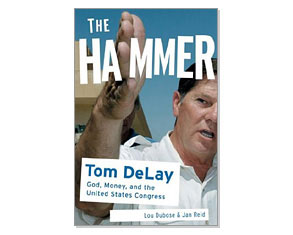

Peter Cloeren was a virgin. At least when it came to politics. He had never participated in a political campaign. He had never written a check to a candidate for elected office. He lived in a beat-to-shit Texas Gulf Coast town abandoned first by the shipping industry and more recently by big oil.
He was CEO and majority owner of one of the remaining successful and growing businesses in Orange, Texas. Cloeren Inc. was built on the inventive genius of Peter Cloeren Sr. and expanded by Pete Cloeren’s hard work and market savvy. The company, which does more than $40 million in annual sales, designs, manufactures, and markets extrusion dies, coextrusion dies and feedblocks. In the English we speak in Texas: tools that inject color into colorless plastic.
Until he was seduced by Tom DeLay — a seduction that would cost him $37,000 in political contributions, $400,000 in fines, a two-year probated sentence, and a hundred hours in community service — politics to Pete Cloeren meant showing up to vote for conservative candidates. After his brief involvement with Tom DeLay and an East Texas dentist he was trying to get elected to Congress, Cloeren was done with politics. If Brian Babin lost the 1996 race for the second congressional district in East Texas, Pete Cloeren lost a lot more. And DeLay walked away unscathed. Actually, he flew. Cloeren picked up the $1,320 tab for the executive jet service that made the 180-mile round-trip from Sugar Land to Orange less of a burden for the congressman.
Texas songwriter James McMurtry once said he writes about small towns because they’re easier to figure out than big cities. The $37,000 contribution scheme that got Pete Cloeren crossways with the FBI used the same devices to hide and move tens of thousands of dollars that DeLay and his political PACs use to move millions. It was just done on a small-town scale. Babin needed to raise a lot of money to compete for an open seat in a district that was more Democratic than Republican. In order to circumvent federal campaign finance laws, which then limited individual contributions to $1,000 per candidate and placed restrictions on corporate contributions, he needed “vehicles.” That is, fresh names to attach to money from donors willing to donate more than the $1,000 federal max. Or the cover provided by organizations that were not corporations and could legally contribute to campaigns for federal office. That’s why he needed Cloeren, who had both the money and, as Babin and DeLay would explain to him, the “vehicles.”
Cloeren’s story (told in detail in a sworn affidavit) begins with one of his employees introducing him to Babin, a candidate in the Republican congressional primary. Cloeren was flattered. And impressed. Babin wanted his help and told him that businessmen like him were essential to expanding a conservative Republican majority in Congress. And Babin was the kind of candidate Cloeren could get excited about. A small businessman with Main Street values. A Christian. A candidate who promised less government regulation and lower taxes. A Republican running for a House seat that had been the private property of larger-than-life Democrat Charlie Wilson. When Babin asked him to help raise $50,000, Cloeren said that it was impossible to do in a rural county peopled by blue-collar Democrats. He offered to write Babin a check for $20,000 or $25,000 — a clear sign he was utterly out of touch with federal campaign finance law. Babin advised him there was a $1,000 per-person limit and suggested Cloeren “work with loyal employees.”
In other words, Cloeren should make contributions in his workers’ names, or have them make the contributions and reimburse them. Before long, Cloeren was sending his employees home on their lunch breaks to pick up their checkbooks. And Babin was swinging by Cloeren’s plant parking lot to pick up his checks. The same way Paulie Walnuts picks up the tributo payments that Jersey businessmen owe Tony Soprano. In a charmingly naove line in his congressional affidavit, Cloeren says: “Since I had never raised funds for a political candidate before, I didn’t know whether it was unusual for the candidate to pick up the checks in person.” (He would later learn why Babin avoided the mail.) When Babin made the runoff, he was back again, asking Cloeren to find more employees through which company money could be funneled to the campaign. (Like the wisecracking boys at Tony Soprano’s Bada Bing Club, Babin knew that once you get your hand into somebody’s pocket, you gotta work to keep it there.) Babin’s fundraising consultant even devised a scheme by which Cloeren Inc. employees would get bonuses from the boss — precisely the amount they were contributing to the campaign. After Babin won the runoff, House Majority Whip Tom DeLay got behind his candidacy. And Babin, who had served as mayor of the tiny East Texas town of Woodville, began to show real growth as a candidate. For example, he called Cloeren to ask if he would pick up the tab to fly the congressman in for a fundraiser.
DeLay was the talent at Babin’s campaign event at the Ramada Inn, where the congressman made his standard stump speech: conservative, family values, small government, running against a liberal professional politician. After the speech, DeLay invited Cloeren to a private lunch at the local country club. Cloeren later provided Congressman Henry Waxman’s investigator on the House Committee on Government Reform a detailed account of the lunch:
“Congressman DeLay turned to me and told me that Mr. Babin’s campaign needed more money because Mr. Babin was being out-spent by his Democratic opponent.
“Congressman DeLay told me that the Democratic candidate was receiving a lot of money from liberal interest groups like labor unions and trial lawyers. I told Congressman DeLay that I could not help Mr. Babin raise more money because I had run out of vehicles. Congressman DeLay specifically told me that it would not be a problem for him to find, in his words, “additional vehicles,” since he knew some organizations and campaigns which could serve as these vehicles. Mr. DeLay turned to his aide, Mr. [Robert] Mills and stated that money could be funneled to the Babin campaign through both Triad [a corporation that ran two nonprofit foundations] and other congressional campaigns. Congressman DeLay then specifically told me that Mr. Mills would follow up with me on the details of how to funnel additional monies to Mr. Babin’s campaign.”
After lunch DeLay and Babin held a press conference at the Cloeren Inc. plant. And Pete Cloeren was an instant political player. On the ride to the airport, DeLay told Cloeren that Babin could win if he could raise enough money. He urged Cloeren to do all he could. It was here that fundraising became more sophisticated. As Cloeren listened, DeLay explained how the money could be moved.
DeLay campaign manager Robert Mills suggested that Cloeren contribute to Strom Thurmond’s Senate campaign in South Carolina and Stephen Gill’s House campaign in Tennessee. They would, in turn, donate money to Babin’s campaign. Babin also made the “Triad connection” and Cloeren began writing checks to organizations he had never heard of: $5,000 to the Citizens United Political Victory Fund PAC, which would run issue ads supporting Babin; $20,000 to Citizens for Reform, yet another Triad operation. He also wrote checks to the Thurmond and Gill campaigns, though he had never heard of Gill.
Money was moving in circles: Cloeren wrote a $5,000 check to Citizens United and the PAC wrote a $5,000 check to Babin’s congressional campaign. And the campaign committees of a South Carolina senator and a House candidate from Tennessee were suddenly contributing to a congressional campaign committee in Texas. If the requests were unusual, Cloeren at least had convinced himself he was doing nothing wrong. “I assumed that if a senior member of Congress said to do something that it would be legal, proper, and ethical to do it,” he would later say.
According to Cloeren, Babin and his consultant Walter Whetsell used Triad, Citizens for Reform, and Citizens United interchangeably. Their comments led Cloeren “to believe that Triad might be composed of all these different groups.” It was. Triad Management Services Inc. was a queer political animal, a for-profit corporation that earned no profits, sold no goods or services, and operated two nonprofit organizations: Citizens for Reform and Citizens for the Republic Education Fund. Both nonprofits were described as nonpartisan social welfare organizations. The “nonpartisan” designation allowed the groups to meet an IRS standard and run issue ads — as long as they were not funded by or coordinated with a political candidate. Yet every dime of the $3 million that the two nonpartisan Triad organizations spent in the 1996 election cycle was spent on twenty-nine Republican congressional candidates. Neither the public nor the candidates attacked by the ads bought with Triad money knew what individuals paid for them. Because Triad was a corporation and not a political action committee, it was exempt from disclosure laws. It was a drop box where contributors who “maxed out” their federal giving could send additional money to help their candidates. And perfect cover for donors who didn’t want their names in the public record.
Triad was also one of those shadowy political organizations that will make you believe Hillary Clinton’s claim about “a vast right-wing conspiracy.” Carolyn Malenick, Triad’s sole proprietor, was a graduate of Jerry Falwell’s Liberty University and a close friend of the Falwell family. Her entire professional life had been devoted to raising money for extreme right-wing causes and candidates. She began her career with direct-mail pioneer Richard Viguerie. Then she raised money for Ollie North’s Freedom Alliance and for North’s failed campaign for the U.S. Senate. Her main funder at Triad was Pennsylvania multi-millionaire Robert Cone, a zealous anti-abortion-rights crusader — until his family toy company lost several personal injury lawsuits and he put his heart and political contributions into the tort reform movement. Cone even appeared in Triad’s marketing video (though the corporation sold nothing and served only as a political operation).
For Triad, Pete Cloeren was a perfect mark: a guy with deep pockets and a track record (albeit a short one) of contributing to conservative Republicans. Even if it was just one candidate, he did have deep pockets.
DeLay and Babin were not Triad insiders; DeLay, in fact, was beginning to build his own huge fundraising operation. But he knew that Triad along with the Thurmond and Gill campaigns were conduits through which he could maximize Cloeren’s giving. So he hooked Cloeren up with Malenick, who did for him what her corporation did for other big donors: took his money and moved it on to the candidate of his choice. A Senate committee looking at Triad found that “on occasions multiple PACs received checks from the same individual within a matter of days. All of the PACs receiving the contributions then made contributions to one candidate within days of one another.” Precisely as the $5,000 Cloeren sent to Citizens United found its way back to the Babin campaign.
As the general election campaign began, Babin’s opponent, Jim Turner, was blindsided by ads linking him to gay rights and early release of prisoners. (“God, guns, and gays” campaigns are formulaic fare in Texas; you remind voters that you favor God and guns and that your opponent is aligned with gays.) The ads attacking Turner were paid for by Citizens for Reform. Turner had no idea which “individual citizens” wrote the checks to pay for the attack ads.
To anyone reading Federal Election Commission filings, it would seem that workers at Cloeren Inc. had joined together in a rare show of support — in the form of $1,000 contributions for the congressional campaign of a dentist from a small town sixty miles away. A Beaumont Enterprise reporter looked at the list and didn’t buy it. Maybe it was the Enterprise news story that caught the attention of the FBI. Whatever did it, Pete Cloeren was suddenly the target of a criminal investigation. Cloeren cooperated, phoning Babin to discuss the campaign contributions while FBI agents recorded their conversations.
The investigation wasn’t exactly deep cover. When Cloeren called to get Babin’s comments on tape, the dentist began to grouse about the Feds coming at them, probably, he said, because one of Cloeren’s disgruntled employees tipped them off. According to Cloeren’s affidavit, Babin reassured him that at least he had picked up the checks, so they couldn’t be investigated for mail fraud. Ben Ginsberg, a lawyer who once worked for the Republican National Committee, had warned Babin about mail fraud.
Cloeren also taped conversations with Walter Whetsell, the Babin campaign consultant who steered Cloeren toward Triad. Whetsell must not have shared Babin’s concern about the FBI investigation. According to Cloeren’s sworn account, Whetsell talked freely about the conversation Cloeren had with DeLay and Babin at the country club in Orange. Whetsell also had been in touch with Ginsberg regarding possible exposure to criminal prosecution. Yet he seemed unaware the Feds were watching (and listening).
Cloeren cut himself a deal, though federal prosecutors didn’t cut him much slack. He wouldn’t do any jail time but would plead guilty to misdemeanor violations of federal campaign finance law. He paid a $200,000 fine, and his company paid another $200,000 fine. His relationship with DeLay, Babin, and Triad cost him a half million dollars if you take into account attorneys’ fees, fines, and his actual contributions. His candidate didn’t even win the election. “I presently have no business or personal relationship with Representative DeLay, Mr. Babin, Mr. Whetsell, or Mr. Mills,” Cloeren wrote at the end of the affidavit he submitted to the House Committee on Government Reform. “It seems like they really took advantage of him,” said a local businessman who knows Cloeren casually. There’s a certain journalistic economy of scale in the Triad story. Its small size makes it easier to follow the money. From Cloeren to his employees and finally to Babin. Or from Cloeren to Triad in Washington, to one of the Triad entities, then back to the Babin campaign. Or from Cloeren to the Thurmond and Gill campaigns then back to Babin. Soft money (corporate funds illegal to spend) sent to an entity not required to report it, or to a congressional campaign that could turn it around and send it back as hard money (individual, PAC, or organizational money legal to spend). This is precisely what the fundraising operation that has come to be called DeLay Inc. does on a much larger scale, and with the extra incentive a leader of Congress brings to the process of asking for money.
The Triad affair also illustrates the impunity with which campaign fundraisers operate. A Democratic member of Congress who asked that his name not be used said Clinton Attorney General Janet Reno’s lack of enthusiasm for prosecuting illegal fundraising didn’t help. Reno had put herself in a box. Once she refused to appoint a special prosecutor to look into allegations about improper fundraising in the Clinton White House, any Department of Justice enforcement action against Republicans would appear to be partisan.
Congressional oversight was equally politicized. Committees in both houses were controlled by Republicans and largely focused on Clinton’s fundraising. Democrats were pointing to Triad, arguing that there was more to investigate than the phone calls President Clinton and Vice President Al Gore made to funders, and the names of donors who had slept in the Lincoln Bedroom. Considering the magnitude of the White House fundraising operation and the serious questions raised about it, it’s not surprising that Republicans in Congress had little interest in a small-time shell game in Texas. Yet Government Reform Chair Dan Burton’s conduct was so egregious that it gave partisan excess a bad name. Burton had his sights set on ClintonGore ’96 and wouldn’t look at what Triad had done in the same year.
Not only did Burton refuse to look at Triad. He blocked committee Democrats from conducting their investigation. Burton held his ground until California Democrat Henry Waxman put him on the spot in public. Waxman made such a compelling argument at a mid-May ’98 committee hearing that Burton agreed to allow minority members of the committee to subpoena summaries of FBI interrogations of Triad subjects. Burton quickly reneged, however, implying that Waxman was coordinating his investigation of DeLay with other congressional Democrats who had filed a racketeering suit against DeLay and his fundraising operations.
Though he wasn’t able to hold hearings or subpoena witnesses, Waxman persisted, and Peter Cloeren was able to tell his story to Congress. Waxman sent a minority staff member to Texas to look into Babin, DeLay, Triad, et al. But the scope of his investigation was limited. There is no doubt that the Triad/Babin affair was dwarfed by Clinton-Gore’s fundraising. But Triad was never adequately examined by the House and Senate committees looking into fundraising irregularities. Lacking the authority to issue subpoenas and schedule hearings, committee Democrats were checkmated. (Much of the material here cited is in the public record because it was in the minority reports of House and Senate committees.)
When no one was prosecuted after Peter Cloeren cooperated with the Feds and paid a $400,000 fine, he filed a complaint with the Federal Election Commission. After conducting an investigation, the FEC legal staff recommended $4,544,000 in fines: $1,149,000 against Triad; $1,818,000 against Citizens for the Republic Education Fund; and $1,577,000 against Citizens for Reform. The commissioners, always responsive to political pressure, ignored the recommendations of their own staff, dropped the fines against the two nonprofits, and reduced Triad’s fine to $200,000.
Tom DeLay got a walk on the deal he had done on Peter Cloeren, which DeLay claimed involved no more than speaking to Cloeren for three minutes at lunch. (“I don’t know this man from Adam,” said DeLay.) Whether it was DeLay’s three minutes or the ninety minutes Cloeren swore to in his affidavit, DeLay’s visit to Orange, Texas, occurred as he was moving into major league fundraising. By the time he opened a Texas branch in 2001, DeLay Inc. was raising money in volumes never seen in the United States Congress. Nothing compares. No member of Congress — except members raising money for their own presidential Campaigns — had ever raised the amount of political money raised by Tom DeLay. The Texan elected majority leader in 2003 is in a class of his own.
