

A move, a new job, the beginning or end of a relationship: These are among the traumas — up there with birth and death — that we’re told are sure to send shockwaves through our systems. My friend Sara is about to face a daunting combination of them; she’s quit her magazine job, packed up her beloved apartment, and on Saturday will leave New York, her home of six years, to move in with her boyfriend in Boston.
But my experience doesn’t get much ink in either the self-help or greeting card aisles at Barnes & Noble. My best friend is moving away.
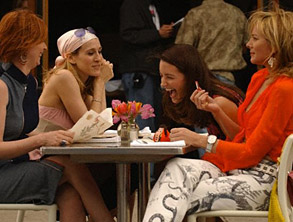
The power of female friendship is widely dramatized and almost as frequently fetishized in fiction. From Marianne and Elinor Dashwood to Nicole Holofcener movies to recent ads for Ortho Tri-Cyclen birth control pills to a certain high-heeled HBO series, yarns about women’s abiding affection for one another — especially in tart contrast to their relationships with men — have been knit into yards and yards of narrative melodrama. But as mating patterns change, and many women put off marriage until their 30s, we gain a decade of independence; a decade that might once have been dedicated to bonding with husbands and children, but is now often unfettered by men or the limitations of family. We may be single, but rarely do we spend those years without a coterie of girlfriends. We may not be growing up within the context of our marriages anymore, but we are not alone. Women become each other’s de facto spouses: We practice habits of sharing and intimacy; we urge each other to be stronger and sharper, to get better jobs, and to accept no less than just and healthy relationships.
Perhaps the books and cards don’t address the commitments of women to each other because we are still catching up with our own changing clocks. Maybe it’s that an honest acknowledgement of the role we play for each other might threateningly suggest yet another way in which men have become dispensable. For whatever reason, we don’t have social mechanisms in place to convey the power of our devotion, or express our pain at its loss.
When Sara and I met, in our early 20s, as peons at the same magazine, we weren’t crazy about each other. She thought I was snotty; she struck me as an emotional train wreck. We stayed in vague, uninterested touch through mutual friends as we got other jobs and each had a series of relationships, until at a friend’s birthday party, three years after we’d met, we began comparing notes on our recently broken hearts. The girl I’d remembered as a delicate, weepy flower gave relentlessly hard-ass advice; she didn’t think I was such a bitch anymore. Sara and I became friends.
We’re very different: She’s blond and pink-faced, I’m brunette and freckled. She’s an incurable hypochondriac who keeps the business cards of all 26 of her specialists in her wallet; I hate doctors and — despite a condition I’m supposed to monitor — haven’t been for a regular checkup in years. Her job is to kvetch at me to go to a doctor; mine is to soothe her through her cataract scares and MRIs. She’s quick to fight with strangers, I’m quick to fight with friends. So I dissuade her from street brawls with Yankees fans and she talks me down from my bouts of social pique. For two such high-octane people, we’ve had an amazingly peaceful run. We’ve argued about things like how she woke me up early on a Saturday morning to pick up a rug; how she took so long to cook her hash browns that my scrambled eggs got cold; about which of us was righter about when our friends would get engaged. We are like two aging drama queens, relieved to step off the stage and relax together with a beer and a cigarette.
Sometimes we are each other’s “plus one” (media parlance for “date”) at dress-up parties, where we eat and drink and gawk at Liv Tyler for free. But mostly, we have kept our old social calendars with our separate groups of friends intact. Sara and I meet for nightly wrap-up sessions in Brooklyn bars where we can violate the smoking ban. We trade in theories, stories, jokes and endless, endless analysis. We are as likely to discuss our weird rashes as we are orgasms. We know all of the other’s office gossip. We watch awards shows and post-season baseball and have served as a two-woman communications headquarters during this election, juggling our mothers and our editors on phone lines, monitoring responses and cracking jokes about candidates. In short, we are a boring couple who have had fun discovering our own bifurcated independence. By leaning just a little on each other, we learned to stop worrying and love our lives.
I’ve learned a lot about the nature of adult relationships from this one. For one thing, I have been disabused of the notion that no man I meet at this stage of my life will ever be able to understand me without having known me for years. It took Sara about three weeks to figure it all out. It was easy, how quickly we explained and understood each other’s full and meticulously drawn-out histories.
Since we’ve been close, Sara has had a couple of relationships; I’ve dated as rarely as humanly possible — too pleased with my impervious shield of post-heartbreak self-sufficiency to risk weakening it. None of the guys she dated ever diminished the tenor of our friendship. When she met Matt, a year and a half ago, it was clear that he was good people; I approved. He was around for only three months before dispatching for his new job in Boston. I don’t think I realized it then, and long-distance has been hard for her, but as far as our friendship went, this was the perfect arrangement. She was in a happy romantic relationship. But she didn’t have to say goodbye to her independence. When it became clear that Matt would not be returning to New York, I was enthusiastic about her moving to be with him. This guy seemed worth a try.
There is little dithering frippery about Sara. She isn’t big on the “Do I look fat in this?” school of femininity; she knows what she knows. When she tells me that a spider bite on her wrist is surely shooting poison to her brain, there is no question in her mind that it’s true. So it has been grim, watching her wrestle this question to the ground: What sacrifices are worth making? What chances are worth taking? How do you balance scales when your job, your home, your friends and your city are on one side and a man you love, a relationship you want to work, is on the other?
I pushed her — again and again — to move. What we wanted, after all, were not just good jobs and good friends, but fun, functional relationships with men, sex and, someday, families of our own. And we knew that all of those things meant choice and compromise and sacrifice. Our time as single women allowed us to build a strength and self-awareness that would help us make healthy choices. We were spending playful, selfish years hammering out what we wanted from life until we knew our own desires well enough that we could take chances — like moving to Boston for a boy — and not risk losing our sense of self. So here we are. Sara’s sacrifice is giving up her home, her job. Mine is giving up her.
And now that it’s happening, I’m angry. So angry that last weekend, hours before her going-away party, I decided it would be the perfect time to call Sara and scold her for some minor social crime, a move that ignited all her bottled stress and sadness. We had a mean shriek-fest of a fight that ended with her hanging up on me, and both of us raging around our respective homes for hours before we mended things. When we did, she gigglingly told me that Matt — in town for the weekend — had been so flummoxed by her howling outbursts of fury and grief that he’d followed her around helplessly, repeating, “It’s just because she’s upset you’re leaving.”
Around the time that Sara and I were hurling obscenities at each other over the phone, the New York Post carried a story in response to the recent flap over actress Cynthia Nixon’s affair with a woman. The story was headlined “The Truth Is Out: Gals Envious of Sapphic Cynthia,” and was illustrated with a photo of Sarah Jessica Parker, Nixon’s “Sex and the City” costar, with a thought bubble over her head that read, “I couldn’t help but wonder … are women better company than men.” “While many straight ladies say they have no intention of swinging Sapphic,” the story read, “they can’t help but wish that dating New York men was as easy as hanging out with their gal pals.” That the piece was ludicrous on almost every level should go without saying: The musty straight-girl “I wish I were a lesbian” refrain might reasonably offend anyone who actually happens to be a lesbian and is denied legal benefits and recognition of her partnerships. Plus: We don’t want to sleep with the people we don’t want to sleep with. But what many of the women in the piece were actually saying was pretty familiar. Like 24-year-old Maryellen Martino, who “said nothing beats her girlfriends because ‘they’re so supportive and understanding.'” And 24-year-old Corinne Covey, who said, “It’s the understanding you get from your girlfriends.”
What the women in this story seemed to be saying — what I’m saying as I let my friend go — is that the alliances single women form with each other are profound and lasting. What we’re mourning, when we yell at those friends who are about to depart, or tell a newspaper that we wish we could be lesbians, is that on some level, these relationships demand recognition. During our formative 20s and into our 30s, women provide us with the emotional and intellectual sustenance and shared curiosity about life that we’re not getting from our parents anymore, or from husbands or from our temporary or nonexistent sexual partners.
As I watch Sara go, I feel slightly duped, slightly betrayed by the peculiar alchemy of the female bond: Has the fortifying power of our friendship made this move possible? Do the best kind of girlfriends act as placeholders for romantic partners? We practice intimacy and boredom and petty bickering and compromise and connection, so that when and if we do settle down with traditional families, we won’t have forgotten how to do those things. But I hate to think of these alliances merely as dry runs for our “real” relationships with men. Perhaps I especially hate thinking of them that way as I prepare to be replaced, in a daily way, by a man.
There aren’t any goodbye rituals for us. This is not a divorce or even a breakup; there was no acrimony here. There’s no division of property, though the de-accessioning of her apartment has left me with a new wine rack and a copy of “Embarrassing Medical Problems.” What I really want is the thing that she’s taking a chance on: love and sex, and, someday, marriage and children. Maybe Sara’s departure will be good for me on that front. Maybe losing my comfortable beer-and-television partner will make me uncomfortable enough that I’ll be forced to open up to the possibility of actual — even optimistic — dating. And it’s not as though I’ll be alone. I have many dear friends, one just around the corner from me in Brooklyn. Sara’s even arranged for mutual friends — who are engaged — to move into her apartment. “So you’ll have someone to take care of you,” she has said, and I know she’s not kidding.
