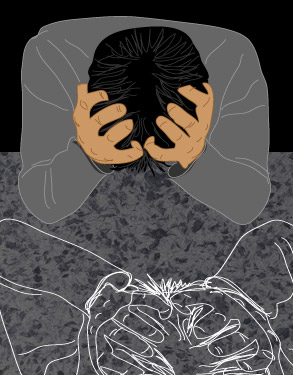

When Frannie was 35, her fiancé ended their five-year relationship. As breakups go, it was a bad one. She could hardly eat, sleep or get out of bed; she suffered panic attacks. Her friends, concerned that she was suicidal, brought her to see a psychotherapist, Belleruth Naparstek, who began treating Frannie (not her real name) with traditional “tell me what you’re feeling” talk therapy, along with Prozac. But she got nowhere. “She sat across from me like a stone, barely able to speak,” recalls Naparstek, who has a private practice in Cleveland. When she did speak, there were “long pauses that trailed off to nowhere.”
Finally, after several sessions, Frannie — now 56 and an educator in the Midwest — began to describe an earlier trauma: losing a previous fiancé, over a decade before, to a brain tumor. Naparstek thought she’d hit pay dirt. But when Frannie started to talk about this loss, she began to have panic attacks at work and episodes of both severe verbal paralysis and strange physical contortions during therapy. Speaking only, Naparstek says, “in disjointed, choppy fragments” — getting the whole story took months — Frannie finally revealed that there was yet another trauma underlying the death of the fiancé: One night after visiting him, she was brutally raped, stabbed and left for dead in the hospital parking lot. Her contortions, Naparstek realized, were a physical flashback to the rape, a phantom effort to twist away from her attacker.
Frannie had never reported the rape and never sought counseling — “I went on with my life and repressed it,” she says — until the memory got triggered in therapy. But talking about the ordeal did not bring catharsis; it made things worse. So Naparstek switched tacks. She began leading Frannie in guided meditations and encouraged her to imagine herself in a safe place, surrounded by loving and protective figures. Eventually, Frannie was able to calm herself at will, and the panic attacks began to fade away.
Frannie is one of approximately 5 million Americans who suffer from post-traumatic stress disorder. Surprising to some is the fact that most of the people who suffer from PTSD did not fight in Fallujah, see their homes swept away by hurricanes or escape from the twin towers. (They’re not even the John Kerry people reportedly being treated for “post-election trauma.”) People like Frannie develop PTSD from more intimate or individual traumas such as car crashes, surgery, assault or even the constant sense of threat in a violent community (9 percent of Israelis are said to suffer from terror-related post-traumatic stress disorder.) In fact, more people may have PTSD today than anyone ever realized. But because of recent advances in biochemistry, brain imagery and epidemiology, researchers are finding out that all manner of conditions — some psychiatric, but some also physiological, such as chronic pain — can be traced to PTSD.
“The symptoms of post-traumatic stress can mimic severe, chronic mental illness, and many people have been misdiagnosed and assumed to be hopelessly ill,” says Naparstek, author of “Invisible Heroes: Survivors of Trauma and How They Heal.” “But people with PTSD aren’t crazy, and they get better.” Today, in fact, their prognosis is the best it has ever been. For many years, “we didn’t know how to help trauma survivors in any consistent way,” says Naparstek. As she herself discovered while treating Frannie, “Talking about it — the stock in trade of mental health professionals, pastors, good friends and spouses — is not necessarily all that helpful, and can sometimes make symptoms worse.” But now Naparstek, and more and more trauma experts, are using additional forms of treatment — such as guided imagery and somatic experiencing — that have only recently shifted from the fringe to the mainstream. Research is even underway on a PTSD pill.
While PTSD wasn’t included in the Diagnostic and Statistical Manual of Mental Disorders until 1980, there are accounts of similar conditions dating to the Civil War, World War I and even to ancient times. PTSD — though now defined by a term more accurate than “Vietnam syndrome,” one of its earlier iterations — is actually not a disorder. Nor is it an illness, not even a mental one. “PSTD is a normal reaction to abnormal events,” says Beverly Donovan, a clinical psychologist at the Veterans Affairs Medical Center in Brecksville, Ohio, who runs an intensive treatment program for combat vets with PTSD.
Here’s how trauma typically operates in the body: When you sense danger, your body automatically releases a massive blast of biochemicals, such as stress hormones (e.g., adrenaline), into your bloodstream. Then the “thinking” part of your brain asks: Am I in serious trouble, or just on a Tilt-A-Whirl? If the answer is the former, your hard-wired “fight or flight” action kicks in, sending your heart, lungs and liver into overdrive. Typically, then, you either fight or flee. All those chemicals, all that energy, gets discharged or burns off. Your parasympathetic nervous system then steps in to say “Show’s over,” decreasing blood pressure and heart rate, reactivating normal blood flow and organ function. You might be hungry or exhausted, even upset and shaken, but internally you’re fine.
But some people get stuck. Even if they know the threat has passed, their neurons get jammed on orange alert. Remaining hypersensitive, the primitive, reactive part of the brain will pull the alarm at the slightest provocation: a loud noise, a footfall, a certain smell. Meanwhile, the constant state of alert leaves a waxy buildup of biochemicals and metabolic castoffs in muscle fibers and tissue. (This is why some people’s fibromyalgia, cystitis, migraines and even irritable bowel syndrome may, at their root, be symptoms of PTSD. They may be a result of the truly unnatural amounts of both alarm-state and settling-down biochemicals that, without an efficient means of discharge, get lodged in the tissue.)
Researchers are still studying precisely why certain people are more susceptible than others to PTSD. Of two people in the same armed robbery, one may be fine while another remains traumatized. Someone who was blocks away from the World Trade Center towers on Sept. 11, 2001, may develop PTSD while someone who actually escaped a building may not. What we do know is that susceptibility to PTSD has nothing to do with, say, cowardice, or weakness of character.
So why doesn’t traditional talk therapy usually help? Therapists have found that when PTSD patients seem resistant to talking about their traumas, it’s not necessarily because they don’t want to. That’s because trauma memories are not stored where happy, or even ordinary, memories are. The sensations and experiences of trauma — terror, struggling — get packed away into the more primitive areas of the brain, to which the “rational” — speaking, thinking — parts do not have much access. The advanced areas can blab away all they want, but to the brain’s nether region, they will — at best — be as unintelligible as Charlie Brown grown-ups. Says one of Naparstek’s PTSD patients of an earlier experience with a psychoanalyst: “I kept asking my therapist, ‘What is happening to me?’ And, of course, in good psychoanalytic fashion, she asked, ‘What do you think is happening?’ Despite her good intentions, it was profoundly unhelpful.” If anything, talking — at least initially — may do the opposite of “process”; rather, it can trip the lock on a Pandora’s box. “In many psychotherapy practices this is still going on, out of sheer, well-meaning ignorance, just like mine,” says Naparstek. “Too many of us have been defeated by trying the traditional tactic first, and extending and exacerbating our clients’ suffering. It sucks.”
Based on what’s now known about how and where the residue of trauma lingers, many therapists are employing alternatives, or at least additions, to talk therapy — such as guided imagery, eye movement desensitization and reprocessing, somatic experiencing and other methods — that seem to offer more direct avenues to healing by seeking out trauma where it lives: not only in the mind but also in the body.
“When exposed to trauma, some people will have trouble letting go of the experience, but not because they want to dwell on it,” says Steven Gold, Ph.D., director of the Trauma Resolution and Integration Program at Nova Southeastern University in Fort Lauderdale, Fla., and president of the International Society for the Study of Dissociation. “There are various techniques for helping people move beyond it, which may have as much to do with the body’s reaction to the experience as with the mind’s. A few years ago some of these therapies would have been considered ‘alternative, but now the major specialists in treating trauma would consider them more mainstream.”
So how does one access the inner trauma sanctum? As it turns out, images help where words fail. In some cases, even images of the trauma: Exposure therapy, to name one now-established type of what’s called cognitive behavioral therapy, has the patient imagine the trauma repeatedly — under strictly controlled circumstances — until the concomitant reactions (panic, etc.) begin to abate. It’s more than a matter of telling yourself, “See, it’s over, I’m safe now”; it’s training the body to not go into panic mode.
Therapists may also use metaphors to soothe and dislodge trauma, to “sidestep the [verbal] booby traps that set symptoms off and create more distress,” says Naparstek. One of many image- or metaphor-based techniques is “guided imagery,” which Naparstek calls “deliberate, directed daydreaming.” It’s kind of like meditation, only with someone guiding your experience: a voice (live or recorded) suggesting that you imagine certain safe spaces or soothing sensations, each specifically designed to address a particular condition. Research has found that guided imagery can help alleviate ills including diabetes, bulimia and anxiety — and that it may be particularly helpful for trauma. Even though words are its medium, the language of guided imagery isn’t directly processed by the brain’s advanced speech and thought centers. Rather, the sensations and associations that listening to it produces — such as the presence of a benevolent, protective companion, along with reassuring voice tones and soothing music — are absorbed directly into the primitive brain: exactly where the trauma has set up shop.
Numerous other image-related therapies are gaining in respect and reputation, including eye movement desensitization and reprocessing, in which the patient is gradually desensitized to an image of personal trauma by envisioning it while also being distracted by an additional stimulus: moving the eyes back and forth, being tapped on the body or hearing tones from a headset. The Department of Defense has approved the use of EMDR as one of several therapies for treating soldiers with PTSD.
There’s also a method called somatic experiencing in which patients are not asked to “describe exactly what happened” from beginning to end but, rather, are asked to imagine — and physically mime — elements of the trauma, sometimes resulting in an imagined alternative outcome. “The body doesn’t like surprise,” says Nancy Napier, a Manhattan family and trauma therapist who uses somatic experiencing in her practice. She explains that when we’re startled by a loud noise, for example, our reflexive “orienting response” causes us instantly to look for its source. If someone comes up behind you, say, “the body gets caught in that moment of surprise,” she says. “So part of the [SE] treatment is to complete the orienting response.” Napier might, for example, have an attack victim go, inch by inch, through the motions of looking behind her, focusing on her feelings each time, only to ultimately confirm that there is no longer an attacker there. Somatic experiencing “works to bring the nervous system up-to-date so that it’s no longer locked in unresolved moments of trauma,” says Napier. Mentally and physically re-creating — and reimagining — the situation, practitioners say, is much more effective than, say, just telling yourself you’re going to be OK. It’s a matter, once again, of circumventing the verbal and accessing the physical, primitive and intuitive areas where trauma — and the means to heal it — is stored.
As for Frannie, her ultimate breakthrough came when Naparstek suggested she visit someone who works with “somatic psychotherapy” — a means of helping patients work through trauma (or other issues) via perceiving and describing internal sensations in the body. “I thought it was bullshit,” Frannie says. “Then one day I was lying on the table and [the therapist] asked me to describe my heart. And I said, ‘Well, it’s a boulder in my chest, a frozen stone, a cannonball; you can’t penetrate it.’ And I realized that that was the place where I could start working, to ‘melt’ that heart of stone.”
Sure, it’s just a metaphor, and it might even sound corny, but for Frannie, discovering the “stone” was progress. Frannie found she could describe the stone in a way that she could not describe her feelings, at least not without triggering flashbacks. It served as a stand-in for her emotions, a metaphorical repository for the effects of her experiences. “It was a way of getting to the same place that words would have brought us to had her language capacity not been so hobbled,” says Naparstek.
Over time — in Frannie’s mind’s eye — the “stone” went from hot and ugly to soft and malleable, and ultimately melted away, leaving an image of her real-live heart in its place. “My heart is back,” says Frannie, who is virtually symptom-free but for a still overprimed startle response. “I’m connected to myself now.”
Susie Carrillo was 21 years old and a mother of two young children when an abnormal Pap smear yielded a triple-whammy nightmare. She was shocked not only by a diagnosis of high-grade cervical dysplasia — a serious precancerous condition — but also by its apparent cause: human papillomavirus (HPV), a sexually-transmitted infection (STI, more commonly known as STD, for sexually transmitted disease). A doctor had found it two years earlier but had largely dismissed it, saying, eh, it’ll probably clear up on its own. With no warnings about the risks of cancer, or transmission, Carrillo says she “just didn’t think about it” and told no one. And that’s what led, in part, to the third and perhaps biggest whammy of all: her husband’s reaction to the cause of her cancer. “He turned it into hell for me. He demanded to know how many people I’d slept with, accused me of cheating and called me a slut,” she says. Even though Carrillo had never strayed — she believes she contracted HPV from a pre-marriage ex — her husband’s abusive words began to infect her, too. “I started to wonder if maybe it was my fault,” she says. Ashamed and embarrassed, she went through cancer treatment alone.
Thankfully, Carrillo was eventually cured: of both her cancer and her self-blame. She ultimately divorced her husband, found support online and learned, as she says, that she has “nothing to be ashamed about.” But even with its happy ending, her story reveals a troubling reality: While STIs have reached pandemic proportions, the stigma surrounding them remains ugly — perhaps especially for women.
“You cannot get through a season of ‘Jersey Shore’ or ‘The Real World’ without an STI ‘joke’ implying that the person accused of having one is skanky and slutty, and saying ‘Ooh, watch out, you might catch something,’” says Adina Nack, Ph.D., a medical sociologist specializing in sexual health and author of “Damaged Goods? Women Living with Incurable Sexually Transmitted Diseases.” “And that person they’re talking about is almost always a woman. There’s a serious misconception that you have to be ‘promiscuous’ in order to contract an STI, and while men in our culture are rewarded for being sexually active, women are judged.” (Nack cites one woman in her practice who’d never even had sex, but who contracted an STI while — successfully — fighting off a rapist. Even she said, “I feel like a slut.”)
To be sure, STIs and their attendant stigmas are (as I’ve written before) no picnic for men, either. But their impact appears to be different, in certain ways, for women. Among the hundreds of people with STIs Nack has interviewed, she says, men tend to be more concerned about medical realities — the best treatment, the best protection for partners — while women focus on much broader, and harsher, implications that strike at the very core of their sexual selves: “Will I be rejected as ‘damaged goods’?” “Are my dreams for sex, love and happiness over?”
All that when, ironically, STIs are now so strikingly common that, as Nack says, “you should go out into the dating world assuming that the person you’re with has already contracted something, even though they may not know it. Even if someone says, ‘I’m ‘clean’ — I’ve been tested for everything,’ they’re either ignorant or lying, because we don’t even have definitive tests for everything.” (STIs are often asymptomatic and frequently go undiagnosed.) The CDC estimates that nearly 19 million new infections occur each year. At least half of the sexually active population will contract HPV at some point; 45 percent of women 20-24 have it already. It’s so prevalent, in fact, that the medical community considers HPV infection a virtual “marker” for having had sex at all. One in 5 adults, whether they know it or not, has herpes right now. In other words, statistically, your date is more likely to carry a sexually transmitted infection than to share your astrological sign.
Though many STIs are easily and effectively treatable, those who have them still live with threats: of painful outbreaks, other medical complications and (in the case of certain HPV strains) cervical cancer; of straight-up slut-shaming and outright rejection. Given how common STIs are — and despite efforts by, for example, writers at Jezebel to chip away at the stigma by indirectly or directly outing themselves — it’s pretty amazing how much dated stereotype and outright ignorance remains (which in turn can deter people from getting tested). People that both Nack and I interviewed tell tales of women with herpes who, when actually outed, were told by officemates to use separate work equipment, and by family members to use separate toilets.
And if people you’re probably not going to sleep with react badly, imagine having to tell someone you like-like. For single women (and of course men) with STIs, the fizzy fun of a promising new date is often flattened, they say, by fear of the looming, dreaded Talk. Michele Bouffidis, 43, of New Jersey, contracted herpes — her “rowdy tenant,” she calls it, though she experiences only rare outbreaks — from an old long-term boyfriend who didn’t tell her he had it until it was too late. Over the next five years, she dared disclose to three men; none stuck around. One, at least, took the time to consider, eventually telling her — gently and thoughtfully — that he didn’t want to take the risk. She totally understood, she says, but it still smarted. Another said, “You seem like a very classy girl — I would never have imagined you having that.” (Translation: “You slut.”) By the time No. 3 rolled around, Bouffidis was dispirited enough that she presented her diagnosis in a negative, “You’re not going to want to deal with this,” light, almost deliberately pushing him away. For three years, she didn’t date at all. “It was because I have herpes,” she confirms. “I didn’t want to deal with ‘The Talk’ any more.”
Kalani Tom, 40, of New York, usually uses e-mail to inform potential partners about her genital herpes (which she controls successfully with medication) to give them a chance to process the information on their own. Sometimes, it goes fine. “One guy said, ‘It’s gonna take a lot more than that to scare me off,’” she recalls. But the more she likes a guy, the scarier it is — and once, when the stakes were high, she choked. “He asked me if I had anything, and I said ‘no,’ ” she admits. “I was a coward. I didn’t want to be judged.” When she finally told him the truth, he was devastated — not just by her diagnosis, but by her dishonesty. (Fortunately, he tested negative.) Another recent prospect just bailed, too, upon hearing the news. But Tom — though quite contrite about her lie — remains hopeful, even defiant. “People may judge, but I know I’m not some repulsive horrible person,” she says.
Plenty of “seropositive” men and women — Nack herself included (and Michele, above) – are in happy, healthy relationships with STI-free partners willing to take on the medical logistics of avoiding transmission. “Not all potential partners are going to reject you,” she says. And many women and men with STIs have found support, community, friends (and more than friends) in online communities specifically for them. There’s an interesting, and ongoing, debate about whether dating sites for people with STIs are godsends or ghettos, but experts say they are — at least — great places for the newly diagnosed to get their groove back.
Kristin Andrews, 30, of Michigan, contracted herpes from an unfaithful boyfriend who, when he heard her diagnosis, called her “a slut and a whore and complained that now it’s gonna be hard for him to date,” she recalls. “For that first few weeks it was awful. I felt like I was one of the worst people in the world, disgusting and degraded and gross.” Then she found MPwH.net (short for Meet People with Herpes), where she got her “newbie” questions answered straightforwardly and reassuringly. Eventually, she arrived at the distinction that our society clearly — and dangerously — still refuses to accept. “I have herpes,” she says. “But it’s not who I am.”
Markai Durham, whose story is told on MTV's "No Easy Decision"
What can’t you talk about on television? These days, not so much. But if there’s one topic that, even amidst reality show ribaldry and talk show turpitude, remains (or has become) glaringly absent — even bizarrely so, given how common it is in real life — it’s abortion.
Sure, “Friday Night Lights” did get massive kudos last summer for its nuanced depiction of a Texas 10th-grader’s decision to end a pregnancy. But that kind of thing basically hadn’t happened since “Maude.” Today, other than a handful of relatively tidy plot turns on “House,” “Six Feet Under,” “DeGrassi” and “South Park” (not to mention “Juno” and “Knocked Up,” where “smashmortion” is ruled out in one or two perfunctory scenes) that’s pretty much it. And, in fairness, that’s all fiction.
If there’s been any elephant in any room, it’s been on MTV, since the launch of the network’s smash-success pair of reality series about teen pregnancy and motherhood. “For two seasons of ’16 and Pregnant’ and two seasons of ‘Teen Mom,’ we have never seen any pregnant teen seriously consider abortion,” media critic Jennifer L. Pozner, author of “Reality Bites Back,” has observed. While 27 percent of pregnant teens choose abortion, Pozner notes, “in MTV’s version of ‘reality,’ 100 percent of pregnant teens give birth.”
Late last night, that changed. MTV aired a 30-plus-minute interview special called “No Easy Decision,” in which three young women — including Markai Durham, who was featured last month on “16 and Pregnant” carrying her first pregnancy to term — spoke candidly about their decisions, as teenagers, to have abortions. Though MTV had not planned to promote the show, which appeared at the way-past-prime-time hour of 11:30 p.m., a leak by EW.com last week did just that — and had everyone prepared for the worst. Circling the wagons against nasty backlash, nonpartisan post-abortion support talkline Exhale, who partnered with MTV on the show, had already planned an online campaign called “16 and Loved” to act as sort of virtual clinic escorts for the young women outing themselves. Abortion-rights opponents smelled pro-choice conspiracy; abortion-rights supporters feared that the network — and especially “Dr. Drew” Pinsky — would tackle the subject with all the nuance and sensitivity of a Snooki Polizzi sucker punch.
But this member of the latter camp is relieved, delighted — and still amazed — to report that MTV got it right. Seriously, they nailed it. And by “nailed it,” I don’t mean they just did a great PSA for abortion. I mean they told the many-sided truth: that abortion is safe and common, that abortion has been made difficult to get, and, most importantly, that abortion is a complex decision made by complex human beings. (That thump you heard around 11:35 p.m. EST was the sound of 100 feminist media critics falling off our collective couches.)
Here’s Dr. Drew opening the show — and racking up stunned “FTW!”s (For The Win!) on Twitter right out of the gate: “About 750,000 girls in the U.S. get pregnant every year. And although nearly a third of these teen pregnancies result in abortion, we’ve never shown this choice on ’16 and Pregnant’ up until now. It can be a polarizing topic, and there’s quite frankly no way to talk about this and please everyone. Although controversial to some, abortion is one of the three viable options, and it’s among the safest, most common medical procedures in the U.S., so we thought it was important for us to discuss.”
In a wrenching produced segment, we then meet Markai and her partner, James, as they wrestle with their options for her unplanned second pregnancy, the result of a missed appointment for her shot of Depo-Provera. As a mother, Markai is tormented both by the prospect of terminating a pregnancy (or relinquishing a baby) and by the prospect of raising a child whose needs will splinter their already slim resources. Referring to her daughter, Zakaria — and reflecting the fact that 61 percent of women who have abortions already have children — she says, “I don’t want her to struggle because of my mistake.”
Through the rest of her segment, and in Dr. Drew’s follow-up interview with her and two other young women (Katie and Natalia), the show manages to include: medically accurate information about abortion procedures, the challenge of finding the birth control method that works for you, the positive presence of supportive family and friends, the compassionate voice of a clinic counselor (vs., for one, the cold depiction in “Juno”), the complex emotions of male partners, the cost of abortion ($750, in the case of Natalia, who sold her prom ticket back to school to help put together the funds), the cruelty of parental notification requirements (Natalie called the experience of securing an alternative judicial bypass “begging for permission to make your own decision”), the positive presence of supportive family and friends (in this case, African-American, a sadly rare portrayal), the normality of mixed feelings after the procedure (Markai says, insightfully, that she feels sadness but not regret), and the characterization of abortion as — in Katie’s words — “a parenting decision.” (In an extended interview available online, Natalia also describes the cruelty of being legally forced to view the pre-procedure ultrasound.)
All that in just over 30 minutes, all without scoldy shaming or down-our-noses voyeurism. Instead, this whoop-worthy kicker from Dr. Drew — “Hopefully this inspires us to be more compassionate when we think about abortions” — and, simply, three brave and articulate women who may have begun to raise the level of public, pop-culture conversation about abortion. Maybe it’s “just” MTV, but it matters (and God knows no one else is doing it).
“This isn’t just a television show. Media portrayals, real or fictional, don’t merely inform us — they form us,” as Gloria Feldt wrote in the Washington Post about “Friday Night Lights.” “And they miss the profound truth of women’s lives when they reduce broad issues such as sexual and childbearing choices to one word — abortion — and reduce abortion to a polarized, black-and-white debate.”
And as Dr. Drew himself said last night: “Having an abortion is not uncommon. But talking about it publicly is.” At this time, there are evidently no plans to repeat or extend the special, which was buried to begin with. So here’s a high-five to MTV for — finally, and so finely — getting this thing going.
A month after Katherine Chloé Cahoon’s peppy promotional videos on “How to Meet European Men” went viral, obsessive debate about her continues. Is this girl for real?!
Why such confusion in the first place? Cahoon’s series of videos, based on the advice in her book, “The Single Girls’ Guide To Meeting European Men,” are so hilariously perky yet wooden, so social-media-savvy yet dated, so mannered yet subtle, so “worldly” yet wide-eyed, that “parody” vs. “real” sides have been ferociously taken. (Video posted below.)
On the one hand, there’s the Gawker conclusion (shared by many), based on “in depth Internet research” revealing Cahoon on Facebook and her book on Amazon: She is “the world’s craziest dating expert” and the videos are “thrillingly real” (“please watch in splendid amazement”). On the other hand, there are those who say the videos — the costume changes! the cheesy soundtrack! the men! — are too thrilling, too splendid, too crazy to be real. Our appetite for irony is so voracious, our radar for hoaxes so sensitive, and (in some cases) satire has become so sophisticated, that indeed: These days, one could imagine Cahoon (or “Cahoon”) pulling off a head-spinningly elaborate pop-culture fake-persona long con: Joaquin Phoenix meets Stephen Colbert meets Tina Fey/Amy Poehler meets Carrie Bradshaw. (This was my take, initially. At least that’s what I was rooting for.) But the debate in the first place is a sign of our post-Blair Witch, post-reality TV, “I’m Still Here”/”Catfish“/”Jersey Shore”/YouTube times: We’ve become so jaded that it’s near impossible to distinguish between real life and a hoax — or a marketing strategy — and we’re always on the defensive for being duped. The argument over what’s real and what’s not has become, more than ever before, a major part of our reaction to art; the membrane between reality and imagination is getting more porous by the day. That mashup is what makes the Cahoon conundrum so captivating. She embodies an irresistible pop-culture zeitgeist two-fer: We thrill to a clueless train wreck; we smell a clever, clever rat.
But in all this investigation and vigorous discussion, one voice was missing: Katherine Chloé Cahoon’s. And so, I decided to call her up. Is Cahoon real or fake? The answer, at once disappointing and exhilarating: She is both.
“We meant to make the videos over the top,” she said from her home in Seattle. “I wanted to be like the travel hostess who says, ‘Come to Europe and all your dreams will come true!”" she says, still amazed that people seem to have thought otherwise. “The guys in the video called me and said, ‘They have to know we’re joking! I don’t really whip off my shirt in the gym and pose on the equipment!’” (On her website, Cahoon responded to the controversy by writing: “Of course they are parodies!”) But the videos — and the book — are also meant to be useful. These were tips the Vanderbilt grad gave to her friends upon returning to campus each fall with fabulous tales of being “manopolized” by suitors in Europe’s most “mantastic” hot spots. She explained one video tip to me about the festival of San Fermin: “If a woman wears red and white at the running of the bulls, it means you’re respecting Spanish culture, and men will want to meet you for that. And I really did have a friend who turned her sarong into a towel after spending the night on the beach!”
To some wiseass doubters, Cahoon’s claim that she meant to be funny would simply make her the Tommy Wiseau of dating advice. (Wiseau famously insisted — after his 2003 film, “The Room,” was cited as one of the worst films ever made — that it was, uh, supposed to be comedy.) But once you spend a little time with Cahoon and her Internet paper trail, it’s hard to do anything but take her at her honest, earnest word. Her ingenuousness, it turns out, is almost impossibly genuine. And that’s where she is totally for real.
The real vs. fake confusion, I think, arises from exactly what’s so beguiling about Cahoon: She actually has no idea how how funny she is. Because, really, her videos are reality magnified only about 1.3 times. In real life, she remains almost as guileless and dreams-come-true, unicorns-and-rainbows sincere as she is on-screen: Elle Woods, or Tracy Flick in a spun-sugar tutu, the über-achiever who, underneath all her cheerfulness, is actually cheerful.
Her videos look and feel awkward in part because it’s actually her dad (a photographer with no video experience) behind the camera. (For her own part, Cahoon says, she drew on what she learned at Vanderbilt in one semester of Intro to Filmmaking.) Also at Vanderbilt, Cahoon sparkled up the gridiron as a member of Danceline, the school’s official dance team. (Amazing Flickr proof lives here.) As a child, though banished from her beloved trampoline by a back injury, Cahoon took ballet six days a week and became an avid — in fact, prizewinning — gardener by age 12. The elaborate garden she created at her parents’ home in Seattle was inspired by a childhood poem she wrote called “Rainbow Ranch,” about stuffed animals who come alive and gather for tea. (In between meetings with Hollywood producers about the in-the-works film based on her book, she still maintains the garden, having spruced it up just recently for some children to come over and act out her poem.) “I love gardening,” she told me. “It’s kind of like writing in a way. You get to create something out of nothing.”
Cahoon does get stopped by people on the street, she says, who compliment her book and ask to take a photo with her. “I try to get to know my readers so I ask about them and there is always some characteristic we have in common,” she says. “One girl was in law school and loved to travel. One man worked for a major film studio. He said his entire office stopped and watched my videos. I feel fortunate to have the opportunity to meet these people.”
To someone raised on rainbows, of course, that “entire office” could have had only the best, the most laughing-with, intentions. But Cahoon is not unaware that there’s also been some laughing-at. And that, indeed, has cost her a bit of her innocence — her Internet innocence, anyway. “All the critical comments I read about me, my videos and my book were inaccurate. For example, one person claimed to have read my book, but her description of it was the opposite of what the book states. She related her own tips for meeting Euro men. These were straight out of my book even though she claimed I had omitted them. For example, she suggested learning some of the native language. Tip No. 19 in my book, entitled ‘Break Through Language Barriers,’ covers exactly this,” Cahoon says, displaying a refreshingly dated belief in the magical power of demonstrable fact. “Also, someone who made several false statements about my videos and book received comments from those who refuted every one with direct references. This did not stop her. She continued to make statements that were so false and vicious they fit the legal description of libel. After learning this, I realized that there are people on the Internet who enjoy making crude, hateful statements. Even when they know these statements are false, they do not care.” (By the way, her book’s reviews on Amazon have taken on a grand satirical life of their own. “Miss Cahoon is kind to her ignorant reader like a Swedish hostel manager might be kind to a single American girl who thinks Sweden is a rustic province of Wales and can’t for the life of her remember if she thought to tell her family she’d be abroad for a few weeks,” reads one.)
Cahoon has also learned that she’s hardly the only victim of online asshattery. “Recently, I saw a video featuring a model from one of the premier agencies. She was absolutely gorgeous. Yet there were venomous comments saying she was overweight. Some went so far as to call her fat. If this girl is fat then heaven help the rest of us!” she says. “What should she do? Quit modeling because some cruel people want to bring her down? Absolutely not! Taylor Swift, who is hugely successful and one of the sweetest girls, would not have written a song called ‘Mean’ if this were not a problem in our society.” Seriously! Europe may be looking better and better.
It’s getting harder to argue that MTV’s hit show “Teen Mom” makes young motherhood look “glamorous.” Last week, Amber Portwood, arguably the most troubled of the four teenagers on “Teen Mom” – and online, the most ruthlessly trashed — was charged with three counts of domestic violence for several physical attacks on her oafish on-again-off-again fiancé and daughter’s father, Gary Shirley. Local authorities had launched an investigation approximately two months ago, CNN reports, after Portwood was seen slapping, hitting, punching and kicking Gary while cameras rolled. Two of the three counts are felonies because Portwood’s toddler daughter, Leah, was in the room when the incidents took place.
The Portwood saga caps an intense season on “Teen Mom,” and an intense two years for examining the nuances of domestic violence through the lens of pop culture. Of course, there’s never been any shortage of male-on-female abuse on TV, especially with ever-scummier reality shows in the mix. But lately what we’re seeing, perhaps more than ever, is female-on-male violence. Before Amber vs. Gary, we also — obviously — had Chris vs. Rihanna, along with the common and supposedly exculpatory allegation that she hit him first. We had slapsticky reports that Elin Nordegren started the whole thing by clocking Tiger Woods with a nine-iron. There was Eminem’s smash “I Love the Way You Lie” featuring, of all people, Rihanna on vocals, which whipped up debate about whether the song offered a groundbreakingly complex tale of relationship hell (with which Eminem is also familiar) or reinforced that old idea that, hey, maybe Rihanna did like the way it hurt. But one thing largely unremarked upon throughout the whole “LTWYL” micro-saga is that the violence is presented as, essentially, equal. In the song’s follow-up, “I Love the Way You Lie (Pt. II),” the woman (Rihanna singing lead this time) is not just complicit in the abuse; she is also — almost blow by blow — as violent as the man. (Eminem: “Tell me I’ll be sorry that you pushed me into the coffee table last night so I can push you off me … You hit me twice, yeah, but who’s countin’ / I may have hit you three times.”)
Inherent in the above is some suggestion of perverse 21st century gender parity: Both partners are equally to blame, both partners are equally abusive; women are strong enough to punch, women are not — or no longer — the only victims. When we hear of a woman who hits, we hear rumblings that women are “becoming more violent,” that this is the dark price we pay for female empowerment. As in, hey, feminism, thanks a lot. But are women really becoming “as violent as men”? And is that even the question we should be asking in the first place?
People who support women’s rights, and who have worked for decades to get male-on-female domestic violence taken seriously, may find this conversation not just eye-rolling, but deeply troubling. As expert Jill Murray, author, most recently, of “But He Never Hit Me,” puts it: Equating the scope, incidence and danger of male vs. female domestic violence “stands to negate everything we’ve been trying to fight for, all the work we’ve done.”
How so? Because when not just played for man-bites-dog laughs, female violence against men — especially in cases of heterosexual domestic abuse — is invoked to diminish, even deny, the reality of male violence against women.
“We can’t ignore or deny that women can be violent to their partners, whether their partners are men or women,” says Jennifer L. Pozner, author of “Reality Bites Back: The Troubling Truth About Guilty Pleasure TV” and founder of Women in Media & News. “But by hyping inaccurate studies in news reports and creating salacious narratives on crime dramas, media have for decades tried to create a false equivalence, discussing the few women who have been violent and using those women’s stories as proof that A) there’s ‘just as much’ female-to-male domestic violence as male-to-female, and B) domestic violence isn’t a problem that women have to deal with as victims anymore.” (Men’s rights activists go even further, claiming that men are [as reporter Kathryn Joyce put it] “victims of an unrecognized epidemic of violence at the hands of abusive wives.”)
Let’s see what the stats really say, and what they mean in context. The DOJ’s numbers do contain this one perhaps surprising stat among many, many others: Males and females in violent relationships are “hit, slapped, or knocked down” by partners at almost exactly the same rate. Other research accumulating since at least 2000 suggests that, in fact, females are at least as likely as males to perpetrate intimate partner violence and that abusive relationships often involve mutual violence. So if you were cherry-picking, or very-broad-stroking, you could sort of call it even.
Except it’s not. Not at all. Experts say the raw, in-a-vacuum numbers don’t even start to tell the whole story of a given relationship, or of the complex dynamics of domestic violence. Other DOJ data shows men are more likely to be attacked with a knife or hit with a thrown object; women are more likely to be grabbed, held or tripped, raped, or sexually assaulted. Perhaps more to the point, females are more likely than males to sustain severe or injurious violence and to require medical treatment. “When you take the data out of context, in some cases, women come up as violent as men,” says Meda Chesney-Lind, Ph.D., a criminologist, professor of women’s studies at the University of Hawaii, and author, most recently, of “Fighting for Girls: New Perspectives on Gender and Violence.” “But men will often use the excuse ‘she hit me first’ to justify decking her or throwing her against a wall. She slaps him, and that’s used as a pretext to beat the crap out of her. She’s the one who winds up in the hospital.”
Research also shows that male victims do not take violence by their partners as seriously as females do and, conversely, that women are more likely to be frightened by future violence. Men, perhaps most significantly, are much more likely to commit the extended, continuing violence known as “battery.”
In other words, even where select data points appear to be equal, “shared rates are not shared problems,” says Jeff R. Temple, Ph.D., an assistant professor of obstetrics and gynecology at the University of Texas Medical Branch who specializes in intimate partner violence.
Temple also notes that — likely related to changing mandatory- and dual-arrest laws in cases of domestic violence — reporting of female domestic abuse has increased; that skews the numbers as well.
Another fallacy, says Chesney-Lind: the presumption that violent women are a new post-feminist breed, hitting because being “empowered” makes them more like men. In reality, male and female domestic violence tend to emerge from different places, and with different intentions. In the context of heterosexual domestic abuse, she says, “male violence is an expression of power and control over women; men are hitting to control and get things. Women’s violence is an expression of frustration and rage and exasperation.”
And that’s where we get to the bigger picture. Bottom line, says Chesney-Lind, “we are fascinated by girls’ and women’s violence.” For those who like to see women — Angelina Jolie, even Helen Mirren — wielding serious, even heretofore forbidden, power, it’s hot. For those who fear women in that role, it’s … not. “For all the increased tolerance, even celebration, of aggressive women in pop culture, in daily life there’s still a lot of disapproval of women even speaking up at meetings or asking for a raise, let alone committing a physically aggressive act,” says Maud Lavin, author of “Push Comes to Shove: New Images of Aggressive Women.”
Adds Chesney-Lind: “To take the longest possible view, one of the things you do when you want to discourage women from seeking social justice for their gender is show that there are terrible downsides to ‘mimicking maleness.’ That has been a motif since the first wave of feminism. If you demand to go into the public sphere you’re going to be corrupted, just like men — and the most recent version of that is that you’re going to get ‘out of control,’ even hyper violent.”
None of this is to say that domestic violence by women should be accepted, excused or cheered. But when it comes to pop culture and public discourse, it needs to be discussed on its own face and in its own context, with its own set of causes and implications, not as a game of one-upmanship — and certainly not as a consequence of liberation. “Once we became concerned about them, it was very easy to find violent girls, because they’d always been there,” says Chesney-Lind. That more enlightened, accurate conversation might be — among other things — one step toward “I Love the Way You Lie (Pt. III), in which both singers say, “… and that’s why I got out.”
She’s a bird. He’s a bee. In other words, they do it. And yet, we soon find out, what “should” be the most “natural” thing in the world isn’t happening: After a year and a half of doing it, there’s still no, um, bird-bee baby on the way. She wings another negative test across the bathroom; he sneaks a peek at his package — his bee package — in the mirror, wondering if it’s all his fault. She gamely acts as baby shower gift-note secretary, wondering, “Who has a baby shower on her fourth child, anyway?” They, in a failed attempt to “relax,” play a joyless game of bird-bee Jenga.
Mr. and Mrs. Bird-Bee are actually “Neil and Karen,” who are actually two very funny deadpan actors in giant goofy costumes. They’re the stars of a series of five webisodes at the centerpiece of a new campaign designed to raise awareness about infertility, one that nails the experience so knowingly and wittily that it’s getting big love from the infertility community — which is especially notable considering that, in fact, it’s coming from big pharma. Sponsored, subtly (no, really), by EMD Serono — Massachusetts-based maker of fertility drugs used to stimulate ovulation — the “Increase Your Chances” campaign encourages couples to visit a specialist if they hit that fertility wall, and, more broadly, aims to change the way infertility is talked, or, more to the point, whispered about, in our culture. (Part of the campaign involves sending bird- and bee-clad actors onto the streets of small cities — two weeks ago, it was Austin — to “get couples talking about fertility issues.”) The Web spots also close with key facts about infertility: One in eight couples struggles with it; it’s about equally likely that fertility issues will stem from the male as the female partner; 85 to 90 percent of fertility issues are treatable; infertility — “just relax,” my ass — has no correlation with stress. While scattered dissenters find the humor trivializing, most bloggers and commenters became big fans on sight, sending the videos to each other and also (as one poster wrote) to “close (and fertile) friends who are trying to be supportive of me but who just don’t quite understand what living with infertility is like.”
“This ad campaign takes infertility out of the darkness,” says Barbara Collura, executive director of RESOLVE: the National Infertility Association, who has partnered with Serono as a resource for patients.
What’s it doing there in the first place? Thankfully, infertility is not like it was for my childless great-aunt Bess (for whom my daughter is named), born in 1898, who went through it even before it had a name (or books, or blogs, or support groups, or treatments). But for all the resources and help available, there somehow persists the old-fashioned, possibly sexist notion that women get pregnant because that’s what they do, that conceiving is the natural, default outcome — after all, we spent so many years trying not to, goddammit — such that failing to seems to mean there’s something wrong with you. Not your plumbing, you. Result: stigma, secrecy, shame. (For the, mercifully, relatively short time I subscribed to Conceive magazine, I felt like I had to slip it inside something respectable, like Us Weekly, when I read it on the subway.) The assumption persists that every (married) woman will have a child, even those who aren’t interested. So you can imagine how that might feel for those who are. But, then, articles about infertility online, for one, often elicit ungenerous commentary that basically boils down to “boo-fucking-hoo.” Our nation’s collective pop-culture “bump watch” being on permanent orange alert (what Rebecca Traister called “pregnancy porn”) doesn’t help, either.
Speaking of culture, it’s not overflowing with positive, nuanced or compassionate images of women struggling to conceive or seeking fertility treatment. (One word: “octo-mom.”) Also, if you totally forgot that there was a dramedy about a fertility clinic on NBC called “Inconceivable,”good. In “Increase Your Chances,” Neil and Karen do drift a bit toward the tired doofy-husband/testy wife (hey, it works in “Modern Family”), but they’re still pretty winning; they still ring real, right down to the rank wheat-grass snake oil and military-timed robosex (post-coital murmur: “Don’t forget the dry cleaning”). They’re tense, they’re tender: You root for them. “They’re note-perfect, an assessment that my commenters share,” says Julie Robichaux of ALittlePregnant.com. “They’re kind of Everyinfertile, in fact, stunningly typical. For people trying to conceive, that makes it easy to relate to the couple. For those not in that situation, it advances the notion that people who do seek fertility treatments aren’t quite as egomaniacal/selfish/not-like-us as they may previously have thought — a win for the infertile community. By humanizing the couple so unerringly, the ads make us receptive to the message.”
How did Serono (and mono, the agency they worked with) get it so right? Not rocket science: They talked to people. “What you see comes directly from conversations with patients,” confirms David Stern, executive vice president of endocrinology for EMD Serono. “We wanted to come up with an awareness campaign to help create less stigma around infertility. We looked at everything being done online by IVF clinics, patient advocacy groups, and competitors, and we saw very similar themes: flowers and soft colors and other warm, fuzzy things and babies. Lots of babies. It’s all done very softly. We said, ‘OK, a lot of people are doing this and there’s still this stigma. We want to do something different that will get a conversation started, in a way that’s humorous without making fun.” He adds: “We also want to get people to physicians who know how to treat them. If they use fertility drugs, that’s great, but we really want to motivate people to go in to see specialists because that’s the best route for them to become parents.”
That’s a welcome message, too, says Robichaux. “It undoubtedly serves the drug company, but it also serves anyone who’s been trying for a while with no success. Nothing frustrates me more than to hear a friend tell me, ‘Well my gynecologist said a year’s not that long, that we should just keep trying on our own.’ Lady. You’re 41. Your doctor has done you no favors.”
The ads, she notes, also don’t pander or patronize by promising success. “That’s huge,” she says. “Not only is it a truthful acknowledgment of the limitations of medicine — imagine that — it’s also a very respectful position to take with regard to the intended audience. Infertile people know that there’s no magic bullet, or silver needle, or pregnant rainbow Pegasus crop-dusting the world with glittery baby dust.” And now they also know that there are a few more people who understand.
Award-winning journalist Lynn Harris is author of the comic novels Death By Chick Lit and Miss Media, and co-creator of the venerable BreakupGirl.net. She also writes for the New York Times, Glamour, and many others, often about gender, pop culture, relationships, reproductive justice, religion, and disability. A mother
of two and the wife of a rabbi, she has lived in Park Slope since before everyone else did.