
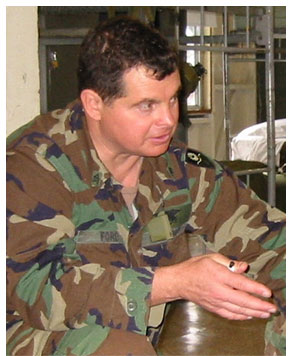

On June 15, 2003, Sgt. Frank “Greg” Ford, a counterintelligence agent in the California National Guard’s 223rd Military Intelligence (M.I.) Battalion stationed in Samarra, Iraq, told his commanding officer, Capt. Victor Artiga, that he had witnessed five incidents of torture and abuse of Iraqi detainees at his base, and requested a formal investigation. Thirty-six hours later, Ford, a 49-year-old with over 30 years of military service in the Coast Guard, Army and Navy, was ordered by U.S. Army medical personnel to lie down on a gurney, was then strapped down, loaded onto a military plane and medevac’d to a military medical center outside the country.
Although no “medevac” order appears to have been written, in violation of Army policy, Ford was clearly shipped out because of a diagnosis that he was suffering from combat stress. After Ford raised the torture allegations, Artiga immediately said Ford was “delusional” and ordered a psychiatric examination, according to Ford. But that examination, carried out by an Army psychiatrist, diagnosed him as “completely normal.”
A witness, Sgt. 1st Class Michael Marciello, claims that Artiga became enraged when he read the initial medical report finding nothing wrong with Ford and intimidated the psychiatrist into changing it. According to Marciello, Artiga angrily told the psychiatrist that it was a “C.I. [counterintelligence] or M.I. matter” and insisted that she had to change her report and get Ford out of Iraq.
Documents show that all subsequent examinations of Ford by Army mental-health professionals, over many months, confirmed his initial diagnosis as normal.
An officer at the California Office of the Adjutant General in Sacramento, Calif., Sgt. Maj. Patrick Hammond, has known Ford for over 15 years during their service in the California National Guard. Hammond said, “I have never had any reason to question his honesty and I don’t do so now.” This reporter served in the military with Ford in Iraq for seven months and can also attest that he is sane and level-headed.
Ford, who has since left the military, claims that his superiors shipped him out of the country to prevent him from exposing the abusive behavior. “They were determined to protect their own asses no matter who they had to take down,” he says.
Col. C. Tsai, a military doctor who examined Ford in Germany and found nothing wrong with him, told a film crew for Spiegel Television that he was “not surprised” at Ford’s diagnosis. Tsai told Spiegel that he had treated “three or four” other U.S. soldiers from Iraq that were also sent to Landstuhl for psychological evaluations or “combat stress counseling” after they reported incidents of detainee abuse or other wrongdoing by American soldiers.
Artiga and other higher-ups in the 223rd M.I. Battalion deny Ford’s charges. But in the aftermath of the Abu Ghraib scandal, federal agencies including the Department of Defense, the Army’s Criminal Investigation Command (CID), and the FBI are finally looking into them. The Department of the Army’s Office of the Inspector General has launched an investigation, according to Ford and his attorney, Kevin Healy, who have been contacted by investigators. If Ford’s allegations are proven, the Army would be faced with evidence that its prisoner abuse problem is even more widespread than previously acknowledged — and that some of its own officers not only turned a blind eye to abuses but actively participated in covering them up.
The 223rd M.I. Battalion was one of the first divisions to enter Iraq after the U.S. “Shock and Awe” aerial bombardment ended, in mid-April 2003. (I also served in that unit in-country from April through October 2003. I met Ford in February 2003, at Fort Bragg, N.C., and continued to stay in contact with him until he was shipped out of the country. I have also since left the military.) The battalion’s mission was to collect counterintelligence. Its agents, highly trained soldiers responsible for force protection and for investigating national security crimes committed against the Army, were divided into small units called Tactical Human Intelligence Teams, or THTs. Every day, these teams went out from their forward operating bases in Iraq and interacted with the local people in an effort to gather critical intelligence on such matters as the location of conventional and unconventional weapons and the whereabouts of the fugitives depicted on the Pentagon’s 55-most-wanted playing cards. It was arguably one of the most sensitive and important jobs in the entire Iraqi theater of operations. As the team sergeant of his THT, Ford was second in command of his four-person team and responsible for training, discipline, logistics and supervision of day-to-day operations. He was also the team’s designated combat life saver, or medic.
Ford spent his first weeks in Iraq at Balad Air Base, also known as Camp Anaconda, about 50 kilometers north of Baghdad along the Tigris. In early May, he was assigned to a THT that was headed for Samarra, another 20 kilometers to the northeast. An ancient trading center that dates to the Mesopotamian era, Samarra was known as a hotbed of Sunni Arab loyalists, ex-Baath Party officials, and Islamist extremists. The two-story police station the Army occupied was located in the center of town, closely surrounded by taller buildings, giving anyone who cared to fire on the Americans an excellent field in which to do so. And fire they did. Almost every night, Ford and his teammates would be forced to dive from their bunks for cover as mortar rounds rocked the compound. The concussions shook the foundation and broke whatever glass windows remained. Fortunately, the Iraqi mortar crews proved wildly inaccurate, and no Americans were killed, but several were wounded and the attacks never let up. There was immense pressure on the THT to find out who was behind the attacks and to supply the information to the “gunslingers” of the 4th Infantry Division. It was in that environment that Ford says he saw the incidents that led to the end of his long military career.
Late last summer I met Ford for lunch on a sunny afternoon at the Delta King Riverboat, which is tied to the docks in downtown Sacramento. Ford has returned to his longtime job as a corrections officer at Folsom Prison, and his wavy brown hair is longer than it was when I knew him in Iraq. He has spent the past year trying to clear his name, but apart from a few newspaper interviews he gave after the Abu Ghraib scandal broke last spring, he has not told his story to anyone until now.
Ford seemed calm and resolute as he talked about how the events that took place in Samarra contradicted everything he thought he knew about the military. For more than three decades, he said, he had always served with “people that I knew I could depend on when it really mattered. They were people that I would have sacrificed my life to save if need be, and I knew they would do the same for me, no questions asked.”
He went on, “There were also rules and regulations to follow. Some of the rules applied only in peacetime, some only in time of war. Some always applied. You knew which was which. These simple, basic rules were pounded into your head from the day you got off the bus at basic training. You broke the rules, you paid the price. Period. Everyone knew that simple fact, and everyone accepted it.”
But Ford said those rules were savagely broken in Samarra in June 2003. He described multiple incidents of what he called “war crimes” and “torture” of Iraqi detainees ranging in age from about 15 to 35. According to Ford, his teammates, three counterintelligence agents like himself — one of them a woman — systematically and repeatedly abused several Iraqi male detainees over a two-to three-week time period. Ford describes incidents of asphyxiation, mock executions, arms being pulled out of sockets, and lit cigarettes forced into detainee’s ears while they were blindfolded and bound. These atrocities took place in an Iraqi police station, Ford said. His attempts to stop the abuse were met with either indifference or threats by his team leader, who was himself one of the abusers, according to Ford.
Ford clenched his fists tightly and shook his head slowly from side to side. “I guess one of the things that pisses me off most is the arrogance,” he said. “The condescending attitude that my team had. Some of the medics, too. Saying things like ‘So what, he’s just another haji,’ like they were scum or some kind of animal, really just pisses me off.”
Ford said he was fighting a raging battle with himself over whether to report what he’d seen to his superiors at Anaconda or to confront the team leader one last time. He felt “sick inside” about the mistreatment of detainees, but he did not want to be a “rat,” either. Having worked as a corrections officer for almost 20 years, Ford knew how he would be perceived among the troops if he snitched. “I didn’t want to have to watch my back at the same time I was dodging mortar rounds from the Iraqis. I decided that I had to confront [the team leader] and tell him, in no uncertain terms, that I would not stand for any more of that kind of shit toward the detainees.”
Ford said he found the team leader and had it out with him. “I told him that if there was ever a court-martial over these incidents, I would absolutely testify against him. I said that this kind of crap has to stop or else I would report it to Artiga.” According to Ford, the team leader replied, “Fine, Greg, you do what you have to do.” By then, Ford said, he’d “had enough.” He told the team leader that he would be filing a complaint against him and the other agent as soon as possible. He said the team leader told him he was “crazy” and “seeing things” and no one would believe him anyway, so “knock yourself out.”
The next day, Ford said he rode with the rest of his team down to Camp Anaconda, where the 223rd had its headquarters, as did the 205th M.I. Brigade, which was made infamous by the Abu Ghraib scandal. Both divisions were commanded by Col. Thomas Pappas. Upon his arrival, Ford said that he immediately went to the company headquarters and met with Artiga and 1st Sgt. John Vegilla. Ford said that it was clear that Artiga knew he was coming. “I told them that I wanted to request a formal investigation into allegations of war crimes committed by my team against Iraqi detainees. I said I wanted to request a removal of this whole team and their replacement by a senior team, because they’re bringing the house down. He looked right at me and said, ‘Nope, that never happened. You’re delusional, you imagined the whole thing. And you’ve got 30 seconds to withdraw your complaint. If you do, it will be as if this conversation never took place.'” Ford refused, and Artiga told him to “get out of here” and that he would call him when the complaint was ready.
In an interview, Artiga denied making those statements. Vegilla did not respond to interview requests.
A few hours later, Marciello, a senior counterintelligence agent, arrived to accompany Ford from the transient tent where he was staying to company headquarters to see Artiga and Vegilla. The slight and bespectacled Marciello, who looks like a cross between Woody Allen and Wally Cox, recently retired from the National Guard after almost 35 years of service. According to Marciello, “Artiga then instructed Vegilla to take Ford’s M-16 and ammunition away from him for safekeeping and said that he was revoking Ford’s security clearance. He [Artiga] also said that I was being assigned to escort Ford 24 hours a day until further notice.” Artiga then ordered Ford to report immediately to Capt. Angela Madera, an Army psychiatrist, at the base mental-health facility for a “combat stress evaluation.” Marciello says he escorted Ford to his meeting with Madera.
According to Marciello, he waited outside Madera’s office for approximately one hour while Madera interviewed Ford. After the interview, “I escorted Ford back to his tent and then stayed with him for the remainder of the day.” To Marciello, Ford seemed frustrated at the situation but calm and under control.
Marciello remembers being summoned the next morning, June 16, to company headquarters by Artiga, who according to Marciello was “really pissed” about the report Madera had written regarding Ford. “He was pacing around in the office holding the report up,” Marciello said. “Dr. Madera had diagnosed Ford as completely ‘normal’ and ‘not a danger to himself or others.'” Artiga was “just livid,” Marciello recalls. “He took me in tow over to meet with Madera. Just me and him. We practically ran over there. Once we got there, he held up her report and asked her what she thought she was doing. He walked right over to her and got right in her face. Then he told her that this report cannot stay the way it is. He said that she will change it to read that Ford is unstable and must be sent out of [the Iraqi] theater immediately. He then said something to the effect that this was a C.I. or M.I. matter and that he was telling her that she had better see to these changes right now.”
Artiga denied pressuring Madera to change her diagnosis and said he did not recall whether Marciello or anyone else was in the room during the meeting.
According to Marciello, “Madera was really shook up by the encounter with Artiga … She was trembling.” With that, Marciello said, “Me and Artiga just up and left Madera’s office and headed back to the company area. Artiga went back to the office and I went to find Ford.” Marciello found Ford in his tent and related what had just occurred. “I told him to stay put and that I would return in a little while.” It was the last time Marciello saw Greg Ford.
The Geneva Conventions signed by the United States and 114 other countries in 1949 give prisoners of war strict protections. They cannot be assaulted, photographed (except for counterintelligence purposes), threatened with physical harm, denied medical care and medication, or deprived of food, water, clothing or sleep. They are also entitled to have mail access and regular visits from the Red Cross or other humanitarian groups.
The photographs from Abu Ghraib prison in Baghdad that became public in the spring showed interrogators flagrantly violating those conventions. Seven low-level soldiers have since been charged, with one conviction, but no one up the ladder has been held accountable. Meanwhile, it has become increasingly clear that the mistreatment at Abu Ghraib was symptomatic of a wider problem. The Department of Defense is currently investigating more than a hundred allegations of prisoner abuse. So far, not a single officer or high-ranking enlisted soldier has been charged in any of them.
There are striking parallels between the conditions at Abu Ghraib when the abuses took place and those at Samarra when Greg Ford says he saw his colleagues torturing detainees. Both facilities were suffering heavy casualties as the result of daily mortar attacks from an invisible enemy. In both cases, the command became increasingly frustrated at its inability to identify, locate and stop the attackers and — bolstered by directives from top military brass to “set the conditions” for information collection — allowed combat troops and military intelligence operatives to use harsh tactics. Both facilities were populated mostly by young reservists with no combat experience. The majority of detainees, meanwhile, were adolescents or old men of little to no intelligence value.
The M.I. units at both centers also shared a commanding officer, Col. Thomas Pappas, who arrived in Iraq sometime in the middle of June 2003 and formally took charge of the 205th M.I. Brigade at an elaborate change-of-command ceremony at Anaconda on July 1. The 205th comprises Ford’s 223rd M.I. Battalion and the 519th M.I. Battalion, which played a part in both the Abu Ghraib scandal and at least one detainee death in Afghanistan, resulting in criminal charges being filed. After Pappas ordered all members of the 205th to be present at his change-of-command ceremony, three soldiers from the 519th were killed in a vehicular accident while traveling through hostile territory from northern Iraq in order to attend.
The Army has already dealt with one case of abuse by soldiers stationed at Samarra. At a recent court-martial in Fort Hood, Texas, four enlisted soldiers from the 4th Infantry Division in Samarra were convicted of manslaughter for forcing two handcuffed Iraqi men to jump off a bridge over the Tigris River during an interrogation. One of the Iraqis drowned. The soldiers’ commanding officer, a lieutenant colonel that regularly worked with agents of the 223rd, was administratively disciplined for helping to cover up the incident.
Not long after Marciello left him, Ford said, Madera, accompanied by an unknown male captain, entered Ford’s tent and told him to get ready because he was going to be “medevac’d” to Germany immediately. “What the hell is going on here?” Ford remembered demanding, but Madera told him to “be quiet,” that he “had to leave,” and that she would explain once they were airborne. She escorted him to a waiting Humvee that took them to the base airstrip, where a C-130 was warming up on the tarmac.
“Madera ordered me to lie down on a gurney that had been in the rear of the Humvee so she could strap me down. I again asked what was going on, only this time a lot more pissed off. I said that I was perfectly able to walk.” Ford said Madera insisted, telling him it was the order of “[Lt. Col. Timothy] Ryan and Artiga” that he be “bound and secured” when taken “out of country.” “I saw that I had no choice and finally said OK, anything just to get the fuck out of there,” Ford recalled. With the help of the male captain, who Ford said identified himself as a medical officer, Madera strapped him to the gurney.
Just then, Ford claimed, Ryan, Artiga’s superior officer, pulled up in his Humvee and walked over to where Ford was lying on the gurney. “He looked down at me and said, ‘Don’t worry. We are going to get you the best treatment available.’ I was enraged at that point, and it was a good thing I was strapped down. I just stared back at Ryan with looks that I hoped could kill, but I didn’t say nothing. What was the point? He had won that round.”
Ryan did not respond to interview requests for this story.
The propellers of the huge turboprop engines on the C-130 sent scorching blasts of superheated air back toward the group, almost hot enough to singe the skin on a face. (When I left Iraq from the same tarmac a few months later, I did get burned from the blasts.) As Ford’s gurney sank into the steaming tarmac, Madera and the other medical officer wheeled him up the long ramp and into the aircraft’s cavernous interior. Once they were airborne, Madera unstrapped Ford and motioned for him to sit next to her on one of the hard benches that run along the sides of the plane. “She told me that she was forced to get me out of Iraq ASAP by Ryan and Artiga, who she claimed were scared to death by what I might say. She also told me that she wanted me to get out of Iraq as soon as possible because she feared for my safety.” Ford said Madera also told him, “These people are serious and very scary.” She apologized for having orchestrated such an exit, but said there was no other way. “I told her that I understood, but felt as though I had just been kidnapped.” According to Ford, Madera replied, “You were.”
Madera did not respond to several requests to be interviewed for this story.
The C-130 took Ford to Kuwait, where he cooled his heels inside transient tents for two to three days and waited for the 223rd to issue him an order. The order never came — in violation of Army regulations — but eventually he boarded another aircraft, still accompanied by Madera and the other officer but now acting on his own volition, and flew to the Army Regional Medical Center in Landstuhl, Germany. “The first thing they kept asking me at Landstuhl was, ‘Where are your orders?’ How’d you get out of theater?’ I mean, I was probably asked that 50 times when I was there. Everybody asked me that. They have a reception group that meets you there and even the Air Force people when I was getting off the plane said, ‘We don’t know how you got on this plane because you don’t have any orders. We don’t have a single set of orders for you.'”
According to a senior official at the California National Guard headquarters in Sacramento, Ford should have had what is known as a “medevac” order from his unit in Iraq (205th M.I. Brigade) in order to leave the country. No one is allowed out of a theater of operations without either a medevac order or a standard set of written orders authorizing travel to a destination. Ford had neither, which is a violation of Army policy.
After a brief stay for evaluation at Landstuhl, Ford says, he was flown to the United States, where he went first to Fort Sam Houston, Texas, and then to Fort Lewis, Wash., where he was placed in the Madigan Army Medical Center. At Fort Lewis, Ford filed a complaint with the Army’s Criminal Investigation Command, or CID, in which he cited both the uninvestigated “war crimes” allegations and the retaliation that he says followed.
At every stop along the way, from Kuwait to Germany to the United States, Ford was evaluated by Army mental-health professionals and given a clean bill of health. Doctors at each location confirmed Madera’s original diagnosis — that he was mentally stable. Ford supplied me with documents from all of the hospitals he visited, showing diagnoses of “normal,” “not delusional,” “not paranoid,” “no evidence of hallucination,” “stable mental condition,” and other similar remarks. There is nothing to suggest that any of the Army medical personnel who evaluated Greg Ford after he made his allegations in Iraq felt that there was anything wrong with him. Tsai at the Army Regional Medical Center in Landstuhl, Germany, gave Ford a final diagnosis of “Stable Mental Condition.” Dr. Thomas Hardaway of the Brooke Army Medical Center at Fort Sam Houston, Texas, wrote, “there was not any indication of overt paranoia or delusional quality to what he was saying about his circumstances.” He went on to say, “There is nothing on my initial screening evaluation indicating any overt pathology or personality problems … Release patient from Behavioral Medicine Clinic.”
Finally, in February 2004, eight months after he blew the whistle, Ford was released from active duty and given an honorable discharge, and in October, 10 months after his initial application, he was formally retired from the Army.
Even if Ford’s allegations of prisoner abuse turn out to be false, the Army’s treatment of him betrays an outrageous attempt to cover up a potential scandal and a blatant disregard for its own rules. According to both Ford and a credible witness, Marciello, Ford was strapped to a gurney and bundled off to a mental ward on the basis of a coerced diagnosis for an indefinite period of time, all before any investigation was even started, much less completed. When a CID investigator finally began pursuing the matter in the fall, Artiga told the investigator that the 223rd had “looked into it” and found “nothing wrong.” If what Ford and his witnesses say turns out to be true, then the officers involved could face criminal charges ranging from threatening and intimidation, perjury, and assault to false imprisonment, conspiracy and obstruction of justice. The list of potential breaches of Army regulations is just as long, including “conduct unbecoming of an officer,” a serious offense in the military.
In addition to Ford and the other soldiers treated by Tsai, other Army whistle-blowers have also reported this type of mistreatment. According to a May 25 report by United Press International, Julian Goodrum, a decorated lieutenant in the U.S. Army Reserves, was allegedly locked in a psychiatric ward as punishment for filing a complaint over the death of a soldier in his command. He had also testified before Congress about the poor medical care Reserve soldiers returning from Iraq and Afghanistan were receiving at Fort Knox, Ky. After he escaped from the locked ward, he was charged with being AWOL and was even given a $6,000 bill for room and board during his involuntary hospital stay. Still another whistle-blower, Sgt. Samuel Provance of the 205th M.I. Brigade, was stripped of his security clearance and assigned to administrative duties in Germany after reporting abuses at Abu Ghraib. Provance told me in recent e-mails that he has been harassed by other soldiers and commanders since he made his allegations and has become something of a pariah in his unit.
In August 2004, Ford filed a report on his allegations of war crimes and abduction with the Sacramento office of the FBI. That office forwarded the report to the Bureau’s headquarters in Washington, which in turn passed it along to the Department of Defense. Ford says he met with investigators from the DoD’s Office of the Inspector General in the last week of September. “It was obvious from their line of questioning that their mission was to cover up for DoD and the Army,” Ford said. Special Agent Karen Ernst of the FBI’s Sacramento office told me that the Bureau “may” have jurisdiction in the matter and is prepared to step in if the DoD “drops the ball on this.” Although she would not offer an opinion of Ford’s case, she did say that they only file reports if they believe the allegations have “some merit.”
The Department of the Army Office of the Inspector General has also launched an investigation into Ford’s allegations. Although by policy they can neither confirm nor deny the existence of a current investigation, Ford said that investigators have flown out to California to interview him and have conducted several follow-up interviews as well as requested documents and e-mail records from him. Requests through the Freedom of Information Act to the Army or the DoD for any reports relating to Ford and his allegations have resulted in a flurry of letters stating essentially that the case is “complex” and that it will take additional time to compile all of the requested documents.
Neither the California Office of the Adjutant General in Sacramento nor the state’s Judge Advocate General (JAG) office would officially comment, but staff at both places told me off the record that they hoped Ford would be vindicated and the officers in question punished for “abuse of authority.”
According to an Army CID special agent who is familiar with Ford’s case, “This is a classic case of a whitewash. A coverup. The agent in Iraq never even looked at the 15-6 investigation the 223rd supposedly did. No one was ever interviewed until Abu Ghraib hit the fan.” When I asked him whether the CID was complicit in an Army coverup of the case, he said, “Absolutely … Do you have any idea how ugly this case could get if they ever really looked into it? It would open up a whole can of worms that they just don’t want to touch.” The agent, who refused to give his name for fear of retaliation, added, “Based on everything I know about this case, I believe Ford. I have seen too many similar cases not to. It fits the pattern. Everyone involved in this blatant coverup should be criminally prosecuted. For this to have dragged on for over a year without being investigated is ridiculous.” In September, the CID conducted two telephone interviews with Marciello, but no one else in the 223rd has yet been interviewed, including myself.
His nightmarish experience with the Army in Iraq has changed him forever, Ford told me as we sat on a bench near the fountain in front of California National Guard headquarters in Sacramento. He said that he intended to devote the next few years, and maybe even the rest of his life, to working with individuals and organizations in the fight for human rights and dignity. He specifically mentioned Amnesty International and the World Organization for Human Rights. The latter has formally requested that Attorney General John Ashcroft file criminal war-crimes charges against high-ranking administration officials, including Secretary of Defense Donald Rumsfeld and President George W. Bush, over the revelations coming out of Abu Ghraib. Ford said he hoped to join in pushing for that action.
