
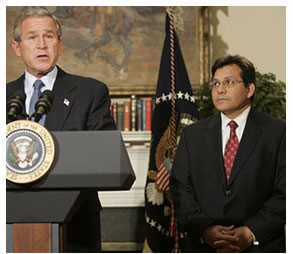
Now that conventional wisdom has focused attention on “moral values” as our paramount national concern, it might be worth spending a few minutes considering how President Bush’s nominee for attorney general, Alberto Gonzales, dealt with one of those values — human life — on 57 occasions.
Gonzales’ values, to say nothing of his legal judgment, have come in for scrutiny of late due in part to his supposedly aggressive questioning of homeland security nominee Bernard Kerik (which failed to uncover extramarital affairs, unpaid taxes on an illegally employed nanny, a warrant for his arrest related to unpaid condo fees, and alleged links to organized crime), as well as to two highly controversial memoranda Gonzales authorized for Bush that laid out the case for torturing prisoners taken in the “war against terrorism.” Whether Gonzales’ central role in designing policies that may have led to the abuses at Abu Ghraib and other military facilities should disqualify him for the job of attorney general will be a major focus of his Senate confirmation hearing set to begin Thursday morning.
In addition to questioning Gonzales about when he thinks it’s appropriate to torture people, Judiciary Committee members might want to ask Gonzales when he thinks it’s appropriate to kill them. A sizable body of evidence on that subject has been extracted from the Texas State Archives, the repository of the gubernatorial records of George W. Bush, and these documents suggest that Gonzales didn’t give the subject the kind of thought one might expect of a man burdened with a mantle of moral values. As governor of Texas, Bush acted as the court of last resort for 153 men and women, the last public official standing between them and the executioner. On 152 occasions Bush opted for death, and for 57 of those decisions he relied almost exclusively on briefings prepared by Gonzales — briefings that appear to have been designed, above all, to facilitate the governor’s predisposition for execution.
Now, some people will no doubt take umbrage at the suggestion that the final appeal of a condemned murderer raises serious questions about the value of human life. When one considers, however, that 117 innocent people have been found on the nation’s death rows, including eight in Texas (the most recent on Oct. 6, 2004), the moral imperative of executive clemency comes into sharper focus. An examination of Bush’s public statements suggests that he understood clemency to be a profound moral obligation, at least in the abstract. Bush called clemency “an awesome responsibility” and said he personally acted “as a fail-safe — one last review to make sure there is no doubt the individual is guilty and that he or she has had the due process guaranteed by our Constitution and laws.” Bush also said on numerous occasions that he had “no doubt” that every person executed in Texas under his watch satisfied those criteria.
But how did the man who was to become the nation’s moralizer in chief erase all doubt of the inmates’ guilt? Why was Bush so certain that he hadn’t executed an innocent and that all of those executed had received due process from the courts? And how does Gonzales figure into this sense of self-certainty? At the time, few people questioned Bush’s claims, although they seemed transparently suspect. Anyone who has grappled with the intricacies of an even moderately complex death penalty case knows that it can be a Herculean undertaking, requiring an enormous investment of time and mental effort that frequently leads into a cul-de-sac of uncertainties. Add to that the sheer volume of cases Bush had to consider — as many as two executions a week, as many as eight in a single month — and the holy grail of certitude would seem even more of a reach.
We now know that Bush’s repeated assurances of certainty and thoroughness were patently untrue. And we have more than a modicum of certainty about this because we have access to Bush’s daily appointment logs — which show that he rarely spent more than 30 minutes on an execution briefing — and we have Gonzales’ own files, which show that he did not send Bush a clemency petition laying out a defendant’s best arguments for a pardon on even one occasion. Most important, we have Gonzales’ actual execution case summaries on which Bush relied in making his decisions to proceed with more than 99 percent of the death warrants that landed on his desk.
Gonzales’ memos, running anywhere from three to seven pages, are, in many cases, so slapdash, incomplete and inaccurate that no one relying on them could possibly make a fair, balanced and intelligent decision as to whether clemency should have been a consideration. Anyone relying solely on Gonzales’ briefings would have probably done exactly what Bush did — put a little black check next to the word “Deny” at the end of the summary and send the offender to his death. True, Gonzales and his staff of lawyers were handling an unprecedented number of executions. But Gonzales’ omissions appear less the oversights of overworked attorneys than the deliberate design of a lawyer who knew what his client wanted — an open-and-shut argument for execution — and was all too happy to deliver.
How otherwise might one explain Gonzales’ summary of the Terry Washington murder case? Washington was executed on May 6, 1997, for the murder of Beatrice Huling, a 29-year-old mother of two. Huling was stabbed 85 times and nearly eviscerated. For many people those facts alone would be sufficient to fry Washington. But Bush seemed to set forth a higher moral standard of review. In his autobiography, “A Charge to Keep,” he wrote that he wanted to be informed if “there are new facts or evidence of which a jury was unaware, or evidence that the trial was somehow unfair.”
Yet in Washington’s case there was a sizable body of evidence the jury never heard, which should have made it glaringly obvious that Washington’s trial met even the most conservative definition of unfairness. Jurors weren’t told that Washington was mentally retarded and brain damaged, that as a child he and his 10 siblings were repeatedly whipped with water hoses, extension cords, wire hangers and automobile fan belts. Gonzales apparently concluded that this evidence was insignificant, because he didn’t bother to mention it in the summary he prepared for Bush. Instead he wrongly suggested that there was “conflicting information” about Washington’s mental state. Gonzales also didn’t bother to mention Washington’s forceful claim of ineffective counsel, arising from his attorney’s failure first to present jurors with the mitigating evidence of Washington’s childhood abuse and mental retardation and, second, to call a mental health expert to testify to these facts.
Indeed, “ineffective” or “incompetent” counsel would be an accurate description of Gonzales, whose execution summaries repeatedly failed to mention the most salient claims of defendants. Consider, for example, these four cases not previously reported:
Three other cases demonstrate equally egregious reporting by Gonzales:
Without question, all these men were sentenced to die for committing horrible crimes. And it is easy to imagine how Bush or Gonzales or anyone who takes the time to review the endlessly horrifying details of dozens of homicide files might become cynical about the idea of granting even a single pardon. The rogues’ gallery of miscreants and the roster of innocent victims tend to drain sympathy. Among those approved for lethal injection by Bush were Samuel Hawkins, who confessed to 25 rapes and was guilty of two murders; Ricky Lee Green, who killed four people and castrated one of his victims after having sex with him; cop-killer Patrick Fitzgerald Rogers; and Kenneth Granviel, who murdered 2-year-old Natasha McClenton and sexually assaulted and murdered four of her relatives in their Fort Worth apartment. Then there was James Carl Lee Davis, who murdered his 15-year-old neighbor after raping her and beating and sodomizing her with a pipe, and John Cockrum, who had shot and killed his father when he was 17 but was executed for the murder and robbery of 69-year-old Eva May.
Yet — precisely because our gut tells us that such criminals are dispensable — those charged with clemency have a special obligation to explore the possibility that maybe, just maybe, one of these offenders might have had serious mental problems, a childhood replete with abuse, or an attorney as cavalier about his commitment to justice as Gonzales himself. The fundamental question raised by the extraordinary record of clemency denial under Bush is whether those with the power of clemency have any moral obligation whatsoever to at least contemplate the arguments made by death row inmates in a final appeal for life. An examination of the Gonzales memos strongly suggests that his answer would be no. It is, in fact, difficult to define precisely what factors, other than the kind of intense media and political pressure brought to bear in the case of Karla Faye Tucker, might have sparked his curiosity and led to a more serious discussion of any one case.
Gonzales’ execution summaries demonstrate that while Bush was paying lip service to his moral obligations in the clemency process, both he and Gonzales had turned that process into little more than a charade. In practice, none of the traditional grounds for executive clemency — such as mental incompetence, childhood physical or sexual abuse, remorse, rehabilitation, racial discrimination by the state or by jurors, incompetent counsel, or disproportionate sentences for co-defendants — was seriously considered by either Gonzales or Bush.
Gonzales’ memos illustrate time and again how he and Bush thoroughly neutered the purpose of clemency, designed as an extrajudicial process, by assuming that if the courts had approved an execution, there was no role for the governor. Gonzales’ summaries routinely end with a conclusion that demonstrates how the “fail-safe” final review Bush had promised constituted no review whatsoever other than to certify that the case had passed through all the courts. But that requirement was, in fact, satisfied by definition: A case would not come up for executive clemency unless all other appeals had been denied.
In the final analysis, the only ground for clemency under the Gonzales-Bush “fail-safe” was evidence of innocence. And even then, Gonzales seemed asleep at the wheel. Consider the matter of David Wayne Stoker, who was executed for murdering convenience store clerk David Manrique in a 1986 robbery that netted $96. Gonzales, a Harvard-educated lawyer, summarized the substantive issues in this vicious, stereotypically “pointless” crime in a grand total of 18 lines. Had Gonzales been willing to expend just a little more ink on this matter of life and death, here are some of the things he might have mentioned to the governor: For starters, he might have pointed out that a federal appellate judge concluded that the state’s star witness against Stoker was just as likely the murderer. He might have noted that a key state witness recanted following Stoker’s conviction, explaining that he’d been pressured by the prosecution to perjure himself. He might have mentioned that the state’s star witness received a financial reward for fingering Stoker and had felony drug and weapons charges dropped the day he testified against Stoker — raising the obvious possibility that he had had a motive for accusing Stoker.
But that’s not all. Gonzales apparently didn’t think his boss needed to know that this star witness and two police witnesses lied under oath at trial, that the state’s expert medical witness pleaded guilty to seven felonies involving falsified evidence in capital murder trials, and that the state’s expert psychiatric witness, whose testimony provided the jury with a legal basis for handing down a death sentence, never bothered to interview Stoker. By the time Gonzales was supposedly researching the case for Bush, this expert had been expelled from the American Psychiatric Association for repeatedly providing unethical testimony in murder cases. Needless to say, Gonzales didn’t think it was worth pointing out that the jury that had sentenced Stoker to death was ignorant of all those facts.
Would Bush have opted to execute Stoker even if Gonzales had given him all of that mitigating evidence? Probably, given all we know about his record on clemency. Nonetheless, the case raises important questions about a lawyer’s moral obligation to keep his client adequately informed, as well as that lawyer’s basic sense of fairness and decency. Senators might want to ask themselves if they would have been willing to execute Stoker based on Gonzales’ 18-line summary. Alternatively, would they have executed him knowing the facts Gonzales failed to include? Finally, they might ponder whether Bush, relying on Gonzales, executed an innocent man.
A first-year law student preparing a brief for his client such as the one Gonzales wrote up on the Stoker case would probably be advised to consider another line of work. But not Gonzales. Bush, who would later make “character” the mantra of his first presidential campaign, was apparently more than happy with the Reader’s Digest Condensed work product offered up by his lawyer. In his autobiography, Bush wrote that for every death case, the office of legal counsel would “brief me thoroughly, review the arguments made by the prosecution and defense, raise any doubts or problems or questions.” Bush promoted Gonzales to the office of the Texas secretary of state, to the Texas Supreme Court and finally to White House counsel’s position.
Legal ethicists may argue that the client calls the shots and that the president should have the attorney he is comfortable with. The question the Senate must now confront is whether Gonzales is the right attorney for the rest of the country.
