
Community

Turmoil in blogland

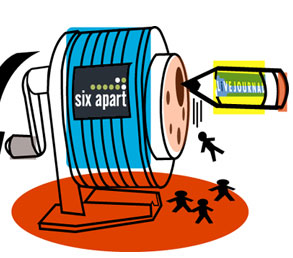
Publishing tool LiveJournal nurtures a dazzling array of unorthodox subcultures. But will diversity continue to flourish in the wake of its purchase by blogging start-up Six Apart?

  • more
    • All Share Services

Turmoil in blogland

The Internet has always been a special place for freaks, geeks, queers and other alienated populations. Online, these marginalized members of society created communities that relished their idiosyncrasies. Collectively, they helped one another take pride in their identities and practices — whether the passion be learning how to make synthetic hair, collecting Japanese manga or engaging in sexual practices frowned on by the mainstream.

The result is an infrastructure of support for a new form of social solidarity — a set of collective beliefs, practices and values — that operates outside of the dominant culture. Most important, these communities have been created virtually, across space, a feature that is particularly valuable for nonmobile populations — teens without driver’s licenses, for instance.

Right now, the communities grouped together by LiveJournal offer one of the most vibrant examples of online subcultural vitality. LiveJournal, according to its own current description, is a “personal publishing tool.” But it’s much more than that: To its users, LiveJournal is still a community where you can offer “an up-to-the-minute log of whatever you’re doing, when you’re doing it” and control who gets to see this.

For a service whose active users number in the millions, LiveJournal’s demographics skew athwart the mainstream: younger, more female and more resistant to the dominant culture. And in a business climate where the word “blog” is on every other Web observer’s lips, even the tools used by the alienated have become desirable to investors. Thus the news, confirmed on Thursday, that the company had been purchased by the venture-capital-backed blogging technology start-up Six Apart. For those of us who care about keeping space open for anyone who veers from the straight and narrow, this business deal is cause for concern.

Over the years, a variety of digital tools have been used to support online subcultures — Usenet, Yahoogroups, EzBoard, specialized Web communities, etc. But right now, LiveJournal brings together a set of software applications that are nurturing one of the most robust and thriving arrays of subcultural communities anywhere online. The variety of communities supported is amazing and, to some people, disturbing or even terrifying, such as the communities of people engaged in self-mutilation or eating disorders. But this is all part of subcultural life — good and bad. And one of the things that makes LiveJournal special is that it is not just a set of software applications. There is also an extensive network of emotional support, both formally and informally.

The dominant culture has a habit of demonizing anything it doesn’t understand — particularly those subcultures that are formed by marginalized populations who are often resisting aspects of mainstream life. But these subcultures play a critical social role: They help restabilize individuals in a society trapped in perpetual anomie.

Anomie — a term popularized in sociology by Emile Durkheim — refers to the state of ultimate societal loss of moral direction and meaning. At its most extreme, cultural anomie results in cultural and individual suicide.

Society has already ostracized many marginalized individuals, placing them in a position of limbo, making them uncertain about how to find meaning and grounding. People who have participated in subcultural life were often alienated by mainstream society long before they found supportive communities. Subcultural participation becomes an act of self-empowerment whereby individuals find a community that loves them for who they are instead of trying to encourage them to be cookie-cutter members of society.

This is not to say that one should romanticize subcultures. Yet, for some, those who have been flung from the ropes of mainstream society, subcultures are a safety net.

Over the years, I have spoken with many individuals for whom LiveJournal has served as that safety net — people who did not have a community of like-minded souls in their everyday life but found direction online. This is not to say that the larger blogosphere does not offer this kind of support for some. It truly does. Yet, consistently, LiveJournal supports some of the most at-risk individuals, the most explicit subcultures. The LJ community knows how to support these individuals, and I am in particular awe of LJ’s support/abuse team for doing what is needed when things get out of hand.

It is for this reason that my heart started beating rapidly when Six Apart decided to purchase LiveJournal. Although this sale may seem like the merger of two prominent blogging companies, it is not that simple. LiveJournal has a particular kind of culture that has formed very distinct from the broader “blogosphere.”

Six Apart consistently provides excellent tools for those who want to be bloggers, but they started by building tools, not by building community. Whether LiveJournal founder Brad Fitzpatrick intended to or not, he created a community that exists far beyond his tools.

Even though 2004 has been marked as the Year of the Blog, there is no universal blogging culture nor even a common definition of the term. There are many different cultures within the blogosphere and within LiveJournal — cultures with different needs, desires, intentions. Yet, at the broadest level, the culture of LiveJournal is distinct from the culture of the blogosphere, even if the actual practice is quite similar: to share that which is most meaningful to you with those who will be interested.

The distinction is often categorized by the terms “amateur journalism” as opposed to “public diarying” — an unfortunate dichotomy that is awkward and fails to represent most of what bloggers and LJers do. Yet in terms of identification, there is often a split. Most people who use LiveJournal talk about their “LJ,” not their “blog.”

There is no doubt that Six Apart recognizes and values LiveJournal and the community that is embedded in it. At BlogTalk in Vienna, Austria, Mena Trott (the president of Six Apart) began her speech by stating that “I feel strongly — and have always — that personal weblogs are often marginalized because of their presumed triviality.” She chastised self-identified bloggers for dismissing practices that appeared different from their own. But Trott also recognized cultural differences, noting that her original conception of bloggers reflected those who valued punditry and sought very large audiences to challenge journalism and politics. But through her work on TypePad — a blogging service hosted by Six Apart — she realized that there was an extensive population of bloggers who did not have these goals in mind — they wanted to post only for their friends and family.

It is the intimacy of friends, family and people-like-me that LiveJournal has fostered. When Six Apart bought LiveJournal, it did not simply purchase a tool — it bought a culture. LJ challenges a lot of assumptions about blogging, and its users have different needs. They typically value communication and identity development over publishing and reaching mass audiences. The culture is a vast array of intimate groups, many of whom want that intimacy preserved. LiveJournal is not a lowbrow version of blogging; it is a practice with different values and needs, focused far more on social solidarity, cultural work and support than the typical blog. It is heavily female, young and resistant. There is no doubt that Six Apart values this, and it should. But at the same time, the act of purchasing someone’s house does require responsibility if you want to do right by the tenants, even when those tenants look nothing like any other tenants you have ever seen.

The freaks, geeks and queers need LiveJournal now more than ever before — they need the safety net that will help them find grounding. My hope is that Six Apart will learn from LiveJournal and treat LJers with nonpatronizing respect. In essence, the company must first value the social contract and culture that are LiveJournal and then let LiveJournal teach it how to make those better.

danah boyd is a Ph.D student at the University of California, Berkeley where she studies sociable media. She also blogs at apophenia.

“Community” botches damage control

A leaked memo reveals Sony's social-media blunder -- and its belief that the cast and fans are easily herded

  • more
    • All Share Services

Joel McHale and Gillian Jacobs in "Community."

It’s adorable the way Old Media keeps forgetting that we live in the age of transparency. Hey, Sony Pictures Television, your metaphoric fly is undone.

You’d think that after that ranting, complaining voice mail that “Community” star Chevy Chase left showrunner Dan Harmon went viral this spring they’d have learned. Or maybe after Harmon responded to his dismissal just last Friday by spilling his guts on Tumblr. You’d think the muckety-mucks would have figured out by now that the best you can do when there’s tension in your little creative family is to be forthright and creative about it.

Note, for example, how the show’s star Joel McHale spent the spring diplomatically – and wittily — handling the talk-show circuit after Chase’s meltdown, joking that the voice mail had to be fake because “there’s no way Chevy could figure out voice mail.” See, it’s glib and funny and sounds magically off-the-cuff! Get it? The cast of “Community” — which includes the incredibly on-the-ball Danny Pudi, Alison Brie and Donald Glover – knows how to handle itself.

So here’s what you don’t do. You don’t send an email saying you “wanted to forward some messaging we hope our cast will find helpful as they navigate questions that will undoubtedly come up.” Oh God, “forward some messaging.” This won’t be good. And sure enough, in a memo obtained Wednesday by the Hollywood Reporter, the talking points sent from Sony to the cast reads like a ransom note. A poorly written one. My friend Jay at the Takeaway suggests reading it in the dean’s voice, but in my head, I can’t hear anyone but Chang.

“We’re hoping that the news will lose some steam over the next day, especially if we’re not perpetuating the topic in any way,” it reads. Then it goes on to suggest the cast just tell the press, “We’re also excited that we’ll be back on NBC’s schedule in the fall and are looking forward to working on those episodes,” “I am looking forward to starting our next 13 episodes of ‘Community,’” “We’re looking forward to working with David Guarascio & Moses Port on a new season of ‘Community.’” Also, guess what? “We’re looking forward to the stories our characters will find themselves in come Sept.” I’m not sure I even understand that last sentence, but you get the gist. Coming this fall! “Community”! REMAIN CALM AND STOP PERPETUATING THE TOPIC.

As one Hollywood Reporter commenter brilliantly opined, maybe now “the cast will all recite the entire memo, verbatim, in interviews. Like hostages reading off cue cards.” It’s just like when Avery Jessup had to do the news in North Korea! Wait, what well-regarded yet low-rated NBC sitcom are we talking about here?

This kind of thing is insulting on so many levels. Primarily, it’s a dis to the cast and team of “Community,” who this weekend managed to tweet gracefully their gratitude to Dan Harmon and his “dementedly awesome brain” without coming off like network-destroying loose cannons. And don’t even get me started on how idiotic Sony must assume the press is to send out something like this. Guys, it’s not all one big Mario Lopez-fueled parade of butt-kissing out there. Worst of all, it’s a shameless slap to fans, who expect that the people who give us a weird treasure like “Community” know how to be funny and sarcastic and sad and real when there is a major shakeup in their ranks — oh, and who also know enough about social media to know you can’t stop a dumb email from getting around. It’s not about sticking to some rote company line. It’s about cultivating the very authenticity that makes “Community” so friggin’ special, and respecting the fans who watch it. And it’s about getting that the title of the show isn’t just about a mythical college. It’s about us.

Continue Reading Close
Mary Elizabeth Williams

Mary Elizabeth Williams is a staff writer for Salon and the author of "Gimme Shelter: My Three Years Searching for the American Dream." Follow her on Twitter: @embeedub.

More sex and disasters, please

TV season finales used to be about crazy couplings and exciting explosions. Where did the fun go?

  • more
    • All Share Services

More sex and disasters, pleaseGabriel Mann and Emily VanCamp in "Revenge"

There are a few times of year when network television can typically be relied upon to be as interesting as cable: The fall, when the networks vomit out dozens of new programs; February, when the networks cough up a dozen or so more; and May, when all the series that have survived the year try to end in spectacular fashion. During this last period, season-finale time, couples couple, get married and have babies; characters quit, get fired and die; disasters occur; buildings explode; guns blaze; hatches are discovered and protagonists are left dangling off cliffs, both actual and metaphorical. It’s the TV equivalent of blockbuster season, and like blockbuster season, it can and should be fun. Though in recent years cable shows have been responsible for a disproportionate number of the “Holy crap, did that just happen?!” finales (hello, Gus Fring and his brand-new face!), network shows are usually good for at least some insanity, some drama, some transcendent event that will get people talking around the storied watercooler. Not this year. Nope, this year, season finale season has been a bust.

The dearth of enjoyably over-the-top finales both is, and is not, a coincidence. Some of the shows that went big in the past opted to take a more low-key approach this May. Last year “The Good Wife” ended with Alicia and Will finally smooching outside a hotel room; this year it ended with Kalinda sitting in her apartment, gun in hand, waiting for her front door to open. Last year, “Community” wrapped up with its balls-to-the-wall, two-part spaghetti-western paintball extravaganza; this year it ended with a relatively understated episode about Evil Abed, leaving everyone to talk about Dan Harmon’s firing instead.

What isn’t a coincidence, is that there are very few good, tentpole network dramas, and it’s those dramas that usually provide the crazy come finale time. The two long-running series that ended this year, “Desperate Housewives”  and “House,” both ended quietly, which is to say in exactly the mediocre fashion they’ve been plodding along in for years. For either of these shows to have had must-see finales, they would have had to wrap up seasons ago, before they got creatively stale. Meanwhile, many of the new shows that started the season with the sort of mythologies that tend to make for the most memorable finales flamed out in one way or another:  The mediocre “Alcatraz” and “Terra Nova” were canceled, “Person of Interest” exists in the CBS procedural ghetto, and very few people watch “Awake.” The only show left that could plausibly deliver a juicy season-ending event is ABC’s super-soap “Revenge,” which finishes tonight. Its creator has promised someone “important” will die. My fingers and toes are all crossed.

Even the shows that have heeded the command of finale time — go big — have felt flat. On “Castle,” the show’s longtime will-they-won’t-they couple finally fornicated, following a very by-the-numbers “here I am on your doorstep all wet from the rain, at long last ready to have sex with you” moment. Last year had an equivalent event, when “Bones’s” longtime will-they-won’t-they couple Dr. Brennan and Booth paired off, but in a stranger and therefore more interesting way. Without so much as an on-screen kiss, Brennan told Booth she was pregnant with his baby. As far as twists go, surprise baby trumps emo sex against a wall.

One show that did bring its A-schlock game to its finale was “Grey’s Anatomy,” which stranded six major characters and a pilot in the woods after a serious plane crash, and crushed one to death underneath the fuselage. (At the time the episode was written, the cast members had yet to re-sign their contracts. Presumably, had they failed to sign, there would have been more fatalities.) This amount of carnage would have been a lot more stupendous if extreme violence wasn’t a staple of “Grey’s,” which had a grieved and crazed gunman shoot up the hospital and its staff two finales ago. The characters have long since taken to calling their workplace “Seattle Grace Mercy Death,” a joke about the number of horrible coincidences that have befallen them there (car accidents, fatal bus crashes, shootings, suicide attempts, exploding bombs, etc.). At this point, I wouldn’t bet against a dirty bomb showing up in next year’s finale. Which, come to think of it, sounds just insane enough to be spectacular.

Continue Reading Close
Willa Paskin

Willa Paskin is Salon's staff TV writer.

What’s “Community” without Dan Harmon?

Less ambitious shows might survive losing a creator. But firing the prickly showrunner bodes poorly for next season

  • more
    • All Share Services

What's Dan Harmon (Credit: AP/Matt Sayles)

A recent episode of NBC’s “Community” floated the possibility — debunked by episode’s end — that the seven main characters had not spent the previous three years navigating life, each other and paintball fights at Greendale Community College, but instead, had only been imagining them. In the episode, the recently expelled Greendale Seven found themselves in a group therapy session with a nefarious shrink, keen to keep them away from their college using any psychological means necessary. The therapist temporarily convinced them they had spent the previous years in a mental institution and that everything they remembered happening at school, except their friendship, had been a collective fantasy, a “shared psychosis” dreamed up in the asylum.

As I was watching this episode, “Curriculum Unavailable,” I remember calmly thinking something like, “Huh. That would really explain Leonard.” The possibility that “Community” might be about to “St. Elsewhere” its audience (“St. Elsewhere” ended on the reveal that everything that had happened in the series had all taken place inside the mind of an autistic boy) was not particularly alarming to me. Group psychosis explained a lot about the show’s extremely dark psychology, and, anyway, on “Community,” stranger things had happened.

As of late Friday evening, when “Community’s” creator and showrunner Dan Harmon was abruptly fired by Sony from the show he obsessively oversaw, I’ve realized that the real reason I was unphased by “Curriculum Unavailable” was because I was already very comfortable with thinking about “Community” as the figment of someone’s feverish imagination. That someone was just Dan Harmon.

Writing about “2 Broke Girls” recently, I noted that there is a fault line running through television where art rubs up against commerce. I should have saved that metaphor, because this “Community” situation is like an 8.0 on the art-commerce Richter scale. Consider the aftershocks: The perpetually low-rated, but fanatically beloved “Community” was just renewed by NBC for a fourth, 13-episode season. Why renew it just to fire the guy responsible for it? To escape the bad press of canceling a critically acclaimed series? Or is it the opposite impulse — to make enough episodes to get the show into syndication?

Harmon is an infamously — and self-proclaimed — difficult guy to work for and with. Earlier this year, he got into a public fight with “Community’s” Chevy Chase after Harmon played an incensed voice mail from Chase at a public event. Harmon apologized, though not to Chase, and a few weeks later was back to calling him a jerk on Twitter. If Harmon’s behavior was bad enough to get him fired, it was also the same crazy mentality that made “Community” one of the strangest shows to ever air on network television. How badly behaved does a great artist have to be to get kicked off his own creation without so much as a phone call?

Speaking about “Community” last week, before the news about Harmon was public, Bob Greenblatt, the head of NBC, said “Shows lose showrunners all the time and do well.” This is and isn’t true. Workaday TV shows, procedurals, sitcoms, long-running dramas, change showrunners all the time. But for the growing number of auteurist series driven largely by one personality — everything from “The Sopranos” and ‘The Wire” to “Louie” and, yes, “Community” — a showrunner change is not common, and is usually about as imaginable or advisable as Matt Weiner getting fired from “Mad Men” and that show soldiering on without him. It happens — Aaron Sorkin left “The West Wing” after four years, for example — but the shows are never the same.

“Community” seems to me particularly poorly designed to continue without Harmon. If “Community” were a more standard comedy, the new showrunners — two writers from “Happy Endings” — would just have to take the seven characters and make them funny. But causing belly laughs seems secondary to “Community’s” précis, which emphasizes being exhilaratingly clever, formalistically inventive and impressively bonkers over being laugh-out-loud hilarious. Harmon’s approach to television has always been almost athletic: With each episode, he sets out to break his previous record for genre bending, to outdo what everyone else has done before. To make “Community” “Community” then, the new writers don’t just have to tell jokes, they have to maintain its outdo spirit. They have to outrun or at least keep pace with Dan Harmon’s brain.

And because of his “let’s boldly go where no TV show has ever gone before!” ethos, Harmon has long since made his brain a major, off-screen character on “Community.” More than most other showrunners, even the great ones, one can feel Harmon in each episode, egging the show on to new heights, exposing the mechanics of the genre. I could watch Troy and Abed do their secret handshake 1,000 times a day, but I don’t watch “Community” for Troy and Abed, adorable besties that they are. I watch for the episodes with multiple timelines, for Dungeons & Dragons games come to life, for claymation Christmas specials, and for “My Dinner With Andre” and “Die Hard” spoofs. I watch for Dan Harmon’s unmatched and, now it seems, unsustainable ambition. Oh, damn it. I guess I mean watched.

Continue Reading Close
Willa Paskin

Willa Paskin is Salon's staff TV writer.

“Community’s” identity crisis

The show tones itself down for its mid-season return. It should just embrace its crazy, exhausting self

  • more
    • All Share Services

Alison Brie as Annie (Credit: NBC/Jordin Althaus)

Confession: I have a case of “Community” fatigue. Community, NBC’s low-rated, but passionately beloved, sitcom returned to the NBC lineup last night. It had been pulled from the schedule in December, kicking off another round of anxiety among fans, critics and the cast that the Greendale Study Group might not be back for a fourth season next fall. In the lead-up to last night’s episode, the Community faithful hectored anyone and everyone who appreciates good television to help save the show and boost Community to the ultimate goal, that longed-for TV state: six seasons and a movie.

“Community” is a wonderful, unique television show, ambitious and rare beyond measure, astonishing for the ways that it has bent and busted the limits of the genre and for the unflagging, unending energy with which it has done so. But the passion in certain parts— the parts where a TV critic spends her time— has reached such a pitch that just liking ”Community” feels inadequate. I imagine it’s a little bit like attending an N’ Sync concert in the late ’90s if you only sort of enjoyed “Bye Bye Bye.” Everyone around you would be screaming, fainting, eager to explain why this was the best boy band ever, and ready to get in a fist-fight if you had a bad word to say about Chris Kirkpatrick’s hair or how he seems a little fundamentally unlikable. (Please understand, I don’t mean to insult “Community” or its fans by comparing either to the boy band of yore. Have you seen what teenage girls are capable of, passion-wise? If Community” had that kind of support, we’d be talking 20 seasons and eight movies.)

All this zeal is exhausting. And it makes me feel like a Grinch for saying that last night’s low-energy episode, “Urban Matrimony and the Sandwich Arts,” wouldn’t even make it onto the third volume of Community’s” greatest hits. (But Britta’s hair did look very nice!)

In an interview “Community”-creator Dan Harmon did with the AV Club about last season, he confessed that in making 22 episodes of TV a year, some of the episodes just get crammed through to meet the schedule’s insane deadlines. (Keeping up with this frenetic pace is something all shows deal with.) Because last night’s was the first after such a long hiatus, and so carefully riffed on the show’s reputation for weirdness, it’s unlikely that this was one of those episodes, and yet … it played like one. Not every episode of Community has to be a send-up of all action movies, created entirely in claymation, contain multiple different realities, or be a gonzo riff on My Dinner With Andre,” but they are all supposed to be funny. I chuckled out loud twice (and actually clapped when Theo Huxtable danced to “Motown Philly”).

In many ways the episode was a very savvy, good faith, if probably not very successful, attempt to appeal to new viewers. The plot was as unalienating and classic as a comedy plot can be: It ended in a marriage. Shirley and her ex-husband Andre decide to get hitched again, just as Shirley and Pierce decide to start a sandwich business together. Britta ends up planning the wedding and realizes she’s very good at it; Jeff has to give the toast and realizes he’s very bad at it; Annie runs around trying to help people; and Abed and Troy decide to be “normal.” It is this last subplot — Troy and Abed’s attempt to “de-whimsify” themselves — that provides this episode with Community’s” standard dose of meta-narrative. Troy and Abed are standing in for the show as it tries to behave in a “normal” way.

But just as Shirley’s husband, Andre (“The Cosby Show’s” Warner), doesn’t buy Troy and Abed’s attempts at normalcy — “Hey, man, you don’t have to be sarcastic,” he says to Abed — I’m not sure a newer viewer would either. By the end of this episode Britta is sobbing about how she’s destined to get married because it’s in her DNA (“This may shock you, Annie, but I come from a long line of wives and mothers”); Jeff is sobbing about how marriage is a lie; Pierce, in the Gordon Gekko outfit he’s been wearing all episode, is cackling drunkenly on his father’s grave; and Troy and Abed are talking like characters from “Inspektor Spacetime.”

“Community” is not normal, and being not normal is what it does best. However well executed the more muted episodes are, the big, insane spectacles are what make “Community” so special. At this point, it should play to its base, the people who know and love it for being so unconventional. Thankfully, at the end of the episode Troy admonished Abed, “We need to be weird!” So, presumably Community will be back to full-weird and whimsy next week. I’ll rest up for it.

Continue Reading Close
Willa Paskin

Willa Paskin is Salon's staff TV writer.

Can a 26-year-old MBA become a gardener? Is that cool?

I've got a BFA too, and I've run a nonprofit, but I want to do what makes me happy

  • more
    • All Share Services

Can a 26-year-old MBA become a gardener? Is that cool? (Credit: Zach Trenholm/Salon)

Dear Reader,

After writing yesterday’s column,  and before heading out to watch “Tinker Tailor Soldier Spy” at the Sundance Kabuki (and before trying to figure it out), I saw a Dec. 12 “Vanguard” piece on Current TV about Occupy Wall Street in which correspondent Christof Putzel moves into Zuccotti Park. I was quite moved by a sequence  about Fetzer Mills, a retired Naval officer from a small town in Lauderdale County near Memphis, Tenn. It brought home the economic devastation that many people are experiencing firsthand.

So as my wife and I turned onto Geary Boulevard on our way to the movies, I thought about what it must be like to be living in a small town and watch the destruction of factories and stores that have been there your whole life. I realized how lucky I was to be employed and going to the movies. It occurred to me that my ideas about how an unemployed professor might cope with joblessness and “social death”  may sound hollow to somebody who’s out of a job and has watched his whole town fall apart.

It’s fine to help an individual cope, but where is the solution? Are all America’s jobless supposed to just sit and meditate and read sociology until things change?

It is not enough to just survive joblessness. We must work for collective political solutions.

My role at Salon is to write about how individuals face crises. But individual crises have roots in political conditions. I don’t share the belief that we can alter our fate simply by visualization, or chanting, or that it’s enough to get into therapy to cope with our misfortune. Bad things happen to good people for political reasons. Good people get screwed over by indifferent strangers thousands of miles away because laws and regulations allow it.

The capitalist world is full of peril. Government’s proper role is to regulate capitalism so its most savage effects are managed and its worst excesses prevented.

That’s what politics is for.

I am employed. I live in a house. One day soon it may be time to crawl into a tent and spend some time with my spiritual brothers and sisters on the front lines of a new and just movement for human dignity and reform. That’s how I feel about it.

Now on to today’s letter.

Cary, please help me.

I loved your latest column because I face a similar issue, but I am at a different phase in my life. I’m 26, married and unemployed. I’m not depressed; I enjoy life and my hobbies, but I don’t know what to do with my life. I have two degrees, some decent experience and no idea what I want to do. I don’t know exactly what I’m good at, so I go by what my husband and some people that I’ve worked with have said.  They say I’m good with people — a relationship builder. I’m a good communicator as well. I am articulate with a great vocabulary, and have worked a lot on my verbal presentation skills. I’ve also been told I’m a decent writer. I’m good at figuring things out and getting them done — a quick learner.

Well, what are my passions? Aside from reading a lot of advice columns, I want to become enlightened, I want to help people, and I want to help the creatures and plants on this earth. Being drawn to sunlight and plants, I worked at a greenhouse in high school, and later as a community garden coordinator (my first “real job”). I learned a lot in the two years as a garden coordinator because I was the only employee. I did fundraising, grant writing, community building, press stuff, and the basic work of the organization. It was a great experience, but I became cynical and soured quickly.

I have a BFA and an MBA, but I don’t have a passion for art anymore, and the business degree I got in order to help with the nonprofit administration, which I clearly didn’t continue with. I’ve done a lot of thinking about the things that I value in a job. I liked the readings that you linked to, especially the whole “work for meaning vs. work for money” dichotomy in “So what’s work?”

I have thought a lot about that, because I’ve never made enough money to survive in my entire life. (My social conditioning says that is pathetic, a comment I try very hard to ignore.) My husband makes enough money that we live comfortably and I’m extremely grateful for that. He thinks it’s safer not to be completely dependent on one income, and I agree.

It is for this reason that I want to work, but also because I want to contribute. I want to participate in life. I know above all, I want to work with nice people … but I need direction. I thought about getting a degree in horticulture, because that is the only thread I can follow in my very short “career.” But what in the hell am I going to do with that degree?

I’ve thought a lot about economics, which perplexes me, and I’ve thought about trying to change the entire field from the ground up. I have only taken one very basic course in this subject, mind you, so I’ve considered auditing some classes in the subject. I want to start a municipal compost program in my city, but I don’t work for the city, and I am a bit daunted by the task that I don’t know anything about, and the fact that there is no one lined up to pay me for it. So I’ve come up with some grandiose ideas about things I want to do, but “practically speaking” it just seems like a crazy fantasy that has nothing to do with an income. Cary, what should I do with my life?

In a Morass

Dear In a Morass,

You like gardens. You like helping people. You like working with money.

Gardens. People. Money. I suggest you follow a path back into the garden, where there are people and also money. There may also be education there. What if you could combine gardening, money, people and education? What if you could teach people about money using the garden as a foundation? What if you could create a nonprofit organization that teaches people how to manage their money by using the garden as a metaphor or experiential teaching ground? That would be interesting.

That’s one idea. There are lots of ideas. But you are in a prime place to do something extraordinary. You don’t have to limit yourself to dull, salary-making activities. Now is the time to dream up something unique and wonderful.

It’s not always going to be like this. Anything could happen. You could have a kid. Your husband could lose his job. One of you could become ill. This is a golden opportunity. So get with somebody who can help you plan and do the paperwork, and come up with something original and wonderful.

Now, ideas are cheap. Advice is cheap. This advice, in matter of fact, is free. And there’s a lot of advice on the Web. One thing I do that others don’t is I try to bring your attention to small events and decisions that may have long-lasting consequences. I look for the little swerves in life that we don’t realize we’re making.

For instance, your disheartening experience with community gardens. You may think that you simply came to some conclusions — that the nonprofit world sucks, that people are insane, etc. — but you may also have unconsciously plotted a path away from the very thing that makes you happy. So  it is crucial to look at this two-year community garden thing you did. First, appreciate it for how great it was. Really. It’s one of the coolest things imaginable. You may have understated just what an accomplishment it was.

Next, ask yourself exactly what happened. Were there conflicts with others? Did you get in a power struggle? Were you blindsided or betrayed in some way? Did the project fail, and did you experience feelings of grief and hopelessness at its failure? Did you see other people behaving in ways that are dishonorable, and did that sour you on working with others? Tease it out. It might help to write it out, maybe in the form of a 12-step inventory.

I really think you will benefit from examining in detail what happened, rather than closing it off as simply an experience that soured you and made you cynical.

Besides, if we look at the origins of cynicism, we see it taught that “the purpose of life was to live a life of Virtue in agreement with Nature.” So when you became “cynical,” it may be that you are seeing into the true nature of people — that they can be duplicitous, shallow, manipulative, mean-spirited, self-destructive, conniving, etc. True enough. Welcome to humanity. People are like that. That doesn’t need to make you bitter or dispirited.

The question is, How, therefore, shall I live?

You have a once-in-a-lifetime opportunity right now to create something new, fun and wonderful, and to be in charge of it. I’ll bet there are foundations that would willingly fund an innovative program for helping people learn how to manage their money, meet their neighbors and grow vegetables at the same time.

Like I say, it’s just one of many ideas. The main thing is, follow what you  love. It will lead you to what you need. And you’ll end up helping others along the way. As you work, you will experience setbacks. At times, nothing will make sense. At times, you will wonder if you’ve done the right thing. No one job or path is going to eliminate worry or uncertainty or random misfortune. But your best bet is to seize the opportunity right now and follow what you love.

Continue Reading Close
Cary Tennis

Cary Tennis writes Salon's advice column, leads writing workshops and creative getaways, publishes books, writes an occasional newsletter and tweets as @carytennis.

Join Cary's Online Writing Workshops

Page 1 of 7 in Community