
George W. Bush

The scandal sheet

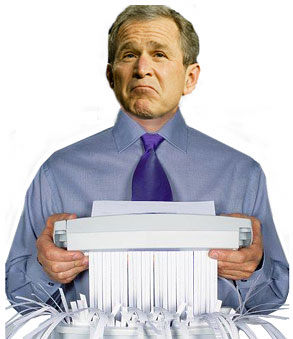
Print it out, send it to Harry Reid, or just read it and weep. Here are 34 scandals from the first four years of George W. Bush's presidency -- every one of them worse than Whitewater.

  • more
    • All Share Services

The scandal sheet

Once upon a time — about five years ago — conservative pundits often talked about “scandal fatigue.” Remember scandal fatigue? It was an affliction supposedly either turning voters against Democrats or, alternatively, a weariness in the body politic preventing Republicans from pursuing even more grievances against Bill Clinton. By any objective measure, however, after four years of George W. Bush’s presidency, the entire nation should be suffering from utter scandal exhaustion.

Consider the raw materials of scandal that this administration has produced: False claims about Iraq’s supposed weapons of mass destruction. Torture in Abu Ghraib. The virtually treasonous exposure of a CIA agent by White House officials. And those are just the best-known examples.

After all, how many citizens can name all the ongoing investigations of Halliburton, Vice President Dick Cheney’s old firm? Who remembers that the administration illicitly diverted $700 million from Afghanistan to Iraq? Or that, on Capitol Hill, Senate Republicans stole strategy memos from Democrats, while a House Republican said he was offered a bribe during a crucial vote? Even a conscientious citizen cannot be expected to keep score, so Salon has compiled a list.

If the next four years of Bush and the GOP running the federal government are anything like the previous four, however, potential scandals will lead to few political consequences for the Republicans. Bush opponents will likely be disappointed if they are waiting for a renewal of the supposed “second-term scandal jinx” dogging Richard Nixon, Ronald Reagan and Clinton.

After all, Washington Republicans are insulated by a rabidly partisan Congress with no interest in investigating the executive branch (and little taste for disciplining itself). By contrast, presidents Nixon, Reagan and Clinton each faced an adversarial Congress. As the late Senate Watergate Committee counsel Sam Dash noted in 2003 about congressional oversight: “Although it worked then, it doesn’t mean it would work now.”

Moreover, Congress allowed the independent-counsel statute, the law that brought us Ken Starr, to expire as Bush assumed office. And the right-wing media — cable news, talk radio, several newspapers — are not about to replicate the drumbeat of scandal they pounded out while Clinton held office. Thus scandals are not a defining part of the GOP’s current identity.

The Democrats, terminally cautious even in the minority, seem unlikely to change this dynamic — although Harry Reid, the Democrats’ new Senate leader, has announced his party will hold monthly oversight hearings, beginning this January, on “unasked and unanswered questions” about the Bush administration. Reid’s project, however, is an uphill battle. The Democrats cannot compel anyone to testify, unlike standard congressional committees, and memorable rhetoric is not a party strength. “This is about honesty and accountability and reforming our federal government,” Reid said in the prepared statement the Democratic Policy Committee released about its oversight plans.

Just think: Someone prepared that quote. To put it more bluntly than Reid did: This is about the dozens of scandals occurring while the Republican Party has enjoyed almost complete control over the federal government. This is about the GOP’s utter disrespect for the laws of the United States. This is about stopping greed, bribery and influence-peddling.

Indeed, here are 34 Republican scandals worthy of further attention, gathered into one place. The list focuses on scandals involving apparently illegal activity or violations of ethics codes. Not everything that is politically, legally or ethically scandalous constitutes a scandal. It is scandalous, for instance, that House Republicans have further weakened their own ethics committee. But that is not, properly speaking, a political scandal. It is just contemptible governance.

This list is also limited to events of the past four years, or those coming to light in that time. It covers both the executive branch and the Congress, since the latter, especially the Senate, is increasingly a mere adjunct to the White House. However, the items are not arranged in terms of moral or historical gravity. Abu Ghraib might create years of anti-American hatred abroad, but it and some other headline-generating events appear near the end of the list, to help familiarize readers first with lesser-known or now-overlooked scandals. Recall how John Ashcroft broke the law? Know why Dick Cheney wants to keep those energy task force documents secret? Read on. You too, Harry Reid.

1. Memogate: The Senate Computer Theft

The scandal: From 2001 to 2003, Republican staffers on the Senate Judiciary Committee illicitly accessed nearly 5,000 computer files containing confidential Democratic strategy memos about President Bush’s judicial nominees. The GOP used the memos to shape their own plans and leaked some to the media.

The problem: The Computer Fraud and Abuse Act states it is illegal to obtain confidential information from a government computer.

The outcome: Unresolved. The Justice Department has assigned a prosecutor to the case. The staff member at the heart of the matter, Manuel Miranda, has attempted to brazen it out, filing suit in September 2004 against the DOJ to end the investigation. “A grand jury will indict a ham sandwich,” Miranda complained. Some jokes just write themselves.

2. Doctor Detroit: The DOJ’s Bungled Terrorism Case

The scandal: The Department of Justice completely botched the nation’s first post-9/11 terrorism trial, as seen when the convictions of three Detroit men allegedly linked to al-Qaida were overturned in September 2004. Former Attorney General John Ashcroft had claimed their June 2003 sentencing sent “a clear message” that the government would “detect, disrupt and dismantle the activities of terrorist cells.”

The problem: The DOJ’s lead prosecutor in the case, Richard Convertino, withheld key information from the defense and distorted supposed pieces of evidence — like a Las Vegas vacation video purported to be a surveillance tape. But that’s not the half of it. Convertino says he was unfairly scapegoated because he testified before the Senate, against DOJ wishes, about terrorist financing. Justice’s reconsideration of the case began soon thereafter. Convertino has since sued the DOJ, which has also placed him under investigation.

The outcome: Let’s see: Overturned convictions, lawsuits and feuding about a Kafkaesque case. Nobody looks good here.

3. Dark Matter: The Energy Task Force

The scandal: A lawsuit has claimed it is illegal for Dick Cheney to keep the composition of his 2001 energy-policy task force secret. What’s the big deal? The New Yorker’s Jane Mayer has suggested an explosive aspect of the story, citing a National Security Council memo from February 2001, which “directed the N.S.C. staff to cooperate fully with the Energy Task Force as it considered the ‘melding’ of … ‘operational policies towards rogue states,’ such as Iraq, and ‘actions regarding the capture of new and existing oil and gas fields.’” In short, the task force’s activities could shed light on the administration’s pre-9/11 Iraq aims.

The problem: The Federal Advisory Committee Act says the government must disclose the work of groups that include non-federal employees; the suit claims energy industry executives were effectively task force members. Oh, and the Bush administration has portrayed the Iraq war as a response to 9/11, not something it was already considering.

The outcome: Unresolved. In June 2004, the U.S. Supreme Court sent the case back to an appellate court.

4. The Indian Gaming Scandal

The scandal: Potential influence peddling to the tune of $82 million, for starters. Jack Abramoff, a GOP lobbyist and major Bush fundraiser, and Michael Scanlon, a former aide to Rep. Tom DeLay (R-Texas), received that amount from several Indian tribes, while offering access to lawmakers. For instance, Texas’ Tigua tribe, which wanted its closed El Paso casino reopened, gave millions to the pair and $33,000 to Rep. Robert Ney (R-Ohio) in hopes of favorable legislation (Ney came up empty). And get this: The Tiguas were unaware that Abramoff, Scanlon and conservative activist Ralph Reed had earned millions lobbying to have the same casino shut in 2002.

The problem: Federal officials want to know if Abramoff and Scanlon provided real services for the $82 million, and if they broke laws while backing candidates in numerous Indian tribe elections.

The outcome: Everybody into the cesspool! The Senate Indian Affairs Committee and five federal agencies, including the FBI, IRS, and Justice Department, are investigating.

5. Halliburton’s No-Bid Bonanza

The scandal: In February 2003, Halliburton received a five-year, $7 billion no-bid contract for services in Iraq.

The problem: The Army Corps of Engineers’ top contracting officer, Bunnatine Greenhouse, objected to the deal, saying the contract should be the standard one-year length, and that a Halliburton official should not have been present during the discussions.

The outcome: The FBI is investigating. The $7 billion contract was halved and Halliburton won one of the parts in a public bid. For her troubles, Greenhouse has been forced into whistle-blower protection.

6. Halliburton: Pumping Up Prices

The scandal: In 2003, Halliburton overcharged the army for fuel in Iraq. Specifically, Halliburton’s subsidiary Kellogg, Brown & Root hired a Kuwaiti company, Altanmia, to supply fuel at about twice the going rate, then added a markup, for an overcharge of at least $61 million, according to a December 2003 Pentagon audit.

The problem: That’s not the government’s $61 million, it’s our $61 million.

The outcome: The FBI is investigating.

7. Halliburton’s Vanishing Iraq Money

The scandal: In mid-2004, Pentagon auditors determined that $1.8 billion of Halliburton’s charges to the government, about 40 percent of the total, had not been adequately documented.

The problem: That’s not the government’s $1.8 billion, it’s our $1.8 billion.

The outcome: The Defense Contract Audit Agency has “strongly” asked the Army to withhold about $60 million a month from its Halliburton payments until the documentation is provided.

8. The Halliburton Bribe-apalooza

The scandal: This may not surprise you, but an international consortium of companies, including Halliburton, is alleged to have paid more than $100 million in bribes to Nigerian officials, from 1995 to 2002, to facilitate a natural-gas-plant deal. (Cheney was Halliburton’s CEO from 1995 to 2000.)

The problem: The Foreign Corrupt Practices Act prohibits U.S. companies from bribing foreign officials.

The outcome: A veritable coalition of the willing is investigating the deal, including the Justice Department, the SEC, the Nigerian government and a French magistrate. In June, Halliburton fired two implicated executives.

9. Halliburton: One Fine Company

The scandal: In 1998 and 1999, Halliburton counted money recovered from project overruns as revenue, before settling the charges with clients.

The problem: Doing so made the company’s income appear larger, but Halliburton did not explain this to investors. The SEC ruled this accounting practice was “materially misleading.”

The outcome: In August 2004, Halliburton agreed to pay a $7.5 million fine to settle SEC charges. One Halliburton executive has paid a fine and another is settling civil charges. Now imagine the right-wing rhetoric if, say, Al Gore had once headed a firm fined for fudging income statements.

10. Halliburton’s Iran End Run

The scandal: Halliburton may have been doing business with Iran while Cheney was CEO.

The problem: Federal sanctions have banned U.S. companies from dealing directly with Iran. To operate in Iran legally, U.S. companies have been required to set up independent subsidiaries registered abroad. Halliburton thus set up a new entity, Halliburton Products and Services Ltd., to do business in Iran, but while the subsidiary was registered in the Cayman Islands, it may not have had operations totally independent of the parent company.

The outcome: Unresolved. The Treasury Department has referred the case to the U.S. attorney in Houston, who convened a grand jury in July 2004.

11. Money Order: Afghanistan’s Missing $700 Million Turns Up in Iraq

The scandal: According to Bob Woodward’s “Plan of Attack,” the Bush administration diverted $700 million in funds from the war in Afghanistan, among other places, to prepare for the Iraq invasion.

The problem: Article I, Section 8, Clause 12 of the U.S. Constitution specifically gives Congress the power “to raise and support armies.” And the emergency spending bill passed after Sept. 11, 2001, requires the administration to notify Congress before changing war spending plans. That did not happen.

The outcome: Congress declined to investigate. The administration’s main justification for its decision has been to claim the funds were still used for, one might say, Middle East anti-tyrant-related program activities.

12. Iraq: More Loose Change

The scandal: The inspector general of the Coalition Provisional Authority in Iraq released a series of reports in July 2004 finding that a significant portion of CPA assets had gone missing — 34 percent of the materiel controlled by Kellogg, Brown & Root — and that the CPA’s method of disbursing $600 million in Iraq reconstruction funds “did not establish effective controls and left accountability open to fraud, waste and abuse.”

The problem: As much as $50 million of that money was disbursed without proper receipts.

The outcome: The CPA has disbanded, but individual government investigations into the handling of Iraq’s reconstruction continue.

13. The Pentagon-Israel Spy Case

The scandal: A Pentagon official, Larry Franklin, may have passed classified United States documents about Iran to Israel, possibly via the American Israel Public Affairs Committee, a Washington lobbying group.

The problem: To do so could be espionage or could constitute the mishandling of classified documents.

The outcome: A grand jury is investigating. In December 2004, the FBI searched AIPAC’s offices. A Senate committee has also been investigating the apparently unauthorized activities of the Near East and South Asia Affairs group in the Pentagon, where Franklin works.

14. Gone to Taiwan

The scandal: Missed this one? A high-ranking State Department official, Donald Keyser, was arrested and charged in September with making a secret trip to Taiwan and was observed by the FBI passing documents to Taiwanese intelligence agents in Washington-area meetings.

The problem: Such unauthorized trips are illegal. And we don’t have diplomatic relations with Taiwan.

The outcome: The case is in the courts.

15. Wiretapping the United Nations

The scandal: Before the United Nations’ vote on the Iraq war, the United States and Great Britain developed an eavesdropping operation targeting diplomats from several countries.

The problem: U.N. officials say the practice is illegal and undermines honest diplomacy, although some observers claim it is business as usual on East 42nd Street.

The outcome: Little fuss here, but a major British scandal erupted after U.K. intelligence translator Katherine Gun leaked a U.S. National Security Agency memo requesting British help in the spying scheme, in early 2003. Initially charged under Britain’s Official Secrets Act for leaking classified information, Gun was cleared in 2004 — seemingly to avoid hearings questioning the legality of Britain’s war participation.

16. The Boeing Boondoggle

The scandal: In 2003, the Air Force contracted with Boeing to lease a fleet of refueling tanker planes at an inflated price: $23 billion.

The problem: The deal was put together by a government procurement official, Darleen Druyun, who promptly joined Boeing. Beats using a headhunter.

The outcome: In November 2003, Boeing fired both Druyun and CFO Michael Sears. In April 2004, Druyun pled guilty to a conspiracy charge in the case. In November 2004, Sears copped to a conflict-of-interest charge, and company CEO Phil Condit resigned. The government is reviewing its need for the tankers.

17. The Medicare Bribe Scandal

The scandal: According to former Rep. Nick Smith (R-Mich.), on Nov. 21, 2003, with the vote on the administration’s Medicare bill hanging in the balance, someone offered to contribute $100,000 to his son’s forthcoming congressional campaign, if Smith would support the bill.

The problem: Federal law prohibits the bribery of elected officials.

The outcome: In September 2004, the House Ethics Committee concluded an inquiry by fingering House Majority Leader Tom DeLay (R-Texas), saying he deserved “public admonishment” for offering to endorse Smith’s son in return for Smith’s vote. DeLay has claimed Smith initiated talks about a quid pro quo. The matter of the $100,000 is unresolved; soon after his original allegations, Smith suddenly claimed he had not been offered any money. Smith’s son Brad lost his GOP primary in August 2004.

18. Tom DeLay’s PAC Problems

The scandal: One of DeLay’s political action committees, Texans for a Republican Majority, apparently reaped illegal corporate contributions for the campaigns of Republicans running for the Texas Legislature in 2002. Given a Republican majority, the Legislature then re-drew Texas’ U.S. congressional districts to help the GOP.

The problem: Texas law bans the use of corporate money for political purposes.

The outcome: Unresolved. Three DeLay aides and associates — Jim Ellis, John Colyandro and Warren RoBold — were charged in September 2004 with crimes including money laundering and unlawful acceptance of corporate contributions.

19. Tom DeLay’s FAA: Following Americans Anywhere

The scandal: In May 2003, DeLay’s office persuaded the Federal Aviation Administration to find the plane carrying a Texas Democratic legislator, who was leaving the state in an attempt to thwart the GOP’s nearly unprecedented congressional redistricting plan.

The problem: According to the House Ethics Committee, the “invocation of federal executive branch resources in a partisan dispute before a state legislative body” is wrong.

The outcome: In October 2004, the committee rebuked DeLay for his actions.

20. In the Rough: Tom DeLay’s Golf Fundraiser

The scandal: DeLay appeared at a golf fundraiser that Westar Energy held for one of his political action committees, Americans for a Republican Majority, while energy legislation was pending in the House.

The problem: It’s one of these “appearance of impropriety” situations.

The outcome: The House Ethics Committee tossed the matter into its Oct. 6 rebuke. “Take a lap, Tom.”

21. Busy, Busy, Busy in New Hampshire

The scandal: In 2002, with a tight Senate race in New Hampshire, Republican Party officials paid a Virginia-based firm, GOP Marketplace, to enact an Election Day scheme meant to depress Democratic turnout by “jamming” the Democratic Party phone bank with continuous calls for 90 minutes.

The problem: Federal law prohibits the use of telephones to “annoy or harass” anyone.

The outcome: Chuck McGee, the former executive director of the New Hampshire GOP, pleaded guilty in July 2004 to a felony charge, while Allen Raymond, former head of GOP Marketplace, pleaded guilty to a similar charge in June. In December, James Tobin, former New England campaign chairman of Bush-Cheney ’04, was indicted for conspiracy in the case.

22. The Medicare Money Scandal

The scandal: Thomas Scully, Medicare’s former administrator, supposedly threatened to fire chief Medicare actuary Richard Foster to prevent him from disclosing the true cost of the 2003 Medicare bill.

The problem: Congress voted on the bill believing it would cost $400 billion over 10 years. The program is more likely to cost $550 billion.

The outcome: Scully denies threatening to fire Foster, as Foster has charged, but admits telling Foster to withhold the higher estimate from Congress. In September 2004, the Government Accountability Office recommended Scully return half his salary from 2003. Inevitably, Scully is now a lobbyist for drug companies helped by the bill.

23. The Bogus Medicare “Video News Release”

The scandal: To promote its Medicare bill, the Bush administration produced imitation news-report videos touting the legislation. About 40 television stations aired the videos. More recently, similar videos promoting the administration’s education policy have come to light.

The problem: The administration broke two laws: One forbidding the use of federal money for propaganda, and another forbidding the unauthorized use of federal funds.

The outcome: In May 2004, the GAO concluded the administration acted illegally, but the agency lacks enforcement power.

24. Pundits on the Payroll: The Armstrong Williams Case

The scandal: The Department of Education paid conservative commentator Armstrong Williams $240,000 to promote its educational law, No Child Left Behind.

The problem: Williams did not disclose that his support was government funded until the deal was exposed in January 2005.

The outcome: The House and FCC are considering inquiries, while Williams’ syndicated newspaper column has been terminated.

25. Ground Zero’s Unsafe Air

The scandal: Government officials publicly minimized the health risks stemming from the World Trade Center attack. In September 2001, for example, Environmental Protection Agency head Christine Todd Whitman said New York’s “air is safe to breathe and [the] water is safe to drink.”

The problem: Research showed serious dangers or was incomplete. The EPA used outdated techniques that failed to detect tiny asbestos particles. EPA data also showed high levels of lead and benzene, which causes cancer. A Sierra Club report claims the government ignored alarming data. A GAO report says no adequate study of 9/11′s health effects has been organized.

The outcome: The long-term health effects of the disaster will likely not be apparent for years or decades and may never be definitively known. Already, hundreds of 9/11 rescue workers have quit their jobs because of acute illnesses.

26. John Ashcroft’s Illegal Campaign Contributions

The scandal: Ashcroft’s exploratory committee for his short-lived 2000 presidential bid transferred $110,000 to his unsuccessful 2000 reelection campaign for the Senate.

The problem: The maximum for such a transfer is $10,000.

The outcome: The Federal Election Commission fined Ashcroft’s campaign treasurer, Garrett Lott, $37,000 for the transgression.

27. Intel Inside … The White House

The scandal: In early 2001, chief White House political strategist Karl Rove held meetings with numerous companies while maintaining six-figure holdings of their stock — including Intel, whose executives were seeking government approval of a merger. “Washington hadn’t seen a clearer example of a conflict of interest in years,” wrote Paul Glastris in the Washington Monthly.

The problem: The Code of Federal Regulations says government employees should not participate in matters in which they have a personal financial interest.

The outcome: Then White House counsel Alberto Gonzales, spurning precedent, did not refer the case to the Justice Department.

28. Duck! Antonin Scalia’s Legal Conflicts

The scandal: Supreme Court Justice Antonin Scalia refused to recuse himself from the Cheney energy task force case, despite taking a duck-hunting trip with the vice president after the court agreed to weigh the matter.

The problem: Federal law requires a justice to “disqualify himself from any proceeding in which his impartiality might reasonably be questioned.”

The outcome: Scalia stayed on, arguing no conflict existed because Cheney was party to the case in a professional, not personal, capacity. Nothing new for Scalia, who in 2002 was part of a Mississippi redistricting ruling favorable to GOP Rep. Chip Pickering — son of Judge Charles Pickering, a Scalia turkey-hunting pal. In 2001, Scalia went pheasant hunting with Kansas Gov. Bill Graves when that state had cases pending before the Supreme Court.

29. AWOL

The scandal: George W. Bush, self-described “war president,” did not fulfill his National Guard duty, and Bush and his aides have made misleading statements about it. Salon’s Eric Boehlert wrote the best recent summary of the issue.

The problem: Military absenteeism is a punishable offense, although Bush received an honorable discharge.

The outcome: No longer a campaign issue. But what was Bush doing in 1972?

30. Iraq: The Case for War

The scandal: Bush and many officials in his administration made false statements about Iraq’s military capabilities, in the months before the United States’ March 2003 invasion of the country.

The problem: For one thing, it is a crime to lie to Congress, although Bush backers claim the president did not knowingly make false assertions.

The outcome: A war spun out of control with unknowable long-term consequences. The Iraq Survey Group has stopped looking for weapons of mass destruction in Iraq.

31. Niger Forgeries: Whodunit?

The scandal: In his January 2003 State of the Union address, Bush said, “The British government has learned that Saddam Hussein recently sought significant quantities of uranium from Africa.”

The problem: The statement was untrue. By March 2003, the International Atomic Energy Agency showed the claim, that Iraq sought materials from Niger, was based on easily discernible forgeries.

The outcome: The identity of the forger(s) remains under wraps. Journalist Josh Marshall has implied the FBI is oddly uninterested in interviewing Rocco Martino, the former Italian intelligence agent who apparently first shopped the documents in intelligence and journalistic circles and would presumably be able to shed light on their origin.

32. In Plame Sight

The scandal: In July 2003, administration officials disclosed the identity of Valerie Plame, a CIA operative working on counterterrorism efforts, to multiple journalists, and columnist Robert Novak made Plame’s identity public. Plame’s husband, former Ambassador Joseph Wilson, had just written a New York Times opinion piece stating he had investigated the Niger uranium-production allegations, at the CIA’s behest, and reported them to be untrue, before Bush’s 2003 State of the Union address.

The problem: Under the Intelligence Identities Protection Act it is illegal to disclose, knowingly, the name of an undercover agent.

The outcome: Unresolved. The Justice Department appointed special prosecutor Patrick Fitzgerald to the case in December 2003. While this might seem a simple matter, Fitzgerald could be unable to prove the leakers knew Plame was a covert agent.

33. Abu Ghraib

The scandal: American soldiers physically tortured prisoners in Iraq and kept undocumented “ghost detainees” in the Abu Ghraib prison in Iraq.

The problem: The United States is party to the Geneva Conventions, which state that “No physical or mental torture, nor any other form of coercion, may be inflicted on prisoners of war to secure from them information of any kind whatever.”

The outcome: Unresolved. A Pentagon internal inquiry found a lack of oversight at Abu Ghraib, while independent inquiries have linked the events to the administration’s desire to use aggressive interrogation methods globally. Notoriously, Gonzales has advocated an approach which “renders obsolete Geneva’s strict limitations on questioning of enemy prisoners and renders quaint some of its provisions.” More recently, Gonzales issued qualified support for the Geneva Conventions in January 2005 Senate testimony after being nominated for attorney general. Army reservist Charles Graner was convicted in January 2005 for abusing prisoners, while a few other soldiers await trial.

34. Guantánamo Bay Torture?

The scandal: The U.S. military is also alleged to have abused prisoners at the U.S. Navy’s base in Guantánamo Bay, Cuba. FBI agents witnessing interrogations there have reported use of growling dogs to frighten prisoners and the chaining of prisoners in the fetal position while depriving them of food or water for extended periods.

The problem: More potential violations of the Geneva Conventions.

The outcome: An internal military investigation was launched in January 2005.

Peter Dizikes is a science journalist based in Boston.

Using Bush’s playbook

"Karl Rove politics" aren't quite dead: Obama's strategy in 2012 will mirror W's in 2004

  • more
    • All Share Services

Using Bush's playbookGeorge W. Bush and Barack Obama (Credit: Reuters/Larry Downing)

Barack Obama’s presidency was born from nothing so much as his repudiation of George W. Bush’s administration — its policies and politics, its style and tone. One of Obama’s most effective 2008 stump speech refrains was his promise to end the era of “Scooter Libby justice, ‘Brownie’ incompetence and Karl Rove politics.”

But the political dynamics for winning a second presidential term often differ markedly from winning the first. So don’t be surprised by many eerie parallels between Obama’s 2012 reelection bid and Bush’s 2004 campaign. The president may not rely upon “Karl Rove politics” in the strictest sense, and nobody would confuse David Axelrod with Rove. But Obama’s reelection route and rhetoric may bear more than a few Rovian hallmarks.

Now that Mitt Romney has won the Republican nomination, two key features prevail over the 2012 campaign — and both were also plainly evident in 2004. First, the incumbent president’s reelection fortunes are far from certain; and, second, the incumbent faces a decent but nevertheless weak challenger who is further hampered by internal problems within his party’s coalition.

Because incumbents can’t run for reelection promising “change,” and because “hope” during a lingering recession was also off the menu, the Obama campaign’s 2012 theme of  “forward” — a word that often follows “plow,” mind you — was the best available alternative. That said, and substituting the economy for terrorism, Obama is implicitly if not explicitly advancing the same theme Bush did in 2004: America suffered a tough blow, but the situation could have been worse and, more to the point, under my stewardship the nation is steadily regaining its footing.

This counterfactual campaign theme — vote for me not because of what happened, but what might have but didn’t — is a common thread for Bush and Obama. It’s not an uplifting message, but it sufficed in 2004 and Obama is counting on it working again in 2012.

Politics 101 further dictates that when an incumbent’s reelection is in doubt, he must go negative against the challenger. Obama political operatives in the White House and at the Democratic National Committee long ago made it abundantly clear they were willing to do just that. Team Obama may not go negative against Romney to the degree the Bush camp did against John Kerry in 2004. (By mid-summer 2004, 75 percent of Bush’s TV ads were negative attacks on Kerry.) But don’t be surprised if attacks on Romney’s record and even character are plentiful, harsh and relentless. In 2008, America saw candidate Obama’s toothy grin; four years later, expect to see President Obama’s fangs.

Expect the Obama camp to emphasize two major critiques of Romney: that he is a flip-flopper willing to say anything or reverse any position to win; and that he is an economic royalist whose personal and public life suggest a person incapable of understanding the lives and struggles of average Americans. Again — note the unusual parallels with 2004.

Although Romney is a Republican former governor and Kerry was at the time his state’s Democratic junior U.S. senator, the two Massachusetts pols make for similar targets. Each man is an extraordinarily rich preppie and Ivy Leaguer. Each represents the liberal wing of his respective party. Each has shown a propensity for ruining an otherwise valid point with sloppy, backfiring language. And each has a reputation for lacking political spine.

The flip-flop frame is candidate character assassination of the first order. Like the lone negative number in a string of multiplied positives, the critique that nobody can trust any statement or claim made by a politician has the potential to negate every accomplishment or promise. If it sticks, it can be fatal, as Kerry learned in 2004.

Obama and the Democratic National Committee know their electoral history and, sure enough, last November — a year before the election and two full months before a single Iowan had caucused — the DNC released a four-minute “Mitt vs. Mitt” ad and its accompanying website with the damning tag line, “the story of two men trapped in one body.” The site is a brilliant homage to the Bush campaign’s 2004 windsurfer attack ad and the devastating, 11-minute ad the Republican National Committee produced chronicling Kerry’s “evolution” on Iraq.

And then there is what might be called “the Willard factor”: Romney as Richy Rich, the Monopoly Guy with the Bain Capital background and the Swiss bank account. His bio would be political gold to Romney’s opponent any election cycle, but it’s gold-plated platinum in the first full presidential campaign following the biggest economic crisis since the Great Depression, the rise of the Occupy Wall Street movement, and the long overdue national debate over income inequality.

Again, the wealth-personified line of attack mirrors the out-of-touch, Martha’s Vineyard yoke the Bush team put around Kerry’s neck in 2004. Right on cue, in the first public event of his reelection campaign, last week Obama attacked Romney by name and invoked the economic disconnect card with relish. “He sincerely believes that if CEOs and wealthy investors like him make money the rest of us will automatically prosper as well,” said Obama of Romney, adding that “corporations aren’t people – -people are people.” (For the record, Kerry is actually wealthier than Romney, who would become one of the richest men ever to occupy the White House, should he win.)

Obama will also try to shift the national debate toward areas of strength, as Bush did. Historically, this meant the same strategy, but with inverse implications for each party: The so-called mommy party Democrats would encourage voters to focus on more favorable kitchen-table economy issues — healthcare, jobs, education — and away from less favorable “daddy party” Republican issues surrounding foreign wars abroad and culture wars. Because Obama is net-positive in foreign policy approval and net-negative on the economy, rather than mirroring by inversion, Obama will try to duplicate Bush’s shift-in-emphasis in 2004. GOP complaints that Obama is politicizing the killing of Osama bin Laden reveal Republican fears that Obama is going to play the terrorism card in 2012 just like Bush did eight years ago.

The 2004 parallels extend beyond message. Obama will be amply resourced and enjoy a field technology by virtue of his campaign’s state-of-the-art Web, donor, volunteer and social media innovations. Remember the Bush reelection campaign’s vaunted “72-hour” voter turnout model? That seems like an Edsel compared to the Ferrari the Obama team will be sporting this summer and fall. Among the perquisites modern presidential incumbents enjoy is the option to test-drive the best mobilization machines before anyone else.

Finally, what most connects Obama 2012 to Bush 2004 is the stability of the electoral map itself. Only three states — two net to Bush — flipped from one party to the other between 2000 and 2004; only nine states flipped between 2004 and 2008. Split the difference and a good, back-of-the-napkin over-under for number of states likely to flip between 2008 and 2012 is six. And thus, like the lead sailboat during a windless race, Obama doesn’t need or want conditions to change much from 2008: He merely has to replicate the map that swept him into office, with the burden of figuring out how to shake up the Electoral College falling to Romney, just as it did for Kerry against Bush. Even Karl Rove’s mapping of the 2012 election concedes this reality.

The 2008 election was memorable; to borrow the title of one best-selling chronicle, it was a “game changer.” But 2012 will not be. In many respects, it will be a game repeater, with Obama playing Bush to Romney’s Kerry of 2004. The president may be asking Americans to look “forward” in 2012, but the best preview of his reelection campaign can be found by looking backward eight years.

Continue Reading Close

The Bushies are back

Missed the neocons? Don't worry: Mitt Romney's getting the band together again

  • more
    • All Share Services

The Bushies are back (Credit: Reuters/Win McNamee)

There was good reason for Republicans to cry foul over the Obama campaign’s advertisement highlighting the president’s killing of Osama bin Laden; the GOP has lost its decades-long edge on national security. According to a Washington Post poll, “By a margin of more than 2 to 1, Americans say the president’s handling of terrorism is a major reason to support rather than oppose his bid for reelection.”

Republicans lost their popularity on security issues for one reason: George W. Bush’s foreign policy was a disaster. And yet, the party’s nominee, Mitt Romney, has assembled a foreign-policy team composed almost exclusively of individuals with the same war-always mentality and ideology that served Bush — and the United States — so poorly. In some cases, the exact same men responsible for Bush’s catastrophic national security policies are advising Romney. The former Massachusetts governor could have included some of the pragmatists and realists from the George H.W. Bush administration. Instead, a Romney presidency seems like it would be Bush 43 all over again.

Richard Grenell, who served as United Nations spokesman under Bush, may be gone from the Romney campaign after an uproar over his sexuality, but there are plenty more former Bushies. First off, there are Romney’s “special advisors.” There’s Michael Chertoff, W.’s Homeland Security director. Chertoff oversaw DHS’s failures during Hurricane Katrina, and amassed unprecedented powers of secrecy. Next up is Eliot Cohen, counselor to the State Department for Bush’s last two years and on the Defense Policy Advisory Board for the president’s entire term. Cohen was an adamant supporter of the Iraq War and advised Bush directly on the issue. Or take Cofer Black, the man who infamously said to Bush in September 2011 about al-Qaida that “When we’re through with them they will have flies walking across their eyeballs.” Black went on to become chairman of Blackwater, where he resigned after the company illegally bribed Iraqi officials.

Then there are the 13 “working groups” composed of equally worrisome individuals. The Middle East and North Africa Working Group is co-chaired by Bush’s Assistant Secretary of Defense Mary Beth Long, and Meghan O’Sullivan, Bush’s special assistant and deputy national security advisor for Iraq and Afghanistan. The remaining co-chair is Walid Phares, who never worked for Bush but advised Lebanese warlords in the 1980s. Romney has reportedly promised Phares a top job in his administration, despite his virulently anti-Islamic views.

All told, Romney lists 37 holdovers from the George W. Bush administration — the very same administration he and all other Republican candidates barely referenced during their many debates because it was so discredited and toxic, even to the Republican base.

It didn’t have to be this way. There are, in fact, people in Republican circles who are sensible on international affairs. The Cato Institute, in particular, has experts that could dramatically change the direction of American foreign policy. Men like Justin Logan and Christopher Preble were prescient on Iraq and a host of other issues. Similarly, the Center for the National Interest (formerly the Nixon Center) has a host of solid scholars, including ones like Dimitri Simes and Geoffrey Kemp, who have valuable government experience in the Nixon and Reagan administrations, respectively, and a history of perceptive analysis. Richard Haass, president of the Council on Foreign Relations, would have been another good pick.

So why aren’t guys like this being tapped? Why is the GOP sticking with a discredited foreign-policy approach rather that looking to its own past for wiser counsel? “Most of the realists and pragmatists have simply been driven out of the Republican Party,” says Stephen Walt, who writes a blog at Foreign Policy and teaches at Harvard. “The neoconservatives have been driving the agenda since Bush was elected and they remain well-entrenched.”

Another factor is that the Republican Party’s base remains strongly militaristic and reluctant to recognize limits on American power. Jon Huntsman’s failed presidential campaign illustrated that problem. The good news is that nobody seems to be calling for nation-building and occupying foreign countries in the mold of Iraq and Afghanistan. But that’s the only lesson that seems to have been learned from the last decade of foreign-policy debacles.

Finally, it may just be that the United States has too much power to change course. While the Unites States has undoubtedly made disastrous decisions in the last decades, it is so powerful that it is largely insulated from the consequences of them. If Romney’s foreign-policy advisor list is anything to go by, a Romney administration would have to teach the U.S. all over again about the problems with trying to police the world. Prepare for Bush redux.

Continue Reading Close

Jordan Michael Smith writes about U.S. foreign policy for Salon. He has written for the New York Times, Boston Globe and Washington Post.

Bush aide blasts torture

Philip Zelikow tried to warn Bush on interrogations. Now he's penned an authoritative article on how he was ignored

  • more
    • All Share Services

Bush aide blasts torture (Credit: Reuters/Jim Young)

The Bush administration hasn’t heard the last from Philip Zelikow. After the rediscovery last week of his long lost 2006 anti-torture memo, Zelikow, a former State Department official, has written arguably the most damning article yet about U.S. government’s interrogation policies from 2001 to 2009. The article, called “Codes of Conduct for a Twilight War,” will be released in a forthcoming issue of the Houston Law Journal, and was obtained exclusively by Salon. Says Zelikow in an email: “I’m not aware of other accounts that combine historical, policy and legal approaches to” the subject of the Bush administration’s interrogation methods.

Based on published histories and his firsthand observations, and adapted from a lecture delivered in November, the article calls the administration’s rationale for its use of torture — which he nonetheless insists only on calling “extreme interrogation” and “coercive methods” — “radical,” “an amazing contention,” “untenable and extreme,” “unsustainable,” “an unprecedented program of coolly calculated dehumanizing abuse and physical torment,” and, finally, simply a “mistake.” He concludes: “This was a collective failure of American public leadership, in which a number of officials and members of Congress (and staffers) of both parties played a part, endorsing a CIA program of physical coercion without any precedent in U.S. history.”  In fact, “The only defense against criminal prosecution would be that officials acted in good faith reliance on the advice of their government lawyers.”

Part of what makes Zelikow’s analysis so damning and definitive is its judiciousness. The article is deeply empathetic of the uniquely fearful situation under which the Bush administration was initially operating. Zelikow calls the Sept. 11 attacks a “collective trauma” and a “shoc[k] to mass beliefs.” He notes that Bush and others spent time in burn units, morgues and with survivors of the attacks. One traumatic experienced often overlooked — overlooked because it appeared in Stephen Hayes’ stenographic biography of Dick Cheney — was that the vice-president’s daughter was (falsely, it turns out) told that her house with her children in it had tested positive for anthrax. Similarly, Cheney and National Security Advisor Condoleezza Rice were told that they and others had been exposed to an extremely lethal toxin in a particular area of the White House — and might soon die as a result. “The alarms did not stop and they too were not abstract … The pressure on Bush and his senior advisers was so direct because so much of the response had to be invented and improvised,” the article reads.

An additional factor in the power of the article is Zelikow’s credibility and history. Before entering government, he was a civil rights lawyer in Texas battling the Ku Klux Klan and then a highly esteemed Harvard historian specializing in U.S. foreign policy — he co-authored one book with Rice. He then served on the National Security Council under President George H.W. Bush and directed the 9/11 Commission before becoming counselor to Rice at the State Department from 2005 to 2007. He currently volunteers part-time on the President’s Intelligence Advisory Board under President Obama.

Such bipartisan, establishment credentials render the breakdown and conclusion of this article all the more damning. He believes that what should have been a political and moral question — should the United States torture captives? — became strictly a legal matter left up to government lawyers, few of whom had any experience with these issues, and who had to take the necessity of extreme measures as a given. “These lawyers then became secular priests, granting absolution to the supplicant policymakers,” Zelikow writes.

The problems began when the Office of the Vice President and the CIA took central roles in policymaking. Cheney felt himself above the rest of the National Security Council, bypassing Rice and other traditional channels of national security policymaking. Ad-hoc decision-making and improvisation became “a habit of thought,” which seemed initially to pay off in the security of the nation, as well as in Bush’s political standing and self-confidence.

With Cheney and CIA head George Tenet “the key entrepreneurs in setting codes of conduct for the War on Terror,” it was essentially left to their obsequious lawyers to decide, in secret, on the interrogation methods America should employ. Bush even told the Senate’s Intelligence Committee chairman that “the vice president should be your point of contact … [He] has the portfolio for intelligence activities.” Decisions were made to jettison international treaties. By December 2001, the CIA was already interested in reverse-engineering methods “heretofore used only to treat Americans to resist enemy torture.” When a senior al-Qaida member was captured in March 2002, the prototype for the administration’s torture policies was already developed. “So, for the first time in American history, leaders of the U.S. government carefully devised ways and means to torment enemy captives.”

Zelikow notes that “None of the policy or moral issues connected with these choices appear to have been analyzed in any noticeable way.” Perhaps worst of all, no serious consideration was given to weighing the costs of benefits of the torture program, with reference to relevant historical precedents and/or examinations of the respective French, British and Israeli experiences in dealing with captured terrorists. “Bush and Rice should have insisted on this,” Zelikow writes.

The 52-page article observes the successes of Obama’s counterterrorism policies after repudiating the use of torture. On the basis of the empirical evidence then, “[t]here is no evident correlations between intelligence success and the available of extreme interrogation methods,” no matter what Bush and Cheney claim. Finally, “The program’s costs — which include the high-level effort expended in order to establish, maintain, and defense the program — appear on the evidence so far to have well outweighed any unique value the program might have had as a method of counterterrorism intelligence collection.” This is apart from the damage to America’s international standing and corrosion of its traditional values.

Zelikow concludes his analysis by arguing that, although the Obama administration has the right to wage war and use extralegal methods to defeat al-Qaida, its claim of that authority to defeat “associated forces” is unwarranted. “The U.S. government should publish and explain any overarching policy and legal documents that guide and confine the conduct of deadly operation against its foreign enemies … the executive branch of the U.S. government has a duty to articulate the scope of its warfare to the Congress and the public.” The Bush administration’s unprecedented elevation of torture to national policy may be history, but the job to get U.S. foreign policy in line with its constitutional and moral obligations is far from over.

Continue Reading Close

Jordan Michael Smith writes about U.S. foreign policy for Salon. He has written for the New York Times, Boston Globe and Washington Post.

Thomas Kinkade, the George W. Bush of art

The rise and fall of Thomas Kinkade, the Painter of Light™ in a decade of bad faith

  • more
    • All Share Services

Thomas Kinkade, the George W. Bush of art

News of Thomas Kinkade’s death arrived on the same day I received in the mail a vintage teacup on which I had spent a ridiculous amount of money. It has a cottage painted on it. Kinkade, whose work has long exerted a morbid fascination for me (to the concern of all my friends), specialized in cottages. So some part of me understands the appeal, I guess, but, damn: Those paintings make my corneas hurt. And yet, I could barely stop looking at them.

Kinkade was only 54, and his family told the media that he died of “natural causes.” This comes after years of reports of drunken public misbehavior: cursing at people who tried to save him from falling off bar stools, heckling Siegfried & Roy, grabbing a woman’s breasts at a publicity event and, most memorably, urinating on a Winnie the Pooh statue at the Disneyland Hotel while proclaiming, “This one’s for you, Walt!” There were DUI arrests. Also, his manufacturing company declared bankruptcy two years ago, and former franchisees of the once-ubiquitous Thomas Kinkade Signature Galleries won settlements against him for fraud.

That’s quite a fall for a man who frequently spoke of his Christian faith and family values when asked to comment on the mammoth success of his brand in the early 2000s. “When I got saved, God became my art agent,” Kinkade explained in a 2004 video. He went from a childhood in Placerville, Calif. (invariably characterized as “hard-scrabble”) to an apprenticeship selling his work in supermarket parking lots to his apotheosis as the nation’s “most profitable” artist, the Painter of Light™, and multimillionaire. He was profiled in the New Yorker by Susan Orlean.

I first learned about the dark side of the Painter of Light™ — sorry, couldn’t resist that one — when I reviewed “his” novel, “Cape Light,” in 2002. The novel, first in a series, was produced much as his paintings are: by a semi-industrial process in which low-level apprentices embellish a prefab base provided by Kinkade. He wasn’t the only artist to work in this way; he wasn’t even the only novelist. To the best of my knowledge, his novels — heartwarming, fuzzily pious tales of small-town life — have been coming out ever since, one more facet of a lifestyle brand that, at its most ambitious, included an entire Thomas Kinkade-themed housing development.

My review was just a goof intended to amuse Salon’s readers, but after it appeared, I began to receive emails from people who had sunk their life savings in Thomas Kinkade Signature Galleries (essentially, mall and shopping-district outlets for his prints) and been fleeced. I didn’t really understand how the financial architecture of Kinkade’s gallery empire worked, and I sure didn’t share their taste in wall art, but these people struck me as decent and sincere. They’d believed in Thomas Kinkade — not just in the man or the company, but in the ethos supposedly represented by his work, one in which (to quote Kinkade’s introduction to “Cape Light”) “people have the time to savor life’s simple pleasures” and lead “deep, satisfying lives.”

My conversations with these victims made me uneasy. Was there some relationship between the franchisees’ naivete, perhaps even their willful self-delusion, and their terrible taste? Was it hopelessly snobby to wonder that? What about Kinkade himself? He seemed to be at best a hypocrite and at worst a crook. Was there a meaningful connection between his bad conscience and his bad art? German thinkers of the 1930s would have said so, and they had plenty of opportunity to observe bad fascist art up close. Hermann Broch maintained that someone who chooses to make kitsch is “ethically depraved, a criminal willing radical evil.” The novelist Milan Kundera believes kitsch to be the natural expression of totalitarianism. That’s a lot of moral weight to place on a bunch of garish cottage paintings, but Kinkade was always the first to present his work as a form of ideology.

I felt compassion for the ripped-off gallery operators, and at the same time I was aware that quite a few of them had probably also fallen for the similarly sanctimonious, bogus folksiness of George W. Bush, thereby subjecting our nation to one of the worst presidents in its history. Kinkade and Bush struck me as of a piece, probably because they had both borrowed from Ronald Reagan in promising that we could get back to a better way of life that never existed in the first place. In nearly every encounter with the press, Kinkade delivered a diatribe against the art-world “establishment” that had shut him out. They were “elites” touting unfathomable, downer junk to hardworking people who needed uplift instead. Art snobs were the aesthetic counterparts of the so-called liberal elites, a group that surely included me.

At the same time, I must admit that I, too, like a cottage. Granted, I like the stylized, art-deco kind painted on bone china, rather than the insanely detailed and phosphorescently lit specimens in Kinkade’s pictures. And I’m in little danger of equating my new teacup with a Brancusi just because it’s cheerier. Nevertheless, I suspect that my idea of what’s pleasing about a cottage isn’t too different from that of Kinkade’s fans: an aura of harmless coziness, of modest domestic beauty and comfort not too cut off from the past. It’s as if we’re speaking the same word, but in different languages.

I suspect this is why Kinkade’s paintings have exerted their weird, hypnotic effect on me. They are so preposterous (especially the stream-side ones; he really needed to sit down with an architect and go over the basics of drainage), so awful. And yet I can still detect — beneath that cacophony of hollyhocks and cobblestones and snapdragons — the whisper of something intelligible. I’m pretty sure I know why the hordes of Kinkade collectors love his work, even if I don’t like it myself. Kinkade’s paintings are irredeemably false, like all kitsch, but through them you can just barely glimpse the honest desires they seek to exploit, sinking under the dreck.

Kundera defined kitsch as “the absolute denial of shit,” meaning it offers an airbrushed, sterilized, sentimentalized view of the world. From that, it doesn’t necessarily follow that art wallows in shit, but art doesn’t exist for the primary purpose of denying it, either. Kitsch is, first and foremost, a lie; its very existence is founded on bad faith.

Kinkade, like Bush, peddled a falsely simplified image of the world — one without mildew or flooded basements, for one thing — which, no surprise, turned out to be plastered over a whole lot of stinky stuff. The true believers, the ones who bought into these men the most during the 2000s, ended up paying some of the highest prices, from the Kinkade acolytes who invested in his gallery Ponzi scheme to the working-class red-staters who sent off their kids to die in a pointless war. Bad taste, harmless as it may seem, can end up costing you a lot.

Further reading

Los Angeles Times obituary for Thomas Kinkade

Susan Orlean’s 2001 profile of Thomas Kinkade for the New Yorker

A 2006 Los Angeles Times story documenting Kinkade’s business problems

Salon’s Janelle Brown visits Hiddenbrooke, a Kinkade-theme housing development in Northern California

Laura Miller reviews “Cape Light,” a novel by Thomas Kinkade and Katherine Spencer

Continue Reading Close
Laura Miller

Laura Miller is a senior writer for Salon. She is the author of "The Magician's Book: A Skeptic's Adventures in Narnia" and has a Web site, magiciansbook.com.

The memo Bush tried to destroy

A document advising the Bush administration against torture has resurfaced, despite his best efforts to hide it

  • more
    • All Share Services

The memo Bush tried to destroyGeorge W. Bush in 2006 (Credit: AP/Ron Edmonds)

In February of 2006, Philip Zelikow, counselor to Secretary of State Condoleezza Rice, authored a memo opposing the Bush administration’s torture practices (though he employed the infamous obfuscation of “enhanced interrogation techniques”). The White House tried to collect and destroy all copies of the memo, but one survived in the State Department’s bowels and was declassified yesterday in response to a Freedom of Information Act request by the National Security Archive.

The memo argues that the Convention Against Torture, and the Constitution’s prohibitions against cruel and unusual punishment, do indeed apply to the CIA’s use of “waterboard[ing], walling, dousing, stress positions, and cramped confinement.” Zelikow further wrote in the memo that “we are unaware of any precedent in World War II, the Korean War, the Vietnam War, or any subsequent conflict for authorized, systematic interrogation practices similar to those in question here, even when the prisoners were presumed to be unlawful combatants.” According to the memo, the techniques are legally prohibited, even if there is a compelling state interest to justify them, since they should be considered cruel and unusual punishment and “shock the conscience.”

Chillingly, the memo notes that “corrective techniques, such as slaps,” may be legally sustained, as might be “[C]ontrol conditions, such as nudity, sleep deprivation, and liquid diets…depending on the circumstances and details of how these techniques are used.” However much distress Zelikow’s memo caused the White House, it was not an ACLU briefing paper.

“I’m pleased the memo is now part of the historical record and available for study,” Zelikow wrote Salon in an email. The White House had determined that the memo — which was not binding since Zelikow’s was a bureaucratic position without legal authority — was too dangerous to exist. “I later heard the memo was not considered appropriate for further discussion and that copies of my memo should be collected and destroyed,” he said in a May 2009 congressional hearing.

At that hearing, before the Senate Committee on the Judiciary, Subcommittee on Administrative Oversight and the Courts, Zelikow said he had “no view on whether former officials should be prosecuted,” a decision he thinks should be left to “institutions.” However, he did call for a thorough inquiry and a public report examining how the U.S. came to employ torture.

Of course, no such inquiry was ever launched. The Obama administration declined to revisit the U.S. employment of torture, with the president saying he didn’t want to “look back.” Zelikow believes this was a mistake. “I still believe an inquiry would be useful, though less so as time passes and more information becomes available, especially after the 9/11 trials conclude, hopefully this year,” he says in an email.

During his congressional testimony, Zelikow declined to say whether Department of Justice lawyers acted improperly or immorally, conceding only that their opinions were “unsound, even unreasonable.” But in a 2007 lecture in Houston, he had no problem saying “the cool, carefully considered, methodical, prolonged, and repeated subjection of captives to physical torment, and the accompanying psychological terror, is immoral.”

The importance of the memo lies in its revelation that there was real, serious debate inside the Bush administration about how to interrogate captured terrorist suspects. The members of the White House declined to enter that debate — indeed, they did their best to squash it. The destruction of Zelikow’s carefully reasoned memo suggests the White House did not want any record of alternative views even existing, lest they be considered reasonable or people get the idea that the torture policies were thought controversial even by members of the administration.

Continue Reading Close

Jordan Michael Smith writes about U.S. foreign policy for Salon. He has written for the New York Times, Boston Globe and Washington Post.

Page 1 of 436 in George W. Bush