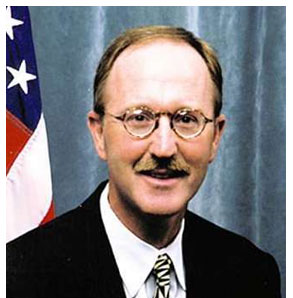

Arlen Specter, D-Pa.

Big biz battles for Bush’s bench

Last year the Senate rejected former mining and cattle lobbyist William Myers for the Court of Appeals. Now Bush is trying again -- and this time Myers' business pals are waging a multimillion-dollar campaign for him.

Last year, when the Senate considered William G. Myers III for the U.S. Court of Appeals for the 9th Circuit, Democrats blocked his nomination with a filibuster after questions arose about his work as a lobbyist for mining and cattle interests. Sen. Charles Schumer, D-N.Y., described Myers’ environmental record as being “off the deep end,” and environmental and Native American groups opposed Myers for his criticism of laws such as the Endangered Species Act and his alleged disrespect for Indian lands and rights. On Tuesday, Myers’ nomination goes back before the Senate Judiciary Committee, the opening battle in Washington’s on-again partisan wars over President Bush’s judicial nominees. This time around, Myers has the full support of his friends in industry.

On Feb. 14 Bush renominated Myers and 19 other unsuccessful judicial candidates, seven of whom were blocked by Democrats in the last Congress, hoping that the four-seat Republican gain in the 2004 election would help push the nominees through. Myers is the test case. If Myers’ nomination is blocked again, the GOP leadership might resort to what is known as the “nuclear option,” whereby it would try to change the Senate’s procedural rules and ban filibusters. Senate Judiciary Committee chairman Arlen Specter, R-Pa., apparently believes that Myers has a good chance of reaching the 60 votes that would ensure a filibuster-proof Senate. Two Democrats voted with Republicans to try to end the first filibuster of Myers, and Colorado’s new Democratic senator, Ken Salazar, whose state went for Bush in 2004 and has big mining and cattle interests, has indicated he might vote for Myers.

To help Myers and the rest of Bush’s nominees get those votes in the Senate, Myers’ former clients in the National Association of Manufacturers plan to wage a multimillion-dollar campaign. The manufacturers hope to provide the critical boost the Republicans need by employing television advertising and grass-roots lobbying to pressure moderate or red-state Democratic senators to help prevent any filibusters. A spokesperson for the business group says that securing approval of Bush’s appellate court nominees is now its top priority. This unparalleled effort by big business to influence the judiciary by promoting nominees such as Myers who owe a great deal to the industry lobby raises potential conflict-of-interest questions and poses a new threat to the traditional independence of the judicial branch. And if the Democrats manage to filibuster Myers’ nomination again, the pressure on them by outside groups like NAM is only likely to increase.

NAM, the principal lobbying group representing U.S. companies, from multinationals to small manufacturers, is campaigning for Bush’s nominees because it believes that the biggest problem facing manufacturing in its race to compete in the global marketplace is non-production costs like tort litigation and regulatory compliance. It presumes that most of Bush’s nominees, if approved, would be inclined to stop what it considers frivolous lawsuits, whose costly litigation and awards, it says, are a drag on economic development and discourage job growth and risk taking. NAM president and CEO John Engler, a Republican and a longtime friend of Bush’s, says the NAM wants a “fair, impartial and predictable legal system,” with fewer delays and appeals.

To accomplish its goals on the national stage, NAM is promoting the package of litigation legislation endorsed by the White House, including the bill to curtail class-action lawsuits signed by the president on Feb. 18 (which will increase federal jurisdiction over such suits), as well as coming bills on asbestos litigation and medical malpractice, which aim to put caps on financial awards to those claiming damages. On the state level, NAM is backing sympathetic political and judicial candidates and trying to sway voters on the issues of frivolous lawsuits and costly verdicts. But NAM also has recognized that much of judges’ work concerns commercial and economic matters, and says that the confirmation of federal judges sympathetic to its goals is a “matter of utmost importance.” According to Engler, NAM’s membership believes that it is vital to confirm judges who “get it right” to replace those who “are negating the work of elected officials in the executive and legislative branches.”

NAM’s interest in judicial selection parallels the emergence of the courts as a principal battleground on the issue of government regulation. Business is no longer interested simply in educating judges to be more sympathetic to the cost of regulation on commerce but in selecting those already familiar with business through their prior connections. A study conducted by the Center for Investigative Reporting of all of Bush’s appellate court nominees in his first term revealed that a significant number had close ties to the energy and mining industries as lobbyists or counsel and that many, like Myers, were nominated for federal judicial districts where battles over natural resources are frequently fought in the courts.

NAM’s assessment of the importance of judicial selection was recently validated by an unlikely source. A study released last October by the Environmental Law Institute concluded that a federal judge’s political affiliation is a decisive factor in how he or she will rule on key environmental cases. It found that there is a wide gulf in the positions taken by appointees of Democratic and Republican presidents in environmental suits.

NAM’s lobbying campaign will focus on politically vulnerable or receptive Democratic senators. Five of the 16 Democrats up for reelection in 2006 come from states that went for Bush in last year’s election, and two of those previously voted with Republicans to stop some of the judicial filibusters in Bush’s first term. (One, Nebraska’s Sen. Ben Nelson, voted to end the filibuster against Myers.) All these senators are undoubtedly aware that fellow Democratic Sen. Tom Daschle’s support for the filibusters, particularly that of Myers — who is seen as a friend to agriculture because of his cattle industry connections — was an issue in his losing South Dakota campaign last year. His opponent John Thune, who ultimately defeated Daschle, charged that in voting on judicial nominations, Daschle had sided with liberal extremists against the state’s farmers and ranchers.

NAM’s rallying of corporate muscle around judicial nominations is not unprecedented. In 2002, C. Boyden Gray, counsel to the first President Bush from 1989 to 1993, established the Committee for Justice and a companion foundation and ran a grass-roots and ad campaign similar to that planned by NAM concerning blocked judicial nominees. The committee lists on its Web site the Democrats who have sometimes voted with Republicans to stop a judicial filibuster, along with the Democrats it considers the chief barriers to confirmation. The group credits its television ads with helping to defeat Texas Democratic senatorial candidate Ron Kirk in 2002 over his stand opposing Bush’s nominees. Business groups and Republican supporters have donated tens of thousands of tax-exempt dollars to the committee’s foundation. And one of the committee’s members is Engler, a former Michigan governor and now NAM’s chief executive.

Myers has never served on the bench. He was the Department of Interior’s top lawyer in 2001-03 and is currently a lawyer in Idaho with the same firm that employed him as a lobbyist for mining interests. He ran into organized opposition to his first nomination from environmental and Native American groups for actions he took at the Interior Department and as a lobbyist in the 1990s for the cattle and mining industries, which are major Republican donors. This time he will benefit from the membership on NAM’s executive committee of the president and CEO of Arch Coal. Myers’ lobbying of Congress in 2000 helped pave the way for Arch’s recent expansion of its federal coal leases despite the opposition of federal regulators and six state attorneys generals who considered the increase potentially anticompetitive and harmful to consumers.

One example of the potential negative impact that judges’ rulings favorable to business can have on consumers is a case highlighted last April in Salon. Representing Arch Coal and two other major coal producers, Myers helped push through the Coal Market Competition Act of 2000, which allowed the producers to expand their federal coal lease holdings. The Federal Trade Commission subsequently challenged a consolidation of Wyoming coal producers allowed under the new law, and was soon joined by attorneys general from six states that rely on power from plants fueled by Wyoming coal. They argued that combining the substantial federal coal leases would make anticompetitive coordination among the remaining Wyoming coal producers more likely and thus hurt consumers by increasing their electric utility costs.

“If allowed to go through, this merger would combine two of only four major producers of Powder River Basin coal,” Missouri attorney general Jay Nixon warned. But last August a U.S. district court judge nominated by President Bush denied the FTC’s request for a preliminary injunction, and the U.S. Court of Appeals for the District of Columbia Circuit then declined to issue a stay pending an appeal.

At the end of January, prior to organizing its initiative on federal judges, NAM launched the American Justice Partnership to push for legal changes in state courts and influence the selection of state judges and politicians. Its success with state judicial campaigns is what helped persuade the NAM’s Engler to develop a federal judicial strategy. Engler told a National Press Club audience on Feb. 10 that his interest in influencing the selection of federal judges came from his “assessment back in Michigan of how important the legal climate can be to a state and to a business climate, and therefore extrapolating that to the nation.”

Legal experts and the public have sharply criticized the growing involvement of special interests in state judicial elections. A 2003 poll for the New York state court system indicated “an alarming 83 percent of New York voters believe that campaign contributions have some or a great deal of influence on judges’ decisions.” Survey respondents also believed that political party leaders, campaign contributors and special-interest groups have the most influence over who becomes a judge. And Supreme Court Justices Anthony Kennedy and Stephen Breyer have voiced their concern about the trend that has leading business and Democratic supporters such as trial lawyers and unions pouring millions of dollars into state judicial races.

Underlining the worries about mixing justice with special interests, a committee headed by Breyer is reviewing the status of federal judicial ethics as provided for in a 1980 law that permits anyone to file a complaint alleging a federal judge has engaged in misconduct. But the committee’s report is not expected for several years.

Meanwhile, while waiting for his judicial fate to be decided, Myers practices law in Boise for Holland & Hart, which calls itself the largest law firm in the Rocky Mountain West. Its Web site touts its roster of nearly 300 lawyers, 49 of whom were selected for inclusion in the latest edition of “The Best Lawyers in America,” the “definitive guide to legal excellence in the United States.” Myers’ name, however, is not among them.

Dan Noyes is a reporter at the Center for Investigative Reporting. The Open Society Institute supports the Center's reporting on the federal judiciary.

2010: Not the year for party-switchers

Parker Griffith and Arlen Specter both learned that establishment support won't help you avoid voters' fury

Rep. Parker Griffith (R-Ala.) and Sen. Arlen Specter (D-Pa.)

It should have been obvious all along that party-switching Rep. Parker Griffith was heading to defeat in Tuesday’s Alabama GOP primary. (And actually, to many Democrats hoping for Griffith to fall, it was.) Politicians have been getting away with jumping from one side of the aisle to the other for a long time — but 2010 is clearly not the year for it.

Griffith quit the Democratic Party in December, citing healthcare reform — and a generalized dislike for, oh, pretty much everything the party stands for — as his reason. The Republican establishment welcomed him with open arms, trumpeting the leap as another good omen for the GOP’s November 2010. (Mostly open arms, that is, except when they accidentally attacked him in party-funded mailings.) At the time, Griffith seemed to be making the right move — Democrats had stalled in their push for the healthcare bill, President Obama (never particularly popular in Griffith’s district) was watching his approval ratings plunge and elections the month before had mostly gone well for the GOP. But on the ground back home, activists weren’t so quick to get on board. In Madison County, Alabama, the local party endorsed anyone but Griffith in a three-way race. The Tea Party blasted Griffith, calling him a Republican in name only — which was hard to refute, since he’d only been a Republican for a few months.

The fate Griffith met Tuesday night — defeated handily, with main rival Mo Brooks winning more than 50 percent even with a third candidate on the ballot — mirrored what had already happened to Sen. Arlen Specter among Pennsylvania Democrats. Specter switched parties last April, at a moment that seemed as good for Democrats as Griffith’s leap seemed bad. Both candidates admitted part of the reason they jumped was to help themselves win reelection, but Specter was more nakedly calculating; he wasn’t ready, he said, to let Pennsylvania’s conservative GOP primary voters have the final say on whether he would continue to represent the state in the Senate. The conventional wisdom then was that Republican Pat Toomey would have rolled right over Specter in a GOP primary, but that Specter would probably be able to beat him in the general election.

Democrats in the state, though, weren’t as easily persuaded. Rep. Joe Sestak resisted establishment efforts to muscle him out of the race (including, yes, by dangling the prospect of some kind of job) and perservered even though longtime donors were advised by power players in the state that they shouldn’t give his campaign any money. And lo and behold, on a rainy primary day, Specter lost.

Of course, northern Alabama Republicans don’t have that much in common with union activists, liberals and the other die-hard Pennsylvania Democrats who turned out there last month. But what they both do seem to share is an unwillingness to go along with establishment marching orders without question. So far this year, that’s been the overwhelming trend — just ask Charlie Crist or Trey Grayson, chased out or defeated by their party base despite backing from national Republicans, or Sen. Bob Bennett, beaten soundly in Utah’s GOP convention before the primary even came along.

So Griffith’s loss Tuesday might be troubling for both parties. For Republicans, of course, it’s just the latest sign that the Tea Party folks the GOP has been depending on for energy in 2010 might spin farther and farther out of the party establishment’s sphere of influence. (And at some point, if your ground troops refuse to take any orders at all, are you really better off having them on your side?)

But for Democrats, who have been cheering Brooks on in hopes of avenging Griffith’s betrayal, there’s a hidden downside, too. Optimistic strategists in Washington keep saying that the mood in the country isn’t anti-Democratic, it’s anti-incumbent. Griffith’s defeat might prove them right — and they could still wind up having a brutal Nov. 2. After all, there are far more Democratic incumbents trying to hold onto their jobs this year than Republicans. If voters are really in a “throw the bums out” mood, which Tuesday’s result seems to add more evidence is the case, that math adds up to bad news for Democrats down the line.

Continue Reading Close

Mike Madden is Salon's Washington correspondent. A complete listing of his articles is here. Follow him on Twitter here.

Tea Party could cost GOP nine Senate races this fall

Uprisings by the GOP base could produce weak Republican candidates in some of this year's biggest races

Don’t get me wrong: Republicans are still on course to perform well in November’s midterm elections. But it’s starting to look like they’ll leave some money on the table — maybe a lot of it.

The reason is simple: The Tea Party movement — also known as the GOP base — isn’t that interested in working with the Republican Party establishment. In one key race after another, this could result in the GOP fielding candidates in the fall who are ideologically pure but electorally deficient.

The prime example of this is in Kentucky, a conservative state that never much cared for Barack Obama in 2008 and that has turned even more sharply against him, and against the national Democratic Party, since his presidency began. This, coupled with the feeble economy and the basic buyer’s remorse nature of midterm elections, should make the contest to replace retiring Sen. Jim Bunning a cakewalk for the GOP.

But it isn’t, because the GOP base, in a revolt against a party establishment that it believes has betrayed conservative principles, opted for Rand Paul in the May 18 primary, instead of Trey Grayson, the establishment’s choice. Within 24 hours, Paul was scrambling to prove to a national audience that he doesn’t actually oppose the Civil Rights Act of 1964. He’s now clammed up and shaken up his campaign staff, but Paul is an unseasoned candidate and a true believer. With more than five months to go until the election, further embarrassments seem inevitable.

Democrats, in other words, could end up stealing a Republican-held seat in a conservative state. The more controversial Paul becomes — the more he becomes the main issue in the Kentucky race, instead of Obama, Washington Democrats and the economy — the more conceivable it becomes that swing voters who are otherwise ready to vote against the Democrats will end up voting against Paul instead.

This, obviously, wouldn’t have been the case if Grayson were the GOP nominee. In a year like 2010, with the national climate so favorable to their party, there’s virtue for Republican candidates in being inconspicuous — something that the bland, cookie-cutter Grayson would have had no trouble pulling off. Paul? Not so much.

This same basic dynamic — the GOP base forcing the nomination of a deeply flawed candidate — could end up playing out in as many as nine Senate battleground venues, potentially saving Democrats from an electoral drubbing.

Take Nevada, where Majority Leader Harry Reid should, by most historical measures, be a goner. His polling numbers are poisonous, his long-term incumbency and D.C. insider status are severe drags, and his state’s independent voters seem eager to use the midterm to “send a message” to Obama.

But it’s looking more and more like the GOP will nominate Sharron Angle, a far-right former assemblywoman who has the ardent backing of the Tea Party movement. Like Paul in Kentucky, Angle herself could easily become an issue in the fall campaign. Making the race a referendum on the GOP candidate is Reid’s only hope. If Angle’s his foe, he’ll have a chance to do that.

Or there’s Florida, where the GOP base’s revolt against Charlie Crist has flushed the popular governor out of the party — and into an independent Senate bid that is attracting significant Democratic support. If Crist prevails, there’s now reason to believe he’ll vote with Democrats to organize the Senate next year. And in California, the flaky Carly Fiorina has marginalized another Tea Party favorite and surged ahead of moderate Tom Campbell in the GOP primary. If she wins the nomination, Fiorina will face Barbara Boxer, whose popularity is now ominously low — and who is surely grinning at the prospect of dodging Campbell.

The GOP base could also topple establishment favorites in primaries in Colorado, New Hampshire, Washington and Arizona — ideological triumphs that would severely complicate GOP prospects in fall races that would otherwise be very winnable. And the party base’s revolt in Pennsylvania last year, which prompted Arlen Specter to switch parties, has left the GOP with Pat Toomey, who faces an iffy fall campaign against Joe Sestak, who knocked off Specter in the primary.

Right now, Republicans need to pick up nine seats to draw even with the Democrats in the Senate (at which point Republicans could potentially win Joe Lieberman over) and ten to gain control of the chamber outright. The good news for them is that — especially with this week’s decision of Dino Rossi, an electable establishment favorite, to run for Patty Murray’s seat in Washington — there are (potentially) enough vulnerable Democratic incumbents to hit those numbers. And the national political climate only helps. The bad news is that just every time a Tea Party favorite wins a primary, it means the GOP won’t be fielding his strongest fall candidate — which could help Democrats claim seats they have no business winning in this environment.

This may be the biggest single difference between 2010 and the GOP revolution of 1994 — which many Republicans believe they can replicate this fall. In ’94, the party base was about as cranky and agitated as it now is; this is just how the right gets when it’s denied White House and congressional control. But that anger was largely trained on Bill Clinton and the Democratic Congress. The GOP base generally trusted — or at least was willing to work with — its party’s Washington establishment.

Not so in 2010. Now, the GOP base distrusts the establishment as much as it distrusts the Democrats. It’s a consequence of 1994. As Salon’s Gabriel Winant has noted, the election of a GOP Congress in ’94 (and then a GOP president in 2000) fundamentally altered the base’s expectations: It was time for the establishment to take all of its lip service to the base and put it into law.

But that, of course, didn’t happen. Newt Gingrich backed off his confrontation with Bill Clinton in 1995, George W. Bush campaigned on “compassionate conservatism,” and a Republican president and Congress spent the aughts expanding government and racking up massive debt.

No wonder that today, unlike 1994, the Republican base is unwilling to take the establishment at its word. The consequence is the proliferation of Tea party candidates — a proliferation that might just save the Democratic Congress come November.

Continue Reading Close
Steve Kornacki

Steve Kornacki writes about politics for Salon. Reach him by email at SKornacki@salon.com and follow him on Twitter @SteveKornacki

Halter only one of the “replacements” who could save Dems

In a handful of races, the party has replaced doomed incumbents on the ballot. And the results are encouraging

Joe Sestak, Andrew Cuomo and Bill Halter

Here’s one simple way for Democrats to enjoy a better-than-expected November: throw out their own incumbents before the voters get the chance to. In some of this year’s marquee races, the party has done just that, and the early results are encouraging.

Take the crucial Pennsylvania Senate contest, where Republican Pat Toomey essentially spent the last year running ahead of Arlen Specter, who had been the presumed Democratic nominee. The Democrats who were propping up Specter insisted he would be the party’s best general election bet, even though his 30 years in the Senate seemed to clash with the public’s anti-incumbent mood. Specter, of course, lost last week’s Democratic primary to Joe Sestak — and Sestak has, at least in the initial post-primary polling, opened a small lead over Toomey.

Sure, it could simply be that Sestak, who was barely known to Pennsylvanians even on primary day, is enjoying the kind of bounce that often accompanies generally positive saturation news coverage. But it’s also easy to see that in opting for him over Specter, Democrats made a smart fall bet.

The very attributes that were supposed to make Sestak an easy mark — his lack of name recognition, experience and polish — are all working for him right now. He’s been in Congress since 2007, but he feels new to most Pennsylvanians. In the last week, he’s been introduced to them as a gutsy outsider who took on the Democratic establishment and knocked off a calculating, five-term incumbent. This image is a perfect match for the moment, with marginal voters frustrated with the ruling Democrats (part of the buyer’s remorse nature of most midterm elections) and furious with the Washington establishment in general. It’s almost impossible to conceive of Specter keeping these voters in the Democratic fold in November. But Sestak at least has the potential to.

Democrats in Arkansas may be on the verge of a similar switch-out, with Blanche Lincoln potentially facing defeat in a June 8 Democratic runoff. As with Specter, national Democrats have touted Lincoln as their best — and maybe only — hope of holding on to the seat. By conventional standards, this would probably be true: She’s succeeded in conservative Arkansas in part by defining herself in opposition to the national Democratic Party on key issues. But in 2010, the evidence suggests, Arkansans don’t see her as a “centrist.” They simply see her as a Washington insider — and a member of the party they’re already inclined to vote against.

Her Democratic foe, meanwhile, would ordinarily be seen as too liberal to win in the fall. Lt. Gov. Bill Halter has received substantial support from organized labor and from national liberal groups that are angry with Lincoln. Halter has avoided using the “l-word,” but he’s been running against Lincoln from the left. And yet, last Tuesday’s preliminary election returns — which showed Halter besting Lincoln in conservative pockets of the state — suggest Arkansans don’t see him as a lefty; they see him as an outsider. And that reputation will only grow if Halter manages to knock off Lincoln on June 8. Winning in the fall would still be tough, but Halter — like Sestak — clearly offers his party its best chance.

This same game can also work at the state level. Take New York, where state Attorney General Andrew Cuomo formally announced his gubernatorial candidacy over the weekend. Cuomo is only running because the incumbent, David Paterson, has been rendered politically toxic, in part because of his own blundering and in part because of voters’ general rage toward Albany. Cuomo, despite his pedigree, has managed to craft an outsider’s image, using the A.G.’s office to score enviable headlines while avoiding the taint that comes with dealing with the Legislature (or grappling with the state budget). Paterson would lose to just about any Republican this fall, but Cuomo — in polling released on Monday — leads each of the three prospective GOP candidates by more than 40 points.

Or there’s Colorado, where first-term Democratic Gov. Bill Ritter declined earlier this year to seek reelection. Like many other governors, he’d seen his numbers drop as the economy and his state’s budget woes worsened. A poll last week gave Ritter an approval rating of just 34 percent. And yet that same poll found the Democrats’ replacement candidate, Denver Mayor John Hickenlooper, notching a favorable score of 47 to 33 percent. In a general election trial heat, Hickenlooper and Republican Scott McInnis are tied at 44 percent — a far cry, no doubt, from where Ritter would be if he’d stuck it out.

In most races this fall, Democrats will be handicapped by their party affiliation. But by replacing embattled incumbents with “outsiders,” they can level the playing field in some crucial ways.

That said, this approach will probably be of limited use to the party this year. For one thing, the Democratic establishment (just like the GOP establishment) instinctively rallies around its incumbents. So efforts from the party’s leadership to nudge aside vulnerable incumbents have been (and will continue to be) limited. Democrats were able to gently persuade Chris Dodd to give up in Connecticut back in January, but that’s been the exception, not the rule.

Then there’s the calendar. Sestak’s electability advantage (and potentially Halter’s) has come as a genuine eye-opener to many Democrats. Only now are they recognizing how poisonous incumbency really is this year. You can argue that they should have seen it coming — it’s pretty clear, for instance, that Democrats would have had a better chance in last year’s New Jersey gubernatorial race if they’d replaced the doomed Jon Corzine with former acting Gov. Richard J. Codey — but as a practical matter, it’s now too late to organize credible primary challenges in most states and districts.

Still, if Democrats end up holding on to the Pennsylvania or Arkansas seats (or both), it almost certainly would be enough to save their Senate majority — rather impressive, considering the party establishment’s warning that throwing out incumbents would jeopardize both seats.

Continue Reading Close
Steve Kornacki

Steve Kornacki writes about politics for Salon. Reach him by email at SKornacki@salon.com and follow him on Twitter @SteveKornacki

What Tuesday’s results mean (and what they don’t)

Arlen Specter is done, Rand Paul is a step closer to the Senate, and Blanche Lincoln is in trouble. What it means

Rand Paul, Senator Arlen Specter and President Barack Obama

This wasn’t about the White House: Sure, President Obama endorsed Arlen Specter and (though you heard a lot less about it in Arkansas than in Pennsylvania) Blanche Lincoln. And no, it didn’t help.

But don’t read Tuesday night’s results as a rebuke to the White House. In Arkansas, where Obama won only 38 percent of the vote in the 2008 elections, he never figured into the race. And in Pennsylvania, Specter — who spent his career as a Republican — was a flawed vehicle for the White House’s message. A primary election in which only the most dedicated Democrats turned out hardly means a rejection of Obama.

All the support the party establishment gave Specter, after all, was mostly just payback. Specter’s switch a year ago gave Democrats the 60th vote they needed to overcome Republican filibusters (after Al Franken was finally seated), and his support before that had helped pass the economic stimulus. By now, though, Specter isn’t the 60th vote anymore; Obama didn’t even care enough about whether he won or lost to risk a late campaign appearance on his behalf. Sestak — who stubbornly resisted entreaties to quit the race — hammered Specter constantly for cutting a deal for the White House help. But he also said he wants to be Obama’s “closest ally” if he makes it to the Senate. That doesn’t exactly sound like an anti-White House message.

There are signs of an enthusiasm gap: In January’s special Senate election in Massachusetts, voters came out in surprisingly high numbers. A total of 2,253,737 ballots were cast that day — the most in a non-presidential statewide contest in the Bay State since 1990 — as Republican Scott Brown defeated Martha Coakley.

In Pennsylvania’s Democratic primary on Tuesday, it was a different story, with turnout light across the state. In Philadelphia, for instance, it was on pace to hit around 170,000. Compare that to the city’s turnout in the 2002 gubernatorial primary (between ex-Mayor Ed Rendell and Bob Casey) when it was nearly 290,000. Statewide, the Specter-Sestak turnout tally was on course to be significantly lower than the ’02 total.

Sure, primaries and general elections are different species. But the contrast between Massachusetts and Pennsylvania speaks to the nature of midterm elections: The in-power party’s base tends to be disengaged, while the out-of-power party’s base is motivated (along with independents, who latch on to the out party as a protest vehicle). So it is that a hotly contested Senate primary did little to stir Pennsylvania’s Democratic electorate, while the opportunity to deliver a blow to Barack Obama and the Democratic Congress sent independents and Republicans (and even some conservative Democrats) flocking to the polls in Massachusetts.

Don’t fear the establishment: In Kentucky, the Senate Republican leader’s preferred candidate was destroyed in a Tea Party wave. In Arkansas, incumbent Sen. Blanche Lincoln struggled to win, much less get 50 percent of the vote, and a candidate no one took seriously at all wound up with 14 percent. In Pennsylvania, Arlen Specter’s whole campaign boiled down to a full-throated defense of incumbency and a collection of powerful endorsements.

It’s always easy to oversell the benefits of being in office and the usefulness of having other politicians weigh in on your behalf. But in 2010, it’s clear the establishment has very little clout, in either party, and incumbents need to start looking at their experience as a liability, not an asset.

Specter, in particular, ran the ultimate insider’s race. At his final press event Monday, he had boasted of his 20-plus votes for minimum wage laws. On Tuesday, he dropped by the Famous Deli for Philadelphia’s traditional Election Day lunch gathering of political operatives and union bosses — and sent a few dozen campaign volunteers to stand around outside, as if to show the power brokers he had a presence, instead of going to drag voters out to polling places in the rain. None of the pork he’d brought home over the years was enough to help him overcome a general Democratic revolt over his party switch; Sestak positioned himself as an outsider, hoping to tap the lingering anger at the system that have made the last two election cycles about change, and will likely power November’s voting, as well.

Sestak’s victory isn’t a liberal triumph: At first glance, the storyline out of Pennsylvania looks rock solid: Joe Sestak attacked Arlen Specter — former Republican — from the left and won, despite support from the Democratic establishment in Washington, Harrisburg and points between. But it’s not really that simple. Sestak and Specter barely disagreed on anything; Specter opposed the troop surge in Afghanistan, which Sestak opposed, and they both supported the healthcare reform bill. Late in the campaign, Sestak ripped Specter for attacking his support of an assault weapons ban, but he used that mostly to remind voters that Republicans had pulled out the same issue against Barack Obama in 2008.

Actually, independent polls showed — and Sestak campaign advisors told Salon — many conservative Democrats liked Sestak better than liberals did. Specter actually led Sestak in polls among liberal voters, and Sestak led Specter among conservatives. Sestak’s camp says his early TV ads, which focused on his biography — especially his career as a Navy admiral — meant their man was introduced to voters first as, basically, a military guy; that’s not the kind of thing that screams “liberal” to the electorate.

Essentially, Sestak won over progressive voters for two reasons: Many of them already liked him for his 2006 campaign against Republican Rep. Curt Weldon, and Arlen Specter spent most of his career as a Republican. Expect him to talk about “change,” and sound some populist, outsider themes during the fall campaign — but don’t look for him to become a new liberal hero.

A Republican House isn’t inevitable: The GOP’s confidence in its 2010 prospects has been soaring — and on paper, it’s made sense. Midterm elections always favor the out-of-power party, especially when unemployment is hovering near double digits. And there’s plenty of low-hanging fruit for the GOP to pursue this year — Republican-friendly districts that ended up in Democrats’ hands thanks to the collapse of the GOP in the 2006 and 2008 elections.

But Tuesday offered Republicans a sobering reality check, as the party failed to win a special election in the only House district in America that flipped from John Kerry in 2004 to John McCain in 2008. Yes, the GOP has a built-in excuse: Democratic turnout in Pennsylvania’s 12th District was aided by the state’s Democratic Senate primary. But that only counts for so much. The profile of the 12th — working-class, culturally conservative, never too keen on Obama in the first place — made it a perfect target for the GOP. But they ended up losing — by nearly 10 points. Republicans need to pick up 40 House seats to win back the chamber in November. That number looks a lot more imposing after Tuesday than it did before.

Continue Reading Close

Mike Madden is Salon's Washington correspondent. A complete listing of his articles is here. Follow him on Twitter here.

Small crowd gathering at Specter party

Soul music blared and a TV had to be switched from Fox News to MSNBC. Early returns showed Specter up narrowly

Sen. Arlen Specter (D-PA) fields media questions during a news conference at his campaign reception hall during his U.S. Senate democratic primary re-election event in Philadelphia, Pennsylvania, May 18, 2010. REUTERS/Bradley Bower (United States - Tags: POLITICS ELECTIONS)(Credit: Reuters)

Some old habits die hard. So the TV in the corner of the hotel ballroom in Center City where Arlen Specter’s supporters were gathering Tuesday night to watch election returns lingered on Fox News Channel for a while — until someone finally remembered that at Democratic events, you’re supposed to watch something else.

Early returns started to trickle in not long after the polls closed at 8 p.m. Eastern, and they didn’t look great for Specter. Turnout was, as everyone had been saying all day, pretty low; Philadelphia was on pace to deliver only about 160,000 total votes — which doesn’t seem like it’s anywhere near enough for Specter, who was counting on a big margin here. A DJ spun soul music — Bill Withers, Stevie Wonder — as people picked at bacon-wrapped scallops and hit the bar.

Check back here for more updates throughout the night.

Mike Madden is Salon's Washington correspondent. A complete listing of his articles is here. Follow him on Twitter here.

Page 1 of 20 in Arlen Specter, D-Pa.