Katharine Mieszkowski

Now serving no trans fat!

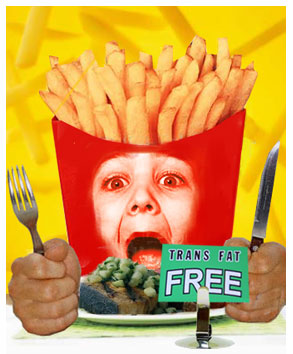
The food industry and the USDA's ballyhooed war on trans fat distracts Americans from their real problem: They eat too much of the wrong food.

  • more
    • All Share Services

Now serving no trans fat!

In the past few months, I’ve gotten sucked into the newest food fear: trans fat. The artery-hardening enemy du jour is a fat that’s now thought to be so incontrovertibly bad for you that even the notoriously laissez-faire Bush administration recently advised citizens to consume as little of the stuff as possible.

I’ve heeded the call by dutifully scrutinizing the ingredients list on every granola bar, box of crackers and jar of peanut butter in the kitchen cupboard for traces of this new public enemy No. 1 in the fat-ass American diet. And now that the cupboard’s purged of foods that include “partially hydrogenated vegetable oil” or shortening, it looks a lot barer than it did a few months ago.

Which is why I am now in crispy bliss, eating a big plate of fried squid in Tiburon. The waterfront hamlet across the Golden Gate Bridge in Marin County is the kind of community where folks longing to buy a new $10 million estate “will find everything they need,” as one local real estate agency claims. I journeyed to Tiburon because it has proclaimed itself the first “trans fat free city” in America. While most restaurants have been slow to take trans fat off the menu, all 18 restaurants in this tony town have voluntarily agreed not to use fat made with partially hydrogenated vegetable oil when they deep-fry or bake, making their town just a little bit more health-conscious than pretty much everyone else’s.

It’s a message that’s served up right in the front window of Servino Restaurant on Main Street. A green heart-shaped sign says: “We use trans fat FREE cooking oil. Ask us for a leaflet.

After I help my husband Jim polish off the 30-piece appetizer of fried Monterey calamari, I lay into a 12-inch pepperoni pizza, which supposedly serves one. Jim has four veal medallions glistening with prosciutto and fontina. For dessert we split an order of profiteroles — two baseball-size pastries stuffed with vanilla ice cream and doused in dark Godiva chocolate. Yum. And it’s trans fat free!

Earlier in the day, Jim had run 10 miles. But I had done nothing more strenuous than walk to and from the car. So by the time the check comes I’m already vowing silently to never … eat … again.

That’s the paradox of the great trans fat purge that leaves nutritionists and public-health advocates frustrated at the “zero grams trans fat”-hype now sweeping a grocery aisle near you. Sure, trans fat should go. Who doesn’t think that?

But nutritionists fear that focusing on one ingredient creates the illusion that purging it will make up for our other crimes against the waistline. Health advocates say the war on trans fat has become little more than a marketing opportunity for the major food companies to continue serving junk food with a healthy conscience. Meanwhile, with its new guidelines about avoiding trans fat, the USDA can appear to be doing the healthy thing without really causing the food companies to change their fatty ways.

“PepsiCo had full-page ads in major national newspapers saying that Doritos and Fritos are now trans fat free — 0 grams trans fat,” says Marion Nestle, professor and chair of the Department of Nutrition and Food Studies at New York University. “So they took the trans fat out. Now they’re a health food? Give me a break. It’s a calorie distractor.”

So much for my health-conscious dinner of fried squid, pepperoni pizza, vanilla ice cream and chocolate sauce.

The race is on to take the manmade trans fat out of pretty much everything we’ve put it into. The ingredient occurs naturally in dairy and meat products that come from ruminants, like cows. So, unless you go vegan, there’s no way to avoid it entirely. But most nutritionists (and the Department of Health and Human Services) aren’t as worried about the naturally occurring kind. It’s the trans fat that’s made from pumping hydrogen into vegetable oil that even the Bush Agriculture Department says everyone should avoid. The kind that McDonald’s pumps into its fries.

Today, most Americans get about 2.6 percent of their total calories per day from trans fat, according to the FDA. The new 2005 federal dietary guidelines advise Americans to “keep trans fatty acid consumption as low as possible.” That’s vague. But at a press conference announcing the new dietary regime in January, then Secretary of Health and Human Services Tommy G. Thompson said 2 grams per day is probably the “upper limit” that an adult should aim for in their diet. Even a small order of McDonald’s French fries has more than that.

Trans fat still lurks in all kinds of tasty goodies from packaged crackers, cookies and pastries to movie-theater popcorn in the form of partially hydrogenated vegetable oil. Processed-food companies are scrambling to get it out of their products before Jan. 1, 2006, when they’ll have to list the number of grams of trans fat on their labels, just like saturated fats. The lengths and expense that they’re going to achieve this — and keep the taste and consistency that customers are used to in products like packaged cookies and donuts — have been chronicled on the front page of the New York Times.

McDonald’s is taking the trans fat issue on its triple chin: The fast food giant will pay $8.5 million to settle two lawsuits that argued that the Golden Arches misled the public about the amount of the fat in its foods. McDonald’s announced it would remove the artery-clogging fat from its menu back in 2002 but then failed to do so. Apparently, it’s not that easy to make McDonald’s signature item — the French fry — without trans fat. The lawyer involved in the suits also organized the campaign to make the restaurants in his town — Tiburon — trans fat free. He famously sued Kraft about all the trans fat in Oreo cookies, a few years back, before withdrawing the suit, saying he’d made his point.

And as the jihad against trans fat spreads, health magazines are even creating shopping lists of treats that don’t have dreaded stuff. So the great trans fat purge has turned into a marketing bonanza, because even some of the junkiest junk foods can boast that they don’t have trans fat. In September 2004, Tostitos started sporting “0 grams of Trans Fat” on the front of the packaging, with Frito-Lay promising chips like Lay’s, Ruffles, Doritos, Fritos and Cheetos would soon do the same.

That’s one reason nutritionists and public-health advocates think that focusing too much on the worst fat in the American diet clouds the larger issue: getting people to eat less junk and more nutritious foods like vegetables and fruits. Simply removing trans fat from food products hardly makes them healthy. In many cases, they are still loaded with sugar, preservatives and calories. Just because Fritos or Doritos chips don’t have trans fat doesn’t mean a dietician will recommend shoveling them down with abandon.

“It’s a joke to me,” says Michele Simon, director of the Center for Informed Food Choices in Oakland, Calif. “As if taking the trans fat out of something makes it healthy. This is a typical food industry strategy. They turn it into a marketing gimmick. This is the problem with the focus on a single ingredient. The industry will just find some substitute.”

One key issue is: What will replace trans fat? To keep the texture, taste and mouth-feel that consumers are used to in their cookies and snacks, some companies may just take out the trans fat and pack on the saturated fat. “We actually might be taking a step backward if food companies are taking out trans fat and substituting in twice as much or more saturated fat,” says Dr. Penny Kris-Etherton, professor of nutrition at Penn State University, who served on the federal dietary guidelines advisory committee. “We’ve really done a lot in recent years getting people to decrease saturated fat, and I’d really hate to see the pendulum swing back there and have saturated fat increase.”

But it’s hard to see how that won’t happen. “For companies to find some kind of reasonable substitute, it’s either going to cost them, or they’re going to have to put in more saturated fat,” says Nestle from New York University.

One reason trans fat oil has been so attractive to companies has nothing to do with taste, consistency or the shelf-life it gives products. It’s very cheap. Soybeans, which trans fat is often derived from, are a heavily government-subsidized commodity. In the ’90s, the domestic soybean industry waged war on Malaysian palm oil, a major source of saturated fat. “They organized this huge campaign,” Nestle says. “Everybody took the palm oil out of their foods.” She thinks it would be “very ironic” if the campaign against trans fat brings it back.

I’d already done as much myself in the microcosm of my cupboard. When I stopped buying crackers that have trans fat, I stocked up on wheat crackers. It never occurred to me to check the saturated fat from the palm oil in those crackers, although I did note that they had a lot of calories.

R. Elaine Turner, assistant professor of nutrition at the University of Florida, sees the current interest in trans fat as part of a long cycle of getting food manufacturers to reformulate foods that doesn’t necessarily improve anyone’s overall health. When fat was the enemy 10 or 15 years ago, companies made low-fat and fat-free products. When carbs were bad, they took out sugars and carbohydrates. Now, trans fat has to go.

“We keep in this cycle rather than just cutting down on things that provide us with a lot of calories and fat and not very many nutrients,” Turner says. “Instead of eating less of those, we encourage manufacturers to reformulate those to seem more attractive, at least initially. ‘Oh, it’s fat free, it must be good for me.’ Not necessarily. ‘Oh, it’s trans free, it must be good for me.’ Not necessarily.”

It wasn’t long ago that dietitians used to recommend trans fat as a substitute for saturated fat. “We made a terrible mistake with trans fat,” says Kris-Etherton. “We thought they were good. We thought it was a good replacement for saturated fat. And it turned out to be a bad thing to do.” All the more reason that Americans need more specific guidance about what to do about it now.

And the vague new federal guideline “to keep trans fatty acid consumption as low as possible” isn’t helping. Kris-Etherton’s committee recommended that Americans be advised to limit their daily trans fat intake to less than 1 percent of overall calories. “You can see I’m frosted about this,” she says. “One percent would be success. It would make an impact. For a lot of people, they’d be decreasing intake by twofold, and with a lot of other people it would be even more.”

Nor are the new food-labeling laws models of clarity. They allow some amount of trans fat in foods that say “zero” on the label. Take the Quaker Oats Chewy Granola Bar, a snack food marketed to parents as a healthier alternative to potato chips, cookies, pretzels, donuts and even loose trail mix. Personally, I used to eat it every day until I saw the dreaded “partially hydrogenated oil” in the ingredient list, and it had to go.

In the past year, the granola has been reformulated, reducing the amount of trans fat from 1 to 1.5 grams per serving — depending on the flavor — to less than half a gram per serving. Food and Drug Administration guidelines say that if there is less than half a gram, the packaging can read zero trans fat.

However, nutritionists are not really worried about lesser levels of trans fat. “It’s a bizarre labeling quirk,” Nestle says. “If you don’t eat too much of it, it doesn’t matter much. It’s not a poison.” I guess I can put the Quaker Oats Chewy Granola bars back in my cupboard.

More troubling to Nestle is the twisted way that the fight against trans fat gives food companies something to do in the obesity epidemic that won’t interfere with their bottom line, while the American waistline only grows bigger. She maintains that in a business that depends on cheap government-subsidized staples such as corn and soybeans, the food companies are under constant pressure to get customers to stuff more and more into their mouths.

“The real root of the problem is Wall Street,” Nestle says. “You’ve got a situation in which every company is trying to grow and there’s only so much people can eat.” While valiantly working to take trans fat out of their food products — and advertise that fact — companies can look as though they’re doing their part to improve Americans’ health without cutting into profits: “In a sense, it’s a bone thrown to the food industry: Here’s something you can do to clean up your act that won’t put you out of business,” she says.

And the government neatly avoids antagonizing the food industry by never saying you shouldn’t eat what they’re selling. Imagine federal dietary standards that said, “Stop eating Big Macs, Doritos and Oreos,” Simon, of the Center for Informed Food Choices, has written. “Those are recommendations that most Americans could understand, but not ones we are likely to hear.”

I asked the owner of the Tiburon restaurant that was the scene of my delicious debauch about his decision to switch from trans fat to rice oil for frying. “When you read how bad those oils are, you worry about your own health and the health of your customers,” Angelo Servino told me. “Life is not all about profit sometimes.”

He already used olive oil for most dishes, but now he fries in rice oil, which costs more than the trans fat stuff. Americans typically eat one in five meals out at restaurants that are under no obligation to disclose what kind of grease they’re clogging their customers’ arteries with. And some 40 percent of those meals are picked up from fast-food restaurants. Servino said he hopes to set an example for other restaurants.

I couldn’t help thinking that shrinking the portion sizes might set a better example. Yet that would risk cutting into the bottom-line of food suppliers and restaurants and likely go against customers’ expectations. After all, when we were happily stuffing our faces, my husband and I didn’t say, “Um, waiter, could you bring us less chocolate, vanilla ice cream, pepperoni, veal, prosciutto and cheese?”

Pity the nutritionists, who are sounding ever more like so many Cassandras as Americans search for some easy solution — now: 0 grams trans fat! — while getting fatter and fatter. In my no trans fat dinner, I’m pretty sure I blew through my 267 daily “discretionary calories,” allotted for such niceties as cheese, sugar and alcohol in the new 2005 federal dietary guidelines, long before the dessert arrived.

Dolphins are dying to amuse us

SeaWorld and aquariums, implicated in the shocking new documentary about dolphin slaughter, "The Cove," strike back

  • more
    • All Share Services

The riveting new documentary “The Cove,” which opens in theaters nationwide Friday, exposes the annual slaughter of more than 2,000 dolphins in Taiji, Japan. The dolphins are among the more than 20,000 cetaceans, including whales and porpoises, annually killed in Japan.

In Taiji’s so-called drive fishery, fishermen in a menacing flotilla of boats herd wild dolphins, who are sensitive to noise, by banging pipes underwater. Fleeing this cacophonous wall of sound, the dolphins are corralled into a hidden cove and speared, clubbed and stabbed to death. By morning the entire cove is red with blood.

Salon film critic Andrew O’Hehir says the beautifully filmed and highly entertaining “The Cove” is “one of the most wrenching movies you’ll ever see. It raises troubling questions about how badly we have befouled the 70 percent of our planet that’s covered with water, and about why we have treated the species closest to us in intelligence with such cruelty and contempt.”

While the mass slaughter is horrific enough, “The Cove” raises another troubling question that hits closer to home. The documentary stresses that “dolphinariums” — performing dolphin shows, aquariums and swim-with-the-dolphin programs — have bought live dolphins from the Japanese fishermen, making them complicit in the marine mammal carnage.

“The Cove” has kicked spin departments at American dolphinariums into high gear. “We think we’re being unfairly criticized for something we’re opposed to, haven’t been involved with in 20 years, and when we were involved with it, it was for very good reasons,” says Fred Jacobs, a spokesperson for SeaWorld.

Adds Marilee Menard, executive director of the Alliance of Marine Mammal Parks and Aquariums, which has 50 member organizations in 10 countries, the filmmakers are “misrepresenting that the majority of zoos and aquariums with dolphins around the world are taking these animals.” The truth is not quite so simple.

According to “The Cove,” on the international market, a single live dolphin can sell for more than $150,000, while a dead one is worth only about $600 for its meat. The film argues that it’s the trade in live dolphins that creates the real economic incentive for the whole cruel hunt.

“All of these captures help create the largest slaughter of dolphins on the planet,” says activist Ric O’Barry in the film, who is the campaign director for Earth Island Institute’s Save Japan Dolphins.

O’Barry, who is the protagonist of “The Cove,” was the original dolphin trainer for “Flipper,” the hit TV show. He has spent the past several decades as an activist working to free the world’s captive dolphins. “I feel somewhat responsible because it was the ‘Flipper’ TV series that created this multibillion-dollar industry,” he says. “It created this desire to swim with them and to kiss them and hold them and hug them and love them to death, and it created all these captures.” He adds: “I spent 10 years building that industry up, and I spent the last 35 trying to tear it down.”

It’s now illegal to import a dolphin caught in Taiji, or any similar drive around the world, into the United States. “NOAA [National Oceanic and Atmospheric Administration] does not and would not issue permits to import animals from the Japanese drive fisheries. It doesn’t meet the humane collection requirement of the Marine Mammal Protection Act,” explains Tom Eagle, a fishery biologist for the National Marine Fisheries Service, which is a part of NOAA.

But that wasn’t always the case. While the Marine Mammal Protection Act was passed in the early ’70s, as recently as the ’80s, marine theme parks, including SeaWorld, aquariums and even the U.S. Navy imported dolphins captured in Japan in slaughter drives.

“There was a time in our history when we took animals from this hunt, and of course we viewed it in a defensible way; they were the only animals that were going to survive,” says Jacobs of SeaWorld. “If you could ask these animals: ‘Who wants to volunteer to go to an aquarium?’ I think that you’d have quite a few animals that would volunteer.” (In this hypothetical human-marine mammal conversation, the reply might be: “If it’s all the same to you, I’d rather just go back to the ocean, thanks.”)

In 1993, environmentalists at Earth Island Institute threatened to sue the federal government if it allowed the importation of four live Pacific false killer whales (which despite the name are actually a type of dolphin) caught in a drive in Japan. NOAA did not issue the permits, and hasn’t allowed the importation of dolphins from such barbaric captures since.

Bottlenose dolphins, like the ones made famous in “Flipper,” haven’t been captured in U.S. waters since 1989. The last capture of any live dolphin in U.S. waters was in 1993 for the Shedd Aquarium in Chicago. It’s a point that Steve Feldman, a spokesperson for the Association of Zoos and Aquariums, wants to make clear. “We don’t have these animals. We wouldn’t take these animals,” he says, adding that AZA supports a petition denouncing the dolphin killings in Taiji, which has so far collected 124,000 signatures.

So, where do the jumping, splashing, performing dolphins in the U.S. come from today? They’re mostly bred in captivity. “Over 65 percent of bottlenose dolphins in our collections right now were born there,” says Menard. What about the other 35 percent? Dolphins can live to be 30 or 40 years old, so some of those in captivity were indeed once wild. The others are their descendants.

Among the 218 zoos and aquariums that are members of the AZA, there are about 200 dolphins living in captivity. More than 75 percent of those were born in captivity, according to Feldman.

Yet every year, wild dolphins captured in Taiji continue to be sold in Japan and internationally to the captivity industry. O’Barry estimates that about two dozen live dolphins are sold from Taiji every year, with buyers including aquariums and swim-with-dolphin operations in China, Dubai, Turkey, Mexico and the Philippines. In an e-mail statement, the Japan Embassy in the United States confirmed that from Taiji, “live animals go to domestic aquariums as well as foreign ones, but we don’t have a specific number.”

Yet even in countries where dolphins captured in this cruel manner are no longer being displayed, activists argue that the industry has an obligation to do a better job policing its own. Lending support to an online petition and officially denouncing the practice is not enough.

While the World Association of Zoos and Aquariums has joined groups like the AZA in officially denouncing the Taiji drive fishery, it has not expelled its members who continue to trade in the dolphins captured there.

“Members of the World Association of Zoos and Aquariums should be taken out of that membership organization until they end the use of these drive fisheries as a source of dolphins,” says Mark Berman, associate director of Earth Island Institute. He argues that the AZA should also publicly condemn American citizens operating in other countries, who trade in the dolphins captured this way.

And aquariums and marine parks, who profit from marine mammals, could be doing more to educate their visitors about the horrors taking place in Taiji. “They could at least tell their millions of visitors that this is going on,” says O’Barry. “How can it be really educational if you don’t give them the information?”

It’s O’Barry’s conviction that no dolphin can thrive in captivity, regardless of whether it was bred there, or caught in the wild in a drive. “You’re talking about a creature that’s primary sense is sonar,” he says. “You have a sonic creature in a concrete box. There are generations of dolphins born in a concrete tank who have never seen the ocean, have never seen a live fish, and have never experienced the tides or the current. They’ve lived in a concrete box. They were born there. These are freaks that we have inbred for our amusement.”

The dolphinariums disagree. “Based on objective science, dolphins in AZA-accredited facilities are healthy, long-lived and thriving,” writes the AZA’s Feldman in an e-mail. “Not only do these dolphins receive great care, they play an important role in science-based education programs that inspire millions to care more and do more for ocean conservation.”

Whether “The Cove” will shame Japan into ending the killing of dolphins in Taiji rests on whether the Japanese people get to see the film. The Tokyo International Film Festival recently decided not to screen the film, despite the fact that the theme of this year’s festival is ecology, and rolling out a “green carpet.”

O’Barry is asking Americans to boycott dolphin shows to protest the slaughter in Japan. And in September when the dolphin drive begins in Taiji, he will return to the cove to try to bring more attention to the bloodshed. This year, he says he’ll have actor Ben Stiller in tow.

Continue Reading Close

Pregnant women hit hard by swine flu

Expectant moms may be among first eligible to receive vaccine for influenza A H1N1

  • more
    • All Share Services

The first American to die of swine flu was a 33-year-old schoolteacher named Judy Trunnell of Harlingen, TX. She died on May 5, after slipping into a coma, and giving birth to a healthy baby girl by C-section. Now, American epidemiologists are finding that Trunnell’s experience was not a tragic anomaly, since pregnant women infected with this flu appear more likely to suffer serious illness and even die from it.

Since April, the Centers for Disease Control and Prevention believe that the virus formerly known as swine flu, now called influenza A H1N1, has infected one million Americans. Of 302 deaths in the United States to date that have been attributed to this flu, the CDC has detailed information on 266 of them, according to the Associated Press. The CDC has found that 15 of the 266 were pregnant women — or about 6 percent. That doesn’t sound like that many, but pregnant women only make up about one percent of the United States population.

Expectant moms — especially those in the third trimester — are more vulnerable to the effects of influenza, because of changes that happen to the lungs and immune system that make it harder for them to shake off respiratory infections, Dr. Kevin Ault, an Emory University obstetrician told the AP. In a recent report on H1N1, the World Health Organization found that pregnant women appear to be “at increased risk for severe disease, potentially resulting in spontaneous abortion and/or death, especially during the second and third trimesters of pregnancy.”

The CDC’s advisory committee on vaccines will meet on Wednesday to decide who should receive priority in getting the vaccinations when they become available, likely in October 2009. It’s probable that health workers, who are on the front lines in treating patients with the flu will be first, but pregnant women may get bumped up to second in line.

Yet, if the H1N1 vaccine becomes available to them, will pregnant women take it? Only about 15 percent of pregnant women get vaccinated for seasonal flu, although the CDC recommends that they all should. Thanks to those unfounded fears about vaccines causing autism that just will not die, some women are concerned that the flu vaccine will harm the developing fetus.

Doctors say the vaccine actually protects both the mother and the baby-on-the-way. And when an infant is born, some of that immunity stays with them for the early vulnerable months of life. One study published in the New England Journal of Medicine in 2008 found that flu shots given to pregnant women reduced flu in infants by 63 percent.

The U.S. hopes to have 160 million doses of the H1N1 flu vaccine available in October. In the meantime, for some sensible tips on staying healthy — yes, vigorous hand washing! — click here.

Continue Reading Close

Sushi to die for

Will bluefin tuna survive our insatiable appetite for status and taste?

  • more
    • All Share Services

This environmental crisis has everything: world-renowned chefs and Hollywood celebrities in an intercontinental food fight over the fate of one of the world’s great predators, the bluefin tuna.

Pound-for-pound, bluefin is the most valuable fish in the world, prized as a delicacy at the finest sushi bars. But after decades of overfishing, this magnificent fish, which can grow to weigh three-quarters of a ton, has been so severely depleted that it swims on the brink of oblivion. Yet its prized buttery flesh is still on the menu at Nobu, the celebrated high-end sushi chain, which is co-owned by Robert De Niro, and has 24 restaurants in 13 countries.

With demand for the rare tuna showing no signs of abating, the market for it has grown more feverish. At the highest level of bluefin mania, a single fish that weighed 444 pounds was sold at auction for $174,000 in 2001. Since the tuna jackpot can be so huge, it’s no surprise that the weak regulations that exist to curb overfishing have been flouted by greedy constituents of the fishing industry, which put short-term profits over long-term sustainability.

But now conservationists, with help from Hollywood, are trying to transform bluefin from a status symbol to an environmental mark of Cain. In June, inspired by the muckraking documentary “The End of the Line,” Sting, Elle Macpherson, Alicia Silverstone, Sienna Miller and Charlize Theron signed a letter, pleading with chef Nobu Matsuhisa to stop serving the fish.

Actress Greta Scacchi and Terry Gilliam of Monty Python fame stripped naked for an ad campaign to raise awareness about the bluefin’s fate. In May, Nobu’s New York outpost, more commonly the haunt of hedge-fund managers than raging activists, was the subject of dining-room activism by Greenpeace. Picketers carried make-believe menus, advertising such endangered-species delicacies as “Rack of Mountain Gorilla Seasoned with Powdered Rhino Horn ($32.00).”

“It’s crazy for people to still be eating critically endangered species,” says John Hocevar, a marine biologist with Greenpeace, who recently spent two and half weeks on a boat off the coast of Malta, Italy, and Tunisia patrolling for illegal bluefin fishing operations. “Eating bluefin is like eating cheetah or rhino.”

Yet despite all the pressure, Nobu has refused to stop serving the fish. Under pressure from the campaigners, the restaurant has put an asterisk next to the delicacy on the menu at its London locations, advising diners that the fish is “environmentally threatened.” But Nobu is not the only bluefin offender. While some high-profile celebrity chefs, such as Jamie Oliver and Gordon Ramsey, have pledged to boycott the fish, it is still served at most high-end sushi restaurants around the world.

Many of them, including Nobu, don’t list a price on the menu, but instead say “m/p” or “market price,” depending on the cut and quality of the fish that’s available. In other words, if you have to ask, you can’t afford it.

And many restaurants that carry bluefin don’t exactly boast about it, but feature it for those in the know. In 2008, wait staff at Nobu denied serving the fish until DNA testing exposed their lie. If you’re quoted an eye-popping price for “toro” on a sushi menu, that’s likely bluefin, explains Casson Trenor, author of “Sustainable Sushi: A Guide to Saving the Oceans One Bite at a Time.” If you see the words “chutoro,” which means from the sides of the belly, or “otoro,” which means the center of the belly, that’s bluefin too.

Bluefin tuna require global cooperation to save them. The fish are truly creatures of the open oceans. Species include Pacific, Atlantic and Southern bluefins. “These are the fighter jets of the sea. They are really highly evolved to be able to swim far and fast,” says Randy Kochevar, a marine biologist at Stanford University’s Hopkins Marine Station, which runs the Tuna Research and Conservation Center with the Monterey Bay Aquarium. “They are really a global species. They cover a lot of ground.”

In a mere 18 months, one tuna tagged by biologists off the coast of San Diego swam up to Monterey, Calif., back south to San Diego, across the ocean to Japan, back to San Diego, over to Japan again, before it was caught by a fisherman. Their range makes regulating them particularly difficult, as their lifestyle takes them into international waters.

The organization that’s supposed to conserve tuna in the Atlantic is known as the International Commission for the Conservation of Atlantic Tunas. It’s an intergovernmental body that recommends how many tuna can be sustainably caught. Theoretically, it should be able to put the brakes on the fishing frenzy in, say, the Mediterranean from May to July, when the fish congregate there to breed. But ICCAT’s recommendations are so corrupted by fishing interests that ecologist Carl Safina, author of “Song for the Blue Ocean,” and president of the Blue Ocean Institute, famously nicknamed the commission the International Conspiracy to Catch All the Tuna. “The tuna commission is a complete failure,” he says.

The last time ICCAT met, in 2008, scientists suggested that the annual take be limited to between 8,000 and 15,000 metric tons. Ignoring the advice of its own scientists, ICCAT proceeded to set the limit at 22,000 tons. What’s more, fishermen are not stopping at the ICCAT recommendations. As recently as 2007, when ICCAT set the quota at 30,000 tons, scientists estimated that closer to 60,000 tons were caught, thanks to unlicensed vessels pirating tuna, and licensed vessels flouting the rules to catch more than their share.

The tuna are taking a hit. “If you take a 1,200-pound fish out of the ocean, it’s going to take a long time to replace that fish,” explains Kochevar. “As you remove the large fish from the population, you’re going to end up with a population that’s smaller in numbers and size.”

Enter the practice of bluefin ranching, where fish are caught and kept alive in ocean pens to be fattened for months until they reach sellable size. That means some of the younger fish are being taken out of circulation before they’re old enough to breed and reproduce, precipitating the decline in the ocean.

There are two distinct populations of Atlantic bluefin. One breeds in the Gulf of Mexico and the other in the Mediterranean. On this side of the Atlantic, fishermen lament that they are catching only a fraction of the tuna they did seven years ago. But according to Safina, they have only themselves to blame. For years the fishing industry fought restrictions on bluefin quotas and now they are facing the consequences. “The opposition is so weakened by their own success,” says Safina. “They got what they want, and now they’re out of business.”

The last few years have brought a flurry of bad news for the big fish of the sea. Some 90 percent of the world’s great fish, including blue marlin and Antarctic cod, have almost disappeared since the 1950s, according to a paper published in Nature in 2003 by Ransom Myers and Boris Worm. By 2048, the world’s supply of seafood will likely simply run out, Worm and other marine biologists warned in the pages of Science in 2006. As of 2008, 80 percent of the world’s fish stocks were considered either vulnerable to collapse or already collapsed.

“This is a new era that we’ve moving into,” says Gerry Leape, senior officer at the PEW Environmental Group. “We globally have assumed that there are always more fish in the sea, and it’s only been in the last decade when the peer-reviewed science has come out to show that’s not true.”

With ICCAT still in the tank for fishing interests, according to Safina, wildlife advocates are turning to international bodies that govern endangered species to save the bluefin. In March 2010, the Convention on International Trade in Endangered Species of Wild Fauna and Flora [CITES], in which 175 countries participate, will hold its next meeting in Doha, Qatar, and momentum is building to restrict trade of bluefin. President Nicolas Sarkozy of France has announced that his country will support banning trade in endangered Atlantic bluefin. Britain and Monaco have indicated that they’ll support the restrictions as well. The U.S. is considering doing so, but is still officially on the fence.

But CITES doesn’t have a great history when it comes to conserving fish. “CITES has had trouble figuring out how to list commercially caught fish species,” explains Leape. “Land animals, you can see and count them. When they get down to X number, of course there is no argument. You need to save the 200 snow leopards which are left.” Those deep, ocean-dwelling fish are harder to count. “You can count zebras, you can count trees, you can estimate numbers of fish,” says Hocevar.

In the 1990s, advocates tried to get CITES to list the west Atlantic bluefin tuna, but failed under pressure from countries that fish for it, trade in it and eat it. In 1992, Sweden proposed curtailing trade in the tuna at CITES, but the effort was squashed by Japan, where the majority of the world’s bluefin tuna is sold, and consumed. “It should have happened in 1992. That’s when it really could have saved the fish,” says Safina, who drafted the proposal to list it then. “Now they’re trying to lock the barn after the horse has been depleted.”

Locked boat barn or not, say conservationists, environmental regulations today can’t seem to keep pace with human appetites. The sushi craze that took off in the 1980s is still going strong, and bluefin tuna remain the pièce de résistance.

Continue Reading Close

Born too soon

Vicki Forman's twins weighed only a pound at birth. She thought they should be allowed to die. Doctors disagreed

  • more
    • All Share Services

Born too soonAbove: A nurse holds the foot of Milagros Pimentel, a baby girl born at 20 weeks in a Colombia hospital.

After years of trying to conceive, writer Vicki Forman’s twins were finally coming. Way too early.

Evan and Ellie were only 23 weeks gestation when Forman went into labor. They were so premature Forman thought she was having a miscarriage. At birth, each baby weighed only about a pound.

“One of life’s great illusions is the notion that we can want — and get — things on our own terms, no matter what. It’s human nature to seek pleasure and avoid suffering, but what happens when suffering finds you?” Forman writes in her harrowing new book “This Lovely Life: A Memoir of Premature Motherhood.” “My husband and I had tried for two long years to conceive these twins, had lived through miscarriages and fertility treatments to bear them. When I learned they were coming so early and so fragile, I had only one wish: to let them go.”

While Forman thought the twins should be allowed to die, their doctors struggled to save them. While Ellie lived for only four days, Evan, who endured severe disabilities including the inability to speak or see, died just shy of his eighth birthday.

“This Lovely Life” is Forman’s bracing account of becoming the mother of two super-preemies. Its drama comes not only from the relentless medical challenges that tiny Ellie and Evan faced, but also from Forman’s often conflicted emotions, as she cares for her son through his first tenuous years, navigating myriad medical crises, and becomes his greatest advocate. Yet, she feels angry and frustrated that her daughter and son were not to be among those celebrated “miracle babies” who are born terribly premature, but turn out just fine. Along the way, the book raises difficult questions about the ethics of the infertility business, as well as the rights of the parents of extremely premature children vs. the responsibilities of hospitals that treat them.

I spoke with Forman, 47, who teaches writing at the University of Southern California, by phone from her home, where she lives with her husband, Cliff, and 12-year-old daughter, Josie.

What does being born at 23 weeks gestation mean physically?

The brain is still very immature. The retinas have not developed. The lungs are not fully developed. For the most part, the rest of the fetus is fully developed, but cannot survive primarily because of the lung development. Until the advent of surfactant in the early ’90s, which is used to lubricate the lungs, babies born this early did not survive because their lungs could not provide respiration to the body.

When a baby with immature lungs respires, the lungs stick together. They can inhale, but they can’t exhale. Surfactant essentially greases the lining of the lungs so that there is more plasticity so that they don’t stick together on the inhalation.

Even a decade earlier, there is no chance that the twins would have survived?

No chance.

What was your initial reaction when the twins were born so early?

I thought I was having a miscarriage. I had had absolutely no signs that I detected as being of pre-term labor.

I was an educated person. I thought I had been trained to see the signs and symptoms, and I really knew nothing. The doctors examined me to discover that I was 7 centimeters dilated, which is effectively too far gone to stop the labor.

I was shocked and completely overwhelmed. My husband and my then 3-year-old daughter had come with me. They were there with me in the hospital in the examining room.

I knew that if the babies were to be delivered they would certainly not be able to survive. I had been informed during my pregnancy that 24 weeks was the edge of viability, so to my mind, since we had not yet reached 24 weeks, these babies would not be viable.

I felt that it was important not to intervene [to resuscitate the babies after birth], in that it would be a painful experience for them, and for me and for us as a family. It certainly felt to me that the risks of morbidity and mortality were so high that I didn’t understand why the plan was to intervene.

Why was the hospital policy in conflict with your wishes as the twins’ mother?

What I’ve come to learn is that policies regarding care in cases of extreme prematurity vary from hospital to hospital, and even, from what I’ve been able to determine, from shift to shift.

It can often be the decision of the obstetrician, or the neonatologist on duty, as to what to do in these cases. I have heard from other parents at other hospitals where they had twins born at this gestation, who were actually told that they shouldn’t resuscitate the twins. This indicates to me that there is very little consistency across hospitals at this gestation whether or not to provide care or to withhold it.

You were being told that the twins had to be resuscitated?

I was being told that I had no choice. I was told that the laws of the state of California required resuscitation because the babies would be born with signs of life. I was allowed to labor. I delivered the twins. They were both resuscitated. They were taken to the NICU [neonatal intensive care unit].

They were provided with intensive care, which included artificial ventilation and an enormous amount of drugs which are necessary to keep an infant born this early alive. Within a few days, my daughter had suffered a brain hemorrhage, and the hemorrhage was so severe that — as the doctors put it — the quality of her future life was deemed nil. They then met as a team, and allowed us to remove her from life support, which we did when she was 4 days old.

What were some of your feelings during this time?

I was deathly afraid. I had two very, very sick infants, and I had a 3-year-old who needed me at home. I firmly believed during the delivery that the twins shouldn’t be resuscitated. However, once they were born they were my children, and I began to understand that it was my job to take care of them, and to look out for them, and that if I didn’t love them, who would?

Initially, friends and even some doctors would try to arm you with stories of children who had been born this early, and turned out fine. What was that like for you?

It gave me a kind of hope, and I certainly wanted to believe the stories that they were telling me. I remember commenting to a friend, “Apparently, they can make an artificial womb, and that’s what they’re doing, and when they’re all done growing this baby, he’s going to come out of the hospital, he’s going to be OK, and it doesn’t seem to matter that they were born 16 weeks too early,” which sounds ludicrous. Of course it matters.

I wanted to believe in the stories of positive outcomes, but I also was very aware that we were facing a long road, and tried to prepare myself for being the mother of a child with disabilities.

How did your feelings change as Evan progressed and grew within the hospital setting?

I found myself with surprisingly strong protective instincts. No matter what fear I had initially about what it meant to have a baby born that early, I fell in love with my son, and it was my job to be his mother, and it was my job to learn how to be his mother, whatever those challenges might be.

What advice do you have to other parents of super-preemies?

When your child is born this early, and they’re in the hospital, it’s really not your baby. The baby somehow belongs to the doctors and the team. It’s not up to you to provide the care that that child needs.

But even given the fact that you’re not responsible for that level of care, you can become the advocate who learns and knows everything there is about this situation, and potential difficulties that you may face. I think it’s very important to stare those down, and to learn what they may be, because when you come home you need to be as prepared as possible.

When Evan finally did get out of the hospital, what problems did he face?

My son came home with 15 different diagnoses, and at least half a dozen medications that he required on a regular basis, and referrals to half a dozen specialists. Taking care of him became a full-time job, and I certainly applied myself to those duties with as much diligence as I’ve applied myself to anything in my life.

Did you feel like the risks of extreme prematurity were clear to you before you had the twins?

My husband and I did go through fertility treatments, and the multiple birth was the result of those fertility treatments. I remember in passing the doctor mentioning multiple birth as a potential “risk,” as he put it, but never mentioning prematurity or extreme prematurity as a subsequent risk.

I think that fertility doctors clearly are very focused on providing a successful pregnancy for their patients. And parents who want these children are also very focused on achieving a successful pregnancy. It’s not a story that one wants to hear. I don’t know if someone had told me that this was possible that I would have even been prepared to listen. But it is a reality, and it does happen.

I’m not a statistician, but we’re seeing more fertility treatments, which result in more multiple births. And multiple births carry a much higher risk of prematurity — that’s a fact.

As you were going through the initial months of your son’s life, how did your friends and family react?

It was unpredictable. The people who I thought would be by our side and understand weren’t always the people who were able to know what to do. This experience affects an entire family and circle of friends in ways that you can’t describe, and some friends were very supportive, and some friends were overwhelmed, and really didn’t know how to handle it.

I think that it’s a very challenging experience. I think it’s hard on everyone. It’s hard on family, and it’s hard on friends. I don’t think that people are equipped always to know what to do or say.

What advice do you have family and friends?

I think that the best advice is to maintain contact, and to simply say: “What can I do?” And if the answer is “nothing,” then keep calling and say: “What can I do? Is there anything I can do?”

The hardest part for me during this entire experience when Evan and Ellie were born, during those years of his chronic illness, was just feeling alone. I think it’s really important for parents not to feel alone. So, whatever a family member or friend can do to make that person feel less alone that’s the thing that is going to make the difference. Not the right words.

Is it because you are so consumed with your child’s care that you feel alone? Or, because you didn’t have contact with other parents who were going through the same thing?

I think that it has more to do with the trauma of the experience. I think that anyone who has gone through trauma will say: “I can’t explain this. No one understands this.” It’s just the typical reaction to trauma. The people who make you feel less alone are the people with whom you share that trauma.

Do you think that the parents should have the ultimate say about intervening to save an extremely premature child’s life? Or that hospitals should just be more clear about their policies upfront?

I think that the parents should have the final decision, and I think that that decision needs to be informed by some honest facts about outcome. It’s a terrible decision, but it really has to be for the people who are going to be living with their children, and caring for them for the rest of their lives. Those are the people who have the right to make the decision ultimately.

What do you mean by the honest facts about outcome?

Ninety percent of babies born about Evan and Ellie’s gestational age have permanent disabilities of some kind. I knew that, because I had done my research, and I said that during the delivery, and I think the doctor was trying to convince me that wasn’t true.

A lot of people would not know that, and then hear the stories about the 24-weeker who is just fine, and go home very unprepared. There are a range of permanent disabilities — learning disabilities, blindness — but these are lifelong disabilities, and that is the reality.

What were some of the disabilities that your son had?

My son was blind. He did walk eventually at the age of 5, but he was very obviously developmentally delayed in terms of his walking. He was nonverbal. He did not really eat. He came home with a permanent feeding tube. For several years, we fed him solely through that feeding tube. Eventually he did learn to drink a little, and take a little bit by mouth, but he was never going to eat hamburgers and hot dogs.

He had very low muscle tone, which made it hard for him to achieve any kind of developmental milestones. He didn’t smile until he was 9 months old, which most parents would know is very delayed.

But you came to see not only in these clinical terms, because he was your son, and you could experience his joy as well.

I did. He taught me how to see his life as a real life. I’m grateful that I was able to learn that lesson.

After he was out of the initial extreme crises, do you feel like he had good quality of life?

Absolutely. He was loved. He was cared for. He was happy.

At what point were you able to feel like you weren’t in a constant state of emergency when it came to his health?

Every time he got sick I was in a renewed state of emergency. It was relentless from the time he was born until about the time he was 3 years old.

The first two years were especially difficult. We were seeing doctors all the time, he was sick all the time. He was on medication. He remained on oxygen. We had a lot of medical supplies in the house. My dad came to visit me, and he said: “You’ve got your own little ICU here,” and he was right.

But after about 2 years, gradually we’d find ourselves with a little less to worry about. And by the time he was 3 he was no longer fragile or chronically ill.

How did your son’s condition impact his older sister?

My daughter from the time Evan came home until many years later would want to play these games that I thought were just sort of normal play, and now looking back I see that she was really working a lot out. We would play the patient game. She would hook me up to machines, as she called them, using yarn, and then I would have tubing. And then she would give me shots.

She certainly missed her sister. She thought she was going to have a sister, and she doesn’t. I think also she was afraid. When something like this happens, a child automatically worries that it could happen to them. I did what I could to be present for her, while also being very aware that her life had changed in a significant way, and there was nothing I could do about that.

How did this experience affect your marriage?

My husband and I would find new things to fight about. Like any marriage, we had had our ups and downs, we’re very solid, and we’re still solid, but I think that this experience puts such a strain on a marriage, and there is no avoiding that strain.

Eighty percent of couples with disabled children divorce, and we knew that statistic. We worked hard. We still work hard. And we certainly had to solve problems in our marriage that many people do not have to solve, such as where do we bury our child? Or, I don’t feel like taking him to the 15th doctor’s appointment this week, can you do it? Those kinds of negotiations were certainly far more intense than most people have to make in a marriage, but we’ve made them, and so we’re lucky.

Initially, you blamed yourself for the twins’ extreme prematurity. Why do you think you did that? And how did that change over time?

I think as mothers we feel very omnipotent, and very responsible, as though we’re supposed to somehow make everything go well. And in my case I had not been able to do that, so I felt responsible. A lot of people tried to explain to me that it wasn’t my fault.

But I still felt as thought I should have known, and I should have been able to prevent it. Finally, I understood that I had to stop blaming myself, and accept what happened, and that it wasn’t my responsibility. That is humbling, because the other side of the belief in your omnipotence is the realization that maybe you’re not in charge.

What were your experiences like with doctors who treated your son?

I think that we were left behind by doctors who felt that a normal outcome was a child who could see and talk and walk. And that we did not have that. It took me a long time to understand that there were some doctors who were going to walk away and say: “That one didn’t work out.”

But that there would also be some doctors who would say: “Look at him. Look at what he’s doing. This is amazing,” and feel like that was more important.

What was your son’s life like from ages 3 to 8?

When my son was 3, like most children with disabilities, he entered special education. He went to a very small, public special ed classroom, preschool. He had devoted teachers and therapists who saw him through so many personal challenges.

He had a lot of really big successes. He learned how to walk. He did learn how to feed himself a little bit. He was happy. He loved his friends. He laughed.

Kids in preschool have to stand up and put their little name on the felt board and say: “I’m here.” And he would stand up, and put his name up. Then he had this assistive technology, a button he could push that said, “I’m here.” And he would laugh, and think that was just so great.

How did Evan ultimately die, and why?

On the morning of his death, my son woke up happy and playful. He had been experiencing some discomfort that we weren’t able to really problem solve, because he was nonverbal.

But by noon, he had developed an acute abdominal obstruction, and by 2 the next morning he had died, due to organ failure essentially brought on by this obstruction. It was shocking and tragic and utterly unexpected.

As we later learned, the obstruction actually dated back to the surgery that he had had to place his permanent feeding tube. So, in effect, my son died from complications from his prematurity.

How do you feel you were changed by having the twins?

I think that I understand better now that you can feel more than one way at a time about something. We live in this very either-or culture. Either it’s a miracle or we’re a success, or we’re somehow a failure, and we’re not a miracle.

But in my own experience, I could want not to resuscitate my twins, and I could love them. I could be my son’s mother, and I could understand how to be the parent of a disabled child, and I could feel joy again. For me, it’s just been very eye-opening to see that you can feel both ways, and there is sorrow in the joy. I learned how to hear not loss but life.

———-

Do you have experience raising or caring for a child with a disability? Share your stories on Open Salon – click here for more details.

Continue Reading Close

New York Times crazy with puppy love!

Why is one of the most powerful women in American journalism writing about her dog?

  • more
    • All Share Services

The most emailed story on the New York Times Web site right now is the debut of Jill Abramson’s new weekly series called “The Puppy Diaries,” about the first year of her new pooch’s life. Abramson is the Times managing editor for news, who can more typically be found fielding questions from readers on such weighty matters as the state of investigative journalism and Times’ coverage of the Israeli-Palestinian conflict.

Let’s just say the Puppy Diaries is a departure for Abramson. “She arrived almost housebroken, a wonderful surprise,” the Times editor writes. “Somehow I had forgotten how much having a new puppy is like having a new baby. It’s not only the made-up games, the hide-and-seek and stuffed animals. There is the special puppy smell, much like the distinctive scent, better than perfume, of a new baby’s head.” Yes, there is a super cute Flickr photostream of the pooch and Abramson, too.

In sum, one of the most powerful women in American journalism is now simultaneously on the news desk and on the chew-toy beat. Cognitive dissonance, anyone? As Salon’s editor-in-chief Joan Walsh tweeted yesterday: “I like Jill Abramson. I love my puppy Sadie. Is it just me, or is the idea of NYT female ME blogging about new puppy off somehow?”

While the New York Times, like every other newspaper, struggles to find a new business model in the digital age, it must be great to have a puppy-loving hit on their hands. And I am certainly sympathetic to the tremendous devotion that pets inspire. Hey, maybe giving readers’ a more intimate view of the lives of the editors who run the Grey Lady suits the new Web-tastic journalism world, too.

Still, what’s next? Times executive editor Bill Keller’s weekly ruminations on the vagaries of his home remodel. Somehow, I highly doubt it.

What do Broadsheet readers think?

Continue Reading Close

Page 1 of 142 in Katharine Mieszkowski