
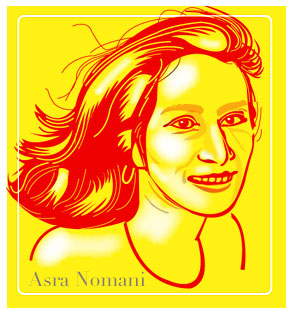

In her new book “Standing Alone in Mecca: An American Woman’s Struggle for the Soul of Islam,” Asra Nomani, formerly a reporter for the Wall Street Journal and an international correspondent for Salon, embarks on a demanding spiritual and physical quest to make peace with her Islamic identity and her place as a woman within the faith. Joined by three generations of her family — including her newborn son, Shibli — she journeys to Mecca to complete the hajj, the great pilgrimage required of all Muslims once in their lives.
Though Saudi Arabia is controlled by strict, Wahhabist clerics, Nomani encounters unexpected liberties in Mecca. The sheer number of people who attempt the hajj — more than 2.5 million each year — makes it difficult to enforce many of the restrictions that normally impinge on Muslim women’s freedom. At the Masjid al Haram, the most sacred mosque in Islam, Nomani walks proudly through the main doors beside her father — an act she realizes would be forbidden in her hometown mosque, where segregation between men and women is strictly enforced. And though she fears for her safety as an unwed mother in a country where zina, or illegal sex, is punishable by death, she’s surprised to encounter a supportive and complex spiritual community of pilgrims.
Buoyed by the kindness of her companions and inspired by examples of strong and daring Muslim women from the history of Islam, Nomani returns to America determined to address the inequities and abuse many women suffer at the hands of repressive fundamentalist theologians. She even takes the battle to her own backyard, challenging the leaders of her local mosque by refusing to submit to segregated prayer services and bigoted sermons. What begins as a simple act of personal protest ignites firestorm of dissent and controversy, and earns her both ire and admiration from the global Muslim community.
This month, Nomani launches the Muslim Women’s Freedom Tour, which will take her across the country in a campaign for religious equity and personal justice for women in Muslim communities around the nation and the world. She spoke with Salon by phone from her West Virginia home about her hopes for the future of Islam, her anger over the murder of her friend and colleague, journalist Daniel Pearl, and how it feels to be put on trial by her own mosque.
Your life has been full of dualities: You grew up a practicing Muslim in a largely white middle-class West Virginia town, and while you profess devotion to family and the traditions of Islam, you chose a very independent and unconventional life as journalist and a single mother. How do you think those dualities have shaped your identity?
I think that I had to cross boundaries — even physical boundaries — from the earliest age, and I ultimately had to cross a lot of the psychological boundaries that usually serve as a box around our identities. I was always feeling out of sorts when I was a kid. I never felt like I had found a real home in the place I was living. When I first moved to New Jersey [from India] when I was 4, I didn’t even speak English. So I think I was always an observer of reality, and ultimately I became an observer of my own reality, which eventually led me to journalism and writing. Writing helped me reconcile a lot of the contradictions in my life, because it meant I would actually take note of them. And traversing that world made me recognize that you can really be anything you want to be.
Before you decided to go on the hajj, you traveled through Asia as a journalist reporting on Buddhist pilgrimages, and you even wrote a book on the Hindu erotic philosophy, tantra. Have you always found yourself drawn to stories about faith?
I think from my earliest days I’ve wondered about spirituality and all of the questions that plague mankind and humanity about God and truth and goodness. I see it in my journals from when I was young, where I wondered about the conflicts in culture that I was seeing between Islam and the West. I was always trying to make sense of the world, and I think that was why as an adult when I finally got a paycheck and could travel freely, that’s what I chose to do — to physically travel where my mind had been taking me.
While covering the war in Afghanistan for Salon, you fell in love with a Pakistani man and became pregnant with his child while still unmarried — an act that branded you a criminal in the opinion of many Muslims. How did you reconcile your decision to keep your child with your religious upbringing?
My parents loved me so fully when I couldn’t even love myself. I spent my pregnancy curled up in despair, and I lived with the shame of it like a noose around my neck. I felt so lonely; I had been fighting for my relationship so I could be the nuclear family I thought I was supposed to be. But my parents never gave me a hard time. They were the ones who let it go — they didn’t want to see me destroyed. It was through the compassion and the love that they showed me that I was actually able to be kind to myself.
But it seems like becoming a mother really made you aware of your own spirituality. Did you feel it was a catalyst?
What I write about in the book is the moment when I first see my son; I was in this haze of anesthesia, from an emergency C-section, and nothing had worked out like I’d planned. I did not have a husband beside me, and I wasn’t even awake when my baby emerged into the world. I was giving birth in Morgantown, to a West Virginia hillbilly, right? But when my baby was in my arms, I realized that I was touched by heaven. He was the closest I was ever going to get to heaven on this earth, and I saw that all of the anguish and all of the pain had just evaporated. And he had not absorbed any of it — despite every psychiatric study I’d read during my pregnancy that said that a mother in crisis is going to have a troubled baby. He was so perfect, and that was really when I just chose to be happy and to be free. I had gone so deep into despair that I knew that the alternative was just going to be a miserable childhood for my son.
So when my son, Shibli, arrived, I thought, “This is my choice. He’s given me a new chance.” And I did not cry. I thought that I was the prime candidate for postpartum depression. I thought that I was going to be on drugs as soon as he was free from my womb. I didn’t think that I would breast-feed him, just because of all the chemicals that would be running through me to keep me medicated. But I didn’t have to go on any drugs in order to stay balanced and happy and healthy. I simply made a choice.
How did that change of heart influence your decision to make the journey to Mecca?
Well, you are supposed to return from Mecca newborn. Mecca is supposed to wipe away all the sins, all the darkness of your life. I don’t judge myself — I leave that to others and the greater forces in this world — but I knew that I wanted a new start, that I had to have a new start. I felt a great responsibility over my son having chosen me to be his mother. I’ve had my crisis in faith as woman in Islam, but I always had a deep, deep belief in the spiritual and the divine. And the fact that Shibli chose me to be his mother, when he could have chosen so many women who would have given him the two-parent household, and none of the issues of religion and society and culture — but he chose me. And I got courage from that.
You learned you were pregnant the same week Daniel Pearl went missing in Karachi. Did your friendship with him — and then his murder — play a role in pushing you toward doing the hajj?
When Danny came to my house [in Karachi] on Jan. 22, 2002, I was just trying to go on the hajj. I thought that I was just going to go as a journalist for Outside magazine and report it as a really cool trip. I was going to try to camp out under the stars and ride a camel to Mecca. But when I had to confront the evil that is practiced in the name of Islam, I knew I had to go to Mecca to actually figure my religion out. I knew I had to go there to figure out whether there was a place for me in my faith.
I couldn’t believe it when the investigators told us that Danny’s captors had prayed the mandatory five-times-a-day prayer while they plotted his kidnapping. The prayers are supposed to be the litmus test of a good Muslim, and I certainly didn’t pass them. I realized that I was so different from these men who claimed to be great Muslims. I would never hurt a fly; I believe what the Buddhists teach — that a fly could be an incarnated ancestor. And I’ve always tried to live honestly and with kindness. Just having known the beauty of Danny, it was in such stark contrast to the darkness that these men were perpetuating in the name of Islam.
I knew him as a human being and a friend — I even read every single one of his e-mails, trying to find clues to his kidnapping, and I don’t think many people can say that they don’t have dark moments in their e-mails. But he didn’t gossip, he didn’t trash people, he didn’t talk bad behind people’s backs. And he was joyful, and I know that what was driving him as a journalist was the desire to make the world a better place. So the fact that people could completely twist Islam, to kill him because he was a Jew, was to me, so unconscionable. When I returned to Morgantown, I was just so angry. Everyone claims that Islam is a peaceful religion, but I had to find out if there was truth to that. The hajj literally represents a journey to the most sacred place in Islam, and I had to see if that place really was sacred.
In your book you also allude to the fact that the growing power of right-wing, fanatical Islam is just one version of the dilemma faced by countries around the world — including the U.S. — where moderates are being challenged by the extremist political voices. What message do you hope to impart to your non-Muslim readers?
This is book written by a woman in Islam, but it is a book meant for people of all faiths and all genders, because in each one of our lives we are all challenged by forces that are trying to preach intolerance, extremism, and even hate. What we’re facing in Islam manifests itself in so many forms in this world, and basically my book is a call to action to all people to stand up within our faiths and our cultures and our societies against intolerance. And the stakes are so high, because the demonization of any people just feeds the cycle of violence in this world. My book is a testimony to my efforts within my faith, but we each have all of these challenges. In American society, and British society, in the West and the East, in Islam and Christianity and Judaism and Hinduism, even Buddhism, people are trying to denigrate our earth for power, control and ego, and we can’t let it happen.
As we speak now, you are under trial at your local mosque — a mosque your family helped found — because you refused to accept the rule that women enter through a back door and pray in a secluded balcony.
Yes, my father helped found the mosque here in Morgantown, but I am still sitting on trial to be banned.
What about your experience on the hajj made you initiate that protest once you got back home?
It really hit me hard when the police investigators in Pakistan told me and Mariane [Pearl] that the kidnappers had used a mosque in Karachi as a drop-off point for the pictures that the world saw of Danny with a gun to his head and shackles around his wrists. That really affected me because I realized that the mosque has become a safe house for absurdity. I really and sincerely went up to the front doors of my mosque thinking that I could be a part of my community. I had just chosen, as I wrote in the book, to raise my son a Muslim, and it seemed like the perfect opportunity to really practice what I had promised I would do, by giving back to the community. A new mosque had opened. It was much bigger, and I just knew they had much more space to share with the women than the dinky little mosque they had been using for years. And I had enjoyed such rights on the hajj that I didn’t have at home.
I was wondering about that. In the book, you really make it seem like such a contrast.
I didn’t even know it was going to be a contrast. I just expected that all of the rights that I enjoyed on the hajj in Mecca were going to filter through to the rest of the Muslim world. I knew from traveling through India and Pakistan that women are not welcome in mosques, but I just really believed that it would be different in America. After all, all of the leaders of my mosque were professors, and physicians and Ph.D. candidates. So when I walked up to the front, I was really stunned when the board president yelled at me and told me to take the back door. I was so horrified, I felt so violated and angry, and it stirred up a lot of pain that I had just put aside, being a marginalized member of the Muslim community. Growing up, I never felt like I belonged because women were always in the kitchen or in a corner, and while my parents encouraged me to be successful and strong, there was no place for my kind of woman in my Muslim community.
Both your decision to make the trip to Mecca and your protest at your local mosque put not only yourself but also your young son and extended family squarely in harm’s way. How are you able to justify the risks you have taken?
That’s a really good question. I think I have been so confident in the righteousness of tolerance and equity that I’ve just believed that harm could not come our way. Even under threat, one night when one of the members of the mosque lunged at my father and called him an idiot, I was trembling inside, but still returned, because at the end of the day I believe they are so wrong. And I know that the dark side has slain many great people in world history, and I’ve tried not to be naive about any of the risks. Basically, Danny trusted the men who kidnapped him, and I came back from Karachi with serious trust issues.
But I guess I also know that intimidation is part of the cycle of social change. When I came back from the hajj and became a volunteer at the rape and domestic violence shelter, I studied what women go through when they confront their abuser, and I know that isolation and intimidation and emotional abuse are part of the consequences of challenging power and control. I’ve never taken it personally, though it has hurt a lot. I just pray that good will win and keep us all safe.
How has your family responded to the experience?
My parents are so resilient, and they are the ones who have always encouraged me. They never advised me to cave in to fear. Even when I was in Karachi, it was a risk and a danger to stay and keep searching for Danny. We were under virtual house arrest, even though it was supposedly the command center. We were surrounded by police and we couldn’t even walk outside without armed guards. I walk into the mosque in Morgantown with my phone always charged, ready to call 911 if I need to. I don’t know how far people will go to protect the status quo, but I know they have gone to great lengths to resist change.
Now we’re doing this woman-led prayer, and I am shocked, but not surprised (if you can be both at one time) by the reaction from folks who oppose a woman leading prayer — something that has not happened since the Prophet was alive in the seventh century. People are using every form of intimidation that they possibly can, from theological intimidation, to threats about what will happen to us in the hereafter. And I say to these folks, “Don’t be a part of this change if you don’t want to, if you don’t believe in it. But allow people to coexist with you in a peaceful way with different points of view.” I just have to read what the civil rights leaders and suffragists had to go through to know that change doesn’t come easily, but it does eventually happen.
Your story went from being a personal journey to being a public, social movement. I wonder now that you’ve reached that other threshold, what kind of response you are receiving from the wider Muslim community? You must be getting some very supportive responses as well as threats.
It’s amazing the hunger in the Muslim world for leadership that will actually represent the real principles of Islam. September 11th changed the face of our generation, and the next generation, and the generation after, and put a lot of responsibility on Muslims, which I have taken. At the beginning, the reason why I wrote about this from a personal perspective was that I couldn’t find women who were willing to really stand up and testify with a strong voice to the inequities they were facing, so I wrote about my own experience. Since then, though, I see that it is really just the tip of the iceberg — so many women and so many men are fed up with the iniquities that betray Islam, so we’re coming together. And we’re doing it for love of the faith, not anything else.
What is so amazing is that the community that has come together around this — over the Internet and long-distance phone calls — is so wide, and we are all just hungry for a community that is loving and kind. We joke that we want to take the “slam” out of Islam — that’s our American generation’s way of understanding it. But it’s really that simple; we’re just so tired of going to our mosques and feeling unworthy or worthless or less than faithful. It said in the Koran, “There is no compulsion in religion,” and yet the fanatics in all religions want to make it compulsory that you follow their path of faith.
Our guiding principle is that religion isn’t meant to destroy people; it’s supposed to uplift people. We anger the fundamentalists who think that there is an algebraic formula to faith, because we believe in a much more creative and inspired recipe for happiness. That is the choice that I made in those first moments when I saw Shibli for the first time, and I remain committed to it because I know that the alternative is what the wife of the man who killed Danny faces. Her husband chose destruction, and at the end of the day I don’t ever want to live that life, I don’t ever want to feel responsible for destroying another person or allow my religion to be used to do that.
The March 18 woman-led prayer, is that part of the Muslim Women’s Freedom Tour that you launched this month?
Yes. On March 1, the start of Women’s History Month, I began the Muslim Women’s Freedom Tour by posting a message titled “The 99 Precepts for Opening Hearts, Minds, and Doors” on the door to my mosque. I attached to it a bill of rights for women in the mosque and a bill of rights for women in the bedroom, and we are going to assert those rights in New York on March 18.
Basically, the men in my religion have certainly made a mess of things, and we want to go from the back rows to the front rows — we want to go from the back of the mosque to the front of the mosque. We believe that we are fulfilling Islam’s teachings that men and women are spiritual equals — and we don’t have to just sit deaf, dumb and blind in the mosque and the community while Osama bin Laden defines our religion for the world. The exciting thing is that we are actually reaching back to the seventh century for a model of the community that we should be building now. The seventh century Muslim community had a place of value and worth for women, and that’s what we’re trying to reclaim.
Considering your past as a journalist, and now your present as an advocate, do you think there is a way for you to go forward and do both? Because the two are not necessarily complementary.
I struggled with the question of how I was going to maintain my trained objectivity as a journalist in a cause where I definitely had an opinion, but then I just looked back to history. I saw that basically the battle against slavery was won by the pamphleteering of folks who wrote about emancipation. Basically, like most journalists, I got into the field to make the world a better place. I can’t think of any way to better use the skills that I’ve gotten as a truth-teller than to bring about some sort of fairness and equity and inclusion in the world. I think when I really reflect on it, I became a solid journalist, I think, because of the principles that my parents taught me as a Muslim; integrity and ethics are vital to being a journalist. So I simply want the same principles to be practiced in my Muslim world, because I’ve seen the alternative.
Sometimes people say that I’m impatient, I speak too loudly. But here in Morgantown, at the college newspaper that I worked on, I grew up with the saying that “little good is accomplished without controversy.” I think the two are mutually compatible, and maybe the only thing I am missing is a law degree. I play with that idea because at the end of the day, I believe that the law is so critical in bringing about social change. But, even lawyers have told me that public discourse and truth-telling have to come first. I could never have predicted this for my life, but I feel like I have been training all my life for this moment.
