
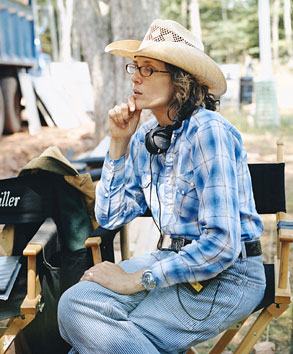
“I warn you, I really don’t want to talk about my father,” said Rebecca Miller, sitting down across from me at a Manhattan restaurant. It was a rickety start to our interview, which trailed directly after one she’d done with “Fresh Air’s” Terry Gross. Gross had apparently put Miller, the writer and director of the new film “The Ballad of Jack and Rose,” in an uncomfortable Vulcan mind-meld on the subject of her dad, the playwright Arthur Miller, who passed away in February.
A brunette who is beautiful in a thin, pre-Raphaelite way, Miller appeared slightly menacing; her eyes focused on mine like a suspicious housecat who would rather scratch a proffered hand than sniff it. I assured Miller that we didn’t need to talk about her father, yet.
But she wasn’t done. “It’s just that A, that’s really not why anyone would go to see a movie,” she said with exasperation, “and B, I resent it when someone hasn’t thought about a thing enough that they can talk to someone about the thing they’re supposed to talk about.” Miller gave a pointed so don’t fuck with me or I’ll tell the next reporter how unprepared you were laugh and managed to un-puff herself enough to order a tomato juice.
Miller, 42, is one of those almost comically hyphenated professionals, though the painter-actress-screenwriter-novelist-director does tend to wear only two of her hats at one time — three if you count the time she adapted and directed her second film, the 2002 Sundance Grand Jury winner “Personal Velocity,” from her own novel. At least her varied vocations obscure her also being a multi-hyphenate celebrity relation: the daughter of Arthur Miller and his wife of 40 years, the late photographer Inge Morath, and the wife of actor Daniel Day-Lewis.
Day-Lewis stars in “The Ballad of Jack and Rose” as Jack Slavin, a terminally ill father who has raised his 16-year-old daughter Rose (Camilla Belle) alone on an abandoned island commune. As he prepares to die, Jack invites his girlfriend (Catherine Keener) and her sons to move into his and Rose’s utopia, and Rose’s jealous devotion to Jack becomes fierce, dangerous and, yes, downright incestuous.
Miller was born in 1962, the year her father’s second wife, Marilyn Monroe, died. Her parents had met on the set of Monroe’s last film, the Arthur Miller-penned “Misfits,” where Morath was a still photographer and he was in the final throes of his marriage. The family lived in Roxbury, Conn., in what Miller said was “then real country” — though it was also home to artists like her parents and sculptor Alexander Calder. “I remember the bulldozers as they made their ineluctable advance across the landscape,” she said. “I would weep, really cry, when I saw a house go up.”
Some of that grief is reborn on-screen in Jack Slavin, a rigid conservationist, though Miller said her interest in commune life came from memories of her half-brother, 16 years her senior, who “experienced the ’60s in a very total way.” When she was a child, Miller visited her brother on the commune where he lived, and “idealized that way of life.” She noted that while she pulled her inspiration for Jack from the leftist radicalism of the 1960s, she’s not sure that she hasn’t created a very conservative hero. “You have people who are radical Christians, all the way on the other side, who [like Jack] don’t want their children to have contact with the outside world,” she said.
Miller’s ever evolving career began with a voracious childhood appetite for the written word. She remembered being assigned “Moby Dick” when she was 11 while the rest of the class read “Little Women.” “I was really turned on by it in every way,” she said of the Melville novel. “It’s a story an 11-year-old kid would be interested in. It’s not like [the teacher] gave me ‘The Golden Bowl’ or something.” Miller said she was later influenced by Russian writers — Dostoyevsky and Tolstoy and Gogol — because “there’s something about their sensibility that I find close to my own. They clearly capture rapidly fluctuating emotion in a beautiful way.” During a post-college stint as an actress — she had parts in “Regarding Henry” and “Mrs. Parker and the Vicious Circle” — she toured in Peter Brook’s 1988 production of “The Cherry Orchard,” and she thinks that if a viewer were looking for Chekhov in her new film, they might find it. “There’s a sort of lightness to the sadness,” she said.
Miller majored in painting at Yale and exhibited her work after graduation. “Painting was a wonderful job for me,” she said. “It was very physical and quiet and contemplative.” But, she said, “the part of me that’s a story-teller wasn’t satisfied.” So she started making movies, though oddly, they did not tell stories. Her early cinematic projects were “totally non-narrative, based on my dreams, very idiosyncratic; they were on loops and I showed them embedded in the wall or in triptychs.” The lasting influence of this period — when Miller was merging painting with film — is evident in the films she’s making now: “Personal Velocity” contains lengthy montages of still photos, and “Jack and Rose” opens with a spiraling shot of a flower.
Miller likes her films to surprise viewers, to “get under people’s skins.” When I told her that I found the relationship between Jack and Rose repellent in part because the chemistry between 46-year-old Day-Lewis and 16-year-old Camilla Belle was so strong that it was easy to root for the father and daughter characters to get it on, she said, “That’s exactly what [the movie] is supposed to do. You’re invited to lose your balance.”
Despite the disconcertingly surreal effects of her work, Miller said she is much more tethered to reality now that she’s a mother. “Dreams and art, that was my life,” she said of her younger self. “I was interested in reverie. I wasn’t needed by anyone.” Giving birth, she said, catapulted her back to this planet. “I think that I became more earthy, less ethereal. Because it was all about blood and flesh and reality.” Plus, she said, “the expectation of being needed is ultimately extremely satisfying.”
Miller claimed that she had recently heard there were fewer female film directors than there were women in any other profession, including “welding and science.” Her identity as a woman has often eclipsed her identity as a professional, she said: “Just once I’d like to be invited to be on a panel with a man on it. I wish there could be some acknowledgment that women are part of the larger tradition of filmmaking and not ghettoized all the time.” Miller routinely works with a group of women she described as being “like sisters” to her, including cinematographer Ellen Kuras, producer Lemore Syvan, casting director Cindy Tolan and editor Sabine Hoffman. “I guess having them around makes me understand better why men hire men,” she said. “It’s just easier with your own sex; you understand each other better.” But, she was clear, “I like working with men. My production designer Mark Ricker is a man. I would be open to having a man cut one of my films.”
“The Ballad of Jack and Rose” marks the first time that Miller has ever worked with her husband, though she first sent him an early draft of the script 10 years ago, before they’d ever met.
“I sent him the script thinking he was the right man to play Jack,” said Miller, who has gone through 33 drafts of “Jack and Rose” in the decade since she began it. “I thought he was the best actor who existed, and Daniel has something that makes people side with him,” she said, explaining that the power to move the audience to empathy was crucial for such a combustible character. But back in 1995, he turned her down. “He wrote me this very sweet note explaining that at that moment he was not ready to experience everything he would need to experience to play Jack.” The character, full of terminal illness, guilt about the way he’s raised his daughter, obsession with the land, a violent streak, and possibly incestuous feelings for his offspring, does seem like an awful lot to sign up for.
Day-Lewis subsequently saw Miller’s first feature, “Angela.” He also starred in the 1996 film version of Arthur Miller’s “The Crucible,” during which he met the playwright’s daughter in person. Day-Lewis, son of British poet laureate Cecil Day-Lewis and actress Jill Balcon, had a pedigree about as impressive as Miller’s. He had previously dated Julia Roberts and had a son in 1996 with Isabelle Adjani. Miller described her pre Day-Lewis romantic life as “pretty checkered” and claimed that she had suffered from a marriage phobia. “If I put a ring on my ring finger, my finger would hurt,” she said of her single days. But when she met Day-Lewis, in her early 30s, she had “lived a lot,” and said she felt more comfortable committing to partnership. The two were married within a few months of meeting. Now married for eight years, they raise their sons Ronin, 6, and Cashel, 3, in Ireland and New York, where Ronin is enrolled in school.
After the couple had their children, they spent a year in Florence, where Day-Lewis turned away from acting for a time and went to work as a cobbler, and Miller published her novel, “Personal Velocity” (named a Washington Post best book of 2001), and made the subsequent movie, which earned her not only plaudits but also the freedom to make whatever she wanted — “within reason” — next. So she returned to “Jack and Rose” and told her husband that he was still her first choice for the lead. Miller said Day-Lewis considered it for a long time before agreeing. “Daniel’s not really capable of doing anything simply as a favor,” she explained.
Miller said the dynamics of their professional collaboration were, “easy, really. He was open and receptive and we quickly fell into step and respected each other’s domains.” Miller bristled when I asked about the power dynamics of directing her husband. “I think Daniel would accept the fact that I’m figuring out how to shoot a scene,” she said shortly. She also said she doesn’t coach performances. “I expect people to be the people when they arrive,” she said, “not to create the performances on set. And Daniel arrives on set so filled up. I never got a sense of resistance.”
“Look,” she continued, still rankled by my power question, “directors have a certain job and actors have a certain job. It’s very hard to define what a director does because it involves stuff like what color are the pillows, and the shot list. On the other hand, the director is doing something more ineffable, which is creating an atmosphere where an actor can do his best work. It’s this contract of trust; I think it would be very weird to feel a power imbalance. I try to stay away from the concept of power. That doesn’t mean I’m a pushover. But there has to be a gentleness, because you want to make everyone want to do their best work, not just the actors but the sound engineer.”
“It’s not that I’m always pleasant,” said Miller. “But I try not to be unjust or randomly petulant.”
This reminded me of how I needed to get back to a nagging question that involved her father. I went for it: As a woman who is known as the daughter of a famous man and the wife of a famous man, was it not a provocative decision to make a movie about an incestuous relationship between a father and a daughter and cast her husband as the father?
Miller’s first reaction was to remind me, “It’s not an incestuous relationship; there are overtones of incest.” Then she paused and nodded. “Yes, it is probably provocative.” She gave a little laugh and continued, “Daniel and I had conversations about it before we did it. At one point he said, ‘Are you out of your mind? Why would we put ourselves through something like this?'”
But Miller liked the thrill of the creative gamble. “It seemed like a big risk, and something about that seemed right. It’s a tiny accent on the film that makes it even more true.” Wait, does that “tiny accent” mean that she intended for all the inevitable my husband, my father, my husband, my father stuff to weave itself into the film?
“Not really, no,” said Miller, acknowledging that 16-year-old Rose “has parts of me: the ruthlessness and purity that a lot of girls that age have. She’s a little bit scary and beautiful as she comes into consciousness about the power she has as a young woman.” Indeed, Rose is scary as she tries to kill the woman sleeping with her father several times. As for her relationship to her own parents, Miller said only, “I was very close to both of them.”
At the end of “Jack and Rose,” Rose lives out some of her father’s dreams in her own adulthood. I asked Miller about her next project, which is adapting her father’s 1944 play, “The Man Who Had All the Luck,” for the screen. It was a play that closed four days after its Broadway opening. Is Miller redeeming his work in some way? She looked slightly uncomfortable, and sad; it has, after all, been less than two months since Arthur Miller’s death. “First of all, I’m adapting it, not directing it,” she said. “And I did it so I could spend some time with him and have some conversations with him. Now I’ll finish it because I said I would.”
As for how her own story relates to Rose’s, Miller said that she thinks the standard American ending for her film would have had the young heroine simply driving off, the implication being that getting away from the scene of one’s youth is enough. But Miller said, “That’s just not true. Whether we like it or not, we are connected to our parents, to their parents before them. We are part of a chain of human beings; we don’t create ourselves. The idea that we can make a total break is an illusion. I think we all find that on some level we’re continuing their work.”
And does she mind that her identity will always be inextricably linked to the identities of those who came before her and to whom she is married?
“I don’t ever think about that,” said Miller. “I’m only aware of it because other people bring it up.” Here she smiled at me, the person who just brought it up. The smile is a kind one. “It’s just my life,” she said. “I love who I love and I’m related to who I’m related to.”
