
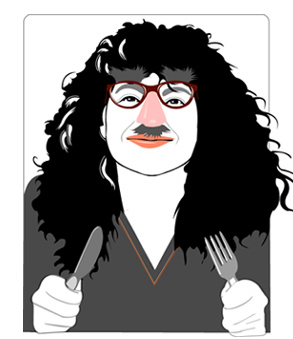

I walk into Cafe Gray, a swank restaurant in the Time-Warner Center in Manhattan, at 6 p.m., dressed in jeans, tank top and cheap-but-stylish coat, my hair extremely frizzy. “Do you have a reservation?” I’m asked at the door. I stutter, realizing that I have not thought to make one. The hostess’s eyebrows lift as I hesitate. Then, taking a guess that my drinks date, as editor of Gourmet and a food critic for over 20 years, will have considered this situation, I say, “It might be under Reichl. R-E-I …”
“Oh, of course!” says the hostess, practically jumping at me. “She’s not here yet.” I’m led to a perfect corner table where a young waitress immediately arrives and asks me if I’m comfortable. I am. She hovers for a moment, then begins stuttering: “Of course we know who Ms. Reichl is.” Great! I reply. “So I’ll lead her directly to the table when she gets here.” Thanks! There is a pause. “Do you need anything else before she gets here?” Nope. The waitress has just disappeared when a waiter descends, bringing me water in a silver water-bottle-carrying device. “If you need anything, my name is Giovanni,” he says, bowing slightly.
It’s good to eat with Ruth Reichl. In fact, it is the kind of attention I’m getting — so out of proportion to the way that “civilian” diners are usually treated — that forced Ruth Reichl into multiple disguises when she was New York Times restaurant critic from 1993-99. The experience of her transformations are at the core of “Garlic and Sapphires,” a new memoir about her tenure at the Times.
When Reichl arrives, she is hard to miss. First, there is her trademark nimbus of black curls. Then there is the bright chinois-style top she’s wearing — it’s hot pink, orange and red. And then there’s the cluster of wait staff, tripping over themselves in an effort to lead her to me. As soon as she sits down, a waitress tells us that chef Gray Kunz, whose 1990s restaurant Lespinasse makes an appearance (and receives four stars) in “Garlic and Sapphires,” wants to present us with some food on the house.
I ask Reichl if this sort of treatment happens at every restaurant she frequents.
“Yeah, it does,” she says, a what-can-I-do expression on her face. But now that she’s not responsible for evaluating the dining experience objectively, she says, “It’s really fun.” Reichl does not go out to eat much anymore; one of the reasons she left the Times was that she wanted more time to have dinners at home with her family in the evenings, rather than heading out to the city’s priciest troughs every night. This week, however, her husband, Michael, is playing golf in Phoenix while their 16-year-old son, Nick, is on a school trip in China, leaving Reichl free to drink and dine like a single woman. “I would guess that I haven’t met anyone for drinks in four years,” she says with a laugh.
Reichl has the kind of face for which the term “ear-to-ear grin” was coined; she smiles constantly, and it splits her strong features in half. With her prodigious mane and colorful ensemble, she looks very Berkeley, Calif., very Upper West Side. Which is appropriate, since the Upper West Side is where she now lives, and Berkeley is where she came into her own personally and professionally, after a childhood in Manhattan’s Greenwich Village, boarding school in Montreal and college at the University Michigan.
“Garlic and Sapphires” is Reichl’s third memoir. The first two, “Tender at the Bone” and “Comfort Me With Apples,” deal with the relationships between food and love, families, sex, politics and identity. Reichl grew up with a mother who routinely poisoned guests by serving rotten food (earning her the nickname “the Queen of Mold”) and suffered from severe manic depression. She moved to Berkeley after college, where she lived in a millet-heavy commune with her first husband and became an unlikely restaurant critic, driving to restaurants that had valet-parking service in a Volvo that she started with a screwdriver in the ignition. Reichl befriended chefs like Alice Waters and Wolfgang Puck, who would go on to transform the American culinary scene over the decades Reichl spent writing about it. Eventually divorcing her first husband and marrying television news producer Michael Singer, Reichl became restaurant critic and food editor at the L.A. Times for nine years, until she joined the staff of the New York Times in 1993.
That’s where “Garlic and Sapphires” picks up, and on its surface, it’s much more a professional story than her first two memoirs, beginning with the call summoning her to the Times and ending with one inviting her to Gourmet. The book is about an institution, the New York Times, but also about the transformations — both physical and emotional — that Reichl made in order to succeed there.
At the heart of “Garlic and Sapphires” are her disguises, which she begins to employ upon learning that her photo is tacked up in the kitchen of every restaurant in New York. When Reichl donned a costume, she went whole-hog, developing finely honed characters — complete with their own credit cards and personal histories — for her undercover dining. “Molly,” Reichl’s first alter ego, is a former English teacher from Michigan with short brown hair and dowdy Armani suits who visits New York a few times a year with her strip-mall magnate husband. When Reichl becomes Molly, the Midwesterner’s demeanor exerts itself over Reichl’s New York brass so powerfully that she doesn’t balk when she’s given a bad table at Le Cirque or when a wine list is ripped from her hands and handed to a man three tables down. Later, when Reichl returns to Le Cirque with a Times editor who is recognized, the dining experience (down to the size of the raspberries on their desserts) improves radically. The gulf between the different kinds of treatment inspires Reichl to write a now-famous review of Le Cirque, in which she contrasts her meals as an unknown diner with her forays as a most favored patron.
Over a glass of 2003 Gruner Veltliner, Reichl says that she cared so much about this chasm of experience because in her mind, restaurants — even very expensive ones — are economic levelers. “One of the things I really love about restaurants is that in many ways they are the ultimate democratic institutions,” she said, “where you get to walk in the door, plunk down your money, and for however long that you’re there you can be anyone you want to be. It’s like a contract that we have. One of the big reasons people go out to eat is to have that experience of being glamorous and wealthy. When restaurants violate that contract, it really annoys me.” In “Garlic and Sapphires,” during a fancy meal at which Reichl is dressed as tweedy, bitter divorcee “Emily,” she is so struck by a young couple who have clearly saved up for an expensive, celebratory meal, only to be disappointed by food and service, that she breaks her character and picks up their tab. “You know, if you’re a young couple, and you save for years to go out to eat, you deserve that magic moment,” she says. If restaurants cheat you of it, she continues, “It’s just not right.”
As a result of these convictions, Reichl spends a huge amount of time turning herself from hard-to-miss to difficult-to-spot. In addition to Molly and Emily, she becomes “Betty,” a lonely, invisible woman who Reichl says “flew so far below the radar” in status-conscious New York restaurants that her dismal treatment inspires Reichl to write a piece called “Why I Disapprove of What I Do.” Then there’s “Chloe,” a red-taloned interior decorator whose husband has left her, and “Brenda,” a funky redhead who is equally comfortable going to Japanese chain restaurant Benihana with young Nick as she is kibitzing with fellow diners at four-star Daniel. It’s not that all of Reichl’s characters are economically disadvantaged, but few of them look or behave as though they are rich, important or particularly sophisticated — the signposts that can lead wait and kitchen staff to treat a patron right.
Much of “Garlic and Sapphires” is about class. In the pantheon of Times food critics, Reichl is known as one of the strongest democratizing forces. She made a point of reviewing Japanese, Korean, Indian and Chinese restaurants rather than simply the old French granddaddies of midtown. She wrote about how much meals cost in addition to how they tasted, and at least at the beginning of her reign, traveled to the outer boroughs, though she says that Times readers didn’t want to read about dining in Queens, “and after all, you’re there to serve the reader.”
As a former commune dweller, does Reichl still experience doubts about the exorbitant price of some food? “I have had a lot of ambivalence about it all my life,” she says. “Now I have more ambivalence about it than ever before.” Reichl says she sees an ever-shrinking middle in the American culinary spectrum, with Wal-Mart on one end, Whole Foods on the other. “If you’re a rich person, you could spend your whole life eating vegetables that had never been touched by pesticides, eating animals that had never been inside a factory, eating all the pristine and wonderful organic foods that I’m thrilled about,” says Reichl. “If you’re a poor person you’re pretty much relegated to overprocessed junk, factory animals and pesticide-laden vegetables.”
At the same time, says Reichl, “Masa is one of my favorite restaurants in the world.” She points at the wall of Cafe Gray, indicating the neighboring sushi restaurant that costs around $500 a head. “It’s an extraordinary experience and I’m thrilled that it’s there and I would gladly give up four meals in lesser restaurants to eat one meal there.” She pauses. “On the other hand, when I put down my $500 for a meal, it worries me.” Reichl says that she has eaten at Masa twice, once with her son on his birthday, and once with her editor Ann Godoff, who was so moved by her meal that she “burst into tears.” Seeing Godoff’s reaction “I thought, ‘How could anyone say this is too expensive?'” Reichl says, especially in an atmosphere where people don’t think nearly as hard about throwing $500 at a car or a watch or even a pair of shoes.
It’s these kinds of questions and contradictions that have always obsessed Reichl — and have allowed her to carve her life into not one but three long books. As a critic, she was never a hatchet woman, always a true enthusiast — literally happy just to be sitting at the table. “My friends will tell you that every time I go into a restaurant I say, ‘Oh, this is going to be great!'” she says ruefully. “And it’s really got to not be great before I’m willing to say it’s not. I went into every place with great optimism.” She believes in the cheerleading school of criticism in part because “one of the best roles a critic can have is to help people appreciate what they’re going to experience more than they would without your review,” in the way that good film, art or dance critics can.
Her enthusiasm, combined with her far-flung taste and willingness to criticize august Gotham institutions on behalf of the proletariat, earned Reichl some enemies at the Times. In the book, she recounts a kerfuffle with her predecessor Bryan Miller that played out in the New York Post’s Page Six gossip column. It’s clear that Reichl has an enormous amount of affection for the Gray Lady, but that she harbored misgivings both about its preeminence and about her role there. “I loved being at the Times and they were incredibly good to me,” she says now. “I think it’s a wonderful paper and I was really well edited.” Reichl pauses briefly. “I do think that one of the problems with the Times is its institutional sense of its own importance. Everybody there really believes that it’s the best paper and that if they do [a story], it must be right. I don’t think that’s good for any institution or any person. I think a little self-doubt is very helpful.”
Though she writes about many of her colleagues with love and respect, her impulse to deflate egos does seep into her writing, from the first phone call she receives from Warren Hoge, who introduces himself as assistant managing editor of the New York Times. “He proclaimed it proudly, as if faint trumpets were sounding off in the background,” writes Reichl. I ask her if she’s worried about how her former colleagues will receive the book, and she becomes very quiet. “Of course I’m worried about it,” she says shortly. “Yeah. Yeah, I’m worried.”
Reichl says that unlike some of her predecessors — such as Miller — who found it difficult to return to civilian life after having been food critic, she experienced no regret when she left her post. In part it was because her new job, running Gourmet, kept her too busy to miss being a critic anymore. “I was 50 years old and I didn’t have a clue about how to do the job,” says Reichl of her initiation at Gourmet. “I think it’s hard, when you’re someone who likes to please people, as I am, to be a boss. I had to learn how to rein myself in and not terrify people.”
Speaking of terrifying, one of the most powerful moments in “Garlic and Sapphires” comes when Reichl disguises herself as her mother, Miriam, a woman whose mercurial presence loomed large over the first two books. Miriam passed away in the years between “Comfort Me With Apples” and “Garlic and Sapphires.” But she is brought back to life as her daughter dons not only her mother’s old jewelry but her personality. This, Reichl now says, was its own kind of catharsis. After the first two books, in which Miriam was read as a maternal nightmare, Reichl says this “was my chance to show what was great about my mother. She was a life-force, and a wonderful person. A wonderful person with emotional problems, yes. But when she was on top of it, she took care of things; she made you feel safe.”
But Reichl insists that the disguise was just that: a disguise. And that she has not found herself, as so many daughters do, turning into her mother at home. “Not at all,” she says with certainty. The exception is that every morning she gets up early and squeezes fresh orange juice for her husband and son, as Miriam used to do. “I figured if I’m going to be like my mother in any way, it should be a good way,” she says, taking a bite of the spiced ground lamb that has been presented to us, along with scallops marinated in grapeseed oil, sesame-seasoned chicken, and foie gras sandwiches.
“Wow, this one is really delicious,” she says, a smile of satisfaction on her face.
