
Business

Scam I am

Management consulting is a giant fraud! OK, we knew that. But what Martin Kihn reveals in his entertaining new book is just what miserable lives these know-nothing "experts" lead.

  • more
    • All Share Services

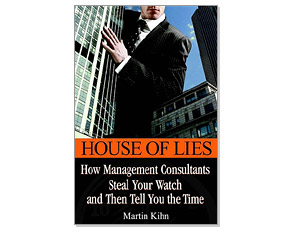
Scam I am

“Business books are boring,” Martin Kihn writes early in “House of Lies,” a book that, the inside flap informs us, the Library of Congress catalogs as a business book. But no matter; irony is Kihn’s mitier. So let’s let him continue the thought: “Business books are boring. They are bloated compendiums of half-baked ideas committed in fourth grade prose. Their purpose is to transform a commonsense concept or two into a consulting career through the catalyst of hollow jargon.”

With this inauguration, Martin Kihn sets out to write the anti-business book business book. In Kihn’s view, corporate America isn’t the gleaming place you’ll find in business strategy classics like “Built to Last” and “Reengineering the Corporation.” The common-sense concept Kihn wants to convey regarding American corporate culture is that it has no common sense; in “House of Lies” business culture is arbitrary, illogical and humorless, and it’s dominated by a set of leaders whose abiding talent is shameless trickery. These leaders are called management consultants. If you work for an American corporation of any respectable size, you’ve likely heard of them, though you can be forgiven for not knowing exactly what it is these people do. What they do is not quite clear to anyone, not even, it turns out, to the consultants themselves; how the business world suffers under their dominion is unknown, though it’s obvious that the consultants themselves suffer untold indignities. We know this because Martin Kihn tells us so, and he knows it because several years ago, more or less accidentally, in the way that Gregor Samsa once woke up as a cockroach, Martin Kihn became a management consultant. Now, here, he’s spilling his guts.

Kihn has good reason to be angry at business books. It was a business book, he suggests, that introduced him to the idea of management consulting, and therefore kind of ruined his life. Once upon a time, Kihn was a normal, likable fellow. At Yale, he wanted to be a poet. He loved the ballet. He married a musician. He wrote for Spy and GQ — clever dispatches on Harold Bloom, Hal Hartley and David Byrne. Then he got a gig in TV, an improbably successful run as head writer on the seminal 1990s VH1 show “Pop-Up Video,” where he was called upon to slap snarky bits of trivia onto popular videos of the day. This life — the ballet, the wife, the job in TV — doesn’t sound half bad. Nice as it was, though, Kihn, like the rest of us, wanted more money. And one day, after picking up a business book by a management consultant identified here only as “The Rainmaker,” a book that was so simply written it surprised him that it “could be sold in the grown-ups’ section,” Kihn hit upon an idea for cashing in. He would quit TV. He would go to business school. He would become a management consultant. How hard could it be?

Harder, and more bizarre, it turns out, than anything he’d ever imagined. “House of Lies” is being marketed as an exposé of the management consulting industry — a tome designed, press materials included with the book say, to bring down the “mysterious and powerful people in America.” In one sense, it lives up to that billing. Kihn does show that the whole business of management consulting is a charade in which neither the consultants nor the businesses who hire them profit from the arrangement. But Kihn knows that attacking management consultants for being superfluous is too easy a trick, like pointing out that Michael Jackson is weird, or that Maureen Dowd’s columns are often loopy; we already know this. That’s why he declares in his prologue that he doesn’t really want to write an exposé — instead, it’s a cautionary tale. The real story here focuses on the damnable daily life of the modern management consultant.

Kihn’s breezy, Jay McInerney-inspired writing style renders this drudgery precisely, often hilariously. It’s the natural condition for corporate workers to hate management consultants. In the popular culture they’re seen as arrogant, effete Ivy League SOBs who’ve never worked a day on an assembly line but who still want to tell the old-timers what to do, or whom to fire. The thing is, though, they probably work more hours than you, their jobs are likely more difficult than yours, and they’ve got to put up with more annoying people than you do, too. They get more money, but not that much more. At first, “House of Lies” seems to set out to make us hate management consultants; its subtitle is “How Management Consultants Steal Your Watch and Then Tell You the Time.” But don’t be surprised if Kihn’s book inspires pity, if not respect, for these guys; they’re a sorry bunch, and maybe it’s time we were all a little nicer to them.

“To be a management consultant is to be always on the defensive,” Kihn writes. Everyone’s always asking the consultant who died and made him the expert. “What do you know about my business?” clients ask. And those taunts are “nothing compared to the utter, irredeemable, unknowing cruelty of one’s parents, siblings, and friends when they ask — as they always do — quite coolly but not without a certain challenge to their tone: So, what do you actually do?

“This is a wickedly difficult question,” Kihn writes, “one that cannot, in truth, be answered.” This seems like a cop-out at first, but as we move through the book it begins to ring true; in Kihn’s narrative, there is ever less purpose to the consultants’ existence. Consultants aren’t hired for their expertise, Kihn points out. Nor are they hired for their ability to make strategic business decisions, or to offer recommendations to a firm that anyone will be expected to act upon. That’s because, of course, consultants don’t have much specialized knowledge in many of their clients’ industries — and so, for instance, because they don’t know tires, they don’t attempt to offer any specialized knowledge on tires, and any advice they offer will be ignored, because, well, they don’t know what they’re talking about. Consultants are often hired to search through and organize massive amounts of corporate data, but Kihn gives no indication that consultants are any good at such labor-intensive tasks. In the instances he describes, the consultants certainly don’t succeed.

Kihn ultimately suggests in a moment of epiphany that the real reason firms hire consultants is stunningly simple, and ridiculous: It makes companies feel good. For the most part, it turns out, companies using consultants aren’t doing all that badly (if they were, they couldn’t afford the consultants). Firms that solicit the services of consultants are actually some of the biggest, richest corporations in the world, and they’d do fine without extra help. So why do they hire them? Because they can, Kihn says — because consultants, like limos and fancy office parties, are a luxury, and companies like to indulge in luxuries. In Kihn’s telling, consultants are like extremely well-educated corporate call girls. The clients don’t care to listen to what consultants have to say; they just want to see them go through the motions.

Consulting, like prostitution, is one of those careers one chooses out of desperation; business students don’t want to be consultants, but when they’re done with their MBAs they pick up consulting as a short-term gig, something they think of as an easy way to pay off their student loans. In business school consulting looks glamorous — the tragedy, Kihn says, is that the kids have no idea what they’re getting into.

Though “House of Lies” is exceedingly smart and funny, over a couple hundred pages it also turns unsettling, depressing and tragic. The book is penned in the second-person (“I will not use that pronoun again,” the book begins), a technique that brings the action close, smashing your face tight against the ugly goings-on. Kihn isn’t saying, after all, that he attended Columbia business school after getting rejected by Harvard, and then joined an unnamed “top-tier consulting firm” after getting rejected by McKinsey (the topmost-tier consulting firm), and that, in the week after he started working at this firm, the dot-com crash roiled the business world and he watched the entire consulting industry implode in a haze of jargon and lies and incompetence. Kihn’s story is that all this happened to you — this could have been your awful life. Anyone is at risk.

Consulting is like prostitution in another way, too — it’s a surprisingly physically taxing exercise. Every Monday morning, the consultant departs for his client’s far-off plant. He remains there, working day and night, with bad food, little sleep and no friends, until Thursday afternoon. So consuming is this nomadic routine that for the consultant travel arrangements become a constant obsession. “There is no topic of conversation more galvanizing, powerful, and useful among groups of top-tier management consultants than the accoutrements of travel — hotel facilities, American v. United, Hertz v. Avis …” To the consultant these things take on the quality of a religion; in an ever-shifting world, national airlines and chain hotels are all that sustain them.

Well, actually, that’s not all — they also have jargon, which Kihn points out is of an altogether different sort than that of most other professionals. Doctors or lawyers use inside words to exclude outsiders, while consultants’ jargon “must exclude without being unapproachable,” he says. Consultants’ language “must function along very slender dimensions,” Kihn writes, “creating a patina of authority while also seeming quite clearly to say something to the listener …” Kihn draws up a dozen-page-long glossary of consultant jargon, many of whose words and phrases perform this double duty, excluding while not seeming exclusionary (“blue sky” for “brainstorm,” or “bio break” for defecation).

But jargon is a poor substitute for actual language — for talking, for fighting, for laughing, crying — and such human expressions are nowhere to be found in the consulting world. Management consulting as Kihn describes it is in the end a chilling, lifeless pursuit, in which “unsolicited opinions are a one-way ticket to a counsel out,” which is jargon for the pink slip. “Sacking is the payment for clear points of view … No war talk, peace talk, tax talk, or talk show talk. No blather about Ireland, North Korea, southern Canada. No moments when frustration escalates, the rage appears upon the surface of your blood and you thwack! the team room table — say, ‘What an ASSHOLE!’ No. No assholes. No whats. No frustration, escalation, genetics … no rage.”

Given the difficult lives consultants lead, and the dubious payoff for all of their efforts, you’d think someone in the American business community would have wised up already. You’d think consulting would be on the wane. But it’s not. Though the industry shrinks during recessions, during boom time there’s always more work for high-priced, useless outside advisors. The situation underscores the latent absurdity of the American corporate world. Business people, especially successful business people at huge corporations, are thought of as rational, serious, logical people. “House of Lies” shows you that business, like much of the rest of life, is ultimately a silly enterprise. All royalty needs court jesters; for the kings and queens of American business, consultants are necessary comic relief.

States shush corporate critics

From factory farms to home foreclosures, state governments are helping hide corporate wrongdoing

  • more
    • All Share Services

States shush corporate criticsWorkers at the Perdue Farms Inc. processing plant prepare cleaned and gutted chickens for packaging at the plant in Accomac, Va. (Credit: AP/J. Scott Applewhite)

You can’t be outraged by — or fight back against — what you don’t know. At least that seems to be the theory behind a spate of new government-backed efforts to help corporations prevent inconvenient information from ever reaching the public domain. In states across the country, as in Washington, D.C., lawmakers are helping companies keep secrets in everything from factory farming to fossil fuel exploration to home foreclosures.

In five states, for instance, so-called Ag Gag laws are now on the books. Iowa just passed legislation that “criminalizes investigative journalists and animal protection advocates who take entry-level jobs at factory farms in order to document the rampant food safety and animal welfare abuses within,” according to the Atlantic’s Cody Carlson.

The impetus for such laws is obvious: After a series of damning videos of factory farms abusing animals, Big Ag faced a consumer backlash. But rather than make its facilities more humane, it has opted to spend its cash on lobbyists and court cases aimed at preventing the public from ever seeing the atrocities in the first place. Accomplishing that means pioneering new legal theories that threaten to set dangerous new precedents curtailing some of the most basic First Amendment freedoms we take for granted.

Over in the world of energy, it’s much the same thing. Last month in Pennsylvania, the oil and gas industry successfully lobbied state legislators to ban physicians from telling patients what toxic fracking chemicals they may have been exposed to. As Mother Jones’ Kate Sheppard reports, “While companies must disclose the identity and amount of any chemicals used in fracking fluids to any health professional that requests that information … the new bill requires those health professionals to sign a confidentiality agreement stating that they will not disclose that information to anyone else — not even the person they’re trying to treat.”

At least doctors in Pennsylvania get to see some basic information about the industry’s toxic brew, which is more than health professionals in other states have been able to say in recent years. Indeed, in 2008, an emergency room nurse nearly died after being exposed to a company’s fracking chemicals and, according to High Country News, the company cited a trade secrets law in “refus(ing) to provide more specific information (about the chemicals) to the hospital once she fell ill.” That left her “intensive-care doctor to guess what to do as he tried to keep her alive.” This possibility still exists in states that still do not fully mandate disclosure of fracking chemicals.

In the housing sector, you probably assume you at least have a right to see relevant documents related to your imminent home foreclosure. After all, with that basic information, you might stand a chance of going to court and preventing a bank from illegally throwing you out of your home. Yet, if you live in Colorado, your assumption about being able to see such information would be wrong.

With details of the financial industry’s document shredding and robo-signing scandals still leaking out, the Denver Post reports that Republicans in the Legislature there voted down a bill simply “requiring that lenders prove their right to foreclose on a home.” That means Colorado remains the only state to “allow for a foreclosure without the lender first proving” it has the legal right to repossess a person’s domicile. With the GOP so successfully defeating the reform proposal in the face of public outrage at bank fraud, look for the financial industry to try to get state governments to set the same “no doc foreclosure” precedent all over the country.

Then there are corporate taxes, perhaps the most egregious area in which the government uses its power to shield politically significant information. As the Institute on Taxation and Economic Policy reports, “neither the SEC nor most state governments require corporations to release detailed information on their state corporate tax payments” — which deliberately makes it “hard to identify which corporations are not paying their fair share at the state level.” At the federal level, after corporate tax disclosure laws made it onto the books in the 19th and early 20th centuries, they were removed. Bloomberg News notes that the Financial Accounting Standards Board has the power to “make the income-tax returns of all companies with shares traded on U.S. stock markets available to the public,” but that it has refused — even in the wake of reports proving that many of the most profitable corporations are now paying no tax at all in America’s loophole-ridden tax system. The result is that the government empowers corporate management to prevent both companies’ shareholder-owners and the public at large from ever evaluating a firm’s tax compliance — or lack thereof.

Each of these examples — and the many others like them — are closely related to the concurrent corporate efforts to prevent labeling mandates. And as disparate as such examples may seem, they each prove that 21st-century capitalism and old-school Orwellian control are not polar opposites, as they are often portrayed. On the contrary, those two political forces now often coexist in a symbiotic relationship — one that uses state power to keep politically charged information hidden. The theory beneath the calculation is simple: Public ignorance equals corporate bliss.

With protest movements rising and the possibility of widespread social unrest a real possibility, we should expect that calculation to be more prevalent in our politics than ever.

Continue Reading Close
David Sirota

David Sirota is a best-selling author of the new book "Back to Our Future: How the 1980s Explain the World We Live In Now." He hosts the morning show on AM760 in Colorado. E-mail him at ds@davidsirota.com, follow him on Twitter @davidsirota or visit his website at www.davidsirota.com.

AT&T agrees to drop bid for T-Mobile

Government objections put an end to planned $39 billion acquisition

  • more
    • All Share Services

LOS ANGELES (AP) — AT&T Inc. said Monday that it is ending its $39 billion bid to buy T-Mobile USA after facing fierce government objections.

The cellphone giant said that the actions of the government to block the deal do not change the challenges of the wireless phone industry, which it says requires more airwaves, known as spectrum, to expand.

The deal would have solved that problem for a time, and without it, “customers will be harmed and needed investment will be stifled,” AT&T said in a statement.

It called on the government to quickly approve its purchase of unused spectrum from Qualcomm Inc. and come up with legislation to meet the nation’s long-term needs.

AT&T, the nation’s second-largest wireless carrier behind Verizon Wireless, faces paying Deutsche Telekom $3 billion in cash and may have to enter into a roaming agreement with Deutsche Telekom, while transferring it the rights to spectrum it doesn’t need for the rollout of its planned, next-generation “4G” network.

AT&T’s purchase of T-Mobile from Deutsche Telekom of Germany would have made it the largest cellphone company in the U.S. T-Mobile is currently the fourth-largest.

The Justice Department sued to block the merger on Aug. 31, saying it would reduce competition and lead to higher prices.

Last month, the companies withdrew their application to the Federal Communications Commission after its chairman also opposed the deal.

Continue Reading Close

I hired the wrong person and she turned on me

She's gone now, thank God, but I can't get her out of my head

  • more
    • All Share Services

I hired the wrong person and she turned on me (Credit: Zach Trenholm/Salon)

Dear Cary,

Three years ago, I hired what I thought to be a talented, kind and honest second in command at the magazine where I work. It turns out, I was only one-third right. While “Sally” was great at many parts of her job, she wasn’t honest and she wasn’t nice. She began sleeping with another person in my department (my work equal), and was dishonest about it, and would often say, “The art department feels this would work better this way,” when our entire organization knew these people were a couple. She’d undermine me at meetings with higher-ups, criticizing my ideas and interrupting me, and in meetings with me one-on-one, she’d burst into tears at the slightest disagreement or say, with a stern little look, “We’ll just agree to disagree.” It made any sort of discussion darn near impossible.

She also puffed herself up constantly — “I was mistaken for a model yesterday!” and made digs at me and other people at work, “Well, that’s not MY taste. But, interesting!”

I was trying to figure out how to fire her when she took another, more lucrative job in another field. The guy at my office dumped her shortly before this happened. But sadly, even though it’s been a year, I’m still haunted by the experience. I feel like I let myself be steamrolled by an “All About Eve” clone, and I dread running into her at events in my relatively small professional circle.

I honestly believe she’s a pretty lousy person, and I wish her ill. But I check her Twitter feed, and, honestly, am a little obsessed with hating her. How can I move beyond this, or, better yet, make sure other people in my industry know she is evil?

The Bad Boss

Dear Bad Boss,

I know how hard these things can be. I am a champion grudge-carrier myself.

I could go into business carrying grudges. I could get a truck with a magnetic sign: No Grudge Too Small. Bulk Rates. Tired of carrying that grudge? Call 1-800-GRUDGE-KING.

Would it make you the most miserable man on earth, carrying all those grudges for others? Or would it be liberating, knowing that not one of them is yours?

Anyway, some of us are champion grudge-carriers and we need a way to let go of a grudge. If we don’t deal with it, it can last for years.

So what we do in the 12 steps, we do inventories. You could look that up. We work with a sponsor. We’ll say, I can’t stop thinking about this person who screwed me over. And the sponsor will say, Well, let’s do the steps on this. Or, have you done the steps on this? Or, what step are you on?

Doing the steps gets you focused on you, not the person you’re obsessing about.

In doing the steps, we write things down. We answer questions like, what happened, and who was involved, and what sort of injury or threat did we perceive? What area of life was affected? Was it our sex relations, our self-esteem, our status?

We just more or less dispassionately look at what happened. We break it down. We also ask what role we played. This is not done in a blaming way. We just, for instance, say, well, the role we played was, we made the decision to hire her. OK. The great part about that is it puts us in the mix and gives us a sense of agency. We’re not a victim, we’re a participant. We see, OK, we did have a decision and we did play a part. We might have made a different decision. Likewise with the other events, we just identify what part we played. It may be that all we did was choose to go to a party. But we realize then, though it may have seemed like we  had to do what we did, we see  that maybe we could have avoided the upset. Not that it’s our fault, but that we were present and played a part in it.

It reminds me a little bit of how one proceeds in cognitive therapy. What I like about cognitive therapy and the 12 steps is that they lead us increasingly toward reality. We are always asking what is real, what is concrete, what can we see?

Then we often find that our response had something to do with fear. We see that we were trying to prevent something from harming us.

As we continue in this way, dissecting the event, we begin to see that in an existential sense we can’t protect ourselves anyway. We are vulnerable. We may be disliked or disrespected by co-workers or family members. We may be cheated on or deceived. There are no guarantees. We cannot control other people. Meditating on this returns us to the real world; it restores a correct relationship to the awesome powers of life and death that surround us; it fills us with appropriate awe for nature and fate; it unites us with other creatures living and dead; it humbles us and returns us to the bosom of humanity.

This notion of letting go of control is a sticky one, because it involves beginning to trust in something outside ourselves, and often we have been adamantly self-sufficient. But to get out of our awful predicament we focus on something beyond ourselves. We place trust in something larger than us.

It’s not like we get converted or saved or ascend to a higher state of consciousness. It’s more subtle. We entertain the notion of something bigger than us, and it shifts our focus away from ourselves, away from our vexing, all-consuming fear. We see that the world is awesomely powerful and if it wanted to strike us down it would have done so already. So we relax a little. If it’s coming, it’s coming. Don’t sweat the small stuff.

Once you entertain that notion that maybe you are not the one in control, then you do not need to respond to every possible threat with a flanking maneuver and a public relations campaign. Some things you can just let go of.

You are able to entertain the notion that maybe it’s not about the other person. Maybe it’s about you.

So you work with a sponsor and the sponsor suggests you do a fourth step, or a tenth step, or maybe the sponsor just talks with you about this obsession you have. But somehow you work through it by working through it. You have a method. That’s the point. The 12 steps offer a method, a simple, concrete method of purging ourselves of worry, doubt and fear.

If you’re not an alcoholic or drug addict and don’t have an eating disorder or a sex addiction you can always go to Al-Anon.

It’s just helpful to have a group. The Al-Anon group is all about how we deal with problems associated with other people — how the behavior of other people affects us, and how we learn to separate our problems from other people’s problems.

Really, I suggest you check out Al-Anon. You can get some grounding in the 12 steps, and you can hear personal stories from people who are coping with similar situations.

Plus it’s sort of fun. Really. Once you get over the initial novelty of it it becomes fun.

If you don’t want to do the steps, you can certainly get into therapy. I’m all for therapy. But therapy costs money and its efficacy depends on the intelligence and talent of the therapist. The 12 steps are pretty much free, and they work.

So that’s my approach to dealing with grudges.

But I still like the idea of the grudge-carrying truck.

I bet I could make some money.

Continue Reading Close
Cary Tennis

Cary Tennis writes Salon's advice column, leads writing workshops and creative getaways, publishes books, writes an occasional newsletter and tweets as @carytennis.

Join Cary's Online Writing Workshops

Fox Business Network exec: Channel has too much Fox, not enough “business”

Rupert Murdoch's would-be CNBC-killer suffers in the ratings as it imitates its ultra-conservative sister network

  • more
    • All Share Services

Fox Business Network exec: Channel has too much Fox, not enough (Credit: Salon)

In 2007, Rupert Murdoch started the Fox Business Network to crush CNBC using the same tactics that Fox News used to surpass CNN: Make a louder, sexier, angrier, more right-wing populist product, and the old people who watch TV during the day will tune in. Except it didn’t really work with Fox Business.

CNBC averages 263,000 viewers during the workday, according to Nielsen. Fox Business tops off at 85,000 from 4:30 to 8 p.m., and that period includes daily shows hosted by Fox stars Lou Dobbs and Neil Cavuto. Fox Business executive vice president Kevin Magee had a great idea to finally turn things around, according to a memo Reuters obtained: Maybe focus more on business news?

“I’ve been asked to remind you all again that they are separate channels and the more we make FBN look like FNC the more of a disservice we do to ourselves,” Magee said in the memo dated October 5, carrying the subject line “Fox News and Fox Business.”

“I understand the temptation to imitate our sibling network in hopes of imitating its success, but we cannot,” Magee went on to say in the memo. “If we give the audience a choice between FNC and the almost-FNC, they will choose FNC every time. Earnings, taxes, jobs etc give us PLENTY to chew on.”

As Media Matters ably documents here, Fox Business is right now just a sort of weird alternate-Fox News, with slightly different personalities who are still fixated on the exact same right-wing causes and phony outrages. (Plus cantankerous Connecticut cowboy Don Imus in the mornings, which is an odd choice for a “business” channel.) It’s Fox’s ESPN 2, except without extreme sports.

Why would an investor or trader want to watch Eric Bolling interview Pam Geller about the “ground zero mosque”? Who turns on a “business news” channel hoping to see former Wall Street Journal editorial writer David Asman promote birtherism and interview an ex-NFLer about the dangers of gay marriage?

The problem with Fox Business is baked right into the channel’s founding: It serves a market that is totally satisfied with preexisting offerings. People who want conservative-slanted market news all day already had a channel: CNBC. Just about everything Fox Business has ever done is either a retread (sexy ladies talk about stocks, just like on CNBC!) or just stupid (a five p.m. show set in a weird fake Irish pub!). While CNBC flatters its viewers’ senses of sophistication and superiority, Fox Business assumes its audience would rather watch an interview with Tila Tequila than hear about the SEC’s decision to charge Goldman Sachs with fraud.

The Fox model doesn’t work with business news, where the pro-corporatist mind-set is already baked into the majority of “objective” coverage and there isn’t a need to spice up the mundane business of promoting the interests of the wealthy with culture war material. Fox Business should be targeting the conservative elites who find Muslim-bashing and birtherism a bit distasteful (if necessary). But those elites may never find a reason to tune in. News Corp’s own Wall Street Journal has an exclusive deal with CNBC, and WSJ reporters are just as turned off by the Fox Business brand as everyone else.

Continue Reading Close
Alex Pareene

Alex Pareene writes about politics for Salon and is the author of "The Rude Guide to Mitt." Email him at apareene@salon.com and follow him on Twitter @pareene

No, I can’t edit your manuscript for free

I write about books for a living, so people think I'd love to critique their prose

  • more
    • All Share Services

No, I can't edit your manuscript for free (Credit: Zach Trenholm/Salon)

Dear Cary,

I’m writing to you because you’re very nice and have a great deal of empathy, and I’m hoping you can tell me how to respond with empathy in a situation that’s causing me distress.

I write about books for a living. I have been working with, around and in books for over a decade. Hooray for my job; I feel very lucky. In the last six months, four people I know have approached me and asked for help with books they are writing. They want me to read and evaluate and edit their manuscripts. They want me to tell them where to send their manuscripts after I have made them publishable.

To which I say: No way! First of all, I have two jobs and am often so busy I feel breathless. Second, I write about books; I’m not a literary agent or an acquisitions editor at a major publishing house. I haven’t even published a book of my own (though I hope to, someday).

But, even if I had the knowledge they seek, why should I use it to benefit them? Reading and editing a manuscript would take a helluva long time. What’s more, it’s work, work that other people get paid for.

All these requests have come from men. None of these men are professional writers. I am not in regular contact with any of them; they are once-removed from my daily life: the brother of a friend, the husband of a friend, and  the father of a friend. They don’t ask how I am. They don’t stop to consider if I’m busy. They don’t seem to read my (published!) writing, since their manuscripts are in genres I don’t write about.

When I get these requests, I feel incredibly stingy. I get angry and anxious and think uncharitable thoughts about them.  It seems to me that they are all entitled jerks who have no respect for me or my career. Sure, they might think I can steer them on a path toward publication, but also seem to think I have nothing better than sit around and read their stupid manuscripts. They’re so out of line I can hardly think straight.

I blew off the first request. I flat-out refused the second two. I still haven’t responded to the fourth one, which I received this morning. This last request seems very problematic, since it comes from someone I’ve known since childhood and who’s sick.

So, Cary, what do I do? Am I right in refusing these people? If so, what’s the best way to tell them that I can’t do it? And how do channel some generosity of spirit toward them? How do I stop getting so upset? Right now, I feel like a mean-spirited jerk.

Sincerely,

Angry Books Writer

Dear Angry Books Writer,

You are absolutely right that such work is not to be expected casually or for free. It is very demanding work.

So here is what I suggest: Think of an hourly rate that would make you happy. Don’t think of the “correct” rate or the “going” rate. Think of a number that makes you smile. Think of a number that is high enough to discourage most casual requests.

This is what a person — whom I was paying to advise me — advised me to do when I received such requests. It seemed weird at first. I thought, well, I should just charge what is the correct rate. She said no, forget correct. How much do you want? What would make you happy? And what would discourage casual requests? You don’t really want to do this work all that much anyway, right? So, OK, a number came to me. It seemed high. It seemed almost silly it was so high. But it felt good to me! So I said it out loud. And the person advising me said, OK, when people ask you for this kind of work, quote that number. And I did.

I ended up accepting some work at that price. Surprisingly, I enjoyed doing the work. The person desiring my services was happy to pay that rate. Neither one of us felt cheated. We were both pleased.

It turns out that stuff is worth exactly what someone is willing to pay for it. It turns out — surprise, surprise! — that you can make an agreement with one individual based on what each of you wants and it will work out fine. Amazing.

That one piece of advice was worth all the money I paid this person for her advice, and more. It solved the problem. It made me happy. I’m grateful to the person who gave me that advice. And now I am giving that advice to you. It makes me happy to be able to give it to you. Really, it does. Because I have benefited greatly from it.

As to your desire to respond with empathy, how can you not have empathy for someone who wants to publish a manuscript? Poor bastard. How can you not have empathy for the person? That doesn’t mean you have to become their servant.

When somebody asks you if you would do this kind of work for them, tell the person that you do occasionally take on such projects, in a selective way, and here is your hourly rate. And see what happens.

Continue Reading Close
Cary Tennis

Cary Tennis writes Salon's advice column, leads writing workshops and creative getaways, publishes books, writes an occasional newsletter and tweets as @carytennis.

Join Cary's Online Writing Workshops

Page 1 of 139 in Business