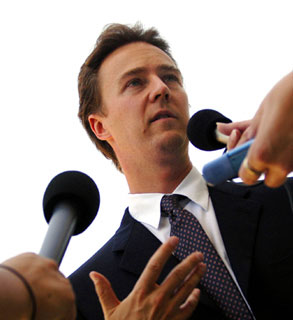

Amanda Griscom Little

Light club

Outspoken enviro Edward Norton talks about the fight to take solar energy mainstream, what makes a good green movie, and "Trippin'" with fellow eco-warrior Cameron Diaz.

  • more
    • All Share Services

Light club

The world has known Edward Norton as a neo-Nazi skinhead, a lusty priest, a warbling romantic, Larry Flynt’s attorney, and Nelson Rockefeller. There is also a far less publicized role that Norton plays every day: a dyed-in-the-wool eco-devotee on the front lines of the renewable-energy movement.

In 2003, Norton teamed up with oil giant and leading solar-panel producer BP to develop the Solar Neighbors Program, which aims to get photovoltaic (PV) panels onto low-income homes in Los Angeles. Norton has brought star power to the cause with support from showbiz buddies including Brad Pitt, Salma Hayek and Danny DeVito, and within the first year of the program succeeded in getting resources for dozens of solar installations for inner-city families.

Norton is now starring in his first eco-themed media project as narrator of “Strange Days on Planet Earth,” a four-part National Geographic documentary series chronicling scary environmental phenomena occurring on a global scale, the final episode of which aired this week on PBS. Norton spoke to us by phone from his hotel in Prague, where he is on location shooting “The Illusionist,” to discuss his impressive environmental pedigree, his indignation over Bush administration policies, his heroes and his vices.

What was interesting to you about the way “Strange Days on Planet Earth” approaches environmental issues?

I was impressed with the theme that the globe is a truly integrated biological and ecological system. There’s that old adage that when a butterfly beats its wings in China, it can cause a hurricane in Africa. The film explores that concept to the nth degree, showing how science is demonstrating more and more specifically just how intimately connected to each other we are. It amazes me that we got our first images of the earth from space just over 35 years ago, and still for the most part don’t have a sense of the planet as a unified whole.

What part of the film best demonstrates this theme?

Take frogs, which are indicators of ecosystemic health. You might go into the film thinking, Who cares whether a frog species goes extinct or whether it’s growing both kinds of sex organs, but realize that it relies on the same water system as humans do. It represents a warning sign, a signal, a symptom of a deeper systemic ailment. There could be catastrophic consequences if we continue to ignore these signals.

Tell us about the solar project you put together with BP to help get PV installations on low-income homes in Los Angeles.

My brother and I were looking into solar applications for my house in Los Angeles and were stunned to find that the subsidies available through the state and the city were substantial enough that it made good financial sense and was a way of saving money over time. I work with Enterprise Foundation, the largest nonprofit developer of affordable housing in the country, which my grandfather founded in the late ’70s, and realized that the people who could benefit from this technology the most are the people who can afford it the least. Arguably the benefits of subsidizing solar for low-income families — and the radiating benefits to society of easing living expenses for these families — are far greater than subsidizing solar for million-dollar homes.

So you convinced BP to donate solar to affordable housing developments?

I set a goal of trying to get a substantial number of solar panels onto low-income families’ homes in a concentrated area of L.A. Then I went to BP and proposed that if we could round up celebrities and public figures to buy BP solar systems for their homes, the company would then donate a matching system for each purchase to a low-income family. They were really responsive to the idea, and we created a program called Solar Neighbors. What we’re hoping to do is have a condensed data pool to trace economic and environmental benefits for the families.

Historically the city has built power plants to satisfy peak demand in low-income neighborhoods. We’re trying to show that if you can lower demand on the grid, you reduce the likelihood of these peaker plants turning on, which are incredibly noisy and polluting.

What is the timetable for the project, and who have you gotten onboard?

We had our first-year celebration back in November. My colleagues and friends who had participated in the program — Danny DeVito, Rhea Pearlman, Brad Pitt, Salma Hayek, Daryl Hannah, Alicia Silverstone — came down and met with the families that have gotten systems. We got about 25 systems on families’ homes in the first year, which allowed us to qualify for a $500,000 grant that will supply 40 or 50 new installations. And more people are getting involved. Bruce Willis called and wants to put an installation on his house in the Caribbean. Larry King agreed to do it. We’re trying to go beyond Hollywood to bring in broadcasters, politicians, sports figures and musicians. I’m hoping for a snowball effect.

So your aim is to convince policymakers to develop more solar subsidies targeted at low-income communities, and ultimately to help to bring down the cost of solar through economies of scale?

Precisely, so that eventually it won’t need subsidies. What will make a technology like solar panels cross that hump that, say, computers crossed when they went from being a novelty to something that everybody has in their family, is a function of both affordability and faith in the innovation. We’re as interested in helping to lower the price as we are in demystifying the technology — making people aware of and comfortable with it.

I understand that your dad is director of a Nature Conservancy project in China, and both of your siblings are involved in environmental work.

My father has been in China for five years directing the Nature Conservancy’s Yunnan Great Rivers conservation project. Growing up, he was a big outdoor enthusiast, and head of public policy for the Wilderness Society in the ’80s fighting all of those battles against James Watt. He engaged me and my siblings in environmental policy from a very early age. My sister got her graduate degree at the Monterey Institute of International Studies in environmental policy. My brother is a professional guide and has run white-water trips through the Grand Canyon and elsewhere many, many times. He’s on the board of Idaho Rivers United and working very hard on the salmon-recovery issue up in Idaho. So we’re all involved in different aspects of these issues.

What are your thoughts about the Bush administration?

This administration comes as close to criminal as any in history on issues of energy and the environment. Their agenda adds up to complete sellout of American public interest to corporate profit. It is to the shame of this administration that amidst all that’s going on in the country and in the world right now, no one is saying that conservation and alternative energy need to be as seriously and aggressively explored as drilling in the North Slope of Alaska.

It confounds me to see them put forth completely bankrupt policies, even as Republican national-security analysts are stepping forward and saying energy conservation has got to be a part of our national security plan. Even as a fellow Republican, Arnold Schwarzenegger, is proposing the most aggressive solar development and incentive program in the history of the United States. Even as the United States is getting its ass kicked by the Japanese and the Germans, who are beginning to dominate clean-technology industries. Even as billions of dollars and many thousands of lives are being spent to fight oil regimes in the Middle East. It’s truly a national tragedy.

Based on interviews I’ve read, you seem to be generally upbeat about the progress of the environmental movement. Are you optimistic even in the face of the political barriers the movement is facing?

I think the environmental community is fighting a rear-guard action to try to prevent irrevocable damage from occurring. Some fights are being lost, but I think more than people realize are being won. We can’t overlook the fact that some of the worst efforts are being thwarted. And we can’t underestimate the optimism inherent in the technological solutions on the rise — technology is becoming a powerful ally.

Even though it’s a very grim time in this country, I do think the consciousness on the pressing importance of these issues is rapidly expanding to all corners of the globe. Like any missionary movement, it’s one that has a lot of young adherents.

Does it concern you that the environmental movement appeals primarily to a narrow, white bourgeois constituency?

Yes, but it’s a terrible mistake to assume that people in inner-city or poor communities don’t or can’t engage in these issues. I’ve seen so many examples of the people we work with in South Central L.A. who have gotten more excited about the environmental benefits of the program than the utility-bill savings. People understand what it means when you say a 3 KW system can eliminate 5,000 pounds of carbon dioxide a year.

What role can Hollywood play in advancing the cause?

There are ways that the culture of celebrity gets used in America that are really unappealing, but it can also be an opportunity for substantive public leadership. While the environmental organizations are fending off assault on the day-to-day legislative level, it’s an important time for us to engage in the more public battle to win hearts and minds on this issue.

Are you going to go for an adventure with Cameron Diaz on her eco-themed MTV show “Trippin’”?

[Laughter.] I haven’t been invited, but it sounds fun. Who wouldn’t want to go on an adventure with Cameron Diaz?

“Trippin’” brings together all manner of unlikely environmentalists — hip-hop artists, Latino actors, skate kids, country rockers — and seems to be a good example of an effort to reshape the white, geeky enviro identity and help get the green message to a more diverse audience.

Yes, I’ve been really trying to get people like Magic Johnson involved in our solar program because he’s been such a force in the revitalization of L.A. low-income communities. Someone like Magic can do more to raise the profile of an effort like we’re doing in those communities than I could after years of effort. You need people with real credibility in their own communities.

You’ve done politically themed movies — “The People vs. Larry Flynt,” “American History X.” Do you have any ideas for, or interest in, doing eco-themed feature films?

Well, there’s the famous Edward Abbey book “The Monkey Wrench Gang” that I know has been kicked around, about some guys who make a plan to blow up the Glen Canyon Dam and release the Colorado River. But I don’t think you can construct a good story from just an angle or an issue; you need it to touch on classic themes as well. “Erin Brockovich,” for instance, was as much a David-and-Goliath corporate-litigation story as it was an environmental story.

That said, my company produces movies for Universal and we picked up a book called “Buffalo for the Broken Heart,” which is a chronicle of a South Dakota cow rancher’s efforts to transform his Great Plains ranch into a buffalo ranch and bring it back to life, which has a very strong environmental component.

What steps have you taken personally to lessen your environmental footprint?

In addition to solar, I think the car we drive is the most fundamental choice in American life. I live in New York, so I don’t actually own a car, but when I’m traveling or in L.A. I use car agencies that rent hybrids. I’m renovating a little extension on my home in New York and have been exploring what’s available in terms of recycled and reused materials. My brother is hounding me to try to make my garden around my house in L.A. less water-intensive. It’s completely absurd that we have the Colorado River getting pumped into our lawns in Los Angeles for no good reason really, so my next step is to try a more native-species or dry-climate garden. It’s also important to me to financially support organizations like the Nature Conservancy, the Grand Canyon Trust, Earthjustice, the Wilderness Society, the American Museum of Natural History.

What are your vices?

Well, I fly a lot, and I wouldn’t be surprised if one trip on a jet plane from New York to London is the pollution equivalent of driving five SUVs hard for a year, so that doesn’t put me in very good standing. But I haven’t figured out how to tackle that one yet.

Who are your environmental heroes?

The people who don’t usually get acknowledged, but are doing incredible work day-to-day to hold the ground against forces of greed. NRDC [Natural Resources Defense Council], Global Green, Grand Canyon Trust, regional groups like that. One of my best friends from college is a lawyer for Earthjustice, so I’m aware of the kind of dedication it takes to make that your life’s work. All those people are fighting very heroic battles. It’s not people like me who are doing the heavy lifting.

Continue Reading Close

The green philosophy of Dennis Kucinich

The Democratic candidate calls for a new energy paradigm. But are Americans ready to be "in harmony with nature"?

  • more
    • All Share Services

He may be eating the front-runners’ dust in the polls, but among deep green voters, Dennis Kucinich is considered a trailblazer. A Democratic U.S. representative from Cleveland, Kucinich is calling for a radical overhaul of the U.S. government and economy — one that would infuse every agency in the executive branch with a sustainability agenda, phase out coal and nuclear power entirely, and call on every American to ratchet down their resource consumption and participate in a national conservation program.

A vegan who counts Ralph Nader among his heroes, Kucinich doesn’t exactly embody the sensibility of the average American. He says his commitment to sustainability “extends to everything I am and do” — from the food he eats and clothes he wears to the policies he espouses. It’s the same progressive platform that made him a darling of the far left when he ran for president in 2004. Will it take him any farther this time around?

I reached Kucinich by phone at his home in Ohio.

For more information on his platform and record, check out Grist’s Kucinich fact sheet.

Why should voters consider you the strongest green candidate?

Because mostly our candidates aren’t going to be able to do anything about the underlying issues that threaten our environment. Many of the candidates — [John] Edwards, [Barack] Obama and [Hillary] Clinton — are heavily funded by hedge funds on Wall Street, which are driven by a psychology of short-term profits and investments. And with candidates taking that kind of money from those interests, it defies belief that they’re going to be in a position to take this country in the direction it needs to be taken.

What sets your green platform apart from the rest?

As president of the United States, I’m going to shift the entire direction of America. We need to see the connection between global warring and global warming, and it’s oil. Sustainability is the path to peace. And I’m the only true peace candidate in this election. So peace means being in harmony with nature. If you’re in harmony with nature, you don’t exploit nature. You don’t ruin the land, you don’t extract the oil, you don’t take the coal out of the earth.

My underlying philosophy is a green philosophy. It means that I’m looking at a total reorganization of the federal government to create a cooperative and synergistic relationship between all departments and administrations for the purpose of greening America.

You propose, for instance, the Works Green Administration.

The Works Green Administration harks back to the days of Franklin Roosevelt and the Works Progress Administration, where he put millions of people back to work rebuilding America’s infrastructure. I too have an infrastructure-rebuilding program which will put millions of people back to work. Picture this: You take every area of involvement in the federal government — whether it’s the Small Business Administration, or the Housing and Urban Development Department, or the Department of Agriculture, or the Department of Labor. Each would incorporate green goals. We’d have billions of dollars loaned to the states at zero interest for green development programs; we’d have programs furthering green housing; agricultural policies would relate to green.

Do you think Americans are ready to answer the call to conserve?

Of course they are. They’re just waiting for leadership, and it has to come from somebody who’s not tied to any of these interest groups, or is worried about whether he’s going to offend a contributor. And so, yes, I think people know that their future’s at stake.

What I intend to do as president is to call forth that instinct which is within every person for not just survival but to be able to thrive. We need to make the connection between prosperity and sustainability. It also means we have to turn toward peace, we have to stop warring, because war is ecocide, war destroys the environment. And so I’m going to call forth the people of this country for a whole new direction. I think America’s not just ready for it, it’s overdue and people know that.

I will also ask the American people to participate in a grand and great conservation effort. Imagine if tens of millions of homes suddenly had an awareness that when you don’t need the electricity, don’t flip the switch. That you use only the water that you need and you don’t use any more — you don’t let the faucet run.

Do you believe that we need a carbon tax in addition to a cap-and-trade program, or neither, or both?

We need to do whatever we can do to create disincentives for the use of carbon-based energy. But that’s not enough. Carbon-based taxes alone won’t cut it because some people may be willing to pay an extra tax to use something that’s bad for the environment. Inevitably we need a requirement to move away from all carbon-based technologies and to fund fully all alternative-energy research that is in harmony with the environment.

So you would propose a strict cap on carbon emissions, a carbon tax and a massive government-supported plan to promote renewable technologies?

Yes, but I’d want to put the emphasis first on the government supporting renewable technologies. A tax could reflect the full cost to society of certain types of energy. But the answer is not simply punishing those people who are using carbons. You have to do everything you can to move people toward renewable energy.

You’ve been calling for years for a renewable portfolio standard that would have the U.S. get 20 percent of its electricity from renewables by 2010. Now that 2010 is around the corner, what sort of RPS plan would you implement as president?

Well, obviously we’ve lost the advantage of that particular time frame. For the next time frame, I think we could set something by 2020 and look to 30 or 40 percent. But that means we’re talking about a very sharp turnaround here.

How would you shift the utility industry toward renewables, toward this whole new paradigm?

One of my proposals is to have millions of homes with wind and solar technologies, and people can sell energy back to the grid. The role of utilities will change dramatically because it’s not going to be a centralized approach toward energy production. They’ll have to figure out different ways that they might be able to provide support for green alternatives. I want to see, eventually, all the homes in this country have the option of that technology. In turn, you can create millions of jobs building alternative technologies.

Would nuclear power play any role in your energy policy as president?

Nuclear has to be phased out. The hidden costs of nuclear are enormous — of building these plants and storing the waste forever. It’s not financially or environmentally sustainable.

Nuclear makes up 20 percent of America’s electricity supply. What would you replace this with?

You don’t want to leave a gap in our energy needs, but at the same time, with a program of conservation and movement toward alternative energy, we can begin phasing out nuclear.

What about coal, the source of more than half of our electricity supply? Would you phase that out, or do you believe in the promise of advanced coal technologies?

No, coal has to be phased out. In the same way that the Department of Agriculture for years was paying some farmers not to grow, I think we can get to the point of paying coal miners not to mine. Why should the miners have to suffer from the lack of foresight of our energy policies? That’s something that I intend to address in my Works Green Administration.

The electric utility industry would argue that such a massive shift would pass along huge rate hikes to consumers. How would you protect Americans from these expenses?

We do not need to be held hostage by the utility industry. I’m not someone who’s going to roll over when these utility industries issue their threats. We’re going to break up the monopolies in utilities; that’s No. 1. No. 2, these utilities are going to be closely regulated for their activities. No. 3, they’re going to be required to go green as license conditions. No. 4, they’re going to be closely monitored and shut down if they violate the Clean Air Act. We’re going to have a very aggressive Environmental Protection Agency, and utilities are not going to be dictating energy costs. I don’t mind working with them, I don’t mind moving toward areas where they can be cooperative in protecting the environment, but they’re not going to run energy policy.

But such a transition would create huge costs. How would you pay for them?

It pays for itself. See, the whole idea about sustainability is that you conserve, you save and then you use the savings for other things. However, where we need financial incentives, this is where the government can play a major role in putting money into circulation for the production of these [green] products, and in putting people to work. Roosevelt understood in the ’30s that there were things he had to do to move the economy. And I understand what we need to do to move the economy in a green direction.

Do you support subsidies for ethanol or other gasoline alternatives, like biodiesel?

I don’t know about subsidies. I think those technologies are transitional to fuel-cell technology. I wouldn’t want to create incentives to lock us into usages that are not where we ultimately want to go. And there is a serious issue with ethanol and its impact on food supplies.

Many argue that the U.S. shouldn’t commit to a global greenhouse-gas reduction target that doesn’t involve China and India. Do you agree, and how would you bring them to the table?

First of all, as president, I’m going to let the rest of the world know that the days of America trying to be a nation above nations is over. We have to quit trying to dominate other countries, and we have to step out of our isolation and into the brotherhood and sisterhood of all people. I think the world is ready for an American president who puts the sword down, so that nations won’t have to spend a tremendous amount of their resources trying to prepare for war.

We have to be ready to take the lead, but we need to have harmony with other nations. As president, I intend to work with the leaders of China and India and other nations to promote an environmental consciousness and sustainable economies. I will use trade as a vehicle to try to raise the level of living for all people, and environmental sustainability must be the watchword. All of our trade agreements must have within them requirements for protecting the air and the water and the land of all the countries we do business with.

After climate and energy, what do you think is the most important environmental issue facing the nation?

Agriculture — the way we grow our food — and we really need to make sure that we protect our water supply. These issues are closely tied to each other.

Who is your environmental hero?

Oh, I have many. Thomas Berry, whose book “The Great Work” talked about how our great work in life is to achieve a real harmony with the environment. I think Lester Brown has done some incredible work on raising the consciousness of people. Amory Lovins has done some excellent work, and I think Ralph Nader has pointed to a lot of the environmental implications of corporate conduct and trade laws. And John Robbins has been so incredible in his awareness of the impact of the food we eat on our environment.

What was your most memorable wilderness or outdoor adventure?

As a child, we lived in the city, we moved around a lot. But there was one place we lived, above railroad tracks, and on the other side of the tracks was this vast acreage called “the gulley” that was created with the blasting of the railroad. It had these huge rock piles and vegetation everywhere and it almost looked prehistoric. It was a place that I would go to often and find solitude and be able to just think. So much of my own life has been connected with a desire to be close to nature, to be close to the water, to be close to green.

If you could spend a week in one natural area of the U.S., where would it be?

I would say somewhere in northern Maine. The whole state is beautiful, but northern Maine is just extraordinary, and I’ve seen all 50 states. I also love Maui.

What do you do to lighten your environmental footprint?

My philosophy of life extends to everything I am and do. If I say I’m for peace, I’m for peace in the kind of products that I use, in the kind of shoes that I wear, and in terms of the clothes that I wear, in terms of my eating habits. I’m always thinking in terms of sustainability. That’s the way I live. I live in a small house and we’re very conscious of our energy usage. I drive an American car, a Ford Focus, but it’s one of the highest fuel-economy cars.

I’ve been living an essentially vegan lifestyle since 1995, and that has led me to a condition of extraordinary health and clarity. Now, I’m not, as president, going to tell everyone what they have to eat, but I will share my own story about how the choices that I’ve made have meant, for myself, a better life, and a happier life. I’m 60 years old, but I’ll bet that I’m in better physical shape than a lot of people a lot younger.

If George Bush were a plant or an animal, what kind of plant or an animal would he be?

I don’t want to go there.

Fair enough. Would you spin it around on yourself? If you were a plant or animal, what kind would you be?

An eagle.

How so? Truly American?

No. Keenness of vision.


This article is part of a series of interviews with presidential candidates produced jointly by Grist and Outside.

Continue Reading Close

Ron Paul’s free, green market

The libertarian presidential contender says laissez-faire policies could stop global warming and save the planet.

  • more
    • All Share Services

Enviros may roll their eyes at a candidate who dismisses the U.S. EPA as feckless and disposable, who believes all public lands should be privately owned, and whose remedy for an ailing planet is “a free-market system and a lot less government.” But Ron Paul, the quixotic libertarian U.S. rep from Texas, has a bigger cult following online than any other presidential candidate, and has won unexpected attention in the GOP debates with his provocative ideas.

Some of those ideas arguably have environmental merit. Paul is known for his zealous opposition to the Iraq war, which he duly notes causes pollution and the “burning of fuel for no good purpose.” He wants to yank all subsidies and R&D funding from the energy sector, which many believe would benefit the growth of renewables. A cyclist himself, he has cosponsored bills that would offer tax breaks to Americans who commute by bicycle and use public transportation. Still, his libertarian presidency would, among other things, allow drilling in the Arctic National Wildlife Refuge, boost the use of coal, and embrace nuclear power. Moreover, it wouldn’t do diddly about global warming because, Paul reasons, “we’re not going to be very good at regulating the weather.”

I called Paul up on the campaign trail in Iowa to get the skinny on how the environment figures into his small-government agenda.

For more info on his platform and record, check out this Paul fact sheet.

What makes you the strongest candidate on energy and the environment?

On energy, I would say that the reliance on the government to devise a policy is a fallacy. I would advocate that the free market take care of that. The government shouldn’t be directing research and development because they are bound and determined to always misdirect money to political cronies. The government ends up subsidizing things like the corn industry to develop ethanol and it turns out that it’s not economically feasible. So, my answer to energy is to let the market work. Let supply and demand make the decision. Let prices make the decision. That is completely different than the bureaucratic and cronyism approach.

On environment, governments don’t have a good reputation for doing a good job protecting the environment. If you look at the extreme of socialism or communism, they were very poor environmentalists. Private property owners have a much better record of taking care of the environment. If you look at the common ownership of the lands in the West, they’re much more poorly treated than those that are privately owned. In a free-market system, nobody is permitted to pollute their neighbor’s private property — water, air, or land. It is very strict.

But there are realms of the environment that, by definition, can’t be owned, right? How would you divide the sky or the sea into private parcels?

The air can certainly be identified. If you have a mill next door to me, you don’t have a right to pollute my air — that can be properly defined by property rights. Water: if you’re on a river you certainly can define it, if you’re on a lake you certainly can define it. Even oceans can be defined by international agreements. You can be very strict with it. If it is air that crosses a boundary between Canada and the United States, you would have to have two governments come together, voluntarily solving these problems.

Can you elaborate on when government intervention is and isn’t appropriate?

Certainly, any time there’s injury to another person, another person’s land, or another person’s environment, there’s [legal] recourse with the government.

What do you see as the role of the Environmental Protection Agency?

You wouldn’t need it. Environmental protection in the U.S. should function according to the same premise as “prior restraint” in a newspaper. Newspapers can’t print anything that’s a lie. There has to be recourse. But you don’t invite the government in to review every single thing that the print media does with the assumption they might do something wrong. The EPA assumes you might do something wrong; it’s a bureaucratic, intrusive approach and it favors those who have political connections.

Would you dissolve the EPA?

It’s not high on my agenda. I’m trying to stop the war, and bring back a sound economy, and solve the financial crises, and balance the budget.

Is it appropriate for the government to regulate toxic or dangerous materials, like lead in children’s toys?

If a toy company is doing something dangerous, they’re liable and they should be held responsible. The government should hold them responsible, but not be the inspector. The government can’t inspect every single toy that comes into the country.

So you see it as the legal system that brings about environmental protection?

Right. Some of this stuff can be handled locally with a government. I was raised in the city of Pittsburgh. It was the filthiest city in the country because it was a steel town. You couldn’t even see the sun on a sunny day. Then it was cleaned up — not by the EPA, by local authorities that said you don’t have a right to pollute — and the government cleaned it up and the city’s a beautiful city. You don’t need this huge bureaucracy that’s remote from the problem. Pittsburgh dealt with it in a local fashion and it worked out quite well.

What if you’re part of a community that’s getting dumped on, but you don’t have the time or the money to sue the offending polluter?

Imagine that everyone living in one suburb, rather than using regular trash service, were taking their household trash to the next town over and simply tossing it in the yards of those living in the nearby town. Is there any question that legal mechanisms are in place to remedy this action? In principle, your concerns are no different, except that, for a good number of years, legislatures and courts have failed to enforce the property rights of those being dumped on with respect to certain forms of pollution. This form of government failure has persisted since the industrial revolution when, in the name of so-called progress, certain forms of pollution were legally tolerated or ignored to benefit some popular regional employer or politically popular entity.

When all forms of physical trespass, be that smoke, particulate matter, etc., are legally recognized for what they are — a physical trespass upon the property and rights of another — concerns about difficulty in suing the offending party will be largely diminished. When any such cases are known to be slam-dunk wins for the person whose property is being polluted, those doing the polluting will no longer persist in doing so. Against a backdrop of property rights actually enforced, contingency and class-action cases are additional legal mechanisms that resolve this concern.

You mentioned that you don’t support subsidies for the development of energy technologies. If all subsidies were removed from the energy sector, what do you think would happen to alternative energy industries like solar, wind, and ethanol?

Whoever can offer the best product at the best price, that’s what people will use. They just have to do this without damaging the environment.

If we’re running out of hydrocarbon, the price will go up. If we had a crisis tomorrow [that cut our oil supply in half], people would drive half as much — something would happen immediately. Somebody would come up with alternative fuels rather quickly.

Today, the government decides, and they misdirect the investment to their friends in the corn industry or the food industry. Think how many taxpayer dollars have been spent on corn [for ethanol], and there’s nobody now really defending that as an efficient way to create diesel fuel or ethanol. The money is spent for political reasons and not for economic reasons. It’s the worst way in the world to try to develop an alternative fuel.

But often the cheapest energy sources, which the market would naturally select for, are also the most environmentally harmful. How would you address this?

Your question is based on a false premise and a false definition of “market” that is quite understandable under the current legal framework. A true market system would internalize the costs of pollution on the producer. In other words, the “cheapest energy sources,” as you call them, are only cheap because currently the costs of the environmental harm you identify are not being included or internalized, as economists would say, into the cheap energy sources.

To the extent property rights are strictly enforced against those who would pollute the land or air of another, the costs of any environmental harm associated with an energy source would be imposed upon the producer of that energy source, and, in so doing, the cheap sources that pollute are not so cheap anymore.

What’s your take on global warming? Is it a serious problem and one that’s human-caused?

I think some of it is related to human activities, but I don’t think there’s a conclusion yet. There’s a lot of evidence on both sides of that argument. If you study the history, we’ve had a lot of climate changes. We’ve had hot spells and cold spells. They come and go. If there are weather changes, we’re not going to be very good at regulating the weather.

To assume we have to close down everything in this country and in the world because there’s a fear that we’re going to have this global warming and that we’re going to be swallowed up by the oceans, I think that’s extreme. I don’t buy into that. Yet, I think it’s a worthy discussion.

So you don’t consider climate change a major problem threatening civilization?

No. [Laughs.] I think war and financial crises and big governments marching into our homes and elimination of habeas corpus — those are immediate threats. We’re about to lose our whole country and whole republic! If we can be declared an enemy combatant and put away without a trial, then that’s going to affect a lot of us a lot sooner than the temperature going up.

What, if anything, do you think the government should do about global warming?

They should enforce the principles of private property so that we don’t emit poisons and contribute to it.

And, if other countries are doing it, we should do our best to try to talk them out of doing what might be harmful. We can’t use our army to go to China and dictate to China about the pollution that they may be contributing. You can only use persuasion.

You have voiced strong opposition to the Kyoto Protocol. Can you see supporting a different kind of international treaty to address global warming?

It would all depend. I think negotiation and talk and persuasion are worthwhile, but treaties that have law enforcement agencies that force certain countries to do things, I don’t think that would work.

You believe that ultimately private interests will solve global warming?

I think they’re more capable of it than politicians.

What’s your position on a carbon tax?

I don’t like that. That’s sort of legalizing pollution. If it’s wrong, you can buy these permits, so to speak. It’s wrong to do it. It shouldn’t be allowed.

Do you think it should be illegal to emit harmful pollutants?

You should be held responsible in a court of law, and you should be able to be closed down if you’re damaging your neighbor’s property in any way whatsoever.

Who would set the law about what pollutants could and couldn’t be emitted? Congress?

Not under my presidency — the Congress wouldn’t do it. The people who claim damage would have to say, look, I’m sitting here, and these poisons are coming over, and I can prove it, and I want it stopped, and I want compensation.

You’ve described your opposition to wars for oil as an example of your support for eco-friendly policies. Can you elaborate?

Generally speaking, war causes pollution — uranium, burning of fuel for no good purpose. The Pentagon burns more fuel than the whole country of Sweden.

Do you support the goal of energy independence in the U.S.?

Sure. But independence does not mean to me that we produce everything. I don’t believe governments have to provide every single ounce of energy. I see independence as having no government-mandated policy: If you need oil or energy, you can buy it.

What about being independent from the Middle East, so we’re not buying oil from hostile countries?

I think it’s irrelevant. We wouldn’t be buying it directly, we would be buying it on the world market. I don’t think the goal has to be that we produce alternative fuel so that we never buy oil from the Middle East. The goal should be to provide all useful services and goods through a market mechanism instead of central economic planning or world planning. That system doesn’t work.

What role do you think coal should play in America’s energy future?

Coal is a source of energy and it should be used, but it has to be used without ever hurting anybody. I think we’re smart enough to do it. Technology is improving all the time. If oil goes to $150 a barrel because we’ve bombed Iran, coal might be something that we can become more independent with. I think technology is super, and we are capable of knowing how to use coal without polluting other people’s property.

But coal technology has been proven to harm people — with poisons like mercury and asthma-causing particulates — so should old-style coal plants be allowed to continue operating?

Use of the technology I mentioned to prevent harm to people, even if it costs more for the coal producer, is another example of how costs must be internalized to the energy source. To the extent coal can be efficiently produced in a way that does not pollute another’s property or another’s physical body, it will be chosen as a viable energy source. Certainly no producer of energy or anything else has a right to pollute or harm another’s property or person.

If coal is not competitively priced when all costs to keep production safe are internalized to the producer, then coal will not be purchased or produced. I do not happen to believe this will be the case, but it is for the market to sort out, not politicians in Washington. It may be that, from time to time, as other energy sources become scarce, “safe coal” will be viable even if it is not at some other point in time.

What’s your take on nuclear?

I think nuclear is great. I think it’s the safest form of energy we have.

Ethanol?

I don’t think anything’s wrong with ethanol — it’s just not economically competitive. It’s only competitive now because those who produce it get subsidies.

What environmental achievement are you most proud of?

Nothing really special, other than trying to explain to people that you don’t need government expenditures and special-interest politics to promote safe, environmental types of energy. That comes about through a free-market system and a lot less government, and I think that’s the most important thing I can contribute.

If you could spend a week in a park or natural area in the United States, where would it be?

There’s probably hundreds of places. I probably have gone to Colorado more than any place, around Telluride and Ouray.

Can you describe your connection to the natural world? Have you had any memorable outdoor or wilderness adventures?

My favorite thing is riding bicycles, and at home my hobby is raising tomatoes. I live on the San Bernard River in Texas, and I belong to an environmental group that works very, very hard to protect the natural aspects of that river.

Can you elaborate on what you’ve done personally to reduce your energy and environmental impact?

Well, no, other than the fact that I’m just always aware of doing anything damaging to the environment. I don’t think I do anything that damages it at all. I don’t ride my bike because I think I’m destroying the environment by driving my car; I ride it because it’s a great way to be outdoors and enjoy the environment.


This article is part of a series of interviews with presidential candidates produced jointly by Grist and Outside.

Continue Reading Close

Huckabee: God wants us to fight global warming

The Republican presidential candidate believes it's our biblical duty to stop climate change.

  • more
    • All Share Services

Should you heart Huckabee? The jovial former Arkansas governor famously shed 100 pounds in two years and became an outspoken health and fitness advocate, and now he’s focusing that can-do attitude on a much weightier problem: America’s beleaguered energy system.

“The first thing I will do as president is send Congress my comprehensive plan for energy independence,” he proclaims on his Web site. “We will achieve energy independence by the end of my second term.” The goal may sound admirable, but even if it’s achievable — and many experts doubt that it is — Huckabee’s plan for getting there is light on specifics. Rather than spell out what steps he would take, he talks of creating a market environment that encourages innovation, and he praises just about every energy source you can think of — nuclear, “clean coal,” wind, solar, hydrogen, biomass, biodiesel, corn-based ethanol, cellulosic ethanol, oil from the Arctic National Wildlife Refuge and other untapped domestic areas, and, yes, conservation too.

A conservative Republican and devout Christian, Huckabee believes he has a biblical responsibility to protect God’s planet from climate change, even though he’s not convinced that climate change is largely human-caused. But mandatory limits on greenhouse-gas emissions make him squeamish.

I called Huckabee up in Iowa to find out how his ideas are playing on the campaign trail.

For more info on his platform and record, check out this Huckabee fact sheet.

What makes you the strongest Republican candidate on the issues of energy and the environment?

For one thing, I’m one of the few people who’s actually talked about the fact that as Republicans we have done a lousy job of presenting the case for conservation. We ought to be the leaders, but unfortunately we’ve been the last people speaking out on conservation.

Not only as a Republican, but as a Christian it’s important to me to say to my fellow believers, “Look, if anybody ought to be leading on this issue, it ought to be us.” We can’t justify destroying a planet that doesn’t belong to us, and if we believe that God did create this world for our pleasure and wants us to enjoy it, then all the more reason that we should take care of it.

You’ve vowed in your presidential platform to achieve energy independence by your second term. What inspired this stand?

A country is not free if it can’t produce three things for itself — its own food, its own fuel, and its own fighting apparatus. If we depend on someone else for those things, then we are at the mercy of those producing states. That’s why energy independence is not only an environmental and economic concern, but an urgent national-security priority. If we didn’t have any dependence on oil from the Middle East or even from Venezuela or Russia, we would not be nearly so worried about what’s happening in those countries. We’re desperately tied up in making sure that their stability is, in essence, our stability.

How would you achieve energy independence by your second term?

The key is to create the kind of unbridled marketplace that turns innovators loose to find the solutions. I don’t think we’re going to find one big answer. I think it’s going to be a combination of many that will include hydrogen, solar, wind, nuclear, domestically produced fossil fuels — at least for the short term. Our goal is to be nondependent upon fossil fuels, but there will be an interim period in which we’ll need to utilize all the domestic oil that we can generate by ourselves, whether it’s from ANWR or the continental shelf.

What role will coal technologies play, including liquefied coal?

I think there’s a place for it, and I think we need to insist that it’s clean coal. What we don’t need is another generation of coal that has serious polluting consequences.

Agricultural-based fuels are very important to me because they’re renewable and help create some stability in the agriculture economy of the United States.

Hydrogen has great potential. I recently visited a hydrogen plant in Iowa — they derive hydrogen-based fuel from ammonia. The technology is still somewhat challenging to make affordable, but it’s a relatively simple process. We could accelerate our ability to make it more cost-efficient.

Do you think we need to expand the role of nuclear power in the U.S.?

Absolutely. France is almost completely nuclear, and it’s not like they’re a nation given to risky behaviors. There’s been a real bias against nuclear energy in the United States, going all the way back to Three Mile Island in 1979, but I think most of it is unfounded. I mean, we’ve been running nuclear submarines for 60 years without accidents.

What would you do about the problem of storing nuclear waste?

I recognize that’s the sticky part. Everybody wants the benefits of nuclear energy, but nobody wants the storage of the nuclear material in their own backyard. Part of it is you have to make it economically viable for somebody to actually receive it. But a lot of it is changing attitudes, educating the public that nuclear byproducts can be disposed of safely, because the first reaction people have is, “Our kids are going to glow in the dark if we put that stuff in our state.” That’s not the case.

You mentioned your support for ethanol and other biofuels. Do you think we’ll need to transition from corn-derived ethanol to the more energy-efficient varieties, like cellulosic?

I think that makes sense. I think there’s still going to be a place for corn to be a part of it. What we need to be doing is — and I don’t think we’re all that far from it — is developing a technology that would take virtually any kind of biomass, and be able to then burn it, so that it doesn’t have to necessarily be corn-specific or rice-hull-specific. There would be different ways of processing it, and what you’re really doing is generating the energy from the biomass itself.

How would you encourage a shift toward renewable and clean industries? Would it be incentive-based? Would you have a renewable portfolio standard that requires utilities to produce a certain percentage of their power from renewable sources?

Some of both. I think that there ought to be some government grants and subsidies for those who accelerate ways to produce the energy. And I’d simply say, we’re not going to tax you for coming up with these ideas. I would eliminate all tax on productivity and replace it with a simple consumption tax.

I would also want to assemble some of the best minds in the country to make sure that we set goals that really challenge us. I think the problem is we’ve not set challenging goals. We’ve got a lot of leaders who only want to take on issues that they can solve in their own first term so they can get reelected. We need to be looking at things in the same way John F. Kennedy looked at the space program and said, “We’ll put a man on the moon within a decade.”

Do you think we need to increase auto fuel-economy standards to help achieve your energy-independence goal?

I’m not opposed to it, but I don’t honestly know what the standards should be. That’s where I’d want to get some scientific advice on what we can achieve. You don’t want to do something that’s going to completely wreck the current economy. But I also think we need to do some serious pushing. We need to get to the place so that within a decade we can tell the Saudi royal family that we’re no longer going to continue to make them obscenely wealthy with our purchase of their oil. Frankly, much of that wealth ends up coming back to finance terrorism.

You often invoke your faith when talking about environmental stewardship. How are these two issues connected for you?

This world doesn’t belong to me. I’m a guest here. I don’t have a right to abuse it, any more than I have a right to abuse someone else’s property if they were to let me stay in their apartment for a weekend. It’s a sin against future generations for me to act as if there are no future generations that should enjoy the world as I do.

I love the outdoors. We have a beautiful, magnificent world: rivers and streams and mountains. I find myself overwhelmed when I look at it. I want my great-great-great-grandchildren to one day go out and smell the same fresh air, fish in wonderful streams, and be able to see the same mountains I see. I sure don’t want them to have it in worse shape and wonder why I didn’t do a better job of handing it down to them.

Do you believe that human beings are the primary drivers of climate change?

The honest answer is I don’t know. And for me, that’s not the issue. Instead of being wrapped into this political discussion of “Is there global warming, and who caused it?” what we need to be saying is, “Look, let’s agree that we all have responsibility to present a better planet to the next generation.” Whether or not you want to believe that it’s caused by driving to work, let’s agree that we need to take better care of the planet. Being a conservationist is the proper way to live, whether there is human-based global warming or not.

How would you go about reducing greenhouse-gas emissions?

I think there’s several things we can do — for example, replace light bulbs with the fluorescent types. We need to shoot for less fossil fuel, go to more energy-efficient and certainly non-carbon-producing methods of energy.

Do you think that voluntary efforts are enough, or do we need to impose mandatory emissions reductions?

Hopefully it can be a combination. I’m always concerned when someone mentions mandatory, because I think that there’s going to be a government-imposed restriction on a lot of our lifestyle choices. What really ought to happen is, when we start developing a different kind of energy economy, it will evolve rather quickly.

What role should the U.S. play in crafting a new international climate-change agreement?

I think the best role that we can play is by the example we set and by many of the market changes that we can make. When people start making a lot of money off alternative fuels and fuel-efficient vehicles and energy sources, you can rest assured that people are going to gravitate toward it. That’s got to be our goal, and it’s got to be an urgent one.

The U.S. consumes far more energy per capita than other countries. Do you believe that we have a moral obligation to take the global lead in curbing our energy use and CO2 emissions?

I certainly think we ought to be mindful, but I have to be careful here because I don’t think the government needs to start telling people we’re going to limit how many hours a day you can run your fan, or whether or not you can plug in your television set. I’d like to believe that people would start thinking that it’s their responsibility to do it. But I don’t know that I want the government telling me, “I’m sorry, you can’t drive that kind of car.” I have a flex-fuel vehicle right now; I very well may buy a hybrid, but I don’t want the government telling me I have to.

What about the government saying, “Hey, electricity industry: You need to find a way to create that same energy with lower emissions?”

I’m open to that, and I think that’s a worthy kind of goal. Maybe it’s an incentive, where they have lower tax burdens if they find ways to cut the cost of production.

What do you think is the most pressing environmental issue facing the nation, if not climate change?

I think the issue of pollution of the water, air and soil, because that affects everything in our overall eco-structure, whether it’s our streams or our soil to produce our food. Everything that we truly treasure is better when we take care of it, and it’s truly harmed when we pollute it, when we act as if we are a one-time generation and we don’t have any obligation for the future.

What environmental achievement are you proudest of?

I campaigned for Amendment 75 of the Arkansas constitution that dedicates an eighth of a percent of sales tax for everything purchased in the state for conservation. And we’ve used that money to completely rebuild our state parks system, fight pollution, purchase thousands of acres that are now set aside to remain natural, and create friendly and affordable places for families to enjoy the outdoors. We have the responsibility to make sure that the poorest family in the state can enjoy a day in the outdoors, whether it’s hunting, fishing, hiking or camping.

Could you share a memorable outdoor adventure or natural experience?

I’ll tell you one that almost got me killed. A group of my staff and Cabinet members went on a float trip on the Buffalo River, up in north Arkansas, which is one of the most absolutely beautiful places on earth. We pulled over to have lunch, and there was this group of guys in their 20s to early 30s, and they had some elastic-type straps and they were using them as a slingshot and shooting beer cans across the river, slamming them against this huge rock wall. I just couldn’t believe this. I was appalled, because we’re very protective of the Buffalo River in Arkansas.

Before I could even think about it, I went over to those guys, who were twice my size, and I said, “Do you have any idea what the fine is for littering?” I said, “This is not just a state treasure, it’s a national river. Do you have any idea what it is?” And I said, “I’ve already taken the number of your canoe. I can find out who you are.” And they just looked at me and their eyes went like, “Who are you?” I didn’t even bother to tell them. I just said, “It’s $1,000 per incident. I’ve just seen you knock three cans against it. You’ve got two choices: You either go over there and pick up those cans, or I’m going to make sure that you get the full extent of the law.”

And finally my troopers came over, and one of the guys I was talking to said, “Well, we’ll go get them.” I was walking away, and someone asked, “Who is that guy?” And another guy said, “He’s the governor of the state.”

If you could spend a week in one park or natural area, where would it be?

Lake Greeson in Arkansas. It’s a lake my wife and I grew up on as kids and it has special meaning to us.

You’re known to be a strong fitness advocate, having lost more than 100 pounds in recent years. As president, how would you advocate better fitness nationally?

There are two basic elements to health: good nutrition and activity. We’ve got to help this country to start realizing that whole, natural foods are critical to health. I often tell people a couple of basic rules of nutrition: One is, if it wasn’t a food 100 years ago, it probably isn’t a food today. Secondly, if it comes through the car window, it isn’t food. So much of what people eat today is a chemical product that has been processed, and when you really look at what it is and read the label, you’d be better off eating the box and throwing the contents away, because the box would at least give you some fiber.

Is there a way of promoting healthier lifestyles from a federal level?

One thing is that the marketplace is moving. Every food company with whom I’ve spoken has told me that the growth of their marketplace is in the healthier food choices.

We’re not going to solve it all overnight, but we can start making a genuine transition to healthier, more whole-food products, doing more to subsidize fruits and vegetables, rather than just the processed food, and creating the appetites in children by exposing them more to fruits and vegetables at the marketplace, and the schools, and their homes and neighborhoods.

On a personal level, what have you done to lighten your environmental footprint?

We have a flex-fuel vehicle. We are changing all of the lights in our house to fluorescent. We just replaced our heating and air-conditioning systems with the highest-level SEER-rated models, so that they would run on 60 percent less energy than what we had been using. I run and enjoy the outdoors and I often ride my bicycle to the store. My kids laugh at me and call me an old geezer, but I love it. Several years ago, I would have driven.


This article is part of a series of interviews with presidential candidates produced jointly by Grist and Outside.

Continue Reading Close

Tancredo pushes for more nuclear energy R&D

The presidential hopeful says alternative energies aren't just good for the environment -- they're good for America.

  • more
    • All Share Services

U.S. Rep. Tom Tancredo, R-Colo. — best known for his zealous opposition to illegal immigration — bills himself on his campaign Web site as “a solid pro-life, pro-gun, small government Republican.” What’s not mentioned on his site is anything about the environment or energy issues. (Considering that he’s got a lifetime approval rating of 11 percent from the League of Conservation Voters, perhaps that’s no surprise.)

But when asked about these issues, Tancredo makes a patriotic call for energy independence, just like the rest of the presidential contenders. And while he likes to joke that Al Gore’s “An Inconvenient Truth” is the last book of fiction he’s read, Tancredo also pays lip service to a shift away from carbon-based energy sources and the withdrawal of subsidies from fossil-fuel energy. Still, his free-market-driven vision of America’s energy future includes lots more coal mining and oil drilling, as well as nuclear power.

I caught Tancredo by phone while he was campaigning in New Hampshire and tried to get a better picture of how environmental goals fit into his conservative platform.

You support a fence along the U.S.-Mexico border to curb illegal immigration. Environmentalists have raised concerns that such a fence could be harmful to wildlife and the broader ecosystem in the area. Do you think this is a legitimate concern?

What is even more disturbing is the environmental damages caused by illegal aliens crossing the border. On average, an alien crossing the border will drop about eight pounds of trash on a one- to three-day journey. This amounts to hundreds to thousands of pounds of garbage left in an ecosystem completely unprepared for that type of pollution.

What do you see as the most pressing energy and environmental issues facing the nation?

We can take care of a couple of issues with one sort of strategy. If we successfully reduce our reliance on oil produced by countries that are dangerous to us — and that’s a good thing from a national-security standpoint — you will automatically reduce the amount of carbon we produce in the United States. A major initiative to move away from carbon-based products would accomplish a great deal.

How do you envision such an initiative? Is this a priority for you?

Yeah, it certainly is, because it’s a national-security issue, primarily.

I don’t doubt that global warming is a true phenomenon. I’m saying the extent to which you can attribute it directly to man’s actions, I think, is still at least debatable. But that doesn’t matter if we move in the direction I’m saying.

So what can the federal government do? Besides investment in research and technology, which of course I think it must do, we could require, for instance, all federal vehicles to be alternative-fuel vehicles. A lot of things are happening right now as a result of the market, and I am, frankly, reluctant to tamper with the market to a great extent.

I’ve heard you say you trust the market far more than you trust government. If the market were a level playing field and all subsidies were removed from the energy sector, what would happen to the renewable and alternative energy industries?

You would see the most efficient develop; the most inefficient would lag behind or not survive. I don’t think that subsidies are a good way to go. Even now, the markets are already working. You look at the number of alternative-fuel and hybrid vehicles that are being purchased, it’s really quite significant. Toyota took over GM’s spot as the No. 1 auto producer in the world, and why? Something called the Prius.

Would you, as president, remove subsidies from fossil-fuel industries?

Yeah, I say remove subsidies. I certainly think that’s appropriate.

However, R&D is a subsidy, and I would support efforts in research and development. We can obtain a lot more fossil fuels from things like shale, but it may require some R&D to find ways to make it cheap enough so that you can extract the oil from the shale.

I also think that it is appropriate for us to remove restrictions on the development of fossil-fuel resources within the continental United States and off of the continental shelf.

Again it goes back to national-security issues. What I’m trying to do is rely less and less on any sort of fuel from countries that are potentially very dangerous.

Would you fund R&D for emerging technologies like wind and solar?

Yes, and it can be broader than that. It can be R&D into biotechnology and biofuels. There are two reasons I am willing to do that: One, the national-security thing. The other is that we have OPEC, so there isn’t truly a free market. You have to have some degree of government involvement in this because the OPEC nations can and do control the market to a certain extent. When emerging technologies become a threat to oil, OPEC can [flood the market with oil], driving the price down to make it impossible to compete, and that new technology goes down the toilet.

Can you clarify your take on global warming? It sounds like you think it’s a problem but not necessarily one that’s human-caused.

It may certainly be a phenomenon that’s got nothing to do with the impact of humanity on the environment, or very, very little anyway. It may be a cyclic thing that we will simply have to deal with. I don’t know. There’s plenty of reliable research on both sides.

So I say, look, it really doesn’t matter. The thing we must do is reduce our reliance on potentially violent countries. If in reducing carbon emissions we actually have a positive impact on this global-warming phenomenon, then great.

Do you support a cap on carbon emissions?

I really think there are a lot of problems with that, especially in terms of enforcement — you are talking about the possibility of a lot of fraud. I’d look very skeptically at any type of cap-and-trade scheme. Let’s put it this way: It’s not impossible, but I’d be very skeptical.

What role should the U.S. play in crafting a new international agreement on climate change?

We should encourage countries to rely on markets more than anything else to accomplish the goal.

You’re a strong supporter of nuclear power in the U.S. What do you see as the advantage of increasing nuclear power?

I believe that we have developed the technology to where it is very safe. The biggest problem we have, of course, is with storage [of the nuclear waste]. We’re having a hell of a time trying to get Yucca Mountain certified [as a waste-storage site]. In the meantime, we’ve got communities in Texas that are saying, “Let’s do it here.” Why? Because there are a lot of jobs involved. There’s a lot of money involved. It’s a great market-oriented solution. It also allows us to have an alternative fuel that is clean and plentiful. What more could you ask for?

So your waste-storage solution would be Yucca Mountain or a distributed storage plan?

Absolutely, we can keep looking at Yucca Mountain as the important place, but it’s not the only place. There are already sites in Texas that we are working to try to open. It will happen. We will get the storage. It’s all about supply and demand.

What role do you think coal should play in America’s energy future?

I think coal gasification, especially if we can perfect the in-ground storage of carbon. [Oil] prices are high enough now that it makes it feasible to move in the direction of coal gasification.

What about liquefied coal?

Same thing — lots of it. Again, the trade-off there is the carbon issue. As you know, there’s a lot of technology being developed to try and store the carbon.

What about ethanol?

Same thing. That’s another point where markets will be helping to determine this, because at a certain point [ethanol] becomes less than efficient both in terms of the energy trade-offs that are involved and just the sheer cost. When you mandate a certain amount of fuel like we do now, it is an indirect subsidy. Subsidies for the creation of biofuels — that’s not something I’m crazy about, theoretically speaking.

There’s growing belief among evangelicals and other communities of faith that we need to be stewards of the earth and protect the planet from global warming. What’s your take on this?

I think it would be better for them to deal more directly with issues relevant to their communities of faith.

There are some Republicans in Colorado who have been disgruntled by the increased drilling for oil and natural gas in the state. What’s your take?

I’m supportive of the drilling, especially [for natural gas] on the Roan Plateau. It’s an important source of clean fuel, and the footprint is very small. Everyone wants to use the energy, everyone wants to claim that they are supportive of a greater environment — and yet here when we can accomplish that, when we increase the use of coal-bed methane and natural gas and a variety of other alternatives to petroleum-based products, they are screaming, “Not in my backyard.”

It’s sort of the hypocrisy of the Kennedys, in a way. They talk about how much they want the rest of us to make sacrifices in order to accomplish [environmental] goals, but they are not willing to have a wind farm where they can see it from [Cape Cod].

We all have to accept the responsibility. I don’t like it when states are talking about “you can’t drill off of our coast” or “you can’t drill here,” but they have no reluctance about consuming all of the oil production that originates from the rest of America. There’s a lot of hypocrisy there.

What environmental achievement are you most proud of?

My work on the Healthy Forests [Initiative] — frankly, I think that’s enormous. If we could begin to implement that in a more effective way, I think we could see a lot of really important developments, not the least of which is the reduced risk of major, catastrophic forest fires. Healthier forests are also healthy for the environment because they suck up out of the environment what we don’t want, and produce what we do.

Who is your environmental hero?

I have none.

Can you talk about a memorable outdoor experience you’ve had?

I just got done with a competitive shooting event here in New Hampshire, outdoors. It was great! First you shoot trap, and then you move to a target range with a rifle, and then you move to a target range with a pistol. I finished all three a little bit ago. I did really well.

Do you enjoy hunting?

Yes, I do. A while back, Mitt Romney said he’s been hunting all his life, but he just got his first license last year. I actually have been hunting all my life.

I had golden retrievers for years. You get mesmerized by them and sometimes miss a good shot because you’re watching the dogs work. They’re just wonderful. They’re in their element, doing exactly what they were born for.

If you could spend a week in a natural area, where would it be?

I actually love the grassland, the Pawnee National Grassland in northeastern Colorado. It’s quite beautiful. I know most people don’t think of grasslands as offering that kind of beauty, but to me they do. You just look over that sea of waving grass, and I think it is breathtakingly beautiful.

What have you done personally to reduce your environmental footprint?

I have a 2005 Prius. It’s a great car. It also lets me drive in the restricted lane on the way to work.


This article is part of a series of interviews with presidential candidates produced jointly by Grist and Outside.

Continue Reading Close

John McCain’s climate-change forecast

Right or wrong, we have to act, because the risk of not curbing greenhouse-gas emissions is too great.

  • more
    • All Share Services

John McCain likes to project a tough-guy stance on the issues, and global warming is no exception. “Americans solve problems. We don’t run from them,” he’s quoted as saying on the environment page of his Web site, which goes on to argue that “ignoring the problem reflects a ‘liberal, live for today’ attitude unworthy of our great country.”

McCain has earned the right to put his own conservative spin on the fight against climate change. The first high-profile Republican to start talking seriously about the issue, he has called President Bush’s approach to global warming “disgraceful.” He cosponsored the first Senate bill calling for mandatory greenhouse-gas reductions, the 2003 McCain-Lieberman Climate Stewardship Act, and has pushed a number of versions of the bill in years since. The latest iteration, though, has little support from environmentalists, because there are now much stronger climate bills in Congress, and because McCain’s bill contains significant financial support for nuclear power.

But, for the most part, McCain’s climate advocacy has earned praise and respect from the mainstream green establishment over the years. In his 2004 Senate campaign, he got the endorsement of the League of Conservation Voters, even though the group has only given him a 26 percent lifetime voting score.

McCain is the candidate best positioned to attract support from Republican voters concerned about climate change and the environment. I rang him up recently on the campaign trail in Iowa to find out how environmental and energy issues are figuring into his push for the presidency.

For more info on his platform and record, check out Grist’s McCain fact sheet.

Why should voters consider you the strongest green candidate? What sets your platform on energy and the environment apart from the others?

My clear record of environmental advocacy and activism, ranging from my efforts to protect the Grand Canyon to working with [Connecticut Sen.] Joe Lieberman to get a cap-and-trade proposal to reduce greenhouse-gas emissions through the United States Senate.

You’ve said that global warming would be one of three key issues for your presidency. Why do you think the issue is important?

It’s like Tony Blair said: Suppose we’re wrong, and there’s no such thing as greenhouse-gas emissions, and we adopt green technologies. All we’ve done is give our kids a better planet. But suppose we’re right, and do nothing? Then what kind of a legacy are we handing on to future generations of Americans? I think we ought to frame the debate that way.

And I think most, if not all, of the ways that we can address this issue are through profit-motive, free-enterprise-system-driven green technologies. General Electric dedicated itself to green technologies, and guess what? They’re still making a lot of money.

Why do you think many of your fellow Republican candidates aren’t making climate change a priority? Do you think Republican voters care about the issue?

I’m very confident that Republican voters care, and I’m happy to say that more and more members of the so-called Christian right, or evangelical movement, are beginning to focus on our biblical obligation to be stewards of our planet.

Why others have not been more involved — you’d have to ask them. But when I ran [for president] in 2000, in New Hampshire person after person stood up and said, “What are you going to do about climate change?” And after I lost — grrrr — I went back as chairman of the Senate Commerce Committee and had hearing after hearing after hearing on the issue. I’m deeply disappointed in the administration’s failure to act on this issue, in some cases creating obfuscation and delay. But I stayed on it and developed, among other things, the bill with Joe Lieberman.

You’ve been a leader in Congress in calling for a cap-and-trade program to reduce greenhouse-gas emissions. What about a carbon tax?

No. Cap and trade, to me, is far more capitalistic and free-enterprise oriented.

Would you endorse a goal of reducing greenhouse-gas emissions 80 percent by 2050?

I’m all for setting goals, but you’ve got to figure out ways to get there, OK? I could set a goal that we’d have zero greenhouse-gas emissions by next year, but that’s the easy part. The hard part is telling people how you’re going to get there. And by the way, I’m confident people will do what’s necessary to help with this problem of greenhouse-gas emissions — they’re convinced.

Some argue that the U.S. should not sign on to an international climate agreement unless China and India participate. Do you agree?

I agree, if only from a purely political standpoint. You’re not going to get anything through the Congress of the United States unless it’s truly international and India and China are engaged. Now, there are lots of ways to negotiate. There are steps that we can take as a country to reduce greenhouse-gas emissions. But you’re going to have to have the two rising greenhouse-gas emitters in the world involved in an international treaty, I believe, to pass it through the Senate.

To what extent is Iraq a war for oil?

I think it has a big impact. It’s not just Iraq oil — it’s the whole region and the stability in the region. And the stable supply of oil obviously gives it a higher national-security priority. What I don’t interpret that to mean is that I think we went to war for oil, but it’s certainly a factor in our national-security equation.

Sometimes the goals of achieving energy independence and reducing climate change are at odds. Would you, as president, oppose subsidizing technologies that would worsen global warming, even if they would reduce our reliance on foreign oil?

I would certainly give highest priority to those technologies that both reduce greenhouse-gas emissions and reduce our dependence on foreign oil — including and to a significant degree nuclear power. Nuclear power is going to have to be part of any equation if we’re truly going to reduce greenhouse-gas emissions.

How would you address the problem of safely storing and disposing of nuclear waste?

We need to make tough decisions just like the French have, and just like other European countries have: You either store it or you reprocess it. We have the reprocessing capability at the Savannah River Site [in South Carolina], and we also have a place called Yucca Mountain [in Nevada], where I believe we could safely store the nuclear waste. We have the worst of all worlds now. We’ve got nuclear waste sitting all over America, and we also have not moved forward with the construction of nuclear power plants, which we could do if we would streamline the procedures. Meanwhile, coal-burning power plants are being constructed as we speak.

What role do you think coal should play in America’s energy future?

I’d like to see coal gasification, and I would subsidize R&D in that effort. I’m all for government funding basic R&D, by the way. I really believe that we’re going to have to use a kind of a coal [technology] that does not emit the greenhouse gases that present-day coal-fired utility plants do.

What about coal-to-liquids, turning coal into car fuel?

I’m for any new technologies that will reduce greenhouse-gas emissions — hydrogen, all of those things.

You used to be an outspoken critic of ethanol. Do you believe now that it should be part of America’s energy future?

I do, because, one, of its role in reducing dependence on foreign oil. And also when oil is $10 a barrel, it doesn’t make a lot of sense; when oil is $70 a barrel, it makes a lot more sense. I’m for all kinds of ethanol. I mean, corn-based is obviously the flavor of the month — and I’m all for it — but we also need sugarcane-based ethanol, such as what’s coming out of Brazil, and we need switchgrass biofuels. There should be a broad variety of sources of ethanol besides just corn.

And by the way, I still do not support subsidies for ethanol; it’s doing just fine without them.

Why do you support subsidies for nuclear power, but not for ethanol?

I don’t support, particularly, subsidies. I think what I strongly support is a streamlined licensing process [for nuclear plants], an ability for the investors to be confident that they’ll be able to have some secure future as far as the construction of these facilities are concerned. But I’m not particularly interested in subsidies for them, or the oil and gas industry, for that matter.

But doesn’t your climate-change bill include subsidies for nuclear power?

Nuclear support in my climate-change bill is paid for from the proceeds of an auction of emission allowances to industry, not from taxpayer dollars. The nuclear funding is for the early development of the next generation of nuclear power plants and includes such things as a demonstration program to reduce first-time regulatory costs and a research program for fuel cycles. The support is not for the continuous operation of the plants.

What’s your position on subsidies for green technologies like wind and solar?

I’m not one who believes that we need to subsidize things. The wind industry is doing fine. The solar industry is doing fine. In the ’70s, we gave too many subsidies and too much help, and we had substandard products sold to the American people, which then made them disenchanted with solar for a long time.

Ethanol is, to a large degree, a mature technology. Some of the coal and hydrogen and other technologies are not mature. I think that’s really the difference. The government can help with pure research and development, whether it be on climate and greenhouse-gas emissions or development of the Internet. But there’s a point where you should let the free-enterprise system take over.

In 2002, you introduced a measure to increase fuel economy to 36 miles per gallon by 2016. What would you do as president to improve fuel economy?

We need to increase CAFE standards. We all know that. But the devil is in the details. I’m open to negotiations. We obviously don’t want to drive all the car companies out of business. But there needs to be dramatic improvement and no loopholes.

What environmental achievement are you proudest of?

Limiting Grand Canyon overflights is one. Probably the most proud one is working for Mo Udall [a former Democratic representative from Arizona], because he was a leader who put 3.5 million acres of Arizona into permanent, pristine wilderness status.

Who is your environmental hero?

Mo Udall. He was the most dedicated person to our environment that I have known. He was incredibly effective in getting legislation through the Congress — wilderness bills and all kinds of environmental protections. History will show that he and his brother Stu, who was secretary of the interior for eight years, were two of the great environmentalists of the 20th century.

Can you share an anecdote about your most memorable outdoor or wilderness adventure?

I’ve had many. Last year, my son Jack, who’s at the Naval Academy, and I hiked the Grand Canyon rim to rim. Not for the first time, but it’s an incredible experience. I think rafting the canyon is great. I think the least-known great outdoor experience is the Canyon de Chelly [in Arizona].

I’ve also traveled the world and seen visible manifestations of the tremendous harm that global warming has done to our planet. In Greenland, you can see the glacier has receded dramatically. You can go to northern Norway and see the impact there. You can go to the Arctic Circle, as I have, and see it. You can go to the South Pole, fly around in a helicopter, and see incredible damage. They’re the miners’ canaries, worse than the miners’ canaries. The visible manifestations of climate change are there, and they’re very disturbing.

If you were to spend a week in a park or natural area of the United States, where would you go?

I’d probably go to Canyon de Chelly. And second to that would be probably the Chiricahua [National Monument, in Arizona]. Go there and you’ll understand why Geronimo ran off like he did after they took him out of his beloved land.

What have you done personally to reduce your energy and environmental footprint?

We just moved from a very large house with swimming pool and grounds into a condominium, so we made a dramatic change. My daughter has a Prius. And we have a place up north where we have solar panels in some of the buildings. But we haven’t done enough, and we intend to do more.

If you were a plant or animal, what kind of plant or animal would you be?

I think I’d like to be a jaguar. Or if I were a plant, I wouldn’t mind being a saguaro cactus, because you sure do live a long time.


This article is part of a series of interviews with presidential candidates produced jointly by Grist and Outside.

Continue Reading Close

Page 1 of 15 in Amanda Griscom Little