
Alternative Energy

The gushing truth

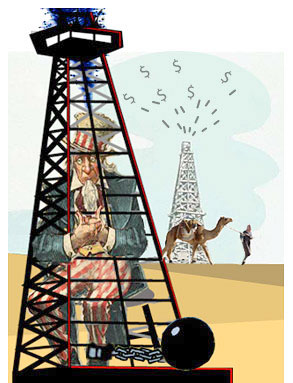
Contrary to Bush, enviros and Thomas Friedman, America will never be energy independent. The sooner we accept this, the sooner we'll be able to change our gas-guzzling ways.

  • more
    • All Share Services

The gushing truth

It would be easy to blame it on Richard Nixon. He started blathering about “energy independence” shortly after the Arab oil producers raised prices and launched an embargo against the U.S. in October of 1973. Within weeks, oil prices quintupled and the American economy went into seizures.

The crusade for energy independence reached another crescendo last week, when the House voted to approve some $8.1 billion in tax breaks for the mightily struggling energy industry. Let’s see, during the first quarter of this year, Exxon Mobil’s profits jumped 44 percent. Royal Dutch/Shell’s profits were up 42 percent while Marathon Oil’s profits were up a measly 26 percent. And there’s this news: According to John S. Herold Inc., a research-only firm, five of the country’s biggest oil and gas companies had a total of some $51.4 billion in cash on hand at the end of 2004.

Never mind the absurdity of tax breaks for a sector that’s printing money. The main problem with the energy bill is that it’s being sold as a magic potion that will help America wean itself from foreign sources of energy. When that “energy independence” moment occurs, goes the reasoning, America will be a self-sufficient Valhalla with lots of good-paying manufacturing jobs. Farmers will make big profits by growing acre upon acre of corn and other plants that will be turned into oil-replacing, clean-burning ethanol. And American GIs will never again need to visit the Persian Gulf, except, perhaps, on vacation.

If you believe in that vision, stop reading here. That vision will not happen. America will never — repeat, never — be energy independent. America is such a major energy user and the energy market is so complex that we can never be independent. America simply sucks up too much oil (25 percent of world production), too much natural gas, and too much coal to ever cut itself off from the global market. The price for these commodities is set by global market forces like booming economies in China and India, and by the ever-increasing energy needs of citizens everywhere to power their cars, fax machines, computers and air conditioners.

In short, there’s no silver bullet when it comes to energy. Pretending that there is only obscures the magnitude of the problem. And that problem is enormous. Hydrocarbons of all types are becoming harder to find and more expensive to produce. And more people are vying for the resources that remain. Domestic oil production has been falling since the early 1970s and no matter how large the subsidy or tax break to domestic drillers, that trend cannot be reversed. Given our current energy consumption, the idea that we can mine enough domestic crude to meet our demand is simply fallacious. You’d be hard-pressed to find any diner at the Houston Petroleum Club to say otherwise.

If we continue pretending that we can somehow be independent of these hard truths, it will be that much harder to make the difficult changes that must be made: a strong embrace of efficiency and conservation (particularly in the transportation sector) and a bolder, more comprehensive program to develop renewable and alternative sources of energy.

I’ll explain more in a moment why we can’t be independent. But first, a short review of recent comments from the right, the left and the center that use the “I” word:

  • On April 19, White House spokesman Scott McClellan endorsed the energy bill, saying, “It is time to act to make America more energy independent … We are dependent on foreign sources of energy. It is a threat to our economic security and our national security.”
  • On April 20, U.S. Sen. Maria Cantwell, D-Wash., during a press conference with fellow Democrat New York Sen. Charles Schumer, said that the U.S. needs to increase its research and development spending in order to “focus on technologies that can lead us to energy independence.”
  • On April 21, the National Environmental Trust denounced the House version of the energy bill, saying President George W. Bush and his cronies should “get serious about American energy independence.”
  • On April 27, during his press conference, President Bush used the oxymoronic phrase “greater energy independence” seven times. (Never mind that the very idea of independence is absolute. “Greater” has nothing to do with it.) Nevertheless, Bush insisted that “By harnessing the power of technology, we’re going to be able to grow our economy, protect our environment, and achieve greater energy independence.”

    Then there’s New York Times columnist Thomas Friedman, who has begun calling himself a “geo-green.” Last December, he called for a Manhattan Projectlike “initiative for alternative energy and conservation to make America energy-independent in 10 years.” On Jan. 30, Friedman repeated his battle cry, proclaiming that if only Americans were more energy efficient, the Arab OPEC members’ oil revenues will shrink and “they will have to open up their economies and their schools and liberate their women … It is that simple.”

    Oh, Tom, if only it were.

    Numerous factors keep America from ever becoming energy independent. First is our enormous auto fleet. Amory Lovins and the other energy efficiency gurus keep saying that we can quit buying foreign crude oil if only we all drove more fuel-efficient cars. Their argument goes like this: Two-thirds of the oil the U.S. consumes is used for transportation. In fact, our transportation consumption nearly equals our oil imports. Thus, if we make transportation more efficient, then the need for that imported oil goes away.

    Alas, even dramatic increases in America’s automobile fuel efficiency will only slow the growth rate of our oil imports. According to the National Commission on Energy Policy, if automakers increased the efficiency of their fleets from the current 24 miles per gallon to 44 mpg, America’s motor fuel consumption will still increase by 3.7 million barrels per day by 2025. That trend reflects two facts: Americans are driving more miles each year, and Americans own more than 200 million vehicles, each of which has a life span of about 15 years. Converting that gigantic fleet to one that is more fuel efficient will take decades and cost tens of billions, perhaps even hundreds of billion of dollars. In the meantime, people still need to commute to work. And they are not going to spend $25,000 on a Prius just to save $25 every time they fill up their gas tanks.

    Second, even if the U.S. did manage to reduce its overall oil consumption, it is unlikely to have a major effect on oil prices or oil supply. Oil is so fungible and demand so high that crude being loaded at Yanbu, Saudia Arabia, that isn’t bought by a refiner in Texas, will be shipped instead to Singapore or Shanghai.

    The booming economies of China and India are creating enormous demand for petroleum. The Chinese economy grew by almost 10 percent during the first quarter of 2005. Decreasing consumption in America “won’t have a global impact on major oil exporters,” says Scott Tinker, the director of the University of Texas Bureau of Economic Geology. “In fact, quite the opposite. The big oil-exporting countries are recognizing that the future market for them is in the mid- and Far East, in countries like India and China. Increased demand in those regions will overshadow decreased consumption in the U.S., keeping global demand above global supply.” That’s bad news for all those Hummer drivers who will be paying yet higher prices at the pump.

    Tinker raises a key point: Global demand is reaching parity with global supply. The Organization of the Petroleum Exporting Countries has, for three decades, controlled global oil prices. But OPEC has no spare capacity. Thus, the price of oil has become more volatile, and every barrel that comes onto the market is quickly sold. That means that oil buyers cannot deny their currency to one supplier in favor of another. In short, oil prices are determined on a global market in which every player is subject to fluctuations in price and supply. This point was summarized in a 2002 report by the Congressional Research Service. It determined that “energy independence will not free the United States from oil price shocks.”

    Oil is only part of the imported energy question. Over the next five years, America is going to become a major natural gas importer. By 2010, according to the Federal Energy Regulatory Commission, the U.S. will be importing about 10 percent of its daily gas needs in the form of liquefied natural gas (LNG). That gas will come from places like Qatar, Trinidad and Nigeria. By 2025, the FERC expects LNG to account for 20 percent of America’s daily gas consumption. And there is no alternative. The U.S. — which has built dozens of new gas-fired electric power plants over the past few years — cannot meet its gas demand any other way. No amount of tax subsidies or drilling programs will allow the U.S. to escape the ongoing decline in domestic gas production.

    Furthermore, over the next decade or so, the natural gas market will increasingly mimic the oil market — with price being determined on a global basis. That trend will accelerate in the coming decades as natural gas grabs a larger percentage of overall global energy consumption. Gas is an excellent fuel source. It contains no sulphur. It burns cleanly, is easily shipped via pipeline and there is a lot of it. But there’s a problem. According to the Energy Information Administration, nearly half of all proven global gas reserves are in the Persian Gulf. So even if the U.S. does everything right and in the coming two or three decades we all start driving efficient cars that use less oil, and using waffle irons that use less electricity (and less imported natural gas), we are still going to be tied to the Persian Gulf.

    One final factor to keep in mind when thinking about energy independence is peak oil, the concept that the world is reaching, or has already reached, its capacity to produce ever-increasing amounts of petroleum. Peak oil is fundamentally changing the global balance of power. It is giving the big oil-exporting nations a lot more power and we had better get used to it.

    If oil producers cannot meet surging global demand, energy prices, and gasoline prices in particular, will likely continue upward. Which means that the Arab OPEC countries — which are already swimming in cash — will become even richer. According to a recent report from the World Bank, the Arab oil-producing countries will take in nearly $300 billion from their oil exports this year. That’s nearly double the amount they garnered in 2002. By the end of this year, the World Bank predicts that Iran will have $18.5 billion in cash on hand — more than four times the surplus the country had in 2002. Kuwait will have $13.9 billion, more than three times its 2002 surplus. The Saudis will have a staggering $60.6 billion surplus, five times the amount they had in 2002.

    These countries are using that cash to strengthen their own economies. And well they should. Saudi Arabia, Iran, Iraq and Nigeria all have rapidly growing populations. According to the U.N., Saudi Arabia’s population will increase by more than 41 percent over the next 15 years. All of those new citizens will need education, housing and medical care. These population surges could cause major instability in all of these countries. And as we are seeing in Iraq, insurrections are bad for exports. The Bush administration originally claimed that Iraq’s oil revenues would pay for all of the rebuilding efforts. But the country is struggling to maintain export rates of 1.5 million barrels per day due to the constant attacks on the country’s oil infrastructure.

    More important, these countries may view the idea of energy independence as an opportunity to move out of America’s orbit. So even though the U.S. is a popular market for the OPEC countries, George W. Bush and his policies are not. A year ago, the Pew Center for People and the Press found that in predominantly Muslim countries, “anger toward the United States remains pervasive.” It remains to be seen if the major oil-producing countries will refuse to do business with the U.S.

    Bush has sought to isolate the Venezuelan and Iranian oil markets but his efforts aren’t working. Venezuelan President Hugo Chavez has already struck major oil contracts with Cuba and China. Over the last few months, the Iranians have signed a $40 billion energy deal with India and a $70 billion deal with the Chinese. The Iranians are also negotiating a huge deal with Pakistan and India that would carry natural gas to India. Dubbed the “peace pipeline,” the Bush administration is actively trying to stop the project. But in March, India’s oil minister, Mani Shankar Aiyar, told reporters that the project “can’t be compromised for any third-party concern.” Then, speaking more directly to the Bush administration, he said that “friendly countries in the world must recognize that even if they have national concerns, we have a very important requirement of energy without which we cannot hope to sustain priorities.”

    As for the Saudis, they remain one of America’s closest allies. But two weeks before Saudi Crown Prince Abdullah went to Crawford, Texas, to hold hands with George W. Bush, he was in Paris, signing a $26 billion defense deal with Jacques Chirac. The deal calls for the Saudis to buy 96 Rafale fighters from France. Meanwhile, our dear friends, the Kuwaitis, are demanding that the U.S. pay them $500 million for the fuel they have been supplying (at no cost) to American troops involved in the second Iraq war.

    The point is this: Globalization is a fact of life in the energy business. It has been for a long time. And the global interconnectedness of the energy trade is accelerating. That trend is accelerating even as oil-rich countries like Russia, Venezuela, Kuwait and others are taking more control over their domestic energy resources. That means that the major oil companies, long accustomed to getting major concessions in these countries, may not have as much access to big oil fields as they once did — another reason why the major oil companies (Exxon Mobil, BP, Shell) will soon reach peak production.

    All of these factors should be forcing the U.S. toward more energy efficiency and huge investments in renewable energy. Instead, President Bush is talking about building refineries on old military bases. But he is not telling us exactly where he’s going to get the crude oil to feed those refineries. He wants to drill in the Arctic National Wildlife Refuge. But the U.S. Geological Survey estimates that only about 6 billion barrels of oil could be recovered from the refuge, a billion less than Americans consume a year. What’s more, there’s no guarantee that oil companies that set up shop on the Alaskan refuge will hawk their oil only to the United States.

    Although America will always be part of the global oil market, we must still aggressively pursue conservation, efficiency and renewable energy at home. Conservation in the automotive sector can help us reduce oil consumption. That’s good for America because it reduces air pollution and cuts greenhouse emissions. It may also reduce the amount of oil we need to import. The U.S. now spends about $12 billion per month on imported oil. Cutting those energy imports will be good for our balance of trade. Biofuels, like ethanol made from domestically grown plants, can make a significant contribution toward offsetting imported oil. Rethinking our transportation system, and diverting some of our transportation dollars away from cars and roads and toward mass transit, will help reduce urban sprawl and conserve open space.

    We need renewable sources of energy like wind and solar for many reasons. First, they are environmentally friendly: no greenhouse gases or pollutants. Second, the cost of these technologies is falling, and they may soon become competitive with fossil fuels (coal and natural gas). Third, they can reduce the amount of fossil fuels needed to produce electricity and reduce the need for building expensive new power plants.

    Unfortunately, George W. Bush has shown no leadership on energy issues, even as big strides are being made in developing alternative sources. One new technology turns infrared light into electricity, dramatically improving the efficiency of existing photovoltaic cells. Wind power continues to grow rapidly, while getting only minor federal subsidies. Other more capital-intensive processes like coal gasification and gas-to-liquids are showing promise. If environmentalists are going to be realistic about America’s energy future, they are going to have to get over their long-standing aversion to nuclear power. The Japanese conglomerate, Toshiba, has just introduced a prototype of a micro-nuclear power plant that produces 25 megawatts of power and does so at fairly low cost.

    All of these technologies could have roles in America’s energy future. But reducing America’s energy consumption — or at the very least, slowing the rate of growth of our fossil fuel consumption — will take years, barrels of cash, and more than a little bravery in Congress and the White House.

    It’s time to get started.

  • Continue Reading Close

    U.S., China need a green peace, not a trade war

    As Obama meets Xi, the U.S. is investigating China’s practices in the solar and wind sectors

    • more
      • All Share Services

    U.S., China need a green peace, not a trade warSolar panels in the city of Baoding in China. (Credit: Reuters/David Gray)

    Chinese Vice President Xi Jinping’s visit to the United States comes at a contradictory time in clean energy relations between the two countries. On the one hand, significant progress has been made under the clean energy cooperation agreements signed by Presidents Hu Jintao and Barack Obama in the fall of 2009. On the other hand, the two countries may be on the verge of a clean energy trade war. As a result, the positions that Xi and Obama take on these issues over the next week may well set the tone for that relationship’s future, for better or worse.

    China and the United States have launched numerous energy cooperation initiatives during the past 30 years.  Only over the past decade, however, have they become global leaders in the relevant technologies, both as users and manufacturers. China now leads the world in wind power deployment, followed by the United States. Chinese investments in clean energy exceeded those of any other country in both 2009 and 2010, but the U.S. was back to No. 1 in 2011 (where it had been for several years prior to 2009).

    The seven new bilateral clean energy initiatives launched in 2009 focused on key areas, including renewable energy, advanced coal technology, energy efficiency and electric vehicles. The US-China Clean Energy Research Center (CERC) (a virtual center that sponsors work in several locations in both countries) in particular has established a new model for cooperative clean energy research, development and demonstration that spans the public and private sectors and involves top researchers from universities and national laboratories in both countries. These programs have propelled numerous other collaborations,  some of which — if the two sides decide to emphasize clean energy cooperation over competition — may be included in major  announcements during Xi’s visit.

    However, at the end of last year the United States initiated antidumping and countervailing duty investigations into China’s practices in the solar and wind sectors, and the Department of Commerce will decide soon whether to impose duties on Chinese solar panels and wind turbine components.  In the meantime, election year politics and a slow economic recovery are fueling competitive tensions.

    President Obama announced in his State of the Union address last month that he would establish a new trade enforcement unit to speed investigations of unfair trading practices by China. Beijing has (not surprisingly) responded with its own investigation into American clean energy support programs. This comes as the U.S. renewable energy industry is increasingly divided over China’s role. For example, the Coalition for Affordable Solar Energy (a U.S. solar industry association) has asked the Coalition for American Solar Manufacturing (another U.S. solar industry association) to drop its petition that launched the solar panel investigation. A CASE report estimates that higher U.S. import duties on Chinese solar panels will eliminate up to 60,000 American jobs and hurt U.S. consumers even more than U.S. producers.

    We are entering a period in which the incentives for conflict may overpower the incentives for cooperation. China and the United States are the world’s two largest economies, and should be leaders in establishing and enforcing the rules of the global trading system. But as the largest producers and consumers of energy, as well as the largest greenhouse gas emitters, they also have a responsibility to develop domestic, clean and affordable sources of energy for themselves as well as for others.

    Both nations recognize the vital importance of strengthening innovation systems to inspire economic competitiveness, and both are increasingly becoming the leaders of the clean energy industry. These technologies are global industries with global supply chains, however, and national technology providers increasingly are crossing borders for both innovation and production. Our leaders would be well served to focus on how the two nations can work together to develop crucial energy technologies for the future, rather than on how to create even more obstacles.

    Continue Reading Close

    Dr Joanna L. Lewis is an assistant professor at the Walsh School of Foreign Serivce, Georgetown University. Her focus is on science, technology and international affairs, especially issues related to renewable energy.

    Wind power: Renewable resource, or another corporate scam?

    A fascinating new film about one small-town political fight takes on the pseudo-green wind industry

    • more
      • All Share Services

    Wind power: Renewable resource, or another corporate scam?A still from "Windfall"

    In telling the story of a small-town political fight over wind power, Laura Israel’s fascinating documentary “Windfall” at first seems like another entry in the long laundry list of post-”Inconvenient Truth” doomsayer environmental films. Indeed, “Windfall” has some of the rural, homespun feeling of Josh Fox’s Oscar-nominated “Gasland,” which helped ignite a national debate over the natural-gas extraction method known as fracking. Israel’s film also offers a direct riposte to Bill Haney’s “The Last Mountain,” in which Robert F. Kennedy Jr. is seen promoting wind power as a clean alternative to the dirty and destructive combination of mountaintop-removal coal mining and coal-generated electricity.

    Viewed through a long lens, “Windfall” is about much more than the hidden costs and unexpected side effects of wind-power generation, or about a citizens’ uprising in the tiny town of Meredith, N.Y., in the Catskill region 150 or so miles northwest of Manhattan. (Mind you, both are gripping stories.) It’s about the American tendency — and very likely the human tendency — to look for magic-bullet solutions to complicated social and economic problems, where none are available. It’s a microcosmic version of the political divisions — between left and right, environmentalists and free-marketers, corporations and citizens — that have virtually paralyzed our republic. It’s a reminder that whenever a virtually unregulated industry (as in this case) offers capitalists a chance to defraud the little guy and make a bundle, they’ll do it. It’s a tantalizing case study that suggests ordinary people still have the power to steer a course between faceless bureaucracies and greedy capitalists, but only just — and only if they can find a way to overcome their differences and work together.

    In the abstract, wind power sounds like a good thing to nearly everybody. It relies on an essentially infinite resource, carries little or none of the obvious environmental downside of coal or oil, and presents no Fukushima-style doomsday scenario. Wind generation has become a major focus of venture capital; Israel includes video of a hearing a few years ago at which T. Boone Pickens told a congressional committee that he could imagine, in the relatively short term, 20 to 25 percent of the country’s electricity demand being fulfilled by wind and other renewables. I have no way to evaluate that claim, but the experts Israel consults in the film think it’s hokum. Given the inherently inconstant nature of wind, they argue, it’s not a stable or permanent solution to our energy crisis, and is unlikely ever to amount to more than a drop in the bucket.

    Setting aside the discussion of whether it’s worthwhile to pursue wind power in the first place — and we shouldn’t really set that aside — there might be locations in the Great Plains states, the Southwest and the high western deserts where wind farms, even on the enormous scale imagined by Pickens, would do no great harm. But as people in Meredith and numerous other communities in the wind-friendly rural Northeast and Great Lakes region have discovered, living anywhere near those gargantuan wind-harnessing engines is quite a different matter. These days, the typical industrial wind turbine is around 400 feet high — the height of a 40-story building, or twice the length of a jumbo jet. The blades alone can weigh upward of 35 tons, and the entire assembly anywhere from 150 to 400 tons (resting on a platform of concrete and rebar, which itself may be 30 feet deep and weigh several hundred tons). It’s an enormous construction site, culminating in a high-voltage electrical device, that emits a 24/7 whoppa-whoppa-whoppa noise and incessant low-frequency vibration, and is topped with a brilliant flashing light. By daylight, there’s the nightmarish strobe effect — the vast rotating shadow that falls across an entire neighborhood when the turbine is between you and the sun. (While the question of whether it’s actually unhealthful to live near a turbine is unresolved, it’s definitely unpleasant.) If your neighbor put one up in her backyard without asking permission, how would you feel?

    As it happens, I have a personal interest in the events and location of “Windfall,” because I spend summers in a town just a few miles from Meredith. But nothing about the town or its surrounding area (in Delaware County, N.Y., one of the poorest and least populated counties in the Northeast) is untypical of rural America. Meredith has a mix of longtime residents and big-city emigrants, and its longtime dairy-farm economy has largely collapsed in recent years, partly replaced by an unstable mixture of tourist-oriented businesses, craft initiatives and boutique organic farming. These social tensions came to the fore, predictably, during the wind-power debate, with the major landowners and dairy farmers on one side — hoping for the rather skimpy royalties paid by the corporate investors in wind — and many “recent” New York City arrivals, convinced that the region’s economic future depends on its unspoiled landscapes, on the other. (I use the scare quotes because anyone who’s lived in Delaware County less than 30 years is often viewed as a newcomer.)

    People on both sides of the issue in Meredith assumed at first that the anti-turbine forces were an elitist minority, partly because the town board had always been dominated by the same landowning families, and partly because wind-power companies had signed people up to secret agreements that forbade them from discussing anything about the relationship. What ensued was a fascinating lesson in democracy (and a version of the same lesson the Tea Party and its supporters may learn later this year). After 826 people — more than half of Meredith’s total population — signed a petition opposing the town board’s pro-development policy on wind turbines, it turned out that the people who thought of themselves as the “real” residents were in the minority, and the jig was up for the wind industry in this one tiny corner of America. Yet as one newly elected board member reflects at the end of the film, nobody came out of this fight feeling good. A formerly harmonious community is now bitterly divided, and the Mitt Romney-style venture capitalists of wind power will just move on to the next town and sell their pseudo-green poisoned chalice to somebody else.

    “Windfall” opens this week at the Quad Cinema in New York and the Facets Cinémathèque in Chicago. It opens Feb. 9 at the Art House Cinema 502 in Ogden, Utah, Feb. 24 at the Clinton Street Theater in Portland, Ore., and March 2 at the Northwest Film Forum in Seattle, with other cities and festival screenings to follow. It’s also available on-demand from cable, satellite and online providers, including Amazon, iTunes and VUDU.

    Continue Reading Close

    The environmental movement takes on coal country

    Activist Flavia de la Fuente talks about why it's crucial to combat climate change in politically hostile areas

    • more
      • All Share Services

    The environmental movement takes on coal countryFlavia de la Fuente(Credit: Fiorenza Comunian)
    This article originally appeared on Grist.

    There are probably easier things one could do than to organize against the construction of a coal-powered electricity plant near the Gulf Coast refinery town of Corpus Christi, Texas. But Flavia de la Fuente wouldn’t want to be doing them. After the life-long Californian graduated from UCLA in the spring of 2010, she applied for a job as an organizer with the Sierra Club. She was offered her pick of three options — San Francisco, Washington D.C., or Texas.

    The choice was easy. “I firmly believe in going to the trenches and being where the fight is,” says de la Fuente. That meant Texas. In the 1960s, she points out, the civil rights movement flourished where it was “hardest” — in the Deep South. The same, she hopes, will be true for the environmental movement.

    “If we can turn things around on climate change where things are the hardest, then we can win,” she says. “And there are a lot of people in Texas who really, really want to win.”

    The decision to focus on climate change was bit of a switch from her days as an undergraduate working with undocumented immigrants and organizing support for passage of the DREAM Act. The daughter of parents who were forced by desperate economic conditions to emigrate from Chile in the 1970s, de la Fuente had always believed that she would continue to focus on immigration reform after college.

    “But I started to think on a bigger level about what real immigration reform is, and I realized that what motivates me is that I hate it when people are forced to leave their homes due to circumstances beyond their control,” says de la Fuente. “And the biggest driver of that in the future is going to be climate change.”

    “I’m probably never going to meet all the people that I want to support, like refugees in Pakistan or farmers in Africa,” says de la Fuente. But she’s convinced that, by organizing volunteers to push for a renewable energy mandate in Texas and to oppose proposed coal-fired power plants, she’ll be doing what she can to ease their hardships.

    “It’s hokey,” she says “but John Muir’s famous quote is that when you pick something out of the universe it’s hitched to everything else. The fact is, we’re all connected.”

    Combine Muir’s sense of interconnection with Cesar Chavez’s commitment to grassroots organization and you’ve got Flavia de la Fuente. While some environmentalists have been driven to despair by gridlock in Washington, or the pace of greenhouse gas-spewing industrial development in China, or President Obama’s failure to deliver on their hopes, de la Fuente, describing herself as a “happy warrior,” exudes a sense of undaunted confidence.

    “I read an article in Grist a few weeks ago that said environmentalists are depressed. But you can’t let this stuff get you down, or else you will hide in your living room and never get active.” Instead, de la Fuente draws strength from the enormity of the challenge before her — and all of us. “I draw a lot of energy from the bigness of this fight. I kind of thrive on it. What could be more exciting than taking on the biggest, most complicated problems that humanity has ever faced?”

    Continue Reading Close
    Andrew Leonard

    Andrew Leonard is a staff writer at Salon. On Twitter, @koxinga21.

    Green energy, the cost-efficient option

    Despite huge subsidies for fossil fuels, eco-friendly alternatives are making headway

    • more
      • All Share Services

    Green energy, the cost-efficient option

    Among the standard epithets often leveled at green energy is the one about subsidies. As the conservative myth goes, green energy is allegedly not “cost competitive” with dirty energy sources like coal or natural gas. This, we are led to believe, makes green energy just another wasteful taxpayer-supported boondoggle for dominant special interests. In this version of the story, big, bad all-powerful solar, wind and insulation companies are supposedly getting government handouts to unfairly oppress the earnest mom-and-pop oil and gas industry.

    As laughable as it is to portray oil, gas and coal companies — some of the wealthiest corporations in the world — as underdogs, the narrative’s Machiavellian brilliance should be obvious. For both the global fossil fuel industry and a conservative political movement underwritten by oil barons like the Koch brothers, the mythology self-servingly casts environmentally friendly alternatives as inherently ill-suited to free market economics. In the process, it convinces millions of consumers and entrepreneurs that even if they want to go green, they can’t do so in any sort of economically viable way, meaning they should just keep guzzling as much fossil fuel as ever.

    But in an up-is-down political arena where being a millionaire is “struggling” and where pure unadulterated fabrication is now the norm, a recent spate of headlines are starting to show us that the true energy story is exactly the opposite of the mythology.

    Here’s the truth: In the real world that exists outside the media and political theater, fossil fuels rely on massive public expenditures to rig “free” markets against green industries, which don’t get nearly the same level of taxpayer support. Indeed, as Bloomberg News reported in 2010, “Global subsidies for fossil fuels dwarf support given to renewable energy sources such as wind and solar power and biofuels” — and that doesn’t even include the subsidies inherent in federal lands being regularly leased for fossil fuel development at bargain basement prices. At the global consumer level, that makes fossil fuels comparatively lower priced than they would be in a true free market, thus encouraging more fossil fuel consumption than ever.

    Considering this gross market-skewing inequity, the shocking energy story of 2011 is that a green industry exists at all. And not only does it exist — it is now suddenly drawing sustenance in a swath of the economy that today seems like a barren desert: the devastated housing market.

    Last year, for instance, the National Renewable Energy Lab study showed “that solar homes sold 20 percent faster [and] for 17 percent more than the equivalent non-solar homes.” And this was before solar power began its renewed push to hit price parity with fossil fuels. Now, the Los Angeles Times reports “that newly constructed homes with third-party certifications for sustainability and energy efficiency sold for 8 percent more on average than noncertified homes in the six-county Portland metropolitan area” and that “existing houses with certifications sold for 30 percent more.”

    While more data is still needed to document this shift on a national basis, the trend is clearly real — and it is clearly an important dose of positive news in an otherwise depressing housing landscape lately more often defined by blight and foreclosures.

    Equally important is the deeper meaning of the trend. It shows that the green movement is now being actively rewarded by consumers, even though fossil fuel subsidies are artificially skewing the market against the green movement.

    For those looking to preserve the value of their homes in the still-volatile housing market, this is great news. It means green investments (solar panels, insulation, etc.) are a new avenue for potential financial protection. For the planet, it’s just as good news — it means there’s an ever bigger financial upside for products that do right by the environment.

    Just imagine how huge that market could be if it was subsidized at even half the level of fossil fuels. Suddenly, the world’s energy challenges would look a a lot less impossible — and the global economy might look a whole lot better.

    Continue Reading Close
    David Sirota

    David Sirota is a best-selling author of the new book "Back to Our Future: How the 1980s Explain the World We Live In Now." He hosts the morning show on AM760 in Colorado. E-mail him at ds@davidsirota.com, follow him on Twitter @davidsirota or visit his website at www.davidsirota.com.

    What will replace oil?

    The next 30 years will see a competition between alternative energy sources. We assess the leading contenders

    • more
      • All Share Services

    What will replace oil?

    A 30-year war for energy preeminence? You wouldn’t wish it even on a desperate planet. But that’s where we’re headed and there’s no turning back.

    From 1618 to 1648, Europe was engulfed in a series of intensely brutal conflicts known collectively as the Thirty Years’ War. It was, in part, a struggle between an imperial system of governance and the emerging nation-state. Indeed, many historians believe that the modern international system of nation-states was crystallized in the Treaty of Westphalia of 1648, which finally ended the fighting.

    Think of us today as embarking on a new Thirty Years’ War. It may not result in as much bloodshed as that of the 1600s, though bloodshed there will be, but it will prove no less momentous for the future of the planet. Over the coming decades, we will be embroiled at a global level in a succeed-or-perish contest among the major forms of energy, the corporations which supply them, and the countries that run on them. The question will be: Which will dominate the world’s energy supply in the second half of the twenty-first century? The winners will determine how — and how badly — we live, work, and play in those not-so-distant decades, and will profit enormously as a result. The losers will be cast aside and dismembered.

    Why 30 years? Because that’s how long it will take for experimental energy systems like hydrogen power, cellulosic ethanol, wave power, algae fuel, and advanced nuclear reactors to make it from the laboratory to full-scale industrial development. Some of these systems (as well, undoubtedly, as others not yet on our radar screens) will survive the winnowing process. Some will not. And there is little way to predict how it will go at this stage in the game. At the same time, the use of existing fuels like oil and coal, which spew carbon dioxide into the atmosphere, is likely to plummet, thanks both to diminished supplies and rising concerns over the growing dangers of carbon emissions.

    This will be a war because the future profitability, or even survival, of many of the world’s most powerful and wealthy corporations will be at risk, and because every nation has a potentially life-or-death stake in the contest. For giant oil companies like BP, Chevron, ExxonMobil, and Royal Dutch Shell, an eventual shift away from petroleum will have massive economic consequences. They will be forced to adopt new economic models and attempt to corner new markets, based on the production of alternative energy products, or risk collapse or absorption by more powerful competitors. In these same decades, new companies will arise, some undoubtedly coming to rival the oil giants in wealth and importance.

    The fate of nations, too, will be at stake as they place their bets on competing technologies, cling to their existing energy patterns, or compete for global energy sources, markets, and reserves. Because the acquisition of adequate supplies of energy is as basic a matter of national security as can be imagined, struggles over vital resources — oil and natural gas now, perhaps lithium or nickel (for electric-powered vehicles) in the future — will trigger armed violence.

    When these three decades are over, as with the Treaty of Westphalia, the planet is likely to have in place the foundations of a new system for organizing itself — this time around energy needs. In the meantime, the struggle for energy resources is guaranteed to grow ever more intense for a simple reason: there is no way the existing energy system can satisfy the world’s future requirements. It must be replaced or supplemented in a major way by a renewable alternative system or, forget Westphalia, the planet will be subject to environmental disaster of a sort hard to imagine today.

    The Existing Energy Lineup

    To appreciate the nature of our predicament, begin with a quick look at the world’s existing energy portfolio. According to BP, the world consumed 13.2 billion tons of oil-equivalent from all sources in 2010: 33.6 percent from oil, 29.6 percent from coal, 23.8 percent from natural gas, 6.5 percent from hydroelectricity, 5.2 percent from nuclear energy, and a mere 1.3 percent percent from all renewable forms of energy. Together, fossil fuels — oil, coal, and gas — supplied 10.4 billion tons, or 87 percent of the total.

    Even attempting to preserve this level of energy output in 30 years’ time, using the same proportion of fuels, would be a near-hopeless feat. Achieving a 40 percent increase in energy output, as most analysts believe will be needed to satisfy the existing requirements of older industrial powers and rising demand in China and other rapidly developing nations, is simply impossible.

    Two barriers stand in the way of preserving the existing energy profile: eventual oil scarcity and global climate change. Most energy analysts expect conventional oil output — that is, liquid oil derived from fields on land and in shallow coastal waters — to reach a production peak in the next few years and then begin an irreversible decline. Some additional fuel will be provided in the form of “unconventional” oil — that is, liquids derived from the costly, hazardous, and ecologically unsafe extraction processes involved in producing tar sands, shale oil, and deep-offshore oil — but this will only postpone the contraction in petroleum availability, not avert it. By 2041, oil will be far less abundant than it is today and so incapable of meeting anywhere near 33.6 percent of the world’s (much expanded) energy needs.

    Meanwhile, the accelerating pace of climate change will produce ever more damage — intense storm activity, rising sea levels, prolonged droughts, lethal heat waves, massive forest fires, and so on — finally forcing reluctant politicians to take remedial action. This will undoubtedly include an imposition of curbs on the release via fossil fuels of carbon dioxide and other greenhouse gases, whether in the form of carbon taxes, cap-and-trade plans, emissions limits, or other restrictive systems as yet not imagined. By 2041, these increasingly restrictive curbs will help ensure that fossil fuels will not be supplying anywhere near 87 percent of world energy.

    The Leading Contenders

    If oil and coal are destined to fall from their position as the world’s paramount source of energy, what will replace them? Here are some of the leading contenders.

    Natural gas: Many energy experts and political leaders view natural gas as a “transitional” fossil fuel because it releases less carbon dioxide and other greenhouse gases than oil and coal. In addition, global supplies of natural gas are far greater than previously believed, thanks to new technologies — notably horizontal drilling and the controversial procedure of hydraulic fracturing (“fracking”) — that allow for the exploitation of shale gas reserves once considered inaccessible. For example, in 2011, the U.S. Department of Energy (DoE) predicted that, by 2035, gas would far outpace coal as a source of American energy, though oil would still outpace them both. Some now speak of a “natural gas revolution” that will see it overtake oil as the world’s number one fuel, at least for a time. But fracking poses a threat to the safety of drinking water and so may arouse widespread opposition, while the economics of shale gas may, in the end, prove less attractive than currently assumed. In fact, many experts now believe that the prospects for shale gas have been oversold, and that stepped-up investment will result in ever-diminishing returns.

    Nuclear power: Prior to the March 11th earthquake/tsunami disaster and a series of core meltdowns at the Fukushima Daiichi nuclear power complex in Japan, many analysts were speaking of a nuclear “renaissance,” which would see the construction of hundreds of new nuclear reactors over the next few decades. Although some of these plants in China and elsewhere are likely to be built, plans for others — in Italy and Switzerland, for example — already appear to have been scrapped. Despite repeated assurances that U.S. reactors are completely safe, evidence is regularly emerging of safety risks at many of these facilities. Given rising public concern over the risk of catastrophic accident, it is unlikely that nuclear power will be one of the big winners in 2041.

    However, nuclear enthusiasts (including President Obama) are championing the manufacture of small “modular” reactors that, according to their boosters, could be built for far less than current ones and would produce significantly lower levels of radioactive waste. Although the technology for, and safety of, such “assembly-line” reactors has yet to be demonstrated, advocates claim that they would provide an attractive alternative to both large conventional reactors with their piles of nuclear waste and coal-fired power plants that emit so much carbon dioxide.

    Wind and solar: Make no mistake, the world will rely on wind and solar power for a greater proportion of its energy 30 years from now. According to the International Energy Agency, those energy sources will go from approximately 1 percent of total world energy consumption in 2008 to a projected 4 percent in 2035. But given the crisis at hand and the hopes that exist for wind and solar, this would prove small potatoes indeed. For these two alternative energy sources to claim a significantly larger share of the energy pie, as so many climate-change activists desire, real breakthroughs will be necessary, including major improvements in the design of wind turbines and solar collectors, improved energy storage (so that power collected during sunny or windy periods can be better used at night or in calm weather), and a far more efficient and expansive electrical grid (so that energy from areas favored by sun and wind can be effectively distributed elsewhere). China, Germany, and Spain have been making the sorts of investments in wind and solar energy that might give them an advantage in the new Thirty Years’ War — but only if the technological breakthroughs actually come.

    Biofuels and algae: Many experts see a promising future for biofuels, especially as “first generation” ethanol, based largely on the fermentation of corn and sugar cane, is replaced by second- and third-generation fuels derived from plant cellulose (“cellulosic ethanol”) and bio-engineered algae. Aside from the fact that the fermentation process requires heat (and so consumes energy even while releasing it), many policymakers object to the use of food crops to supply raw materials for a motor fuel at a time of rising food prices. However, several promising technologies to produce ethanol by chemical means from the cellulose in non-food crops are now being tested, and one or more of these techniques may well survive the transition to full-scale commercial production. At the same time, a number of companies, including ExxonMobil, are exploring the development of new breeds of algae that reproduce swiftly and can be converted into biofuels. (The U.S. Department of Defense is also investing in some of these experimental methods with an eye toward transforming the American military, a great fossil-fuel guzzler, into a far “greener” outfit.) Again, however, it is too early to know which (if any) biofuel endeavors will pan out.

    Hydrogen: A decade ago, many experts were talking about hydrogen’s immense promise as a source of energy. Hydrogen is abundant in many natural substances (including water and natural gas) and produces no carbon emissions when consumed. However, it does not exist by itself in the natural world and so must be extracted from other substances — a process that requires significant amounts of energy in its own right, and so is not, as yet, particularly efficient. Methods for transporting, storing, and consuming hydrogen on a large scale have also proved harder to develop than once imagined. Considerable research is being devoted to each of these problems, and breakthroughs certainly could occur in the decades to come. At present, however, it appears unlikely that hydrogen will prove a major source of energy in 2041.

    X the Unknown: Many other sources of energy are being tested by scientists and engineers at universities and corporate laboratories worldwide. Some are even being evaluated on a larger scale in pilot projects of various sorts. Among the most promising of these are geothermal energy, wave energy, and tidal energy. Each taps into immense natural forces and so, if the necessary breakthroughs were to occur, would have the advantage of being infinitely exploitable, with little risk of producing greenhouse gases. However, with the exception of geothermal, the necessary technologies are still at an early stage of development. How long it may take to harvest them is anybody’s guess. Geothermal energy does show considerable promise, but has run into problems, given the need to tap it by drilling deep into the earth, in some cases triggering small earthquakes.

    From time to time, I hear of even less familiar prospects for energy production that possess at least some hint of promise. At present, none appears likely to play a significant role in 2041, but no one should underestimate humanity’s technological and innovative powers. As with all history, surprise can play a major role in energy history, too.

    Energy efficiency: Given the lack of an obvious winner among competing transitional or alternative energy sources, one crucial approach to energy consumption in 2041 will surely be efficiency at levels unimaginable today: the ability to achieve maximum economic output for minimum energy input. The lead players three decades from now may be the countries and corporations that have mastered the art of producing the most with the least. Innovations in transportation, building and product design, heating and cooling, and production techniques will all play a role in creating an energy-efficient world.

    When the War Is Over

    Thirty years from now, for better or worse, the world will be a far different place: hotter, stormier, and with less land (given the loss of shoreline and low-lying areas to rising sea levels). Strict limitations on carbon emissions will certainly be universally enforced and the consumption of fossil fuels, except under controlled circumstances, actively discouraged. Oil will still be available to those who can afford it, but will no longer be the world’s paramount fuel. New powers, corporate and otherwise, in new combinations will have risen with a new energy universe. No one can know, of course, what our version of the Treaty of Westphalia will look like or who will be the winners and losers on this planet. In the intervening 30 years, however, that much violence and suffering will have ensued goes without question. Nor can anyone say today which of the contending forms of energy will prove dominant in 2041 and beyond.

    Were I to wager a guess, I might place my bet on energy systems that were decentralized, easy to make and install, and required relatively modest levels of up-front investment. For an analogy, think of the laptop computer of 2011 versus the giant mainframes of the 1960s and 1970s. The closer that an energy supplier gets to the laptop model (or so I suspect), the more success will follow.

    From this perspective, giant nuclear reactors and coal-fired plants are, in the long run, less likely to thrive, except in places like China where authoritarian governments still call the shots. Far more promising, once the necessary breakthroughs come, will be renewable sources of energy and advanced biofuels that can be produced on a smaller scale with less up-front investment, and so possibly incorporated into daily life even at a community or neighborhood level.

    Whichever countries move most swiftly to embrace these or similar energy possibilities will be the likeliest to emerge in 2041 with vibrant economies — and given the state of the planet, if luck holds, just in the nick of time.

    Continue Reading Close

    Michael T. Klare is a professor of peace and world security studies at Hampshire College and the author of "Resource Wars," "Blood and Oil," and "Rising Powers, Shrinking Planet: The New Geopolitics of Energy."

    Page 1 of 6 in Alternative Energy